Every enterprise now competes for the same scarce resource: a customer’s attention in a market flooded with near-identical digital experiences. Fragmented focus and rising customer expectations are pushing businesses to differentiate through intelligence, not just interface. For organisations seeking to engage customers, eliminate operational bottlenecks, and outpace market disruption, AI development solutions have become the primary lever, not an optional upgrade.
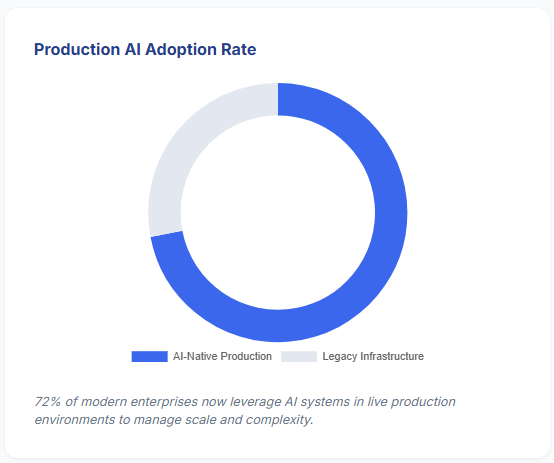
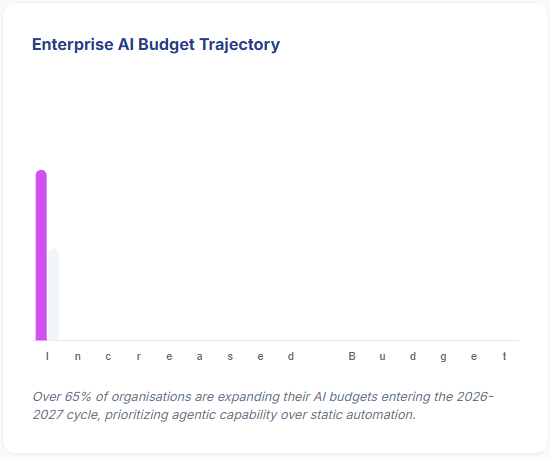
Through autonomous agentic workflows, real-time analytics, and hyper-personalised customer journeys, AI empowers organisations to streamline operations while driving continuous innovation. Over 72% of modern enterprises actively leverage AI systems in production, with more than 65% expanding their AI budgets entering 2026 to 2027. Organisations that deploy enterprise-grade AI development solutions report substantial cost efficiencies, elevated worker productivity, and accelerated time-to-market.
Vinova, a Singapore-headquartered IT consulting and software engineering partner trusted by 250+ clients globally, has delivered 300+ successful projects across 16+ years. Vinova approaches AI development not as a trendy add-on, but as an AI-Native imperative: intelligence built into the architecture from day one, not bolted on afterward. This guide explores the enterprise AI development landscape in 2026, Vinova’s delivery process, and the trends shaping the next 18 months.
Table of Contents
What Are AI Development Solutions?
AI development is the discipline of designing, engineering, and deploying intelligent software systems capable of executing complex cognitive tasks: natural language understanding, visual perception, automated reasoning, predictive modelling, and multi-step autonomous planning.
At Vinova, AI development solutions mean more than standalone models or basic chatbots. It is the end-to-end integration of intelligent capability into scalable enterprise architectures, secure data pipelines, and core business workflows, enabling systems to reason logically, adapt dynamically, and deliver verifiable ROI.
The role of AI development in businesses’ decision-making in 2026
In 2026, AI development has evolved from isolated proof-of-concepts into the core operational nervous system of digital enterprises across Singapore, Southeast Asia, and global markets. Four drivers define this shift:
- AI-Native Software Development Lifecycle: AI automates routine tasks and data processing, freeing teams for high-value work. Vinova embeds an AI-Native, Not AI-Added methodology across the SDLC, using AI-assisted prompt engineering, code generation, and test suite synthesis to accelerate delivery while maintaining strict code quality
- Autonomous and predictive decision-making: enterprise AI systems now analyse real-time streaming data, multimodal inputs, and knowledge graphs to deliver actionable intelligence rather than static dashboards. For IPOS International, Vinova’s custom Digital Workbench uses intelligent document parsing and workflow automation to lift patent examiner throughput
- Context-aware personalisation: AI interprets user intent in real time. Whether powering multi-channel booking systems like PEC+ Singapore or specialised healthcare platforms like SIT’s AI-Sight myopia tracking platform, contextual AI drives user retention and engagement
- Agentic workflows and new digital business models: enterprise systems now leverage autonomous AI agents to manage complex, multi-system operational tasks, creating scalable digital services and new AI-as-a-Service monetisation channels
Why Partner with an AI Development Expert Like Vinova?
Deploying enterprise AI development solutions in 2026 requires more than calling API endpoints. It demands deep domain knowledge, hybrid vector database management, Retrieval-Augmented Generation (RAG and GraphRAG) architecture, cloud security, and strict regulatory compliance. A specialised technology partner translates raw AI models into robust enterprise solutions, and provides five end-to-end capabilities:
- AI strategy and Design Thinking consulting: identifying high-impact AI use cases through empathy mapping and ROI prioritisation
- Custom software and system engineering: architecting microservices and cloud solutions (React, Angular, Node.js, Python, Flutter, Java, .NET) with embedded AI modules
- LLM fine-tuning and RAG architecture: fine-tuning specialised open and closed models, implementing GraphRAG pipelines, and integrating proprietary enterprise knowledge bases
- Enterprise modernisation and ERP integration: integrating AI functionality into core legacy systems, cloud environments (AWS, Azure, GCP), and enterprise backbones such as Odoo
- Managed AI services and continuous evaluation: ongoing model evaluation, guardrail enforcement, drift monitoring, and SLA guarantees
Key criteria for selecting a reliable AI development partner
- Proven track record and production deployments: demonstrated experience in complex, mission-critical systems across both public and private sectors
- Modern technical stack and engineering rigour: deep expertise in agentic frameworks (LangChain, LlamaIndex, AutoGen), vector stores, modern programming languages, and microservices
- Data security and ISO certifications: strict adherence to ISO 27001 (Information Security Management) and ISO 9001 (Quality Management), alongside compliance with Singapore’s PDPA, the EU AI Act, GDPR, and HIPAA where applicable
- Agile and human-in-the-loop methodology: combining Design Thinking with rapid two-week Agile sprints to deliver validated MVPs before full enterprise rollout
- Post-deployment guardrails and drift management: dedicated governance frameworks to monitor accuracy, prevent hallucinations, and retrain models safely
The Vinova advantage: dual-shore, ISO-certified delivery
Headquartered in Singapore with engineering hubs in Vietnam, Vinova runs a proven Hybrid Delivery Model. Singapore leadership provides direct strategic oversight, project management, and same-timezone collaboration for seamless client engagement. Vietnam engineering scale gives access to top-tier technical and prompt/AI engineering talent cultivated through university partnerships, delivering high-speed development at optimal cost structures. Across both shores, AI-assisted quality assurance applies a Shift-Left testing philosophy and ISTQB-certified QA processes to validate code early, enforce security standards, and guarantee system reliability.
Practical Enterprise Applications of AI Development Solutions
Enterprise AI implementation drives measurable results across three core business pillars:
1. Conversational AI and autonomous support agents
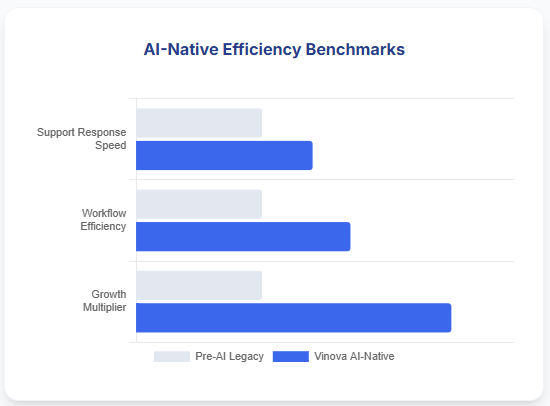
Modern AI support agents offer multi-turn, multi-lingual problem solving, handling complex inquiries across web and mobile touchpoints while seamlessly escalating edge cases to human personnel. Over 65% of global consumers now interact with conversational AI agents for immediate service; enterprise implementations reduce first-response times by over 40% and lower peak operational staffing bottlenecks by up to 70%. Global platforms like Klarna automate a majority of customer support interactions this way. Vinova builds context-aware NLP chatbots and intelligent assistants into web and mobile enterprise platforms to automate user onboarding and self-service support.
2. Predictive analytics, RAG, and decision intelligence
Combining historical data analysis with Retrieval-Augmented Generation enables systems to answer complex queries, predict demand, and mitigate supply chain risk. Organisations using predictive decision intelligence are 2.5 times more likely to surpass financial growth benchmarks compared to those relying on legacy reporting. Streaming platforms like Netflix report saving significant sums annually through predictive retention algorithms; in supply chain and inventory management, predictive models optimise stock allocation, reducing holding costs and stockouts.
3. Business process and workflow automation (agentic automation)
Pairing Robotic Process Automation with LLM-driven agentic logic transforms unstructured document handling, claims processing, and multi-step approvals into streamlined digital workflows. For IPOS International, Vinova engineered a comprehensive Digital Workbench, automating complex workflow engines, document classification, and claim analysis to boost examiner productivity. In developer workflows, enterprise tools like GitHub Copilot and Microsoft 365 Copilot save employees meaningful time daily on administrative and technical tasks, a pattern Vinova replicates internally through its AI-Native SDLC.
The Vinova AI Development Process: Design Thinking to MVP and Scale
Vinova combines Design Thinking with Agile execution across three phases, ensuring high user adoption and rapid business ROI:
| Phase | Key Activities |
| 1. Design Thinking and Data | Empathy workshops and user journey mapping; SMART goal and KPI definition; data governance baseline under ISO 27001 and PDPA |
| 2. Agile MVP and Agentic Engineering | Vector indexing and RAG pipeline setup; model selection and domain fine-tuning; 2-week Agile sprints delivering iterative MVPs |
| 3. Deployment and Shift-Left QA | Multi-cloud or edge deployment; Shift-Left QA and security testing; continuous drift monitoring and retraining |
Phase 1: Design Thinking, SMART objectives, and data architecture
Empathy workshops and discovery map key user journeys, identify operational bottlenecks, and align AI capabilities directly with business objectives. Project benchmarks are defined as SMART goals (Specific, Measurable, Attainable, Relevant, Time-bound) backed by clear KPIs. Data pipelines are structured under strict ISO 27001, PDPA, and GDPR compliance from this phase onward, not retrofitted later.
Phase 2: Agile prototyping and agentic engineering
Enterprise content is preprocessed and indexed for hybrid search and RAG pipelines tuned for high accuracy. Optimal open or proprietary foundational models are selected and fine-tuned for domain-specific execution. Working in two-week Agile sprints, Vinova delivers rapid MVPs, enabling early stakeholder feedback and quick iteration before the full build budget is committed.
Phase 3: Secure deployment and AI-assisted optimisation
Solutions deploy into multi-cloud environments (AWS, Azure, GCP), on-premise infrastructure, or hybrid setups depending on data residency requirements. Shift-Left quality engineering executes automated testing early across the SDLC to eliminate vulnerabilities and ensure model guardrails remain intact. Continuous monitoring tracks live system performance, guards against hallucination or model drift, and runs ongoing fine-tuning pipelines rather than treating launch as the finish line.
Future Trends in AI Development: A 2026 Strategic Outlook
As enterprise AI matures in 2026, six trends are driving competitive differentiation across Singapore, Southeast Asia, and global markets:
- Mainstream multi-agent workflows: autonomous agent networks capable of decomposing complex tasks, calling external APIs, and executing multi-step business logic are replacing basic single-prompt systems
- On-device Small Language Models and Edge AI: compact, high-performance SLMs running directly on mobile and edge devices offer near-zero latency, reduced cloud costs, and heightened data privacy
- GraphRAG and enterprise knowledge integration: standard Retrieval-Augmented Generation has evolved into GraphRAG, combining vector search with knowledge graphs to deliver deeper contextual reasoning over enterprise data
- Sovereign AI and strict governance enforcement: with full enforcement of frameworks like the EU AI Act and Singapore’s Model AI Governance Framework for Generative AI, enterprise solutions must feature explicit auditability, safety guardrails, and bias mitigation
- AI-driven cyber defence and resilience: AI tools proactively hunt for system vulnerabilities and defend against automated attack vectors, making AI-assisted cybersecurity a baseline requirement for modern enterprise infrastructure
- Hyper-personalisation at scale: dynamic UI generation, predictive recommendations, and customised content delivery are now standard expectations across fintech, e-commerce, and digital health applications
| Build Your AI Development Solution with Vinova Book a complimentary 2-hour AI strategy consultation with Vinova’s Singapore-based team. We’ll identify your highest-ROI AI use case, assess data readiness, and scope a PDPA-compliant delivery plan. No commitment required. Schedule Your Free 2-Hour AI Strategy Consultation with Vinova |
AI Development Solutions FAQ
What is the difference between AI development solutions and off-the-shelf AI tools?
Off-the-shelf AI tools (ChatGPT, generic chatbot platforms, template automation) deploy fast at predictable subscription cost, but they cannot enforce Singapore data residency, cannot be configured to exclude sensitive identifiers from external API payloads, and cannot be adapted to proprietary business logic without workaround engineering that compounds over time. Custom AI development solutions are built specifically for the client’s data architecture, compliance obligations, and business processes. The right choice depends on the use case, the data sensitivity, and the expected system lifetime; Vinova’s discovery phase maps this tradeoff explicitly before recommending a build.
How long does it take to deploy AI development solutions for a business?
A focused AI MVP validating a single high-impact use case (customer inquiry automation, document classification, predictive forecasting) typically reaches production in 8 to 12 weeks through Vinova’s Agile MVP framework. A full enterprise programme with multi-system integration, RAG or GraphRAG pipelines, and regulatory compliance architecture runs longer, generally 4 to 10 months depending on data readiness and integration scope. The 2-week sprint cadence means stakeholders see working functionality early rather than waiting for a single large release.
What data does a business need to start an AI development project?
AI development solutions have different data requirements depending on the architecture. Rules-based automation and workflow engines like the IPOS Digital Workbench require little historical training data, since they execute on programmed logic. RAG and GraphRAG systems require a structured, access-controlled document corpus rather than labelled training data. Predictive models require moderate-to-abundant structured historical records. Vinova’s discovery phase includes a mandatory data readiness assessment before any development budget is committed, since most businesses discover their data is less ready than assumed.
How do AI development solutions stay compliant with Singapore’s PDPA and emerging AI regulation?
Compliance is built into the architecture from Phase 1, not audited in afterward. Vinova structures data pipelines with purpose-specific minimisation, tokenises personal identifiers before external model calls, hosts data and inference within Singapore-region cloud instances, and aligns agentic system boundaries with Singapore’s Model AI Governance Framework for Generative AI. For customer-facing financial decisions, MAS TRM and FEAT transparency requirements shape model selection: black-box architectures that can’t produce explainable outputs are ruled out early rather than patched with explainability tooling after deployment.
Why choose a hybrid Singapore-Vietnam delivery model over a fully onshore AI team?
Singapore’s tight talent market and COMPASS EP processing timelines of 10 to 18 weeks make assembling a fully onshore AI engineering team slow and expensive for time-sensitive programmes. Vinova’s hybrid model keeps strategic ownership, compliance governance, and client relationships in Singapore while executing engineering at scale through Vietnam-based teams under the same ISO 27001 and ISO 9001 certified processes, at 40% to 60% lower cost than an equivalent fully onshore build, without a gap in accountability or communication.
| Vinova: Singapore’s AI development and enterprise engineering partner since 2010. ISO 27001:2022 and ISO 9001:2015 certified. PDPA, MAS TRM, and IMDA-aligned. 300+ in-house engineers across Singapore, Hanoi, Da Nang, and Ho Chi Minh City. AI development clients include IPOS International, Porsche Experience Centre Singapore, and Singapore Institute of Technology. Financial Times Top 500 High-Growth Companies Asia-Pacific 2026. The Straits Times Singapore’s Fastest-Growing Companies 2024, 2025, and 2026. Explore Vinova’s AI development services. |