In 2026, enterprise AI has moved past prompt execution and thin API wrappers. Organizations are building multi-agent systems, stateful reasoning engines and private retrieval-augmented generation (RAG) pipelines, and the framework chosen in the first month decides how fast the program ships, what it costs to run and how much architectural debt it carries.
The market also moved while many shortlists stood still. Microsoft folded AutoGen and Semantic Kernel into a single Agent Framework, Google widened its agent platform, and Singapore published governance guidance written specifically for AI agents.
For a CTO or Chief Risk Officer, the question is not which framework is most popular. It is which one gives you state you can recover, tool access you can bound and an audit trail you can show a regulator.
This guide compares ten AI development tools and frameworks on those terms, shows where each one fits and where it does not, and sets out the Singapore governance expectations you should test them against, including the IMDA agentic AI framework and the MAS AI risk management guidelines.
Quick Answer
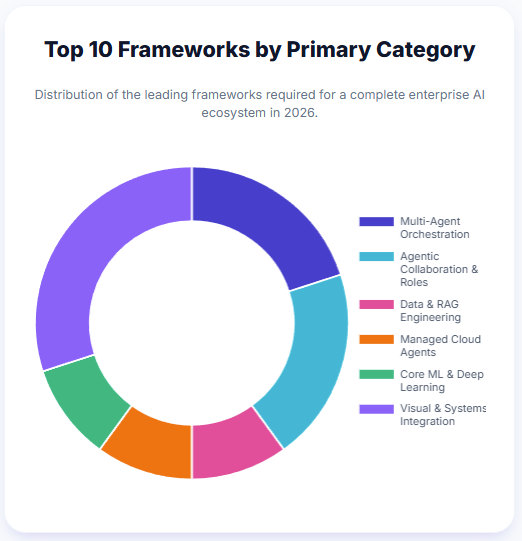
AI development tools and frameworks are the software layers that orchestrate models, agents and data in production: multi-agent orchestration (LangGraph, AG2, CrewAI, Microsoft Agent Framework), data and RAG engineering (LlamaIndex), cloud-managed agent runtimes (Google ADK, OpenAI Agents SDK), code-first agents (Smolagents), visual builders (Dify) and the deep learning foundation (PyTorch). Most enterprise deployments combine two or three of them, because orchestration, retrieval and model training are separate problems with different best-fit tools.
Key Takeaways
1. Enterprise AI needs orchestration, not wrappers. Multi-agent systems and private RAG pipelines need persistent state, recovery from failed steps and clear control flow.
2. Off-the-shelf platforms hit hard limits. Data privacy, legacy integration, transactional logic and compliance are where SaaS chatbot tools fall short.
3. Four pillars decide the shortlist. State persistence, observability, security guardrails and vendor-independent scalability separate a production framework from a demo framework.
4. Governance is part of the architecture. Test every framework against the PDPA, IMDA’s agentic AI framework and, for financial institutions, the MAS AI risk management guidelines before you commit.
Table of Contents
What Are AI Development Tools and Frameworks?
The term covers the engineering of core AI infrastructure. Rather than gluing together isolated SaaS tools, specialist engineers design and deploy unified systems that integrate machine learning libraries, data ingestion pipelines, LLM orchestration layers and agentic workflows directly into core business applications. That is the difference between a demo-grade wrapper and a system a serious enterprise can run.
Why out-of-the-box tools fall short for enterprises
- Data privacy and IP lock-in: public SaaS platforms can expose proprietary data to external training loops, or tie you to subscription tiers without data ownership.
- Rigid architectural limits: pre-packaged AI wrappers cannot handle transactional rollbacks, complex state persistence or asynchronous multi-step business logic.
- Inflexible integration: off-the-shelf tools struggle to connect to custom legacy databases, SAP, Salesforce, SuccessFactors or on-premises microservices.
- Token and infrastructure overhead: without model routing, quantization and caching layers, running unoptimized foundation models at scale creates unsustainable compute costs.
Key Selection Criteria for Enterprise-Ready Frameworks
When evaluating open-source frameworks or commissioning a custom architecture, enterprise CTOs and technology leads test four engineering pillars:
- State persistence and transactional memory: the capacity to preserve conversation history, transactional rollbacks and multi-step execution logs across asynchronous workflows.
- Observability and telemetry: native integration with tracing tools (LangSmith, OpenTelemetry, MLflow) to monitor latency, token expenditure and hallucination rates in real time.
- Security and guardrail hardening: defenses against prompt injection, role-based access control, single-tenant data isolation and alignment with the PDPA, GDPR where it applies, and Singapore’s AI governance frameworks.
- Scalability and vendor independence: abstraction layers that let you swap the underlying model (Anthropic Claude, OpenAI GPT, Google Gemini or open-weight models such as Llama) without rewriting core application logic.
Quick Comparison: Top 10 AI Agent and ML Frameworks
| # | Framework | Category | Best For | Key Differentiator |
|---|---|---|---|---|
| 1 | LangGraph / LangChain | Multi-agent orchestration | Stateful, cyclic agent workflows | Built-in persistence, LangSmith observability and human-in-the-loop controls |
| 2 | AG2 (AutoGen lineage) | Agentic collaboration | Event-driven multi-agent systems | Peer-to-peer conversation patterns and asynchronous execution |
| 3 | CrewAI | Role-based automation | Quick-turnaround team workflows | Intuitive role delegation and minimal setup overhead |
| 4 | LlamaIndex Workflows | Data and RAG engineering | Enterprise search and document AI | Event-driven indexing and advanced retrieval pipelines |
| 5 | Google ADK | Cloud agent toolkit | Google Cloud and Gemini ecosystems | Open-source toolkit optimized for Gemini, with managed deployment on Google Cloud |
| 6 | OpenAI Agents SDK | Lightweight multi-agent | Fast Python-native development | Handoffs, input and output guardrails and built-in tracing |
| 7 | PyTorch | Deep learning foundation | Custom model training and fine-tuning | Industry standard for custom weights, from research to production |
| 8 | Smolagents (Hugging Face) | Code-first agentic AI | Lightweight, sandboxed execution | Code-as-action design and Hugging Face Hub access |
| 9 | Dify | Visual orchestration | Rapid prototyping and hybrid teams | Low-code, drag-and-drop agent building with enterprise backends |
| 10 | Microsoft Agent Framework / Semantic Kernel | Enterprise systems integration | C#/.NET and cross-language backends | Native .NET support, enterprise plugin architecture and telemetry |
What changed in the framework landscape in 2026
Three shifts matter for any shortlist built from last year’s articles:
| Change | Date | What it means for you |
|---|---|---|
| Microsoft Agent Framework reached general availability, unifying Semantic Kernel’s enterprise foundations with AutoGen’s orchestration approach | 3 April 2026 | Start new Microsoft-stack projects on Agent Framework. Semantic Kernel 1.x remains supported, so plan a migration rather than a rewrite |
| Google Antigravity 2.0 announced, adding an SDK and Managed Agents in the Gemini API alongside the desktop app and CLI | 19 May 2026 | Google now has two routes for agents: the open-source ADK and the Antigravity platform. Choose deliberately |
| IMDA published the Model AI Governance Framework for Agentic AI | 22 January 2026 | Agent tool access, human approval points and testing are now governance topics, not only engineering choices |
| MAS issued Guidelines on AI Risk Management for all financial institutions | 7 October 2026 | Framework choice feeds your AI inventory, lifecycle controls and third-party AI accountability |
The Rule: Choose the framework that matches the failure you cannot afford: lost state, ungoverned tool access or an integration nobody can maintain. Popularity is not a requirement.
Detailed Breakdown: The Top 10 AI Development Tools Frameworks
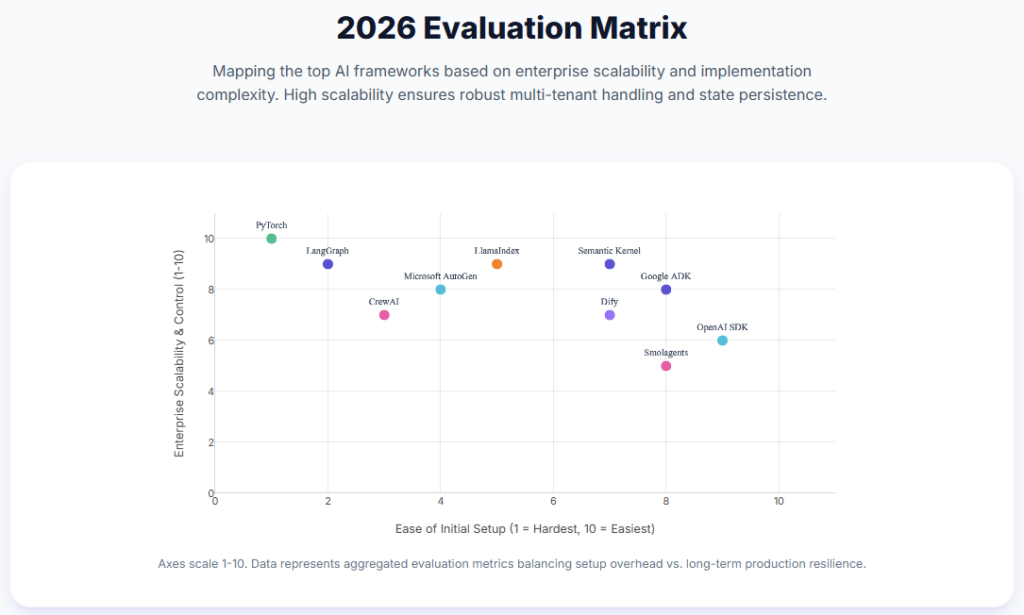
1. LangGraph / LangChain Ecosystem
Best for: enterprise teams needing stateful, cyclic and observable multi-agent systems.
LangGraph, built by the LangChain team, models agent interactions as graphs. Nodes are functions or model calls, and edges define control flow based on state, which allows loops and iterative refinement that linear chains cannot express.
- Core strengths: cyclic graph orchestration, durable state with checkpointing, time-travel state debugging and deep LangSmith integration for production tracing, evaluation and token tracking.
- Typical enterprise use: decision engines, multi-agent validation loops and complex RAG pipelines integrated with SQL and NoSQL databases.
Vinova engineering insight: in automated technical design and deep research pipelines that combine Gemini and Perplexity, LangGraph gave us strong state recovery when an API step timed out. Strict state typing needs upfront architectural planning, which we complete in Phase 1 discovery.
Trade-offs: a steeper learning curve, and large production systems need a disciplined state schema.
2. AG2 (the AutoGen Lineage)
Best for: peer-to-peer agent negotiation and multi-agent collaboration.
AutoGen began as a Microsoft Research project for multi-agent conversation. Microsoft has since carried its orchestration approach into Microsoft Agent Framework (see framework 10), and AG2 continues the original AutoGen design as a community-led project run by its original creators. Treat them as separate codebases: check which one a tutorial, a library or a vendor proposal actually uses before you commit.
- Core strengths: event-driven, asynchronous multi-agent conversation patterns, configurable code execution (including Docker-based executors) and model-agnostic design.
- Typical enterprise use: automated software QA suites, financial scenario simulation and data science pipelines.
Vinova engineering insight: in our AI-assisted quality assurance framework, benchmarked for a Singapore utilities group, AutoGen-style agents let code review and test-case creation work together. We added custom token-budget guardrails to stop infinite conversation loops between agents.
Trade-offs: it needs careful guardrailing to prevent endless agent-to-agent loops and runaway compute cost, and the split lineage means you should pin versions and plan for API changes.
3. CrewAI
Best for: fast-turnaround business automation with role-based agent structures.
CrewAI organizes agents into structured crews. Each agent gets a role, a goal, a backstory and a set of tools, which mirrors how human teams are organized and keeps the logic readable to non-engineers.
- Core strengths: a fast implementation cycle with clean Python syntax, intuitive role delegation and task management, and independence from LangChain.
- Typical enterprise use: lead research, content auditing, customer support routing and competitive intelligence.
Vinova engineering insight: in early prototyping for a talent acquisition portal, CrewAI let us stand up a recruiter agent and a hiring manager agent in under two days. It is ideal for rapid MVP validation, and for enterprise release we wrapped it in custom PostgreSQL state persistence.
Trade-offs: less granular, low-level control of state persistence than graph-native engines such as LangGraph.
4. LlamaIndex (Workflows)
Best for: enterprise RAG, unstructured document processing and knowledge graph construction.
Where many frameworks focus on agent routing, LlamaIndex focuses on data orchestration. Its Workflows engine builds event-driven ingestion, indexing and query pipelines that connect structured, unstructured and semi-structured enterprise data to LLM runtimes.
- Core strengths: a large data connector ecosystem (SQL, PDFs, Notion, Confluence, Snowflake), event-driven workflow steps, hybrid keyword and vector search, semantic chunking and automated evaluation metrics.
- Typical enterprise use: document intelligence platforms, legal contract search and private corporate knowledge assistants.
Vinova engineering insight: in document-heavy work for a national IP office and a financial sector regulator, hybrid BM25 plus vector retrieval outperformed pure semantic search on dense legal and financial citations. The measured gain is in the results table below.
Trade-offs: it is specialized for retrieval and search intelligence rather than general-purpose multi-agent state routing.
5. Google ADK
Best for: organizations already invested in Google Cloud and Gemini models.
Google’s Agent Development Kit (ADK) is a code-first, open-source toolkit for building agents, optimized for Gemini and deployable to managed Google Cloud runtimes. Google’s separate Antigravity platform, announced in its 2.0 form at Google I/O in May 2026, adds an SDK and Managed Agents in the Gemini API. Compare the two routes before standardizing.
- Core strengths: close optimization for the Gemini model family, native multi-modal handling (vision, audio, text), managed deployment options on Google Cloud and a code-first developer experience.
- Typical enterprise use: high-throughput cloud-native agents, workspace productivity assistants and enterprise data processing jobs on GCP.
Vinova engineering insight: in AI and ML MVP discovery programs with a Singapore university, ADK gave us the fastest path to multi-modal vision and document processing on GCP while holding latency low for high-volume requests.
Trade-offs: the best performance and feature set are tied to Google Cloud and Gemini infrastructure.
6. OpenAI Agents SDK
Best for: developers who want clean Python orchestration with built-in safety controls.
Released in March 2025, the OpenAI Agents SDK is a lightweight, Python-native framework for multi-agent orchestration and tool calling. It turns agent loops, handoffs and guardrails into a small set of primitives.
- Core strengths: a minimal API surface that reduces boilerplate, handoffs between specialized agents, input and output guardrails and built-in tracing.
- Typical enterprise use: customer-facing virtual assistants and automated helpdesk workflows.
Vinova engineering insight: in a 24/7 visitor engagement and booking portal for a luxury automotive experience center, the built-in guardrails kept the assistant on topic without custom middleware. We treat guardrails as one layer of defense and add separate controls against prompt injection.
Trade-offs: it is a newer entry with a smaller ecosystem than LangChain or AutoGen. Guardrail scope is limited: input guardrails run on the first agent in a chain and output guardrails on the last. The default tracer reports to OpenAI’s platform, so plan an OpenTelemetry route to your own stack, and expect non-OpenAI models to need an adapter.
7. PyTorch (Custom Core ML Engine)
Best for: proprietary model training, fine-tuning and hardware-accelerated deep learning.
Orchestration frameworks handle routing. PyTorch remains the foundation underneath most modern AI. It is governed by the PyTorch Foundation, part of the Linux Foundation, and it is the standard framework for training custom weights, fine-tuning open-weight LLMs such as Llama and deploying custom neural networks.
- Core strengths: architectural freedom through dynamic computation graphs, compiled execution with torch.compile, broad hardware support (NVIDIA GPUs, AMD ROCm, Apple Metal) and a deep research community.
- Typical enterprise use: fine-tuning specialized open-weight models, domain-specific classification engines and high-throughput inference backends served through TensorRT or ONNX Runtime.
Vinova engineering insight: in diagnostic imaging pipelines for a global medical technology company, PyTorch was the required engine for custom neural network pattern matching. Compiling with torch.compile cut inference latency in production microservices, as shown in the results table below.
Trade-offs: it demands significant data science expertise, dedicated GPU infrastructure and MLOps effort compared with high-level API orchestrators.
8. Smolagents (Hugging Face)
Best for: developers who want a simple, code-first agent framework with isolated execution.
Created by Hugging Face, Smolagents takes a code-as-action approach. Instead of emitting JSON for each tool call, the agent writes short Python snippets and executes them. The project reports about 30% fewer steps than JSON tool-calling, and its core agent logic fits in roughly 1,000 lines, which makes it easy to audit.
- Core strengths: a small footprint, access to the Hugging Face Model Hub, local execution and line-by-line debugging.
- Typical enterprise use: developer tooling, automated code refactoring agents and secure internal automation.
Vinova engineering insight: our DevSecOps squad integrated Smolagents into internal CI/CD code scanning workflows. Running the generated code inside Docker sandboxes lowered token consumption against verbose JSON tool-calling, as shown in the results table below.
Trade-offs: there are no built-in visual interfaces or management dashboards for non-technical stakeholders. The default local Python executor is not a security sandbox, so production use needs Docker, E2B, Modal or an equivalent isolation layer.
9. Dify and Visual Orchestration Frameworks
Best for: hybrid teams that want visual, drag-and-drop workflow building on enterprise backends.
Dify combines a visual workflow builder with backend infrastructure, so cross-functional teams can work on prompts, RAG configuration and agent routing together. It is released under Apache 2.0 with additional conditions: running it as a multi-tenant service requires written authorization, and the console logo and copyright notice must stay in place. Workflow tools such as n8n are source-available under a fair-code license, which is not the same as open source. Read the license before you build a product on either.
- Core strengths: a visual interface for multi-step AI pipelines, built-in vector database management, multi-provider model switching, user management and API generation.
- Typical enterprise use: low-code internal platforms where business analysts adjust prompt logic and workflow rules after launch without engineering intervention.
Vinova engineering insight: in internal portals for a legal education body and a national workforce agency, Dify let non-technical HR and operations leads adjust prompt templates and business rules without a developer redeployment.
Trade-offs: less programmatic flexibility for complex, low-level edge cases than code frameworks such as LangGraph, plus license conditions to review.
10. Microsoft Agent Framework and Semantic Kernel
Best for: enterprises with existing C#/.NET backends and enterprise system integrations.
Semantic Kernel is Microsoft’s open-source SDK for connecting LLMs to C#, Java and Python code through plugins, prompts and memory. Microsoft Agent Framework, generally available since 3 April 2026, is its successor, built by the same teams and combining Semantic Kernel’s enterprise foundations with AutoGen’s orchestration approach. New projects should start on Agent Framework. Existing Semantic Kernel systems stay supported, so migrate on a plan rather than in a panic.
- Core strengths: first-class C# and .NET support alongside Python, a plugin system for enterprise APIs, OpenTelemetry-based observability and close alignment with Azure.
- Typical enterprise use: retrofitting legacy systems (C#/.NET, Dynamics 365, SAP) with AI functions under strict type safety.
Vinova engineering insight: for clients with heavy Microsoft environments, including Office 365 integrations for a national IP office, Semantic Kernel was our primary choice. Its strongly typed plugin architecture removed type-mismatch bugs in SAP and Azure microservice calls. For new builds we now scope Agent Framework first.
Trade-offs: it is tailored to enterprise application integration rather than Python-first research, and teams must track the migration path from Semantic Kernel.
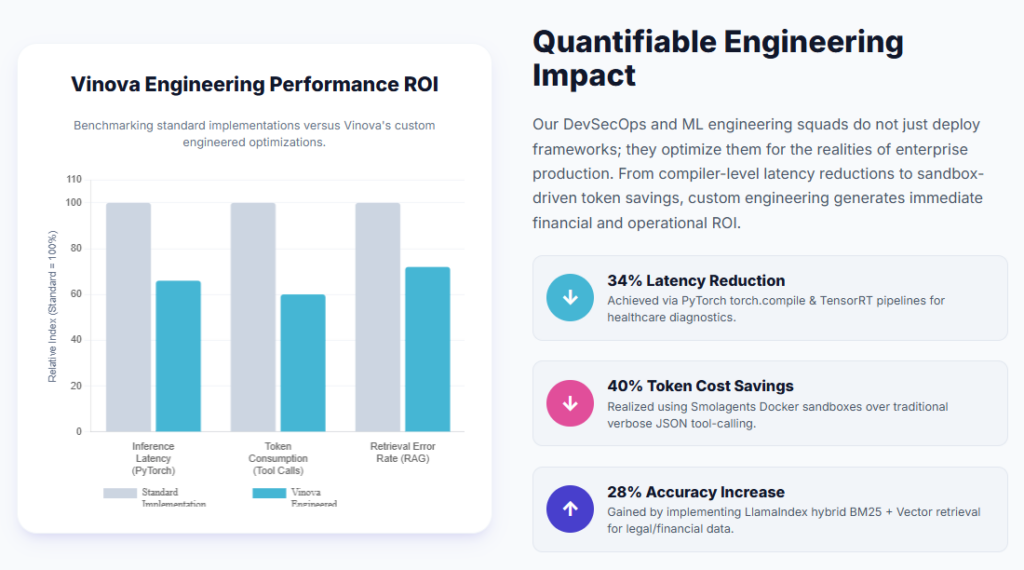
Field Insight: Measured Results From Our Delivery Work
What these numbers are: results from Vinova delivery engagements, shown without client names. Methodology, datasets and baselines vary by engagement, so treat them as indicative, not as benchmarks.
| Framework | Delivery Context | Measured Result |
|---|---|---|
| LlamaIndex | Document search over dense legal and financial citations | Hybrid BM25 plus vector retrieval beat pure semantic search by 28% |
| Google ADK | Multi-modal vision and document MVP on GCP for a university | Latency under 800ms at high request volume |
| PyTorch | Diagnostic imaging microservices for a medical technology company | 34% lower inference latency with torch.compile |
| Smolagents | Internal CI/CD code scanning in Docker sandboxes | 40% lower token consumption than JSON tool-calling |
| Custom allocation engine | Auto-dispatch for facility management and maritime operations | Over 40% less manual dispatch effort |
Vinova’s AI Engineering Capabilities
When you partner with Vinova on enterprise AI frameworks, you work with 300+ in-house engineers across Singapore and our Vietnam delivery hubs, backed by project experience across regional and global enterprises and government agencies:
| Capability | Tools | Purpose |
|---|---|---|
| Multi-agent orchestration | LangGraph, AG2, CrewAI, Microsoft Agent Framework | Stateful workflows, role delegation, human-in-the-loop approval gates |
| Core ML and deep learning | PyTorch, TensorFlow, JAX, Keras 3 | Custom model training, fine-tuning open-weight LLMs |
| Enterprise RAG and data | Pinecone, Qdrant, pgvector, Neo4j | Hybrid vector and keyword search, knowledge graph construction |
| Edge AI and on-device | LiteRT, ONNX Runtime, Flutter FFI, React Native | Low-latency, offline-first AI for field operations |
| Enterprise MLOps and DevSecOps | Docker, Kubernetes, MLflow, OpenTelemetry, Azure, AWS | Production deployment, telemetry, cost attribution |
End-to-End Service Offerings and Deliverables
We structure engagements around your organization’s maturity and compliance requirements:
| Service Tier | Focus Area | Key Deliverables |
|---|---|---|
| Custom AI framework architecture | System blueprints and stack selection | Architecture diagrams, framework evaluation reports (PyTorch vs. JAX, LangGraph vs. CrewAI), API gateway specs, data flow mapping |
| Agentic workflow development | Multi-agent systems and tooling | Custom autonomous agents, tool-binding modules, multi-actor state management, human-in-the-loop safety workflows |
| Enterprise integration and API wrapping | Legacy and ERP system integration | Secure REST and gRPC microservices connecting AI frameworks to SAP, SuccessFactors, Salesforce and Odoo |
| MLOps and infrastructure setup | Production scaling and cost control | CI/CD pipelines, telemetry dashboards (LangSmith, MLflow), fallback routing, GPU cost optimization |
Vinova’s Proven 4-Phase Implementation Process
To lower delivery risk and speed adoption, we apply a Design Thinking and Agile MVP discovery method refined across 300+ project deployments:
| Phase | Focus and Deliverables |
|---|---|
| 1. AI Readiness Assessment | Use case validation, data hygiene audit and technical blueprint. Deliverables: architecture blueprint, data flow diagram, tech stack proposal, feasibility matrix |
| 2. PoC and Core Build | Lightweight sandbox MVP (3 to 6 weeks), accuracy benchmarking, latency optimization. Deliverables: functional AI framework MVP, benchmark evaluation report |
| 3. Integration and Security | SAP and ERP connections, guardrails and role-based access control, PDPA compliance. Deliverables: production integration suite, compliance audit trail |
| 4. Production MLOps | Container deployment, telemetry and retraining, SLA support. Deliverables: production launch, MLOps telemetry pipeline, SLA maintenance plan |
Responsible AI, Security, and Singapore Governance Standards
Deploying enterprise AI demands regulatory alignment, data security and operational predictability. Vinova delivers under an ISO 27001:2022 (Information Security) and ISO 9001:2015 (Quality Management) certified framework, and we are a member of the AI Verify Foundation.
Data isolation and single-tenant hosting
- Private cloud and local hosting: deploy private LLM runtimes and vector stores in AWS or GCP Singapore regions, or on private corporate servers.
- Retention controls: negotiate zero-data-retention terms where your model provider offers them, and confirm in the contract that your data is not logged or used for training.
Compliance and regulatory alignment
We design platforms to align with the PDPA and with Singapore’s AI governance guidance, and where relevant GDPR and sector rules for healthcare data. The guidance that matters most for agent frameworks is the IMDA Model AI Governance Framework for Agentic AI, launched on 22 January 2026. It is guidance, not statute, and it maps directly to framework selection:
IMDA Agentic AI Framework: What to Test in a Framework
| IMDA Dimension | What It Asks | What to Verify in a Framework |
|---|---|---|
| Assess and bound risks upfront | Limit what an agent can do, including its access to tools and external systems | Scoped tool permissions, identity management, role-based access control |
| Make humans meaningfully accountable | Human approval at significant checkpoints, such as high-stakes or irreversible actions | Native human-in-the-loop interrupts and approval gates |
| Implement technical controls and processes | Test agents before deployment and monitor them continuously afterward | Evaluation hooks, tracing, staged rollout and monitoring |
| Enable end-user responsibility | Tell users what the agent can do and what data it can reach | Transparent action logs and user-facing disclosure |
Source: IMDA, Model AI Governance Framework for Agentic AI, 22 January 2026.
Financial institutions should also read the MAS Guidelines on AI Risk Management issued on 7 October 2026. They apply to all forms of AI, expect an AI inventory and materiality assessment, and hold the institution accountable for third-party AI. Phased expectations begin on 7 October 2027.
Guardrails, hallucination control, and explainability (XAI)
- Structured outputs: use type-safe function calls and JSON schemas to constrain the format of agent output. A schema controls shape, not correctness, so add validation, retries and human approval for high-risk actions.
- Comprehensive tracing: log every agent decision, tool execution parameter, vector retrieval source score and model prompt state for audit-ready compliance.
Real-World Case Studies: Vinova Project Track Record
Our AI engineering is validated across government, enterprise, healthcare and logistics engagements. Client names are withheld to protect confidentiality.
1. Singapore Utilities Group: Enterprise AI Talent Acquisition Platform
Challenge: modernizing HR talent acquisition workflows across complex enterprise data streams.
Solution: Vinova engineered a multi-tenant AI engine using Python, ReactJS and AI developer tooling (Copilot, Cursor, Playwright), integrated with SAP SuccessFactors for automated resume parsing, candidate scoring and workflow orchestration.
Impact: shorter candidate screening cycles, with corporate governance and integration reliability maintained.
2. Facility Management and Maritime Operators: Smart Dispatch Engine
Challenge: optimizing provider dispatch and resource allocation across large-scale facility management and maritime operations.
Solution: an intelligent allocation framework that processes real-time geospatial data, job complexity history and technician availability, connected to legacy enterprise SAP systems.
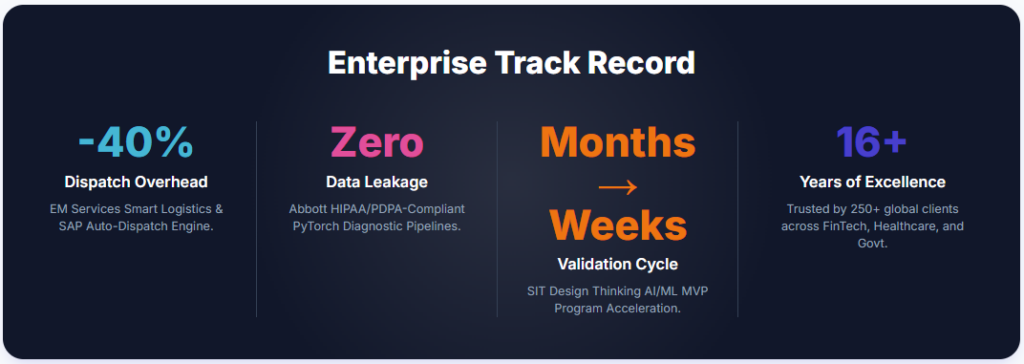
Impact: over 40% less manual dispatch overhead, fewer job schedule overruns and better customer satisfaction metrics.
3. Singapore University: Design Thinking AI/ML MVP Program
Challenge: identifying, validating and prototyping high-impact AI and ML use cases aligned with institutional goals.
Solution: Vinova led Design Thinking workshops and Agile sprints to co-create user-centered MVPs, validating technical feasibility before full-scale deployment.
Impact: AI feature validation cycles shortened from months to weeks, with strong stakeholder adoption.
4. Global Medical Technology Company: Privacy-Controlled Diagnostic Pipelines
Challenge: structuring high-dimensional clinical and patient data under strict healthcare compliance.
Solution: PyTorch deep learning models for medical image pattern matching, alongside Scikit-learn tabular risk scoring engines, deployed in single-tenant infrastructure.
Impact: audit-ready explainability with no unauthorized data retention.
How We Evaluated and Selected These AI Development Tools Frameworks
Our technical evaluation assesses AI inference platforms and orchestration frameworks across four engineering metrics:
- Production reliability: state persistence, error recovery, transactional rollbacks and multi-tenant scaling under high-concurrency loads.
- Observability and tracing: native OpenTelemetry, token consumption tracking, cost attribution and detailed execution trace logs.
- Enterprise integration: ease of connection to SQL and NoSQL databases, vector stores, REST and gRPC endpoints and ERP systems (SAP, Salesforce).
- Flexibility and vendor independence: open, framework-agnostic systems that let you swap LLM providers without re-architecting core business logic.
Ready to build with the right AI stack for your enterprise?
Book an AI Discovery Session and Technical Blueprint Consultation with Vinova’s AI engineering team. We will assess your architecture goals and recommend the framework stack that fits. No commitment required.
AI Development Tools Frameworks FAQ
How do I choose between different AI development tools and frameworks for my enterprise?
Start with your architectural requirement, not the framework’s popularity. If you need stateful, cyclic multi-agent workflows, LangGraph fits. If your team works in C# and .NET, Microsoft Agent Framework or Semantic Kernel fits. If you are fine-tuning custom models, PyTorch is the standard regardless of what else you pick. Most enterprise deployments combine two or three frameworks rather than standardizing on one, because orchestration, data and RAG, and model training are three separate problems with three different best-fit tools.
What is the difference between an AI framework and an AI application?
An AI framework provides the structural building blocks, developer APIs, data pipelines and orchestration logic (PyTorch, LangGraph, LlamaIndex). An AI application is the finished, user-facing product built on top of it, with user interfaces, business logic and custom database integrations.
Should my business build a custom AI framework or use an off-the-shelf SaaS platform?
Off-the-shelf platforms allow rapid prototyping but carry long-term risks: recurring subscription costs, limited workflow flexibility, data exposure and vendor lock-in. A custom build with Vinova gives you ownership of the code and IP under a Singapore-law Master Services Agreement, the option to cut inference cost through model routing and caching, data security controls you can audit and direct integration with your core backends.
Which AI agent framework (LangGraph, CrewAI, AG2, Google ADK) is best for our enterprise?
It depends on your architecture. LangGraph is the strongest fit for cyclic, stateful workflows that need precise state management. AG2 suits multi-agent peer-to-peer negotiation. CrewAI suits rapid, role-based team automation. Microsoft Agent Framework suits enterprise .NET ecosystems, and Google ADK suits Google Cloud estates. Vinova’s discovery team evaluates your IT environment to select and integrate the right hybrid stack.
Do we need a fully prepared enterprise dataset before starting an AI framework project?
No. Phase 1 of our work includes data auditing, pipeline design and structuring of unorganized data. Our data engineers help with extraction, cleansing, semantic chunking and vector indexing during discovery and architecture setup.
How long does a custom AI framework project take to deploy to production?
A proof of concept or MVP is typically delivered in 3 to 6 weeks through our Agile sprint method. Full enterprise integration, security hardening and production MLOps deployment generally take 8 to 16 weeks, depending on system complexity and legacy integration requirements.
How Vinova Engineers Enterprise AI Frameworks
Vinova, a Singaporean Government-Grade Technology Partner, Made Accessible, has delivered more than 300 projects across custom software, mobile, data, AI and cybersecurity over 16 years. We are a member of the AI Verify Foundation. For framework work, we start from your governance obligations and your integration estate, choose the smallest stack that meets the requirement and build tracing, testing and approval gates in from day one. Explore our AI and machine learning services to see how we work.
Vinova’s approach is built around accountability:
- Fiduciary Governance & Regulatory Alignment: Delivery operations certified under ISO 27001:2022 (Information Security) and ISO 9001:2015 (Quality Management) and GovTech Category 1B approved, with platforms designed to align with the PDPA, the IMDA agentic AI framework, the MAS TRM Guidelines, the MAS AI risk management expectations and sector regulator requirements.
- Singapore Corporate Governance: Master Services Agreements governed under Singapore law with SIAC arbitration, so IP ownership and accountability are defined before the first commit.
- AI Framework Engineering Practice: Framework selection, agentic workflow development, enterprise integration and production MLOps, built around the evaluation criteria in this guide.
- Engineering Depth: 300+ in-house engineers across Singapore and Vietnam delivery hubs in Ho Chi Minh City, Da Nang, and Hanoi, with 8% to 12% annual voluntary attrition, so the people who build your agent platform are still there to run it.
The Takeaway
The Takeaway: There is no single best AI framework, only the one that fits the failure you cannot afford. Match orchestration, data and training tools to their jobs, check each framework’s license and maintenance status, test tool access and human approval against IMDA’s agentic guidance, and plan for the MAS AI risk management expectations before the first agent reaches production.
Whether you are standardizing an agent stack, retrofitting a .NET estate or preparing an AI inventory for MAS, Vinova brings certified delivery, Singapore compliance discipline and engineering depth to the work.
Vinova: a Singaporean Government-Grade Digital Transformation Partner, Made Accessible. For 16 years, we have designed digital systems for 300+ companies and government agencies worldwide, backed by ISO 27001:2022 and ISO 9001:2015 certification and Singapore GovTech Category 1B approval.
300+ employees across offices in Singapore, Vietnam (Hanoi, Da Nang, Ho Chi Minh City), Norway (Oslo), and Thailand (Bangkok), scaling platforms and engineering capacity to serve clients across the globe.
Financial Times Top 500 High-Growth Companies Asia-Pacific 2026. Recognized among Singapore’s Top 100 Fastest-Growing Companies in 2024, 2025, and 2026.