By 2026, the initial hype around generative AI has given way to strict board-level scrutiny and P&L accountability. Yet enterprise engineering leaders trying to scale their AI development projects past sandboxed demos face a sobering reality: the industry-wide AI project failure rate currently sits somewhere between 80% and 95%, depending on which research you read, according to landmark work from the RAND Corporation and MIT’s Project NANDA. With 42% of organisations abandoning most of their AI initiatives in 2025 alone, the root cause is rarely the model itself. Projects collapse during the unglamorous engineering transition between an isolated proof-of-concept and a secure, low-latency production system.
This is why AI projects fail and how they can succeed is really two separate questions that need two separate answers: understanding the failure mechanics, and having an actual production blueprint that avoids them. Both are covered below.
Table of Contents
Key takeaways:
- Production Gap: Most AI projects fail not because models lack intelligence, but because they collapse during the complex engineering transition from proof-of-concept to secure, production-ready systems.
- The Pilot Trap: Rapid prototypes often fail because they skip essential engineering disciplines like automated CI/CD, data schema enforcement, and role-based access control.
- Deterministic vs. Probabilistic: Success requires isolating AI for natural language parsing while using deterministic code for core business logic and state updates to ensure predictability and cost efficiency.
- Workflow Integration: AI adoption drops when users are forced to switch contexts; successful deployments embed AI directly into existing enterprise tools like Teams, ERP, and CRM.
1. The Real AI Project Failure Rate: Reconciling the Data
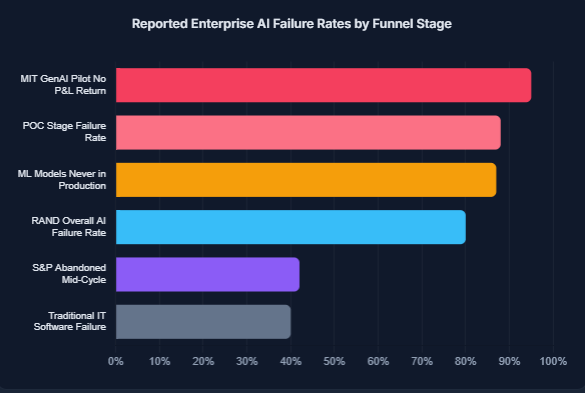
Different studies report different numbers because they’re measuring different things, not because the research disagrees. Anyone tracking the AI project failure rate closely will notice the gap: MIT’s Project NANDA found that 95% of enterprise generative AI pilots deliver no measurable P&L impact. RAND found that over 80% of all AI initiatives fail to reach production at all, roughly double the failure rate of conventional software projects. Neither number is wrong; they’re measuring different stages of the same funnel, and both describe genuine ai implementation failing at different points in the pipeline.
| Source | Reported Rate | What It Actually Measures |
| MIT Sloan / Project NANDA | 95% | Enterprise GenAI pilots that fail to achieve measurable P&L return |
| RAND Corporation | 80%+ | Total failure rate across all AI initiatives, 2x the ~40% rate for traditional IT |
| S&P Global Market Intelligence | 42% | Enterprise AI initiatives fully abandoned mid-cycle before deployment |
| VentureBeat / KDnuggets | 80%-87% | Trained ML models that never reach a production environment |
Survey data shows 42% of enterprises abandoned the majority of their AI initiatives in 2025, up sharply from 17% in 2024, and separate enterprise analytics put AI implementation failure at the proof-of-concept stage specifically at 88%, meaning the large majority of POCs never graduate to broad operational deployment. The takeaway for CTOs is blunt: AI projects don’t fail because the model can’t learn. They fail during the grinding engineering transition from an isolated prototype into a secure, production-grade system.
Does Gartner really say 85% of AI projects fail?
You’ve likely seen this exact claim, “Gartner: 85% of AI projects fail”, cited constantly across the industry, and it’s worth being precise about where it actually comes from. The original source is a 2019 Gartner press release forecasting that through 2022 specifically, 85% of AI projects would deliver erroneous outcomes due to data bias, algorithm misalignment, or implementation issues, a narrower and time-bound claim than the blanket “85% fail” version that gets repeated today, years past that original window. The underlying pattern it pointed to (data quality and implementation gaps driving most failures) has held up consistently in every study since, RAND, MIT NANDA, and S&P Global all land in a similar 80-95% range for different reasons, but the specific “Gartner 85%” figure everyone quotes is an older, more specific forecast than most citations of it suggest.
2. The Pilot-to-Production Trap: Why Sandboxes Lie
This trap is where most of the AI project failure rate actually originates, and it’s what we’d call the “10-minute demo” delusion, the biggest reason behind AI pilots failing specifically, as opposed to fully-built systems failing later. Engineering teams assemble rapid prototypes using basic API wrappers, static prompts, and clean sample datasets. The demo looks great. Then it collapses under real operational payloads, missing database fields, and the unstructured edge cases a curated demo dataset never included.
Moving a statistical model into production demands engineering discipline that pilots skip entirely: automated CI/CD pipelines, latency optimisation, explicit data schemas, role-based access control, and continuous observability. Skipping these during prototyping just defers the cost, it shows up later as technical debt that halts deployment the moment security and infrastructure teams actually audit the stack.
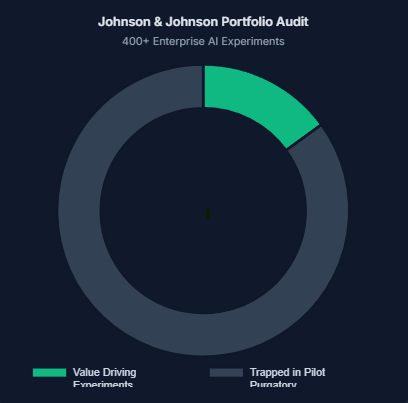
Johnson & Johnson’s own portfolio review of over 400 internal POCs found a stark Pareto distribution: roughly 15% of structured AI experiments drove over 80% of the enterprise’s total business value. The remaining 85% sat trapped in what’s become known as “pilot purgatory,” burning API budget without clearing the latency, security, or financial governance bar production actually requires.
3. The 4 Fatal Flaws Killing Enterprise AI, and Vinova’s Engineering Remedies
These four flaws account for most of the AI project failure rate this guide opened with, and each one has a specific, engineerable fix, not a vague cultural one.
Fatal Flaw 1: The Deterministic Fallacy
Teams repeatedly force non-deterministic, probabilistic AI models into operational nodes that demand 100% predictable, rule-based execution. Stuffing fifty business rules into a system prompt doesn’t turn a probabilistic token generator into a deterministic state machine, compiled code and standard SQL still beat generative models on cost, latency, and precision for that kind of logic every time.
Vinova’s remedy, strict functional boundary mapping: we isolate probabilistic AI to natural language parsing and unstructured context interpretation specifically. All core business logic, state updates, and transactional calculations run through deterministic code boundaries and strongly typed interfaces instead, exactly the pattern behind the Navig8 case study below.
Fatal Flaw 2: The Framework Trap
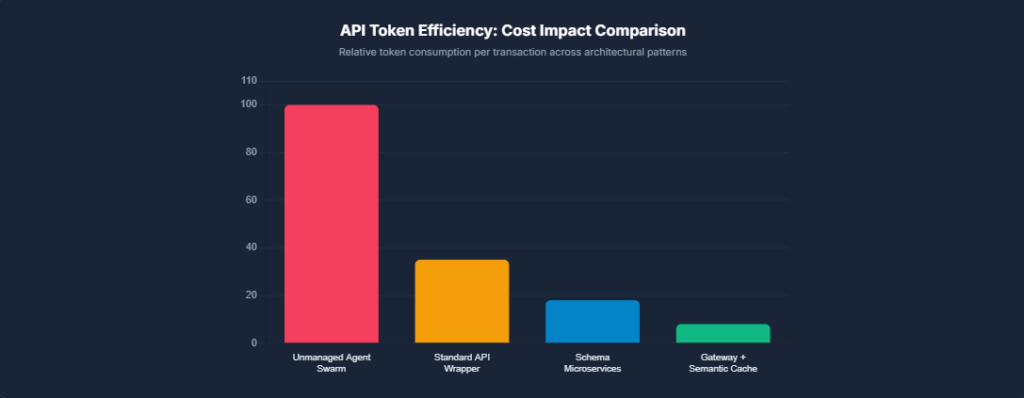
Architectures get compromised by over-reliance on bloated multi-agent abstractions and fragile wrapper libraries. These “black-box swarms” trigger infinite execution loops, run redundant downstream queries, and quietly conceal failures, then break the moment an underlying API dependency updates. In early architecture reviews, we regularly find stacks where third-party agent abstractions are burning 10x the token budget they actually need, purely from recursive loops nobody’s watching.
Vinova’s remedy, schema-enforced microservices: we replace bloated wrapper frameworks with lightweight, custom-orchestrated microservices using explicit XML/JSON delimiters and Pydantic schema validation to enforce strict input/output contracts. Our 8-to-12 week Rapid MVP Development Cycles ($40,000-$190,000 SGD) build these schema-enforced workflows directly, protecting enterprises from unvalidated in-house hiring sprees that routinely run past $340,000 SGD in wasted overhead before anyone notices.
| Is a Rising AI Project Failure Rate Stalling Your Roadmap? Most enterprise AI initiatives don’t fail in the sandbox, they break at the boundary between non-deterministic model outputs and production data pipelines. Stop burning API budget on fragile wrapper abstractions before sunk costs multiply. Schedule a 30-Minute AI Architecture and Failure-Risk Audit with Vinova |
Fatal Flaw 3: The Data Illusion
Leadership often assumes a large historical data lake means the data is ready. It rarely is. Poor data quality and fragmented ingestion pipelines are the single largest bottleneck for over 50% of IT executives surveyed, and legacy databases were never structured for real-time model context ingestion, which shows up in production as retrieval latency, schema drift, and pipeline timeouts nobody predicted in the demo.
Vinova’s remedy, discovery before code: before writing a line of AI orchestration code, we run a 2-to-4 week Product Discovery phase auditing enterprise data assets, establishing automated pipeline hygiene, and building RAG architectures with active metadata management, exactly the process behind the Navig8 Connect build detailed below.
Fatal Flaw 4: Enterprise Integration and Security Blindspots
Standalone AI dashboards and chatbots force employees to switch application contexts constantly, and adoption drops off almost immediately when that happens. Deployments missing fine-grained RBAC, HIPAA/ISO compliance, or hard token budget limits face instant rejection from risk committees, and unmanaged multi-agent tools routinely burn 5x to 30x more tokens per transaction than a simple query, which shows up as a very unpleasant surprise on the first monthly bill.
Vinova’s remedy, native workflow embedding: we integrate AI directly into the tools people already use daily (Microsoft 365, Teams, ERP, CRM) rather than building a separate destination nobody opens twice. To keep cost and security under control, we deploy enterprise AI API gateways with cost-based rate limits, semantic caching, dynamic model routing, and ISO 27001 / MAS FEAT compliant controls, the same approach behind the Abbott Labs case study below.
4. The De-Risking Framework: How the Top 15% Ship to Production
This is the actual sequence separating the 15% from the AI project failure rate everyone else falls into:
Phase 1: Diagnostic and feasibility audit (Day 1-14)
Classify every operational node as requiring probabilistic AI reasoning or deterministic code, then model strict financial ROI hurdles: token compute, vector infrastructure, and API cost per request, against the manual labour baseline it’s replacing.
Phase 2: Agile architecture and schema-first scaffolding
Enforce rigid input/output typing through Pydantic schemas to trap malformed data before it propagates downstream. Deploy continuous evaluation suites (such as Singapore’s Project Moonshot) to measure latency, semantic precision, and hallucination rates before release, and design explicit fallback paths that route low-confidence outputs to a human operator rather than letting them through.
Phase 3: Hybrid delivery and legacy modernisation
Pair Singapore-based Business Analysts handling strategic scoping and architecture with dedicated offshore engineering in Vietnam, cutting development cost while holding compliance and quality steady. Shadow engineers trained alongside primary developers eliminate ramp-up cost during long-term maintenance transitions, and legacy mainframes get modernised incrementally via the Strangler Fig Pattern rather than one high-risk, multi-year rewrite.
5. Enterprise Case Studies: De-Risking in Action
Three examples of the same production discipline that keeps the AI project failure rate low, applied to real engagements rather than a whiteboard.
Maritime logistics: Navig8 Group
The challenge: Navig8 needed to streamline fleet management, container tracking, and procurement analytics across 20+ operational modules without runaway token costs or false-positive sensor alerts.
The architecture: Vinova ran a 2-to-4 week Product Discovery phase to build Navig8 Connect, deliberately separating standard REST database queries (container tracking) from AI email parsing (demurrage dispute handling), exactly the deterministic/probabilistic boundary mapping from Fatal Flaw 1. We also deployed TB Marine Tech Manager and Navig8 ShipWatch, applying predictive ML to hull condition and fuel efficiency.
The outcome: upfront scope discipline increased development velocity by 60%, while the hybrid architecture eliminated false-positive alarms and optimised vessel fuel efficiency across international trade routes.
Financial services: OCBC Bank
The challenge: modernising legacy COBOL mainframe systems across Southeast Asia while holding strict regulatory compliance, zero audit breaches, and full MAS FEAT compliance throughout.
The architecture: Vinova engineered custom AI-driven code translation and documentation agents using the Strangler Fig Pattern, letting developers safely parse, document, and convert millions of lines of legacy COBOL into modern frameworks without a full rewrite.
The outcome: developer productivity rose 30% to 40%, and compliance turnaround dropped from several business days to under 3 minutes, with complete auditability and no exposure of sensitive banking data.
Healthcare operations: Abbott Labs
The challenge: accelerating global HR query resolution and field support for healthcare teams, keeping staff focused on core medical work while strictly adhering to HIPAA data privacy standards.
The architecture: Vinova built an HR mobile application featuring “Maya,” an AI assistant natively embedded into daily employee workflows with schema-enforced RAG pipelines and role-based access controls, rather than a separate dashboard nobody would open.
The outcome: Maya autonomously resolved 32% of monthly employee queries at a 74% success rate, meaningfully cutting HR ticket overhead while holding full data privacy compliance.
6. The 60-Second AI Project Readiness Diagnostic
If you’re trying to understand why enterprise AI fails before it happens to your own project, this is the fastest gut-check available. CTOs and transformation directors can run any planned initiative through this before committing budget, and a genuinely honest AI success rate prediction usually comes down to how many of these five pass, not how impressive the model demo looked:
| Criteria | What Passing Actually Looks Like |
| Objective clarity | Success is quantified by P&L impact, not vague technical exploration |
| Determinism check | The workflow safely tolerates probabilistic variation without breaking compliance |
| Data pipeline health | Automated pipelines active, with strict schema validation and low retrieval latency |
| Workflow fit | Users interact with AI inside native tools (Teams, ERP, mobile) without context switching |
| Cost governance | Token spend, cache hit targets, and compute costs are explicitly modelled at expected production volume |
| Schedule Your Enterprise AI Feasibility Assessment Partner with Vinova’s enterprise software architects for a full review before committing capital to production scaling: infrastructure and legacy compatibility, probabilistic vs. deterministic mapping, and token cost projections at expected production volume. Book Your Free AI Feasibility Assessment with Vinova |
Why Singapore/APAC Delivery Experience Is a Head Start for Scaling Into Australia
Vinova doesn’t have an Australian office or an Australian AI client roster yet, and it would be dishonest to pretend otherwise. What Vinova does have is direct, repeated production experience solving exactly the failure modes covered above, deterministic/probabilistic boundary mapping, schema-enforced governance, MAS FEAT-aligned compliance, inside one of the region’s most demanding regulatory environments.
The reason 80-95% of AI projects fail isn’t unique to Singapore, it’s a global pattern. What’s transferable is the specific engineering discipline that gets a project into the surviving 15%: the same discipline this guide has walked through, proven on real production systems, not just a framework on a slide. That’s a considerably shorter learning curve for an Australian enterprise than starting from zero, backed by a Singapore-Vietnam delivery model and a timezone that overlaps far more workably with Australia’s eastern states than a US or European AI vendor.
Frequently Asked Questions
What is the difference between an AI pilot failure and a traditional IT failure?
Traditional IT failures usually come from scope creep, poor scheduling, or budget overruns inside otherwise deterministic systems. AI pilot failures happen for a structurally different reason: introducing non-deterministic, probabilistic models into workflows without clean data pipelines, schema enforcement, or real-world evaluation. Traditional software stalls during construction; AI pilots build a convincing prototype quickly and then collapse entirely on contact with a live environment.
Why do hard-coded algorithms often beat generative AI in production?
Hard-coded algorithms execute deterministically, with predictable complexity, zero token cost, and near-zero latency. Generative models carry real per-token inference cost and produce variable, probabilistic outputs. In Vinova’s own builds (Navig8 Connect is the clearest example), using generative AI for structured business logic increases latency and inflates spend, while restricting AI to unstructured text parsing specifically delivers both speed and cost efficiency.
How can enterprises prevent runaway inference and API token costs?
Through an enterprise AI API gateway enforcing four controls: model routing (sending simple requests to low-cost models, reserving expensive reasoning models for complex logic), semantic caching (reusing responses for semantically equivalent queries via vector similarity, typically cutting external API calls 40% to 70%), prompt compression (stripping redundant language from system prompts before transmission), and cost-based rate limiting (hard spend limits per user, department, or API key at the gateway itself).
When should a company buy off-the-shelf AI versus building custom architecture?
Off-the-shelf tools are genuinely fine for general horizontal tasks, document summarisation, generic email drafting. Custom architecture becomes necessary the moment AI needs to touch core proprietary data pipelines, legacy mainframes, or regulated workflows where generic products can’t hold data privacy, handle real edge cases, or meet latency requirements.
Is a high ai project fail rate inevitable, or can it genuinely be engineered around?
Engineered around, based on what the data actually shows. The 15% of projects that succeed aren’t lucky, Johnson & Johnson’s own 400-POC review found they share the same structural traits: deterministic/probabilistic boundaries mapped explicitly, schema-enforced data pipelines, and native workflow integration instead of a standalone tool nobody adopts. The pattern behind a high AI project failure rate is consistent enough across RAND, MIT NANDA, and enterprise case data that it stops looking like bad luck and starts looking like a predictable, avoidable engineering gap.
| Vinova: Enterprise AI and software engineering partner since 2010. ISO 27001:2022 and ISO 9001:2015 certified. 300+ projects delivered, including Navig8, OCBC Bank, and Abbott Labs. Rapid MVP Development Cycles and Singapore-Vietnam Hybrid Delivery Model built specifically to de-risk enterprise AI production deployment. Financial Times Top 500 High-Growth Companies Asia-Pacific 2026. The Straits Times Singapore’s Fastest-Growing Companies 2024, 2025, and 2026. Contact Vinova to lower your AI project failure rate and de-risk your next deployment. |