Practical guidance for matching the right AI technique to an enterprise problem.
By the Vinova AI Engineering Team. Reviewed under ISO 27001:2022 and ISO 9001:2015 delivery standards.
Every vendor deck now promises something “AI-powered.” Very few say whether that means a rule engine, a decision-tree model, or a transformer with a GPU bill. The three are not interchangeable. One has no training at all, because a person wrote the logic. One trains in minutes on a CPU. One needs days to weeks on a large compute cluster. A buyer who cannot tell them apart will pay for the most expensive and be unable to audit any of them.
In modern business technology, Artificial Intelligence (AI), Machine Learning (ML), and Deep Learning (DL) are three of the most frequently used, and most frequently confused, terms. Marketing materials often treat machine learning vs AI vs deep learning as interchangeable buzzwords. They are different concepts that sit in a nested, Russian-doll relationship. Understanding machine learning vs deep learning vs AI, where they overlap, and how each one operates is critical for technology leaders making high-stakes decisions on architecture, budget, and talent.
The question for a Chief Technology Officer (CTO) or Chief Risk Officer (CRO) is not which term sounds most advanced. It is which method the problem actually needs, and whether the result can be audited when a regulator or a board asks.
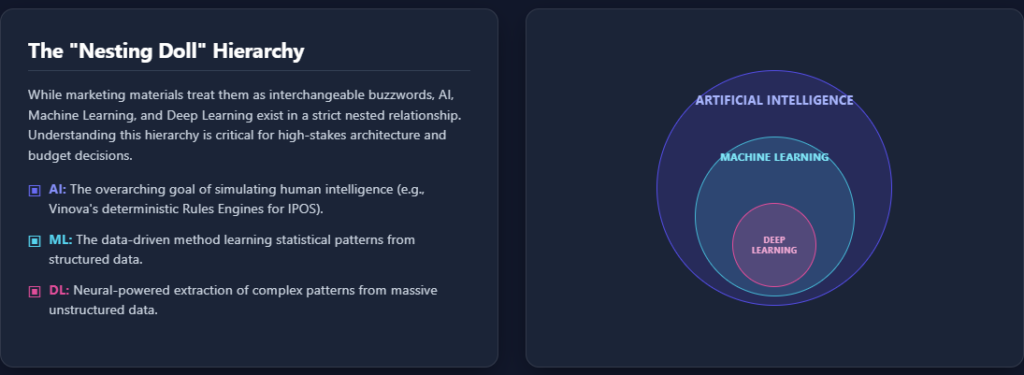
Table 1: The Nesting Relationship of AI, Machine Learning, and Deep Learning
| Artificial Intelligence (outermost) | Machine Learning (inside AI) | Deep Learning (inside ML) |
| The broad field of simulating human intelligence. Includes rule-based systems such as business rules engines and automated workflows | Data-driven statistical pattern learning. Predictors, recommenders, fraud detection | Multi-layered neural networks. Transformers, large language models (LLMs), convolutional neural networks (CNNs) |
Table of Contents
Quick Summary: AI vs Machine Learning vs Deep Learning
- Artificial Intelligence (AI): the overarching goal of building machines that simulate human intelligence, decision-making, and reasoning.
- Machine Learning (ML): the primary data-driven method used to achieve AI, where algorithms learn patterns directly from data, most often structured data, instead of being explicitly hard-coded.
- Deep Learning (DL): a specialized subfield of machine learning that uses multi-layered artificial neural networks (ANNs) to learn complex patterns from raw, unstructured data such as text, images, and audio.
However the search is phrased, whether AI vs ML vs deep learning, machine learning vs artificial intelligence vs deep learning, or AI vs ML vs DL, the question is the same: how do these three tiers relate, and which one does the business need?
At Vinova, our AI-first strategy is grounded in practical capability that can be measured. With 16+ years of enterprise IT experience and 300+ projects delivered, we help organizations match the right-fit technology, AI, deep learning, or machine learning, to the operational problem in front of them. Whether the work is a multi-tenant facilities management platform for a Singapore services group or a mobile app for a regional life insurer, the goal is measurable enterprise impact, not technology for its own sake.
Understanding Artificial Intelligence (AI)
Artificial Intelligence is the broad discipline of computer science dedicated to engineering systems that perform tasks that traditionally require human intellect: logical reasoning, spatial perception, natural language processing (NLP), automated planning, and problem-solving.
Categories of AI
- Artificial Narrow Intelligence (ANI): goal-specific AI designed to excel at a single, well-defined task. Every commercial AI system in production today, from chess engines and spam filters to patent examination tools and recommendation engines, is an instance of Narrow AI.
- Artificial General Intelligence (AGI): a hypothetical future state in which a system has human-level cognitive adaptability across arbitrary, multi-modal domains. AGI remains a theoretical milestone, not a deployable technology.
Rule-Based AI vs Learning Systems
Not all AI learns from massive, unpredictable datasets. Rule-based AI runs on hand-coded, deterministic logic (“if-then” statements) engineered by human domain experts. Its outputs are predictable, there is no model to drift, and every decision can be audited. The rules still need maintenance as policy and business logic change.
Rule-based AI in practice: when a Singapore government intellectual property services body needed to modernize its patent search and examination process, it did not need a generative model that might hallucinate. It needed legal precision. Vinova delivered a custom Business Rules Engine tightly coupled with a Workflow and Task Management Engine. That deterministic approach automated highly structured, complex professional decision-making while keeping the complete legal audit trail that regulators require.
The Rule: when a regulator asks why a decision was made, a rule engine can point to the rule. A generative model can only point to a probability.
Pre-built AI in practice: when rapid perception features were needed instead, we used existing application programming interfaces (APIs). For a Singapore university, Vinova designed an integrated AI layer for a gamified micro-learning platform that built Amazon Rekognition (image analysis) and Amazon Comprehend (text analysis) into the architecture rather than training visual and language models from scratch. That delivered advanced AI functionality to students and faculty without the cost and time of a custom model build.
The Takeaway: for standard vision, speech, or sentiment tasks, training a network from scratch buys a GPU bill, not an advantage.
What Is Machine Learning (ML)?
Machine Learning is a subset of AI in which systems parse historical data, discover statistical patterns, and build a mathematical representation, an ML model, that makes predictions or decisions on new data without being programmed with static rules. Historical data trains the algorithm into a model, and that model then scores new, real-time data into predictions.
The Four Main Types of Machine Learning
- Supervised learning (labeled data): the model trains on explicit input-output pairs. Used for classification and regression, such as credit scoring or forecasting power grid energy demand.
- Unsupervised learning (unlabeled data): the model scans raw data to uncover hidden clusters, structural anomalies, or correlations without human guidance.
- Semi-supervised learning: a hybrid that combines a small set of curated, labeled data with a large pool of unlabeled data, balancing cost and predictive accuracy.
- Reinforcement learning (RL): an agent learns optimal action paths by interacting with an environment and receiving numerical rewards or penalties. Used in dynamic bidding systems, logistics routing, and robotics.
Enterprise integration in practice: ML models are useless if they cannot communicate with core business systems. On a multi-tenant facilities management platform for a Singapore services group, the challenge was not only the predictive maintenance logic that flags asset failures before downtime occurs. It was engineering the data bridge to the client’s large legacy SAP environment.
Personalization in practice: for a Singapore events and bookings initiative serving international visitors, Vinova architected a smart e-commerce, event, and booking ecosystem on a scalable Odoo backend. Unsupervised learning on user behavior drives personalized visitor recommendations, and an AI-powered NLP chatbot provides 24/7 interaction with international guests.
Where It Works: structured business and operational data. Tree-based models train faster on standard CPU hardware, need smaller datasets, and stay transparent enough to audit, which is why predictive maintenance and personalization on tabular data rarely justify a neural network.
The Catch: traditional ML leans on human feature engineering, so a model is only as good as the columns your domain experts chose to feed it.
Key Components and Enterprise Data Pipelines
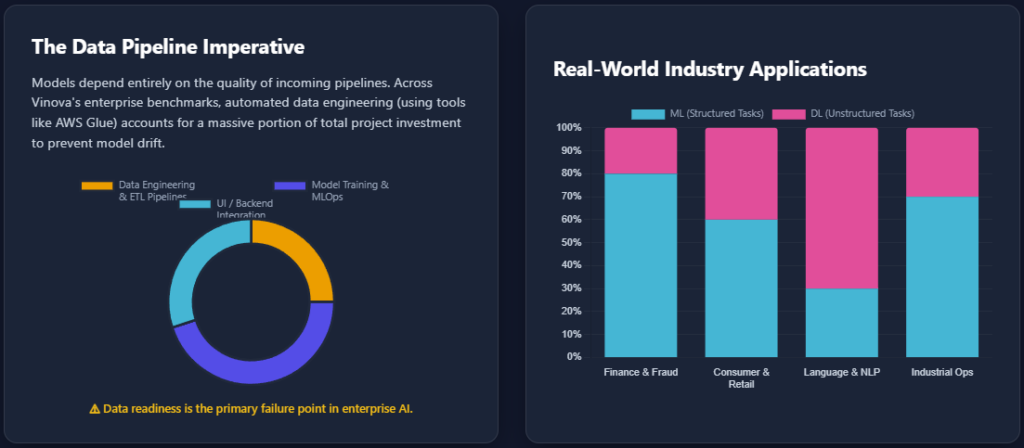
Traditional ML relies heavily on human-led feature engineering, where domain experts select which database columns matter most. In Vinova’s delivery experience, data engineering typically represents 15% to 25% of total project investment. We use AWS Glue to orchestrate real-time and batch extract, transform, load (ETL) pipelines so that data is validated, schema-standardized, and deduplicated before models run inference.
Decoupled data ingestion: third-party AI APIs and agents should never touch the production database directly. Vinova implements event-driven pipelines with Apache Kafka, Debezium for Change Data Capture (CDC), Apache Airflow, and dbt, which isolates core transactional databases from downstream model execution. If an AI agent queries the transactional database directly, one runaway prompt becomes a production outage.
What Is Deep Learning (DL)?
Deep Learning is a subfield of machine learning that uses multi-layered Artificial Neural Networks (ANNs), inspired by the structure of the biological brain. “Deep” refers to the presence of multiple hidden layers between the input and output layers.
How Deep Learning works
Unlike traditional ML, which needs manual feature engineering before a model can run, DL models accept raw, unstructured data directly and discover hierarchical features across consecutive layers: edges in early layers, shapes in middle layers, and full objects in deep layers. Common architectures include CNNs for computer vision, and Transformers, which power LLMs such as the GPT, Claude, Gemini, and Llama families, for sequential and text data.
Training Large Language Models Responsibly: Reinforcement Learning from Human Feedback (RLHF) in Practice
Deploying deep learning in regulated enterprise environments requires strict alignment and safety guardrails to reduce AI hallucinations. Vinova does not only consume AI. We help train it. Vinova operates a dedicated 40-member AI Evaluation Squad that supports a global AI data platform, executing RLHF: crafting domain-specific test prompts, benchmarking model outputs for factual precision, flagging adversarial exploits before a model is promoted, and generating high-quality training feedback so that large language models are more reliable before they reach a production enterprise environment.
If a model is promoted without that loop, the hallucination does not stay in a chat window. It becomes a wrong clause in a contract summary, and then a compliance finding.
Sovereign infrastructure: regulated workloads add a second constraint, which is where the model runs. Vinova collaborates with a specialized infrastructure partner to supply sovereign, on-premise AI server clusters for Singapore financial institutions, so high-throughput LLM workloads stay within Monetary Authority of Singapore (MAS) Technology Risk Management (TRM) data sovereignty requirements.
Key Differences: Machine Learning vs. Deep Learning
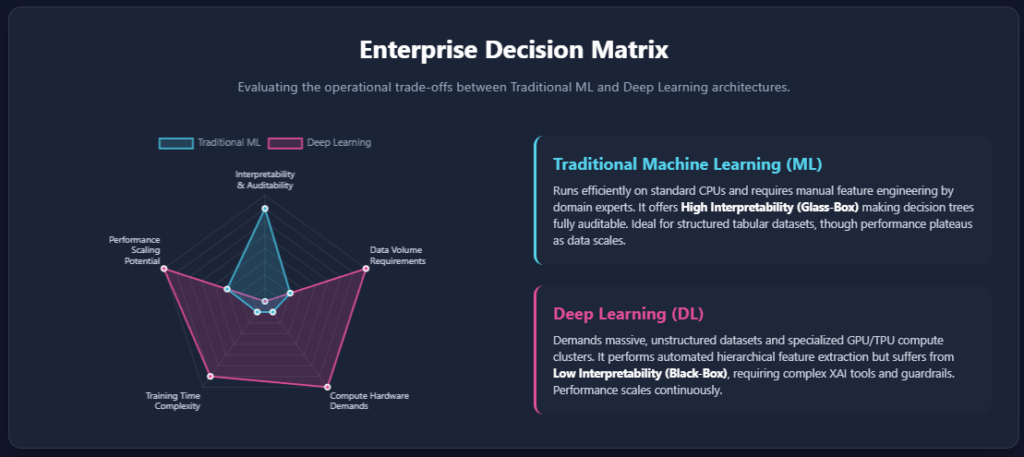
The difference between machine learning and deep learning comes down to how much a model must be told versus how much it works out on its own. The comparison below sets out the practical differences.
Table 2: Machine Learning vs Deep Learning by Operational Criterion
| Operational Criterion | Machine Learning (ML) | Deep Learning (DL) |
| Feature engineering | Manual: human domain experts select and extract input features | Automated: learns hierarchical features directly from raw data |
| Data requirements | Small to medium: performs well on structured, tabular datasets | Large: needs substantial unstructured datasets (text, vision, audio) to avoid overfitting |
| Hardware and compute | Standard: runs efficiently on CPUs and light cloud instances | Specialized: typically needs graphics processing unit (GPU) or tensor processing unit (TPU) capacity for training and, often, for inference |
| Training time | Fast: models commonly train in minutes to hours with a straightforward machine learning operations (MLOps) setup | Resource-intensive: training can take days to weeks on large compute clusters |
| Interpretability | High (glass-box): decision trees and linear models are fully traceable and auditable | Low (black-box): multi-layered neural weights are complex and call for explainability (XAI) tools |
| Performance scaling | Tends to plateau: accuracy levels off as data volume grows | Tends to keep improving as data and compute grow, with diminishing returns |
Practitioner Verdict: most Singapore enterprises should reach for predictive analytics and RAG before agents. They pay back sooner, fail more predictably, and are far easier to audit.
Execution Strategy: The AI-Assisted Engineering Advantage
At Vinova, we do not only build AI for our clients. We apply the same AI tooling inside our own engineering practice that we recommend to clients.
In a tender for a Singapore energy utility group’s digital arm, to build a talent acquisition platform, Vinova proposed an AI-Assisted quality assurance (QA) Framework that integrates GitHub Copilot, Cursor, and Playwright into sprint cycles across the software development life cycle (SDLC). The aim is to free engineers for high-value, complex work, such as integrating the platform with SuccessFactors HR APIs, instead of writing boilerplate code, and to pass the resulting speed and cost benefits on to the client.
Routine unit testing and boilerplate are automated. Commit-level static application security testing (SAST) and software composition analysis (SCA) gates keep the generated code from carrying security debt into production. If AI-generated code reaches the main branch without those gates, the speed gain arrives as an unpatched dependency.
Vinova’s AI Execution Matrix: Which Technique Fits Which Problem
The six deployments above map onto one table. The pattern is deliberate: the technique follows the data and the audit requirement, not the other way round.
Table 3: Vinova AI Execution Matrix by Enterprise Problem Domain
| Enterprise Problem Domain | Optimal AI Technique | Vinova Project Application | Applied Architecture and Stack |
| Legal and regulatory workflows | Rule-based AI (deterministic) | Patent examination modernization for a Singapore government intellectual property services body | Custom Business Rules Engine, task workflow engine |
| Student perception and analytics | Pre-built cloud AI APIs | Gamified micro-learning platform for a Singapore university | Amazon Rekognition, Amazon Comprehend |
| Dynamic visitor personalization | Unsupervised machine learning | Events and bookings ecosystem serving international visitors in Singapore | Scalable Odoo backend, clustering algorithms, NLP assistant |
| Predictive asset maintenance | Supervised machine learning | Multi-tenant facilities management platform for a Singapore services group | Failure prediction models, legacy SAP integration |
| LLM safety and model accuracy | Deep learning with RLHF alignment | Evaluation work for a global AI data platform | 40-member RLHF squad, prompt red-teaming, factual verification |
| Enterprise SDLC acceleration | Generative AI coding tools | Talent acquisition platform tender for a Singapore energy utility group’s digital arm | GitHub Copilot, Cursor, Playwright, automated continuous integration and continuous delivery (CI/CD) gates |
Ready to Engineer Your AI Success?
Choosing between rule-based AI, machine learning, and deep learning is a strategic business decision. Book a free consultation with Vinova’s Technical Advisory team, combining local Singapore compliance experience with regional engineering scale. No commitment required.
AI vs. Machine Learning vs. Deep Learning FAQ
Is deep learning always better than machine learning?
No. Deep learning is superior for unstructured data such as images, free text, and audio. For structured, tabular data, traditional machine learning is often the better choice: on typical tabular datasets, tree-based models have been shown to outperform deep learning (Grinsztajn et al., NeurIPS 2022). Traditional ML models also train faster, run on CPU infrastructure, need far less data, and offer clear auditability without black-box explainability problems.
Does deep learning require coding?
Custom deep learning architectures typically require programming in Python with frameworks such as PyTorch or TensorFlow. Enterprise teams can also use pre-built AI APIs (Amazon Rekognition, OpenAI APIs) or work with an integration partner like Vinova to deploy deep learning capability without building neural networks from scratch.
What’s the difference between neural networks and deep learning?
Artificial Neural Networks (ANNs) are the foundational mathematical building block, inspired by biological neurons. Deep learning refers specifically to training neural networks that contain many hidden layers, the “deep” architectures, which can learn complex abstractions that single-layer or shallow networks cannot capture.
Can an enterprise transition from machine learning to deep learning later?
Yes, and Vinova recommends a phased adoption strategy. Building traditional ML or rule-based systems first lets your organization validate business logic, establish reliable AWS Glue data pipelines, and gather telemetry before committing capital to dedicated deep learning GPU capacity.
Is AI machine learning? Is machine learning artificial intelligence?
Machine learning is AI, but AI is not machine learning. It is a subset of AI, not a synonym for it. Every ML system is a form of AI, but not every AI system uses machine learning. Rule-based engines, like the one Vinova built for the Singapore government intellectual property services body, are genuine AI with no machine learning involved. So the answer to “is machine learning artificial intelligence” is yes, it is one method among several for achieving AI. The answer to “is AI machine learning” is no, because AI is the broader category that ML sits inside.
What is AI and machine learning, in plain terms?
Artificial intelligence (AI) is the broad goal: building systems that simulate human-like reasoning, perception, or decision-making, however that is achieved. Machine learning (ML) is one specific approach to that goal: teaching a system to find patterns in data instead of hand-coding every rule. Put together, AI is the field and ML is a method within it. The difference between AI and machine learning is exactly this containment: every ML system is AI, but not every AI system is ML.
Machine learning vs. artificial intelligence: what’s the actual difference?
The machine learning and artificial intelligence difference is scope, not capability. AI is the destination, and ML, deep learning, and rule-based engines are three different roads that can get you there. When people ask about the AI vs ML difference, they usually mean: does this system learn from data (ML) or follow hand-coded logic (rule-based AI)? Both are legitimately AI. Only one is machine learning.
Artificial intelligence and machine learning, and machine learning deep learning: how do all these terms actually connect?
However the terms are framed, whether artificial intelligence and machine learning, AI and ML, ML vs AI, or the machine learning deep learning difference, they map onto one containment structure: AI is the outer field, ML is a technique inside it, and DL is a technique inside ML. Machine learning never exists outside artificial intelligence, and deep learning never exists outside machine learning. The nesting runs in one direction only.
Choosing the Right AI Approach: Accountability Before Architecture
Choosing between rule-based AI, machine learning, and deep learning is an accountability decision as much as a technical one: it determines what can be audited, what it costs to run, and who answers for the output. Vinova’s approach is built around that accountability:
- Fiduciary Governance & Regulatory Alignment: Delivery operations certified under ISO/IEC 27001:2022 (Information Security) and ISO 9001:2015 (Quality Management) and GovTech Category 1B approved, with delivery designed to align with the Personal Data Protection Act (PDPA), GovTech Instruction Manual 8 (IM8), and MAS TRM requirements.
- Pre-Release Model Testing: as a member of the AI Verify Foundation, Vinova runs the Infocomm Media Development Authority (IMDA) AI Verify open-source toolkit and Project Moonshot inside continuous integration and continuous delivery pipelines, evaluating models for bias, explainability, robustness, and performance drift before release.
- Cross-Border PDPA Protection: Section 26 of the PDPA is enforced through ASEAN Model Contractual Clauses (MCCs), Singapore-hosted Virtual Desktop Infrastructure (VDI) environments, and synthetic datasets, so production personally identifiable information (PII) is never used in development environments.
- Singapore Corporate Governance: Master Services Agreements governed under Singapore law with Singapore International Arbitration Centre (SIAC) arbitration, so intellectual property (IP) ownership, audit rights, and accountability are defined before the first sprint.
- Right-Fit AI Delivery Practice: rule-based systems or traditional ML first where the data and the audit requirements allow, deep learning only where unstructured data justifies the compute, with telemetry and a measured baseline at every phase.
- Engineering Depth: 300+ in-house engineers across Singapore and Vietnam delivery hubs in Ho Chi Minh City, Da Nang, and Hanoi, with 8% to 12% annual voluntary attrition, so the people who build your system are still there to run it.
Explore Vinova’s AI and custom software development services, or talk to our team about which approach fits your use case.
Vinova: a Singaporean Government-Grade Digital Transformation Partner, Made Accessible. For 16 years, we have designed digital systems for 300+ companies and government agencies worldwide, backed by ISO 27001:2022 and ISO 9001:2015 certification and Singapore GovTech Category 1B approval.
300+ employees across offices in Singapore, Vietnam (Hanoi, Da Nang, Ho Chi Minh City), Norway (Oslo), and Thailand (Bangkok), scaling platforms and engineering capacity to serve clients across the globe.
Financial Times Top 500 High-Growth Companies Asia-Pacific 2026. Recognized among Singapore’s Top 100 Fastest-Growing Companies in 2024, 2025, and 2026.