By the Vinova AI Engineering Team. Reviewed under ISO 27001:2022 and ISO 9001:2015 delivery standards.
Every automation vendor promises a workforce that never sleeps. What most deliver is a bot that never notices the invoice template changed, plus a maintenance contract to teach it.
Enterprise AI automation in Singapore has moved past the proof-of-concept phase. The organizations pulling ahead in 2026 are not the ones running more pilots. They are the ones that have closed the gap between data analysis and operational execution, built agent networks that maintain state and hand work off cleanly, and designed their architecture to meet the Personal Data Protection Act (PDPA), the Monetary Authority of Singapore (MAS) Technology Risk Management (TRM) guidelines, and the Infocomm Media Development Authority (IMDA) Model AI Governance Framework for Agentic AI (Version 1.5, May 2026). The organizations still running UI-bound Robotic Process Automation (RPA) workflows are paying maintenance on systems that break whenever a screen changes.
The question for a Chief Technology Officer (CTO) or Chief Risk Officer (CRO) is not which platform to buy. It is who is accountable when an autonomous agent acts on a regulated transaction.
This guide sets out the best practices Vinova applies to every AI automation engagement: the architectural shift from deterministic RPA to cognitive systems, a vetting framework for ten widely used automation platforms, a deployment matrix drawn from Vinova’s Singapore delivery, the six-phase implementation lifecycle, and the security and compliance architecture that decides whether a platform survives regulatory scrutiny.
Key Takeaways
- RPA breaks where AI adapts, but not everywhere. UI-bound RPA fails on screen changes and cannot read unstructured documents without extra tooling. Stable, rule-driven tasks can stay deterministic. Use AI where the input varies.
- Model the five-year cost before you choose to build. In Vinova’s illustrative model for 150 users, custom software totals about USD 590,000 over five years against about USD 1,450,000 for an equivalent Software-as-a-Service (SaaS) stack, with breakeven in 18 to 30 months. Your assumptions will differ, so run your own numbers first.
- Data readiness sets the timeline. In Vinova’s planning experience, data collection, cleansing, and PDPA pipeline configuration take 40% to 70% of the project lifecycle.
- Governance is an architecture requirement. The Personal Data Protection Commission (PDPC) Advisory Guidelines on Use of Personal Data in Generative AI (20 July 2026) and the IMDA agentic framework are advisory and voluntary respectively, but they set the standard regulators and boards will measure you against.
Table of Contents
From Legacy RPA to Enterprise AI Automation: The Architectural Shift
Traditional RPA runs on deterministic, UI-based instructions: DOM selectors, fixed desktop paths, and hard-coded conditional logic. When an enterprise system changes its schema or redesigns a screen, the bots break and generate a storm of exceptions. RPA also struggles with unstructured data such as contracts, email threads, and non-tabular invoices unless costly pre-processing sits in front of it. Teams that manage large rule sets and selector drift often find maintenance absorbing much of the original saving.
Enterprise AI automation replaces hard-coded execution with dynamic, cognitive workflows. Vinova’s systems run on a four-stage loop, and the first two stages read the situation.
Discover ingests and classifies unstructured assets. In one Vinova document-processing pipeline, a local CLIP and nearest-neighbor classifier handled 96% of pages, and only 4% fell back to a vision-language model, which keeps model application programming interface (API) spend low. Decide is the orchestration layer, running semantic reasoning over organizational ontologies held in knowledge graphs and vector databases.
The last two stages act on the result. Act connects agents to tools, databases, and external SaaS platforms through the Model Context Protocol. Optimize collects telemetry continuously and feeds model tuning and distillation, so the model footprint shrinks as usage scales.
Table 1: Traditional RPA versus Enterprise AI Automation
| Parameter | Traditional RPA Workflows | Enterprise AI Automation (Vinova) |
| Processing core | Deterministic, hard-coded rules mapped to static screen coordinates | Probabilistic transformer models capable of semantic planning and multi-step execution, with deterministic controls around them |
| Unstructured data | Minimal: needs rigid OCR pre-processing and custom parsers that fail on format variation | Native: reads document layouts, audio, and multi-page PDFs using vision-language models |
| Maintenance | High: selectors and workflow paths need manual refactoring when targets change | Lower: agents adapt tool paths from updated semantic descriptions and API schemas, with regression evaluation to catch drift |
| Integration | Surface-level GUI scraping, simulated keystrokes, proprietary desktop connectors | Composable API architecture using the Model Context Protocol (MCP), which runs on JSON-RPC |
| Long-term total cost of ownership (TCO) | Scales with exception rates; recurring cost from continuous maintenance | Higher initial build cost; run costs managed through model right-sizing and custom-software economics |
The Five-Year TCO Case for Custom Enterprise AI Automation
For a mid-sized organization with 150 users, Vinova’s TCO modeling produces the comparison below. The custom figure assumes a flat maintenance fee, native APIs, and no per-seat charges. The SaaS figure assumes 12.2% average annual price escalation, which Vinova has observed across APAC enterprise vendor contracts. Treat it as an illustration of method: the first deliverable Vinova produces, before any build recommendation, is this comparison rebuilt with your own numbers.
Table 2: Illustrative Five-Year TCO, 150 Users (Vinova Model)
| Option | Cumulative 5-Year Cost | Key Assumptions |
| Custom-built enterprise AI automation platform | USD 590,000 | Flat maintenance fee; native APIs; zero per-seat charges |
| Equivalent SaaS stack | USD 1,450,000 | 12.2% average annual price escalation; per-seat and usage charges |
| Breakeven point (custom versus SaaS) | 18 to 30 months | Depends on build scope, user growth, and SaaS pricing tiers |
Vetting 10 Enterprise AI Automation Platforms in 2026
Vinova’s solutions architects evaluate AI automation platforms on architectural modularity, compliance baseline, and orchestration capability. The verdicts below reflect Vinova’s engineering judgment, drawn from each vendor’s public documentation as of October 2026. Features and certifications change quickly, so confirm current terms with the vendor before you shortlist.
1. Vellum
A local-first personal AI assistant that is open source and runs on your own machine by default, with an optional hosted cloud. It keeps conversation history, memory, and credentials local, and it asks for approval before high-stakes actions.
Vinova verdict: strong for individual and engineering-group use where data must stay local, and extensible through custom skills. It is a personal assistant, not a back-office orchestration platform, so it is a poor fit for multi-agent automation across business lines.
2. Microsoft Power Automate
The natural automation layer for organizations committed to Microsoft 365, Azure, and Copilot Studio, with a broad pre-built connector catalog and identity through Microsoft Entra ID.
Vinova verdict: a good fit for Microsoft-centric, mid-market process automation. Integrations outside the Microsoft ecosystem can need custom connectors, and subscription costs rise with action volume as cognitive usage grows.
3. AWS Bedrock AgentCore
A managed AWS runtime for building, deploying, and operating agents, with a gateway that connects agents to MCP servers, knowledge bases, and internal APIs under per-connection authentication and access control. It supports any agent framework and model.
Vinova verdict: built for AWS-native enterprises running serious multi-agent workloads. Its capabilities are delivered as separate services that teams provision, secure, and monitor themselves, and Vinova routinely bridges that integration effort for clients.
4. Vertex AI Agent Builder (Google Cloud)
Google’s environment for building and scaling production agents, now part of its Gemini Enterprise Agent Platform. It combines low-code design with a code-first Agent Development Kit and persistent memory across sessions.
Vinova verdict: strong for multi-turn evaluation and memory continuity. For high-security Singapore public sector work, confirm customer-managed encryption key (CMEK) and data residency support feature by feature and model by model before committing.
5. Tray.ai
An integration and agent platform for connecting fragmented SaaS portfolios, with 700+ connectors, tracing of agent actions and MCP tool calls back to a user, and System and Organization Controls (SOC) 2 Type 2, Health Insurance Portability and Accountability Act (HIPAA), and General Data Protection Regulation (GDPR) attestations.
Vinova verdict: strong for mapping complex SaaS-to-SaaS data paths quickly. Its public documentation does not state on-premises or private-network options, so confirm those with the vendor before shortlisting it for air-gapped or sovereign environments.
6. n8n
A developer-centric, source-available workflow engine with a self-hosted Community Edition that runs in Docker. Developers can write JavaScript or Python directly in execution nodes.
Vinova verdict: among the tools Vinova recommends most for developer-led visual automation, because it pairs low-code speed with full code-level control. Community self-hosted deployments lack some enterprise controls, so Vinova adds a custom reverse proxy and HashiCorp Vault for credentials, and checks edition-level role-based access control (RBAC) before production.
7. Zapier Enterprise
A low-code integration platform for connecting thousands of cloud applications, aimed at business teams who want to prototype automations and sync CRM data without engineering support.
Vinova verdict: a good choice for early proof-of-concept validation and lightweight SaaS syncing. It is built around trigger-and-action flows, so for stateful, multi-turn reasoning pair it with a dedicated orchestration layer.
8. Lindy AI
An AI employee platform in which non-technical users configure agents through natural-language playbooks that monitor communications and draft context-aware responses.
Vinova verdict: effective for personal productivity and back-office scaling. Any prompt-driven agent behaves less predictably than code, so before it touches transactional workflows, insist on code-enforced execution gates and deterministic validation of every tool call.
9. Gumloop
A platform for building, sharing, and governing AI agents across a company, connected to tools such as Slack, HubSpot, Gmail, and Salesforce, with a model router, admin role controls, spend caps, audit logs, and single sign-on (SSO). It works with models from several providers.
Vinova verdict: a strong pipeline choice for high-volume document and data transformation. Usage is metered in credits, so set spend caps and review consumption before peak processing runs, and confirm any retrieval and indexing needs against the current feature set.
10. Stack AI
A low-code platform for document-heavy workflows in regulated industries, with a visual builder for Retrieval-Augmented Generation (RAG) pipelines, guardrails, personally identifiable information (PII) protections, and role-based access control. It states SOC 2 Type II, GDPR, and HIPAA compliance and supports self-hosting on your own servers.
Vinova verdict: Vinova’s preferred option for rapid visual RAG prototyping in regulated sectors. It is a closed ecosystem, so custom API connectivity and complex agent-to-agent patterns follow Stack AI’s own interfaces, which can limit architectural flexibility at scale.
Table 3: Platform Fit at a Glance
| Platform | Best Fit | Check Before You Commit |
| Vellum | Local-first personal assistant | Not a multi-agent back-office platform |
| Microsoft Power Automate | Microsoft-centric mid-market automation | Non-Microsoft connectors; cost at high action volumes |
| AWS Bedrock AgentCore | AWS-native multi-agent workloads | Provisioning and securing separate services |
| Vertex AI Agent Builder | Multi-turn evaluation, memory continuity | CMEK and residency support per feature |
| Tray.ai | SaaS-to-SaaS integration at scale | On-premises or private-network options |
| n8n | Developer-led visual automation, self-hosted | Edition-level RBAC and credential vaulting |
| Zapier Enterprise | Proof-of-concept and light SaaS sync | Stateful, multi-turn reasoning needs |
| Lindy AI | Personal productivity and back-office assistants | Code-enforced gates before transactional use |
| Gumloop | High-volume document and data pipelines | Credit-based cost control |
| Stack AI | Secure RAG in regulated sectors | Closed ecosystem at scale |
Practitioner Verdict: no platform on this list removes the need for an architecture decision. Pick the one whose limits you can write down in advance.
Enterprise AI Automation Deployment Matrix: Eight Deployments, Eight Proof Points
Where does AI automation operate in Singapore’s economy? These are eight engagements across the sectors where Vinova has delivered production systems, with the use case and the compliance baseline each runs under. Client names are withheld, and each engagement is described by sector and scale.
Table 4: Vinova Deployments and Compliance Baselines by Sector
| Sector | Vinova Deployment | Compliance Baseline |
| Finance and Risk | Long-term managed services for a Singapore public financial-sector agency; multi-agent fraud detection and audit-trail generation as the reference design | MAS TRM, GovTech Instruction Manual 8 (IM8), Fairness, Ethics, Accountability, and Transparency (FEAT) Principles |
| Operations Support | 24/7 natural language processing (NLP) chatbots for two Singapore customer-facing organizations, in automotive experience and driving education | Odoo and Salesforce API integration; PDPA |
| Supply Chain | Marine shipping Enterprise Resource Planning (ERP) system for a global maritime group, with 20+ integrated modules and real-time vessel database sync | Data sovereignty controls |
| HR and Upskilling | Personalized learning platform for a Singapore university, using Dynamic Bayesian Knowledge Tracing | SkillsFuture, Ministry of Manpower (MOM) guidelines, National AI Impact Programme (NAIIP) |
| IT and Cybersecurity | Whole-of-government governance, risk, and compliance (GRC) platform for a Singapore government technology agency | GovTech Category 1B, IM8 |
| Legal and IP Services | Deterministic Business Rules Engine coupled with a Workflow and Task Management Engine, automating patent examination for a Singapore government intellectual property services body | Public sector governance; complete decision audit trail; Microsoft 365 integration |
| Asset and Facilities Management | Predictive maintenance on high-frequency sensor telemetry for a multi-tenant facilities management platform at a Singapore services group, bridged into a legacy SAP environment | AWS Glue pipelines; interpretable tabular models; legacy SAP integration |
| AI Model Evaluation | Dedicated 40-member AI Evaluation Squad supporting a global AI data platform, covering adversarial prompts, factual audits, and human preference datasets | Human-in-the-loop alignment; red-teaming before enterprise deployment |
Finance, Risk, and Compliance
A multi-agent design for continuous fraud detection works like this. Transactional events stream through Kafka pipelines. Retrieval agents query active ledger databases, cross-reference buyer profiles against anomaly patterns held in a graph database (Amazon Neptune), and score each transaction against compliance thresholds in real time. Every automated decline generates a natural-language explanation trace stored in an immutable audit record that a regulator can inspect.
Vinova delivers long-term managed services for a Singapore public financial-sector agency, covering the lifecycle of critical fiscal instruments and cash flows between public institutions under central-bank-tier security. That is the engineering discipline the fraud-detection reference design inherits.
The Result: ongoing managed services for critical fiscal instruments and inter-institutional cash flows under ISO 27001:2022, IM8, and FEAT principles, with continuous compliance against the 1-hour MAS incident notification mandate. The same multi-agent reference design applies to regulated insurers.
Customer Support and Operations
Vinova built AI-powered NLP chatbots for two Singapore customer-facing organizations, in automotive experience and driving education, delivering 24/7 personalized engagement. When a customer queries a billing discrepancy, the agent does not return a template response. It queries the enterprise customer relationship management (CRM) system through a secure API (Salesforce and Odoo are among the platforms integrated), retrieves the invoice, and validates the transaction against contract terms held in a vector index.
If the discrepancy is confirmed, the agent prepares the refund and updates the ledger. Under the IMDA agentic framework’s accountability principle, refunds above an agreed threshold route to a human approver before payment, while small, reversible corrections can close automatically.
For the back-office workflow of one automotive client, Vinova ran a five-year TCO analysis during the initial assessment and recommended Odoo Enterprise off the shelf rather than a custom build. That recommendation cost Vinova the development revenue. It was the right architectural call.
Supply Chain and Procurement
The marine shipping ERP Vinova built for a global maritime group integrates more than 20 modules with external vessel databases in real time. When a shipment arrives, the pipeline extracts barcode metadata, structures document tables, and validates them against purchase orders in the ERP. If it finds a pricing discrepancy, it opens a supplier query for procurement review. If the shipment validates, the system routes the payment request to the finance gateway within seconds.
Live telemetry stays synchronized between cloud microservices and legacy databases through Debezium for Change Data Capture (CDC), Apache Kafka, and dbt, so operations never wait on a batch job. If reconciliation stays manual, a pricing discrepancy surfaces at month-end instead of at the dock.
A rigorous five-stage upfront Product Discovery phase de-risked the scope. The project then ran with a dedicated offshore squad of 30+ engineers for over three years with minimal turnover, and that discipline, together with a decoupled architecture, increased the client’s overall development and system integration velocity by 60%.
HR and Workforce Upskilling
Vinova co-developed a personalized learning platform with a Singapore university to support freshmen moving into a demanding academic environment. It maps student profiles across metacognitive approaches, personal wellbeing, and academic resilience, and uses Dynamic Bayesian Knowledge Tracing to sequence tailored micro-lessons in real time. Rather than sinking capital into custom neural networks, Vinova embedded pre-built cloud perception APIs, Amazon Rekognition for image analysis and Amazon Comprehend for text and sentiment analysis, directly into the platform architecture, paired with user experience (UX)-first gamification.
The automation layer tracks training milestones and compiles reports that support program reporting under NAIIP. Cohorts that had previously resisted digital tools showed sustained engagement and measurable improvement in self-regulated learning behaviors and academic resilience, the outcomes the institution needed, not just the technology it deployed.
IT Infrastructure and Cybersecurity
Vinova delivered a whole-of-government GRC platform for a Singapore government technology agency, under GovTech Category 1B approval. The security-automation pattern below is Vinova’s reference design for incident response, and it shows what governed automation looks like in this domain. When the engine detects a potential breach vector, such as unauthorized lateral movement or credential abuse, the agent revokes the compromised user’s access token, isolates the affected microservice in a network sandbox (Docker or gVisor), starts an automated log search for the exploit origin, and drafts an incident report for the on-call security analyst. Containment happens at machine speed, stopping lateral spread within milliseconds, and only an authorized human analyst can approve service restoration and credential re-issuance.
Legal and IP Services: Deterministic Rules Over Generative Creativity
Best practice applied: choose deterministic, rule-based AI over probabilistic models where legal precision and regulatory auditability outrank generative creativity.
Implementation: for a Singapore government intellectual property services body, Vinova did not deploy a generative model that could hallucinate a legal precedent. It built a high-precision Business Rules Engine, tightly coupled with a Workflow and Task Management Engine, that classifies and routes complex patent applications against statutory examination frameworks and integrates directly into Microsoft 365.
The Result: high-volume professional decision-making is automated with a complete audit trail and no generative component, so there is no hallucination risk to govern. If an examiner asks why an application was routed, the system answers with the rule, not a probability.
Asset and Facilities Management: Interpretable Predictive Maintenance
Best practice applied: feature engineering on structured tabular data, AWS Glue pipelines, and legacy ERP integration.
Implementation: on a multi-tenant facilities management platform for a Singapore services group, Vinova used AWS Glue to extract and normalize high-frequency Internet of Things (IoT) sensor telemetry and operational logs across tenant assets, trained supervised machine learning models to predict component failure intervals, and automated maintenance scheduling. The unglamorous part was a reliable data bridge into the client’s complex legacy SAP environment.
The Result: operations shifted from reactive emergency repairs to proactive maintenance. Interpretable tabular models also avoided the black-box explainability problem: a facilities manager can see which signals drove a failure prediction.
AI Model Evaluation: The 40-Member RLHF Squad
Best practice applied: human-in-the-loop alignment, red-teaming, and Reinforcement Learning from Human Feedback (RLHF) to curb generative AI hallucinations.
Implementation: Vinova operates a dedicated 40-member AI Evaluation Squad supporting a global AI data platform. The squad engineers adversarial test prompts, audits multi-turn model responses for factual correctness, flags safety vulnerabilities, and generates human preference datasets.
The Result: frontier foundation models are hardened and aligned before enterprise deployment, closing the gap between raw transformer output and regulated enterprise requirements. If nobody red-teams the model first, a customer’s first week in production does it for you.
Architectural Strategy: The Three Layers of an Enterprise AI Automation Platform
Every AI automation platform Vinova ships is assembled from three separable layers, and workflow design starts by deciding what belongs in each. The data foundation determines retrieval quality, the automation fabric turns business intelligence into execution, and the governance layer sets the security boundary. The sections below cover each layer in build order.
Layer 1: Data and Infrastructure Foundation
The storage and indexing layer is the foundation. To keep retrieval fast, Vinova’s data layer is normalized and decoupled across three specialized configurations.
- Vector storage (pgvector, OpenSearch): holds chunked enterprise document bases, policy guidelines, and semantic indices. Prompt caching for stable system prompts cuts cost and latency on repetitive interactions. Anthropic’s published figures cite up to 90% lower cost and up to 85% lower latency for long prompts, with gains varying by use case.
- Graph databases (Amazon Neptune): map organizational hierarchies, master data relationships, and product dependencies. GraphRAG traversal builds deterministic inference paths that reduce the chance of a model inventing basic business relationships.
- Structured output schemas: every model execution adheres to a schema validated with Pydantic, converting probabilistic generation into typed objects before any data write is triggered.
Layer 2: Analytical Process Automation (APA) as the Automation Fabric
APA removes the traditional separation between business intelligence and operational execution. Vinova’s APA architectures automate the continuous collection, cleansing, and normalization of data streams across local databases and multi-tenant cloud storage, instead of leaving analytical models isolated in sandboxes.
The system recalculates operational parameters, such as inventory demand and customer churn scores, and pipes the results into automated routing gates that change processes in real time without a manual analytical step. In the maritime ERP, this is the architecture that keeps shipping parameters synced to live vessel data across 20+ modules. In the financial-sector managed services, it is the pipeline that recalculates transaction risk scores as new Kafka events arrive.
Layer 3: Governance and Control via the Model Context Protocol (MCP)
The governance layer is the platform’s security boundary. MCP follows a host, client, and server architecture. The host is the application that runs the model and coordinates reasoning; it creates and manages client instances, enforces security policies and consent requirements, and handles authorization decisions. Each client keeps an isolated, one-to-one session with a single server. Each server is a focused service that exposes a restricted set of tools, resources, and prompt templates. By design, a server cannot read the whole conversation or see into other servers.
Vinova turns that design into controls: least-privilege tool exposure per server, schema validation on every call, allowlisted routes, and logging of every tool invocation. When a target system lacks native APIs, such as a legacy on-premises ERP or SOAP-based infrastructure, Vinova builds translation middleware that exposes a standard MCP interface and converts requests into the legacy payload format. These controls limit what a manipulated model can do. They do not make prompt injection impossible, so high-impact actions also sit behind human checkpoints.
For legacy modernization, Vinova applies the Strangler Fig Pattern: cloud-native services built around the edges of the existing monolith, replacing components incrementally and shifting traffic gradually so end users see minimal disruption. Vinova has applied it for a global maritime group and a Singapore energy-sector digital company, and it is the standard approach for any institution where downtime carries operational or reputational cost.
For public sector and education deployments, Vinova aligns to the guardrail and pre-deployment testing approach GovTech has published, Sentinel for runtime safeguards on LLM applications and Litmus for adversarial testing, where the agency provides access to those tools, and applies equivalent controls where it does not.
The Six-Phase Enterprise AI Automation Lifecycle
Adoption fails more often than models do, so Vinova runs every AI workflow automation program through a fixed six-phase sequence, from readiness assessment to hypercare. Each phase ends in a gated deliverable. The phases run in this order.
Phase 1: Enterprise Readiness Assessment and Project Scoping
Every Vinova engagement begins with product discovery and requirement workshops. Vinova scopes automation on three numbers: how often the process runs, how often it breaks, and how much regulation it touches. Headcount saved is not one of them.
A process audit and financial assessment decide whether the workflow needs a custom-engineered system or can be solved with off-the-shelf software. The five-year TCO comparison is the first deliverable. If the numbers do not justify a custom build, Vinova recommends the platform that does, as it did for the automotive back-office workflow above.
Phase 2: Stakeholder Alignment, Funding, and Hybrid Delivery Design
Executive sponsorship starts by anchoring the strategy within Smart Nation 2.0 and workforce transformation priorities. On funding, check the current scheme before you plan around it. The Enterprise Development Grant closed to new applications after 29 September 2026. From 30 September 2026, Enterprise Singapore’s EDGE Grant covers more than 100 activities, with support of up to 70% of qualifying costs for small and medium-sized enterprises (SMEs) and up to 50% for non-SMEs, set by activity, and a cap of SGD 100,000 in total grant support per year. Applicants must be registered in Singapore with at least 30% Singaporean or Permanent Resident (PR) ownership. Qualifying activities and vendor requirements must be confirmed with Enterprise Singapore, and Vinova can support the application documentation. The funding decision is theirs.
The hybrid delivery model then sets the cost structure. The table shows Vinova’s planning ranges against fully loaded Singapore hiring.
Table 5: Monthly Cost per Engineer, Singapore Hiring versus Vinova Hybrid Model (Planning Ranges)
| Operating Model | Senior AI and Machine Learning (ML) Specialist | Mid-Level Full-Stack Engineer |
| Singapore, fully loaded (base, 17% Central Provident Fund (CPF), Skills Development Levy (SDL), benefits) | SGD 14,000 to 22,000+ | SGD 11,000 to 15,600 |
| Vinova hybrid model (all-inclusive flat rate) | SGD 5,400 to 8,100 | SGD 4,000 to 5,400 |
| Capital saving, comparing like ends of each range | 61% to 63% | 64% to 65% |
Vietnam’s UTC+7 time zone sits one hour behind Singapore, which supports real-time daily standups throughout the Singapore business day. Vinova’s delivery hubs run 8% to 12% annual voluntary attrition, so system knowledge stays in the team.
Phase 3: Data Collection, Cleansing, and PDPA Pipeline Configuration
In Vinova’s planning experience, data readiness takes 40% to 70% of the overall project lifecycle. Vinova builds automated pipelines, using Debezium change data capture into Apache Kafka, Apache Airflow for extract, transform, load (ETL) orchestration, and dbt for schema unification, to extract historical transactional records, customer profiles, and operational documents from siloed databases. Every retrieval pipeline is mapped against the PDPA, and National Registration Identity Card (NRIC) numbers, biometric profiles, and financial data are programmatically masked or stripped before storage unless collection is required.
Phase 4: Platform Selection, API Vetting, and Integration Matrix Mapping
Platform components are chosen against project constraints: n8n for developer-led visual automation with self-hosted compliance, Bedrock AgentCore for multi-agent systems in AWS-native environments, and Stack AI for secure document processing in regulated sectors. Every target API undergoes a security audit, and its authentication method (OAuth with Proof Key for Code Exchange (PKCE)), access privileges, and rate limits are documented in an Integration Matrix before any integration is built.
Phase 5: Automated Evaluation, Model Right-Sizing, and Security Red-Teaming
Vinova compiles golden evaluation datasets in observability tools such as Langfuse or Phoenix and runs regression checks on faithfulness, answer relevance, and hallucination rate. Where cost or latency demands it, Vinova right-sizes the model, distilling a large teacher model into a compact student model or choosing a smaller model outright, and measures the quality given up on the target task against the evaluation set rather than assuming it. Distillation must also respect the teacher model’s license, because some providers restrict using their outputs to train other models. The codebase undergoes static application security testing (SAST) and automated prompt-injection red-teaming before any deployment gate opens.
Phase 6: Canary Deployment, Hypercare, and Continuous Telemetry
Deployment uses a canary release: 5% of live traffic routes to the new platform while the legacy workflow stays active. Vinova tracks time-to-first-token (TTFT), token consumption, memory write speeds, and model decision paths in real time. Unexpected behavioral drift triggers automatic routing back to the stable baseline while engineers isolate the failure. Vinova’s planning guideline reserves about 15% of the budget for post-launch hypercare and continuous optimization.
After all six phases, the client has an AI automation platform that is live in production, aligned to the PDPA and IMDA guidance, and improving with every deployment cycle. That is what makes the move from proof of concept to operational velocity permanent.
Security, Compliance, and Governance Best Practices
Governance separates a deployable system from a regulatory liability. In Singapore it rests on three pillars: PDPA data protection, the IMDA agentic AI framework, and workforce pacing. Secure enterprise automation treats each as an architectural requirement, not a policy document.
PDPA Data Protection and AI-Specific Notification
Vinova hosts compute and vector storage in AWS ap-southeast-1, Google Cloud Singapore, or sovereign private networks. Data is encrypted in transit with TLS 1.3 and at rest with AES-256, using customer-managed keys in AWS KMS or Google Cloud KMS. Hosting in Singapore is not a legal requirement, but it simplifies the Transfer Limitation Obligation (Section 26), which allows a transfer abroad only where the recipient is bound by legally enforceable obligations that give comparable protection.
A 2026 development to plan for: on 20 July 2026 the PDPC issued its Advisory Guidelines on Use of Personal Data in Generative AI. The guidelines are advisory, but they interpret binding PDPA obligations. Where an organization relies on consent to use personal data for large-scale training or fine-tuning of a generative AI model, it must notify individuals of that purpose, explaining the types of personal data involved, how the data will be used, and the model’s functions. General wording such as “new product development” is considered insufficient because it does not identify AI model development. Notification is not needed where deemed consent or an exception, such as the business improvement or research exception, applies. Vinova designs explicit AI-specific notices with opt-out instructions and documents Retention Limitation Obligation (Section 25) procedures alongside them.
Data leakage risk: sending files with raw NRIC numbers, home addresses, or financial data to multi-tenant frontier APIs without local masking creates serious PDPA exposure. The PDPA’s financial penalty can reach 10% of annual Singapore turnover where that turnover exceeds SGD 10 million, and SGD 1 million otherwise. As one control, offshore Vinova developers reach client systems through Singapore-hosted virtual desktop infrastructure with no local data storage. VDI reduces exposure, but it does not by itself satisfy Section 26, so each engagement also documents the contractual and legal basis for any cross-border access.
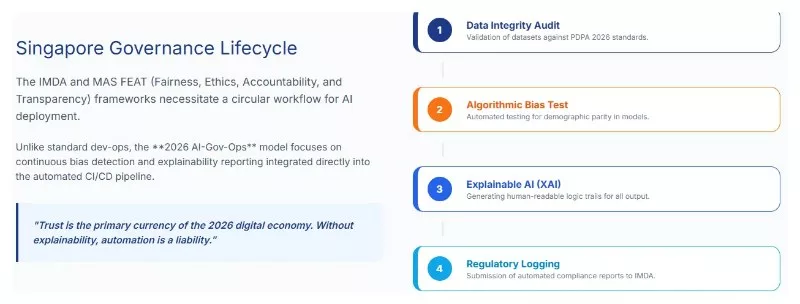
IMDA Agentic AI Framework: Three Control Patterns
The IMDA Model AI Governance Framework for Agentic AI (Version 1.5, 20 May 2026) is voluntary. It is organized around four dimensions: assess and bound risks upfront, make humans meaningfully accountable, implement technical controls and processes, and enable end-user responsibility. Vinova implements three control patterns that map to them.
- Structural boundaries: deterministic, rule-based controls, such as strict code gates and least-privilege tool access, take precedence over soft prompt-layer guidelines. Each agent is restricted to the minimum tools its role needs, enforced through static system architecture.
- Run-time controls: rate limits and input and output filters prevent excessive tool use, recursive loops, and memory poisoning. All agent interactions are written to immutable audit trails.
- Checkpoint triggers: significant, non-reversible actions, such as executing financial transactions or altering sensitive records, need explicit human approval first. Vinova monitors human override rates to detect automation bias. A 100% approval rate is a red flag, not a quality signal.
Workforce Pacing and Skill Retention
As autonomous systems take over repetitive cognitive tasks, organizations risk losing the manual tradecraft of their people. If the platform goes down through a network outage or cloud disruption, an organization whose staff have forgotten the manual process faces operational paralysis.
Vinova builds responsible pacing into every system: periodic human exposure to manual operations, AI-bilingual upskilling aligned to SkillsFuture programs and the National AI Impact Programme, and structured fallback workflows that preserve resilience. Automation that trains people out of the skills needed to run the business manually is not automation. It is fragility.
Deploy Enterprise AI Automation with Vinova
Book a complimentary 2-hour technical consultation with Vinova’s Singapore-based team. We will audit your current automation stack, identify your highest-return AI automation priorities, and design a delivery plan aligned to PDPA and IMDA guidance. No commitment required.
Schedule Your Free 2-Hour Enterprise AI Automation Consultation with Vinova →
Enterprise AI Automation FAQs
What is the fundamental difference between traditional RPA and enterprise AI automation?
Traditional RPA follows static, rule-based paths mapped to UI selectors and screen coordinates. When a screen or schema changes, workflows fail and exception handling consumes the original savings. AI automation uses cognitive models that ingest unstructured data, plan, and use tools dynamically, adjusting execution paths without hard-coded rules.
The operational difference: when a supplier changes the format of an invoice PDF, an RPA bot breaks. An AI automation system reads the new format, extracts the data, and continues the workflow, with a human reviewing anything it is unsure about.
How does an AI agent differ from a traditional static workflow when interacting with external APIs?
A traditional workflow runs a linear, pre-defined sequence: a trigger fires, Action A calls an API, Action B writes to a database. If Action A returns a non-standard response, the workflow halts, and a human must find the failure, update the rule, and restart.
An AI agent runs a stateful reasoning loop. It receives a high-level objective and selects tools from an exposed registry using semantic descriptions. When a tool returns something unexpected, the agent reflects, reformulates its plan, and continues. Because it can act in unexpected ways, its permissions, rate limits, and approval checkpoints are enforced in code, outside the model.
How do Singapore enterprises ensure AI automation platforms comply with PDPA and the 2026 IMDA Agentic AI Framework?
Four controls cover the ground:
- Data location and transfers: host storage, embeddings, and inference in Singapore regions where practical, and where data leaves Singapore, put enforceable arrangements in place that satisfy the Transfer Limitation Obligation (Section 26).
- AI-specific notices: under the PDPC’s 20 July 2026 advisory guidelines, where consent is the basis for large-scale training or fine-tuning, give clear notices that name AI model development, the data types used, and how to decline or withdraw. Generic “product improvement” wording is considered insufficient.
- Agentic boundaries: use deterministic structural controls, such as least-privilege access, rate limits, and fixed permission scopes, instead of relying on natural-language prompt instructions that adversarial inputs can override.
- Human accountability: add validation checkpoints for high-risk and non-reversible operations, and monitor human override rates to detect automation bias.
What core observability features should a lead architect expect from an enterprise AI automation platform?
Five primitives:
- Unified trace viewers: traces that map every node in an agentic reasoning loop, recording prompts, intermediate tool parameters, and model outputs.
- Latency analysis: granular tracking of time-to-first-token (TTFT) and generation speed to expose bottlenecks before users feel them.
- Real-time cost diagnostics: telemetry on credit or token consumption, so cost spikes are caught before they compound.
- Automated evaluators: continuous tests on live and held-out traffic that detect output drift and regressions before they reach production.
- System audit logs: immutable logs of authentication, role-based tool discovery, and human override actions, to support PDPC and MAS auditability.
What programming languages, database systems, and deployment configurations suit enterprise AI automation at scale?
- Languages: Python for model engineering, data preprocessing, and training pipelines (PyTorch, Pydantic); TypeScript, Go, and Java for high-throughput API gateways and lightweight MCP server microservices.
- Databases: PostgreSQL with pgvector or OpenSearch for semantic search, and Amazon Neptune or an equivalent graph database for relationship hierarchies, both with row-level security enforced at the database level.
- Deployment: for regulated workloads, weigh shared SaaS runtimes carefully and prefer isolated Kubernetes clusters running Docker containers; for high-security environments, use private VPCs or local-first on-premises configurations that keep compute inside the corporate firewall.
Enterprise AI Automation Is Decided by Accountability, Not Features
Enterprise AI automation in Singapore in 2026 is decided by three things: an architecture that separates data, execution, and governance; a platform chosen against compliance constraints instead of feature lists; and a five-year TCO model built before the first line of code. Vinova’s approach is built around that accountability:
- Fiduciary Governance & Regulatory Alignment: Delivery operations certified under ISO/IEC 27001:2022 (Information Security) and ISO 9001:2015 (Quality Management) and GovTech Category 1B approved, with delivery designed to align with PDPA, IM8, and MAS TRM requirements. Vinova is also a member of the AI Verify Foundation.
- Singapore Corporate Governance: Master Services Agreements governed under Singapore law with Singapore International Arbitration Centre (SIAC) arbitration, so intellectual property (IP) ownership, audit rights, and accountability are defined before the first sprint.
- Governed Automation Delivery Practice: a five-year TCO model before any build recommendation, rule-based controls around every agent, human checkpoints on irreversible actions, and drift and cost monitoring in production.
- Engineering Depth: 300+ in-house engineers across Singapore and Vietnam delivery hubs in Ho Chi Minh City, Da Nang, and Hanoi, with 8% to 12% annual voluntary attrition, so the people who build your system are still there to run it.
Explore Vinova’s AI and machine learning services, or contact Vinova to audit your automation stack and get a delivery plan aligned to PDPA and IMDA guidance.
Vinova: a Singaporean Government-Grade Digital Transformation Partner, Made Accessible. For 16 years, we have designed digital systems for 300+ companies and government agencies worldwide, backed by ISO 27001:2022 and ISO 9001:2015 certification and Singapore GovTech Category 1B approval.
3300+ employees across offices in Singapore, Vietnam (Hanoi, Da Nang, Ho Chi Minh City), Norway (Oslo), and Thailand (Bangkok), scaling platforms and engineering capacity to serve clients across the globe.
Financial Times Top 500 High-Growth Companies Asia-Pacific 2026. Recognized among Singapore’s Top 100 Fastest-Growing Companies in 2024, 2025, and 2026.