Author: Enterprise Solutions Architecture Practice at Vinova | Updated: 2026
Evaluating enterprise software architecture in 2026 shouldn’t feel like choosing between two frustrating extremes: clinging to legacy centralized databases vulnerable to single-operator manipulation, or falling for speculative crypto marketing that ignores what production engineering actually requires.
Here’s the real difference, in one sentence: traditional software is mutable, code gets patched, database tables get updated, a bad release gets rolled back in minutes. Blockchain is mathematically permanent. Once it’s deployed, it’s deployed. A logic flaw can’t be erased with a quick server reboot.
That’s not a minor technical detail. It’s an entirely different engineering discipline, one that borrows more from aerospace software verification than from typical web development.
Across Singapore and the broader Asia-Pacific region, where MAS has pushed institutional asset tokenization further than almost anywhere else, technology leaders have moved past the whitepapers and into production. We’ve spent 16+ years building enterprise software, 300+ delivered platforms for 300+ clients, under dual ISO 9001 and ISO 27001 certification. Here’s what actually separates these two disciplines, and how to tell which one your project needs.
Table of Contents
The Short Version
- Traditional software fails fast and gets fixed fast. Blockchain demands a mission-critical mindset instead, closer to aerospace software than typical web development, because bugs are irreversible once deployed.
- Centralized isn’t a dirty word. It’s the cheapest, fastest option for internal, single-organization workflows. Blockchain only earns its cost when competing parties need to coordinate without trusting each other’s database.
- Personal data still never belongs on-chain. Writing customer identities or pricing directly onto an immutable ledger breaches Singapore’s PDPA. Production systems keep that data off-chain and commit only a cryptographic fingerprint, the same Zero-PII pattern you’ll see across statutory registries and healthcare data generally.
- Nobody rips out their ERP for this. Mature enterprises don’t replace SAP or Oracle. They connect a distributed ledger as an external trust layer through ordinary API gateways.
- Testing gets a lot more paranoid. Modern blockchain teams run automated tools that throw at least 100,000 randomized scenarios at a contract before it goes live, on top of static analysis and multi-signature upgrade governance.
1. The Development Lifecycle Itself Is Different
“In traditional software engineering, bad code is an inconvenience you patch on Tuesday afternoon. In smart contract engineering, bad code is a bank vault with the door permanently welded shut. The entire lifecycle flips from ship fast and iterate to verify mathematically before deployment.”
Choosing to build on a distributed ledger is a genuine departure from the assumptions that have guided enterprise software for the past two decades.
| Architectural Dimension | Traditional Enterprise Software (Web2 Cloud) | Blockchain Development (Smart Contracts) |
|---|---|---|
| Data & Code State | Mutable: code gets hotfixed, database schemas get altered, rolled back, or deleted. | Immutable: bytecode and validated transactions are permanent. State can’t be rewritten. |
| Risk of Error | Manageable and expected: edge cases get caught by log monitors and patched in the next sprint. | Catastrophic and irreversible: a logic flaw can permanently lock or drain funds, with zero administrative recourse. |
| Primary Engineering Goal | Feature velocity: build, ship, test against real users, refine from telemetry. | Mathematical correctness: invariant fuzzing, static analysis, and formal audits before anything goes live. |
| Data Privacy (PDPA) | Simple: a database DELETE or UPDATE handles a customer’s data request. | Demands a Zero-PII hybrid architecture: personal data lives off-chain so it can actually be deleted. |
| Data Storage Cost | Negligible: roughly $0.02 per GB per month on standard cloud object storage. | Expensive: every byte of on-chain state carries ongoing network consensus and validator storage overhead. |
This permanence pushes the risk profile much higher than most engineering teams are used to. Traditional software benefits from continuous deployment, where a bug gets fixed in minutes. Blockchain protocols demand the opposite instinct: front-load the verification, because there’s no fixing it after the fact.
2. It Also Needs a Genuinely Different Kind of Engineer
“You can take a brilliant full-stack engineer, give them six months of Solidity tutorials, and they’ll still write contracts that lose money. Why? Because Web2 developers assume the server environment is benign and code can be rebooted. Blockchain engineers have to think like adversarial game theorists.”
A strong full-stack background is only the starting point. Blockchain engineering layers on economic game theory, multi-party consensus mechanics, and cryptography that rarely show up in conventional web development.
- Low-level cryptography: implementing and securing public-key signatures and hashing algorithms used to verify that on-chain state hasn’t been tampered with.
- Deterministic execution environments: understanding how the sandboxed runtimes that process blockchain code manage memory and meter computational cost through transaction fees.
- Economic game theory: designing contracts that stay secure against exploitation, flash-loan attacks, front-running, and misaligned incentives generally.
- Hybrid systems integration: building resilient middleware that bridges ordinary enterprise cloud infrastructure with deterministic on-chain execution.
Why This Talent Costs More
Experienced blockchain engineers command a real premium over general application developers, for three reasons that actually make sense once you see them:
- It’s genuinely scarce. Plenty of engineers build well in TypeScript or Java. Very few have mastered deterministic state machines and low-level contract optimization.
- Mistakes cost more, permanently. A junior developer’s Web2 bug means temporary downtime. The same kind of mistake in a contract managing corporate funds can destroy real money with no way to undo it. Enterprises pay for a verified track record to avoid that outcome.
- The ecosystem itself is fragmented. Different networks use different runtimes, consensus models, and scaling approaches. Getting them to interoperate takes specialized knowledge across more than one stack.
3. Centralized vs. Decentralized: The Actual Trade-Off
“Centralization isn’t a dirty word. If your application serves internal users inside a single company, deploying a blockchain is pure engineering theater. A centralized database writes state in under 5 milliseconds for pennies. Decentralization is only justified when independent counterparties refuse to let each other hold the master key.”
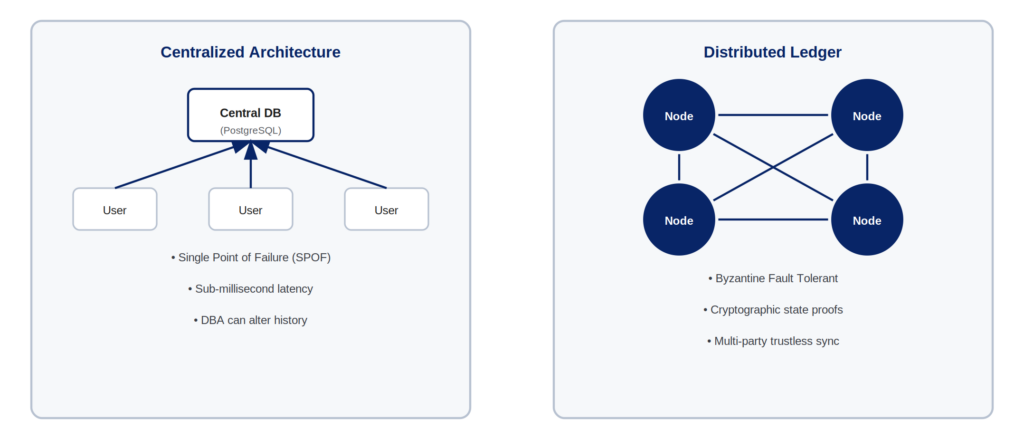
The Two Poles
- Centralized systems are governed by a single entity managing the application server and database. That entity holds root administrative permissions and defines the single source of truth.
- Decentralized systems are governed by a peer-to-peer network running deterministic consensus. Control is shared across independent nodes, and the rules are enforced by code rather than human discretion.
The Real Trade-Off: Speed vs. Resilience
Centralized systems win on raw efficiency, a centralized database writes state changes in under 5 milliseconds, handling tens of thousands of transactions per second. For internal applications where one organization holds clear legal authority, that’s simply the better architecture, and there’s no shame in it being the right answer.
Decentralized systems win on multi-party resilience. By removing any single point of failure, they stay operational even if several nodes go offline, and no single compromised account can quietly rewrite the historical record. The trade-off: reaching consensus across independent nodes is inherently slower than writing straight to local disk.
The Fast Version
- Stay centralized for: internal, single-tenant workflows, HR systems, internal financial reporting, CRM. If one entity already has full legal authority, a blockchain just adds cost and latency for no real benefit.
- Go decentralized for: multi-stakeholder environments where participants need to coordinate but don’t inherently trust a database owned by a competitor, cross-border trade logistics, multi-bank clearing, supply chain provenance, syndicated asset registries.
Not Sure Which Architecture Your Project Actually Needs?
Most projects don’t need a blockchain, and a good architecture review will tell you that upfront. Book a free consultation with our Singapore team and we’ll give you an honest read, no commitment required.
4. The Strategic Comparison, Side by Side
| Dimension | Centralized Architecture | Distributed Ledger Architecture |
|---|---|---|
| Topology | Client-server; one database cluster controls global state. | Peer-to-peer; state is replicated and synchronized across independent nodes. |
| Control model | Hierarchical; a single administrator retains root authority. | Consensus-based; state changes require cryptographic agreement across validators. |
| Fault tolerance | Low native resilience against insider tampering; prone to single-point outages. | High; removes single points of failure through distributed consensus. |
| Audit defensibility | Relies on internal logs, which a root admin can modify. | Tamper-resistant by construction; blocks are cryptographically chained. |
| Settlement finality | Bilateral reconciliation; clearing across external parties takes days. | Programmatic and near-instant; multi-party transactions settle simultaneously. |
| Data privacy posture | Simple PDPA compliance via direct record deletion. | Requires a Zero-PII hybrid architecture; personal data stays off-chain. |
The Part Nobody Warns You About: Getting Rivals to Agree
“The hardest part of enterprise blockchain is almost never the cryptography, it’s commercial diplomacy. Getting fierce market competitors to synchronize their supply chains onto a shared network means solving the coopetition paradox: agreeing on who validates blocks without letting any single rival control the game.”
Moving from centralized IT to a shared ledger is rarely a purely technical decision, it’s mostly a governance negotiation. In a multi-party trade consortium, no single enterprise gets to unilaterally dictate the architecture. Competitors, suppliers, and logistics partners all have to agree on validation rights, transaction ordering, dispute resolution, and who sees what. Getting direct commercial rivals to actually agree on a shared standard is usually the real barrier to adoption, not the engineering.
5. Where the Value Actually Comes From
Strip away the hype, and enterprise blockchain earns its value from three mechanisms, not ten:
| Pillar | What It Actually Does |
|---|---|
| 1. Cryptographic Trust & Append-Only State | Cryptographic links between blocks prevent retroactive tampering by a rogue administrator or an attacker. |
| 2. Consensus Resilience & No Single Point of Failure | Multi-party validator networks remove single-operator downtime and platform monopoly risk. |
| 3. Deterministic Code (Business Automation) | Smart contracts automate conditional escrow and settlement without a human intermediary in the loop. |
Pillar 1: Transparency and a Real Audit Trail
In a consortium network, every authorized party sees the same synchronized transaction log. Because the ledger is append-only, new state gets recorded, but nothing already written can be quietly altered or deleted. That creates a shared, tamper-evident record between organizations that would otherwise be maintaining separate, conflicting spreadsheets.
Pillar 2: Security Through Math, Not Just Perimeter Defense
- Cryptographic hashing: every validated block carries a hash pointer to the one before it. Alter historical data, and every subsequent block’s hash breaks.
- Consensus validation: rewriting history would mean compromising a supermajority of independent nodes simultaneously, an economic and computational impossibility at production scale.
- The one thing it can’t fix: a ledger guarantees data can’t be altered once recorded, but if false data gets submitted at the point of entry, the ledger will faithfully preserve that false record forever. Verifying the integrity of upstream data sources still matters.
Pillar 3: Smart Contracts as Business Automation
Smart contracts are self-executing business logic. When predefined conditions are met, they execute state changes deterministically, no manual reconciliation required. Think of them less as a blockchain gimmick and more as a genuinely trustless form of business process automation, cutting out the administrative drag of manual escrow, bilateral invoice matching, and multi-day settlement windows.
6. How This Actually Gets Built Alongside What You Already Have
“Enterprise blockchain is never a rip-and-replace project. If a vendor tells you to scrap your SAP or Oracle core to run everything on a ledger, that’s the wrong answer. Mature engineering keeps your ERP as the high-speed transactional core and deploys the ledger purely as an external trust and settlement layer.”
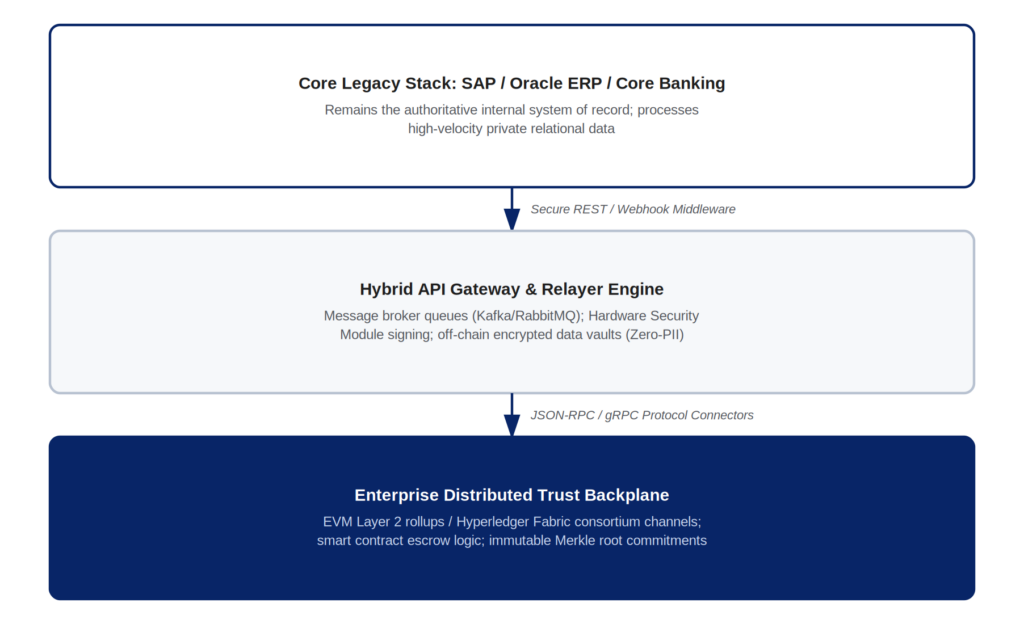
For most enterprises, replacing a stable, operational system like SAP, Oracle, or a core banking platform simply isn’t viable. This is the exact same problem we solve on the AI integration side too, see our piece on legacy modernization with AI in Singapore for how the same bridge-not-replace principle applies there. The practical path here is a hybrid integration that adds the trust and settlement benefits of a shared ledger alongside what’s already running, not instead of it.
Step 1: Figure Out If You Actually Need This
Every engagement starts with qualification, not technology selection. We cut through the buzzwords to isolate the specific operational bottleneck where distributed consensus beats a relational database on actual ROI, and check regulatory defensibility under MAS’s Technology Risk Management guidelines and Singapore’s PDPA Section 25 along the way.
Step 2: The Hybrid Bridge
- The system of record stays put: your ERP keeps handling heavy operational workflows, private employee data, and high-frequency internal transactions, exactly as it does today.
- A secure middleware layer connects the two: custom API gateways and event-driven message brokers reconcile your existing workflows with the ledger in real time. This is the same class of system integration challenge we solve for enterprises generally, not just for blockchain specifically.
- Only the critical proof gets anchored on-chain: milestone commitments, a delivery confirmation, an inspection attestation, get committed as a cryptographic proof, creating an audit trail no external partner can dispute.
Step 3: Prove It Small Before You Scale It
We avoid big-bang rollouts. Delivery starts with a focused proof of concept targeting one high-impact workflow, automating a document verification step, or tracking one multi-carrier shipment lane, measuring performance and integration cleanliness before wider production deployment.
7. What This Actually Looks Like in Production
Abstract architecture is one thing. Here’s a real, measured example, alongside how the same pattern shows up in our own work.
The Industry Benchmark: Global Food Safety
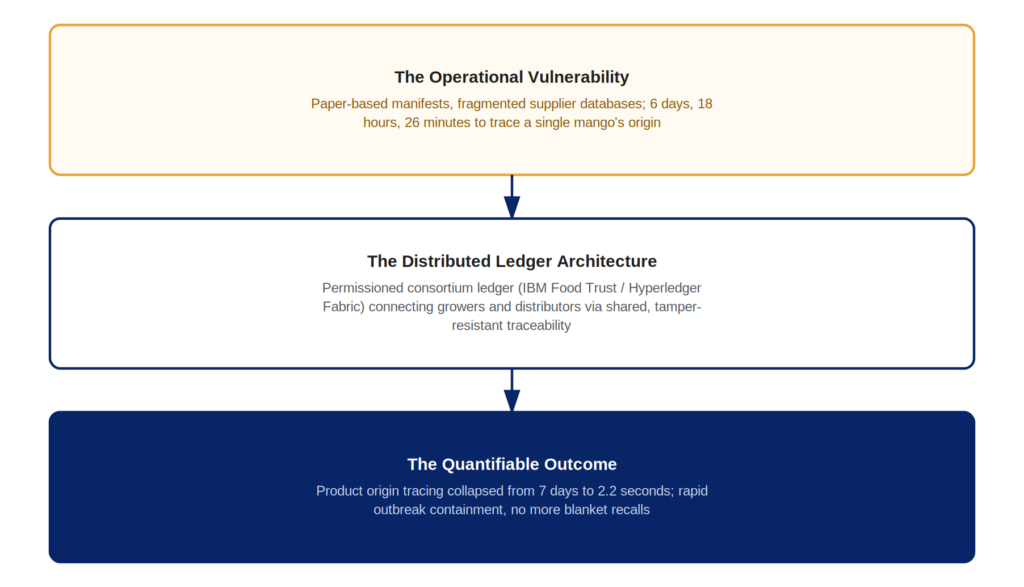
In a well-documented enterprise case, retail giant Walmart partnered with IBM to deploy a permissioned ledger on Hyperledger Fabric. Before that, tracing a package of mangoes back to its originating farm took an audited 6 days, 18 hours, and 26 minutes, across fragmented paper records and disparate ERPs.
By having supply chain partners log cryptographically signed movement attestations to a shared ledger, Walmart collapsed that traceability window from roughly 7 days down to 2.2 seconds. That 2.2-second capability isn’t just an efficiency metric, it’s a genuine risk management asset: it isolates a contaminated batch in minutes instead of forcing a blanket recall across an entire region.
The Same Pattern in Our Own Work
Where we’ve seen this work: Working with maritime logistics and port terminal operators, we’ve built platforms that interface directly with shipping management ERPs, letting independent charterers and port operators synchronize operational milestones without leaking commercial freight rates to competitors.
Where we’ve seen this work: In technical work for statutory intellectual property and patent registries, we’ve built verification systems that anchor deterministic cryptographic proofs rather than the underlying documents themselves. Third-party litigators and overseas patent offices can verify document authenticity in milliseconds without ever touching the internal registry database, which also sidesteps any PDPA data-privacy liability entirely.
Where This Leaves You
Blockchain isn’t a universal replacement for enterprise databases. If your application serves internal employees inside one organization, a relational database on standard cloud infrastructure is still the correct, most cost-effective choice, and no amount of blockchain marketing changes that math.
Distributed ledger technology is a specialized tool for a specific problem: establishing verifiable, automated trust across independent parties who need to coordinate without any one of them controlling the record.
Getting this right takes a partner who can actually bridge low-level cryptographic engineering, enterprise cloud infrastructure, and regulatory compliance, not just one of the three.
We’re a Financial Times Top 500 High-Growth Company for Asia-Pacific in 2026, and a Straits Times Fastest-Growing Company three years running, built on 16+ years of enterprise engineering applied to exactly this kind of work.
If you’re trying to work out whether your project actually needs a blockchain, or already knows it does and needs someone to build it properly, that’s the conversation worth having first. If you’re also weighing who should actually build it, that’s a related question worth getting right early too.
Vinova: Singapore’s blockchain and enterprise engineering partner since 2010. ISO 27001:2022 and ISO 9001:2015 certified.
300+ in-house engineers across Singapore and regional development centers. We’ll tell you honestly whether your project actually needs a blockchain, and build it properly if it does.
Financial Times Top 500 High-Growth Companies Asia-Pacific 2026. The Straits Times Singapore’s Fastest-Growing Companies 2024, 2025, and 2026.