CMS migration services in Singapore have moved from a periodic upgrade exercise to a strategic necessity. Legacy monolithic platforms are accumulating technical debt, security vulnerabilities, and operational bottlenecks faster than engineering teams can patch them. For Singapore enterprises navigating GovTech IM8 directions, MAS Technology Risk Management (TRM) guidelines, and PDPA compliance obligations, a CMS migration is also a compliance event, not just a technical one.
This guide covers when migration becomes unavoidable, the difference between a strategic migration and a simple replatform, Vinova’s 6-phase delivery process, how to preserve SEO equity through the transition, and how to evaluate a CMS migration services partner for Singapore’s regulatory environment.
Table of Contents
Key Takeaways:
- Strategic CMS migrations resolve underlying technical debt and security vulnerabilities, unlike simple replatforming which carries existing code bloat and database structure issues forward into new hosting environments.
- Vinova targets strict 2026 performance benchmarks, including an Interaction to Next Paint under 200ms, Largest Contentful Paint under 2.5s, and a 98% or higher link index retention for SEO.
- Migration is often triggered when security risks become critical, such as the 11,300 new WordPress plugin vulnerabilities reported in 2025, with 43% being exploitable without authentication.
- A complex enterprise migration typically requires 16 to 26 weeks and costs between SGD 80,000 and SGD 200,000, while ensuring compliance with PDPA, MAS TRM, and IM8 regulatory standards.
The 2026 CMS Migration Performance Benchmarks That Matter
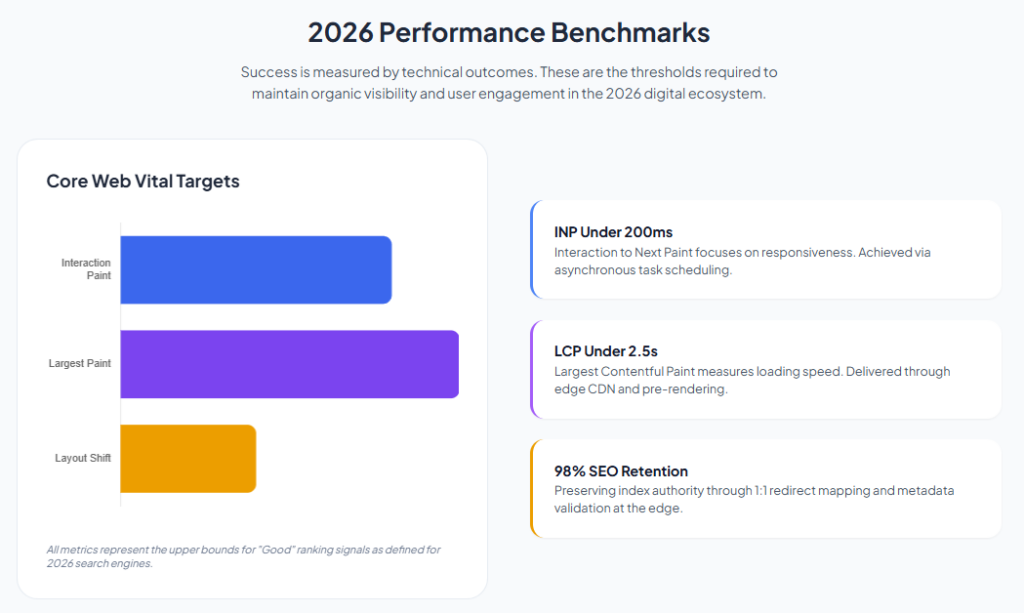
Enterprise CMS migrations are evaluated against measurable technical outcomes, not just successful data transfer. These are the benchmarks Vinova targets and delivers on every migration engagement:
| Performance Metric | 2026 Threshold | How Vinova Delivers It |
| Interaction to Next Paint (INP) | Under 200ms | Asynchronous task scheduling; partial hydration patterns to isolate heavy client-side render loops |
| Largest Contentful Paint (LCP) | Under 2.5s | Pre-rendering key landing routes; above-the-fold images loaded with fetch priority; global edge CDN caching |
| Cumulative Layout Shift (CLS) | Under 0.1 | Explicit layout aspect-ratio declarations; content placeholder reserves for dynamic async widgets |
| Data integrity and relational parity | 100% | Automatic JSON AST validation parsers; programmatic relational reference checks at every ETL stage |
| Organic search equity retention | 98%+ link index retention | Edge-deployed 301 redirect matrices; metadata schema validation; canonical routing verification pre-launch |
CMS Migration vs. Replatforming: Why the Distinction Matters
The two terms appear interchangeably in agency proposals. They describe fundamentally different outcomes. Replatforming moves your existing setup to new infrastructure without restructuring the underlying data. Strategic CMS migration is an architecture-led process that resolves the root causes of platform failure, not just the symptoms.
| Dimension | Replatforming | Strategic CMS Migration |
| What changes | Hosting environment or software version; underlying data architecture unchanged | Full content model redesign; schema restructuring; asset pipeline modernisation; legacy technical debt resolved |
| Technical debt | Carried forward. Code bloat, plugin conflicts, and database structure issues persist | Resolved. Schemas redesigned; obsolete content pruned; clean database relations built in the target environment |
| Content model | Preserved as-is; no schema optimisation | Mapped and modernised; HTML strings converted to structured formats (Portable Text, JSON AST) |
| Outcome | Faster to execute; same problems resurface within 12 to 18 months | Takes longer to execute correctly; resolves scalability, security, and editorial workflow problems for 5 to 7 years |
A strategic CMS migration starts with a comprehensive audit of the existing content ecosystem: identifying and pruning obsolete pages, duplicate assets, and broken integrations before any data is extracted. Content schemas are redesigned from scratch for the target platform. Legacy HTML strings are converted to design-agnostic structured formats. The result is a platform that performs better, costs less to maintain, and doesn’t require re-migration within three years. Vinova’s CMS migration services are always architecture-led. We do not move data from one broken structure to another.
When CMS Migration Becomes Necessary: The Three Trigger Points
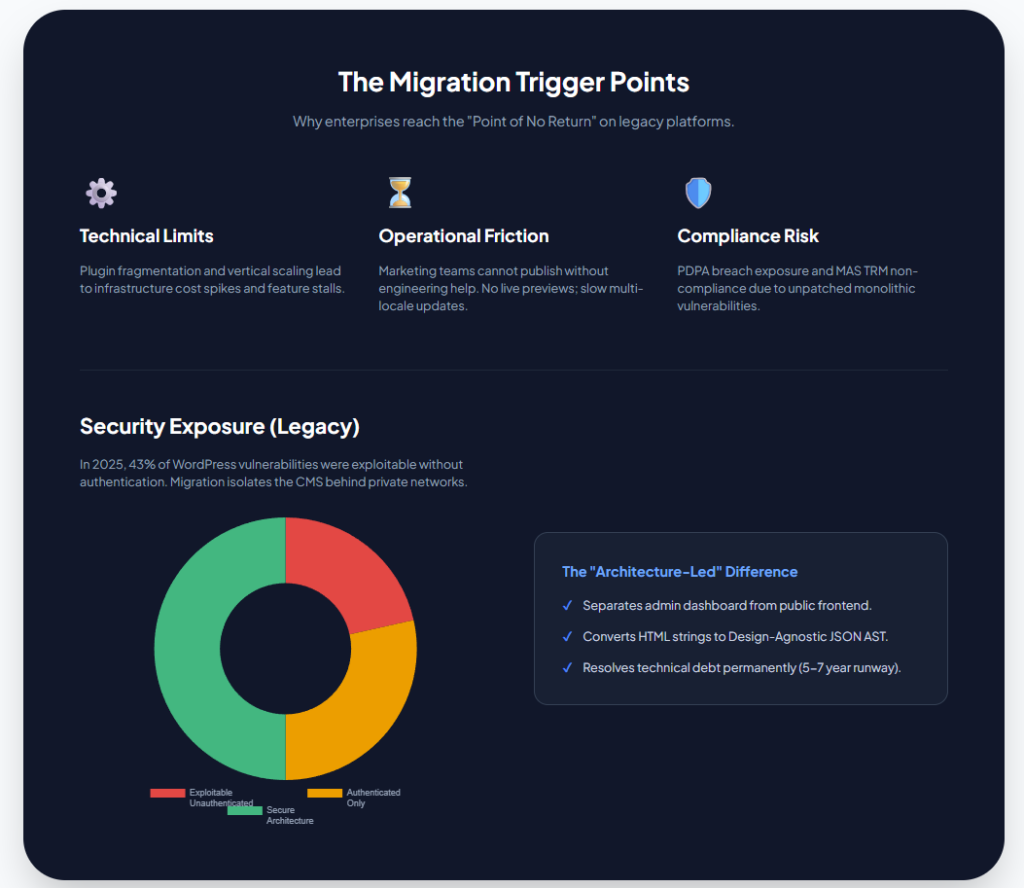
Most Singapore enterprises don’t choose to migrate. They reach a point where the cost of staying on the legacy platform exceeds the cost of moving. The triggers fall into three categories, and most organisations experiencing one are already experiencing all three.
| Trigger | Warning Signs | Business Impact |
| Technical limitations | Plugin fragmentation slowing page rendering; vertical-only server scaling; developer reluctance to maintain outdated PHP or Java templates | Infrastructure costs compound with traffic spikes; engineering talent retention suffers; feature velocity stalls |
| Operational bottlenecks | Editors raising developer tickets for basic layout changes; no live preview capability; multi-locale updates requiring manual duplication per region | Marketing speed constrained by engineering dependency; global campaigns delayed; editorial errors multiply across regional variants |
| Security and compliance risk | Unpatched third-party plugins; outdated core versions; admin and database layers exposed on the same public server | Over 11,300 new WordPress plugin vulnerabilities in 2025 alone; 43% exploitable without authentication. For Singapore businesses: PDPA breach exposure and MAS TRM non-compliance risk |
The compliance risk category is uniquely acute for Singapore businesses. A traditional CMS binds the administrative dashboard, database query engine, and public-facing website into a single runtime. An exploit in an unpatched plugin gives attackers direct write access to the content database. For enterprises processing personal data, this is a PDPA breach event. For MAS-regulated entities, it is a TRM incident. Vinova’s CMS migration services resolve this structurally by isolating the CMS authoring backend behind private networks and serving the public frontend as static files with no database connection logic.
Vinova’s 6-Phase CMS Migration Process
Enterprise CMS migration projects fail when treated as a single deployment event. Content at enterprise scale exists as structured data configurations with field limits, localised translations, internal link paths, asset references, and integration dependencies across CRM, analytics, and e-commerce systems. Vinova’s six-phase delivery model ties each phase to a concrete deliverable before the next phase begins, with no data extracted until Phase 1 discovery is signed off.
| Phase | Name | What Happens | Vinova Deliverable |
| 1 | Team alignment and platform selection | Cross-functional stakeholders aligned on target architecture; compliance standards (PDPA, MAS TRM, IM8) documented; performance baselines established | Signed architecture decision document; compliance checklist; platform recommendation |
| 2 | Discovery, audit, and data preparation | Full content inventory extracted; multilingual locale relationships mapped (English, Simplified Chinese, Malay, Tamil); third-party integrations catalogued; asset cleanup completed | Content inventory CSV; integration dependency map; asset storage optimisation report |
| 3 | Content modelling and architecture mapping | Legacy content models mapped to target schemas; reference integrity rules defined; rich text converted from HTML to structured AST; asset metadata fields preserved | Finalised schema documentation; field validation rules; multilingual content model design |
| 4 | Environment setup and migration execution | Infrastructure provisioned in regional datacentres (AWS ap-southeast-1 Singapore region for data residency); schema validation deployed; test migration on representative sample; full ETL pipeline executed | Staging environment live; test migration report; validated production migration with error log |
| 5 | QA and end-to-end testing | Automated content parity audits comparing source and target; transactional feature testing across device formats; Core Web Vitals audits; API load testing under simulated production traffic | QA sign-off report; Core Web Vitals results; load test performance summary |
| 6 | Launch and post-launch monitoring | 301 redirect matrix deployed at network edge; DNS cutover coordinated with TTL reduction; real-time log monitoring for 404s, API routing issues, and slow queries; editorial team onboarded | Live redirect validation report; 30-day post-launch monitoring; editorial training documentation |
Phase 2 discovery is where most CMS migration services providers underinvest. A thorough content inventory and integration audit prevents the most expensive mid-migration failure mode: discovering undocumented dependencies (an abandoned CRM integration, a custom authentication service, a regional payment gateway) that halt the ETL pipeline in production. Vinova mandates a full dependency catalogue before any extraction begins.
Phase 4 infrastructure provisioning is Singapore-specific in Vinova’s process. By default, all hosting is provisioned in AWS ap-southeast-1 (Singapore region), ensuring data residency for Singapore personal data without requiring post-launch remediation. Offshore development teams in Vietnam access staging environments exclusively through Virtual Desktop Infrastructure hosted in Singapore cloud zones, satisfying PDPA Section 26 Transfer Limitation Obligation throughout the CMS migration lifecycle.
SEO Preservation During CMS Migration: Vinova’s Engineering Approach
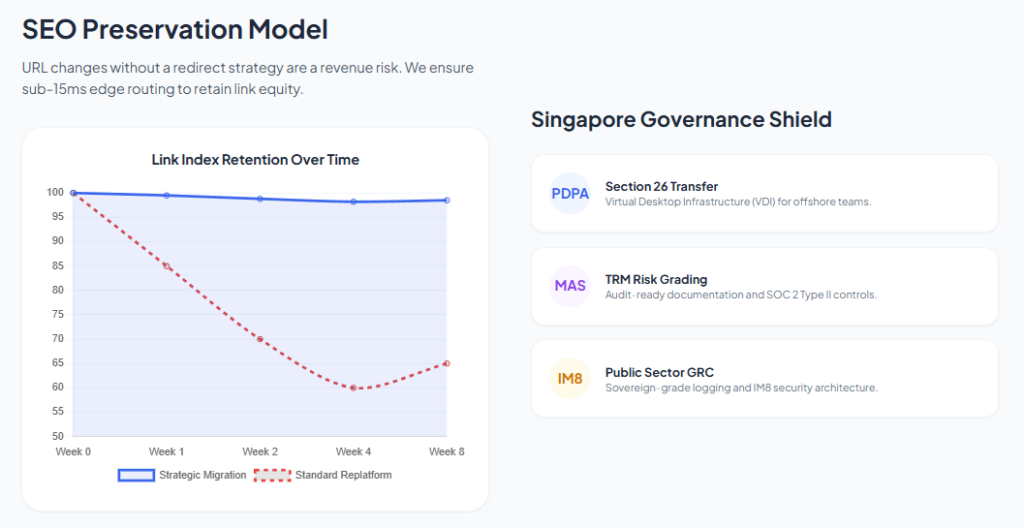
Organic search visibility loss is the highest-stakes business risk in any CMS migration. When URL structures change without a properly deployed redirect strategy, search engine crawlers encounter unresolved 404 paths. Rankings can drop within days of launch and take 3 to 6 months of corrective work to recover. For Singapore enterprises where organic search drives significant lead pipeline, this is a revenue risk, not a technical one.
| SEO Risk Area | What Goes Wrong Without a Plan | Vinova Mitigation |
| URL structure changes | Legacy indexed URLs return 404s; crawlers deindex pages within days; ranking recovery takes 3 to 6 months | Strict 1:1 redirect mapping table built before cutover; 301 rules deployed at network edge (Cloudflare Workers, Vercel Middleware, or AWS CloudFront) for sub-15ms routing |
| Metadata integrity | Meta titles, descriptions, canonical tags, and Open Graph fields dropped or truncated during ETL transformation | Schema validation engine checks all metadata against character limits (160 char descriptions; 60 char titles) and canonical path logic before the migration payload is imported |
| Structured data | JSON-LD schema blocks (Article, Product, BreadcrumbList) lost in content transformation; rich results disappear from search | JSON-LD schemas programmatically regenerated in the target application framework; validated against Google’s Rich Results Test post-launch |
| Core Web Vitals | Rendering strategy change degrades INP, LCP, or CLS scores; performance ranking signals drop | Default rendering strategy: SSG with ISR. INP under 200ms; LCP under 2.5s; CLS under 0.1. Measured via automated CWV audits in Phase 5 QA |
| XML sitemap continuity | Legacy sitemap not maintained during transition; crawl coverage gaps emerge between DNS cutover and new sitemap indexation | Legacy and modern sitemaps maintained in parallel during transition; Google Search Console coverage monitored daily for 30-day post-launch window |
Since the inclusion of Interaction to Next Paint (INP) as a Google ranking signal in 2024, rendering strategy decisions during a CMS migration directly affect search position. Vinova’s default recommendation for migration targets is Static Site Generation (SSG) with Incremental Static Regeneration (ISR): pre-compiled static HTML served from edge CDN nodes at sub-50ms response times, with asynchronous content refresh triggered by CMS publishing webhooks. This delivers the 2026 Core Web Vitals thresholds (INP under 200ms, LCP under 2.5s, CLS under 0.1) without sacrificing content freshness.
PDPA, MAS TRM, and IM8 Compliance in Enterprise CMS Migration
For Singapore enterprises, a CMS migration that moves personal data to a new platform triggers PDPA obligations from the moment data extraction begins. The Transfer Limitation Obligation (Section 26) governs how personal data is handled by offshore development teams during the ETL pipeline. MAS TRM guidelines govern vendor risk management for financial sector clients. IM8 governs security architecture for government and public sector deployments. Vinova builds compliance into the migration architecture from Phase 1, not as a post-launch audit.
| Compliance Requirement | Obligation | Vinova Implementation |
| PDPA Section 26 (Transfer Limitation) | Personal data cannot leave Singapore without ensuring the recipient provides comparable protection | Data Transfer Agreements with ASEAN Model Contractual Clauses signed before any data enters the ETL pipeline |
| Data residency | Singapore personal data hosted in APAC regional cloud zones | Infrastructure provisioned in AWS ap-southeast-1 (Singapore region) by default; offshore teams access data only via Virtual Desktop Infrastructure hosted in Singapore |
| IM8 (Public Sector) | Security architecture, access controls, and data handling for government digital systems | All GovTech, IPOS, and public sector CMS migrations scoped to IM8 from architecture design through to post-launch; audit-ready log trails maintained |
| MAS TRM (Financial Sector) | Vendor risk grading; documented incident response SLAs; audit rights preserved in contracts | SOC 2 Type II documentation provided on request; MAS-audit-ready documentation; incident notification SLA within 24 hours |
| Access governance | Restrict data processing to authorised personnel; maintain audit trail of all access | Zero-Trust IAM with least-privilege access; MFA enforced across all staging and production environments; automated log aggregation across the full migration lifecycle |
Vinova’s compliance posture in CMS migration services has been validated through delivery for Singapore’s most demanding regulated clients: GovTech Singapore (whole-of-government GRC platform under IM8), Monetary Authority of Singapore (MAS) (compliant enterprise system integrations under TRM guidelines), OCBC Bank and Prudential (MAS-regulated financial platforms), and IPOS International (national IP confidentiality standards).
How to Evaluate CMS Migration Services in Singapore: Vinova’s Procurement Framework
For Singapore-based Marketing Directors and CTOs, evaluating CMS migration services requires a different scorecard than a standard web development procurement. Regulatory compliance track record, local governance accountability, and post-launch SLA commitment matter as much as technical capability. Vinova recommends evaluating any partner against these five criteria:
| Evaluation Criteria | What to Ask Any Partner | Vinova’s Position |
| Singapore compliance track record | Can they provide verifiable case studies under PDPA, MAS TRM, or IM8? Are their development cycles audited under ISO 27001? | GovTech, MAS, IPOS, SP Group, SIT, OCBC Bank, Prudential. Active ISO/IEC 27001:2022 and ISO 9001:2015 across all delivery locations |
| Architectural migration depth | Can they demonstrate zero-data-loss migrations from your specific source platform (WordPress, Drupal, Sitecore) to headless composable targets? | 300+ projects delivered since 2010. Full ETL pipeline capability; content model redesign; AST transformation; multilingual locale mapping |
| SEO preservation track record | Have they demonstrated zero ranking regression on a high-traffic migration? What is their redirect validation process? | Engineering-led SEO plan on every migration; edge-deployed 301 rules; metadata schema validation; 30-day GSC coverage monitoring post-launch |
| Post-launch SLA support | Does the contract include real-time monitoring and rapid response commitments during the critical 30-day post-launch window? | 30-day post-launch monitoring standard; MTTR under 1 hour for critical production issues per Vinova DORA benchmark commitments |
| Delivery model and cost | What is the cost vs. a Singapore-only agency? Is discovery fixed-price? Is development on a flexible dedicated sprint model? | 40 to 60% below equivalent Singapore-only agency rates. Fixed-price discovery; dedicated team sprint model for execution; payments tied to working deliverables |
On contract structure: Vinova separates the discovery phase as a fixed-price engagement. You receive a comprehensive content audit, content model design, architecture recommendation, and compliance scope document for a predictable fee before committing to the full CMS migration budget. Development and ETL execution run on a dedicated team sprint model, allowing scope to flex as undocumented dependencies surface during extraction. Payments are tied to working deliverables, not calendar dates.
| Ready to Start Your CMS Migration? Book a complimentary 2-hour consultation with Vinova’s CMS migration team. We’ll audit your current platform, map your content model to a target architecture, identify SEO and compliance risks, and give you a realistic timeline and cost estimate. No commitment required. Schedule Your Free 2-Hour CMS Migration Consultation with Vinova |
Vinova CMS Migration Case Studies
GovTech Singapore: Whole-of-Government GRC Platform
Challenge: Migrate and modernise a complex multi-agency governance, risk, and compliance platform under Singapore’s highest data sovereignty and uptime standards.
Approach: Architecture-led CMS migration services with full IM8 alignment; Zero-Trust access governance; audit-ready log trails across all environments; dedicated development squad maintaining architectural continuity from discovery through post-launch.
Outcome: Zero-downtime migration to a secure, sovereign-grade platform; multi-agency editorial workflows operational from day one.
IPOS International: Digital Workbench Modernisation
Challenge: Modernise complex IP examination content workflows for Singapore’s national patent authority, replacing a fragmented legacy system.
Approach: Strategic CMS migration incorporating deep Office 365 integration, automated task routing, and custom workflow automation; full national IP confidentiality compliance throughout the ETL pipeline.
Outcome: Legacy operational friction replaced by an intuitive editorial dashboard; examiner productivity measurably increased; zero confidentiality incidents during or after migration.
SP Group (SP Digital): Strategic Platform Integration
Challenge: Scale SP Digital’s content and engineering platform while maintaining zero-defect deployment standards for Singapore’s grid operator.
Approach: Shift-Left quality philosophy with V-Model testing embedded across all migration phases; full data sovereignty compliance for Singapore utility-sector standards.
Outcome: Zero-defect deployment path for all migrated core systems; content platform maintained by Vinova under long-term dedicated squad retainer.
Monetary Authority of Singapore (MAS): Secure System Integration
Challenge: Build and migrate core application layers requiring maximum technical security under MAS TRM guidelines.
Approach: Compliant enterprise system integrations with DevSecOps pipelines, structured security reviews, and threat modeling throughout the migration process.
Outcome: Compliant, highly secure platform satisfying all MAS TRM regulatory requirements; blueprint adopted for subsequent financial institution migrations.
FAQ: CMS Migration Services for Singapore Businesses
What happens to existing data and media assets during CMS migration services?
During a CMS migration, legacy data records are extracted from the source database, transformed to match the target schema, and imported into the new system. This requires converting formatted HTML layouts into design-agnostic formats like JSON AST (Portable Text in Sanity; custom AST JSON in other platforms). Media files are catalogued, moved to secure cloud storage, and relinked in the new database. Vinova’s ETL pipeline runs schema validation before and after each transformation stage to ensure 100% relational parity.
Can a high-traffic website migrate to headless CMS without losing search rankings?
Yes, when CMS migration services include a proper SEO preservation engineering plan: 1:1 redirect mapping for every indexed URL, 301 rules deployed at the network edge before DNS cutover, metadata schema validation, structured data regeneration, and Core Web Vitals compliance on the target architecture. Vinova includes all of these as standard and monitors Google Search Console coverage daily for 30 days post-launch.
What is a realistic timeline and cost for CMS migration services in Singapore?
A medium-complexity CMS migration (single brand, clear integration requirements) runs 10 to 16 weeks and costs SGD 20,000 to SGD 80,000. A complex multi-locale enterprise migration with compliance requirements (PDPA, MAS TRM, IM8) runs 16 to 26 weeks and costs SGD 80,000 to SGD 200,000+. Vinova structures discovery as a fixed-price phase (typically SGD 15,000 to SGD 40,000) before committing to the full migration budget.
How does Vinova handle PDPA compliance during a CMS migration involving offshore development teams?
Vinova executes Data Transfer Agreements with ASEAN Model Contractual Clauses before any personal data enters the ETL pipeline. Vietnam-based development teams access all data through Virtual Desktop Infrastructure hosted in Singapore cloud zones, with no local download capability. Zero-Trust IAM with MFA is enforced across all environments. Infrastructure is provisioned in AWS ap-southeast-1 by default. For MAS-regulated clients, SOC 2 Type II documentation is provided and audit rights are contractually preserved.
What makes Vinova different from other CMS migration services providers in Singapore?
Three things. First, local governance accountability: Vinova is headquartered in Singapore (Toa Payoh), legally bound under Singapore law, with direct relationships to GovTech, MAS, and public sector clients that generic offshore agencies don’t have. Second, compliance-native delivery: PDPA, MAS TRM, and IM8 alignment are built into Vinova’s CMS migration process from Phase 1 discovery, not bolted on after launch. Third, cost structure: Singapore-based strategic management paired with 300+ in-house engineers in Vietnam delivers 40 to 60% cost savings vs. Singapore-only agencies, without sacrificing ISO-certified quality standards.
| Vinova: Singapore’s premier CMS migration services partner. Headquartered in Toa Payoh since 2010. ISO 27001:2022 and ISO 9001:2015 certified. ISTQB Partner since 2023.300+ engineers across Singapore, Hanoi, Da Nang, and Ho Chi Minh City. Trusted by GovTech, MAS, IPOS, SP Group, SIT, OCBC Bank, Prudential, and Samsung.Recognised by The Straits Times as one of Singapore’s Fastest-Growing Companies 2024, 2025, and 2026. Schedule a 2-hour consultation: |