By Vinova Systems Practice · 15-minute read
Every IT quote promises peace of mind. The invoice arrives on Monday morning, and it lists eighteen hours of weekend labor at double time. Picture a commodity trading firm in Singapore that chose hourly support because paying S$150 an hour only when something breaks looked like the cheap option. At 11:30 PM on the Friday before quarter-end closing, an unpatched memory leak crashed an unmonitored hypervisor host. The break-fix technician spent the weekend rebuilding virtual machines at twice the standard rate: 18 hours at S$300, or S$5,400, before a single delayed settlement is counted.
Quick Answer: For Singapore Small and Medium-sized Enterprises (SMEs), fixed-fee IT support is usually the better value once monthly support demand passes a break-even point. In the worked example below, a 40-seat firm reaches it at 25 hours a month. A flat fee gives the provider a financial reason to prevent repeat failures, where time-and-materials (T&M) billing pays for every repair. A fixed-fee agreement also puts response times and data-handling terms in writing, though it does not transfer your accountability under the Personal Data Protection Act (PDPA) to the provider.
Table of Contents
Key Takeaways
- Billing Models Set Incentives: T&M pays the vendor for every repair, so it gives the vendor no financial reason to stop a failure from repeating.
- Fixed Fees Invert the Risk: Under a flat rate, the provider’s margin grows when your infrastructure is stable, which rewards automation, root-cause fixes and preventative patching.
- The Break-Even Point Is Low: In the worked example below, a 40-seat firm passes break-even at 25 support hours a month, which is about 38 minutes per user.
- Compliance Needs Written Terms: An ad-hoc technician with no written confidentiality or data-handling terms makes “reasonable security arrangements” under PDPA Section 24 hard to demonstrate.
1. The Commercial Reality: Who Profits When Something Breaks
A contract is not just an invoice format. It decides whether your vendor spends the week preventing an outage or waiting for one.
The choice between a flat fee and hourly billing comes down to incentives. When you pay for hours, you buy activity. When you pay a fixed retainer, you buy stability.
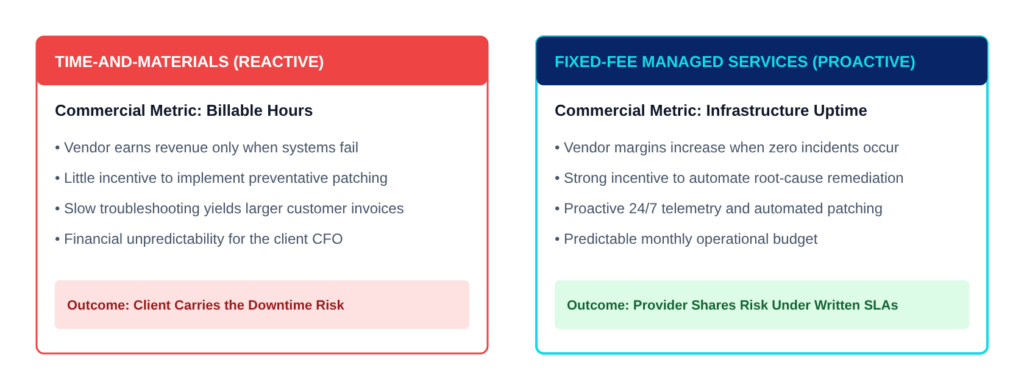
The Rule: Under hourly billing, the client carries the financial risk of an unreliable system.
If a network switch fails repeatedly, a T&M provider bills for every diagnostic visit. Under a fixed-fee Managed Services Agreement, the same twenty hours of root-cause work come out of the provider’s margin, so the provider is commercially pushed to build a permanent, automated fix. The first contract rewards a fast patch. The second rewards a repair that never needs repeating. None of this means your current provider acts in bad faith. It means the contract shapes behavior, whatever the people behind it intend.
2. IT Support Pricing Models in Singapore: How They Work in Production
Billing mechanics decide daily operating behavior, so it pays to look past the marketing summary.
2.1 The Time-and-Materials (Break-Fix) Model
Under pure T&M, you hold no ongoing service contract. When an endpoint fails, a printer drops its network pairing or the mail server panics, you raise a ticket and the provider bills for the time spent investigating and fixing it.
| Billing element | Typical Singapore terms |
|---|---|
| Hourly rate (business hours) | S$120 to S$250 |
| Minimum callout | One or two hours, billed in full |
| After-hours, weekend and public holiday work | 1.5 to 2.0 times the standard rate, set by contract |
| Block-hour retainers | Blocks of 20, 50 or 100 hours at a modest discount |
- Block-Hour Retainers in Practice: The discount helps, but the clock still ticks on every interaction, so staff delay reporting small faults until they become big outages. A managed services agreement vs block hours comes down to who holds the clock: with blocks it is your team, and with a flat fee it is the provider.
2.2 The All-Inclusive Fixed-Fee (Managed IT Services) Model
A fixed-fee Managed Services Agreement sets one predictable monthly price per user or per endpoint. SME IT support cost in Singapore depends on coverage depth, compliance scope and after-hours cover, and published Singapore provider ranges run from roughly S$100 to S$300 per user per month.
- Unlimited Service Desk Triage: Staff can call the desk without anyone worrying that a 15-minute password reset or VPN fix will trigger its own invoice.
- Enterprise Tooling Included: The fee bundles software that a T&M client buys separately: Endpoint Detection and Response (EDR), automated patching, remote management agents and encrypted cloud backup monitoring.
- Proactive Maintenance and Patch Governance: The provider runs scheduled sweeps out of hours (Uninterruptible Power Supply (UPS) battery tests, firewall policy audits, Power Distribution Unit (PDU) load checks, hypervisor firmware updates) without logging extra labor.
2.3 The Hybrid Tier: A Fixed Core Plus Project Blocks
For firms in the middle of a cloud migration, a physical expansion or another structural change, a hybrid model usually fits best:
- Core Operational Baseline (Fixed Fee): 24/7 server monitoring, cloud tenant administration, endpoint protection and unlimited routine remote support for all staff.
- Capital Project Allowance (Discounted T&M or Fixed-Rate Milestones): Pre-scoped work for out-of-scope transitions, such as moving an on-premise Enterprise Resource Planning (ERP) system to Amazon Web Services (AWS) or recabling several floors.
3. Fixed-Price vs Time-and-Materials Managed IT: Modeling the True Cost
A low hourly rate can hide a very expensive outage.
To test whether T&M really saves money, finance controllers should model the annual cost of each contract, including surge labor, tooling and the cost of downtime.
3.1 The Annual Cost of a T&M Contract
Where:
- Hi is the business-hours support time logged across n incidents.
- RStandard is the contracted standard hourly rate.
- Hi,AfterHours is the emergency, weekend or public holiday time logged.
- RSurge is the surge rate, often 1.5 to 2.0 times RStandard.
- CTooling is the cost of EDR, patch management and backup software that a T&M client must buy separately.
- CHardware is the cost of emergency hardware replacement, which can carry spot-price markups.
- LDowntime is the revenue lost while systems are down:
3.2 The Break-Even Point
The break-even number of support hours per month is the point at which a fixed fee costs the same as T&M for the labor it replaces:
Worked Scenario: A 40-Seat Professional Services Firm
Take a legal practice or financial consultancy in Singapore with 40 seats.
| Input | Value |
|---|---|
| Fixed-fee managed services retainer | S$4,800 per month (S$120 per user) |
| Included enterprise tooling value (EDR, cloud backup agent, automated patch licensing) | S$800 per month |
| Net labor component | S$4,800 – S$800 = S$4,000 per month |
| Blended T&M rate | S$160 per hour |
Across 40 seats, 25 hours a month is about 38 minutes of IT support per user. If your staff log more than that on onboarding, troubleshooting, mail sync, SaaS permissions and network triage, T&M stops being the cheaper option before a single outage or surge rate is counted.
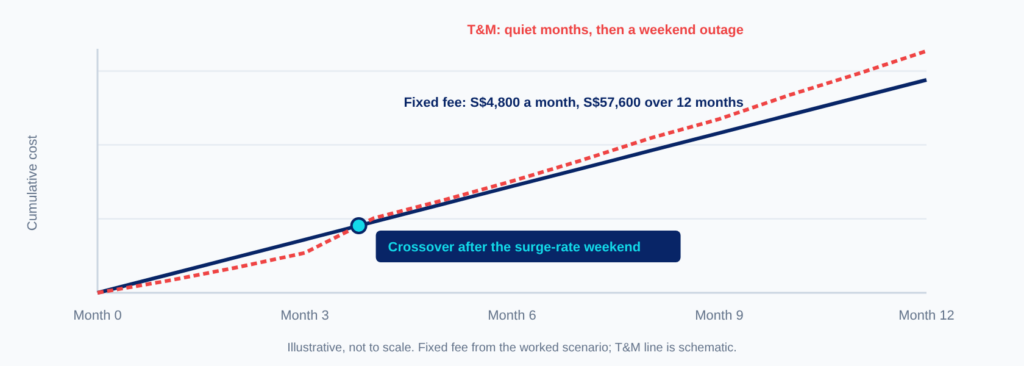
The Rule: The cheapest IT support contract on paper is often the most expensive one on the general ledger.
4. Five Hidden Landmines in Time-and-Materials Contracts
T&M agreements hide operating risks that only show up in the second year.
4.1 The Ticket Padding and Slow Escalation Trap
Under hourly billing, efficiency is penalized. A junior technician sent to an unresponsive server has no commercial reason to solve it in twenty minutes. If they spend four billable hours reading knowledge-base articles before escalating, you have paid for their training. A fixed-fee provider escalates fast, because every hour saved protects its own margin.
4.2 The Accumulation of Deferred Maintenance Debt
Under T&M, every administrative action has a price tag, so owners hesitate to approve basic care: updating hypervisor kernels, rotating Secure Sockets Layer (SSL) certificates, testing UPS batteries under load, reviewing access permissions. The debt compounds silently. When the infrastructure finally gives way, the rebuild runs at emergency rates.
4.3 The Approval Bottleneck Outage
When a vulnerability is published or an operating system patch fails, the fix is urgent. In a T&M relationship the provider must stop, write a scope estimate and wait for corporate approval. While management reviews a 3-hour quotation for days or weeks, the organization stays exposed to actively exploited vulnerabilities.
4.4 Priority Queue Demotion During Sector-Wide Outages
When a global disruption hits, such as the CrowdStrike sensor crash of July 2024 or an undersea cable cut, every business in Singapore asks for an engineer at once. Providers triage by contract. Clients with a fixed-fee agreement and an enforceable Service Level Agreement (SLA) get priority dispatch. Ad-hoc T&M clients go to the back of the queue and can wait days for a field technician.
4.5 PDPA Exposure From Ad-Hoc Technicians
Under Section 24 of the PDPA, an organization must make reasonable security arrangements to protect personal data in its possession or control, including data that a third-party technician handles on its behalf. Bringing in a break-fix technician with no written confidentiality or data-handling terms and no audited identity controls makes it hard to show that you did. If an unvetted contractor opens servers holding employee National Registration Identity Card (NRIC) details or client financial files, you carry the exposure. The maximum financial penalty under Section 48J is up to S$1 million, or up to 10% of annual Singapore turnover for an organization with turnover above S$10 million.
Explore Vinova’s Managed IT Services
Vinova can review your current support agreement against the break-even math above and show you where the hours go.
5. The Decision Matrix: Break-Fix vs Managed IT Services in Singapore
Company maturity and regulatory exposure decide which contract fits. Compare your operating profile against each model:
| Operational Dimension | Time-and-Materials (Break-Fix) | Pure Fixed-Fee Managed IT | Hybrid: Fixed Core Plus Project Blocks |
|---|---|---|---|
| Budget predictability | Low: monthly bills swing with incidents | High: a flat monthly operating expense | Balanced: a predictable baseline plus pre-scoped milestones |
| Vendor incentive alignment | Misaligned: the vendor is paid for repairs, not prevention | Aligned: the vendor earns more from uptime | Aligned: a preventative baseline and transparent milestones |
| Preventative maintenance | None: work starts after a failure | Continuous: automated patching and health sweeps | Continuous: active monitoring plus scheduled project maintenance |
| SLA enforceability | Best effort: no arrival guarantee | Contractually binding, with written response times | Contractually binding across daily operations |
| Included tooling | None: you buy licenses separately | Bundled EDR, cloud backup and patch automation | Core enterprise security stack included |
| PDPA audit defense | Weak: ad-hoc logging | Stronger: audit logs and written data-handling terms | Stronger: centralized governance and compliance |
Option A: Time-and-Materials (Break-Fix)
- Where It Works: Micro-businesses with fewer than 10 employees on commodity public SaaS (for example standard Google Workspace), with no on-premise hardware, no proprietary servers and no compliance obligations.
- The Catch: You are on your own in a critical outage. You pay premium emergency rates and wait behind contracted clients.
- Best for: Early-stage startups with bare-bones funding and no financial penalty for downtime.
Practitioner Verdict: Fine for ten people and a browser. Costly the first time something with a power cable fails.
Option B: Pure Fixed-Fee Managed Services
- Where It Works: Established Singapore SMEs and regional branch offices with 15 to 200 users, running hybrid infrastructure, line-of-business applications, private cloud databases or on-premise comms rooms.
- The Catch: It needs upfront architectural alignment, structured change-control windows and a commitment to a multi-year governance baseline.
- Best for: Mid-market organizations where an hour of full downtime costs more than S$5,000 in lost revenue, idle labor or client penalties.
Practitioner Verdict: The default for any SME that cannot afford a surprise invoice or a surprise outage.
Option C: Hybrid, a Fixed Core With Pre-Negotiated Project Blocks
- Where It Works: High-growth firms in a digital transformation, a physical office consolidation or a move from local server racks to AWS or Microsoft Azure.
- The Catch: It takes disciplined project governance so that daily maintenance tickets are not mixed up with transformation milestones.
- Best for: Organizations with a changing infrastructure roadmap that need stable daily support while modernizing in phases.
Practitioner Verdict: Right while the roadmap is moving, as long as the project scope is written down.
6. Lessons From the Field: Real Financial Collapses
Billing shortcuts produce balance sheet shocks.
Friction point we hit: the unmonitored RAID array. A Tanjong Pagar logistics brokerage chose an ad-hoc T&M contract to cut running costs and turned down a S$400 monthly server monitoring add-on. A hard drive in its database server’s Redundant Array of Independent Disks (RAID) 5 array failed silently. Two weeks later, a second drive suffered a mechanical head crash. With no monitoring telemetry, nobody knew the array had been degraded, and the whole volume was lost. The firm paid S$22,000 for emergency data recovery and spent two days on manual warehouse workarounds that delayed thirty container clearances.
Resolution: We moved the client to a fixed-fee managed agreement, replaced the local array with high-availability cloud storage on AWS, set up automated snapshot replication and turned on continuous 24/7 hardware telemetry.
Friction point we hit: 14 hours of cleaning the same infection. A commercial law firm found that an independent break-fix technician had logged 14 billable hours over three months manually cleaning recurring malware from a senior partner’s workstation, at S$175 an hour, using repeated manual disk sweeps. The root cause was a malicious browser extension that no one had removed.
Resolution: We deployed an EDR agent bundled into our fixed-fee plan, stripped the extension through central group policy and closed the threat for good, with no further hourly labor.
Vinova Field Insight: Financial Predictability for a Singapore Industrial Distributor
The Challenge: A Singapore wholesale distributor with several warehouses was stuck in an unpredictable T&M billing cycle. Monthly invoices swung between S$1,800 and S$9,500 on weekend emergency tickets, uncoordinated patch reboots and ERP database timeouts, and the finance team spent over 15 hours a month auditing disputed engineer timesheets.
The Approach: Vinova moved the firm to an all-inclusive fixed-fee managed agreement run by a named Service Delivery Manager and Incident Manager. We set up centralized endpoint monitoring, containerized the core Application Programming Interface (API) middleware, migrated the fragile on-premise transactional databases to managed cloud clusters with automated snapshot recovery, and put every firmware or operating system update through functional, integration and security testing first.
The Result:
| Metric | Result |
|---|---|
| Unscheduled business-hours ERP downtime | From an average of 6.5 hours a month to under 8 minutes a quarter |
| Monthly support invoice | From swings between S$1,800 and S$9,500 to one flat monthly fee |
| Annual support spend | 34% lower than the trailing 24-month T&M total |
7. The Contractual Playbook: Negotiating an Enforceable Fixed-Fee Agreement
A fixed-fee agreement is only as good as its scope and legal wording. Insist on unambiguous language.
7.1 Defining the Scope Boundary: Maintenance vs Project Work
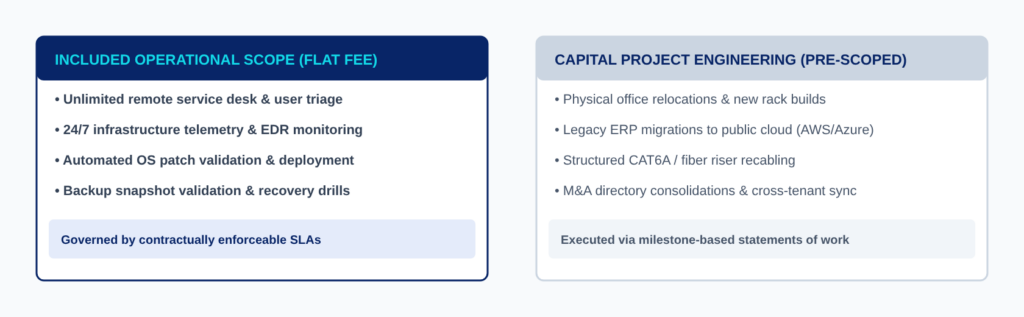
Settle in writing what counts as routine maintenance and what counts as project engineering:
| Scope | What it covers |
|---|---|
| Included operational scope (fixed baseline) | Unlimited remote helpdesk, 24/7 server and network monitoring, operating system patch testing and deployment, user onboarding and offboarding, endpoint security telemetry, local backup verification and quarterly technology reviews |
| Project scope (estimated separately) | Office relocations, floor recabling, migrating legacy line-of-business applications to a new cloud platform, and directory consolidations after a merger or acquisition (M&A) |
7.2 Governing Law, IP Ownership and Dispute Resolution
- Governing Law: The contract is governed by and interpreted under the laws of the Republic of Singapore.
- Intellectual Property: Automation runbooks, cloud architecture templates and network documentation should be assigned to you as they are created, using an assignment of future copyright under Section 140 of the Copyright Act 2021. You should own all configurations outright once you have paid, which removes vendor lock-in.
- Dispute Resolution: If amicable resolution fails, the contract should provide for arbitration administered by the Singapore International Arbitration Centre (SIAC) under its Arbitration Rules, with Singapore as the seat. Awards are then enforceable internationally under the 1958 New York Convention.
Have your legal counsel review the final wording of any clause before signing.
8. Frequently Asked Questions
What is the core difference between fixed-fee IT support and time-and-materials IT support?
Fixed-fee support charges a flat monthly rate for proactive maintenance, monitoring and helpdesk, which points the vendor’s incentives at uptime. T&M support bills hourly for reactive fixes after equipment breaks, so the vendor has no financial reason to prevent repeat failures.
When does a time-and-materials IT support model make sense for a business?
Rarely, and only for micro-businesses with fewer than ten employees that run simple, cloud-only setups with no on-premise servers, no complex line-of-business software and no compliance obligations under the PDPA or Monetary Authority of Singapore (MAS) guidelines.
Are hardware components and commercial software licenses included in a fixed-fee managed IT agreement?
No. A fixed-fee agreement covers management, maintenance, troubleshooting and bundled monitoring tools such as EDR agents and patch managers. Replacement hardware (servers, switches, laptops) and third-party application licenses (such as Microsoft 365 or SAP) are capital expenditure and are billed separately.
How do fixed-fee managed service providers handle emergency after-hours support?
Through written SLAs. Well-drafted fixed-fee contracts include 24/7 monitoring for mission-critical infrastructure such as firewalls, servers and core switches. Severity 1 outages trigger immediate escalation, while routine weekend desktop requests are handled when business hours open.
What is the typical cost per user for fixed-fee managed IT services in Singapore?
Published Singapore provider ranges run from about S$100 to S$300 per user per month. The exact fee depends on infrastructure complexity, the server-to-endpoint ratio, compliance needs (such as the PDPA or the MAS Technology Risk Management (TRM) Guidelines) and whether the contract requires round-the-clock emergency cover.
The Takeaway
The Takeaway: Pay for outcomes, not hours. A contract that earns more when your systems fail will eventually cost you more than one that earns more when they do not, so run the break-even math before the next invoice arrives.
Vinova brings government-grade engineering standards to everyday IT support: written response times, monitored infrastructure and a price you know before the month starts.
Vinova: Singapore’s mobile and web application development partner since 2010. ISO 27001:2022 and ISO 9001:2015 certified.
300+ in-house engineers across Singapore, Hanoi, Da Nang, and Ho Chi Minh City, including teams who build image-heavy mobile and web applications for enterprise and government clients.
Financial Times Top 500 High-Growth Companies Asia-Pacific 2026. The Straits Times Singapore’s Fastest-Growing Companies 2024, 2025, and 2026.