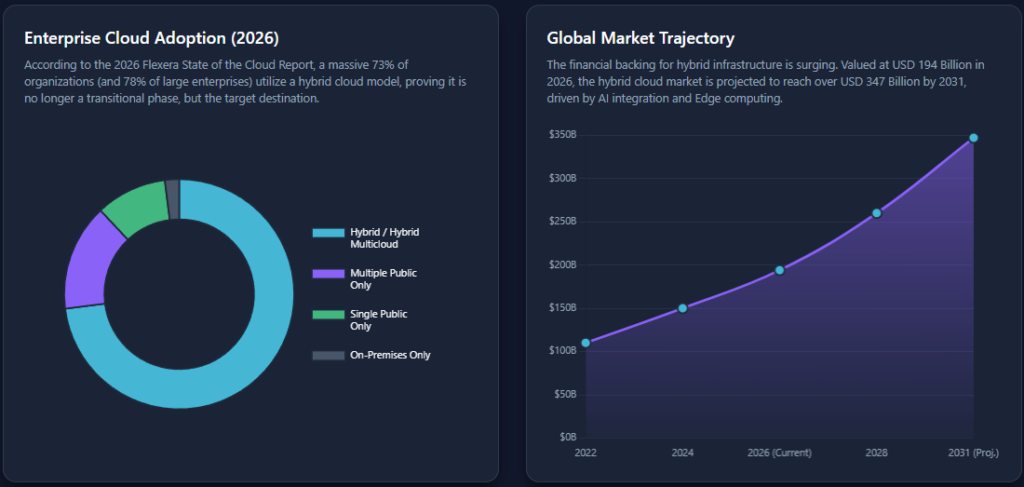
Over the past two decades, cloud computing has fundamentally transformed enterprise IT operations. Public clouds offer rapid scalability and pay-as-you-go economics, but reliance on a single public platform rarely satisfies every business requirement. Strict regulatory compliance mandates, data sovereignty laws, latency constraints, and legacy hardware investments mean modern organisations need a flexible, blended approach.
Today, hybrid cloud solutions have become the dominant architecture for global enterprises, enabling organisations to run each application in its optimal environment while connecting all infrastructure into a single, unified operating framework.
Table of Contents
Key Takeaways:
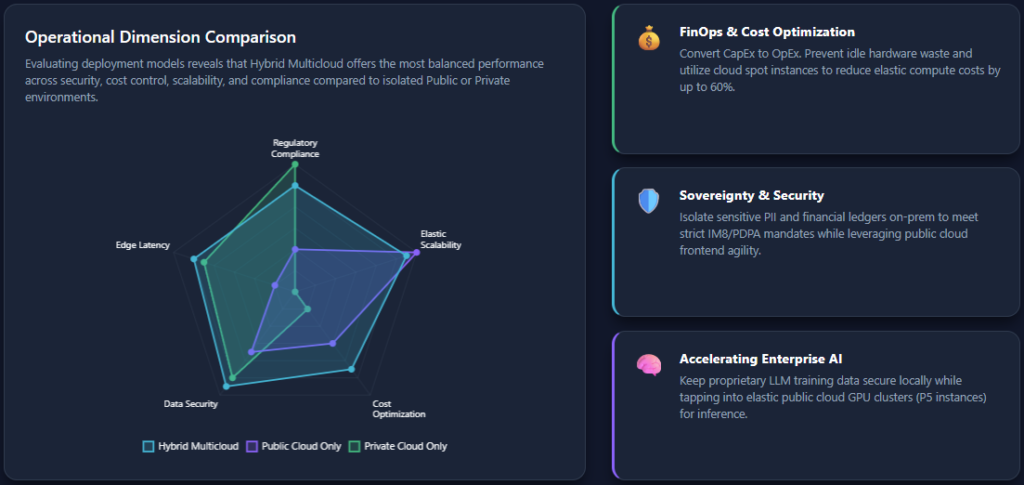
- Optimal Environment Flexibility: Hybrid cloud solutions allow organizations to run applications in their best-suited environment, balancing the regulatory compliance and low-latency needs of on-premises or private infrastructure with the elastic scalability of public cloud services.
- Unified Governance: A successful hybrid architecture connects private and public environments under a single, software-defined operational layer, enabling secure data and workload movement based on automated policies for cost, security, and compliance.
- Strategic Cost and Performance Management: By using private infrastructure for predictable baseline workloads and bursting to public cloud capacity for peaks, businesses can convert fixed CapEx into managed OpEx and reduce costs, while keeping sensitive data local to satisfy strict sovereignty requirements (like IM8 and PDPA).
- Simplified Innovation: Hybrid setups facilitate modern enterprise innovation, such as AI/ML, by allowing companies to keep proprietary data and models secure on private servers while tapping into public cloud GPU resources for heavy inference.
What Is a Hybrid Cloud?
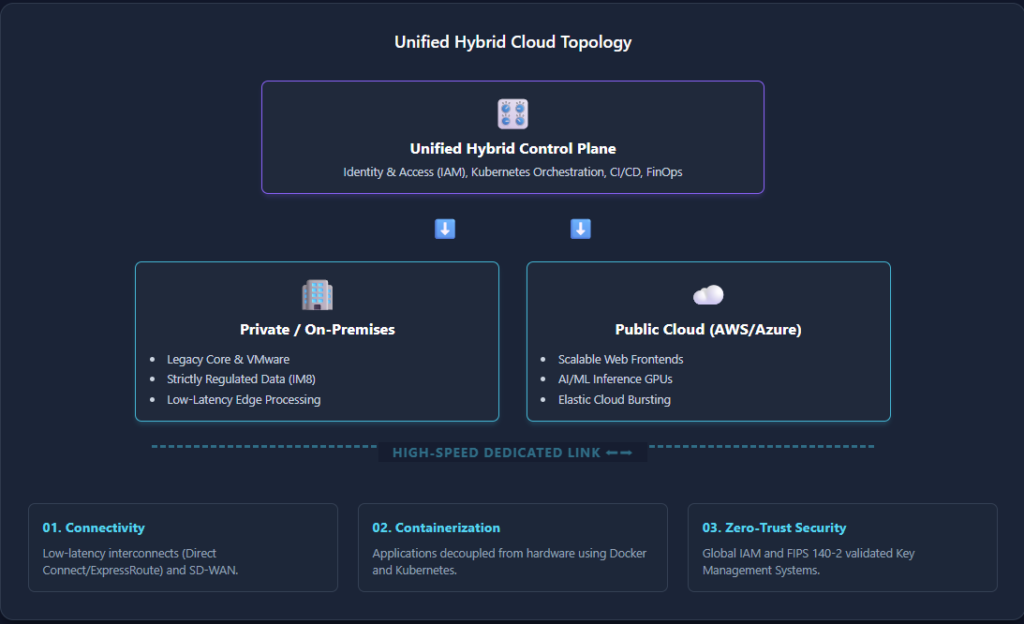
A hybrid cloud is an IT architecture that securely connects public cloud platforms with private cloud infrastructure or on-premises servers over a unified, software-defined network. Rather than forcing an organisation to choose between the physical security of local data centres and the compute capacity of public cloud vendors, modern hybrid cloud solutions unite these environments under a single governance and operational layer. With an effectively architected strategy, data, workloads, and microservices move dynamically between private and public resources based on automated security policies, compliance mandates, latency demands, and cost rules.
| On-Premises / Private | Public Cloud |
| Legacy core systems, VMware, SAN storage. Strictly regulated data, low-latency processing, sovereign records under PDPA/IM8 | AWS, Azure, GCP services. Scalable web frontends, AI/ML inference GPUs, elastic cloud bursting |
Hybrid Cloud vs. Multicloud: What’s the Difference?
Frequently used interchangeably, a hybrid cloud service and a multicloud strategy describe distinct architecture models. Neither is simply a hybrid cloud hosting service in the traditional sense, both involve genuine architectural decisions, not just where servers physically sit:
| Feature | Hybrid Cloud | Multicloud | Hybrid Multicloud |
| Infrastructure | On-prem/private + 1 public cloud | 2+ public cloud vendors, no local servers | On-prem/private + multiple public clouds |
| Primary goal | Balance regulatory control with elastic scalability | Avoid vendor lock-in, best-of-breed tools | Complete operational agility, extreme fault tolerance |
| Data locality | Sensitive data local; elastic traffic in public cloud | Distributed across multiple cloud data centres | Granular placement based on regional data sovereignty |
| Governance | Single hybrid management agent | Native vendor tools or multi-cloud dashboards | Centralised control plane (Azure Arc, OpenShift) |
How Do Hybrid Cloud Solutions Work?
Early hybrid setups relied on simple site-to-site VPNs passing flat files between a server room and a virtual machine. Modern hybrid cloud solutions leverage abstraction, containerisation, and Infrastructure as Code to decouple applications from physical hardware.
Core components of hybrid cloud architecture
- Public cloud platforms: scalable third-party infrastructure (AWS, Microsoft Azure, Google Cloud Platform) providing elastic compute, serverless functions, managed databases, and specialised AI/ML tools
- On-premises / private infrastructure: single-tenant physical hardware, enterprise SAN storage, or private virtualisation clusters (VMware vSphere) hosting legacy core systems, confidential records, or real-time operations
- High-speed network connectivity: low-latency interconnects (AWS Direct Connect, Azure ExpressRoute) combined with SD-WAN and encrypted IPSec tunnels
- Unified containerisation and orchestration: application packaging with Docker, orchestrated via Kubernetes or Red Hat OpenShift across all physical and virtual nodes
- Centralised identity and security controls: global IAM, unified Zero-Trust network access, and centralised key management systems enforcing security policy consistently
Vinova architectural blueprint: modern hybrid stack
Drawing from Vinova’s experience designing enterprise systems for public and commercial clients, a production-grade hybrid cloud computing solutions stack integrates:
- Provisioning and automation: Terraform/OpenTofu for Infrastructure as Code, Ansible for configuration management
- CI/CD delivery: automated Jenkins/GitHub Actions pipelines with automated security scanning (SAST/DAST)
- Data integration and pipelines: AWS Glue, Apache Kafka, or Azure Data Factory for secure asynchronous syncing between on-premises databases and cloud data lakes
- Monitoring and telemetry: Prometheus, Grafana, and ELK Stack for single-pane observability across private servers and public cloud instances
Key Benefits of Implementing Hybrid Cloud Solutions
1. Flexibility and dynamic workload mobility
Hybrid cloud solutions provide complete operational agility. Organisations run steady baseline daily workloads on private servers while executing cloud bursting, automatically shifting surplus traffic to public cloud instances during unexpected spikes or seasonal surges (holiday sales, tax filing periods).
2. Cost optimisation and FinOps realignment
Over-provisioning physical hardware to prepare for annual peak loads leads to idle, wasted capital. Hybrid cloud management solutions let enterprises size on-premises hardware for predictable baseline demand and rely on public cloud pay-as-you-go capacity for peaks.
Vinova engineering insight: implementing automated FinOps rules and auto-scaling policies converts fixed CapEx into managed OpEx. Using spot instances for non-critical workloads in public clouds can reduce elastic compute costs by up to 60%.
3. Enhanced security, data sovereignty, and compliance (IM8 and PDPA)
In highly regulated markets like Singapore and Southeast Asia, stringent governance standards, GovTech IM8, PDPA, and MAS Technology Risk Management guidelines, dictate strict data handling practices. Hybrid cloud solutions let organisations retain sensitive customer PII and core transactional databases within local, audit-ready data centres, while hosting customer-facing frontend portals in certified public cloud nodes.
4. Business continuity, backup, and disaster recovery
Hybrid cloud architecture serves as a high-availability disaster recovery engine, and this is where hybrid cloud backup solutions earn their keep specifically: by continuously streaming encrypted database snapshots and application images from on-premises hardware to isolated cloud object storage (AWS S3 Glacier, Azure Blob Cool tier), enterprises achieve low Recovery Point and Recovery Time Objectives at a fraction of the cost of running a duplicate physical data centre.
5. Reduced latency and high-performance edge computing
Applications powering IoT sensors, automated manufacturing, maritime vessel tracking, or point-of-sale systems can’t tolerate long latency loops to distant cloud regions. Hybrid cloud deployment lets time-critical event processing happen locally at edge nodes, while long-term telemetry analytics sync to public cloud data warehouses asynchronously.
6. Accelerating AI, machine learning, and enterprise innovation
Deploying enterprise Generative AI requires balancing compute power with intellectual property security. With hybrid cloud solutions, enterprises keep proprietary training data, knowledge bases, and fine-tuned model weights secured on private local servers, while tapping into public cloud GPU clusters (AWS EC2 P5 instances) for resource-heavy inference via encrypted APIs.
Real-World Hybrid Cloud Solutions: Industry Case Studies
Vinova field insight: maritime and global logistics ERP
In a large-scale project for Navig8, a global marine shipping company, Vinova engineered an enterprise resource planning platform handling complex operational workflows, financial scheduling, and vessel management.
The challenge: Navig8 required high-performance, secure transaction processing for global operations while adhering to strict maritime compliance and data security standards.
The hybrid solution: Vinova designed a hybrid cloud architecture combining secure, low-latency private database layers with an elastic AWS cloud application framework. Core operational rules and audit trails remain protected on-premises, while global team members access responsive, high-availability web interfaces hosted on public cloud infrastructure, connected via AWS Direct Connect.
The outcome: the hybrid delivery framework increased operational deployment velocity by 60% over a 3-year period while maintaining strict compliance across regional jurisdictions.
Vinova field insight: regulated government and higher-ed portals
Working with public sector bodies and academic institutions such as SIT and GovTech Singapore partners, Vinova architects hybrid cloud systems designed under strict IM8 and PDPA standards.
The solution: student/citizen identity databases and confidential records are isolated on secure local/private cloud clusters. AI-driven learning tools, document processing engines (built with AWS Glue and Amazon Comprehend), and public booking systems operate on public cloud infrastructure.
The impact: modern, 24/7 digital experiences with zero exposure of sensitive underlying citizen or student data.
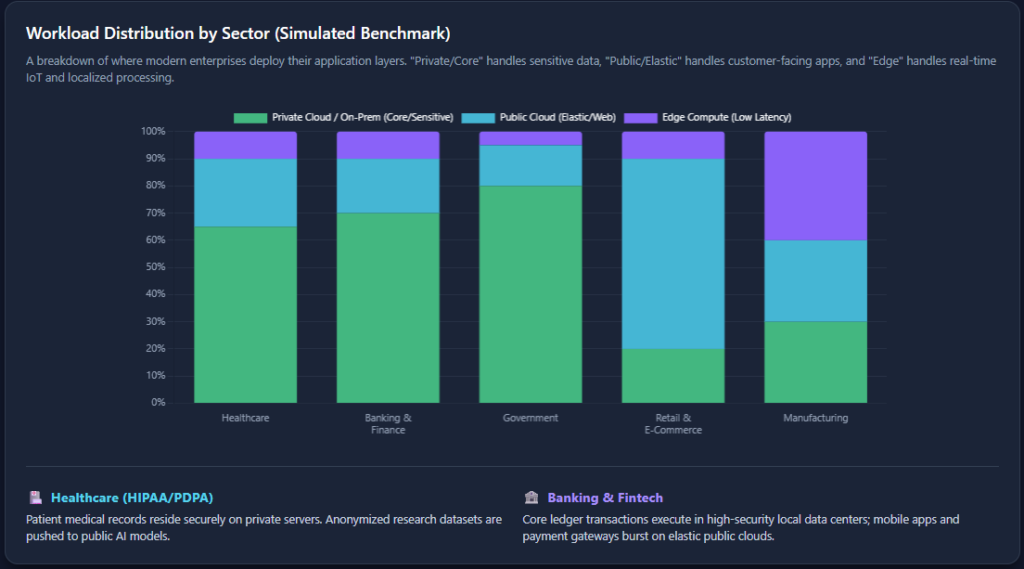
Industry-specific hybrid cloud matrix
| Industry | Primary Use Case | Architecture Pattern |
| Healthcare | Patient records on private servers (HIPAA/PDPA compliant); anonymised research analytics in public cloud AI models | Private database + public AI API gateway |
| Banking and Fintech | Core ledger transactions in high-security local data centres; mobile apps and payment gateways on elastic public cloud | On-premises core + cloud edge API |
| Government and Public Sector | Citizen identity data hosted locally under IM8 standards; public portal frontends burst on public cloud | Isolated private subnet + hybrid identity provider |
| Retail and E-Commerce | Inventory and POS systems run locally at branches; storefronts burst on cloud servers during peak sales | On-premises edge node + cloud bursting frontend |
Challenges and Practitioner Solutions in Hybrid Cloud Adoption
While the advantages are compelling, hybrid cloud implementations require careful management:
Inter-cloud data egress fees
The risk: transferring large volumes of data out of public clouds back to private servers can create unexpected monthly bandwidth bills.
Practitioner solution: implement localised caching layers (Redis/Memcached) and ensure data processing occurs close to where data is generated, transmitting only aggregated results across cloud boundaries.
Configuration drift and operational complexity
The risk: managing separate security policies on VMware servers and public cloud portals leads to security blind spots.
Practitioner solution: mandate Infrastructure as Code using Terraform or Ansible so all infrastructure changes, on-premises or public cloud, are code-reviewed and version-controlled via CI/CD.
Inconsistent security and identity fragmentation
The risk: separate access credentials for local data centres and cloud consoles increase vulnerability to credential leaks.
Practitioner solution: implement a unified Identity Provider supporting SAML/OAuth2 with Single Sign-On and MFA across all environments. This is also where working with established hybrid cloud service providers pays off: identity fragmentation is consistently the gap an experienced partner catches during discovery that an internal team, closer to the day-to-day, tends to miss.
Step-by-Step Implementation Roadmap
Implementing a hybrid cloud strategy requires a disciplined engineering approach:
| Phase | Focus |
| 1. Audit and Classify | Workload mapping, IM8/PDPA compliance check |
| 2. Architect Security | Zero-Trust rules, global IAM/KMS |
| 3. Establish Connectivity | Direct Connect, SD-WAN/IPSec |
| 4. Pilot Staged Migration | Dev/test first, containerise |
| 5. Continuous FinOps | Auto-scaling, egress audits |
1. Audit and classify workloads: categorise every enterprise application based on three metrics: Data Sensitivity (confidential vs. public), Latency Requirements (real-time vs. batch), and Resource Elasticity (steady-state vs. dynamic).
2. Design Zero-Trust security and identity: establish global IAM and unified end-to-end encryption standards (FIPS 140-2 validated KMS) across local and cloud environments before moving production data.
3. Establish high-speed network interconnects: provision dedicated interconnects (AWS Direct Connect, Azure ExpressRoute) paired with redundant VPN failovers for stable, low-latency cross-cloud data transfer.
4. Containerise applications and execute staged migration: wrap monolithic legacy applications into Docker containers managed by Kubernetes. Begin with low-risk workloads (dev/test environments, secondary backup syncs) before moving core application services.
5. Establish FinOps and continuous monitoring: deploy unified monitoring dashboards (Prometheus/Grafana) and automated resource tag tracking to monitor cost performance and prevent infrastructure sprawl.
| Ready to Design a Compliant Hybrid Cloud Strategy? Book a complimentary consultation with Vinova’s cloud architecture team. We’ll audit your current workloads, map your compliance requirements, and scope a migration plan. No commitment required. Schedule Your Free Cloud Architecture Consultation with Vinova |
Hybrid Cloud Solutions FAQ
What is a hybrid cloud solution in simple terms?
A hybrid cloud solution is an enterprise IT architecture that connects a company’s private on-premises servers with public cloud services (AWS, Azure, or GCP) over a secure network, letting data and applications move smoothly between them.
Why choose hybrid cloud solutions over public cloud alone?
Public cloud platforms offer vast scalability, but relying solely on them can mean high data egress costs, strict compliance challenges (IM8 or PDPA requirements), and latency issues. Hybrid cloud solutions combine public cloud scalability with the control, security, and low latency of private infrastructure.
What’s the difference between hybrid cloud services and hybrid cloud solutions?
Hybrid cloud services refer to the individual raw infrastructure building blocks vendors provide (cloud virtual machines, managed databases, object storage). Hybrid cloud solutions are the custom-engineered architecture, security framework, and application integration system architects design to solve a specific business problem. A vendor sells you services; a partner like Vinova builds you a solution.
How does hybrid cloud support AI integration?
Hybrid cloud lets enterprises store confidential business data and proprietary training models safely on private, local servers while connecting to public cloud GPU infrastructure on-demand to execute heavy AI model training and inference.
What should I look for in hybrid cloud managed services versus building in-house?
The honest answer depends on whether you already have the specialised skill sets in-house: Kubernetes orchestration, FinOps discipline, and IM8/PDPA-aligned security architecture are not commodity skills, and hiring for all three locally in Singapore is exactly the kind of slow, expensive process that drives companies toward hybrid cloud managed services in the first place. If you’re standing up your first hybrid environment, a managed partner de-risks the architecture decisions that are hardest to unwind later. If you’re maintaining a mature environment your team already understands well, in-house often makes more sense.
Do hybrid cloud storage solutions cost more than pure public cloud storage?
Not necessarily, and the comparison usually favours hybrid once you account for egress fees. Public cloud storage looks cheaper on the sticker price, but hybrid cloud storage services that keep frequently-accessed or latency-sensitive data on-premises and archive cold data to public cloud object storage typically cost less in practice, since you’re not paying repeated egress fees to move data back out of the public cloud every time it’s needed locally.
| Vinova: Singapore’s cloud architecture and enterprise engineering partner since 2010. ISO 27001:2022 and ISO 9001:2015 certified. 300+ in-house engineers across Singapore, Hanoi, Da Nang, and Ho Chi Minh City. Clients include Navig8, SIT, and GovTech Singapore. PDPA, MAS TRM, and GovTech IM8 aligned. Financial Times Top 500 High-Growth Companies Asia-Pacific 2026. The Straits Times Singapore’s Fastest-Growing Companies 2024, 2025, and 2026. Explore Vinova’s Enterprise Cloud Application Managed Services. |