By Vinova Systems Practice · 17-minute read
Every security vendor promises to “respond in minutes”. At 2:15 AM on a Sunday, a domain controller starts mass-encrypting the datastores across a VMware ESXi cluster. Alerts flood a queue nobody is watching, and a junior administrator, trying to help, pulls the power cables from the server chassis. The encryption stops. So does most of the evidence.
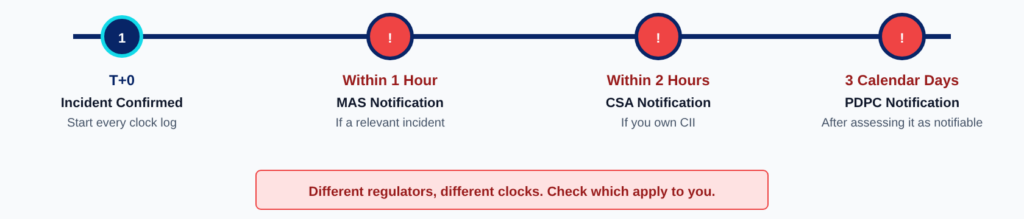
Quick Answer: Cyber incident response is the organized process of detecting, containing, investigating and recovering from a cyberattack, while preserving the evidence you need and meeting the reporting clocks that apply to you. In Singapore those clocks can include the Personal Data Protection Commission (PDPC) within 3 calendar days of assessing a breach as notifiable, the Cyber Security Agency of Singapore (CSA) within 2 hours for critical information infrastructure owners, and the Monetary Authority of Singapore (MAS) within 1 hour of discovering a relevant incident.
Table of Contents
Key Takeaways
- Incident Response Is Not Desktop Maintenance: When ransomware is executing, normal IT administration stops working. The first ten minutes decide how much evidence survives and how much of the estate gets encrypted.
- Volatile Evidence Disappears Fast: Under RFC 3227, memory-resident evidence is lost first. Cutting power erases process lists, network sockets and, in some cases, key material that could have helped recovery.
- Isolate Logically Before You Pull Plugs: Software-defined quarantine lets responders watch command-and-control (C2) traffic while stopping lateral movement. Powering a host off is sometimes the lesser evil, but it is a trade, not a default.
- Singapore Runs Several Reporting Clocks at Once: The PDPC, CSA and MAS each set their own deadlines, and which ones apply to you depends on your sector and the data involved.
1. The Zero-Hour Reality: Incident Response Is Active Systems Engineering
When ransomware executes, standard IT administration stops being the right toolkit.
It is easy to treat an incident response plan as a binder on an intranet shelf, pulled out once a year for an auditor. That illusion ends at 2:15 AM. A domain controller encrypts virtual disks across an ESXi cluster, Kerberoasting alerts pile up unread, and the attacker deploys wipers against backup storage. In the panic, someone cuts power to the servers. That single decision damages your recovery in three ways:
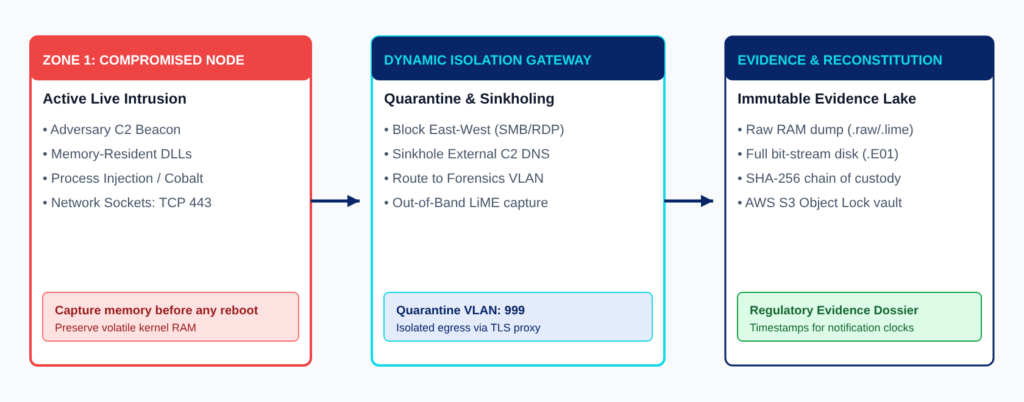
- Loss of Volatile Memory: Cutting power clears RAM. That erases active C2 socket states, injected processes, decrypted payloads and, in some cases, the key material that could have unlocked files without an extortion payment.
- Alerting the Adversary: Abruptly disabling uplinks can tell a human attacker that they have been seen. Attackers who notice may switch to destructive payloads to slow your investigation.
- Broken Chain of Custody: Copying compromised virtual disks with consumer utilities alters access timestamps and metadata, which weakens the evidence you need for regulatory filings and cyber insurance claims.
| The panic response (ad-hoc break-fix IT) | The engineered response (CSIRT) | |
|---|---|---|
| Hosts | Pulls power cords, erasing volatile RAM and any recoverable keys | Captures volatile RAM (LiME or WinPmem) over an out-of-band link, then isolates |
| Network | Runs generic antivirus scans that can trigger wipers | Moves the host to a quarantine VLAN and sinkholes C2 traffic |
| Recovery | Rebuilds at once from unverified backups | Finds the entry path first, then rebuilds from validated snapshots |
| Evidence | Overwrites timestamps and logs | Hashes every artifact and keeps chain of custody for PDPC and MAS filings |
None of this is a criticism of whoever pulls the cables. Without a rehearsed plan, it is a reasonable thing to try.
The Rule: Isolate first, capture memory second, power off last. If encryption is spreading and you cannot isolate a host, powering it off may be the lesser evil. Make that call deliberately.
Specialized Computer Security Incident Response Teams (CSIRTs) treat an intrusion as a live forensic operation. They contain the attack logically, keep the chain of custody, find the root-cause access path and run coordinated eradication across identity and storage tiers.
2. NIST SP 800-61 vs SANS Incident Response: Architectural Anatomy of Modern Frameworks
Frameworks turn chaotic breaches into runbooks that engineers can follow at 2 AM.
2.1 Choosing a Framework
Two reference models dominate:
- SANS PICERL: A six-stage model: Preparation, Identification, Containment, Eradication, Recovery and Lessons Learned. It separates the steps clearly, which suits CSIRT engineers working at the command line.
- NIST SP 800-61: Revision 2 (2012) described a four-phase lifecycle: Preparation, Detection and Analysis, Containment, Eradication and Recovery, and Post-Incident Activity. NIST withdrew Revision 2 in April 2025. Revision 3 reframes incident response as a Community Profile of the NIST Cybersecurity Framework (CSF) 2.0, organized around the Govern, Identify, Protect, Detect, Respond and Recover functions, with lessons learned feeding improvement across all of them.
Most teams still run a lifecycle like PICERL day to day, and use NIST Rev 3 to tie incident response into wider risk management.
| Activity | SANS PICERL | NIST SP 800-61 Rev 2 (withdrawn) | NIST SP 800-61 Rev 3 (CSF 2.0) | What it looks like in practice |
|---|---|---|---|---|
| Prepare | Preparation | Preparation | Govern, Identify, Protect | Out-of-band telemetry, FIDO2 MFA, immutable WORM logging |
| Discover | Identification | Detection and Analysis | Detect | Sigma rules, VPC flow log correlation, process tree extraction |
| Contain | Containment | Containment, Eradication, Recovery | Respond | Quarantine VLANs, session revocation, KRBTGT resets |
| Eradicate | Eradication | Containment, Eradication, Recovery | Respond | Revoke tokens, purge web shells, rebuild compromised hosts |
| Recover | Recovery | Containment, Eradication, Recovery | Recover | Rebuild from validated snapshots, with functional and security test sweeps |
| Improve | Lessons Learned | Post-Incident Activity | Improvement across all functions | Chain-of-custody dossiers and updated runbooks |
2.2 RFC 3227 Order of Volatility in Digital Forensics
Evidence degrades over time, so responders collect it in order of volatility, as set out in RFC 3227:
- CPU Registers and Cache: In practice nobody captures these, which is why memory acquisition comes first.
- Routing Tables, ARP Cache, Process Table, Kernel Statistics and Memory: Live connections, listening sockets, injected processes and credentials held in memory (for example in the LSASS process).
- Temporary File Systems: Swap files,
pagefile.sys,hiberfil.sysand RAM disks. - Disks: Master File Table (
$MFT) entries, file slack, unallocated blocks and local event logs. - Remote Logging and Monitoring Data: Syslog data lakes (Amazon CloudWatch, Athena, Azure Log Analytics), firewall and VPC flow logs.
To capture kernel memory without writing to the suspect disk, engineers run an acquisition module such as Linux Memory Extractor (LiME) and stream the memory image to a forensic workstation over an isolated management network:
# On the compromised Linux host: load LiME and stream memory over TCP. # Run this only on an isolated forensic VLAN, because the stream is not encrypted. insmod lime-$(uname -r).ko "path=tcp:4444 format=raw" # On the forensic workstation: receive the stream, hash it, and encrypt it at rest. nc <compromised-node-ip> 4444 | tee >(sha256sum > host_ram.raw.sha256) \ | gpg --encrypt -r csirt@example.com > host_ram_evidence.raw.gpg2.3 CSIRT Digital Forensics Containment Architecture: Micro-Isolation vs Network Blackholing
Switching off ports or pulling Ethernet cables can disrupt evidence collection, and some malware has fallback routines for when it loses its connection. Modern response favors logical micro-isolation:
- Software-Defined Quarantine (VLAN 999): The host’s switch port or cloud security group moves to a quarantine profile. East-west traffic (SMB, RDP, WinRM) is dropped, which halts lateral movement to file shares and hypervisors.
- C2 DNS Sinkholing: Outbound queries for suspicious domains resolve to an internal sinkhole, which keeps the socket state alive, records beacon patterns and blocks exfiltration.
- Out-of-Band Management Retention: Responders keep SSH or serial console access on a segregated management network, so they can extract artifacts without touching the production network.
3. Cyber Incident Response Plan Template in Singapore: Engineering an Operational Playbook
An incident response plan that has never been exercised is a liability.
A good plan sets out who commands the response, pre-authorizes the first containment actions and gives technical staff playbooks they can run without waiting for approvals.
3.1 The Incident Command Structure
A critical incident is no time for the normal org chart. The plan names:
- Incident Commander (IC): Holds the authority to order shutdowns, isolation and failovers without a board meeting.
- Lead Forensic Engineer: Owns evidence capture, memory analysis and chain-of-custody records.
- Infrastructure Remediation Lead: Owns firewall changes, Active Directory resets and snapshot recovery.
- Legal and Regulatory Liaison: Tracks the PDPC, CSA and MAS clocks, drafts notifications and handles the cyber insurance carrier.
3.2 Incident Response Process Steps: First-Hour Containment Playbooks
When an alert fires, responders run stage-gated runbooks inside the first hour:
- Active Directory KRBTGT Reset: If domain controllers are compromised, resetting user passwords is not enough. Responders reset the
KRBTGTaccount password twice, waiting at least the maximum Kerberos ticket lifetime between resets (10 hours by default, and many teams wait 24), to invalidate forged golden tickets without breaking authentication. - Cloud Session Revocation: If cloud administrator accounts are compromised, responders revoke refresh tokens and sign-in sessions, and block the identities until they are verified:
# Microsoft Entra ID: revoke all sign-in sessions for a compromised account. Revoke-MgUserSignInSession -UserId "compromised-admin@example.com"# AWS: deny all actions for a compromised IAM user and disable their access keys. aws iam attach-user-policy --user-name "compromised-dev" \ --policy-arn "arn:aws:iam::aws:policy/AWSDenyAll" aws iam update-access-key --user-name "compromised-dev" \ --access-key-id <ACCESS_KEY_ID> --status Inactive- Snapshot Isolation and Object Locking: Responders snapshot affected volumes and copy the snapshots and disk images to write-once storage, such as AWS S3 Object Lock in compliance mode or Azure immutable blob storage, so the original state survives for forensic review.
3.3 Sizing the Cost of a Slow Containment
The cost of a breach compounds across containment latency, business stoppage, penalties and legal defense:
Where:
- ΔtMTTC is the Mean Time to Containment in hours from the attacker’s first execution.
- ΦBusiness_Halt is the gross revenue lost per hour of operational unresponsiveness.
- WRemediation is the hourly labor cost of internal engineers and external responders.
- FStatutory is any regulatory penalty, such as a PDPC financial penalty under Section 48J or MAS sanctions.
- CForensic_Legal is the cost of external forensics retainers, legal counsel and third-party validation.
- LChurn is the customer lifetime value lost to breach disclosure and brand damage.
Containment time breaks down by stage:
Every hour you remove from containment cuts the first term of the cost formula directly, and a rehearsed pipeline is what removes those hours.
The Rule: An incident response plan that has not been tested in a tabletop exercise is a document, not a capability.
4. Singapore Statutory Ground Truth: Mandatory Regulatory Breach Reporting
In Singapore, a breach can start several clocks at once.
Handling a breach in Singapore means coordinating technical containment with legal timelines. Which clocks apply depends on your sector and on the data involved.
4.1 PDPC 3-Day Breach Notification: Incident Response Under the PDPA
Under the Personal Data Protection Act 2012 (PDPA), organizations must assess whether a data breach is notifiable:
- When a Breach Is Notifiable: A breach is notifiable if it results in, or is likely to result in, significant harm to affected individuals, or if it is of significant scale, meaning 500 or more individuals. Significant harm turns on the type of data involved, such as financial information, identification numbers combined with names, or account credentials.
- The 3-Calendar-Day Clock: Under Section 26D, once you assess a breach as notifiable, you must notify the PDPC as soon as practicable and no later than 3 calendar days after that assessment. The clock starts at the assessment, so the assessment itself has to be prompt and documented.
- Telling Individuals: Where significant harm is likely, affected individuals must also be notified as soon as practicable. A breach that is notifiable only because of its scale goes to the PDPC alone.
- Section 48J Penalties: The maximum financial penalty is up to S$1 million, or up to 10% of annual Singapore turnover for an organization with turnover above S$10 million.
4.2 CSA Cyber Incident Reporting in Singapore: The Cybersecurity Act
The Cybersecurity Act 2018 regulates Critical Information Infrastructure (CII). The Cybersecurity (Amendment) Act 2024 widened it. Key provisions commenced on 31 October 2025, including expanded CII incident reporting and Systems of Temporary Cybersecurity Concern (STCC). The Act’s provisions for Entities of Special Cybersecurity Interest (ESCI) and major Foundational Digital Infrastructure (FDI) providers had not yet commenced in the sources I checked, so confirm their current status.
- 2-Hour Notification: CII owners must notify the CSA of reportable incidents within 2 hours of becoming aware of them.
- Follow-Up Report: After the initial notification, owners send a fuller report with the attack vectors, indicators of compromise, impact and remediation steps. Confirm the deadline in the regulations for your designation.
- Who This Applies To: If your organization is not a CII owner or another designated entity, these duties do not apply to you directly. Customers who are CII owners may pass equivalent reporting duties down through contracts.
4.3 MAS Technology Risk Management Notices
For financial institutions, the Technology Risk Management (TRM) Notices set out the MAS duties. The Notices were renumbered on 10 May 2024, so older material may quote Notice 644 or 655, which are now FSM-N05 and FSM-N06 for banks. Check the Notice for your licence type.
- 1-Hour Notification: Notify MAS as soon as possible, and no later than 1 hour after discovering a relevant incident, meaning a system malfunction or IT security incident with a severe and widespread impact on operations or a material impact on service to customers.
- Root-Cause Report: Submit a root cause and impact analysis to MAS within 14 days of discovering the incident.
4.4 The Reporting Matrix
| Body | Applies to | Clock | Trigger |
|---|---|---|---|
| MAS | Financial institutions under a TRM Notice | Within 1 hour of discovering a relevant incident; analysis report within 14 days | A system malfunction or IT security incident with severe and widespread impact, or material impact on customers |
| CSA | CII owners, and owners of designated systems such as STCCs | Within 2 hours of becoming aware | A reportable incident affecting the designated system or interconnected systems |
| PDPC | Any organization that holds personal data | No later than 3 calendar days after assessing the breach as notifiable | Significant harm to individuals, or 500 or more individuals affected |
| Singapore Police Force | Recommended for ransomware, extortion or fraud | As soon as practicable | A criminal offense is involved, such as extortion or fraud |
5. Five Catastrophic Landmines in Incident Response Execution
Response disasters come from procedural panic and sloppy forensic discipline.
5.1 The Clean Rebuild From Unverified Backups
When servers are encrypted, teams often restore last night’s backup. But attackers frequently arrive weeks before the ransomware lands. If you restore without finding the entry point (an unpatched edge VPN, stolen service credentials, a persistent web shell), the attacker re-encrypts the restored systems within hours.
5.2 Out-of-Band Communications Breakdown
During a domain compromise, internal communications may be watched. If the response team coordinates through corporate email or Microsoft Teams, the attacker can read your countermeasures in real time. Responders move to a separate out-of-band channel, such as end-to-end encrypted messaging on unmanaged devices or a clean, isolated collaboration tenant.
5.3 Declaring Containment Too Early
Teams often call an incident resolved after killing one infected endpoint. Skilled attackers leave redundant persistence: hidden scheduled tasks, secondary web shells, shadow cloud administrator accounts and golden tickets. Containment is not done until every foothold has been checked.
5.4 Unencrypted Forensic Artifact Sprawl
Forensic work produces sensitive files: memory dumps, disk images and packet captures that contain personal data, passwords and source code. If engineers keep them on unencrypted USB drives or unsecured cloud folders, they create a second exposure, and the PDPA’s Section 24 requires reasonable security for personal data held in them too.
5.5 Keeping the Incident Quiet
Some executives tell internal engineers to handle a breach quietly, without legal counsel or external forensics. In Singapore, delaying the assessment of a notifiable data breach risks missing the PDPC clock and a financial penalty under Section 48J. Involve legal counsel early.
Explore Vinova’s Cybersecurity Services
Vinova can run a tabletop exercise against your plan and the Singapore reporting clocks, and show you where the gaps are.
6. Practitioner Scars: Real Production Disasters From the Trenches
Forensic debt turns into regulatory exposure and operational halts.
Friction point we hit: the holiday-night reboot. A mid-sized healthcare provider suffered a ransomware intrusion at 1:00 AM on a public holiday. An internal administrator, under pressure and with no rehearsed plan, mass-rebooted forty hypervisors into safe mode. That wiped volatile memory and destroyed active C2 connection logs.
Resolution: We deployed an emergency forensics team, recovered what we could from suspended pagefile blocks, rebuilt the attacker’s access timeline from immutable firewall flow logs, identified the unpatched firewall gateway that served as the initial access vector and rebuilt the core cluster in an isolated AWS recovery environment.
Friction point we hit: the unvetted negotiator. A commercial logistics firm tried to negotiate an extortion demand through an unvetted overseas intermediary, with no sanctions check and no preserved evidence. Meanwhile, hidden web shells sat undetected on its internet-facing servers.
Resolution: We halted all unaccredited communications, deployed endpoint telemetry agents to terminate the active web shells, preserved evidence in a form that would hold up in Singapore proceedings and built an auditable timeline that let the firm meet its reporting obligations without paying.
Vinova Field Insight: Containment and Regulatory Evidence for a Singapore FinTech Group
The Challenge: A payment processor detected unusual privilege escalation and lateral movement across its production AWS environment. Live transaction clearing was at risk, and the incident threatened to cross the MAS and PDPC notification thresholds.
The Approach: Vinova activated an emergency CSIRT deployment led by an Incident Commander and a Lead Forensic Engineer. We isolated the affected workloads with micro-segmented VPC security groups, took live memory from suspicious EC2 nodes, correlated logs through AWS Athena and CloudTrail, removed the attacker’s compromised IAM role trust policy and assembled an auditable evidence dossier for MAS and PDPC.
The Result:
| Metric | Result |
|---|---|
| Transaction clearing | Continued without interruption |
| Time to containment after deployment | 110 minutes |
| Evidence dossier for MAS and PDPC | Assembled within 36 hours |
| Cardholder data exfiltrated | None, according to log review |
| Regulatory penalties | None |
7. The Evaluation Matrix: Choosing Your Incident Response Operating Model
Your operating model decides how fast you contain a breach and how well you can defend your decisions afterwards. For the wider question of picking a provider, see how to choose the right cyber security company.
| Operational Dimension | Internal IT staff only | Uncontracted ad-hoc callout | Specialized retainer partner |
|---|---|---|---|
| Response activation | Variable, subject to staff availability | Best effort, often 48 to 72 hours during surges | Contracted SLA: 15-minute triage, 2-hour on-site |
| Volatile memory tooling | Low: antivirus scans or reboots | Variable: depends on the technician dispatched | Advanced: LiME, WinPmem and Volatility |
| Singapore regulatory literacy | Limited: unsure of PDPC and MAS clocks | Medium: generic templates | Prepared PDPC, CSA and MAS notification runbooks |
| Evidence chain of custody | Low: timestamps overwritten | Variable: ad-hoc storage | Hashed artifacts and write-once storage |
| Readiness drills | Infrequent | None: billed only after a breach | Structured: unused retainer hours roll into tabletop drills |
| Cost predictability | High fixed overhead: salaries and training | Volatile: surge billing during incidents | Fixed retainer with clear hourly tiers |
Option A: Internal IT Staff Only
- Where It Works: Non-profits and micro-businesses with low data sensitivity and few regulatory duties.
- The Catch: Generalist engineers rarely have forensic training. In a complex intrusion, unfamiliar procedure can destroy evidence and miss reporting deadlines.
- Best for: Small operations where downtime carries little financial or legal consequence.
Practitioner Verdict: Fine for low-risk operations. Limited once there is an active attacker.
Option B: Uncontracted Ad-Hoc Emergency Callout
- Where It Works: Small businesses that hold basic cyber insurance and choose to defer a retainer.
- The Catch: During regional outbreaks, responders prioritize their retainer clients. Uncontracted organizations can wait days and pay emergency spot rates.
- Best for: Organizations that can accept extended downtime during an industry-wide incident.
Practitioner Verdict: Cheaper until the day everyone calls at once.
Option C: A Specialized Incident Response Retainer
- Where It Works: Financial institutions, multi-outlet retail groups, healthcare operators, logistics firms and any business that holds regulated consumer data.
- The Catch: It asks for structured readiness assessments and periodic tabletop exercises on your side.
- Best for: Mid-market and enterprise organizations that need contracted containment times, regulatory defensibility under Singapore law and a predictable budget.
Practitioner Verdict: The right fit once a bad week costs more than a retainer.
8. The Contractual Playbook: Retainers Engineered for Rapid Containment
When systems are burning, the contract has to put engineers on the way. A retainer should set out its operational and legal commitments before an incident happens.
8.1 Key Service Level Agreements (SLAs)
| Milestone | Target | What happens |
|---|---|---|
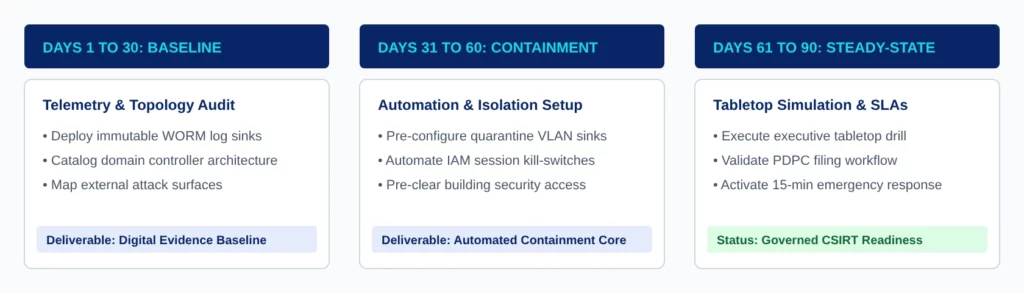
| Remote triage | Under 15 minutes | A certified incident commander starts triage, reviews the first alerts and opens an out-of-band bridge |
| Active containment | Under 1 hour | Responders begin containment: micro-isolation rules and revoking compromised credentials |
| On-site dispatch | 2 to 4 hours | Forensic engineers arrive with forensic hardware at a commercial facility in Singapore |
| Unused retainer hours | Rolled over | Unused hours go into proactive work: tabletop simulations, vulnerability assessments and configuration reviews |
8.2 Governing Law, IP Ownership and Dispute Resolution
- Governing Law: The contract is governed by and interpreted under the laws of the Republic of Singapore.
- Intellectual Property: Custom containment scripts, YARA scanning rules and post-incident runbooks should be assigned to you as they are created, using an assignment of future copyright under Section 140 of the Copyright Act 2021. You should own all post-incident documentation outright once you have paid.
- Dispute Resolution: If amicable resolution fails, the contract should provide for arbitration administered by the Singapore International Arbitration Centre (SIAC) under its Arbitration Rules, with Singapore as the seat. Awards are then enforceable internationally under the 1958 New York Convention.
Have your legal counsel review the final wording of any clause before signing.
9. Frequently Asked Questions
What is the difference between incident management and incident response?
Incident management restores normal service after routine disruptions such as application errors, printer outages or password resets. Cyber incident response is a specialized forensic and engineering function that contains and remediates security breaches, preserves evidence and defends against active human attackers.
What is the first step during an active cyber incident?
Isolate the affected systems logically and open an out-of-band communication channel. Leave systems powered on where you can, so memory can be captured, and avoid antivirus scans and uncoordinated reboots. If encryption is spreading and you cannot isolate a host, powering it off may be the lesser evil, so make that call deliberately.
How long do organizations have to report a data breach in Singapore?
It depends on who you are. Under the PDPA, you must notify the PDPC no later than 3 calendar days after assessing a breach as notifiable (significant harm, or 500 or more individuals). CII owners must notify the CSA within 2 hours of becoming aware of a reportable incident. Financial institutions under a MAS TRM Notice must notify MAS within 1 hour of discovering a relevant incident.
Why does volatile memory (RAM) matter before a reboot or isolation?
RAM holds active process trees, network sockets, injected DLLs and, in some cases, encryption key material used by ransomware. A reboot or power-off erases it, which makes it harder to tell what was stolen and, in some cases, to recover files without paying.
What should an enterprise Cyber Incident Response Plan (CIRP) include?
An incident command structure that names the decision-makers, a severity classification matrix, pre-authorized first-hour containment runbooks, out-of-band communication protocols, notification templates for the PDPC, CSA and MAS where they apply to you, and an evidence preservation runbook based on RFC 3227.
The Takeaway
The Takeaway: Incident response is an engineering discipline that balances fast containment against evidence preservation, so practice it before an attacker tests it for you.
Vinova brings government-grade engineering standards to incident response: rehearsed plans, preserved evidence and notifications timed to the clocks that apply to you.
Vinova: Singapore’s mobile and web application development partner since 2010. ISO 27001:2022 and ISO 9001:2015 certified.
300+ in-house engineers across Singapore, Hanoi, Da Nang, and Ho Chi Minh City, including teams who build image-heavy mobile and web applications for enterprise and government clients.
Financial Times Top 500 High-Growth Companies Asia-Pacific 2026. The Straits Times Singapore’s Fastest-Growing Companies 2024, 2025, and 2026.