By the Vinova AI Engineering Team. Reviewed under ISO 27001:2022 and ISO 9001:2015 delivery standards.
The Short Answer
MLOps (Machine Learning Operations) is an engineering discipline that unifies machine learning system development (ML) with software operations (Ops) to automate the end-to-end lifecycle of machine learning models. Unlike traditional DevOps, MLOps governs continuous integration, continuous delivery, and continuous training (CT) across code, data, and model artifacts to prevent silent performance degradation.
Training a machine learning model inside a Jupyter notebook is easy. Keeping that model reliable, secure, and commercially viable in high-throughput enterprise production is a different and much harder problem.
For a CTO, the risk is not a model that fails loudly. It is a model that fails quietly while every dashboard stays green, and the first signal arrives from a regulator, a customer, or a line in the P&L. Owning that risk means owning the operational system around the model.
In 2015, Google researchers published a widely cited systems engineering paper titled “Hidden Technical Debt in Machine Learning Systems.” Its core warning remains an operational reality for enterprise engineering teams: a mature production system can end up being at most 5% machine learning code, with the other 95% or more made up of glue code and supporting infrastructure.
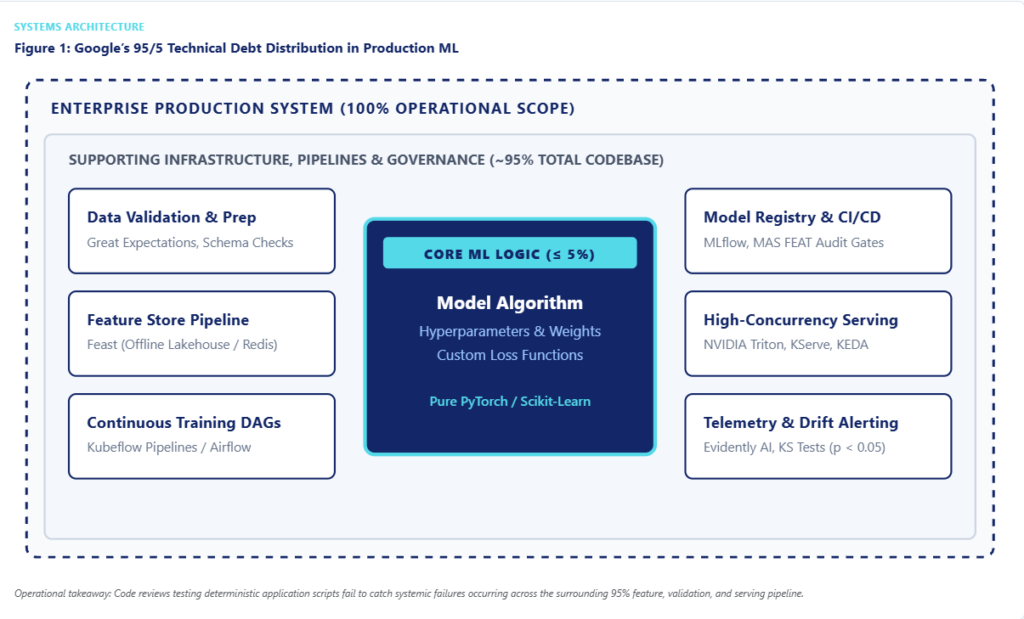
That supporting layer includes data collection pipelines, feature extraction logic, data verification gates, resource schedulers, model analysis engines, serving infrastructure, and real-time monitoring systems.
Table of Contents
The Reality of Production Machine Learning Systems
| Layer | What Lives There |
|---|---|
| Data layer | Data collection, data validation, feature extraction |
| Control layer | Configuration, resource management, machine resource scheduling |
| Core | ML code (at most about 5% of a mature system) |
| Operations layer | Serving infrastructure, model analysis, monitoring and drift detection |
Without a formalized operational discipline, enterprise machine learning initiatives routinely stall. Models perform well during offline validation, then fail silently when exposed to live production traffic.
Data schemas evolve unexpectedly. Consumer behavior drifts. Inbound feature distributions diverge from training baselines. With no automated systems to detect degradation, models make increasingly flawed predictions in silence, turning promising AI investments into balance-sheet liabilities.
So what is MLOps, and why does it decide whether enterprise AI pays back? Machine learning operations (MLOps) is the engineering framework designed to resolve this systemic failure mode.
Key Takeaways:
1. The Tripartite State Problem: Traditional DevOps manages code and compiled binaries; MLOps must simultaneously orchestrate three mutable vectors: code, data, and model weights. Testing code without validating data distributions invites production decay.
2. Continuous Training (CT) as the Third Engine: MLOps extends CI/CD by introducing Continuous Training. Automated triggers retrain, evaluate, and gate candidate models whenever statistical data drift or concept decay breaches pre-set tolerances.
3. The Centrality of the Feature Store: Standardizing feature definitions across offline training (batch) and online inference (low-latency key-value lookups) is essential to eliminate training-serving skew, a leading cause of silent model failure.
4. Fiduciary Governance & MAS FEAT Alignment: Enterprise MLOps requires complete data and model lineage. Models serving regulated industries must support full auditability, aligned with ISO/IEC 42001 and the Singapore MAS FEAT (Fairness, Ethics, Accountability, Transparency) principles.
Here is what is MLOps in practice: how modern MLOps is architected, how it differs from traditional software engineering, the six stages of the production MLOps lifecycle, and how engineering teams move from manual scripts to fully automated enterprise pipelines.
1. What Is MLOps? (Beyond the Industry Hype)
Architectural Rule of Thumb: Machine learning is experimental by nature, but operational delivery cannot be. Treat models not as static software artifacts, but as probabilistic functions of changing data distributions that require continuous operational validation.
Machine learning is probabilistic software, not deterministic code.
What Is MLOps? A One-Paragraph Definition
MLOps is not a single software tool, a Python library, or a cloud provider’s proprietary dashboard.
MLOps is an engineering discipline that unifies machine learning model development (ML), software engineering, and infrastructure operations (Ops) to standardize and automate the deployment, monitoring, and governance of machine learning systems in production.
Traditional software is deterministic: given input X, code path F consistently returns output Y.
Y = F_code(X)
If an error occurs, the defect can be isolated to a deterministic bug in the codebase, a configuration error, or an infrastructure outage.
Machine learning software is probabilistic: output Ŷ is generated by a model parameter matrix Θ trained on historical dataset D.
Ŷ = F_Θ(D)(X)
Even if the underlying application codebase remains completely unchanged, the model’s predictive accuracy will degrade over time if live production input distributions P_live(X) diverge from historical training distributions P_train(X).
Deterministic Software vs. Probabilistic ML Systems
| System Type | Behavior |
|---|---|
| Traditional software: deterministic execution | Input data (X) plus explicit logic (code) produces a guaranteed output (Y). |
| Machine learning: probabilistic behavior | Historical data (D) plus an algorithm produces trained model parameters (Θ). Live data (X) plus those parameters produces a prediction (Ŷ). Accuracy degrades silently when the live data distribution P(X) shifts over time. |
MLOps provides the automated scaffolding that manages this probabilistic lifecycle. It treats data, code, and model weights as version-controlled, auditable, and continuously monitored software assets.
2. MLOps vs DevOps vs DataOps: The Tripartite Reality
Operational Rule of Thumb: DevOps assumes code is the only source of truth. MLOps recognizes that data distribution shifts dictate software behavior. If your pipeline only monitors server uptime and HTTP response codes, your machine learning system is unmonitored.
Traditional DevOps manages code; MLOps must govern code, data, and weights simultaneously.
Engineering leaders frequently ask: “We already run mature DevOps with Kubernetes, GitHub Actions, and Terraform. Why do we need a separate MLOps discipline?”
DevOps was architected for deterministic software. Applying DevOps practices to machine learning systems is necessary, but fundamentally insufficient. The mlops vs devops question is really a question about how many things can change underneath you.
The Three Divergent Vectors: Code, Data, and Model
In traditional DevOps, version control manages a single mutable vector: code. When code passes static analysis, unit tests, and integration suites, the resulting binary artifact is deployed to production.
In MLOps, system performance is dictated by three interconnected, independently shifting vectors:
- Code: The training algorithms, data preprocessing scripts, feature engineering pipelines, and serving wrappers.
- Data: The datasets used to train, evaluate, and run inference against the model. Data is non-static, subject to schema changes, upstream collection failures, and statistical drift.
- Model Artifacts: The serialized binary weights, hyperparameter matrices, and architecture definitions generated by running code against data.
The MLOps Dependency Triangle
| Relationship | Pipeline Discipline |
|---|---|
| Code and Data | Continuous Integration (CI) |
| Code and Model | Continuous Training (CT) |
| Data and Model | Continuous Delivery (CD) |
A change in any single vector alters the behavior of the entire system. A bug-free training script run against corrupted data produces a defective model. Conversely, pristine data fed to an unoptimized model yields poor inference accuracy.
Architectural Comparison Matrix
| Dimension | DevOps | DataOps | Enterprise MLOps |
|---|---|---|---|
| Core Artifact Managed | Code repositories, libraries, compiled containers | Data warehouses, lakes, transformations, dbt models | Code, raw and processed datasets, feature stores, model weights |
| Primary Workflow | Continuous Integration and Continuous Delivery (CI/CD) | Continuous data integration and quality testing | CI/CD + Continuous Training (CT) + continuous monitoring |
| Failure Mode | Explicit: exceptions, 500 errors, crashes, timeouts | Pipeline breaks, missing fields, schema mismatches | Silent: predictions degrade while HTTP endpoints return 200 OK |
| Testing Regimes | Unit tests, integration tests, end-to-end smoke tests | Data completeness, uniqueness, freshness, schema checks | Data distribution tests, model accuracy, latency, bias, drift metrics |
| Monitoring Metrics | CPU/RAM utilization, latency, error rates, APM traces | Pipeline runtime, table freshness, row counts, data volume | Precision, Recall, F1-Score, AUC-ROC, latency, data and concept drift |
| Feedback Loop | Code patch → PR → CI build → production release | Data pipeline fix → table rebuild → data validation | Data drift detected → automated retraining → champion/challenger test → canary rollout |
3. The MLOps Lifecycle: 6 Stages of the Enterprise Loop
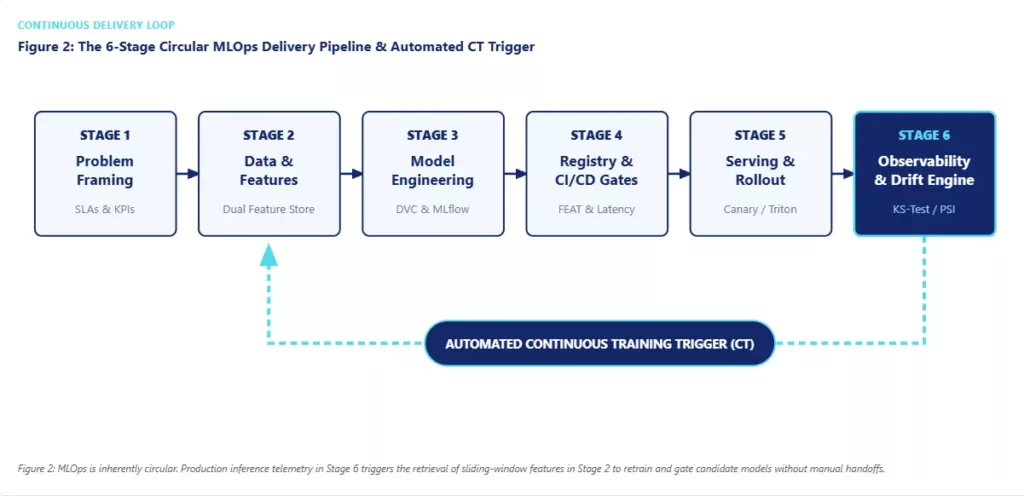
Lifecycle Rule of Thumb: An MLOps lifecycle is circular, not linear. The moment inference telemetry detects feature drift in Stage 6, it must programmatically trigger data extraction and continuous training in Stages 2 and 3.
Production machine learning operates as a closed-loop feedback lifecycle.
Mature enterprise MLOps architectures operate as an unbroken, circular feedback loop divided into six distinct operational stages:
The End-to-End Enterprise MLOps Lifecycle
| Stage | Core Activities |
|---|---|
| 1. Problem Framing | Business KPIs; latency and SLA bounds |
| 2. Data Engineering | Ingestion and validation; offline feature store |
| 3. Model Engineering | Experiment tracking; hyperparameter tuning |
| 4. Model Verification & CD | Automated CI/CD-CT gates; model registry sign-off; MAS FEAT governance |
| 5. Model Serving | Real-time, batch, and edge serving; canary and shadow deploys |
| 6. Monitoring & Drift | Data drift (KS test); concept drift (F1 drop); automated trigger that loops back to Stages 2 and 3 |
Stage 1: Business Problem Framing & Feasibility Assessment
Many failed ML projects begin with the same mistake: engineering a complex model without defining operational constraints.
Before writing a line of code, technical leadership must define three boundaries:
- The Performance Metric vs. Business KPI: A model that achieves 96% accuracy is commercially useless if its false-positive rate degrades customer retention. Align technical loss functions directly with business outcomes.
- Inference Latency Budgets: Does the business use case require real-time synchronous inference (under 50 ms via REST/gRPC), near-real-time streaming, or asynchronous scheduled batch processing?
- Resource Economics: What is the maximum acceptable cost per inference? High-accuracy large language models or deep neural networks that cost $0.15 per inference call will break unit economics for high-volume consumer workflows.
Stage 2: Data Engineering & The Feature Store
Data engineering in MLOps goes beyond standard ETL pipelines. It requires deterministic reproducibility.
- Data Validation Gates: Tools like Great Expectations or AWS Deequ validate incoming datasets against strict statistical schemas before training begins. Datasets containing missing values, unexpected nulls, or out-of-range numerical fields are rejected automatically.
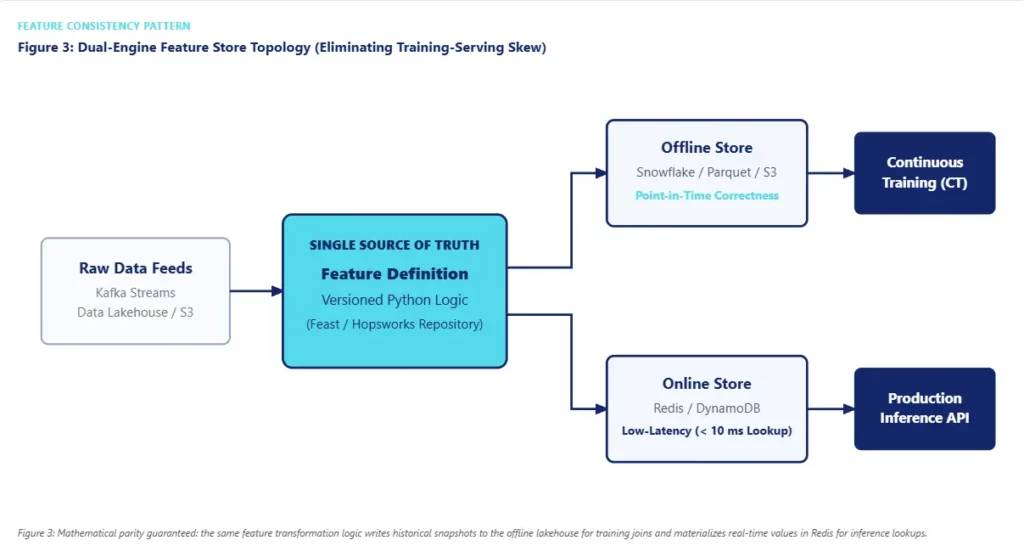
- The Dual-Engine Feature Store: In modern MLOps, a feature store (such as Feast or Hopsworks) acts as the single source of truth for curated features. It solves the critical problem of training-serving skew.
The Dual-Engine Feature Store Topology
| Layer | Typical Technology | Role |
|---|---|---|
| Raw data sources | Data warehouse, Kafka, object storage | Source of all transformations, which are declared once in versioned code |
| Offline store (historical data) | BigQuery, Snowflake, S3/Parquet | Point-in-time time-travel joins; feeds batch model training |
| Online store (low-latency cache) | Redis, DynamoDB, MemoryDB | Sub-10 ms key-value feature reads; feeds the real-time inference engine |
The offline store provides point-in-time correctness for model training, preventing data leakage from future events. The online store caches the exact same transformed features in high-speed memory for sub-10 ms inference retrieval.
Friction Point We Hit: Training-Serving Skew in Feature Transformations (Pandas vs. Go Discrepancy)
In a high-throughput transaction scoring deployment, data scientists engineered complex rolling 30-day transaction frequency features in Python using Pandas. When deploying to production, backend engineers re-implemented the transformation logic in Go microservices to meet a 20 ms API latency SLA.
Within weeks, live fraud classification accuracy degraded by 18%, despite the model passing all offline tests. The root cause was training-serving skew: subtle discrepancies between how Pandas handled UTC timestamp boundary windows and how Go calculated sliding windows produced different mathematical inputs for identical user transactions.
Vinova eliminated this failure mode by deploying a centralized feature store (Feast). Feature transformations are declared once in versioned code; the feature store then compiles the logic into an offline Parquet pipeline for historical training joins and continuously updates an online Redis cluster for real-time inference, guaranteeing mathematical consistency across training and serving.
Stage 3: Model Engineering, Experiment Tracking & Versioning
Model development is iterative and experimental. Data scientists test dozens of model architectures, loss functions, and hyperparameter combinations. Without disciplined tracking, these experiments become unreplicable.
- Experiment Tracking: Frameworks like MLflow, Weights & Biases, or Comet log every training run automatically: hyperparameters, dataset hashes, execution environments, compute metrics, and evaluation curves.
- Data and Pipeline Versioning: Tools like Data Version Control (DVC) or LakeFS track datasets alongside git commits. An engineer can check out any historical model commit and retrieve the exact dataset snapshot used to train it.
Stage 4: Automated CI/CD-CT & The Model Registry
Once a candidate model is trained, it must pass automated governance gates before touching production infrastructure.
- The Model Registry: A centralized repository (for example, MLflow Model Registry or AWS SageMaker Model Registry) that manages model artifact lifecycles across explicit stages: Draft → Staging → Production → Archived.
- Automated Verification Gates: The continuous integration pipeline runs pre-deployment model checks. Performance assertion: does the candidate outperform the current production “champion” across holdout test sets? Bias and fairness audits: does the model show disparate impact across protected sub-populations? Latency benchmarking: does it meet the 50 ms inference budget under simulated concurrency? Adversarial robustness: does it handle corrupted inputs and out-of-distribution edge cases without unhandled exceptions?
Stage 5: Model Serving & Deployment Topologies
Serving moves a trained model from serialized storage into live infrastructure.
Model Serving Architectures
| Pattern | Technical Topology | Typical Latency Budget |
|---|---|---|
| Real-Time (Sync) | REST / gRPC microservice (NVIDIA Dynamo-Triton, KServe) | 10 ms to 100 ms |
| Streaming (Async) | Event-driven consumer (Kafka, RabbitMQ, Flink) | 100 ms to 2 s |
| Batch Processing | Scheduled Spark / Ray distributed jobs | Minutes to hours (high throughput) |
| Edge Inference | On-device runtime (ONNX, TensorRT, CoreML) | Under 10 ms (no network round trip) |
Production deployment must decouple rollout from risk:
- Shadow Deployment: The new candidate model receives a clone of live production traffic in real time. Predictions are logged and evaluated for accuracy and latency, but never returned to end users.
- Canary Deployment: Route 2% of live traffic to the new model, gradually scaling to 100% as error rates and performance metrics remain stable.
- Blue-Green Deployment: Run parallel production environments, switching DNS or API gateway routing instantly with zero downtime.
Friction Point We Hit: GPU Memory Fragmentation & Inference Autoscaling Lags (The Python Serving Bottleneck)
During the production launch of an image inspection pipeline, the engineering team wrapped a deep PyTorch model inside a standard Python FastAPI container deployed on Kubernetes with Horizontal Pod Autoscaling (HPA).
Under sudden traffic spikes, the pods suffered two systemic failures. First, Python’s Global Interpreter Lock (GIL) created severe request concurrency bottlenecks. Second, spinning up cold GPU nodes took nearly 5 minutes to pull the 12GB container image and initialize CUDA drivers, causing 504 gateway timeouts during traffic surges.
Vinova resolved this by migrating the serving layer to NVIDIA Dynamo-Triton (formerly Triton Inference Server) paired with Kubernetes Event-driven Autoscaling (KEDA). Triton enables dynamic microsecond batching and shared memory instance pooling, while model weights were quantized from FP32 to INT8 via TensorRT. Together, these changes cut container memory and raised throughput on the same GPU instances, as the table below shows.
| Metric | Result |
|---|---|
| Container memory footprint | 68% lower |
| Concurrency throughput on the same GPU instances | 3.8x higher |
Stage 6: Observability, Drift Detection & Feedback Loops
The final stage is where MLOps proves its economic value: detecting and mitigating performance decay before it impacts the business.
The Silent Decay: Drift Detection Architecture
| Step | What Happens |
|---|---|
| 1. Inbound production traffic | Real-time payload logging feeds the observability engine. |
| 2. Observability engine (Evidently AI, Arize, Prometheus) | Runs data drift and concept drift checks over sliding windows. |
| 3. Automated alert or webhook trigger | Fires when drift breaches a pre-set tolerance. |
| 4. Continuous Training (CT) pipeline | Fetches a curated sliding-window dataset from the feature store, retrains on scalable compute (Ray / Kubernetes), validates the candidate against the champion model, and deploys automatically if the verification gates pass. |
4. Understanding Silent Decay: Data Drift vs. Concept Drift
Mathematical Rule of Thumb: Data drift is an input change; concept drift is a relationship change. If your model’s inputs look statistically identical to training data but prediction accuracy falls, you are experiencing concept drift.
Machine learning models fail in statistical silence.
Traditional software monitoring alerts on elevated error rates (HTTP 500s) or infrastructure saturation (CPU at 98%). In contrast, a failing machine learning model continues serving predictions with clean HTTP 200 responses and sub-20 ms latencies. The failure is statistical, not infrastructural.
Data Drift vs. Concept Drift
| Dimension | Data Drift (Covariate Shift) | Concept Drift (Relationship Shift) |
|---|---|---|
| What changes | The statistical distribution of the input features: P(X_prod) differs from P(X_train). | The relationship between inputs and target outputs: P(Y | X_prod) differs from P(Y | X). |
| Example scenario | An e-commerce platform expands into a new demographic, and user age shifts from the 22 to 30 range to the 45 to 60 range. | Macroeconomic inflation causes historically high-credit-score users to begin defaulting on payments. |
| Detection velocity | Immediate. Detected in real time without waiting for ground-truth business outcomes. | Delayed. Requires real-world ground-truth labels (for example, a loan default 90 days later). |
| Typical detection method | KS test, PSI, KL divergence on input features. | Ground-truth labels and performance metrics such as an F1 drop. |
Statistical Detection Methodologies
Enterprise observability engines run continuous statistical hypothesis tests over sliding windows of production inference data:
- Kolmogorov-Smirnov (KS) Test: A non-parametric statistical test that compares the cumulative distributions of continuous numerical features between training and production. If the p-value falls below a critical threshold (for example, 0.05), data drift is flagged.
- Population Stability Index (PSI): Extensively used in credit risk and financial engineering to quantify changes in feature distributions over time.
PSI = Sum over i = 1 to k of (Actual_i – Expected_i) x ln(Actual_i / Expected_i)
- PSI below 0.10: No significant distribution change; the baseline distribution is stable.
- PSI from 0.10 up to 0.25: Moderate drift; triggers observability warnings.
- PSI of 0.25 or higher: Significant distributional shift; triggers automated Continuous Training (CT) pipelines.
- Kullback-Leibler (KL) Divergence / Wasserstein Distance: Quantifies the relative entropy or distance between probability distributions, measuring how much information is lost when approximating production features with training baselines.
5. Enterprise MLOps Framework Maturity Model: Levels 0 to 2
Maturity Rule of Thumb: Do not jump from manual scripts to fully autonomous Level 2 pipelines in a single leap. Automate model training and pipeline execution (Level 1) before automating continuous production deployments (Level 2).
Organizational MLOps maturity evolves from manual notebooks to automated continuous training.
Google Cloud’s MLOps framework establishes three progressive levels of organizational maturity, and it is the most practical backbone for an enterprise MLOps framework roadmap:
The MLOps Maturity Spectrum
| Dimension | Level 0: Manual | Level 1: Pipeline | Level 2: Automated CI/CD-CT |
|---|---|---|---|
| Process | Script-driven; disconnected silos | Automated, modular training pipeline | Automated CI/CD for both pipeline and ML code |
| Retraining | Infrequent, manual updates | Continuous Training (CT) triggered by data, schedule, or drift | Drift-driven retraining with no human intervention |
| Tracking & registry | No tracking | Model registry in place | Model registry plus real-time feature store |
| Deployment | Bespoke wrapper code | Manual deployment of the pipeline itself | Production canary rollouts through CI/CD-CT gates |
Level 0: Manual Process (Jupyter Notebooks Thrown Over the Wall)
- Characteristics: Data scientists build models locally in isolated notebooks. Feature transformations, hyperparameter sweeps, and validation are driven by manual execution.
- Handoff: The trained model (a .pkl or .onnx file) is emailed or pushed to a shared folder. Software engineers write bespoke wrapper code to expose the model as an API.
- The Failure Mode: Zero reproducibility. No link exists between the model artifact and the data used to train it. Upgrades take months, and deployment is a high-risk operational event.
Level 1: Automated ML Pipeline (Continuous Training)
- Characteristics: The model training process is converted into an automated, modular pipeline (for example, Kubeflow Pipelines, Airflow, or Vertex AI Pipelines).
- Continuous Training (CT): The pipeline is triggered automatically by new data availability, scheduled cron jobs, or drift detection alerts.
- The Gap: While the training pipeline is automated, deploying the pipeline itself remains a manual engineering process. Code and pipeline deployments are disconnected from automated CI/CD gating.
Level 2: Fully Automated CI/CD-CT Pipeline
- Characteristics: Complete automation of both the ML pipeline and the underlying software delivery lifecycle.
- End-to-End Orchestration: When an engineer pushes new algorithmic code, an automated CI/CD pipeline tests data transformations, runs integration suites, builds container images, and deploys the new pipeline into production.
- Automated Feedback Loop: Production monitoring detects statistical drift, automatically triggering the pipeline to retrain, validate against the champion model, and execute a canary deployment with zero human intervention.
Vinova Field Insight: Scaling an Automated Continuous Training Pipeline for an APAC FinTech Engine
A Singapore-headquartered B2B payment orchestration and digital wealth platform was scoring customer transaction risk with manual, monthly Level 0 machine learning workflows.
The Operational Bottleneck: Training and deploying an updated risk model took 16 weeks of manual data extraction, Jupyter notebook execution, and custom Go API wrapping. Because consumer spending patterns shifted across APAC corridors, the models suffered silent concept drift. Within 6 months, false-positive transaction blocks rose by 24% and undetected fraud losses rose by 14%, while production inference endpoints kept returning clean HTTP 200 responses.
The Vinova Solution: (1) Centralized Feature Store: integrated Feast backed by Snowflake (offline historical joins) and Redis (online caching under 8 ms), eliminating training-serving skew across transaction features. (2) Automated Continuous Training (CT) Pipeline: containerized Kubeflow DAGs orchestrated on Kubernetes, triggered automatically whenever incoming sliding-window data breached a PSI of 0.20 or higher, as measured by Evidently AI. (3) Automated Champion-Challenger Gating: CI/CD-CT verification gates that evaluate fairness against Singapore MAS FEAT guidelines, latency compliance (under 35 ms under concurrency), and AUC-ROC superiority before an automated canary deployment via NVIDIA Dynamo-Triton.
The Measurable Impact: Retraining went from a 16-week manual project to an automated loop that runs without human intervention, and the platform stopped losing money to drift it could not see. The full results are in the table below.
| Metric | Before | After |
|---|---|---|
| Model retraining and deployment cycle | 16 weeks, manual | Under 2 hours, automated |
| Transaction false positives | Up 24% over 6 months of silent drift | Reduced by 38% |
| Undetected fraud losses | Up 14% over the same 6 months | Over $480,000 USD saved annually in prevented fraud losses |
| Inference SLA uptime | Not reported | 99.95% |
| Silent drift outages | Not reported | 0 across 18 consecutive months of production traffic |
Explore Vinova’s AI & Machine Learning Services
See how the feature store, continuous training, and governance patterns in this guide apply to your own production models.
6. Modern MLOps Architecture & Tooling Stack
Tooling Rule of Thumb: Do not build custom infrastructure where standardized open-source or managed cloud primitives exist. Optimize your stack for developer ergonomics and data governance, not tool collection.
Enterprise tooling balances managed cloud convenience against modular, open-source control.
The MLOps ecosystem features two dominant architectural strategies: unified cloud platforms and modular open-source stacks.
The 2026 MLOps Tooling Topology
| Operational Layer | Common Enterprise Tooling |
|---|---|
| 1. Data Validation | Great Expectations, AWS Deequ, Soda Core |
| 2. Feature Store | Feast (open source), Hopsworks, cloud-native feature stores |
| 3. Experiment Tracking | MLflow, Weights & Biases, Comet |
| 4. Pipeline Orchestrator | Kubeflow Pipelines, Apache Airflow, Prefect |
| 5. Model Registry | MLflow Model Registry, SageMaker Model Registry |
| 6. Model Serving | NVIDIA Dynamo-Triton (formerly Triton Inference Server), KServe, BentoML |
| 7. Model Observability | Evidently AI, Arize AI, Fiddler, Prometheus |
Verify vendor status before you standardize. NVIDIA Triton Inference Server is now NVIDIA Dynamo-Triton, Neptune.ai was discontinued in March 2026 after its acquisition by OpenAI, and TorchServe is no longer actively maintained, so it receives no security patches. The market consolidates quickly; a tool that was a safe default two years ago may not be one today.
Strategy A: Unified Cloud Platforms (AWS SageMaker, Azure ML, Google Vertex AI)
- Advantages: Integrated security, IAM role inheritance, pre-configured networking, automated billing, and managed infrastructure scaling.
- Disadvantages: High vendor lock-in, premium cloud resource markups, and limited flexibility to integrate custom edge runtimes.
- Best For: Mid-market enterprises and financial institutions already committed to a single hyperscaler ecosystem.
Strategy B: Modular Open-Source Stack (Kubeflow, MLflow, Feast, Triton)
- Advantages: Complete architectural portability across multi-cloud and on-premise environments, zero vendor license fees, and granular optimization of underlying compute hardware.
- Disadvantages: Requires dedicated platform engineering teams to maintain, patch, and orchestrate the underlying Kubernetes infrastructure. Whether to build that team yourself or bring in a partner is covered in in-house vs outsourced MLOps.
- Best For: High-volume AI product companies, robotics firms, and enterprises operating across hybrid cloud environments.
7. Enterprise Governance, Security & FinOps in MLOps
Governance Rule of Thumb: In regulated machine learning systems, explainability is not an ethical option; it is an audit requirement. Every prediction must trace to its exact code commit, training data hash, and feature attribution coefficients.
Production AI systems require fiduciary auditability and compute discipline.
In regulated enterprise environments, MLOps intersects directly with corporate risk management, legal compliance, and cloud financial operations (FinOps).
Fiduciary Governance & The MAS FEAT Framework
For financial institutions and enterprise scale-ups in Asia-Pacific, deploying machine learning systems requires adherence to regulatory governance frameworks such as the Monetary Authority of Singapore (MAS) FEAT Principles (Fairness, Ethics, Accountability, and Transparency) and the international ISO/IEC 42001 standard for Artificial Intelligence Management Systems. MAS has since built on FEAT with proposed Guidelines on AI Risk Management, which it consulted on from November 2025, and an AI Risk Management Toolkit published in March 2026. Confirm the current status of those documents with your compliance team when you scope controls.
- Accountability & Full Lineage: Every production prediction must be traceable back to the exact model version, the training pipeline execution ID, the training dataset snapshot hash, and the code commit that generated it.
- Fairness & Disparate Impact Auditing: Automated CI/CD gates must evaluate models for demographic parity and equalized odds, blocking candidate deployments that introduce disparate predictive outcomes across protected customer attributes.
- Explainability (SHAP / LIME): Complex ensemble models must be paired with automated feature attribution frameworks, so customer-facing systems can explain why a specific automated credit, insurance, or fraud decision was reached.
Model Security: Defending the ML Attack Surface
Machine learning models introduce distinct cybersecurity attack vectors:
- Data Poisoning: Adversaries inject malicious samples into public or unvalidated training data pools to manipulate model boundaries. Mitigated through cryptographic data validation and hash verification.
- Model Inversion & Membership Inference: Attackers query public inference endpoints to reconstruct private training data records. Defended by enforcing differential privacy and rate-limiting inference APIs.
- Model Stealing: Competitors query endpoints to train surrogate models. Protected via API authentication, tokenized IAM access, and anomaly detection on scraping patterns.
Inference FinOps: Managing GPU and Compute Economics
Uncontrolled inference and training costs are a fast-growing cloud balance-sheet drain:
- Dynamic GPU/CPU Scheduling: Route low-complexity inference traffic to optimized CPU instances; reserve expensive GPU clusters (for example, NVIDIA A100/H100) for high-concurrency transformer workloads.
- Model Optimization & Quantization: Apply post-training quantization (converting FP32 weights to INT8 or FP16), model pruning, and ONNX Runtime optimizations to compress model memory footprints by up to 75% without sacrificing prediction accuracy.
- Autoscaling to Zero: Scale down idle inference endpoints during off-peak hours using Kubernetes Event-driven Autoscaling (KEDA) or serverless inference runtimes.
8. When MLOps Is Over-Engineering (The Disqualification Heuristic)
Disqualification Rule of Thumb: An MLOps platform is an investment in velocity and safety for active production models. If your model doesn’t need to be retrained, or your business problem is better solved with a SQL heuristic, do not build an MLOps pipeline.
Do not build an MLOps platform for problems best solved by deterministic heuristics. Knowing what is MLOps also means knowing when it is the wrong tool.
MLOps is an essential operational investment for organizations running high-velocity, production-grade machine learning systems. It is an expensive distraction for teams that do not need it.
MLOps Disqualification Decision Tree
| If Your Scenario Is: | Then the Better Approach Is: |
|---|---|
| Model is retrained once a year or less | Manual script plus a simple Docker deployment |
| Data distribution is static and unchanging | Standard REST API deployment |
| Business logic fits in a SQL or rule query | Simple deterministic heuristics |
| Team lacks a validated production model | Focus on model-market fit first |
You do not need a complex MLOps architecture if:
- Your Problem Can Be Solved with Heuristics: If a set of deterministic business rules, decision trees, or SQL queries delivers 85% of the business outcome, deploy the rules. Do not deploy a probabilistic machine learning model where simple software logic suffices.
- Your Model Retrains Once a Year: If you are building a static macroeconomic forecasting model updated once every twelve months, building automated continuous training pipelines is a waste of engineering bandwidth. Run a manual, audited script.
- You Do Not Yet Have a Validated Model in Production: Do not spend six months building a multi-cloud feature store and drift detection mesh before validating that your model delivers measurable commercial value. Ship a basic containerized baseline, prove the ROI, and build the MLOps platform as scale demands it.
9. Frequently Asked Questions (FAQ)
What is MLOps in simple terms?
MLOps is machine learning operations: the set of practices and tooling that takes a model from a notebook into reliable production and keeps it accurate over time. It automates training, testing, deployment, and monitoring, and adds the one thing traditional DevOps lacks, which is continuous checks on whether the live data still looks like the data the model learned from.
What is the difference between MLOps and LLMOps?
LLMOps is a specialized sub-discipline of MLOps tailored to Large Language Models (LLMs) and Generative AI applications. Classical MLOps focuses on tabular, image, or audio models trained from scratch, and emphasizes feature stores, numerical data drift, and statistical accuracy metrics (F1, AUC). LLMOps focuses on pre-trained foundation models and prioritizes prompt engineering, vector database management (RAG), parameter-efficient fine-tuning (PEFT/LoRA), hallucination tracking, context-window optimization, and output safety guardrails.
What is the difference between MLOps and DevOps?
The mlops vs devops distinction comes down to what each discipline governs. DevOps manages one mutable vector, code, and fails loudly with errors and outages. MLOps governs three, code, data, and model weights, and fails silently, because a degrading model keeps returning clean HTTP 200 responses. That is why MLOps adds Continuous Training (CT), data validation gates, and drift monitoring on top of the CI/CD foundation DevOps already provides.
What is an enterprise MLOps framework?
An enterprise MLOps framework is the combination of lifecycle stages, tooling, and governance controls that lets an organization run machine learning models reliably at scale. In practice it covers six lifecycle stages (problem framing through drift monitoring), a defined maturity target (Level 0, 1, or 2), a tooling stack for validation, features, tracking, registry, serving, and observability, and the auditability, security, and FinOps controls that regulated industries require.
What are the minimum tools required to start with MLOps?
A minimal, production-grade MLOps starter stack requires three components. Version control for code and data: Git paired with Data Version Control (DVC) or S3 dataset versioning. Experiment tracking and a model registry: an open-source MLflow instance to log training metrics and manage model artifact versions. Automated deployment and serving: a Dockerized container runtime on a managed Kubernetes cluster or cloud container service (for example, AWS ECS or Google Cloud Run) behind standard CI/CD pipelines such as GitHub Actions.
How often should machine learning models be retrained in production?
Retraining frequency depends on the velocity of data drift in your business domain. High-volatility environments such as real-time ad bidding, financial fraud detection, and algorithmic trading require daily or hourly retraining. Moderate-volatility environments such as e-commerce recommendation engines, churn prediction, and demand forecasting typically retrain weekly or bi-weekly. Low-volatility environments such as industrial defect inspection or document OCR often run reliably for months without retraining, updating only when manufacturing tooling or physical packaging changes.
How does an enterprise calculate the ROI of an MLOps platform?
ROI is measured across three vectors. Time-to-production velocity: compressing model deployment timelines from 4 to 6 months down to hours or days. Operational engineering efficiency: reducing the manual overhead of maintaining models so data scientists can focus on research instead of operational firefighting. Risk mitigation: detecting silent data and concept drift before degraded accuracy causes revenue loss, regulatory non-compliance, or customer churn.
Accelerate Your AI & MLOps Maturity with Vinova
Deploying enterprise machine learning should accelerate your digital products, not stall in operational complexity. Now that you have the answer to what is MLOps, the next step is sizing the architecture for your own models.
For 16+ years, Vinova has partnered with leading technology scale-ups, multinational enterprises, and government agencies across Singapore, Australia, and the US to build scalable digital systems, secure cloud architectures, and production AI platforms:
- Singapore Corporate Governance: Master Services Agreements governed under Singapore law, so intellectual property ownership and accountability are defined before the first model ships.
- Regulatory Compliance & ISO Standards: Delivery operations certified under ISO/IEC 27001:2022 (Information Security) and ISO 9001:2015 (Quality Management), GovTech Category 1B approved, with systems designed to align with MAS Technology Risk Management (TRM) and FEAT governance principles.
- Enterprise AI & MLOps Engineering: Dedicated engineering pods specializing in scalable feature stores, automated CI/CD-CT pipelines, and model observability, so models stay accurate after launch day, not just on it.
- Engineering Depth: 300+ in-house engineers across Singapore and Vietnam delivery hubs, with 8% to 12% annual voluntary attrition, so the people who build your pipelines are still there to run them.
Ready to operationalize your machine learning models? Explore our AI and machine learning services or schedule an architecture consultation with our AI systems directors today.
Vinova: a Singaporean Government-Grade Digital Transformation Partner, Made Accessible. For 16 years, we have designed digital systems for 300+ companies and government agencies worldwide, backed by ISO 27001:2022 and ISO 9001:2015 certification and Singapore GovTech Category 1B approval.
300+ employees across offices in Singapore, Vietnam (Hanoi, Da Nang, Ho Chi Minh City), Norway (Oslo), and Thailand (Bangkok), scaling platforms and engineering capacity to serve clients across the globe.
Financial Times Top 500 High-Growth Companies Asia-Pacific 2026. Recognized among Singapore’s Top 100 Fastest-Growing Companies in 2024, 2025, and 2026.