By Vinova Systems Practice · 13-minute read
Every quote you collect for an app will be correct, and no two will match. One agency says S$15,000, another says S$180,000, and both are describing a real app. The difference is not greed or discounting. It is scope, platform, team location and what happens after launch, and a quote that does not spell those out cannot be compared with another.
Quick Answer: App development cost in Singapore runs from about S$15,000 for a basic Minimum Viable Product (MVP) to S$250,000 or more for an AI-powered enterprise platform. A medium-complexity commercial app typically lands between S$30,000 and S$80,000. Plan for annual maintenance of 15% to 20% of the build cost on top, because the build price is the entry fee, not the total price.

Table of Contents
Key Takeaways
- Scope Sets the Price: Screens, integrations, roles and AI features drive cost far more than the choice of agency. Fix the scope before you compare quotes.
- Cross-Platform Usually Wins on Budget: Flutter or React Native can share most of the code between iOS and Android, and that is commonly reported to cut platform engineering hours by 30% to 40% against two native builds.
- Maintenance Is a Recurring Line: Budget 15% to 20% of the initial build each year for operating system updates, security patches and iterative features.
- Team Location Changes the Rate: A hybrid model, with senior leads in Singapore and engineers in Vietnam, can lower the blended hourly rate substantially without losing architectural control.
1. What the Market Charges: Cost by Complexity Tier
Pricing spans a wide range because “an app” covers everything from a booking form to a real-time, AI-assisted platform. A wide range is not a sign that anyone is overcharging. It reflects what each app has to do.
Complexity is the main driver of development time and cost. It covers screen count, database queries, role-based access and the intricacy of the backend logic:
| Tier | What it includes | Typical cost | Typical timeline |
|---|---|---|---|
| Simple MVP | Core user journeys, standard UI components, basic authentication, lightweight database use. Ideal for early market validation | S$15,000 to S$30,000 | 6 to 10 weeks |
| Medium complexity | Custom UI/UX design, payment gateway integrations such as Stripe or PayNow, role-based permissions, push notifications and real-time data sync | S$30,000 to S$80,000 | 8 to 16 weeks |
| Complex and enterprise | On-device or API-driven AI, live geolocation, streaming audio and video, high-throughput microservices and rigorous enterprise security controls | S$80,000 to S$250,000+ | 14 to 28 weeks |
Some Singapore agencies publish ranges that open higher, with S$300,000+ at the top, or that start enterprise builds from S$85,000. Treat any published range as a pointer, not a price, because actual expenditure depends on feature scope, technical architecture and team composition.
To place a real project on this scale: a localized service MVP sits near the S$15,000 to S$30,000 band. An end-to-end commercial operations platform belongs in the enterprise tier. One example is the on-demand dispatch and facility management ecosystem we built for a facilities services group, with SAP and bank payment integrations, where data sync and strict uptime requirements drive the scope.
1.1 How Prices Have Moved Since 2021
Market-reported ranges for custom apps in Singapore have drifted upward as local developer pay, infrastructure complexity and compliance work have grown:
| Year | Reported range |
|---|---|
| 2021 | Simple single-platform apps from S$10,000 to S$15,000; custom builds with full UI/UX and a scalable backend up to S$90,000 |
| 2022 | Basic MVPs from S$15,000 to S$50,000; custom APIs or third-party gateways pushed budgets to S$65,000 |
| 2023 | Entry-level MVPs from S$22,000 to S$45,000; medium builds from S$45,000 to S$70,000; high-complexity systems above S$100,000 |
| 2024 | Custom apps from S$15,000 to S$150,000+ |
| 2025 to 2026 | Basic MVPs from S$15,000 to S$30,000; AI-powered, real-time enterprise platforms from S$80,000 to S$250,000+ |
The trend matches the cost trajectory we have tracked for APAC projects. Talent demand, mandatory compliance work such as the Personal Data Protection Act (PDPA) and cybersecurity frameworks, and higher user expectations for performance all push the same way.
The Rule: A quote with no written scope is not a price. It is an opening bid for the arguments you will have in month three.
2. App Development Cost Breakdown: The Factors That Move the Price
Understanding pricing means looking at the technical and operational inputs, not at a flat estimate.
2.1 UI/UX Design
Design affects adoption and retention directly. Software teams typically allocate about 15% to 25% of the total budget to UX and UI design. That money buys user research, wireframes, interactive prototypes and a design system, and it prevents the expensive engineering re-work that follows a rushed interface.
2.2 Cross Platform vs Native App Cost: Where Frameworks Save Money
Native development (Swift for iOS, Kotlin for Android) means two codebases and two engineering teams, which nearly doubles early development overhead. Modern cross-platform frameworks such as Flutter and React Native have matured into standard production choices. They let teams share roughly 80% to 90% of the business logic across both platforms, and cross-platform delivery is commonly reported to cut platform engineering hours by 30% to 40%, with near-native performance.
The exception is software that needs hardware-level work, such as custom camera pipelines or kernel-level access. For those, native code earns its cost.
2.3 Features and Functionality
Effort follows feature complexity. A profile screen takes modest hours. Payment integrations, real-time chat, matching algorithms and Large Language Model (LLM) recommendation engines need extensive API handling and testing:
| Example | Scope | Typical cost |
|---|---|---|
| Basic dating or directory MVP | Standard profiles and list feeds | S$20,000 to S$30,000 |
| Enterprise-grade version | Intelligent matchmaking, low-latency video streaming, in-app billing and multi-tier moderation | S$120,000 to S$180,000+ |

2.4 Security and Compliance
Apps that hold personal data need security testing and privacy design from the start. Section 24 of the PDPA requires reasonable security arrangements for the personal data you hold, which adds penetration testing, encryption and access-control work to the plan. Leaving it out of the estimate does not remove it from the project. It moves it to the end, where it costs more.
For public sector and regulated buyers, the checklist is longer. Ask whether your partner has delivered on Singapore government cloud patterns, such as the Government Commercial Cloud, and whether the app feeds a Security Information and Event Management (SIEM) stack such as Splunk, AWS Security Hub or Amazon GuardDuty. Also ask whether a formal Vulnerability Assessment and Penetration Testing (VAPT) sign-off is part of the plan before store deployment.
3. Mobile App Development Cost in Singapore by Phase
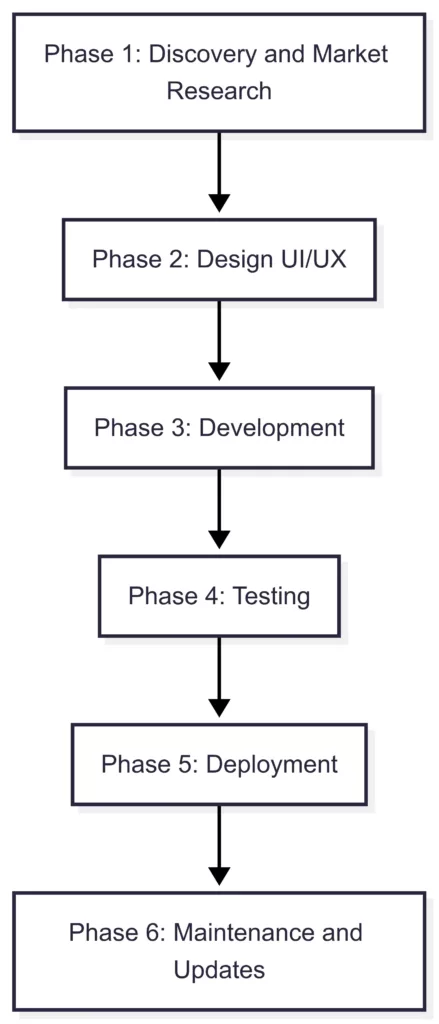
A delivery lifecycle has six phases, and each one has its own cost:
| Phase | What happens | Typical cost |
|---|---|---|
| 1. Discovery and technical scoping | System architecture, user stories, cloud infrastructure, third-party integrations and compliance requirements | S$2,000 to S$7,000 |
| 2. UI/UX design and prototyping | Wireframes, user journey mapping, design systems and clickable high-fidelity prototypes, validated before sprint coding | S$6,000 to S$20,000 |
| 3. Architecture and development | Frontend client, backend API, database configuration and third-party integrations. Roughly 50% to 60% of the overall budget | S$15,000 for a simple MVP, up to S$150,000+ for enterprise multi-service platforms |
| 4. Quality assurance and security testing | Manual usability audits, automated regression suites, network latency handling and security vulnerability scans | S$3,000 to S$15,000 |
| 5. Deployment and store approvals | Apple App Store (US$99 a year for the developer program), Google Play Console (a one-time US$25 registration fee), privacy manifest documentation and production cloud setup | Store fees plus setup time |
| 6. Maintenance and upgrades | Annual iOS and Android version changes, cloud security patches and iterative feature releases | 15% to 20% of the build cost, every year |
3.1 The Total Cost of Ownership Formula
For a build of cost CBuild, annual maintenance at a rate m and an ownership period of n years, the total cost of ownership is:
Where m typically sits between 0.15 and 0.20.
| Input | Value |
|---|---|
| Medium-complexity build | S$60,000 |
| Annual maintenance at 15% to 20% | S$9,000 to S$12,000 a year |
| Three-year total cost of ownership | S$87,000 to S$96,000 |
That figure excludes cloud hosting, third-party API fees and new features, which are budgeted separately.
3.2 App Maintenance Cost in Singapore: Budgeting 15% to 20% a Year
Mobile apps need continuous updates to support annual Apple and Google operating system changes, third-party API refreshes and security compliance. Budgeting 15% to 20% of the initial development cost each year keeps the system reliable and prevents emergency refactoring, which is always priced at a premium.
What an enterprise support agreement buys is more specific than a percentage:
| Coverage | What it provides |
|---|---|
| Business hours | Dedicated support engineers and a service delivery manager handle incidents and change requests |
| Critical (Severity 1) incidents | 24/7 escalation to program managers and account directors |
| Handover and reporting | Regular VAPT reports, maintenance logs and business continuity and disaster recovery (BCDR) plans |
3.3 What Quality Assurance Looks Like Before Launch
The QA phase is where release-day surprises get removed. A structured framework runs these checks before anything reaches production:
- Automated Test Layers: Unit, integration and end-to-end tests run on every build, with end-to-end flows driven by tools such as Playwright.
- Load and Stress Testing: Endurance runs of at least 60 minutes under simulated load, using tools such as JMeter, so memory leaks and slow queries show up before your users find them.
- Defect Tracking: Defects are logged in Jira against severity levels, and regression suites run overnight so every morning starts with a clean picture.
This rigor keeps release-day failures rare and the total cost of ownership predictable.
4. MVP App Development Cost in Singapore: Scoping to Control the Budget
Scope creep is the main reason development budgets overrun. An MVP is the answer, if you hold the line on what goes in it.
- Include: Onboarding, the one core workflow that tests product-market fit, a standard payment integration and basic notifications.
- Leave for Later: AI features, multi-tier moderation, admin analytics, social feeds and any second user role. Each one is a separate quote.
A disciplined MVP in the S$15,000 to S$30,000 range can reach the stores in 6 to 10 weeks, and the first real users will tell you which of the postponed features actually matter. Those users are worth more than any feature list written in advance.
5. Five Strategic Levers to Lower Mobile App Development Costs Without Sacrificing Quality
Capital efficiency comes from delivery discipline, not from cutting corners.
5.1 Adopt a Hybrid Delivery Model: Singapore Strategy Plus Vietnam Engineering
An in-house team staffed entirely in Singapore commonly costs S$6,000 to S$10,000+ a month per senior developer. Unmanaged freelancer models can save on rate but often add communication friction and technical debt.
The hybrid model pairs senior solution architects, UI/UX strategists and project leads in Singapore, for local compliance and business alignment, with dedicated engineering teams in Vietnam. It can cut blended hourly rates by 40% to 60% while keeping architectural rigor. Vietnam is only one hour behind Singapore, so daily stand-ups and live reviews are practical.
The hybrid model is not an experiment for us. Our long-term work for a regional banking group’s digital markets unit ran on it, and Section 9 shows the results.
- The Catch: It depends on strong product ownership and written specifications. A vague brief costs the same in any time zone.
5.2 Build an Aggressively Scoped MVP First
Prioritize the core journey and test it before you fund secondary modules. See Section 4 for MVP app development cost in Singapore and for what belongs in the first release.
5.3 Leverage Cross-Platform Frameworks
Unless your app needs hardware-level work, Flutter and React Native remove the need for duplicate codebases and reduce developer headcount and QA cycles by a commonly reported 30% to 40%.
5.4 Automate QA and Shift Testing Left
Fixing a defect after launch typically costs several times more than fixing it during an active sprint. Continuous integration and automated test suites from day one protect the budget from surprise hotfixes. Vinova’s delivery benchmarks, tracked with the DevOps Research and Assessment (DORA) metrics, show what that discipline looks like:
| Metric | Vinova benchmark |
|---|---|
| Deployment frequency | On demand |
| Lead time for changes | Under 1 day |
| Change failure rate | Under 5% |
| Mean Time to Restore (MTTR) | Under 1 hour |
| Defect density (business applications) | Under 10 defects per 1,000 lines of code |
5.5 Budget 15% to 20% Annually for Maintenance
Plan the recurring line before you sign, so launch day is not the first time anyone discusses it. See Section 3.2.
Practitioner Verdict: Fine to spend less, so long as the saving comes from scope and delivery model, not from skipping testing.
Explore Vinova’s Mobile App Development Services
Vinova can review your scope and any quotes you hold, and show you where the money goes.
6. What Singapore Users Expect: Benchmarks That Shape Your Budget
Singapore’s mobile market is mature, and users judge a new app against the best ones on their phone.
| Category | What users expect | What it does to cost |
|---|---|---|
| Social media | Fast feeds and chat. Singapore had 5.33 million social media user identities in October 2025, about 90.6% of the population, and people spend roughly 17 hours a week on social platforms (DataReportal, Digital 2026) | Real-time messaging, moderation and push infrastructure |
| Transport and super apps | Reliable routing and payments. Government tools such as MyTransport.SG sit alongside Grab and Gojek, and Grab’s super-app model sets the benchmark for combining rides, payments and logistics | Geolocation, payment integrations and high availability |
| Food delivery | Live tracking, dynamic dispatch and fault-tolerant payments, as on GrabFood and foodpanda | Logistics tracking and payment resilience |
| E-commerce and social commerce | Mobile-first checkout, biometric login and omnichannel integration, with Shopee, Lazada and TikTok Shop setting the pace. Singapore’s digital economy gross merchandise value was projected at US$29 billion in 2025 (e-Conomy SEA 2025) | Payment gateways, inventory sync and personalization |
6.1 Where These Tiers Come From
The tiers behind app development cost in Singapore reflect software delivered here, not hypothetical estimates. Client names stay confidential, so here is the work by sector and context:
| Project context | What it involved | What it shows about cost |
|---|---|---|
| A facilities services group | On-demand consumer and commercial facility management mobile platforms, with SAP and bank payment integrations | Integrations and uptime requirements push an app into the enterprise tier |
| A regional banking group’s digital markets unit | A regulated fintech platform built by a hybrid pod of more than 20 engineers | Compliance and scale drive team size and testing effort |
| A payments fintech and a fintech startup | Regulated payment and financial applications | Regulatory scope moves a medium-complexity build upward |
| Singapore public sector and institutional clients | Apps for a government technology agency, a statutory intellectual property agency and a polytechnic’s innovation and enterprise programs | Security sign-off and accessibility add to the plan |
| A luxury automotive brand | A customer experience app | Brand-critical design raises UI/UX investment |
7. Choosing a Delivery Model: Freelancer, In-House, Agency or Hybrid
Four options cover most Singapore projects.
| Dimension | Freelancer | In-house team | Singapore-only agency | Hybrid Singapore and Vietnam partner |
|---|---|---|---|---|
| Cost | Lowest rate | Highest fixed overhead: salary, Central Provident Fund (CPF) and recruiting | High hourly rate | A lower blended rate with local leadership |
| Team depth | One person’s skills | Whatever you can hire | Full team | Full team, scaled to the phase |
| Continuity | Exposed to one person | Exposed to turnover | Contractual | Contractual |
| Compliance and local context | Variable | Strong | Strong | Strong, through Singapore leads |
Option A: Freelancer
- Where It Works: A small, well-defined build, such as a prototype or a single feature.
- The Catch: Key-person dependency. If the freelancer disappears, the knowledge goes with them.
- Best for: Founders testing an idea on a tight budget.
Practitioner Verdict: Good for a prototype. Risky as the foundation of a product.
Option B: In-House Team
- Where It Works: Companies whose product is the app and who will keep building for years.
- The Catch: Hiring takes months, and idle capacity costs money between releases.
- Best for: Organizations with a long roadmap and the budget to carry a permanent team.
Practitioner Verdict: Right for a company that lives in its app. Heavy for a first version.
Option C: Singapore-Only Agency
- Where It Works: Projects with heavy local stakeholder involvement and tight compliance needs.
- The Catch: The highest hourly rate of the agency options.
- Best for: Teams that value proximity above price.
Practitioner Verdict: Strong on proximity. Higher cost per engineering hour.
Option D: Hybrid Singapore and Vietnam Partner
- Where It Works: Most startup and mid-market builds that need local leadership and cost-efficient engineering.
- The Catch: It needs clear specifications and one accountable product owner on your side.
- Best for: Companies that want senior oversight and a team that scales with the build phases.
Practitioner Verdict: The practical default for most budgets, as long as the scope is written down.
8. How to Read an App Development Quote
A useful quote itemizes the work, so you can compare like with like. Ask for each line:
| Line item | The question to ask |
|---|---|
| Discovery and scoping | Is the scope document included, and do I own it? |
| UI/UX design | How many screens, and how many revision rounds? |
| Platforms | iOS, Android or both, and native or cross-platform? |
| Backend and integrations | Which third-party services, and who pays their fees? |
| QA and security testing | What is tested, and does it include a penetration test? |
| Store submission | Who owns the developer accounts? |
| Cloud hosting | What is the monthly run cost after launch? |
| Warranty and maintenance | How long are defects fixed free, and what does the retainer cost? |
| Intellectual property | When does ownership of the code transfer to me? |
Ask your partner to show ISO/IEC 27001:2022 certification for the environments that will hold your data. For apps that handle Singapore residents’ data, confirm experience with Government Commercial Cloud deployments, VAPT audits and your data protection obligations under the PDPA, plus MAS requirements if you are a financial institution. Missing evidence at security sign-off can halt a project late, when delay is most expensive.
Two contract points are worth settling early. Ask for the source code and design files to be assigned to you as they are created, using an assignment of future copyright under Section 140 of the Copyright Act 2021, and for the contract to be governed by the laws of the Republic of Singapore, with arbitration at the Singapore International Arbitration Centre (SIAC) under its Arbitration Rules, with Singapore as the seat. Have your legal counsel review the final wording before signing.
9. What Vinova Offers: Mobile App Delivery From Estimate to Support
Mobile app development cost in Singapore only makes sense when you know what the price includes. Here is what a Vinova engagement covers, and the delivery record behind it.
9.1 What a Vinova App Engagement Covers
| Service | What it covers |
|---|---|
| Discovery and scoping | System architecture, user stories, integrations and compliance requirements, documented before design starts |
| UI/UX design and prototyping | User research, wireframes, design systems and clickable prototypes validated before sprint coding |
| Mobile engineering | iOS and Android apps, native or cross-platform with Flutter and React Native, plus backend APIs and cloud setup |
| Enterprise integration | Connections to systems such as SAP and to bank payment services |
| QA and security testing | Automated unit, integration and load testing, with a formal VAPT sign-off before store deployment |
| Hybrid delivery | Senior leads in Singapore with dedicated engineering teams in Vietnam, run on a structured Agile offshore development center (ODC) model |
| Support and maintenance | Business-hours support, 24/7 escalation for Severity 1 incidents, maintenance logs and business continuity and disaster recovery plans |
9.2 Delivery Stories
Client names stay confidential. The work is described by sector and context.
Vinova Field Insight: On-Demand and Facility Management Apps for a Facilities Services Group
The Challenge: A facilities services group needed mobile platforms for two audiences, consumers booking on-demand services and commercial clients managing facilities, both connected to its enterprise systems.
The Approach: Vinova built both platforms with dynamic dispatch, SAP connectivity and bank payment integrations, designed around strict uptime and data synchronization requirements.
The Result: The platforms were delivered as an end-to-end operations ecosystem. It is the reference we use when we scope integration-heavy apps into the enterprise tier.
Vinova Field Insight: A Hybrid Engineering Pod for a Regional Banking Group’s Digital Markets Unit
The Challenge: A regional banking group’s digital markets unit needed regulated fintech software delivered over a long-term engagement, with enterprise compliance requirements.
The Approach: Vinova ran a pod of more than 20 engineers on its structured Agile ODC model, with delivery tracked against the DevOps Research and Assessment (DORA) metrics.
The Result:
| Metric | Result |
|---|---|
| Development velocity | 60% higher |
| Change failure rate | Under 5% |
| Mean time to restore | Under 1 hour |
We have also delivered apps for Singapore public sector and institutional clients, including a government technology agency, a statutory intellectual property agency and a polytechnic’s innovation and enterprise programs, and for payments and fintech companies. Section 6.1 sets these out by context.
9.3 Credentials and Compliance
- Certified Environments: ISO/IEC 27001:2022 for information security and ISO 9001:2015 for quality management.
- Experience: 16+ years of engineering (founded 2010), with 300+ delivered systems across 300+ global clients.
- Team: 300+ in-house engineers across Singapore, Hanoi, Da Nang and Ho Chi Minh City.
- Singapore Compliance: Delivery experience with Government Commercial Cloud deployments, VAPT audits and PDPA data protection obligations.
10. Frequently Asked Questions
How much does it cost to develop an app in Singapore?
Between about S$15,000 and S$250,000 or more, depending on complexity. A simple MVP costs S$15,000 to S$30,000, a medium-complexity commercial app S$30,000 to S$80,000, and an AI-powered enterprise platform S$80,000 to S$250,000 and above.
What is the cheapest way to build a quality app?
Scope an MVP tightly, build it with a cross-platform framework such as Flutter or React Native, and use a hybrid delivery model that pairs Singapore leadership with Vietnam-based engineers. Do not save money by dropping testing, because defects cost more to fix after launch.
How long does it take to build a mobile app?
About 6 to 10 weeks for a simple MVP, 8 to 16 weeks for a medium-complexity app, and 14 to 28 weeks for a complex or enterprise platform. Timelines stretch when the scope changes mid-build.
How much does app maintenance cost per year?
Plan for 15% to 20% of the initial build cost every year. A S$60,000 app therefore needs about S$9,000 to S$12,000 a year for operating system updates, security patches and iterative improvements.
Why do app development quotes vary so much?
Because they price different things. Scope, platform choice, design depth, integrations, security testing, team location and what happens after launch all differ between quotes. Ask each provider to itemize the same lines, and the gaps become easy to explain.
The Takeaway
The Takeaway: The price of an app is a decision about scope, platform and team, so write those down first and compare quotes second.
Vinova brings government-grade engineering standards to app delivery: a written scope, tested releases and a maintenance plan agreed before launch.
Vinova: Singapore’s mobile and web application development partner since 2010. ISO 27001:2022 and ISO 9001:2015 certified.
300+ in-house engineers across Singapore, Hanoi, Da Nang, and Ho Chi Minh City, including teams who build image-heavy mobile and web applications for enterprise and government clients.
Financial Times Top 500 High-Growth Companies Asia-Pacific 2026. The Straits Times Singapore’s Fastest-Growing Companies 2024, 2025, and 2026.