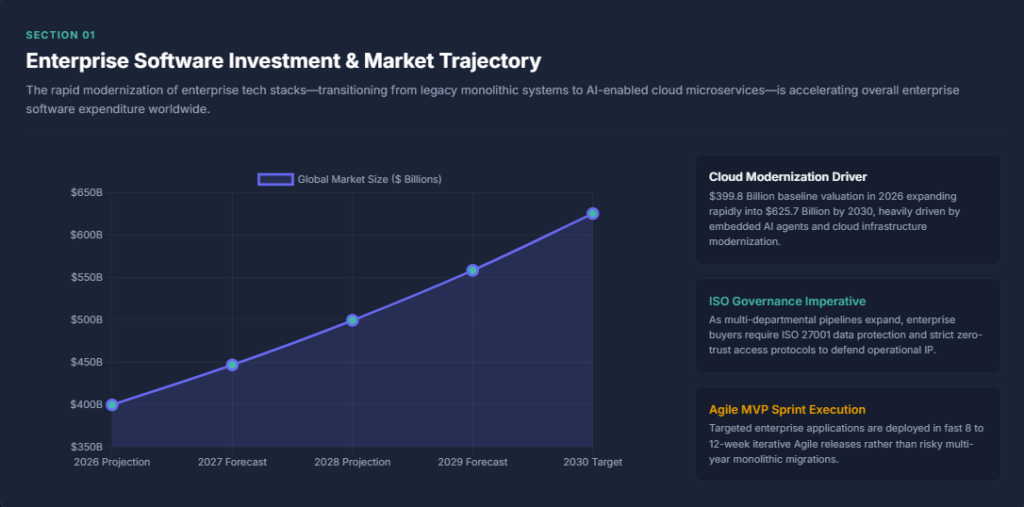
Enterprise organisations rely on specialised, highly secure software systems to streamline complex operations and drive operational agility. Enterprise applications are built to meet the demands of large organisations, driving productivity, optimising cross-departmental workflows, and enabling data-backed decision-making, unlike off-the-shelf consumer apps built for a single generic user.
Drawing from 16+ years delivering 300+ digital transformations for 250+ global clients, including public sector bodies spanning government technology and intellectual property administration, alongside enterprise leaders in energy and utilities, global automotive, and tertiary education, this guide covers the top nine types of enterprise apps, their architectural trade-offs, real-world examples, and where AI agents and ISO 27001-certified governance actually matter in modern enterprise software design.
Table of Contents
What Is an Enterprise App?
Enterprise applications, sometimes called enterprise business applications or business enterprise applications depending on which team is asking, are mission-critical software systems designed to solve complex operational challenges across medium-to-large organisations. Unlike consumer apps, they handle high-concurrency workflows, strict multi-tenant access controls, deep legacy system integrations, and multi-departmental data pipelines, and increasingly, embedded generative AI and autonomous agents that automate routine overhead and enforce governance while scaling securely.
9 Types of Enterprise Apps to Inspire Your Business
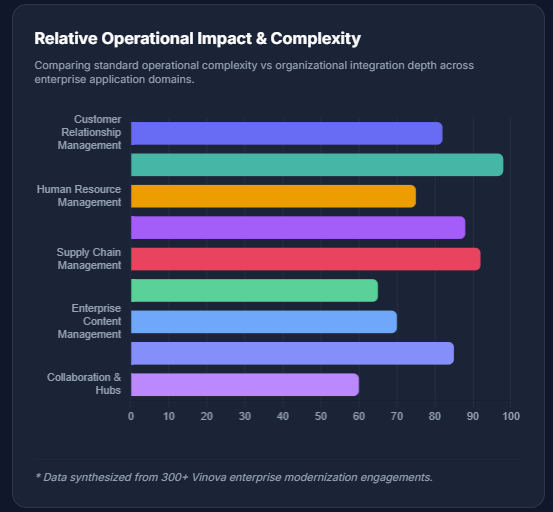
Each of these nine types of enterprise apps solves a genuinely different operational problem, and most mature organisations end up running several at once, integrated rather than isolated.
1. Customer Relationship Management (CRM) Systems
CRM software sits at the centre of client lifecycle management. Modern CRMs integrate autonomous AI agents that handle multi-channel lead scoring, automate personalised marketing journeys, and feed real-time pipeline data to sales teams.
- Key features: automated contact management, AI lead scoring, agentic workflow automation, multi-channel customer tracking, predictive deal forecasting
- Trade-offs: initial data migration from legacy spreadsheets can be complex, and success genuinely depends on clean data engineering, strict role-based access control, and UX intuitive enough to actually drive staff adoption
| Vinova Field Insight: in client engagements across retail and financial services, integrating custom API pipelines between mobile frontend touchpoints and core CRM databases reduced manual lead entry time by over 60% while holding full PDPA compliance. |
2. Enterprise Resource Planning (ERP) Systems
ERP platforms integrate core business functions, finance, procurement, inventory, HR, and compliance, into a single centralised database. Modern ERP combines real-time ledger sync with scalable core architectures (Odoo or custom cloud microservices) to eliminate organisational silos.
- Key features: real-time financial ledger tracking, automated procurement, inventory monitoring, multi-entity accounting, AI-driven process automation
- Trade-offs: traditional monolithic ERP deployments can be slow and costly to change later; forward-looking enterprises opt for modular, API-first architectures specifically to avoid vendor lock-in
| Vinova Field Insight: for a Singapore energy and utilities provider, Vinova’s AI-driven offshore squads built Python engineering and React frontends integrated directly with SAP SuccessFactors, accelerating the development lifecycle while meeting Critical Information Infrastructure security standards throughout. |
3. Human Resource Management (HRM) Software
HRM software streamlines workforce management, from talent acquisition and automated onboarding to payroll, performance reviews, and compliance tracking. AI screening models and self-service portals let HR departments eliminate administrative overhead they used to absorb manually.
- Key features: employee self-service portals, automated payroll, benefits management, AI talent screening, performance tracking
- Trade-offs: HRM systems handle PII directly, so architectures need endpoint encryption and genuine compliance with PDPA or GDPR, not just a privacy policy on file
| Vinova Field Insight: for a global healthcare and diagnostics company, Vinova built “Maya,” an AI assistant natively embedded into the HR mobile app rather than a separate dashboard nobody opens. Maya autonomously resolves 32% of monthly employee queries at a 74% success rate, cutting HR ticket overhead while holding full data privacy compliance. |
4. Business Intelligence (BI) and Analytics Tools
BI tools aggregate structured and unstructured data across enterprise silos into actionable operational insight. Natural-language querying, real-time dashboarding, and predictive analytics let decision-makers query enterprise data without needing SQL expertise themselves.
- Key features: natural language querying, dynamic interactive dashboards, predictive analytics models, real-time automated reporting
- Trade-offs: BI output is only as good as the data underneath it; enterprise setups need robust ETL pipelines and strict AI data governance, or the risk is confidently wrong metrics, not just missing ones
5. Supply Chain Management (SCM) Software
SCM software tracks goods, raw materials, and logistics from tier-1 suppliers through to final delivery. Advanced SCM uses IoT integration and AI forecasting to predict bottlenecks, optimise warehouse stock, and reduce freight costs.
- Key features: real-time inventory positioning, automated purchase order generation, predictive demand forecasting, smart fleet routing
- Trade-offs: multi-vendor supply chains need seamless API integration across dynamic logistics networks, and a missing fallback procedure for external data feed disruption can cascade straight into automated inventory routing
| Vinova Field Insight: Vinova built a maritime trade data platform for a Southeast Asian shipping and logistics operator, integrating complex shipping document management, real-time data pipelines, and workflow automation across 20+ operational modules for a maritime shipping ERP, achieving a 60% increase in deployment velocity over a 3-year engagement. |
6. Project Management Tools
Enterprise project management tools let distributed and hybrid teams coordinate complex initiatives, manage resource allocation, and track milestones. Modern platforms add dynamic task assignment, AI progress summarisation, and automated sprint reporting on top of the basics.
- Key features: dynamic Gantt and Kanban boards, automated resource allocation, real-time file co-authoring, automated progress reporting
- Trade-offs: tool sprawl and notification overload genuinely reduce productivity; enterprises need clear operational guidelines and direct integration into central channels like Slack or Microsoft Teams, not another disconnected tab
7. Content Management Systems (CMS)
Enterprise CMS platforms let non-technical teams author, manage, and publish content across multi-brand websites, internal portals, and customer web apps. Headless CMS architectures, decoupling content backends from frontends via APIs, enable genuine omnichannel content delivery.
- Key features: headless API architecture, multi-locale translation support, digital asset management, granular approval permissions
- Trade-offs: headless setups need structured API design and frontend integration discipline to hold site performance and web security together as content volume grows
8. E-commerce Platforms
Enterprise e-commerce applications manage complex B2B and B2C buyer journeys, high-volume transactional pipelines, dynamic pricing, and multi-region fulfilment. Modern platforms integrate POS systems, custom payment gateways, and automated inventory sync across headful or headless architectures.
- Key features: multi-storefront control, dynamic localised checkout, POS integration, real-time inventory sync, automated order routing
- Trade-offs: requires robust cybersecurity, high-availability cloud infrastructure, and strict PCI-DSS compliance to protect transaction volume specifically during peak traffic, not just on an average day
| Vinova Field Insight: for a global luxury automotive brand’s Asia Pacific experience centre in Singapore, Vinova connected an NLP conversational AI directly to Odoo POS and inventory backends alongside event booking, delivering 24/7 multilingual visitor engagement and a 35% increase in automated booking conversions. |
9. Collaboration and Communication Tools
Enterprise collaboration hubs form the everyday digital workplace for hybrid and distributed organisations, uniting instant messaging, secure file sharing, video conferencing, enterprise search, and bot integrations in place of fragmented channels.
- Key features: threaded channel communications, secure video conferencing, native AI conversation search, deep third-party app integration
- Trade-offs: open communication environments raise data leak risk if left unmanaged; zero-trust access controls, DLP, and ISO 27001-aligned policy aren’t optional extras here, they’re the baseline
Modern Enterprise Examples in Action
Real-world proof of how these types of enterprise applications deliver value in production, not just in a feature list, these are genuine enterprise software applications and enterprise application examples running at scale today:
| Platform | Category | What It Actually Does |
| Salesforce | CRM with agentic AI | Agentforce autonomous agents handling customer service routing and sales pipeline execution |
| SAP ERP | Global finance and supply chain | Joule AI co-pilot automating complex procurement and operational workflows |
| Microsoft Dynamics 365 | Modular ERP, CRM, and BI | Copilot integration across the Microsoft 365 environment |
| Odoo / custom microservices | Modular backend flexibility | Favoured by growing enterprises wanting e-commerce/POS integration without vendor lock-in |
| Shopify Plus | Enterprise headless commerce | Flexible frontend engines paired with secure API backends for global retail brands |
Choosing the Right Enterprise App Architecture
- Strategic alignment: map software features directly to top-level business targets, reducing operational overhead, expanding revenue channels, or accelerating time-to-market, not just adopting a trend
- Scalability and cloud-native infrastructure: build on infrastructure (AWS, Azure, GCP) capable of auto-scaling under fluctuating traffic and data growth without a manual re-architecture later
- API-first and microservices integration: prioritise open REST/GraphQL architectures that connect legacy software with modern web, mobile, and AI capability, rather than isolating them
- User-centric UI/UX: choose interfaces that minimise staff onboarding time and drive adoption across both technical and non-technical teams equally
- ISO security and governance standards: confirm your development partner actually holds ISO 27001 for information security and ISO 9001 for quality management, not just claims alignment with them
Critical Implementation Considerations Before Investing
The global enterprise software market is projected to grow from $399.8 billion in 2026 to $625.7 billion by 2030, an 11.8% CAGR, driven largely by cloud modernisation and secure AI integration. Before committing capital, weigh four things specifically:
- Total Cost of Ownership: beyond initial licensing or development cost, calculate ongoing maintenance, cloud infrastructure usage, API costs, and system upgrades, the numbers that actually determine long-term budget, not the launch quote
- Phased rollouts and Agile delivery: complex systems like ERPs or custom CRMs should deploy in iterative 2-week Agile sprints to minimise operational disruption, not a single high-risk cutover
- Data security and AI governance: full-disk encryption, network segregation, endpoint security, and DevSecOps pipelines protect corporate IP, and need to be architectural defaults, not a checklist added before a security review
- Change management and team onboarding: software succeeds or fails on employee adoption; pair every deployment with tailored training, documentation, and ongoing support, not just a launch email
| Which of These Types of Enterprise Apps Does Your Business Actually Need? Vinova has engineered every category in this guide for real Singapore and APAC organisations, spanning government technology, intellectual property administration, energy and utilities, and global automotive brands. Book a free architectural evaluation with our Solutions team and we’ll map which types of enterprise apps actually move your specific business, not a generic shortlist. Request Your Free Enterprise App Architecture Evaluation with Vinova |
Frequently Asked Questions
Why do enterprises invest in custom software versus off-the-shelf apps?
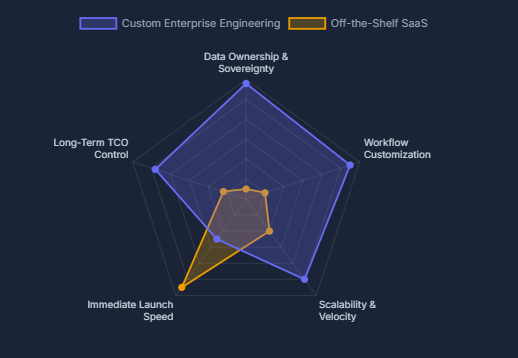
Off-the-shelf platforms offer a convenient starting point, but unique enterprise workflows often need more than generic feature sets. Custom enterprise software aligns precisely with proprietary business logic, integrates directly into legacy stacks, and eliminates recurring per-user licensing fees as teams scale, costs that compound quietly over several years of off-the-shelf subscriptions.
How long does it take to build and deploy an enterprise application?
Depends on scope. Modular microservices or a targeted mobile app can launch in 8 to 12 weeks. A full enterprise ERP or multi-system platform modernisation typically spans several months across phased Agile releases, since supplier and stakeholder onboarding usually takes longer than the engineering itself.
What security certifications should enterprise software vendors hold?
ISO 27001 (Information Security Management) and ISO 9001 (Quality Management) at minimum, plus demonstrated PDPA/GDPR compliance and DevSecOps practices backed by regular third-party security audits, not just a stated policy.
What are some common enterprise applications businesses actually start with first?
CRM and ERP are almost always the first two, since they touch revenue and core operations directly and have the clearest, fastest-to-measure ROI. HRM and collaboration tools typically follow once the core systems are stable, with BI and SCM usually added as the organisation’s data maturity catches up to what those tools actually need to be useful.
How can organisations manage enterprise software project costs effectively?
Structured engagement models help most: a Dedicated Offshore Development Centre paired with local onsite project management combines strategic governance with real cost efficiency, without the budget unpredictability of pure time-and-materials billing against an open-ended scope.
Conclusion: Partnering with Vinova
While off-the-shelf enterprise platforms offer a convenient starting point, unique enterprise workflows often require more than generic feature sets. Engineering custom enterprise applications, across any of these nine types of enterprise apps, turns proprietary operational process into a long-term competitive edge: real security, real scalability, and full digital sovereignty as the business grows.
Why partner with Vinova: 16+ years of IT consulting, 300+ completed enterprise projects, and a global client base of 250+ organisations, from Singapore government agencies to industry leaders spanning energy and utilities, global automotive, tertiary education, and global healthcare. Governed by ISO 27001 information security and ISO 9001 quality standards, delivered through a “One Team” Hybrid ODC model combining Singapore-based strategic governance with a scalable, AI-assisted Vietnam Offshore Development Centre. Full-stack capability spans AWS/Azure cloud, web (React, Node.js, Python, Java, .NET), cross-platform mobile, microservices, DevSecOps, and custom AI/ML integration.
| Vinova: Singapore’s enterprise application and AI engineering partner since 2010. ISO 27001:2022 and ISO 9001:2015 certified.300+ projects delivered for 250+ clients across Singapore and APAC, spanning government technology, intellectual property administration, financial regulation, energy and utilities, global automotive, tertiary education, and global healthcare. Financial Times Top 500 High-Growth Companies Asia-Pacific 2026. The Straits Times Singapore’s Fastest-Growing Companies 2024, 2025, and 2026. Contact the Vinova Solutions Team to discuss your digital transformation roadmap. |