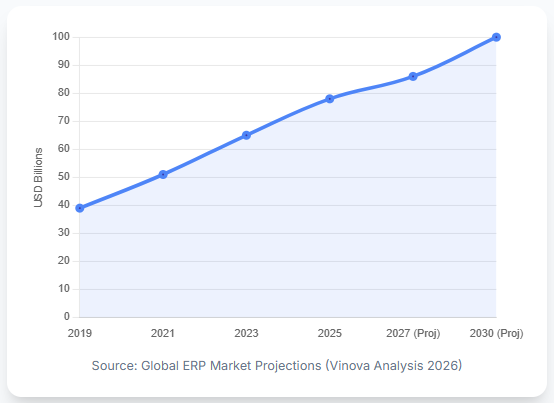
The enterprise software landscape continues its explosive growth. From a valuation of USD 39 billion in 2019, the global ERP market is projected to reach USD 86 billion by 2027 and expand beyond USD 100 billion by 2030, driven by a steady CAGR of nearly 10%. In 2026, ERP systems play a more critical role than ever in financial management specifically, where real-time continuous accounting and AI-driven predictive insight have become standard requirements for market leadership.
At Vinova, a Singapore-headquartered IT consulting and software engineering partner with 16+ years of enterprise delivery experience, we see firsthand how modern organisations struggle with fragmented legacy systems and operational silos. This guide dives into the erp finance module: how it works, how it has evolved in 2026, and why real-time financial transparency is non-negotiable for growing enterprise organisations, backed by Vinova’s own delivery experience integrating financial modules into live enterprise systems.
Table of Contents
What is an ERP Financial Module?
What is ERP finance? The finance module in ERP is a central operational hub that gathers financial data from various departments within your organisation, such as sales, inventory, procurement, customer relations, and human resources, and unifies it into a single source of truth. This data is transformed into actionable business intelligence through critical financial reports: real-time general ledgers, trial balance feeds, comprehensive balance sheets, and automated quarterly financial statements, all essential for evaluating business financial health.
ERP financial management software goes far beyond simple data collection. At Vinova, we view these systems as the command centre for optimising and controlling the entire financial lifecycle. Whether deploying an off-the-shelf platform like SAP, Oracle, or Microsoft Dynamics, or engineering a bespoke custom enterprise solution, a well-implemented module efficiently manages:
- General Ledger: the core of financial recordkeeping, tracking all multi-entity and multi-currency transactions
- Accounts Payable: manages obligations to vendors and suppliers, streamlining automated invoice ingestion and approval workflows
- Accounts Receivable: tracks money owed by customers, automating cash application, collections, and credit risk management
- Fixed Asset Management: monitors the lifecycle, asset health, and automated depreciation schedules of long-term physical and digital assets
- Budgeting and Forecasting: provides predictive planning tools, variance analysis, and AI-assisted cash burn forecasts
The Important Role of ERP Financial Modules
The statistics underline this momentum: in recent enterprise IT surveys, over half of IT decision-makers prioritised ERP modernisation, with global investment in cloud-native ERP solutions remaining at record highs. Why such sustained demand? The answer lies in the indispensable role an erp finance module plays within modern enterprises. These modules serve as the nervous system of financial operations, guaranteeing transparency, regulatory compliance, and operational agility. Core functionalities that make erp financial systems essential in 2026:
- Streamlined financial processes: eliminates manual entry bottlenecks by automating journal postings, bank reconciliations, and expense approvals, reducing human error and saving substantial resource hours annually
- Real-time financial insights: in 2026, waiting weeks for month-end closure is a relic of the past. Integrated ERP modules deliver streaming real-time data feeds as transactions occur, empowering executives to pivot swiftly in dynamic markets
- Regulatory compliance made easier: financial regulations across APAC and global markets are increasingly complex. Modern ERP modules simplify governance through immutable audit trails, granular role-based access control, and automated tax preparation
- Cost management under a microscope: multi-dimensional visibility into cost centres and departmental spend enables finance teams to identify budget leaks, renegotiate vendor terms, and optimise capital allocation
- Enhanced financial reporting: effortlessly generate consolidated financial statements and executive dashboards that keep board members, investors, and leadership fully aligned
- Improved cash flow management: integrated payables and receivables give treasury leaders total clarity over working capital, enabling reliable cash planning and funding strategic expansion
A finance module in ERP is far more than accounting software. It is a strategic growth engine. In 2026, organisations that prioritise intelligent ERP integration gain a decisive competitive edge, and integration, not the software licence alone, is where that edge is actually won or lost.
Features of ERP Financial Modules
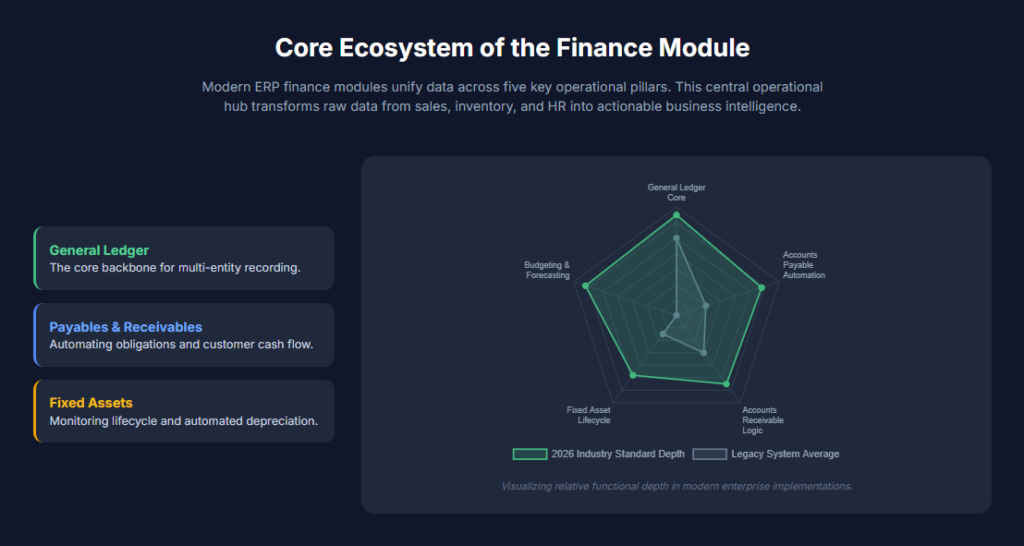
An ERP finance module goes far beyond standard ledger entry. It is equipped with a modern feature suite designed to optimise capital allocation and integrate seamlessly across modern API networks:
- General Ledger: the central backbone of accounting, continuously aggregating financial entries across all operational arms to produce balanced, audit-ready books
- Accounts Payable: automates purchase order matching, supplier onboarding, OCR invoice processing, aging tracking, and cross-border disbursements
- Accounts Receivable: automates customer billing, payment gateway integrations, automated dunning routines, and cash matching
- Cash and Liquidity Management: provides daily multi-bank balance visibility, cash flow forecasting, automated bank reconciliations, and treasury analytics
- Fixed Assets Lifecycle Management: handles multi-jurisdictional asset tracking, automated depreciation runs, asset revaluations, and disposal reporting
- Budgeting and Predictive Planning: features scenario modelling, rolling forecasts, and real-time variance alerts comparing actual costs to allocated budgets
- Financial Consolidation (multi-national groups): built for multi-entity, multi-currency operations, automatically managing currency conversion, intercompany eliminations, and regional tax alignment
- Financial Reporting and Advanced Analytics: delivers customisable interactive dashboards, real-time KPI tracking, and drill-down capability for immediate profit margin insight
- Tax Management: simplifies e-invoicing compliance, GST/VAT calculations, local withholding tax logic, and automated regulatory submissions
- Risk Management and Governance: enforces segregation of duties, automated anomaly and fraud detection, and continuous compliance monitoring
The value of a modern erp finance module is unmatched when implemented, customised, and integrated effectively by an experienced technical partner. This is the step where most ERP programmes actually succeed or fail: not in choosing the platform, but in the quality of the integration work that follows.
Benefits of ERP Financial Modules: Vinova’s Delivery Experience
An erp finance module delivers transformative operational benefits. Here is how Vinova’s own enterprise engagements demonstrate this in practice, alongside broader industry examples:
Improved financial reporting
2026 ERP financial modules stream live transactional data across departments, providing executives with immediate visibility into balance sheets, operational margins, and burn rates. For a maritime logistics operator’s shipping ERP, Vinova architected real-time data pipelines and workflow automation across 20+ operational modules, giving finance and operations leadership unified visibility that legacy siloed systems could not provide, increasing overall development and integration velocity by 60%. PepsiCo’s deployment of Oracle ERP to connect financial accounting with supply chain management is a further example of how real-time data streams eliminate delays historically caused by legacy data silos.
Increased efficiency
Automating routine workflows within erp in finance and accounting eliminates operational drag and reduces administrative overhead. For a luxury automotive brand’s Singapore experience centre, Vinova conducted a rigorous total cost of ownership analysis and recommended Odoo Enterprise off-the-shelf for back-office financial operations rather than a custom build. That recommendation cost Vinova the development revenue. It was the right call for the client, and it is the same discipline Vinova applies before recommending any ERP platform: the goal is the client’s operational efficiency, not the largest possible build. Fulton & Roark’s experience automating inventory and financial accounting workflows during rapid retail expansion illustrates the same principle at a different scale.
Cost savings
By eliminating manual data duplication, preventing billing errors, and providing granular spend tracking, financial ERP modules yield quantifiable cost reduction. Vinova’s integration work for a regional facilities management operator connecting ML-driven workflows with SAP required custom data transformation layers specifically to prevent the duplicate data entry and reconciliation errors that drive up the true cost of a fragmented financial stack. Discover Financial Services’ consolidation onto Oracle Fusion Cloud ERP, giving leadership complete oversight of enterprise expenses, is a further industry example of the same underlying pattern.
Enhanced cash flow management
Integrated accounts payable and receivable engines give finance teams continuous control over working capital and predictive cash runways. Vinova engineers this integration layer directly against a client’s existing banking and payment rails rather than relying on the ERP vendor’s default connectors, which is frequently where cash visibility gaps actually originate — the same treasury and multi-bank reconciliation architecture covered in our guide to open banking solutions in Singapore. Fast-growing technology firms with variable contract timing, similar to cases documented across the industry, have used real-time predictive dashboards to gain meaningfully clearer foresight into future receivables and commitments.
Regulatory compliance
An erp finance module is essential for maintaining strict compliance with local and international financial mandates. Vinova’s ERP integrations for MAS-regulated and GovTech-adjacent clients embed immutable audit trails and role-based access control aligned to MAS TRM and GovTech IM8 requirements from the configuration stage, not retrofitted after go-live. Healthcare providers and other regulated industries facing evolving compliance demands have seen similar results implementing platforms like Epicor SLS, equipping the organisation with robust audit trails and automated compliance reporting.
Risk management
Proactive risk mitigation is a defining feature of modern erp financial systems. Vinova applies the same Strangler Fig phased-rollout discipline to ERP financial module implementations that it uses for any legacy modernisation: cutting over module by module with traffic and workflows shifting transparently, rather than a single high-risk big-bang migration. Hershey’s 1999 ERP rollout is the textbook cautionary tale for why: a compressed, big-bang deployment of three systems at once, timed right before its Halloween peak season, left the company unable to fulfil an estimated $100 million in orders and cost it a double-digit hit to quarterly profit. That is precisely the failure mode a phased cutover is designed to prevent.
How to Implement an ERP Financial Module
Successfully deploying and maximising an erp finance module requires a structured, proven execution strategy. At Vinova, enterprise clients are led through this process using an Agile, security-first implementation framework:
- Discovery and workflow mapping: comprehensive analysis of financial workflows, mapping Business Requirement Documents, user personas, and compliance parameters
- System architecture and configuration: configure the chart of accounts, fiscal years, tax tables, multi-currency engines, and role-based access rules
- Data cleansing and legacy migration: extract, sanitise, and securely transfer legacy financial records, open ledgers, and fixed asset registers into the new ERP platform, with PDPA-compliant handling of any personal data embedded in legacy records
- Inter-module and API integration: connect the financial module with CRM, warehouse management, HR/payroll, and e-commerce payment platforms using scalable microservices and APIs
- Workflow automation and QA testing: establish automated approval chains for procurement, travel expenses, and invoices; perform thorough QA and User Acceptance Testing
- Payables and receivables activation: roll out automated electronic invoicing, bank integration interfaces, and customer/vendor payment portals for streamlined cash management
- Executive dashboard customisation: tailor real-time management dashboards for instant visibility into operational metrics, unit economics, and budget performance
- Change management and ongoing optimisation: provide tailored user training, maintain post-launch support, and continually refine workflows with advanced analytics and AI automation
| Build or Integrate Your ERP Finance Module with Vinova Book a complimentary 2-hour ERP financial systems consultation with Vinova’s Singapore-based team. We’ll assess your current financial workflows, recommend the right platform strategy, and scope a compliant, integrated implementation plan. No commitment required. Schedule Your Free 2-Hour ERP Finance Module Consultation with Vinova |
ERP Finance Module FAQ
What is the most popular ERP module?
Two modules remain foundational across almost every industry vertical in 2026. ERP Financial Management operates as the central command system, where an ERP in finance and accounting manages ledgers, compliance, cash flow, and tax reporting. ERP Supply Chain Management manages procurement, inventory levels, logistics, and order fulfilment, ensuring physical asset movements reflect accurately in financial books. Together, these two modules form the baseline architecture for modern enterprise resource planning.
Is ERP a transaction system?
Yes. An ERP system is a real-time transaction processing system. It captures, validates, stores, and connects operational data across all business functions, from sales orders and payroll disbursements to vendor payments, guaranteeing strict data consistency across the enterprise.
Who is the most reliable provider of ERP financial modules?
Leading enterprise software vendors offer strong ERP financial systems. Selecting the right platform depends on enterprise scale, technical complexity, and customisation goals:
| Platform | Strength |
| SAP | SAP S/4HANA Finance remains the standard for large global enterprises needing high-volume multi-national consolidation and deep supply chain linkage |
| Oracle | Oracle Financials Cloud provides extensive financial management capability, advanced predictive reporting, and robust risk governance |
| Microsoft | Microsoft Dynamics 365 Finance offers high flexibility, modern interfaces, and seamless integration across the Microsoft cloud suite |
| Infor | Infor CloudSuite provides specialised, industry-specific configurations tailored for manufacturing, healthcare, and logistics |
| Odoo and modular ERPs | Popular among mid-market companies seeking fast deployment, cost efficiency, and flexible modular customisation |
Software selection is only half the battle. The ultimate success of any ERP project rests on system integration and custom execution. Off-the-shelf platforms often struggle to match complex legacy workflows on their own. Vinova specialises in custom software engineering, cloud integration, API development, and data migration, ensuring an erp finance module integrates cleanly with the client’s actual business architecture rather than forcing the business to adapt to the software’s defaults.
What is the difference between an ERP finance module and standalone accounting software?
Standalone accounting software (Xero, QuickBooks) handles bookkeeping in isolation: ledgers, invoicing, basic reporting. An erp finance module operates as one integrated component of a broader enterprise system, pulling live data from sales, inventory, procurement, and HR rather than requiring manual re-entry or periodic file imports from those systems. The practical difference shows up at scale: a growing business with disconnected accounting software eventually spends significant staff time reconciling numbers across systems that don’t talk to each other. An ERP finance module is architected so those systems talk to each other by default.
How long does ERP financial module implementation typically take?
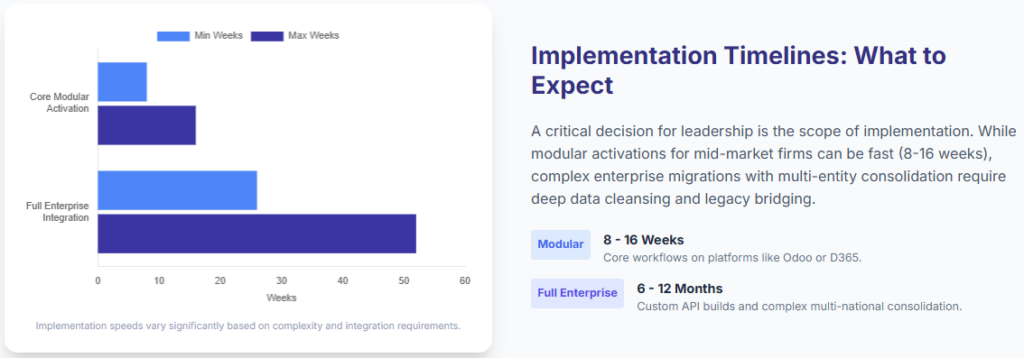
A focused implementation activating core financial workflows (general ledger, accounts payable and receivable, basic reporting) on an established platform like Odoo or Dynamics 365 typically runs 8 to 16 weeks. A full enterprise deployment with multi-entity consolidation, custom API integrations across CRM, warehouse, and HR/payroll systems, and migration of complex legacy financial records extends to 6 to 12 months, depending on data quality and the number of systems being integrated. Vinova’s discovery phase produces a scoped timeline based on an audit of the current financial stack before implementation begins, since data cleansing and legacy migration is consistently the phase most likely to run long if underestimated upfront.
| Vinova: Singapore’s ERP integration and enterprise engineering partner since 2010. ISO 27001:2022 and ISO 9001:2015 certified. PDPA, MAS TRM, and GovTech IM8 compliant. 300+ in-house engineers across Singapore, Hanoi, Da Nang, and Ho Chi Minh City. ERP and financial systems clients span maritime logistics/port terminal operators, luxury automotive brands, facilities management operators, and national utilities/infrastructure providers. Financial Times Top 500 High-Growth Companies Asia-Pacific 2026. The Straits Times Singapore’s Fastest-Growing Companies 2024, 2025, and 2026. Explore Vinova’s ERP and financial systems integration services. |