Written by Vinova’s Enterprise Solutions Architecture Practice.
Architectural failure rarely shows up when your app is quiet; it strikes at the exact moment your business starts winning.
When your platform crosses 40,000 active users, an unhardened database starts timing out, a minor button tweak on the frontend accidentally knocks out user logins, and routine schema updates force you to take the entire service offline in the middle of a workday.
In the software world, this painful bottleneck is known as the “Wrong Stack Tax.” It happens when foundational technology choices are treated like casual developer preferences rather than long-term business decisions. Fixing an inadequate foundation at scale usually means an 8-month, $250,000 ground-up rewrite, burning through your runway and freezing new feature delivery right when you should be accelerating.
We wrote this guide to strip away the developer jargon and show you how production-grade tech stacks actually work. Drawing from Vinova’s 15-year track record building 300+ platforms for global enterprises, public-sector agencies, and regulated financial institutions, we break down the core layers, compare real-world performance benchmarks, highlight the exact friction points that trip teams up, and share a practical decision tree so you can build on a foundation that lasts.
Table of Contents
Key Takeaways
- The Concurrency Breaking Point: Unhardened application stacks usually hit a wall between 20,000 and 40,000 active users, turning early shortcuts into an 8-month, $250,000 full rewrite.
- The Skyscraper Mental Model: Think of your stack like a modern building: the frontend is the public showroom, the backend is the utility core and engine room, the database is the secure basement vault, and cloud infrastructure is the concrete foundation.
- The Layer Boundary Rule: Clean systems keep each tier isolated. Each layer only talks to the one directly above and below it through strict API contracts (REST, GraphQL, gRPC), so a design update never crashes your billing engine.
- Hard Architectural Benchmarks: Backend runtimes handle concurrency very differently. Compiled languages like Go handle 10,000 concurrent connections on under 90 MB of RAM, while un-tuned sync runtimes can consume gigabytes.
- Decoupling AI & Heavy Telemetry: In 2026, running machine learning pipelines or vector search directly inside your main transaction database is an invitation to downtime. Modern stacks isolate event streaming (Kafka) and background queues from the primary ledger.
What Is a Tech Stack? (The 30-Second Definition)
A tech stack is the specific combination of programming languages, frameworks, database engines, and cloud tools layered together to make an application run. It spans the Frontend (what users see), the Backend (the business engine), the Database (where data lives), and Infrastructure (the cloud servers running it 24/7).
Tech Stack Fundamentals: The Skyscraper Mental Model
If you ask five software engineers to define a “tech stack,” you will probably get five different lists of acronyms. But software architecture isn’t abstract art, it works exactly like an enterprise commercial skyscraper.
- The Showroom & Lobby (Frontend Layer): What users see, touch, and tap: Web & Mobile Apps.
- The Engine Room & Utilities (Backend Layer): Business logic, calculations, rules, APIs.
- The Secure Vault & Archive (Data & Caching Layer): Relational databases, documents, in-memory caches.
- The Concrete Foundation & Highway (Infrastructure): Cloud servers, CI/CD pipelines, DevOps monitoring.
- The Dispatch & Automation Core (Data & AI Layer): Asynchronous queues, vector search, LLM pipelines.
In a well-designed skyscraper, plumbing lines don’t cut through the boardroom, and high-voltage power conduits don’t run across the lobby floor. Modern software requires that exact same structural discipline: each tier operates as a discrete domain that communicates strictly with the layer immediately above and below it via standardized Application Programming Interfaces (APIs).
When you break that rule, you end up with “spaghetti architecture,” a tangled codebase where changing the color of a checkout button in the Showroom can accidentally corrupt financial records in the Basement Vault.
Keeping strict layer boundaries gives you three massive operational advantages:
- Safe Renovations (Loose Coupling): You can completely redesign your mobile app or frontend user experience without touching your underlying transaction calculations. For example, when Vinova engineered a modular dashboard for a global automotive enterprise, we built it as an independent Angular micro-frontend designed to plug cleanly into their broader corporate portal, ensuring frontend updates never touched core backend systems.
- Plug-and-Play Upgrades: Want to switch payment processors, add an SMS gateway, or plug in a new identity verification service? Clean adapters let you swap them out without system-wide downtime.
- Cost-Effective Scaling: If your application gets a 50x spike in casual browsing traffic while actual purchases remain steady, your DevOps team can scale up just the client-facing web servers without overpaying for massive, unnecessary database upgrades.
According to Gartner, worldwide enterprise software spending is projected to surpass $1.46 trillion in 2026, driven by companies modernizing legacy infrastructure. Yet CISQ estimates that technical debt and architectural instability already cost US companies over $2.41 trillion annually. Most of that waste isn’t bad coding, it’s good developers trapped inside bad foundations.
The 5 Core Layers of a Modern Tech Stack
Building a system that won’t fall over under real-world load means orchestrating five distinct layers. Here is what each layer actually does, stripped of the marketing fluff:
1. Frontend & Client-Side Engineering (The Showroom)
The client tier is everything your users see and interact with on their phones, tablets, or browser screens.
- What It Actually Does: Renders screens instantly, handles buttery-smooth gesture animations, and validates user input (like making sure an email address is typed correctly) before sending data over the wire.
- Production Tooling: Native iOS (Swift), Native Android (Kotlin), cross-platform mobile frameworks (Flutter, React Native), and modern web platforms (React, Angular, Vue.js, Next.js), following the mobile app architecture patterns Vinova applies across client engagements.
2. Backend Microservices & API Orchestration (The Engine Room)
The backend runs your core business rules, verifies user permissions, and coordinates communication between your user screens and your internal database vaults.
- What It Actually Does: Calculates complex pricing, checks authentication tokens, runs fraud checks, and tells the database what to update.
- Production Tooling: High-concurrency backends built in Go (Golang), Node.js (TypeScript), Java (Spring Boot), .NET Core, or Python (FastAPI/Django).
3. High-Throughput Data Persistence & Caching (The Secure Vault)
Your data architecture determines how your platform stores, indexes, and audits records without losing transactions.
- What It Actually Does: Separates lightning-fast, temporary lookups (like keeping track of who is currently logged in) from permanent, audit-proof records (like your financial ledger).
- Production Tooling: ACID-compliant relational databases (PostgreSQL, MySQL), document databases (MongoDB), enterprise multi-model engines (Oracle Database, Microsoft SQL Server), and in-memory caches (Redis).
4. Cloud Infrastructure & The DevOps “Long Tail” (The Foundation & Highway)
Source code is only half the battle; the rest is the automated deployment pipelines and cloud servers that keep your code alive 24/7.
- What It Actually Does: Provisions cloud capacity, balances traffic during surges, rolls out zero-downtime updates, and rings alarm bells the second response latencies climb.
- Production Tooling: Cloud platforms (AWS, GCP, Azure), containerization via Docker and Kubernetes, automated CI/CD pipelines (GitHub Actions, GitLab CI), and application monitoring (Datadog, Prometheus, Sentry).
5. Asynchronous Event Streaming & AI Orchestration (The Intelligence Dispatch)
Modern applications in 2026 increasingly use a dedicated background intelligence tier to handle heavy compute tasks away from the main user experience.
- What It Actually Does: Handles heavy background tasks, like crunching machine learning models, searching vector databases, or processing large PDFs, so your mobile app never freezes while waiting for an answer.
- Production Tooling: Distributed message brokers (Apache Kafka, RabbitMQ), vector search engines (pgvector, Pinecone), and Model Context Protocol (MCP) gateways.
- Enterprise Precedent: Vinova built custom AI-driven NLP pipelines for a Singapore intellectual-property agency and a local tertiary institution, structuring background intelligence loops that process complex data without slowing down frontline users.
Real-World Architecture Teardown: How Ride-Hailing Apps Handle Scale
To see how these layers work under intense pressure, consider what happens under the hood of a high-concurrency mobility platform like Uber or Southeast Asia’s Grab. Every screen tap triggers an orchestrated round trip across distributed infrastructure:
- The Rider App (Frontend Showroom, built in Flutter or React Native) sends the request over HTTPS/Secure WebSocket to the API Gateway / Cloud Load Balancer.
- The Gateway routes to the Ride-Matching Engine (Go / Node.js API), which reads and writes to Redis (cache) and PostgreSQL (ride ledger).
- The Gateway also publishes to a Distributed Event Stream (Apache Kafka), which feeds AI Dispatch & Surge pricing models downstream.
The Transaction Flow in 5 Steps
- The Client Trigger (The Showroom): A rider taps “Confirm Pickup.” The mobile app packages the GPS coordinates into an encrypted payload and sends it over a persistent WebSocket connection.
- Gateway Ingestion (The Security Guard): The API Gateway validates the rider’s digital auth token, checks rate limits to prevent bot abuse, and routes the request to an available backend worker.
- Geospatial Lookup (The High-Speed Memory): Querying a disk-based relational database here would take hundreds of milliseconds. Instead, the matching service checks an in-memory Redis cache using geospatial indexing, locating candidate drivers within a 2 km radius in single-digit milliseconds.
- State Commit (The Vault): When a driver accepts, the ride status locks. This state change writes to an ACID-compliant PostgreSQL database cluster, logging the fare, generating an immutable audit record, and preventing accidental double-bookings.
- Decoupled Telemetry (The Intelligence Dispatch): The driver’s live turn-by-turn route telemetry flows straight into an Apache Kafka event stream. Background AI pricing models and fraud detection engines consume this stream asynchronously, ensuring real-time analytics calculations never steal CPU cycles from the core booking engine.
The Numbers, Side by Side: Hard Backend Performance Benchmarks
Most tech stack guides give you vague marketing generalities: “Go is fast, Python is simple, Java is enterprise-ready.” But architecture decisions shouldn’t be based on developer vibes.
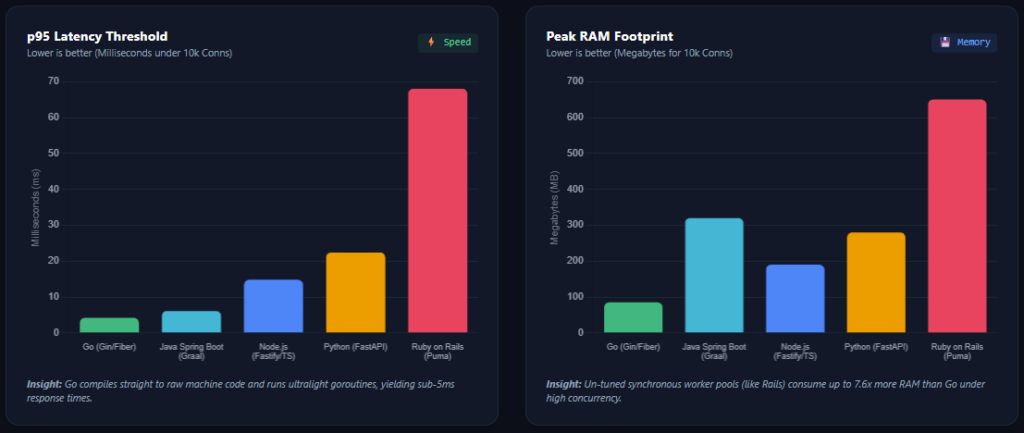
At Vinova, our engineering teams build and benchmark systems across cloud runtimes. Below is how common backend runtimes actually behave under a standardized load test (10,000 concurrent WebSocket connections handling JSON payloads and simulated database round-trips on an AWS c6i.2xlarge instance):
| Runtime / Framework | Latency (p95) | Idle RAM | Peak RAM (10k Conns) |
|---|---|---|---|
| Go (Gin / Fiber) | 4.2 ms | 18 MB | 85 MB |
| Node.js (Fastify / TS) | 14.8 ms | 42 MB | 190 MB |
| Java (Spring Boot 3 GraalVM) | 6.1 ms | 110 MB | 320 MB |
| Python (FastAPI / Uvicorn) | 22.4 ms | 55 MB | 280 MB |
| Ruby on Rails (Puma sync) | 68.0 ms | 85 MB | 650 MB+ (worker pool) |
Why This Matters: Go compiles straight to raw machine code and runs ultralight goroutines, letting it juggle 10,000 open connections while barely sipping memory. Node.js handles I/O effortlessly on a single thread, but will choke if your backend needs heavy in-memory data processing. Java Spring Boot consumes more baseline RAM, but handles sustained enterprise compute workloads with unmatched thread stability once warmed up.
Tech Stack Archetypes & “Friction Points We Hit”
Every architecture involves trade-offs. The trick is knowing which trade-offs you are making before you commit.
Drawing from our daily engineering engagements, here is what each major stack archetype is best for, and the exact friction points our teams run into in production:
1. Cloud-Native Microservices (Next.js / Flutter + Go / Node + PostgreSQL + K8s)
- Where It Shines: High-concurrency platforms, real-time messaging, multi-tenant SaaS, and teams with independent squads working on separate features simultaneously.
- Friction point we hit: The distributed tracing nightmare. When an API call that normally takes 20 ms suddenly spikes to 1.2 seconds, tracking down which microservice is holding up the queue is nearly impossible without full OpenTelemetry and distributed tracing set up from day one. If you adopt microservices too early, your engineers will spend half their sprint just debugging network timeouts between containers.
2. Enterprise Core (Angular + Java Spring Boot / .NET Core + Oracle / MSSQL + Azure)
- Where It Shines: Regulated banking, institutional public-sector infrastructure, and enterprise platforms requiring strict type safety, deep governance, and decades-long maintainability.
- Friction point we hit: Cold-start overhead and memory hunger. If you deploy Spring Boot microservices inside serverless functions or lightweight containers, container spin-up lag can add noticeable delay. You need to leverage ahead-of-time (AOT) compilation with GraalVM or keep warm container pools to prevent latency spikes during traffic bursts.
3. The Battle-Tested Monolith (React + Python Django / Ruby on Rails + PostgreSQL + Redis)
- Where It Shines: Fast-to-market MVPs, B2B SaaS validation, operational dashboards, and teams that need to ship complex features with minimal DevOps overhead.
- Friction point we hit: The synchronous blocking trap. If a developer accidentally runs a heavy CSV export, image resize, or complex financial report on the main web process, it freezes incoming web requests for everyone else. You have to enforce a strict rule from day one: all heavy calculations must be dispatched to background workers (like Celery or Sidekiq).
4. Unified Full-Stack TypeScript (Next.js / React Native + Node.js + PostgreSQL / Supabase)
- Where It Shines: Early-stage startups, customer portals, and internal tools where a single engineering team writes TypeScript across mobile, web, and backend.
- Friction point we hit: SSR memory creep under load. When rendering complex, un-cached data tables server-side during sudden traffic surges, Node.js container memory can climb rapidly. If you don’t implement aggressive edge caching and route-level memory limits, your Kubernetes cluster will spend all morning restarting out-of-memory pods.
Architectural Comparison Matrix
| Tech Stack Archetype | Core Technologies | Primary Strengths | Concurrency & Performance Profile | Scalability Risks & Trade-offs | Optimal Use Case |
|---|---|---|---|---|---|
| Cloud-Native Microservices | Next.js, Flutter, Go / Node.js, PostgreSQL, Docker, K8s, AWS/GCP | Independent squad deployment; exceptional fault isolation. | Very High: 100,000+ live sessions; low memory footprint. | High initial infrastructure overhead; demands experienced DevOps and distributed tracing. | Multi-tenant SaaS, high-concurrency consumer apps, logistics. |
| Enterprise Core | Angular, Java Spring Boot / .NET Core, Oracle / MSSQL, Azure | Strict type safety; battle-tested governance; deep enterprise tooling. | High: Proven multi-threaded throughput under sustained compute loads. | Slower initial feature velocity; heavier baseline memory footprint. | Regulated banking, public sector, healthcare. |
| Battle-Tested Monolith | React, Python (Django) / Rails, PostgreSQL, Redis, AWS | Rapid feature shipping; mature ORMs; vast open-source library ecosystem. | Moderate: Monolithic scaling boundaries demand early database caching beyond 20k sessions. | Synchronous processing bottlenecks under real-time streaming; requires early caching discipline. | B2B SaaS validation, marketplace MVPs, complex operational workflows. |
| Unified Full-Stack JS | Next.js, React Native, Node.js, PostgreSQL, Cloud VPS | Single-language engineering across client and server; rapid prototyping. | Moderate: Non-blocking I/O handles real-time feeds well; vulnerable to CPU-heavy calculations. | Un-cached dynamic SSR can introduce memory leaks; un-structured schemas accumulate technical debt. | Early-stage products, interactive web portals, workflow automation tools. |
How to Choose Your Tech Stack (The 10-Second Decision Tree)
Still trying to decide which stack makes sense for your product? Here is the rapid decision tree our architects use during discovery sessions:
- Validating an MVP in under 60 days with a lean team? Go with a Battle-Tested Monolith (React + Django/Rails/Node + PostgreSQL). You’ll ship features twice as fast without burning budget on complex Kubernetes setups.
- Building for real-time tracking, live chats, or 50,000+ simultaneous connections? Build on Cloud-Native Go or Node.js Microservices backed by Redis and PostgreSQL.
- Operating under strict financial, healthcare, or government compliance? Choose an Enterprise Core (Angular + Java Spring Boot / .NET Core) with strict type safety, automated audit logging, and isolated network layers.
- Want a single engineering team to cover mobile, web, and backend? Opt for Unified Full-Stack TypeScript (React Native + Next.js + Node.js).
- Need heavy AI document analysis, vector embeddings, or machine learning pipelines? Pair your core web stack with a decoupled Python FastAPI + Kafka + pgvector background worker tier.
The “Wrong Stack Tax”: 3 Costly Traps Every Technical Leader Must Avoid
Technical debt doesn’t announce itself, it accumulates silently until user volume forces a crisis. In our technical audits at Vinova, three architectural traps appear repeatedly:
1. The “Because Why Not?” Database Trap
The database is almost always where technical debt carries the highest price tag.
During one audit for a fast-growing digital platform, we found the original team had picked an un-indexed relational database configuration simply because someone said, “Why not? We know how it works.”
It worked fine in local testing. But under sustained production load, standard schema migrations began triggering database-wide table locks, the digital equivalent of locking the front doors and freezing the cash register during peak lunch rush. Transactions timed out, customers churned, and fixing the problem required months of careful, live data migration to an ACID-compliant PostgreSQL cluster without taking the business down.
By contrast, for long-term clients in regulated service industries, where Vinova has engineered and managed mission-critical booking engines and server infrastructure for over 13 consecutive years, intentional schema planning, non-blocking migrations, and proactive Redis caching have maintained zero-downtime stability across millions of lesson and test bookings.
2. Resume-Driven Development (RDD)
Software developers naturally love experimenting with bleeding-edge frameworks. But when an agency or internal engineer chooses an obscure, trendy tool just to bolster their resume, your business gets stuck holding the bag.
When those developers eventually leave, you are left maintaining an exotic, poorly documented codebase. Sourcing replacement senior talent for niche frameworks commands exorbitant contractor rates, burning runway on basic maintenance instead of shipping new revenue-generating features.
3. The Monolithic Speed Trap
When you’re building an MVP, launching quickly is smart. Rapid monolithic frameworks can easily get you to market in 60 days.
The trap is failing to plan for subsequent refactoring. Founders often keep bolting heavy enterprise features onto an unhardened MVP prototype. When active users pass 20,000, the monolith begins to buckle. Shipping a simple third-party integration that should take two days starts taking two months because the underlying code has no modular boundaries.
| Recognize Any of These Traps in Your Own Stack? Every trap on this list came out of an actual Vinova audit, not a theoretical framework. Catching one before it costs you a rewrite is a lot cheaper than fixing it after. Schedule an Architectural Audit with Vinova |
The 4-Phase Tech Stack Lifecycle: From Discovery to Scaled Modernization
Selecting and maintaining software architecture isn’t a one-and-done choice. Vinova structures stack governance into four systematic phases, integrating our two-week agile sprint cycles with public-sector application development standards:
- Phase 1: Technical Discovery & Workload Profiling: We profile expected read-to-write ratios, real-time concurrency demands, and compliance requirements (e.g., financial-sector technology risk frameworks or public-sector architecture standards) before writing code.
- Phase 2: Architectural Blueprint & Boundary Setup: We establish strict API contracts between layers and prioritize proven, well-supported technologies for core business logic.
- Phase 3: DevOps Automation & Observability: We configure automated CI/CD pipelines (GitHub Actions/GitLab CI), containerized staging environments (Docker/Kubernetes), and APM tracking for p95/p99 latency thresholds.
- Phase 4: Zero-Downtime Modernization: As user volumes scale, we execute non-blocking “expand-and-contract” database migrations and peel performance-critical modules out of legacy monoliths into isolated microservices.
What Defines a Top Tech Stack Architecture Partner?
If you are evaluating an external engineering firm to design or modernize your architecture, look past sales decks and assess their operational depth:
What to Look For
- Production Longevity (10+ Years): Anyone can build an app that runs for 30 days. You want partners who have supported and maintained platforms across a decade of software updates and traffic growth.
- Cross-Ecosystem Fluency: Avoid agencies that push the one framework their junior developers know. Look for teams proficient across cloud-native tools (Go, Node.js), enterprise engines (Java Spring, .NET), and modern mobile runtimes (Flutter, React Native).
- Institutional Compliance Experience: Look for verified experience building systems aligned with formal standards, such as public-sector enterprise architecture frameworks, financial-sector technology risk management, or healthcare data regulations.
4 Tough Questions to Ask Before Hiring
- “How will your proposed database schema handle live, online migrations without locking tables under production read/write loads?”
- “How do you enforce clear layer boundaries between client code, API gateways, and backend services to prevent visual updates from breaking billing logic?”
- “What does the regional hiring market look like for your recommended stack, and what will our engineering maintenance costs look like in three years?”
- “How does your architecture isolate heavy background tasks, telemetry, and AI inference from our core transactional database?”
Frequently Asked Questions (FAQ)
What is a tech stack in software development?
A tech stack is the complete collection of programming languages, frameworks, databases, cloud infrastructure, and DevOps tools layered together to build and run an application. It spans the client-side frontend, the server-side backend logic, persistent data storage, and automated deployment pipelines.
Why does choosing the wrong tech stack cause scalability failures?
Choosing the wrong tech stack creates structural bottlenecks, such as table-locking databases, un-cached monolithic servers, and tangled code dependencies, that crash under high concurrency. Fixing these issues after launch often requires taking systems offline or paying for an 8-month, $250,000 ground-up rewrite.
What is the difference between a frontend and backend tech stack?
The frontend tech stack runs on the user’s device (using Swift, Kotlin, Flutter, React, or Angular) to display screens and handle user interaction. The backend tech stack runs on servers (using Go, Java, or Node.js) to execute business logic, enforce authentication, and manage data transactions.
What is Resume-Driven Development (RDD) and why is it dangerous?
Resume-Driven Development occurs when software engineers pick trendy, unproven technologies to make their CVs look impressive rather than serving business needs. It leaves companies with fragile, undocumented systems that become extremely difficult and expensive to maintain once the original developers leave.
When should an enterprise refactor or modernize its tech stack?
You should refactor your tech stack when routine feature updates cause unexpected bugs across unrelated systems, database queries time out under predictable user volumes, or the existing infrastructure cannot scale horizontally. Modernization should always follow an incremental, phased migration rather than a risky “big-bang” rewrite.
How does modern AI integration change tech stack architecture?
Modern AI integration introduces compute-heavy inference calls and non-deterministic model outputs that can easily crash traditional transactional databases if tightly coupled. Scalable architectures decouple AI workloads into dedicated event streams (Kafka), vector stores (pgvector/Pinecone), and background worker queues.
Work with Vinova for Enterprise Tech Stack Architecture
Architecting a software foundation isn’t a casual development checklist item, it is an exercise in capital allocation and risk management.
At Vinova, we build digital backbones engineered to endure. Headquartered in Singapore, we bring over 15 years of engineering experience, delivering more than 300 enterprise-grade deployments for 250+ clients worldwide.
Whether you need to audit an existing codebase running out of steam, decouple a brittle monolithic backend, or architect a greenfield platform compliant with public-sector enterprise architecture and financial-sector regulatory standards, our senior solutions architects make sure your system scales smoothly.
- Technical Architecture Audits: We evaluate your codebases, query indexing, and cloud configurations to eliminate bottlenecks before you hit the “Wrong Stack Tax.”
- Zero-Downtime Core Modernization: We migrate legacy monolithic codebases into resilient, cloud-native microservices without interrupting daily operations.
- Full-Stack Enterprise Engineering: Our senior engineering squads build cross-platform mobile apps (Flutter, React Native), high-throughput backends (Go, Node.js, Java Spring), and secure cloud infrastructure (AWS, Azure, GCP).
About Vinova
If you’re vetting us alongside other partners, here’s the track record and what past clients have said about working with us:
| Vinova: Singapore’s mobile and web application development partner since 2010. ISO 27001:2022 and ISO 9001:2015 certified. 300+ in-house engineers across Singapore, Hanoi, Da Nang, and Ho Chi Minh City, including teams who build image-heavy mobile and web applications for enterprise and government clients. We put our hands on the best free photo viewers so you don’t have to guess. Financial Times Top 500 High-Growth Companies Asia-Pacific 2026. The Straits Times Singapore’s Fastest-Growing Companies 2024, 2025, and 2026. Contact Vinova to Schedule a Consultation with Our Architecture Team |