Most mid-market and enterprise organizations in Singapore do not lack commercial software. They lack a clean connection between the front-office pipeline and the back-office ledger. Sales closes a deal in Salesforce, HubSpot or Microsoft Dynamics, and then an administrator re-keys customer details, line items and tax codes into SAP, NetSuite, Xero or Odoo.
That handover is where margin quietly erodes. Duplicate accounts, unverified Unique Entity Numbers (UENs) and stale inventory counts delay invoices and slow cash collection. Custom ERP CRM integration in Singapore removes the handover by connecting customer workflows to accounting, inventory and statutory reporting through governed, automated data flows.
This guide compares unified platforms with best-of-breed stacks, sets out the Singapore drivers (InvoiceNow, IRAS GST and the PDPA), weighs iPaaS against custom middleware, and lists the data hygiene rules that prevent schema drift.
A reliable ERP and CRM integration starts with clear field ownership, an architecture matched to your transaction volume, and Singapore compliance designed in from the first sprint.
Key Takeaways
1. Choose the architecture first. A unified suite or a best-of-breed stack sets your integration effort and your long-term licensing, so decide before you commission connectors.
2. Singapore rules shape the data model. InvoiceNow addresses a buyer by a UEN-based Peppol ID, and IRAS GST and the PDPA add their own constraints. Validate UENs and tax codes at the point of entry.
3. Match the transport to your volume. iPaaS suits standard cloud schemas. Custom event-driven middleware suits high volumes, legacy protocols and strict hosting rules.
4. Governance goes live before sync does. Master data precedence, idempotent payloads, dead-letter queues and pre-sync deduplication prevent schema drift.
Table of Contents
Should You Unify ERP and CRM or Integrate Best-of-Breed Systems?
Before commissioning API connectors, IT directors and COOs evaluating an ERP CRM system in Singapore face a first decision: consolidate onto one unified core, or integrate separate best-of-breed applications.
Unified Suite vs. Best-of-Breed Stack
| Dimension | Unified Suite (e.g., Odoo Enterprise, NetSuite) | Best-of-Breed Stack (e.g., Salesforce with SAP or Xero) |
|---|---|---|
| Data schema | One shared database, so quotes and ledger entries read from the same records. | Separate databases, so middleware translates schemas between them. |
| Upfront engineering | Less integration work; effort goes into module configuration and workflow customization. | More engineering to build, test and secure bidirectional API pipelines. |
| Five-year licensing | Consolidated licensing, with no overlapping user seats across two vendors. | Two SaaS subscriptions plus recurring middleware costs. Model the five-year total before you decide. |
| Functional depth | Strong end-to-end cohesion; specialist front-end marketing tools may be thinner. | Deepest departmental features for complex sales territories or global manufacturing. |
| Best suited for | Mid-market organizations that want quote-to-cash on one platform. | Established enterprises with an entrenched ERP or specialized sales teams. |
Where you are replacing legacy software wholesale, an open-core platform removes the middleware entirely. Our complete guide to Odoo ERP business management covers that route. Where commercial teams rely on a specialist CRM while finance runs an entrenched ERP ledger, custom integration engineering is the practical answer.
Which ERP-CRM Workflows Should You Integrate First?
Effective integration goes beyond syncing contact names. Four operational loops carry most of the value in Singapore enterprises:
- Quote-to-cash and automated invoicing: when an opportunity reaches closed-won, an event trigger validates the customer’s tax parameters and creates a sales order and draft invoice in the ERP finance module, which removes manual re-entry and speeds up billing.
- Real-time inventory and credit visibility: field sales representatives see live stock levels, committed incoming shipments and customer credit holds in the CRM quote builder before they commit to a delivery date.
- Omnichannel order and POS reconciliation: retail, hospitality and B2B distribution businesses synchronize point-of-sale registers and eCommerce checkouts with CRM loyalty profiles and ERP stock ledgers together.
- Post-sale fulfillment and RMA servicing: shipment milestones, installation schedules and return merchandise authorization (RMA) statuses flow back from the ERP warehouse into customer service views, so agents resolve inquiries without calling operations.
What Does a Reliable ERP-CRM Integration Architecture Look Like?
The pattern we recommend for high-volume or legacy-heavy estates is event-driven: the CRM publishes an event, a queue holds it, middleware validates and maps it, and the ERP posts it. Every message carries an idempotency key, and anything that fails is parked in a dead-letter queue instead of being lost.
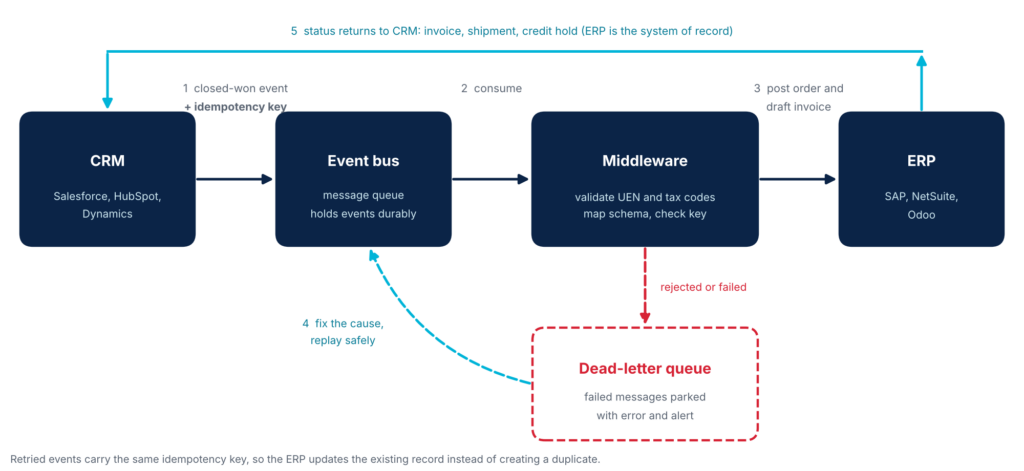
Reference Flow: Stage, Component and Safeguard
| Stage | Component | What Happens | Safeguard |
|---|---|---|---|
| 1. Event | CRM | An opportunity reaches closed-won and publishes an event with a unique idempotency key. | The key is generated at the source and never reused for a different order. |
| 2. Queue | Event bus or message queue | The event is held durably until middleware consumes it. | Absorbs traffic peaks and ERP maintenance windows. |
| 3. Validate and map | Middleware | Checks the UEN, legal entity name and tax codes, then maps CRM objects to the ERP schema. | Invalid payloads are rejected before they reach the ledger. |
| 4. Post | ERP | Creates the sales order and draft invoice and returns a status. | A repeated key updates the existing record, so no second invoice is created. |
| 5. Failure path | Dead-letter queue | Failed messages are parked with the error and an alert. | Engineers fix the cause and replay without data loss. |
| 6. Status return | ERP to CRM | Invoice, shipment and credit-hold statuses flow back to the CRM. | The ERP stays the system of record; the CRM displays it. |
What Do InvoiceNow, IRAS GST and the PDPA Mean for ERP-CRM Integration?
Integration templates built for North American or European markets often miss Singapore’s statutory rules. Three areas shape how the data model should look.
InvoiceNow and Peppol Data Dependencies
InvoiceNow is Singapore’s nationwide e-invoicing network, built on the Peppol framework. The GST InvoiceNow requirement obliges GST-registered businesses to transmit invoice data to IRAS through it. New voluntary registrants have been covered since 2025 and 2026. For mid-market and enterprise firms, the relevant phases run from April 2028 to April 2031, as announced by IRAS at the Committee of Supply 2026 and set out below. Treat that as a design input now, not an imminent deadline, and expect IRAS to publish further details and support measures.
GST InvoiceNow Requirement: Phases for Existing GST-Registered Businesses
| Date | Businesses Covered |
|---|---|
| 1 April 2028 | New compulsory GST registrants and existing registrants with annual supplies of S$200,000 or less |
| 1 April 2029 | Existing registrants with annual supplies of S$1 million or less |
| 1 April 2030 | Existing registrants with annual supplies of S$4 million or less |
| 1 April 2031 | All remaining GST-registered businesses with annual supplies above S$4 million |
The CRM matters on the buyer side. InvoiceNow addresses a business by its Peppol ID, and for a Singapore entity that ID is built from the UEN: scheme 0195, written 0195:SGUEN followed by the UEN. A sender finds the recipient in the SG Peppol Directory by company name or UEN. A blank or wrong customer UEN in the CRM therefore means the ERP cannot reliably look up the buyer’s address, and the invoice cannot be routed until someone corrects the record. On the supplier side, IMDA’s notes on Singapore Peppol BIS Billing 3.0 make your own GST registration number mandatory on GST invoices, but that sits in ERP configuration, not in CRM data.
IRAS GST and Multi-Currency Precision
Regional trading firms often quote in USD, EUR or MYR while reporting GST in SGD. Integration pipelines should carry exchange-rate timestamps, tax codes and currency fields from CRM line items to the ERP ledger unchanged. That keeps the IRAS Audit File (IAF), the listing of supplies, purchases and general ledger entries produced for a GST audit, consistent with the underlying transactions. The IAF header itself carries the company’s UEN and GST registration number.
PDPA and MAS TRM Interface Security
Synchronizing personal data between a cloud CRM and an internal ERP widens your exposure under the PDPA. That includes the Transfer Limitation Obligation (Section 26) when data moves outside Singapore, and the three-calendar-day breach notification once a breach is assessed as notifiable. For financial institutions, the MAS Technology Risk Management (TRM) Guidelines expect a vetting process for entities seeking API access, monitoring of API usage, and strong encryption for sensitive data in transit. Vinova designs integration middleware to align with those expectations: TLS 1.3 in transit as a design target, mutual TLS or OAuth 2.0 token authentication, role-based field masking and immutable audit logs.
Should You Use iPaaS or Custom Middleware for ERP-CRM Integration?
The transport layer between ERP and CRM sets both latency and long-term cost. Organizations typically choose between a managed Integration Platform as a Service (iPaaS) such as Workato, MuleSoft or Boomi, and custom event-driven microservices.
Managed iPaaS vs. Custom Event-Driven Middleware
| Factor | Managed iPaaS (Workato, Boomi, MuleSoft) | Custom Event-Driven Middleware |
|---|---|---|
| Deployment speed | Fast initial setup with pre-built connectors for standard objects. | Longer initial build for schema mapping and API engineering. |
| Pricing model | Usage-based: typically a platform fee plus a usage fee that scales with volume. Model high-volume sync costs before you commit. | Upfront engineering cost plus cloud hosting you control, with no per-transaction platform fee. |
| Legacy ERP compatibility | Strong for modern cloud APIs; legacy SOAP/XML or on-premises databases may need add-ons or agents. | Full protocol flexibility: REST, GraphQL, SOAP/XML, SFTP or direct database wrappers. |
| Throughput | Bound by vendor rate limits and shared multi-tenant queues. | Dedicated brokers such as RabbitMQ, Kafka or Redis, sized to your peaks. |
| IP and infrastructure control | Logic lives inside the vendor’s platform. | Code you own, deployed in your own AWS, Azure or private VPC. |
| Ongoing maintenance | The vendor maintains the platform and connectors. Your team still needs platform-specific skills and governance over recipes or flows, and depends on the vendor’s release cycle. | You own upgrades, monitoring, security patching and on-call support. Budget for engineers who know the code, or a support retainer with your partner. |
| Vendor dependence | Switching platforms means rebuilding flows, and pricing changes follow the vendor’s terms. | Portable code, but the knowledge of how it works must be documented and kept current. |
For a broader comparison of point-to-point connectors, enterprise service buses and event-driven topologies, see our complete guide to enterprise system integration.
How Do You Prevent Schema Drift in ERP-CRM Sync?
Even a fast API gateway corrupts operations if governance rules are undefined. The first safeguard is field-level ownership: every data type has one system of record, and the sync direction follows from it. The table shows a common default, which you should adjust to your operating model.
Master Data Precedence: Default Field Ownership
| Data | System of Record | Sync Direction | Why |
|---|---|---|---|
| Lead source, prospect contacts, pipeline stage | CRM | CRM to ERP on closed-won | Sales owns the relationship data. |
| Customer legal name, UEN, billing address | CRM creates, ERP confirms | Two-way, validated before write | Finance needs verified identifiers to invoice and route. |
| Credit limits and credit holds | ERP | ERP to CRM, read-only | Finance controls credit exposure. |
| Tax classification and GST codes | ERP | ERP to CRM, read-only | Statutory treatment sits with finance. |
| Product SKUs and catalog | ERP | ERP to CRM | One catalog avoids mismatched quote lines. |
| Inventory and shipment status | ERP | ERP to CRM, read-only | The warehouse record is the authority. |
| Invoice and payment status | ERP | ERP to CRM, read-only | The general ledger is the authority. |
| General ledger account codes | ERP | Not synced to CRM | Finance-only data. |
Four technical safeguards should then be in place before bidirectional sync goes live:
- Master data precedence: enforce the ownership table in code, so a field can only be written by the system that owns it.
- Idempotent API payloads: network timeouts make webhooks retry. Every payload carries a unique idempotency key, so a retried “OrderConfirmed” event updates the existing ERP record instead of creating a duplicate invoice or deducting warehouse stock twice.
- Dead-letter queues and automated replay: when an ERP maintenance window or validation error rejects a CRM payload, the message routes to an isolated queue with alerting, so engineers can inspect and replay it without data loss.
- Pre-sync deduplication and UEN validation: apply deterministic matching on UENs, corporate email domains and normalized phone numbers before any new master record is created across systems.
Need a Second Opinion on Your Integration Design?
Schedule a complimentary two-hour architectural roadmap consultation with our Singapore solutions team. We review your schema mapping, middleware choice and compliance controls before you commit to a build.
How Does Vinova Deliver Custom ERP CRM Integration?
Vinova architects ERP and CRM integrations for regulated industries and high-volume commercial operators, following four phases:
- Schema audit and master data mapping: cataloging entity relationships, UEN and GST validation rules, and conflict-resolution precedence across both systems.
- Middleware and queue architecture: building containerized microservices, REST and SOAP adapters and asynchronous message queues under ISO 27001:2022 security governance.
- Sandbox replay and load testing: stress-testing webhook retries, partial network dropouts and peak order volumes in isolated staging environments.
- Cutover, monitoring and hypercare: deploying live pipelines with observability dashboards and post-launch engineering support led by Singapore solutions architects.
Two Singapore deployments show both routes. For a national-scale facility services platform, our engineering teams integrated mobile field dispatching, vendor allocation logic and financial budgeting ledgers into a single operational loop, which is the integration method described above. For a luxury automotive brand experience center, Vinova took the unified route instead: an Odoo Enterprise backbone that brought CRM customer data, simulator bookings and restaurant POS terminals, including payment processing, into one operational dashboard.
Whether you are planning an enterprise CRM implementation in Singapore or untangling years of brittle point-to-point webhooks, a clean middleware layer protects data integrity as transaction volume grows.
What Else Do Buyers Ask About ERP and CRM Integration in Singapore?
How much does custom ERP and CRM integration cost in Singapore?
Cost follows scope: the number of systems, the objects and fields synchronized, legacy protocols, multi-currency GST mapping, real-time inventory reservation, and the security and hosting requirements. A figure quoted before those are mapped is not reliable. Ask each partner for a fixed-price discovery phase that produces the schema map and architecture first, then price the build against it. Compare the five-year cost, including iPaaS usage fees or hosting, not only the build fee. For funding, Enterprise Singapore has announced EDGE to combine the EDG, PSG, and MRA grants into one scheme, and says businesses can keep applying for the existing grants through the Business Grants Portal until then. Eligibility and funding rates vary, so check the current terms.
Should we use an iPaaS like Workato or build custom API middleware?
A managed iPaaS works well for connecting standard cloud schemas quickly at moderate transaction volumes. Custom middleware is the stronger choice when high transaction frequency would push usage-based fees up, when you connect legacy proprietary databases, or when your security or regulatory posture calls for hosting integration infrastructure in a dedicated environment. It also assumes you can own the code afterward, with an in-house team or a partner on a support retainer.
How does CRM data hygiene affect Singapore InvoiceNow compliance?
InvoiceNow transmits structured e-invoices over the Peppol network and addresses each business by a Peppol ID built from its UEN. If a customer’s UEN is blank or wrong in the CRM, the ERP cannot reliably look up the buyer’s address in the SG Peppol Directory, so the invoice cannot be routed until someone corrects the record. Validating UENs at entry and deduplicating before sync prevents that.
How Can Vinova Support Your ERP and CRM Integration?
Vinova, a Singaporean Government-Grade Technology Partner, Made Accessible, has delivered more than 300 projects across custom software, web, mobile, data, AI and cybersecurity over 16 years. Most integration programs are won or lost in the schema audit, before any connector is built, and Vinova’s approach is built around accountability:
- Fiduciary Governance & Regulatory Alignment: Delivery operations certified under ISO 27001:2022 (Information Security) and ISO 9001:2015 (Quality Management) and GovTech Category 1B approved, with delivery designed to align with the PDPA, GovTech IM8 and MAS TRM expectations that apply to your sector.
- Singapore Corporate Governance: Master Services Agreements governed under Singapore law with SIAC arbitration, so IP ownership and accountability are defined before the first commit.
- ERP and CRM Integration Practice: Architects and engineers who design and build the middleware, API adapters and event-driven pipelines that connect your CRM to the ERP, finance and POS systems around it, including Odoo-based builds.
- Engineering Depth: 300+ in-house engineers across Singapore and Vietnam delivery hubs in Ho Chi Minh City, Da Nang, and Hanoi, with 8% to 12% annual voluntary attrition, so the people who build your integrations are still there to run them.
Explore our system integration and enterprise architecture services, or schedule a complimentary two-hour architectural roadmap consultation with our Singapore solutions team to review your ERP and CRM integration design.
Vinova: a Singaporean Government-Grade Digital Transformation Partner, Made Accessible. For 16 years, we have designed digital systems for 300+ companies and government agencies worldwide, backed by ISO 27001:2022 and ISO 9001:2015 certification and Singapore GovTech Category 1B approval.
300+ employees across offices in Singapore, Vietnam (Hanoi, Da Nang, Ho Chi Minh City), Norway (Oslo), and Thailand (Bangkok), scaling platforms and engineering capacity to serve clients across the globe.
Financial Times Top 500 High-Growth Companies Asia-Pacific 2026. Recognized among Singapore’s Top 100 Fastest-Growing Companies in 2024, 2025, and 2026.