Vinova | Family Office Technology Series | Updated October 2026
Every software demonstration ends with an executive summary screen. A single consolidated net worth figure sits in the top corner. Beneath it, liquid custody, direct property, private credit, and venture funds appear in balanced, color-coded rows. The principal glances at the screen, nods, and leaves the room. What the demonstration skips is how that number arrived. In many Singapore family offices, it arrived because an operations analyst spent the final ten days of the month retyping PDF capital call notices into a spreadsheet, manually looking up exchange rates on Friday afternoon, and praying a broken cell formula did not alter the total.
A family office is not a miniaturized retail bank. It carries the asset complexity of an institutional fund, but runs on an operational team that sits around one conference table. When market volatility hits or when two private equity funds issue capital calls in the same week, spreadsheets stop being an administrative inconvenience. They become an active risk to liquidity.
This guide is for the operations lead or controller tasked with evaluating family office reporting software. It addresses multi-asset consolidation from the ground up: why consolidation breaks, the prerequisite decisions you must make before selecting a vendor, the three ways data enters a system, the controls required to catch errors, and how to construct a reliable month-end reporting flow. It quotes no prices, because software pricing varies by contract, and an arbitrary price lifted from a website creates false expectations for your investment committee.
Table of Contents
1. Why Consolidation Is Harder Than It Looks
Consolidating a multi-asset portfolio looks like a formatting exercise until you examine the data pipelines underneath. A single-family office managing wealth in Singapore rarely holds assets in one place. Liquid portfolios sit across three or four private banks. Direct venture co-investments sit in Southeast Asian holding companies. Real estate assets sit in United Kingdom special purpose vehicles. Private equity commitments sit in Cayman Islands partnerships.
Each asset class communicates through a different medium, at a different frequency, under a different accounting convention. Public equities provide automated daily feeds. Private equity funds mail unstructured quarterly PDFs forty-five days after quarter-end. Commercial property requires annual appraisal letters. When you combine these inputs into a single report, you are not assembling a spreadsheet: you are attempting to synchronize asynchronous data streams into a single snapshot in time.
| Asset Type | How Data Arrives | How Often | Where the Gap Shows Up |
|---|---|---|---|
| Public Equities & Fixed Income | Custodian feeds, Society for Worldwide Interbank Financial Telecommunication (SWIFT) messages, or open Application Programming Interfaces (APIs) | Daily | Trade date versus settlement date discrepancies create temporary cash mismatches across custodians. |
| Private Equity & Venture Funds | Unstructured PDF capital account statements and capital call notices | Quarterly (with 45 to 90 day delay) | Valuations lag the market. Reported Net Asset Value (NAV) reflects historical quarters, while cash calls happen in real time. |
| Direct Private Debt & Promissory Notes | Loan agreements, bank interest advice slips, amortization schedules | Monthly or quarterly | Interest accruals are omitted from cash forecasts. Withholding tax deductions are missed until tax filing time. |
| Commercial & Residential Real Estate | Property manager rental statements, debt service notices, appraisal letters | Monthly rental income; annual valuations | Leverage is hidden if property debt sits in local operating entities. Rental yields fail to reflect maintenance reserves. |
| Operating Businesses | Financial statements from management accounting packages | Monthly or quarterly | Intercompany management fees and shareholder dividend distributions conflict with investment accounting books. |
| Digital Assets & Cryptocurrencies | Blockchain node exports, hardware wallet balances, exchange APIs | Real-time continuous | High-frequency pricing swings skew monthly closing figures. Wallet staking rewards create complicated tax tracking events. |
| Passion & Physical Assets (Art, Aviation) | Physical invoices, specialized auction appraisal letters, insurance schedules | Annual or ad-hoc | Often carried at cost for years without depreciation or revaluation, which distorts net worth. |
2. Where Manual Consolidation Breaks
Spreadsheets do not break because operations analysts lack Excel proficiency. Spreadsheets break because they cannot enforce structural governance across asynchronous data. When an office relies on manual workbooks to produce month-end reports, failure occurs across five operational fault lines:
- Timing desynchronization: Liquid bank statements close on the final calendar day of the month. Private equity statements arrive forty-five to sixty days later. When an analyst pastes private equity valuations into a month-end workbook, they are combining October public equities with June private valuations. If the principal reviews the report without an explicit notation of that lag, the office makes asset allocation decisions on distorted assumptions.
- Valuation basis mismatch: Public securities are marked to market daily at the closing bid price. Direct private investments are carried at cost, at the latest financing round valuation, or on a discounted cash flow basis. Real estate is carried at purchase price or appraised value. Combining these figures into a single total without identifying the valuation basis of each row produces a consolidated figure that mixes historical cost with live market risk.
- Foreign exchange volatility: A family portfolio holds assets across United States Dollars (USD), Singapore Dollars (SGD), Euros (EUR), and British Pounds (GBP). If an analyst converts an overseas property using the exchange rate from the date of purchase, converts private equity using the rate on the capital account statement date, and converts liquid cash using the month-end closing rate, currency movements distort asset performance. A portfolio can show positive local investment returns while suffering substantial real losses in the family’s base reporting currency.
- Identifier fragmentation: Public securities use International Securities Identification Numbers (ISIN) or Bloomberg Tickers. Private funds use partnership legal names that appear differently across documents: one bank lists “Apex Private Equity Fund IV, L.P.”, while another records “Apex PE IV”. When an analyst reconciles holdings manually, string mismatches lead to duplicate rows or dropped assets.
- Double counting in multi-tier structures: Wealth is held through nested legal entities: a family trust owns a Singapore Variable Capital Company (VCC), which holds an offshore Special Purpose Vehicle (SPV), which holds an operating asset. If the analyst aggregates the bank balance of the SPV alongside the valuation of the holding company without eliminating intercompany balances, net worth is artificially inflated. An intercompany loan of two million dollars recorded as an asset in entity A and a liability in entity B must wash out completely upon consolidation. In spreadsheets, that elimination is an unrecorded manual task vulnerable to human oversight.

3. Five Decisions Before Picking Family Office Reporting Software
Search committees buy family office reporting software hoping it will impose order on operational chaos. It will not, because software cannot make policy decisions for your family. If your investment committee has not agreed on valuation baselines, configuring software simply automates your confusion. Before reviewing platform demonstrations, establish five operational rules:
1. Base currency and FX source
Select one base reporting currency, usually Singapore Dollars or United States Dollars, and define a single source of truth for exchange rates (such as the Monetary Authority of Singapore reference rates or Bloomberg closing mid-rates). Establish a strict policy for historical transactions: are dividends converted on the cash receipt date, or converted at the month-end closing rate? Changing this convention halfway through the year invalidates performance attribution.
2. Valuation basis policy
Define how illiquid assets are valued when quarterly manager statements have not yet arrived. Will private equity be reported using the latest available Net Asset Value adjusted for subsequent cash calls and distributions, or will it remain strictly unadjusted until the audited statement arrives? Document this rule in writing so every analyst books private positions consistently.
3. The universal as-of date convention
Establish whether liquid securities are reported on a trade-date basis or a settlement-date basis. Trade-date accounting matches economic market risk; settlement-date accounting matches confirmed custodian cash. Mixing the two creates artificial cash discrepancies between the reporting platform and corporate bank statements.
4. Look-through accounting rules
Determine how deeply the reporting software must look through holding entities. If a trust owns forty percent of an operating company that holds real estate, does the principal want to see the gross real estate asset and its underlying debt, or simply the net equity value of the operating holding company? Look-through reporting requires software capable of fractional ownership math and multi-tier elimination rules.
5. Audience and cadence segmentation
The principal, the investment committee, and the external tax accountant do not need the same report. The principal requires a mobile dashboard showing current net worth, 90-day cash runway, and pending commitments. The investment committee needs Time-Weighted Returns (TWR) and benchmark performance attribution. The accountant needs balanced debits, credits, and journal entries. Designing one document for all three audiences results in a report that none of them open. What belongs on the principal’s page one is covered in family office performance reporting.
4. Three Ways to Get Data In
A reporting platform is only as current as its ingestion engine. Every platform fills its database through three methods. A working setup uses all three. The skill is matching each method to the right asset. To see how ten platforms handle these methods, read the best family office software guide.
Automated feeds
Data arrives directly from custodians via SWIFT network messaging (MT940 statements, MT535 holdings, ISO 20022 camt.053 XML files) or direct bank APIs.
Where It Works
- Liquid investment portfolios held at major global private banks and custodial institutions.
- High-frequency cash and security transactions that would overwhelm manual bookkeepers.
The Catch
- Feeds break silently when banks alter security messaging codes or maintenance windows shift.
- Bank setup fees and SWIFT transmission costs can apply per custodian relationship.
Best for: Public equities, sovereign fixed income, mutual funds, and multi-currency bank cash accounts.
Document parsing
Unstructured documents, such as capital call notices and PDF statements, pass through Optical Character Recognition (OCR), visual layout analysis, and private language models to extract structured parameters.
Where It Works
- Private equity, venture capital, and private credit fund notices that lack automated digital APIs.
- Regional private bank statements from institutions across Southeast Asia that do not support automated feeds.
The Catch
- Parsing accuracy drops on complex nested tables, multi-currency schedules, and scanned image documents.
- Requires a human verification interface; fully autonomous document extraction without human approval introduces errors into the accounting ledger.
Best for: Alternative fund notices, private debt interest advice slips, and property manager statements.
Controlled manual entry
Operations staff record valuations and transactions through structured web forms with mandatory fields, validation rules, and dual-authorization approval workflows.
Where It Works
- Bespoke assets that arrive once a year: direct real estate appraisals, art valuations, and superyacht insurance schedules.
- Direct promissory notes and intercompany debt transactions between family holding entities.
The Catch
- Human transcription error remains possible if entry forms lack mathematical range boundaries.
- Creates key-person risk if only one analyst understands the data entry conventions.
Best for: Physical assets, direct venture cap tables, passion investments, and intercompany balancing adjustments.
Practitioner Verdict: Match the input method to the asset, not to the tool. A platform that does one method well and the other two badly leaves you retyping the rest.

Which report takes your team longest?
Every office has one report that eats the end of the month. A short note on which one, and why, tells us where the next guide should focus.
5. What a Trustworthy Consolidated Report Shows
A reporting pack that displays forty pages of colorful pie charts is not proof of technical competence. If a number cannot be traced back to its underlying custodian statement or fund notice, the report is an unverified presentation. A trustworthy consolidated report shows five things:
- Complete data provenance: Every asset balance displays its source document, arrival timestamp, and conversion rate. The principal can tap on a private equity valuation and immediately view the underlying general partner capital account statement PDF that generated it.
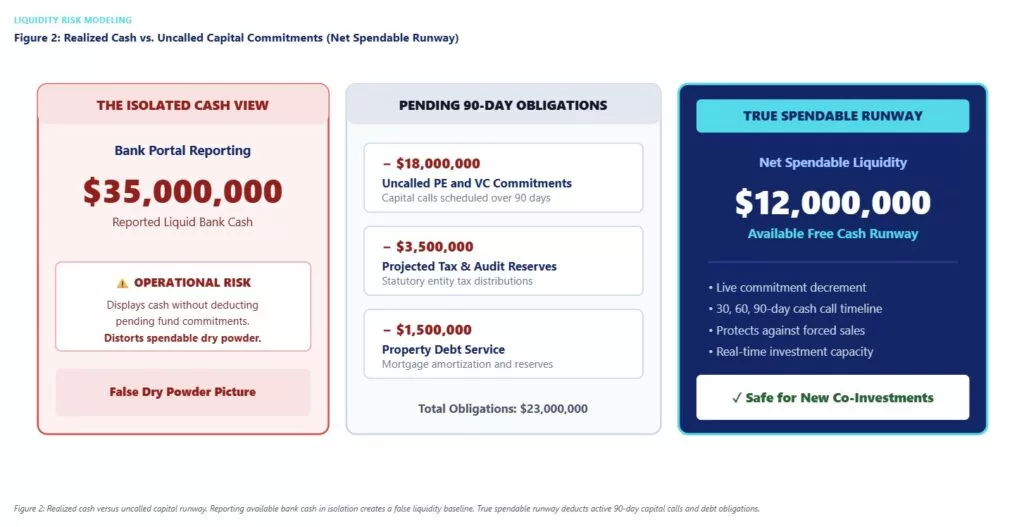
- Realized cash versus uncalled capital runway: The report never presents available bank cash in isolation. It displays a net liquidity metric: available liquid cash minus pending capital commitments due over the next thirty, sixty, and ninety days. This prevents the family from approving direct co-investments against cash that is already committed to private equity managers.
- Transparent valuation age tags: When a report shows private assets alongside public equities, every row includes a tag indicating the age of the valuation. Liquid equities show as marked to market on the closing date; private equity shows as marked to the latest available statement date with an explicit notice of the reporting lag.
- Isolated currency impact: Total portfolio returns are separated into underlying asset performance and foreign currency translation impact. The principal can clearly see whether a positive return was driven by investment alpha or by foreign exchange appreciation against the base currency.
- Beneficial ownership look-through: When wealth is held across multiple trusts, VCC sub-funds, and operating holding companies, the report shows true beneficial ownership percentages. A commercial property held inside an overseas holding company rolls up to display each family member’s exact net equity stake after subtracting entity-level debt.
6. Controls That Catch Errors in Family Office Reporting
Software cannot remove human error. It can stop an error from reaching the board pack. Sound family office reporting software enforces four automated controls:
- Automated cash reconciliation tolerances: When bank transaction feeds ingest daily cash positions, the software compares closing balances against the previous day’s balance plus net transaction activity. If a cash discrepancy exceeds an established tolerance (for example, ten dollars), the platform flags a reconciliation exception before month-end closing starts.
- Valuation outlier alerts: When an analyst records an illiquid asset valuation, the platform runs a sanity check against historical records. If an asset valuation moves by more than a set threshold in a single reporting period (for example, twenty percent), the software requires secondary manager sign-off and forces the user to attach an independent appraisal notice.
- Commitment arithmetic validation: When an analyst books a private equity capital call notice, the software runs a mathematical assertion: the cash call amount must equal the sum of drawn principal, management fees, interest, and expenses. Furthermore, drawn principal must reduce remaining uncalled capital dollar for dollar, while management fees must not deduct from the commitment cap. If the numbers do not balance, the software rejects the transaction entry.
- Tamper-evident audit trails: Every balance adjustment, exchange rate override, and manual transaction entry is recorded in a tamper-evident audit log capturing the user ID, timestamp, prior value, and updated value. Administrators should not be able to alter or erase audit entries. In the event of a valuation dispute, operations can reconstruct every change back to the original save.
7. Where to Start: One Report, Not Ten
The most common implementation mistake is scope overload. An office buys software, attempts to digitize every asset class, tax entity, passion investment, and historical transaction simultaneously, and spends six months in configuration meetings without delivering a single report to the principal. Operations staff burn out, the principal loses patience, and the office returns to Microsoft Excel.
Start with one report: the 90-day cash and liquidity runway report.
- Phase 1: Connect liquid bank accounts. Ingest daily positions from your primary two or three custodian banks. Establish automated foreign exchange conversion to your base currency. Deliver a single mobile dashboard showing total liquid cash, money market balances, and short-term debt maturities.
- Phase 2: Layer in private capital commitments. Record active private equity and venture fund commitments. Connect capital call notices so pending payments decrement available liquidity in real time. The principal now has an accurate answer to the question: “How much cash do we actually have to spend?”
- Phase 3: Add holding entities and direct real estate. Model the parent trusts, Singapore VCC sub-funds, and offshore holding SPVs. Ingest property values and direct company equity. Deliver the consolidated net worth balance sheet.
Shipping one useful report first builds organizational momentum. It gives the principal immediate confidence in the systems investment and allows operations to refine ingestion workflows before taking on complex private assets.
8. A Monthly Reporting Data-Flow Worksheet
Use this illustrative schedule as a starting point for your month-end close, and adjust the days, roles and tolerances to your office. It coordinates data arrival, verification gates and reporting outputs across eight business days:
| Timeline | Operational Step | Data Source / Tool | Responsible Role | Verification Control |
|---|---|---|---|---|
| Day +1 | Ingest liquid positions and month-end cash | SWIFT MT940 / camt.053 custodian bank feeds | Operations Analyst | Automated cash reconciliation check within your tolerance. |
| Day +2 | Lock monthly FX rate table | Monetary Authority of Singapore / Bloomberg closing rates | Finance Controller | Rate variance check against prior month closing rates. |
| Day +3 | Extract and verify alternative asset notices | Private document parsing pipeline (PDF to JSON) | Operations Analyst | Side-by-side human verification: check principal vs fees. |
| Day +4 | Record direct loans and manual asset updates | Structured web forms inside reporting platform | Operations Analyst | Dual-authorization approval by Finance Controller. |
| Day +5 | Execute multi-tier entity eliminations | Consolidation engine (trust, VCC, and SPV rules) | Finance Controller | Intercompany loan balances assert zero net difference. |
| Day +6 | Generate draft consolidated balance sheet | Reporting software aggregation ledger | Chief Operating Officer | Sanity check: investigate any position that moves beyond your variance threshold. |
| Day +7 | Publish principal mobile view and executive summary | Biometric mobile portal & executive summary dashboard | Chief Operating Officer | Verify 90-day cash runway matches confirmed commitments. |
| Day +8 | Export general ledger journal pack for tax audit | Accounting ledger export format (CSV / API) | Finance Controller | Confirm external accountant ledger balances match report. |
9. Four Takeaways
- Standardize rules before buying software: Agree on your base reporting currency, FX rate provider, and valuation horizons before scheduling a demonstration. Software enforces policy; it cannot invent it for you.
- Never report cash without uncalled commitments: Liquid bank cash without uncalled private capital commitments produces an inflated liquidity picture. True spendable runway is available cash minus pending capital calls.
- Test with your own private documents: Run your actual private equity capital call notices and regional bank statements through any prospective vendor’s parser during proof-of-concept testing. A demonstration parsing clean standard statements proves nothing about your portfolio.
- Ship the liquidity view first: Do not attempt a big-bang rollout that replaces every accounting and legal entity workflow at once. Deliver the 90-day cash and liquidity view first, establish confidence, and expand into illiquid assets in stage-gated phases.
10. Who Wrote This: A Note on Vinova
Vinova is a Singapore-headquartered technology transformation partner with delivery in Vietnam and 16+ years of experience. Its information security and quality management systems are certified to ISO 27001:2022 and ISO 9001:2015.
This guide is part of Vinova’s series on family office technology, and it argues from the buyer’s side of the table. The experience behind it comes from adjacent work in regulated, brand-sensitive and multi-entity environments:
| Sector | What was built |
|---|---|
| A global maritime shipping and commodity group | An integrated enterprise platform covering multi-entity finance, budgeting, workflow automation, ticketing, vessel operations, and mobile and web executive dashboards |
| A Singapore legal education body | A centralized portal for accreditation, activity logging, administrative compliance and reporting |
| A luxury automotive brand’s flagship experience center in Singapore | Digital touchpoints and booking systems |
| A Singapore energy utility group | Solution architecture for an artificial intelligence (AI)-enabled enterprise platform on Azure |
Reporting problems look similar across regulated environments. What changes is the data, and the damage when it is wrong.
Frequently Asked Questions
What is the difference between wealth reporting software and portfolio reporting software?
Portfolio reporting software was originally built for asset managers and Registered Investment Advisors to track liquid market performance, benchmark attribution, and public security returns. Wealth reporting software is built for family offices to aggregate the complete multi-asset balance sheet: public equities, private equity commitments, commercial real estate, direct operating entities, debt liabilities, and passion assets, rolling them up through complex legal entity trees.
Can family office reporting software replace an accounting general ledger?
In most cases, no. Many reporting platforms operate on shadow accounting: they track positions, cost basis, and cash balances without maintaining balanced debit and credit journal entries. While reporting software produces executive dashboards and performance returns, formal entity tax filing, partnership capital allocations, and statutory audit compliance require a true double-entry general ledger. Many offices run a reporting tool for visibility and a ledger for books, managing the data flow between them.
How do family offices handle private equity and illiquid asset reporting?
Alternative assets lack automated real-time feeds. Family offices handle them through three methods: manual transcription from quarterly manager statements, third-party managed data transcription services, or private document parsing pipelines that extract capital calls and distributions into structured data with human verification before committing to the ledger.
How long does it take to implement family office reporting software?
It depends on your data quality and scope. One vendor states that most offices go live within four to six weeks. Ledger-based platforms generally take longer, because the chart of accounts and historical data must be mapped. Ask any vendor for a written plan and a reference client of your size.
Is hosting in a Singapore cloud region sufficient for data protection?
No. A Singapore cloud data center region answers where the physical server resides, not who controls it. If the platform is hosted on a shared multi-tenant database, client records are separated only by software tenant IDs. Family offices managing sensitive beneficial ownership records should ask whether the database is single-tenant, who holds the master cryptographic encryption keys, and whether the office can revoke vendor access on demand. The family office security guide has the full list of vendor questions.
Vinova: Singapore’s mobile and web application development partner since 2010. ISO 27001:2022 and ISO 9001:2015 certified.
300+ in-house engineers across Singapore, Hanoi, Da Nang, and Ho Chi Minh City, including teams who build secure web and mobile applications for enterprise and government clients. We wrote this guide so you can map your reporting before you shop for tools.
Financial Times Top 500 High-Growth Companies Asia-Pacific 2026. The Straits Times Singapore’s Fastest-Growing Companies 2024, 2025, and 2026.