Vinova | Family Office Technology Series | Updated October 2026
In a software demonstration, family office performance reporting looks like an interactive dashboard where private equity capital calls, multi-currency cash balances and real estate holding entities synchronize on their own.
In reality, it can look like this illustrative scenario: an operations controller at a dual-monitor workstation late on a Tuesday, reconciling foreign exchange (FX) differences between three private bank PDF statements and an unlinked spreadsheet, while cross-referencing seven capital call notices received by email.
The demo promises real-time portfolio telemetry. In that scenario, the operations lead spends twelve business days at the end of the quarter assembling a seventy-page PDF packet with twenty-two footnotes explaining uncalled capital commitments. The family principal opens page two on an iPad during a flight, checks the cash total, and asks three practical questions over lunch.
A performance report is not an exhaustive statutory general ledger. It is an executive decision sheet. When an office manages private and public assets with four or five people, a corporate accounting packet does not fit. If the team delivers data three weeks after month-end, the principal allocates capital on outdated balances. If those balances ignore pending capital calls, the office risks overdraft fees or forced liquidations.
Data consolidation and custodial reconciliation are covered in our guide to family office reporting software. This article focuses on what to present once the numbers are reconciled.
Table of Contents
1. The Principal’s Three Questions: Why Long PDF Packs Fail in Family Office Performance Reporting
Long reporting packets fail because they prioritize accounting completeness over executive decision-making.
When controllers prepare quarterly reports, they often feel compelled to justify their work by documenting every transaction, dividend credit and corporate action across every holding entity. The resulting bloated packet contains every transaction and almost no executive signal.
A principal reviewing family office performance reporting wants immediate answers to three practical questions:
1. What Is Our Consolidated Net Worth Right Now, and as of What Date?
The principal needs the total value of the family balance sheet across liquid custody accounts, private direct investments, real estate holding special purpose vehicles (SPVs) and trust structures. That number must carry an explicit as-of date. If public equities are valued at yesterday’s market close while private equity funds reflect valuations from six months ago, the total must say so.
2. How Much Liquid Cash Is Available Over the Next 30, 60, and 90 Days?
Net worth does not settle capital calls. Liquid cash does. The principal needs the true cash runway: current liquid deposits and money market funds, minus pending tax liabilities, operating expenses and the uncalled private market commitments due over the coming quarter.
3. Did Our Capital Beat Our Policy Hurdles, Net of All Fees and Taxes?
The principal does not need twenty performance attribution charts. They need to know whether the total portfolio beat its agreed benchmark hurdle after bank custody fees, external manager management and performance fees, legal expenses and structural administration costs.
If a reporting pack takes more than a few minutes to answer these three questions, the principal stops reading it. If the principal stops reading it, they start making opportunistic capital commitments from memory instead of documented liquidity.
2. What a Principal-Ready Report Contains in Family Office Performance Reporting
A principal-ready performance report puts five elements on page one.
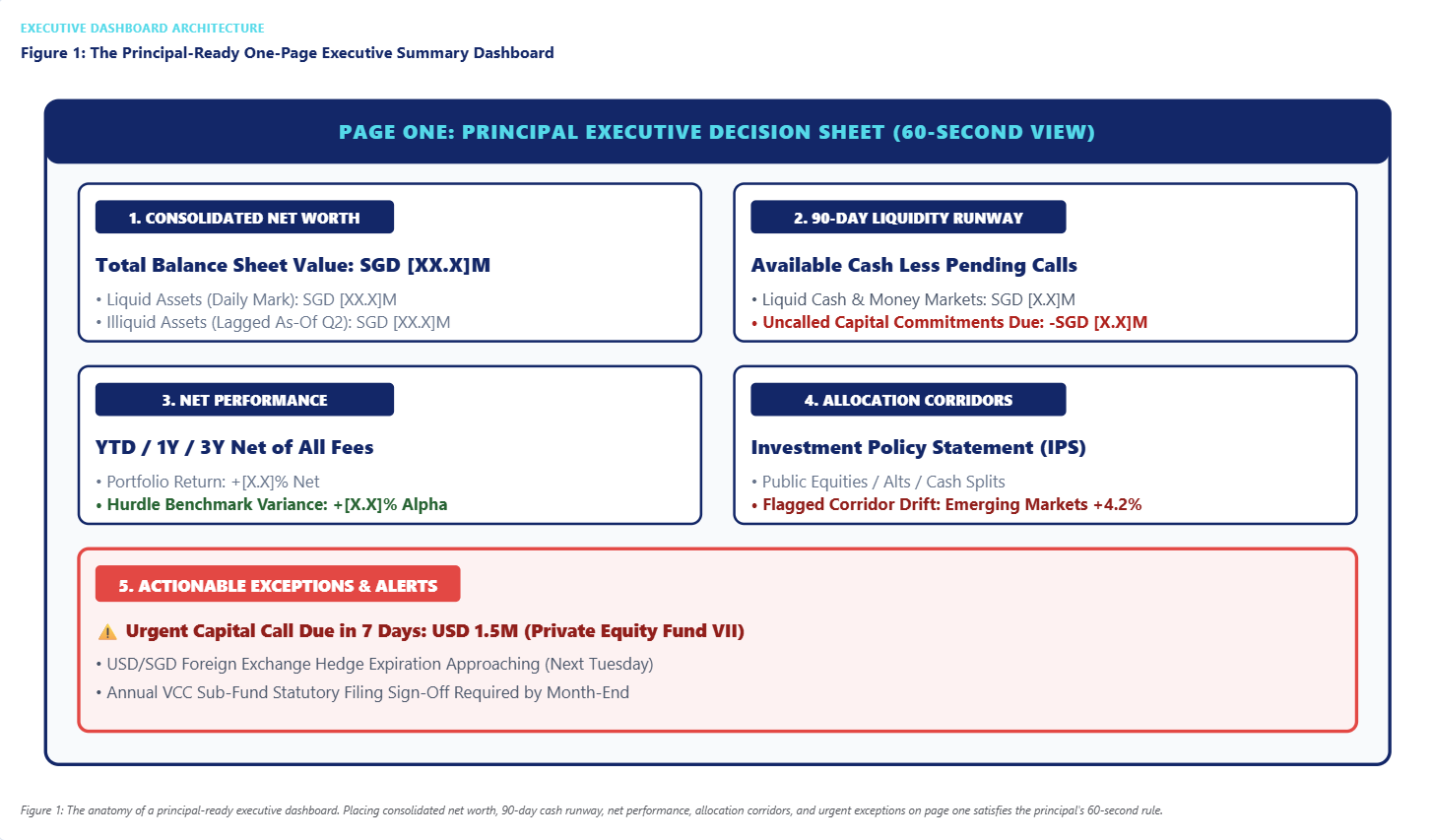
1. Consolidated Net Asset Value (NAV) with Explicit Valuation Dates
The report leads with total NAV, and beneath it states the valuation date for each asset class. Public market portfolios at private banks in Singapore or Switzerland can be marked to market daily. Private equity co-investments, venture capital funds and commercial real estate often report with a lag of a quarter or more. An aggregated balance sheet with no valuation dates creates a false sense of real-time accuracy.
2. Liquidity Runway and Uncalled Commitments
Operating a family office means balancing illiquidity premiums against immediate cash obligations. The report displays:
- Total cash and cash equivalents across all currencies.
- Uncalled capital commitments across all active private market funds.
- Net liquidity runway: available cash minus anticipated capital calls over 30, 60 and 90-day horizons.
If a private equity general partner issues a capital call with a ten-day remittance deadline, the team must know instantly whether existing cash can cover the drawdown without selling public equities in a downturn.
3. Net Performance Trajectory
Performance is calculated across meaningful intervals: Year-to-Date (YTD), rolling one-year, rolling three-year and since inception. Returns are displayed net of all operational and management fees. Reporting gross performance while ignoring custody charges and operating expenses misleads the family about real wealth preservation.
4. Allocation Against Investment Policy Statement (IPS) Corridors
A single family office with a formal investment strategy works under an Investment Policy Statement (IPS) that defines target allocation corridors (for example, public equities 30% to 40%, private equity 20% to 30%, real estate 15% to 25%, and fixed income and cash 10% to 20%). The report shows current allocations beside the target bands and highlights any breach that requires rebalancing.
5. Actionable Exceptions on Page One
The first page highlights the items that need the principal’s attention now, and that block sits at the top of the page (see Rule 2 in Section 5):
- Capital calls due within the next fourteen business days.
- Foreign exchange hedges approaching expiration.
- Pending statutory filings or corporate resolutions.
Format Evaluation: The One-Page Dashboard
- Where It Works: Monthly executive reviews with the principal, family board meetings and weekly liquidity monitoring sessions.
- The Catch: It requires the team to keep data normalized across custodians all month, instead of scrambling at quarter-end.
- Best for: Giving the principal immediate visibility while the full general ledger reconciliations stay archived for external tax accountants and auditors.
3. Performance Measurement Pitfalls: A Comparative Systems Table
Family office performance reporting fails quietly when a return metric meets the wrong asset class. The table below sets out five primary performance measures, what each is best used for, and the calculation trap that comes with each:
| Performance Metric | Best Used For | Watch Out (The Calculation Trap) |
|---|---|---|
| Time-Weighted Return (TWR) | Evaluating liquid, publicly traded portfolios run by discretionary external managers. | Ignores the timing of capital added or withdrawn. If the manager has no control over when the family deposits or withdraws funds, TWR isolates their pure investment selection. It is poorly suited to private equity, where cash flows are irregular. |
| Money-Weighted Return (MWR) / Internal Rate of Return (IRR) | Evaluating private equity, venture capital, direct real estate and the total family balance sheet. | Highly sensitive to the timing and size of cash flows. An early, large distribution can inflate IRR, while a late capital call can depress it, even when total dollars returned stay high. |
| Total Value to Paid-In (TVPI) | Evaluating overall value creation in closed-end alternative funds. | Total distributions plus unrealized value, divided by total capital drawn. It includes the manager’s unrealized valuations (“paper wealth”), which may not match real exit values in a downturn. |
| Distributed to Paid-In (DPI) | Measuring realized cash returned to the family office bank account. | Ignores remaining unrealized assets. A young fund shows a low DPI, near 0.0, during its first investment years. That reflects a normal fund lifecycle, not poor performance. |
| Blended Policy Benchmarks | Comparing multi-asset, multi-currency family portfolios against an objective hurdle. | An artificial benchmark that does not match the portfolio’s real constraints. A simple 60/40 equity and bond index does not reflect the illiquidity, currency risk and direct real estate exposure of an Asian family office. |
3.1 The Time-Weighted Return (TWR) vs. Internal Rate of Return (IRR) Divide
The most frequent dispute between a principal and a controller comes from confusing TWR with IRR.
Take an example. The family deposits SGD 10 million with an external discretionary manager on January 1. Over six months the market rallies and the portfolio gains 20% (value: SGD 12 million). Encouraged, the principal deposits another SGD 40 million on July 1 (total value: SGD 52 million). In the second half the market corrects and the portfolio falls 10% (loss: SGD 5.2 million; ending balance: SGD 46.8 million).
If the controller calculates TWR, the manager reports a positive annual return: (1 + 0.20) × (1 – 0.10) – 1 = +8.0%. The manager argues that stock selection generated positive alpha across both market cycles.
Now take the net cash outcome. The family deposited SGD 50 million in total and ended the year with SGD 46.8 million, an absolute loss of SGD 3.2 million. The money-weighted return is negative.
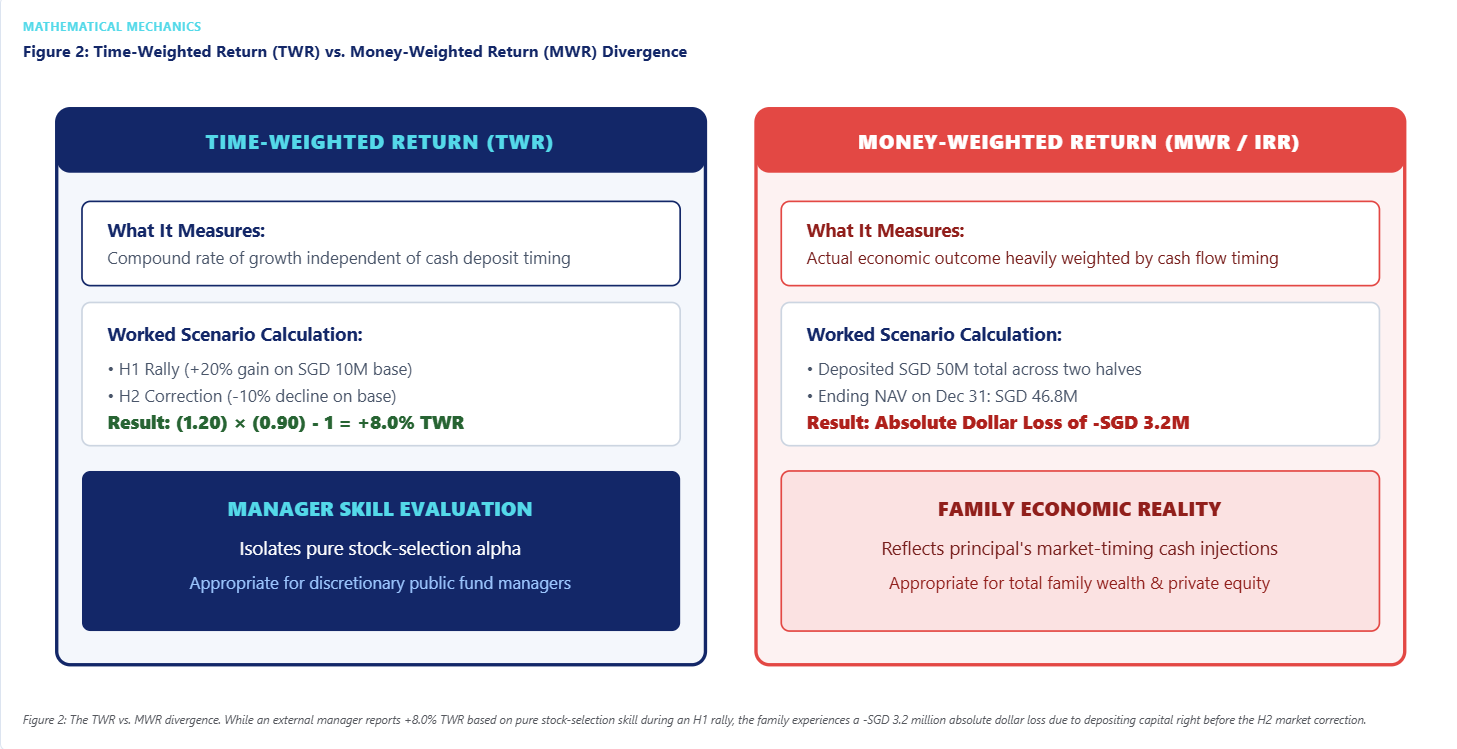
Neither metric is wrong. They measure different things. TWR measures the manager’s skill, independent of cash deposits. MWR measures the family’s actual economic outcome, shaped by the principal’s decision to add capital in July. A principal-ready report shows both, and explains the difference in plain language.
Practitioner Verdict: Show both numbers side by side, with one plain sentence on why they differ. The argument between controller and principal tends to end when both numbers are on the page.
3.2 The TVPI vs. DPI Reality Check in Private Equity
In alternative asset reporting, relying on TVPI without checking DPI distorts the picture.
TVPI includes the general partner’s own valuation of unsold portfolio companies, and in downturns private fund managers often delay marking those valuations down. A family reviewing its private equity holdings may see a healthy TVPI of 1.8×, and believe its capital has grown substantially.
But if DPI sits at 0.2× in year eight of a ten-year fund life, the fund has returned almost no cash. The principal cannot settle new venture capital calls or fund a philanthropic foundation with unrealized TVPI. DPI is the unvarnished number, so performance reporting should always place it beside TVPI.
4. Cadence and Audience Matrix: Matching Reports to Stakeholders
A principal and an auditor should never receive the same document. Family office performance reporting serves four main stakeholders, each with a different level of detail and a different frequency. The table below sets out cadence, core decision metrics and delivery format for each:
| Stakeholder | Recommended Cadence | Core Decision Metric | Delivery Format |
|---|---|---|---|
| Family Principal | A monthly executive snapshot, supported by a weekly cash and liquidity flash. | Consolidated NAV, 90-day available cash runway, policy allocation exceptions and required actions. | A single-page digital summary viewed through an authenticated, biometric mobile portal. No unencrypted email attachments. |
| Investment Committee (IC) | A quarterly review, circulated before each meeting. | TWR by asset class, manager attribution, private market IRR and DPI, policy drift and liquidity stress tests. | A structured analytical workbook with drill-down into position-level records. |
| Next Generation | A semi-annual or annual educational review. | Multi-generational capital preservation, thematic allocations such as sustainable investments, and entity structure mapping. | A visual, interactive tablet presentation focused on long-term stewardship, not short-term market noise. |
| External Auditors and Tax Counsel | An annual statutory compliance and tax package. | Audited historical ledgers, realized gains and losses, dividend withholdings and look-through entity accounts. | Double-entry general ledger exports with an audit trail, in the format your auditors and Inland Revenue Authority of Singapore (IRAS) filings require. |
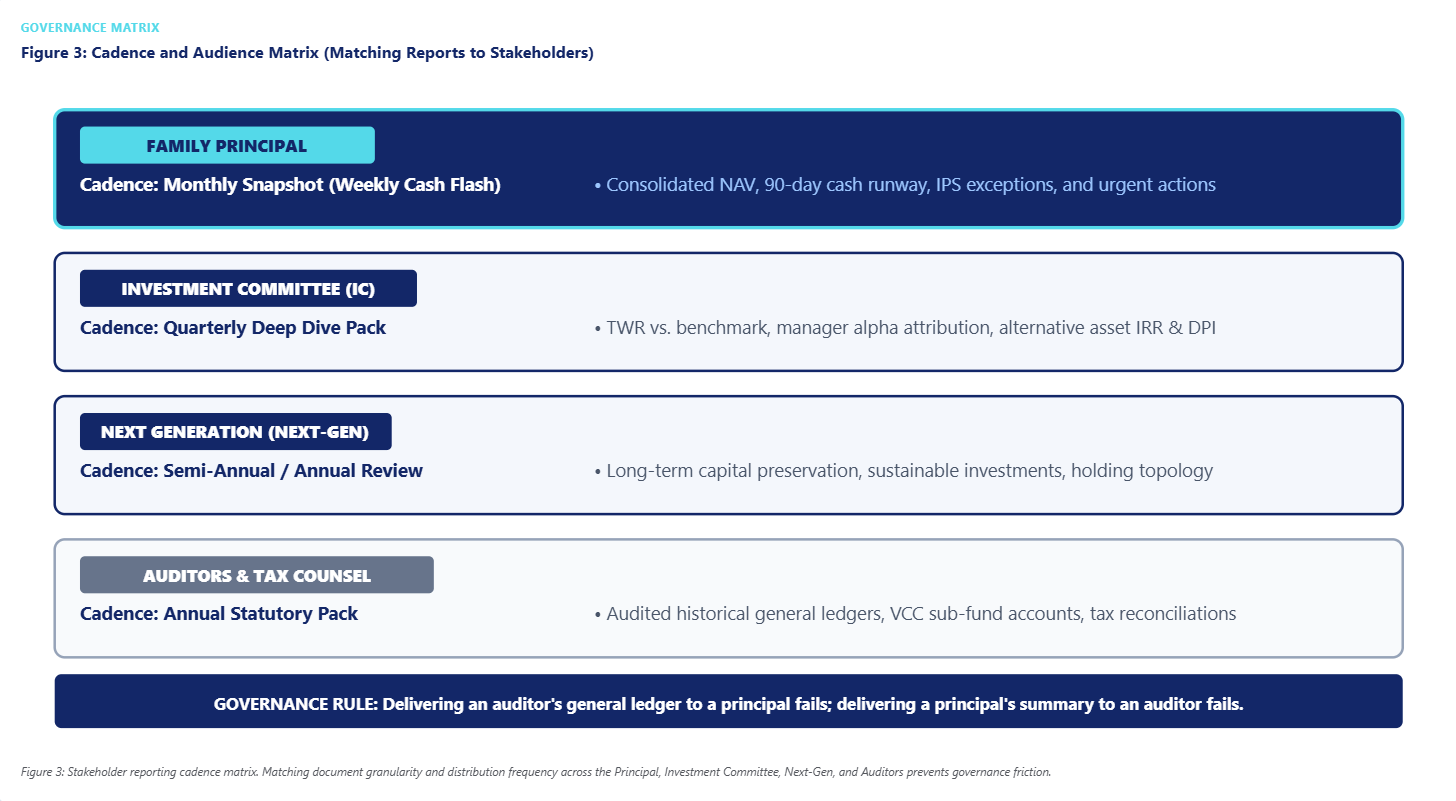
If the team hands an auditor’s full general ledger to a principal, the principal ignores it. If it hands a principal’s one-page summary to an external auditor, the auditor rejects it. Matching the document to the audience is basic family office governance.
5. Core Design Rules: One Page First, Exceptions on Top, and Plain Language
Four rules keep family office performance reporting short enough to be read.
Rule 1: The One-Page Dashboard Rule
The first page of every report stands alone as a complete executive summary. If the principal reads only page one, they know the family’s net worth, cash runway, quarterly performance and pending capital calls. Every later page exists to support page one.
Rule 2: Exceptions and Variances on Top
Do not hide asset allocation breaches or overdue capital calls on page forty. Put an “Exceptions and Actions” block at the top of the executive summary. If emerging market equities have drifted past their 15% policy maximum, or a USD 1.5 million capital call needs funding by next Thursday, show that variance in bold.
Rule 3: Drill-Down to Source Verification
Every aggregated number on the summary traces back to its custodial source. If the summary shows USD 18 million in liquid cash, the supporting schedule lists the specific private bank accounts and verified balances behind it. If nobody can name the accounts behind that number, the principal’s first follow-up question ends the meeting.
Rule 4: Plain Language over Financial Engineering Jargon
State “Realized Cash Returned” instead of “Cumulative Distributed-to-Paid-In Multiple.” State “Net Dollars Gained After All Fees” instead of “Post-Incentive Geometric Residual Return.” Plain language builds trust between the operations team and the family.
What does your principal read first?
Every principal has one page they always open and one they skip. A short note on which is which tells us what the next family office performance reporting guide should cover.
6. Mobile Access Without Email Attachments: Protecting Confidential Holdings
A performance report sent as an unencrypted PDF is a copy you can no longer control. That is true of email attachments and of messaging apps such as WhatsApp, WeChat or Signal alike. Family office performance reporting needs a delivery channel the office can revoke.
In a single family office the principal travels often. Sending balance sheet summaries by email exposes the family’s financial footprint to three risks:
- Email Interception and Compromised Mailboxes: If an external vendor, accountant or family member suffers an email account compromise, unencrypted PDF attachments containing bank coordinates, total net worth and trust deeds are exposed.
- Loss of Document Control: Once an attachment is sent or downloaded to a phone, access cannot be revoked. The file stays in local downloads, unencrypted mobile backups and third-party email servers.
- Personal Data Protection Act 2012 (PDPA) Exposure: Under the PDPA, organizations must make reasonable security arrangements to protect personal data. Sending passport scans, trust structures and private banking holdings over open commercial channels can create compliance exposure.
| Pattern | How it works | The risk or the benefit |
|---|---|---|
| Unencrypted PDF attachment | The controller sends a PDF by email or chat, and it lands in the phone’s local downloads. | Exposed to Subscriber Identity Module (SIM) swaps, device theft and mailbox compromise. The file stays on third-party servers and cannot be revoked. |
| Authenticated portal view | The controller publishes the report to a portal. The principal signs in with multi-factor authentication (MFA) or device biometrics and reads it in an encrypted session. | No local file to lose, and access can be revoked the moment a device goes missing. |
The standard should be plain: executive reporting is accessed through an authenticated portal, in an encrypted view-only session with no local file caching and a watermark showing who is viewing. For the controls around payments, people and incident response, see the family office security guide.
7. What to Look for in Family Office Investment Tracking Software
Family office investment tracking software is not a retail portfolio app with more currencies. It has to model capital calls, entity structures and uncalled commitments. When you evaluate wealth reporting platforms, check five criteria. For a comparison of specific platforms, see our guide to the best family office software.
- Automated Multi-Custodian Data Feeds: Direct ingestion of transactions and positions through Society for Worldwide Interbank Financial Telecommunication (SWIFT) messages (MT940, MT535) and open banking Application Programming Interfaces (APIs) across global private banks, so nobody transcribes CSV files.
- Alternative Asset Normalization: Ledger capabilities that model capital commitments, drawdowns, return-of-capital distributions, carried interest and remaining uncalled capital.
- Multi-Currency Normalization: Daily FX translation into the family’s base reporting currency.
- Entity Look-Through: The ability to visualize multi-tier structures, such as assets held in Singapore Variable Capital Company (VCC) sub-funds, offshore holding SPVs and family trusts, without double counting.
- Key Custody and Isolation: A clear answer on whether hosting is shared or dedicated, and who holds the encryption keys.
8. Build the First Principal Pack in Four Steps
Build the first principal pack before you buy anything. Moving family office performance reporting off spreadsheets takes four stages.
Step 1: Define the Liquidity Runway and Capital Commitment Horizon
Audit all bank accounts to establish exact available cash and liquid securities. Reconcile this against signed limited partnership agreements to record total uncalled commitments, and map the obligations due over 30, 60 and 90-day windows.
Step 2: Establish the Single Cutoff Date and Valuation Standards
Enforce a single month-end cutoff date for liquid assets (for example, the final business day of the month). For alternative assets that report on a quarterly lag, record the value tagged with its valuation date (such as “Valued as of Q2 close”).
Step 3: Agree on Two Benchmarks and Fee Treatment
Sit down with the principal and the investment committee to agree two performance hurdles: one liquid market benchmark (such as a blended global equity and bond index) and one absolute real return hurdle (such as inflation plus an agreed margin). Calculate all reported returns net of custodial, management and administrative expenses.
Step 4: Design and Test the Single-Page Executive Summary Dashboard
Build the one-page summary showing net worth, liquidity runway, net returns, allocation corridors and urgent exceptions. Review it with the principal. If they have to ask where their liquid cash sits or which capital calls are pending, refine the layout until the answers are unmistakable.
9. Four Things to Take Away
Reporting is communication. The test is whether the principal can make a decision after reading it.
- Report for decisions, not for accounting: Family office performance reporting answers three questions: consolidated net worth, 90-day liquidity runway, and performance against policy hurdles. The principal does not need a long pack of ledgers to see them.
- Separate TWR from MWR: Use TWR for discretionary public market managers, and MWR or IRR for total economic outcomes and private funds where cash flows are irregular.
- Secure the delivery channel: Do not send confidential balance sheets or beneficial ownership details as unencrypted email attachments or chat messages. Use authenticated mobile access.
- Governance precedes automation: Software cannot fix broken rules. Set valuation cutoff dates, net returns of fees, and data boundaries before you automate the reporting workflow.
10. Who Wrote This: A Note on Vinova
Vinova is a Singapore-headquartered technology transformation partner with delivery in Vietnam and 16+ years of experience. Its information security and quality management systems are certified to ISO 27001:2022 and ISO 9001:2015.
This guide is part of Vinova’s series on family office technology, and it argues from the buyer’s side of the table. The experience behind it comes from adjacent work in regulated, brand-sensitive and multi-entity environments:
| Sector | What was built |
|---|---|
| A global maritime shipping and commodity group | An integrated enterprise platform covering multi-entity finance, budgeting, workflow automation, ticketing, vessel operations, and mobile and web executive dashboards |
| A Singapore legal education body | A centralized portal for accreditation, activity logging, administrative compliance and reporting |
| A luxury automotive brand’s flagship experience center in Singapore | Digital touchpoints and booking systems |
| A Singapore energy utility group | Solution architecture for an artificial intelligence (AI)-enabled enterprise platform on Azure |
Reporting problems look similar across regulated environments. What changes is the data, and the damage when it is wrong.
Frequently Asked Questions
How frequently should a single-family office deliver performance reports to the principal?
Monthly. A single family office should deliver a single-page executive summary every month, supplemented by a weekly cash and liquidity flash. Prepare detailed performance packs, covering manager attribution, risk and policy drift, quarterly for the Investment Committee (IC), and reserve annual packages for tax and statutory audits.
What is the difference between Time-Weighted Return (TWR) and Money-Weighted Return (MWR) in family office reporting?
TWR measures the manager’s skill, and MWR measures the family’s actual outcome. TWR compounds growth across sub-intervals split at each cash inflow and outflow, which isolates the external manager’s investment selection. MWR, or IRR, measures the performance of all invested capital and weights the periods when balances were largest. TWR suits public discretionary mandates. MWR suits private equity, venture capital and total family net wealth.
Why is Distributed to Paid-In (DPI) more important than Internal Rate of Return (IRR) for private equity investments?
Because DPI counts only cash that has actually reached the family’s bank account. IRR and Total Value to Paid-In (TVPI) also include the fund manager’s valuation of unsold portfolio assets, which can be marked down later. In mature funds, DPI shows how much real, bankable capital the fund has generated.
Are single-family offices in Singapore legally required to follow Monetary Authority of Singapore (MAS) Technology Risk Management (TRM) guidelines for reporting systems?
Not directly in most cases. The MAS TRM Guidelines set supervisory expectations for regulated financial institutions such as banks and licensed fund managers. Most single family offices that manage only family capital are not licensed by MAS, so TRM is a benchmark, not an obligation. Many offices use it anyway, because their private banks and fund administrators work to it. Confirm your own position with a Singapore lawyer.
How should a family office handle delayed private market valuations in monthly reports?
Report the most recent formal valuation statement from the fund manager, tagged with its valuation date (for example, “Valued as of March 31”). Mark liquid public market assets to the current market close. The executive summary should state that the valuation basis is blended, so the principal knows which parts of the balance sheet are current and which are lagged.
Vinova: Singapore’s mobile and web application development partner since 2010. ISO 27001:2022 and ISO 9001:2015 certified.
300+ in-house engineers across Singapore, Hanoi, Da Nang, and Ho Chi Minh City, including teams who build secure web and mobile applications for enterprise and government clients. We wrote this guide so you can decide what the principal sees before you pick a tool.
Financial Times Top 500 High-Growth Companies Asia-Pacific 2026. The Straits Times Singapore’s Fastest-Growing Companies 2024, 2025, and 2026.