Vinova | Family Office Technology Guide | Updated October 2026
Every family office software demo ends the same way: a clean dashboard, one consolidated net worth figure, a principal nodding. What the demo skips is how that figure got there. In many small offices, it got there because someone retyped a private equity capital call notice from a PDF into a spreadsheet at month-end.
A family office is not a small bank. It carries a bank’s exposure with a team that fits around one meeting table. If your systems cannot read a capital call notice, someone on that team spends month-end retyping it, and the principal’s net worth is only as current as that person’s last save.
This guide is for the operations lead who has to pick the tools. It covers what a family office tech stack contains, where off-the-shelf platforms fit and where they strain, what Singapore adds to the picture, how to use AI on private documents without leaking them, and ten questions to ask any vendor before you sign. It quotes no prices. Pricing varies by contract, and a number lifted from a blog post is how budgets go wrong.
Table of Contents
1. Where Spreadsheets Stop Working
Spreadsheets did not fail family offices. Family offices outgrew them. A portfolio that once meant two private banks and a property now spans custodians in several countries, direct private equity, private credit, real estate holding companies and sometimes digital assets, in half a dozen currencies.
The spreadsheet’s problems are structural, not cosmetic:
- No audit trail: A broken formula link or a stale exchange rate changes the answer, and nothing records who changed it. If the principal approves an allocation on a wrong valuation, nobody can reconstruct why.
- Version drift: Two analysts edit two copies. By quarter-end the office has two net worth figures and a meeting about which one is right.
- PDF dependence: Private fund managers, venture funds and property syndicates rarely offer standard data feeds. They send documents. Every figure that arrives as a PDF is retyped by a person, and every retyping is a chance for error.
- Key-person risk: The one person who understands the workbook is also the person who goes on leave.
2. The Five Components of a Family Office Tech Stack
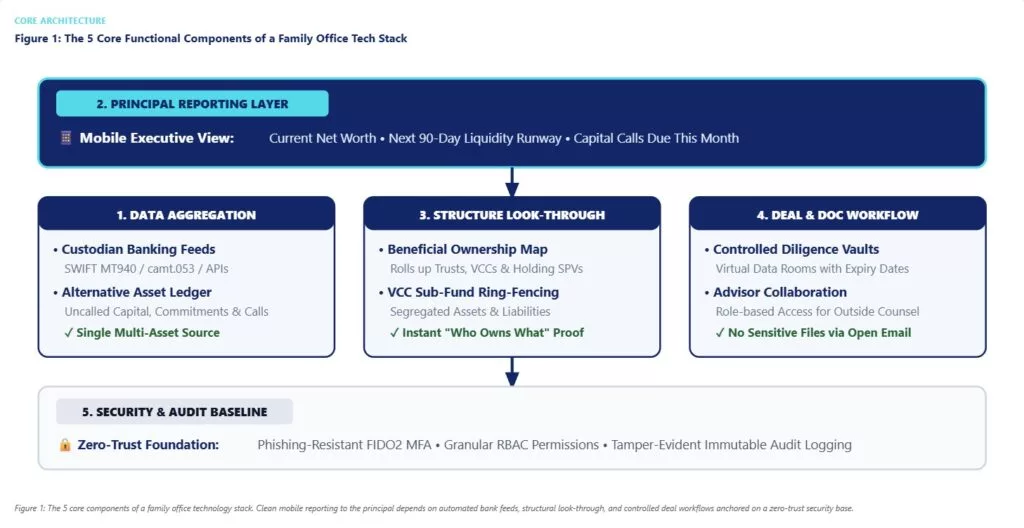
Strip away the product names and nearly every family office stack does five jobs. Not every office needs all five on day one, but every office needs to know which ones it is doing by hand.
- Data aggregation: Pulls positions and transactions from banks and custodians through standard formats such as Society for Worldwide Interbank Financial Telecommunication (SWIFT) MT940 statements and ISO 20022 camt.053 messages, through bank Application Programming Interfaces (APIs), or through document parsing when no feed exists. For private equity, venture and private credit, it also tracks commitments, capital calls, distributions and uncalled capital. If uncalled commitments sit in a separate file, liquidity forecasts quietly overstate what is available.
- Principal reporting: What the family actually sees. Principals tend to want three answers: what is our net worth now, how much cash will we have over the coming months, and what is due this month. If those answers live inside a long PDF pack, many principals stop opening it.
- Entity and structure look-through: Maps how an investment rolls up through holding companies, trusts and funds to the family. Without it, answering “who ultimately owns this?” takes a round of emails and usually a lawyer.
- Deal and document workflow: Tracks inbound opportunities, diligence materials and co-investor communications, with controlled access for outside counsel and advisers. If diligence files travel by email, nobody can say afterward who saw what.
- Security and audit: Controls who can see and move what, and records it. Section 6 covers the baseline.
3. Off-the-Shelf, Custom or Hybrid: Where Each Fits
Off-the-shelf is not the lazy option, and custom is not the sophisticated one. Each is right somewhere. The useful question is where your complexity lives.
Off-the-shelf platforms
Examples include Addepar, Eton Solutions, QPLIX and SEI Archway.
Where It Works
- Liquid, custodian-fed portfolios: Mature feeds, tested reporting and accounting logic you do not have to design.
- Speed to a working system: Configuring beats building when the portfolio is conventional.
- Maintenance is someone else’s job: Upgrades, uptime and format updates sit with the vendor.
The Catch
- Unusual assets: Direct investments, operating companies and non-standard structures are where manual entry returns.
- Regional statement formats: Documents from banks across Southeast Asia, including bilingual statements, may not parse cleanly. Test with your own statements, not the demo set.
- Shared infrastructure: Many platforms are multi-tenant, meaning clients share one hosted environment with logical separation. That is a normal and defensible design. A family with strict data-custody requirements should still ask exactly how isolation works and who holds the encryption keys.
- Slow change path: Changing how the platform models something often means a services engagement with the vendor.
Best for: Offices with mostly liquid portfolios and standard reporting needs.
Custom build
Where It Works
- Exact fit: Models your structures, your asset types and your reports instead of the closest approximation.
- Control of data and keys: The office decides where data lives and who holds the encryption keys.
- Ownership: No dependence on a vendor’s roadmap or pricing changes.
The Catch
- You own the maintenance: Security patches, monitoring, fixes and the person who understands the code. If that person leaves, the system becomes an expensive spreadsheet.
- Time to first value: Nothing works until something is built.
- Scope creep: A build that tries to replace every workflow at once rarely ships.
Best for: Offices with complex holdings that no platform models well, and the internal capacity or long-term partner to run what gets built.
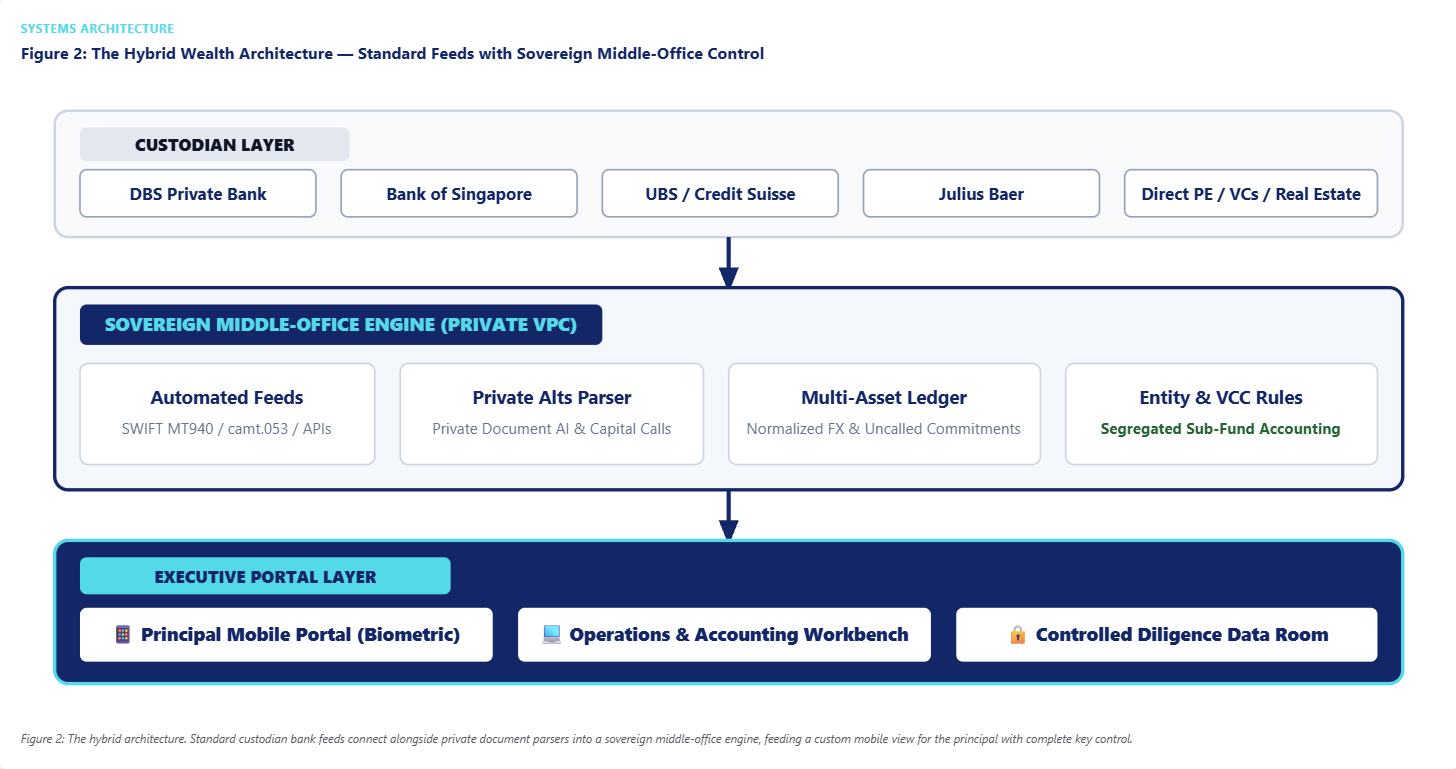
Hybrid
Where It Works
- Keep the strong parts: Use a platform or custodian feeds for liquid assets and build only around the gaps, such as private asset ingestion or a principal dashboard.
- Smaller scope, smaller risk: Less code to build, secure and maintain.
The Catch
- Integration is the work: Two systems means a seam, and seams are where data goes missing.
- Two parties, one problem: When a number is wrong, each side can point at the other.
Best for: Offices with a mostly standard portfolio plus a few assets that break the standard model.
| Factor | Off-the-shelf | Custom build | Hybrid |
|---|---|---|---|
| Speed to first working system | Fastest for conventional portfolios | Slowest; nothing runs until it is built | In between; depends on the integration |
| Fit for unusual assets | Limited by what the platform models | Highest | High for the assets you build around |
| Ongoing maintenance | Lowest; the vendor carries it | Highest; you carry it | Shared, with a seam to manage |
| Data custody and key control | Depends on vendor architecture; ask | Highest | High for the custom layer; vendor-dependent for the rest |
| Exit and lock-in | Data export and contract terms decide | Code and infrastructure ownership decide | Both sets of terms apply |
| Cost shape | Recurring license | Upfront build plus ongoing upkeep | A mix of both |
Practitioner Verdict: Most offices should start by buying and customize only where the platform visibly breaks. Build first only if you can name the specific asset or workflow that no platform handles.
4. What Singapore Adds
Singapore does not change what the five components are. It adds obligations the systems have to track.
- Tax incentive conditions (Sections 13O and 13U): Under the Income Tax Act 1947, the Monetary Authority of Singapore (MAS) sets conditions on assets under management, investment professionals and local business spending for the 13O and 13U fund incentives. Those conditions have been revised more than once, including in 2026. Treat any figure you read online as provisional until you have checked it with MAS and the Inland Revenue Authority of Singapore (IRAS). This guide deliberately quotes none. The technology question is simple: can your system show, on demand, where you stand against each condition?
- The fund vehicle, not the office: The incentives attach to a fund vehicle, often a Variable Capital Company (VCC), not to the family office itself. A VCC can hold multiple sub-funds with segregated assets and liabilities. If your ledger cannot keep sub-funds separate, a cross-charge between them becomes a compliance question as well as an accounting one.
- Personal data: The Personal Data Protection Act (PDPA) governs how organizations in Singapore collect, use and protect personal data. A family office holds passport scans, addresses, beneficial ownership records and staff files, so it belongs in the conversation.
- MAS Technology Risk Management (TRM) Guidelines: TRM applies to MAS-regulated financial institutions, and most single family offices are not one. Their banks and fund administrators are, so TRM is the yardstick those institutions work to and a reasonable reference for your own controls. For an office that is not itself regulated, it is a benchmark, not an obligation. Confirm your own position with a Singapore lawyer.
5. Using AI on Private Documents Without Leaking Them
Family offices are not adopting AI to write emails. The use case with the clearest payoff is dull: reading documents. Capital call notices, distribution notices and quarterly reports arrive as PDFs, and a person retypes them.
The risk is just as dull. If a consumer chatbot is where an analyst pastes a capital call notice, then bank details, fund names and amounts now sit in a tool the office does not control, under terms the office has not read.
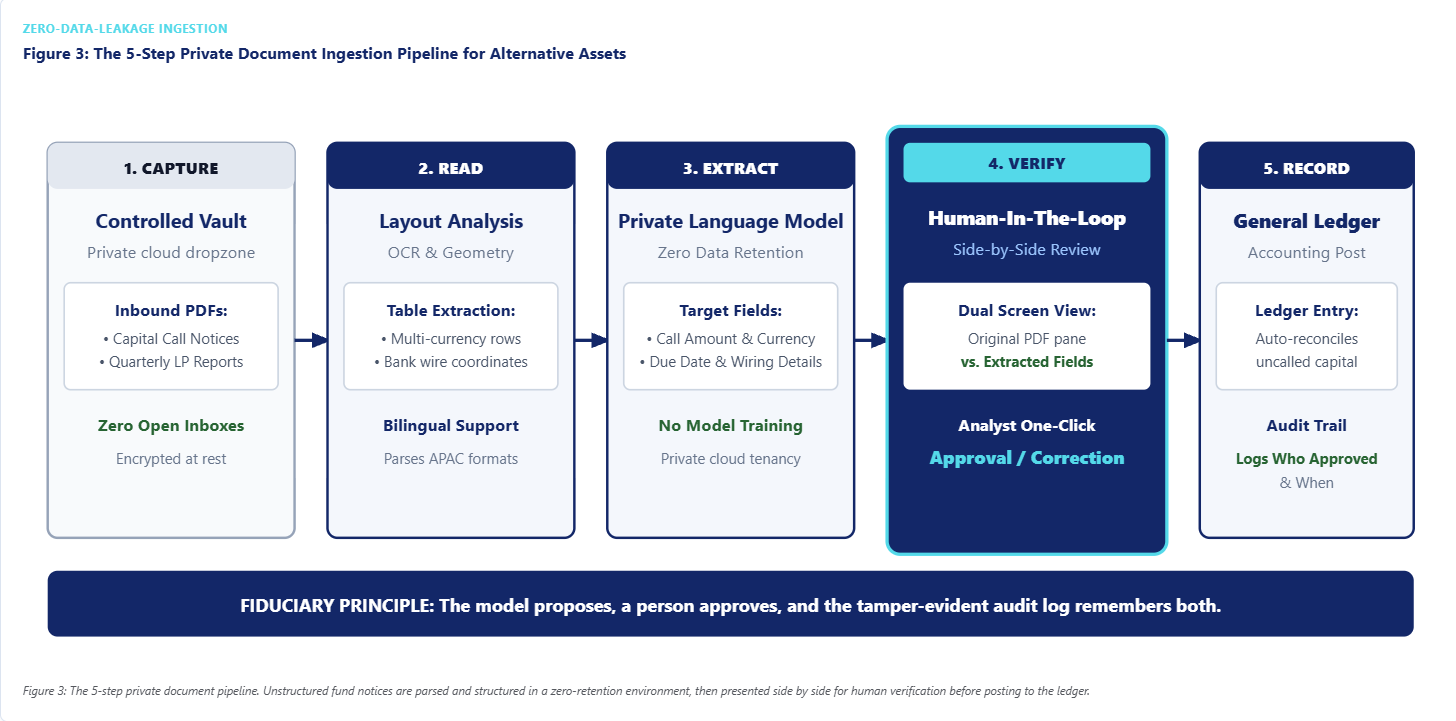
A sound document pipeline has five steps:
- Capture: The document enters a controlled environment, not a personal inbox.
- Read: Optical character recognition (OCR) and layout analysis pull out tables and fields such as call amount, due date and fund name.
- Extract: A language model structures those fields, either hosted where the office controls it or under contract terms that rule out retention and training.
- Verify: A person sees the original and the extracted fields side by side and approves them.
- Record: Approved figures post to the ledger with an audit entry.
Ask any vendor, or your own team, four questions about every AI tool that touches a private document:
- Where does the text go? Which servers, in which country, under whose control.
- How long is it kept? Retention periods, and whether you can delete on request.
- Is it used to train anything? Get the answer in the contract, not on the marketing page.
- Who can read the output? Including the vendor’s own staff.
Self-hosting is not the only safe option, and it is not automatically safe. A private deployment that is configured badly leaks as reliably as a careless vendor does.
Tell us how your office handles this today
Month-end reporting, document flow and access control look different in every office. A short note on how yours works today tells us what the next guide should cover.
6. A Security Baseline Worth Asking For
Family offices combine large liquid balances with small teams, which is the profile social engineers and payment fraudsters look for. A common attack is not a technical marvel. It is a convincing email asking someone to approve a wire.
If wire approvals rely on a password and an SMS code, then one phished employee can move money. The controls below exist to prevent that sentence from ever being true.
| Control | What it prevents | What to ask |
|---|---|---|
| Phishing-resistant multi-factor authentication (MFA), using FIDO2/WebAuthn security keys or passkeys | Credential theft and SIM-swap attacks on SMS codes | Is it enforced for administrators and payment approvals, with no SMS fallback? |
| Role-Based Access Control (RBAC) | Everyone seeing everything | Can an external accountant see ledgers without seeing trust deeds? |
| Encryption at rest and in transit | Exposure of stored or intercepted data | Who holds the keys, and can the office rotate or revoke them? |
| Audit logging | Disputes over who viewed, changed or exported what | Are logs tamper-evident, and can administrators edit them? |
| Backup and recovery | Ransomware and outages | When was a restore last tested, not just scheduled? |
| Independent testing | Flaws nobody on the team noticed | When was the last third-party penetration test, and who has the report? |
| Certification | Security claims with no evidence | Can you see the current ISO/IEC 27001 certificate and its scope? |
Two clarifications. Where the data sits and who controls it are different questions: a Singapore cloud region answers the first, not the second. And a certification covers a supplier’s management system. It is evidence worth asking for, not a substitute for the questions above.
7. Why Family Office Technology Projects Stall
Three failure modes show up repeatedly, and none of them is technical.
- Scope overload: The project tries to digitize every asset class, report and workflow at once. Months pass, nothing goes live, and the team keeps using Excel.
- The data cleanup nobody budgeted: Years of transactions arrive from different banks in inconsistent formats. Load them as they are and the history is wrong from day one, and so is every performance figure built on it.
- An interface the principal will not open: A system built for accountants, with dense screens and filters, gets bypassed. The team goes back to emailing PDFs, which is where it began.
8. The Ten-Question Readiness Checklist
Use it on your own office first, then on any vendor. A “no” is information, not failure.
| # | Question | Why it matters |
|---|---|---|
| 1 | How long after month-end do you have a consolidated net worth figure? | The delay is the cost of manual work. |
| 2 | Which bank and custodian feeds are automated, and which are retyped from PDFs? | Every retyped figure is a possible error. |
| 3 | Where do capital calls, distributions and uncalled commitments live? | Liquidity forecasts depend on uncalled capital. |
| 4 | Who owns the data and the encryption keys, and what happens at exit? | Custody and lock-in are decided here. |
| 5 | Where do documents go when AI reads them, and are they retained or used for training? | A pasted statement can outlive the task. |
| 6 | Can the principal see liquidity and net worth on a phone, behind biometric or passkey login? | A report nobody opens reports nothing. |
| 7 | Can you see how trusts, VCC sub-funds and holding companies roll up? | Look-through answers ownership questions without a round of emails. |
| 8 | How do you track the conditions attached to your tax incentive? | Annual filings are a poor time to find gaps. |
| 9 | Are administrator and payment-approval logins protected by phishing-resistant MFA? | SMS codes can be intercepted or SIM-swapped. |
| 10 | Does an audit log record who viewed or exported what, and can anyone edit it? | No log means no answer when something goes wrong. |
9. Four Things to Take Away
- Buy first, build only where a platform visibly breaks: Name the specific asset or workflow that no platform handles before you consider custom work.
- Test with your own documents: Run your real bank and fund statements through any platform or parser, not the demo set. Regional formats and private asset notices are where tools strain.
- Ask who holds the keys: Data custody, encryption keys and exit terms decide how locked in you are. Get those answers before the pricing conversation.
- Fix wire approvals first: Before any platform decision, make sure payment approvals need phishing-resistant MFA, not a password and an SMS code.
10. Who Wrote This: A Note on Vinova
Vinova is a Singapore-headquartered technology transformation partner with delivery in Vietnam and 16+ years of experience. Its information security and quality management systems are certified to ISO 27001:2022 and ISO 9001:2015.
This is Vinova’s first guide on family office technology, so it argues from the buyer’s side of the table: the questions worth asking before you sign anything. The experience behind it comes from adjacent work in regulated and brand-sensitive environments:
| Sector | What was built |
|---|---|
| A Singapore legal education body | A centralized portal for accreditation, activity logging, administrative compliance and reporting |
| A luxury automotive brand’s flagship experience center in Singapore | Digital touchpoints and booking systems |
| A Singapore energy utility group | Solution architecture for an AI-enabled enterprise platform on Azure |
Access control, audit trails and reporting problems look similar across regulated environments. What changes is the data, and the damage when it leaks.
Frequently Asked Questions
What is family office technology?
It is the set of systems a family office uses to consolidate holdings, report to the principal, track entities and obligations, and control access to sensitive data. In practice that means data aggregation, principal reporting, structure look-through, deal and document workflow, and security and audit.
Do single family offices in Singapore have to follow MAS TRM?
Not directly in most cases. TRM applies to MAS-regulated financial institutions, and most single family offices are not one. The banks and fund administrators that serve them are, so TRM works as a benchmark. Confirm your own position with a Singapore lawyer.
Is hosting in a Singapore cloud region enough for data protection?
No. A Singapore region tells you where the data sits, not who controls it. Ask who holds the encryption keys, who has administrative access, and what the exit terms are.
Should a family office build or buy its software?
Buy first, unless you can name a specific asset or workflow that no platform handles. Offices with mostly liquid, custodian-fed portfolios are usually well served by a platform. Custom or hybrid work earns its cost where the complexity sits outside what platforms model.
Is it safe to use AI on bank statements and capital call notices?
Not through consumer chatbots. Use tools whose contract terms rule out retention and model training, or a deployment you control, and keep a person approving every extracted figure.
Vinova: Singapore’s mobile and web application development partner since 2010. ISO 27001:2022 and ISO 9001:2015 certified.
300+ in-house engineers across Singapore, Hanoi, Da Nang, and Ho Chi Minh City, including teams who build secure web and mobile applications for enterprise and government clients. We wrote this guide so you can ask better questions before you buy.
Financial Times Top 500 High-Growth Companies Asia-Pacific 2026. The Straits Times Singapore’s Fastest-Growing Companies 2024, 2025, and 2026.