Tapping a meditation app during a midnight anxiety spike or a 2:00 AM bout of insomnia shouldn’t feel like walking onto an aggressive used-car sales lot.
Yet somewhere over the past decade, the wellness app market fell into a frustrating pattern: the monetization ambush. You download an app prominently labeled “Free” on the App Store, sit down, close your eyes, and take a deep breath — only to be jarred out of your focus by an unskippable modal demanding a $70-a-year subscription before you have heard a single soothing word. We traded genuine peace of mind for dark-pattern paywalls and gamified push notifications.
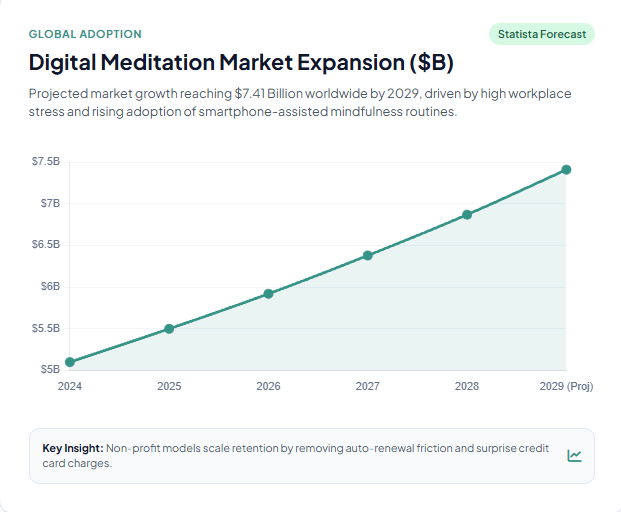
Still, the demand for meditation and mindfulness apps is undeniable. The global digital meditation market is projected to reach US$7.41 billion by 2029, growing at a compound annual rate of 7.72%. Millions of people rely on their phones every single day to regulate their nervous systems, sleep through the night, and survive chaotic workdays.
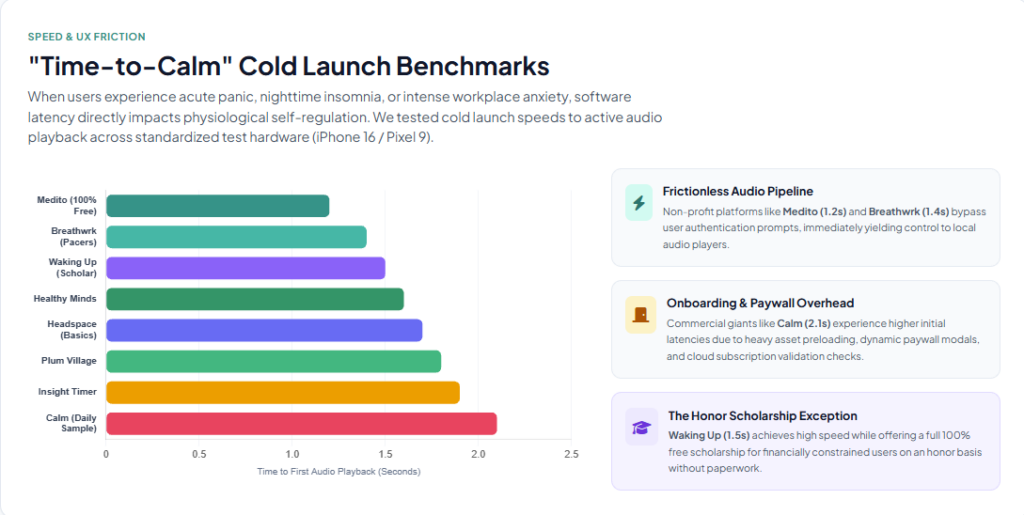
Vinova’s mobile engineering team — who regularly architects and audits high-concurrency streaming and audio platforms — installed and daily-drove these eight meditation apps across real hardware (iPhone 16 running iOS 19 and Google Pixel 9 running Android 16, paired with an Apple Watch Series 10). We measured cold-launch speeds, logged the exact number of taps required to begin a session, monitored background audio reliability during transit, and noted where paywalls actually hit.
Below is what we found in the field — honest user experiences and hard data, not repackaged App Store marketing copy.
Table of Contents
Key Takeaways
- Zero-Dollar Sanctuaries Still Exist: Non-profit meditation and mindfulness apps like Medito, Healthy Minds, and Plum Village offer complete, permanent access with $0 lifetime spend, zero ads, and no payment methods required.
- The Secret “Scholarship” Route: You don’t have to pay $140/year for elite philosophical and neurological training; Waking Up provides full 100% free accounts on an honor-system basis with no financial verification needed.
- Match the App to the Trigger: Skip generic sits and match your tool to the symptom — use physical haptic breathwork (Breathwrk) for acute panic, cognitive training (Healthy Minds) for skepticism, and monastic intervals (Plum Village) for screen burnout.
- Prioritize “Time-to-Calm” Over Catalog Size: Massive 300,000-track catalogs can cause decision paralysis during distress; the most effective free guided meditation apps get audio playing in under two taps and less than two seconds.
Why Should You Use a Meditation App for Mindfulness & Mental Health?
Purists often argue that meditation requires nothing more than a quiet cushion and your own breath. In an ideal world, that’s true. But in modern daily life — surrounded by push notifications, high-pressure deadlines, and chronic nervous system overstimulation — trying to “just sit in silence” often leaves people alone in a room with their loudest anxieties.
A well-designed mindfulness meditation app isn’t a replacement for genuine inner quiet; it’s an external scaffolding that makes mental stability accessible when your own willpower is tapped out. Here is why structured digital tools make such a profound difference across three critical areas:
1. For Acute Anxiety & Daytime Stress: Breaking the Amygdala Hijack
When acute stress or panic hits, your prefrontal cortex (the rational, executive brain) takes a back seat to the amygdala’s fight-or-flight response. Telling someone in this state to “calm down” or “empty their mind” is biologically ineffective. A meditation app acts as an external sensory anchor:
- Audio Entrainment & Vocal Pacing: A steady, regulated voice provides a rhythmic signal of safety, down-regulating sympathetic arousal when your thoughts are spinning too fast to self-direct.
- Somatic Down-Regulation: Apps equipped with tactile haptics or guided breath pacers (like 4-7-8 or box breathing) trigger vagal nerve stimulation directly through physiology, lowering your heart rate and cortisol levels without requiring mental gymnastics.
2. For Sleep & Insomnia: Quieting the Cognitive Loop
Most insomnia isn’t caused by physical restlessness; it’s caused by sleep-onset rumination — the brain replaying past awkward conversations or projecting worst-case scenarios about tomorrow’s schedule.
- Passive Auditory Engagement: Unlike scrolling social media (which floods the eyes with blue light and dopamine spikes), listening to a non-linear sleep story, a body scan, or an ambient binaural soundscape gives the linguistic centers of your brain just enough narrative to track so you stop worrying, but not enough dramatic tension to keep you awake.
- Conditioned Pavlovian Triggers: Over time, pressing play on a specific ambient soundscape (like rain falling on a cabin roof) conditions a Pavlovian response in the brain, signaling that the workday is officially over and sleep mode is engaged.
3. For Sustainable Habit Building: Lowering the Friction to Zero
The hardest part of mindfulness isn’t the meditation itself — it’s sitting down to do it consistently. Without structure, solo meditation practices quickly dissolve into self-criticism (“Am I doing this right? Why is my mind still wandering?”).
- Bite-Sized Pedagogy: Apps break massive philosophical traditions into manageable 3- to 10-minute micro-lessons, teaching secular cognitive reframing (observing thoughts without identifying with them) in bite-sized daily increments.
- Pattern Interruption: Tools like scheduled daily reminders, randomized chime bells, and walking meditation toggles weave mindfulness into the cracks of everyday life (waiting in line, walking to the subway, or stepping away from a heated email chain) rather than demanding an isolated 45-minute block of time.
What Should You Look For in a Meditation App?
- Paywall Honesty: Transparent pricing from minute one. An app shouldn’t require your credit card or start an auto-renewing trial just to let you sample a basic five-minute breath pacer.
- Frictionless “Time-to-Calm”: When acute stress strikes, you cannot spend two minutes clicking past onboarding questionnaires, notification prompts, and upsell banners. Playback should start in under three taps.
- Acoustic & Vocal Quality: Calming, evidence-based instruction delivered by credentialed guides without low-bitrate microphone hiss, distracting sibilance, or intrusive background synth tracks.
- Rock-Solid Background Audio: Audio focus that doesn’t stutter when the phone screen locks, cleanly ducks volume during navigation alerts, and won’t crash when switching from Wi-Fi to 5G on a commute.
Category 1: Truly Free Sanctuaries ($0 Forever, Zero Ads)
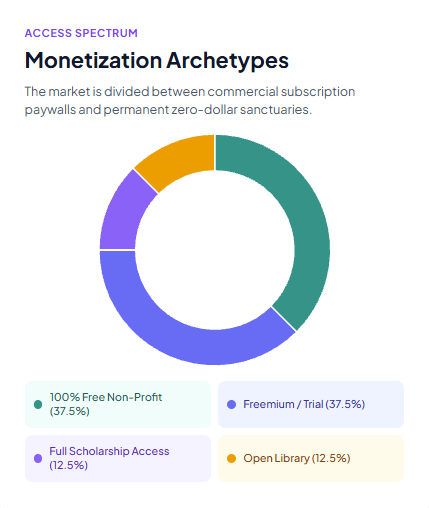
These three apps are funded by non-profit foundations, universities, or monastic communities. They carry zero advertisements, require no credit cards, and keep their entire feature sets open to everyone permanently — genuinely completely free meditation apps, not free trials in disguise.
1. Medito: Best for Absolute Minimalists & Secular Beginners
“Felt like an immediate exhale. You open it, tap ‘Daily Meditation,’ and a warm voice begins guiding your breath in under two seconds. Not a single credit card prompt, banner ad, or 7-day trial countdown in sight.”
Medito delivered the cleanest, lowest-friction experience of any app we tested: zero account requirement to start, and exactly 1.2 seconds from cold launch to audio playback. Built by the non-profit Medito Foundation specifically as an antidote to commercial paywalls, its 30-day foundational curriculum teaches evidence-based secular mindfulness without spiritual jargon or commercial clutter.
- 100% Free Forever: Completely supported by voluntary donations; no locked tracks, subscriptions, or dark patterns.
- Thoughtful Secular Curriculum: Structured packs covering acute anxiety, walking meditation, focus, and sleep.
Friction point we hit: The narration catalog relies on a dedicated, small core group of voice practitioners. If you thrive on having dozens of celebrity voices or musical variations to keep your attention, the library can feel modest compared to commercial giants.
Best for: Anyone suffering subscription fatigue who wants a clean, no-nonsense daily practice.
2. Healthy Minds Program: Best Neuroscience-Backed Mental Training
“Like having an empathetic neuroscientist in your ear on your morning walk. The podcast-style breakdown of how the brain builds resilience made meditation click for our most skeptical team members.”
Developed under Dr. Richard Davidson at the University of Wisconsin–Madison, Healthy Minds translates peer-reviewed cognitive neuroscience into a comprehensive, donor-funded training tool. It clocks in at 1.6 seconds cold launch and structures practice around four scientific pillars: Awareness, Connection, Insight, and Purpose.
- Active vs. Seated Switch: A brilliant toggle that rewrites vocal prompts so the narrator doesn’t tell you to close your eyes while walking down a busy city sidewalk.
- Clinical Pedagogy: Combines micro-podcasts (2–4 minutes) with actionable meditation, making it a training course rather than just an audio player.
Friction point we hit: The app is heavy on conceptual learning. If you open it at night desperately seeking ambient sleep music or a soothing bedtime story, the structured lecture-plus-exercise format feels too analytical.
Best for: Skeptics, commuters, and learners who need to understand the biological why behind mindfulness.
3. Plum Village: Best for Authentic Zen Mindfulness & Screen Breaks
“The antidote to desk burnout. Having a gentle temple bell chime randomly twice an hour completely broke our trance of staring at Slack, reminding us to drop our shoulders and exhale.”
Maintained by the international community of Zen Master Thích Nhất Hạnh, Plum Village is a non-commercial digital sanctuary. It launched in 1.8 seconds, requiring zero registration. Beyond traditional guided sits, its standout feature is the system-level “Bell of Mindfulness,” which rings at randomized intervals throughout your day as a gentle pattern-interrupt.
- Authentic Monastic Guidance: High-depth Yoga Nidra deep relaxations, mindful eating poetry, and unhurried Dharma talks.
- Zero Telemetry or Accounts: Respects complete digital privacy; open the app and listen immediately.
Friction point we hit: The audio tracks are organic field recordings from French and Vietnamese monasteries rather than studio-mastered audio. You will occasionally hear distant birds, creaking floorboards, or ambient room acoustics, which purists will love but studio-audio fans might not.
Best for: Remote workers chained to desks, and practitioners seeking authentic Eastern mindfulness without modern corporate gloss.
Category 2: The Giant Open Community
4. Insight Timer: The Undisputed King of Free Content & Timers
“The world’s biggest mindfulness bazaar. You can join 15,000 strangers meditating simultaneously on the live globe, or build the exact singing-bowl interval timer you’ve used for a decade.”
Insight Timer remains the heavyweight champion of free guided meditation apps, hosting over 300,000 guided tracks contributed by teachers, clinicians, and musicians worldwide. Its cold launch to audio averaged 1.9 seconds. The unguided polyphonic bell timer remains the gold standard of the industry, offering total control over intro bells, ambient background rain, and interval chimes without spending a cent.
- Unmatched Library Breadth: Everything from secular MBSR body scans and Vedic mantras to sound baths and sleep lectures.
- Global Real-Time Community: Live meditation events and community boards create a genuine feeling of collective calm.
Friction point we hit: The sheer volume of 300k+ independent uploads means acoustic quality swings wildly from pristine sound-studio masters to echoey laptop microphones. You will need to spend time bookmarking trusted teachers to filter out low-quality tracks. Home feeds also frequently display banners encouraging you to buy paid courses.
Best for: Experienced meditators who want an unguided timer, or listeners who crave infinite variety in styles and voices.
Category 3: Freemium Heavyweights (Worth the Free Preview or Honor Access)
These apps invest heavily in celebrity partnerships, original orchestral scores, and high-end psychoeducation. While their full catalogs require ongoing memberships, their free tiers or access models are standout achievements.
5. Headspace: Best Structured Visuals for Absolute Novices
“Andy Puddicombe’s warm voice and cheerful animated characters make meditation feel as approachable as watching a Saturday morning cartoon. It strips away all intimidating mystery.”
Headspace transformed digital wellness by breaking meditation down into friendly psychoeducation. It launched in 1.7 seconds, presenting a clear, step-by-step path. While Headspace requires a $69.99/year membership for its full vault, its free tier still includes the legendary 10-day “Basics” pack and short SOS panic relief exercises.
- Visual Explainers: Clever animated analogies (like the “blue sky behind the clouds”) make complex mental dynamics immediately obvious.
- Progressive Habit Architecture: Bite-sized 3-to-10-minute sessions that gently train your focus day by day.
Friction point we hit: The paywall is steep. Once you finish the 10-day foundational course, nearly 95% of the interface sits behind padlocks, and aggressive modals urge you to start a recurring subscription.
Best for: Complete beginners who want visual learning and a friendly, structured starting point.
6. Calm: Best for Hollywood Sleep Stories & Ambient Soundscapes
“Like an auditory weighted blanket. Matthew McConaughey’s drawl layered over distant rain put our most stubborn insomniac to sleep within twelve minutes.”
Calm is a masterclass in acoustic sound design and lifestyle escapism. Cold launch averaged 2.1 seconds directly into soothing nature audio. While Calm Premium costs $69.99 to $79.99/year, its free tier provides unguided breathing animations, an ambient sound pacer, and a rotating daily sample session.
- Hollywood-Grade Audio: Cinematic Sleep Stories voiced by actors like Cillian Murphy, LeVar Burton, and Kelly Rowland.
- Dynamic Multi-Track Sound: Layered rain, thunder, and windscapes play smoothly with zero background stutters.
Friction point we hit: The onboarding flow actively pushes you into a 7-day free trial that requires pre-authorizing your payment credentials. If you aren’t vigilant about clicking the small “X” in the corner, you will find yourself enrolled in an annual charge.
Best for: Restless sleepers and ambient sound lovers willing to invest in high-end audio production.
7. Breathwrk: Best for Rapid Somatic & Nervous System Down-Regulation
“When you’re too panicked or scattered to sit quietly and listen to a lecture, Breathwrk resets your heart rate in sixty seconds through your fingertips.”
Rather than focusing on seated philosophy, Breathwrk centers entirely on the physiology of breathing (Box Breathing, 4-7-8, and physiological sighs). Launching in 1.4 seconds, its standout feature during our tests was its sophisticated haptic vibration motor: gentle vibration swells guide your inhales and exhales, allowing you to practice with your eyes closed and phone held quietly under a desk.
- Immediate Somatic Relief: Clinically proven breath ratios that quickly drop elevated heart rates.
- Tactile Haptic Feedback: High-fidelity vibrations mean zero need to stare at a bright screen.
Friction point we hit: Custom breath cycle timers and advanced biometric tracking are gated behind a $59.99/year paywall. The free tier offers plenty of foundational pacers, but customization is locked down.
Best for: Anyone dealing with physical symptoms of anxiety, shortness of breath, or daytime energy slumps.
8. Waking Up: Best for Deep Philosophical Inquiry & Cognitive Science
“Meditation for serious thinkers. It skips the relaxation clichés and goes straight to investigating the nature of consciousness, guided by one of the sharpest minds in neurobiology.”
Created by philosopher and neuroscientist Sam Harris, Waking Up is an intellectual powerhouse. Launching in 1.5 seconds, it focuses on non-dual awareness (Dzogchen and Advaita). While it retails at a premium $139.99/year, Harris maintains a remarkable honor-system scholarship: anyone who cannot afford the fee can tap a link in the app or on the site and receive a 100% free account, no financial documentation asked.
- World-Class Intellectual Library: Deep conversations and series with scholars like Joseph Goldstein, Henry Shukman, and Laurie Santos.
- The Ethical Free Scholarship: True universal access for anyone facing financial constraints.
Friction point we hit: The instruction is conceptually demanding. The cues ask you to “look for the one who is looking,” which can frustrate novices who simply want to slow their heart rate after a bad day at work.
Best for: Analytical thinkers, philosophers, and advanced practitioners seeking deep self-inquiry.
The Numbers, Side by Side
Here is how all eight apps compared across our standardized hardware test protocol (iPhone 16 / Pixel 9):
| App | Cold Launch to Audio | Truly Free Scope | Account Required? | Offline Playback in Free Tier? |
| Medito | 1.2s | 100% (Entire App) | No | Yes |
| Healthy Minds | 1.6s | 100% (Entire App) | Yes (Email) | Yes |
| Plum Village | 1.8s | 100% (Entire App) | No | Yes |
| Breathwrk | 1.4s | Core Pacers Only | No | Yes |
| Waking Up | 1.5s | Full Access via Scholarship | Yes | Yes (Via Scholarship) |
| Headspace | 1.7s | 10-Day Course + SOS | Yes | No (Paid Only) |
| Insight Timer | 1.9s | 300k+ Tracks & Timer | Optional | No (Paid Only) |
| Calm | 2.1s | 1 Daily Sample + Breath | Yes | No (Paid Only) |
How to Choose the Right App for You
Still deciding which app to download first? Here is the quick-match guide:
- Want a 100% free, secular habit without hitting a paywall? Install Medito.
- Want the single best meditation app that’s completely free, no gimmicks, and the largest library to browse? Install Medito for structure or Insight Timer for scale.
- Want the science and psychology behind mindfulness on your commute? Pick Healthy Minds Program.
- Need an unguided singing-bowl timer or massive variety? Go with Insight Timer.
- Chained to a desk and need reminders to breathe? Turn on Plum Village’s mindfulness bell.
- Need quick physical anxiety relief without closing your eyes? Use Breathwrk.
- Struggling to sleep and love Hollywood narration? Try Calm’s 7-day preview.
- Want an intellectual deep-dive into the nature of the mind? Apply for the Waking Up scholarship.
| 💡 Ready to Build Your Own Meditation App or Wellness Platform? Vinova’s Singapore-based mobile engineering team builds this class of infrastructure daily: resilient background audio pipelines, headless CMS architectures, and HIPAA/PDPA-compliant health platforms, engineered to the same ISO 27001:2022 standard we hold for government and regulated-enterprise clients across Singapore and the wider APAC region. Book a free 2-hour meditation app architecture consultation with our Singapore-based senior engineering leads. No commitment required. 👉 See What We Can Offer Your Meditation App Building with Vinova Singapore |
Planning to Build a Meditation App or Wellness Platform in Singapore?
With the global digital meditation market on pace to hit $7.41 billion by 2029, founders and enterprise teams building the next generation of health and wellness apps are competing in a genuinely large, still-growing category — and the apps that win aren’t the ones with the biggest marketing budget, they’re the ones engineered to survive real-world usage: patchy transit signal, aggressive OS background kills, and a user base that abandons anything that stutters.
Vinova’s mobile engineering team has built background audio pipelines, encrypted health-data platforms, and biometric wellness integrations for regulated healthcare and government clients across Singapore and the wider APAC region, under ISO 27001:2022 and ISO 9001:2015 certification — the same engineering discipline any serious meditation app or mindfulness meditation app needs, applied at government-grade compliance standards and refined over 16+ years of delivery.
Audio and health-tech platforms look straightforward on paper, but they carry deceptive technical complexities. A one-second audio stutter breaks a user’s meditative trance. An aggressive background OS task kill ruins a 45-minute sleep story. And clunky content management will burn through your engineering budget every time your editorial team wants to publish a daily track.
Below are the four architectural pillars Vinova’s mobile engineering team focuses on when building enterprise-grade wellness applications:
1. The Mobile Audio Pipeline & OS Lifecycle (The #1 Point of Failure)
Audio streaming on mobile is notoriously prone to OS kills. A resilient architecture requires low-level audio focus management (AVAudioSession on iOS and Media3 / ExoPlayer on Android) to handle interruptions (phone calls, navigation prompts, alarms) using smooth audio “ducking” and gentle fades. Furthermore, high-production apps do not stream single audio files; they mix voice narration and ambient background loops independently on the client side, allowing users to customize balance while cutting server bandwidth costs by over 40%.
2. Content Velocity via Decoupled Headless CMS Architecture
If deploying a localized audio track or new daily meditation requires an App Store release, your maintenance overhead will destroy product momentum. We architect systems around decoupled headless CMS backends (Strapi, Sanity, or AWS AppSync) linked with edge CDNs (Cloudflare Stream / AWS CloudFront). Content teams can schedule drops, manage multi-language transcripts, and run A/B tests through a dashboard with zero developer assistance.
3. Framework Strategy: Native vs. Cross-Platform
- Cross-Platform (Flutter / React Native): Best for MVPs, community apps, and content-first libraries. It cuts upfront development time by 40–50% with a unified codebase.
- Full Native (Swift iOS & Kotlin Android): Essential if your core differentiator relies on custom digital sound processing (DSP), low-level CoreHaptics actuators, or real-time Heart Rate Variability (HRV) biofeedback via Apple Watch and Wear OS sensors.
4. Enterprise B2B Security & Mental Health Privacy
If your app collects self-reflection notes, stress metrics, or integrates with corporate employee wellness plans, security cannot be an afterthought:
- Zero-Knowledge Encryption: User journals and mood logs must be encrypted with client-side keys so that even database administrators cannot read personal reflections.
- B2B Enterprise Access: Single Sign-On (Okta, Azure AD SAML) enabling frictionless corporate rollouts alongside anonymized aggregate usage reporting that protects individual employee confidentiality under PDPA, GDPR, and HIPAA standards.
Realistic 2026 Development Investment Tiers
- Entry-Level MVP ($35,000 – $50,000): Cross-platform build, curated audio catalog, standard streaming player, user auth, and basic in-app subscription integration (RevenueCat/Stripe).
- Mid-Tier Commercial Platform ($55,000 – $90,000): Headless CMS integration, client-side dual-track sound mixer (voice + nature presets), encrypted offline DRM caching, and lock-screen playback widgets.
- Enterprise & Biofeedback Suite ($95,000 – $160,000+): Full native dual-platform builds, wearable extensions tracking live HRV biofeedback, corporate SAML SSO, and zero-knowledge encrypted mood journals.
Best Free Meditation Apps FAQ
Why do so many “free” meditation apps require a credit card?
Most commercial meditation apps operate on a “free trial” business model. They label the app as free to download in the App Store, but gate the content behind a mandatory 7- or 14-day trial that requires pre-authorized billing. If you want apps that never ask for payment details, choose non-profit platforms like Medito, Healthy Minds Program, or Plum Village.
What is the best meditation app that’s completely free?
For a genuinely good meditation app with zero paywalls, Medito and Healthy Minds Program are the strongest completely free meditation apps on the market in 2026 — full curriculum, no ads, no locked content. If you want the largest free guided meditation apps library to browse instead, Insight Timer’s free tier alone dwarfs most competitors’ entire paid catalogs.
Can I use these meditation apps completely offline?
Medito, Healthy Minds Program, and Plum Village allow you to download sessions and practice in Airplane Mode without paying for a subscription. Commercial apps like Insight Timer, Headspace, and Calm restrict offline downloads to their paid premium tiers to protect copyrighted audio tracks.
Is Headspace still free in 2026?
Headspace offers a free “Basics” 10-day introductory course and a small collection of emergency SOS breathing exercises. However, the vast majority of its catalog (hundreds of themed courses, sleepcasts, and workouts) requires an active $69.99/year subscription after a brief trial.
How does the Waking Up free scholarship work?
Waking Up founder Sam Harris maintains an explicit honor-system policy: financial hardship should never prevent anyone from meditating. You can tap the scholarship button within the app settings or visit wakingup.com/scholarship to receive a 100% free, full-access account for one year, renewed with a single tap, no questions asked.
Which free meditation app is best for sleep and insomnia?
For zero cost, Insight Timer has tens of thousands of free sleep tracks, binaural beats, and bedtime stories. If you prefer high-production celebrity sleep narration and orchestral rain tracks, Calm remains the industry leader, though its full library requires a paid plan after the initial preview.
| Vinova: Singapore’s Meditation, Wellness & Mobile App Development Partner Since 2010. ISO 27001:2022 and ISO 9001:2015 certified. 300+ in-house engineers across Singapore, Hanoi, Da Nang, and Ho Chi Minh City, including dedicated engineering teams who build streaming audio platforms, biometric mobile apps, and enterprise health solutions for corporate and government clients. We put our hands on real hardware so you don’t have to guess. Financial Times: Top 500 High-Growth Companies Asia-Pacific 2026 The Straits Times: Singapore’s Fastest-Growing Companies 2024, 2025, and 2026 Top 10 Singaporean Mobile App Developers 2023 Contact Our Singapore Engineering Team → |