Does your Singapore-registered B2B SME, agency, or consultancy really need a custom mobile app in 2026? While B2C small businesses (cafes, retail boutiques, fitness studios) build apps primarily for consumer loyalty rewards and push deals, B2B small businesses need something different: operational utility, field team automation, secure client portals, and faster supply chains. This guide covers mobile app development for small business specifically from the B2B angle: strategic evaluation, real development cost, and ROI for SMEs operating in Singapore.
In Singapore’s compact, highly digitised business ecosystem, where tight labour markets and high operational costs put a premium on efficiency, investing in custom software is a genuine strategic decision, not a default. Drawing from Vinova’s 16+ years of agile engineering experience in Singapore, this guide gives local business leaders an actionable decision framework: what a well-designed B2B app can do, what it costs, and when it’s the wrong call entirely.
Table of Contents
Key Takeaways:
- Strategic Utility: B2B apps drive value through operational efficiency—such as client portals, field team automation, and real-time logistics—rather than consumer-focused marketing.
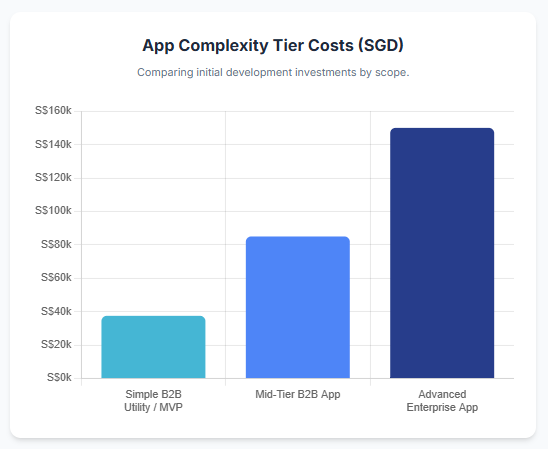
- Cost Reality: Development typically ranges from S$25,000 for a basic MVP to over S$120,000 for enterprise solutions, with an additional “ownership tax” of 15–20% annually for maintenance.
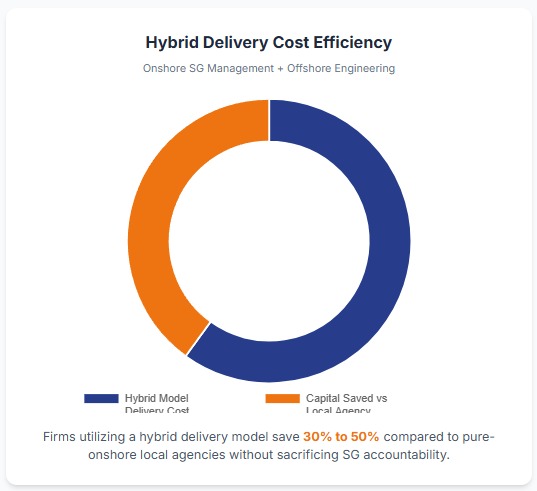
- Hybrid Efficiency: Using a hybrid delivery model (onshore strategy with offshore engineering) can reduce development costs by 30–50% while maintaining quality and local accountability.
- Strategic Fit: Before building, confirm your business has a backend system (CRM/ERP) to connect to, and verify that your clients actually have a daily operational friction point that a mobile tool would solve.
The B2B App Advantage: Four Pillars of Efficiency and Account Retention
In the Singapore B2B space, a mobile app is rarely about casual browsing or impulse buys. Its value is operational: making it effortless for your clients, distributors, or field teams to actually do business with you.
1. High-Touch Client Portals and Digital Identity Integration
An app gives your clients a dedicated, secure environment built around their daily workflows. Integrating native Singapore identities, Corppass for corporate authorisation, Singpass for instant identity verification, enables seamless multi-factor authentication without login friction. Integrating AI NLP chatbots, a capability Vinova deployed for the Singapore Safety Driving Centre (SSDC), adds 24/7 automated client support without adding headcount.
2. Account Retention and Increasing Client Switching Costs
In B2B, long-term account retention drives sustainable profitability. When your tool is embedded into a client’s daily operations, switching to a competitor becomes operationally painful. One-tap reordering for wholesale buyers, mobile sign-offs, and real-time status dashboards create the kind of daily convenience that locks in account loyalty.
3. Direct Operational Alerts and Real-Time Logistics Tracking
With email clutter at an all-time high, targeted mobile push notifications deliver critical updates directly to client decision-makers. Transactional push notifications, delivery status across Singapore/Malaysia logistics corridors, invoice approvals, milestone completions, achieve open rates between 65% and 70%, far outperforming email.
4. Hardware Integration for Field Operations and Asset Management
Native apps put mobile hardware to work solving real field problems. As demonstrated in Vinova’s work on the Gofix FM platform for EM Services, mobile apps use:
- Camera and barcode/QR scanning: instant inventory checks and asset verification
- GPS and geofencing: site audit validation and dispatch tracking
- Offline synchronisation: field technicians capture data on-site in low-connectivity areas (basements, industrial yards in Jurong) and sync automatically once back online
The Strategic Decision: Mobile App vs. B2B Web Portal
For many Singapore SMEs, the real question is whether a mobile app offers enough incremental value over a responsive web portal to justify the cost.
The mobile-responsive web portal: built for acquisition and desktop workflows
- Primary goal: broad accessibility, SEO lead generation, onboarding, complex desktop workflows (multi-page contracts, large financial spreadsheets)
- Pros: instantly accessible via browser, easy to share across procurement teams, lower initial investment, strong Google SEO visibility
- Cons: minimal offline capability, limited hardware access, dependent on browser stability, no direct push notifications
The mobile app: built for speed, field utility, and on-the-go actions
- Primary goal: purpose-built speed and efficiency for mobile workforces, field teams, and high-frequency client approvals
- Pros: biometric authentication (FaceID/TouchID), instant access, offline data capture, direct hardware use (camera/GPS/Bluetooth), real-time push alerts
- Cons: higher initial cost, ongoing maintenance across iOS and Android, required app store management
The recommended hybrid strategy
Most established Singapore B2B firms run a two-tier setup: a desktop web portal for client finance and procurement teams handling long-form reporting and contract management, and a mobile app for operational staff, site managers, or field reps handling instant approvals, job-sheet sign-offs, and inventory scans.
The Financial Blueprint: Development Costs and Delivery Models in SGD
Cost is where most mobile app development for small business conversations actually stall, so here’s the real breakdown before you talk to a vendor.
Vinova’s hybrid onshore/offshore cost optimisation
A major challenge for Singapore SMEs is the high cost of pure onshore development. Vinova solves this with a Hybrid Delivery Model: an onshore Singapore team (Principal Advisors, Solution Architects, Project Managers, UI/UX Designers) handles discovery, client meetings, architecture, and governance locally, while offshore regional hubs (Vietnam) execute code development, automated testing, and backend integration at significantly lower rate cards. This gets Singapore SMEs enterprise-grade software at 30% to 50% lower cost than pure-onshore local agencies, without sacrificing quality or local accountability.
2026 cost tiers in SGD
| App Complexity Tier | Initial Development (SGD) | Annual Maintenance (SGD) | Typical Features and Stack |
| Simple B2B utility / MVP | S$25,000 – S$50,000 | S$4,000 – S$10,000 | Basic dashboard, job status updates, PayNow Corporate links, push alerts, light admin portal |
| Mid-tier B2B app | S$50,000 – S$120,000 | S$10,000 – S$25,000 | Role-based permissions, Corppass login, CRM/ERP sync (SAP/Salesforce), offline data sync, barcode scanner, custom AI chatbot |
| Advanced B2B enterprise app | S$120,000+ | S$25,000+ | Workflow engine, AI document automation, real-time cross-border sync, enterprise security compliance (PDPA / MAS standards) |
Ongoing maintenance: the “ownership tax”
Budget 15% to 20% of initial development cost annually. This covers SG-region cloud hosting (AWS/Azure), security patching, API upkeep, and mandatory annual iOS/Android OS updates. This isn’t optional, and it’s the number most first-time app buyers underbudget.
Co-funding development via Singapore government grants
- Enterprise Development Grant (EDG): administered by Enterprise Singapore, co-funding qualified innovation, productivity, and custom software projects, often 30% to 50% for eligible local SMEs
- Productivity Solutions Grant (PSG): for adopting pre-approved, standardised digital solutions
- IMDA CTO-as-a-Service: free digital advisory to assess your software roadmap before you solicit agency bids
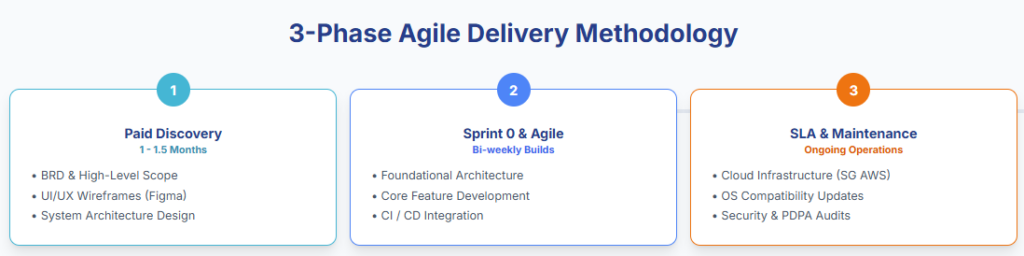
Vinova’s 3-Phase Agile Delivery Methodology
To avoid budget overruns and scope creep, software engagements should follow a structured, phased execution model:
| Phase | Duration | What Happens |
| 1. Discovery and Architecture | 1 to 1.5 months | BRD and high-level scope, UI/UX wireframes in Figma, system architecture design |
| 2. Sprint 0 and Agile Sprints | Bi-weekly iterative builds | Foundational architecture, core feature development, continuous integration and deployment |
| 3. SLA and Maintenance | 15-20% annual ownership tax | Cloud infrastructure (SG AWS), OS compatibility updates, security and PDPA audits |
Phase 1: before writing code, the team runs discovery workshops to map Business Requirement Documents, build interactive Figma prototypes, and design cloud system architecture.
Phase 2: core infrastructure gets set up, followed by 2-week agile development cycles with continuous integration, unit testing, and bi-weekly client playback sessions.
Phase 3: production launch on App Store/Google Play, enterprise onboarding, and ongoing SLA maintenance support.
Measuring B2B ROI: Operational Savings and Account Lifetime Value
B2B software ROI looks nothing like consumer app ROI. Forget ad clicks or viral downloads, this is about reducing labour hours, speeding up order cycles, and retaining key client contracts. Vinova builds the tracking for these into the app itself from day one, not as an afterthought analytics bolt-on:
- Labour hour reductions: annual savings equals hours saved per task, multiplied by tasks per year, multiplied by local hourly staff rate, a genuinely simple calculation most SMEs never bother running before deciding whether an app is worth it
- Order and approval velocity: tracking time-to-fulfilment reductions when approvals happen instantly on mobile versus back-and-forth email chains
- Client contract retention: comparing multi-year renewal rates among clients actively using your mobile portal versus non-app accounts
Decision Framework: Is a Mobile App Right for Your Business?
The core question behind mobile app development for small business always comes back to this: does the operational value outweigh the cost and ongoing maintenance? These signals point in each direction.
Green lights: build a B2B app if…
- High labour dependency: routine manual tasks (order taking, paper job sheets, status calls) tie up staff in Singapore’s competitive talent market
- Mobile and on-site workforce: your field reps, technicians, or clients operate on-site, in logistics hubs, or across ASEAN borders, needing camera, geotagging, or offline tools
- Time-critical approvals: operations bottleneck while waiting for manager sign-offs that could happen via instant push notification instead
- High customer lifetime value: contract values high enough to justify S$30k-S$80k in custom software to build a defensible client experience
Red flags: stick to web/desktop if…
- Infrequent client interactions: clients interact with your business once or twice a year with no need for interim updates
- Complex desktop data entry: workflows need multi-monitor setups, CAD modelling, or heavy spreadsheet input
- No backend digital systems: no database or CRM/ERP in place, meaning costly custom middleware has to be built before mobile sync is even possible
A 5-Step De-Risking Action Plan for Founders
If you’ve decided mobile app development for small business is genuinely worth pursuing, here’s the sequence that keeps the project from running over budget or missing the point:
- Consult your key accounts first: interview your top 5-10 corporate clients to confirm a mobile tool actually solves a daily operational friction point for them, not just an assumed one
- Check grant eligibility early: EDG or PSG eligibility with Enterprise Singapore, before you sign any vendor quote, not after
- Pick a hybrid delivery partner: local Singapore governance backed by cost-effective regional engineering, this is the model that keeps enterprise-grade software within SME budget
- Build a single-purpose MVP: resist feature bloat. Launch with just one core utility (instant reorders, job-sheet sign-off, or asset tracking) and expand from what real usage tells you, not from a wishlist
- Confirm PDPA and security compliance: verify customer data storage aligns with Singapore’s Personal Data Protection Act and relevant cybersecurity guidelines (CSA Cyber Essentials)
| Not Sure If a Mobile App Is Right for Your Business Yet? Book a free 2-hour discovery consultation with Vinova’s Singapore-based team. We’ll walk through your operations, check your EDG/PSG grant eligibility, and give you an honest answer, even if that answer is a web portal instead of an app. No commitment required. Book Your Free Discovery Consultation with Vinova |
Mobile App Development for Small Business FAQ
Is mobile app development worth it for a small business in 2026?
Yes, if your small business relies on high-frequency client interactions, field service operations, or time-critical approvals. For B2B SMEs specifically, an app reduces manual labour costs, speeds up order fulfilment, and locks in long-term account retention. If your clients only interact with you once or twice a year, a mobile-responsive website is almost always the more cost-effective choice, and there’s no shame in that being the right answer.
How much does mobile app development cost for a small business in Singapore?
Between S$25,000 and S$50,000 for a simple MVP/utility app, and S$50,000 to S$120,000 for a feature-rich mid-tier business app. Working with a hybrid agency (local Singapore management plus regional engineering hubs) can cut development cost by 30% to 50% compared to pure-onshore delivery.
What’s the actual difference between a mobile app and a mobile website for a small business?
A mobile website is built for customer acquisition, reach, and SEO, your digital front door. A mobile app is built for retention, speed, and deep utility, offline functionality, push notifications, biometric logins (Singpass/Corppass), and direct hardware integration like camera and GPS. Most businesses that genuinely need both eventually build both; the mistake is building an app first when a website would have answered the actual need.
Can Singapore small businesses get government grants for custom mobile app development?
Yes. Singapore-registered SMEs can tap the Enterprise Development Grant (EDG), administered by Enterprise Singapore, which co-funds qualifying software and productivity innovation projects, typically 30% to 50% for eligible local SMEs. Checking eligibility before signing a vendor quote, not after, is what actually determines whether the grant meaningfully changes your budget.
How do I know if my business is ready for a mobile app, or if I should wait?
The clearest signal isn’t your revenue or headcount, it’s whether you already have a working backend system (a CRM, ERP, or at minimum a structured database) for the app to connect to. Without that, an app project quietly turns into a much larger and more expensive middleware-building project first. Interviewing your top 5 to 10 clients about whether a mobile tool solves a real daily friction point for them is a faster, cheaper way to find out than building an MVP and hoping.
| Vinova: Singapore’s mobile app development partner for B2B SMEs since 2010. ISO 27001:2022 and ISO 9001:2015 certified. PDPA aligned. 300+ in-house engineers across Singapore, Hanoi, Da Nang, and Ho Chi Minh City, specialising in mobile app development for small business and SME clients across B2B sectors. Clients include Singapore Safety Driving Centre (SSDC) and EM Services (Gofix FM). Financial Times Top 500 High-Growth Companies Asia-Pacific 2026. The Straits Times Singapore’s Fastest-Growing Companies 2024, 2025, and 2026. Explore Vinova’s mobile app development services. |