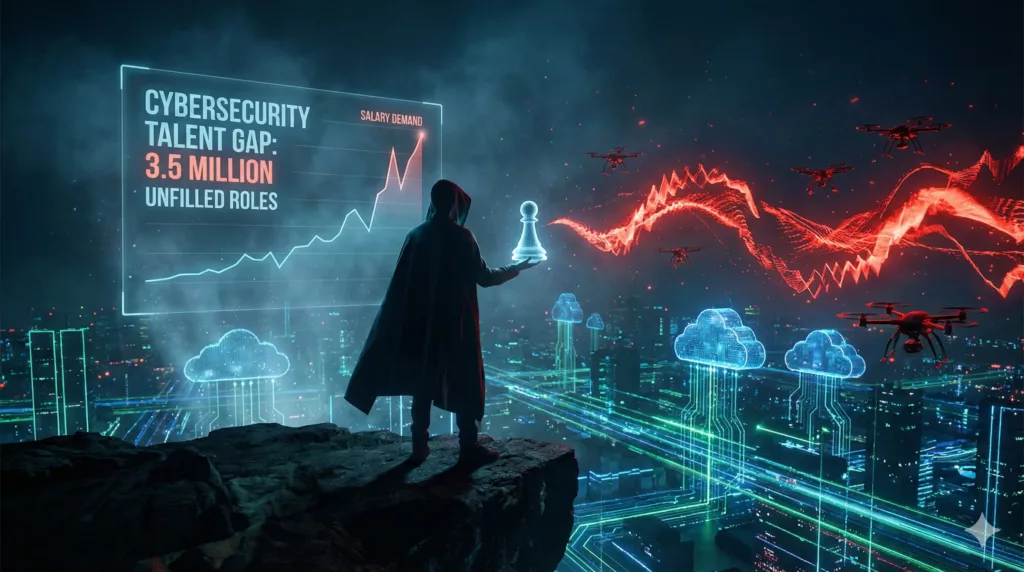
The tech job market is broken. In 2025, giants like Microsoft are cutting 15,000 jobs to fund AI, yet 3.5 million cybersecurity spots sit empty.
This is the “Staffing Paradox.” AI can write code, but it can’t fight hackers. In fact, it creates more risks. While general coding roles shrink, security jobs are booming, with median US salaries hitting $125,000.
This guide explains why cybersecurity is the only “guaranteed win” for your career—and why you are safer protecting tech than building it.
Table of Contents
Key takeaways
- A projected 3.5 million cybersecurity roles sit empty globally, creating a structural crisis where demand for specialized talent persists despite 15,000 job cuts at major tech firms.
- Median US salaries have hit $125,000, with specialized roles like AI Security Engineers or CISOs often exceeding $300,000 as companies hunt for experts to secure complex hybrid environments.
- The Bureau of Labor Statistics projects 33% growth for Information Security Analysts through 2033, driven by the sheer volume of AI-generated threats and strict regulations like the EU AI Act.
- Cybersecurity resists automation because 54% of breaches stem from skill gaps, requiring human judgment for high-stakes ethical decisions and strategic creativity that algorithms cannot safely replicate.
Why is Cybersecurity Talent So Hard to Find?
The inability to fill cybersecurity roles is not a simple supply shortage. It is a structural crisis. The industry faces a mismatch of quality versus quantity, rapid technological changes, and high burnout rates.
A 3.5 Million Role Gap
A projected 3.5 million cybersecurity roles remain unfilled globally in 2025. This deficit is uneven. The Asia-Pacific region faces the acute shortage, lacking roughly 3.4 million professionals due to rapid digitization.
In the United States, the gap exceeds 500,000 positions. This creates a vicious cycle. Organizations cannot fill roles, so they burden existing staff. This causes burnout, driving professionals out of the industry and widening the gap further.
Complexity Requires Unicorns
The era of the generalist IT security officer is over. Modern threats require deep specialization.
- Cloud Security: Migration to the cloud demands architects fluent in AWS, Azure, and Google Cloud. These skills differ from on-premise network security.
- Shadow AI and IoT: Employees now use unauthorized AI tools, and corporate networks house billions of IoT devices. Securing an IoT thermostat or a Large Language Model requires specific, cross-disciplinary skills.
Companies hunt for “unicorns”—professionals who can secure these complex, hybrid environments. They refuse to hire juniors for high-stakes roles but also refuse to train them. This “experience trap” leaves millions of roles empty.
Digital Transformation Expands Risk
As companies digitize supply chains, every touchpoint becomes a potential entry for attackers. Supply chain vulnerabilities are now a top risk for 54% of large organizations.
This expands the competition for talent. Security is no longer just for banks. Hospitals, factories, and retailers now compete for the same limited pool of experts. A hospital must now bid against a tech giant for a security architect, driving up costs.
The Skill Gap and AI
A cybersecurity skill becomes outdated in roughly two years. Attackers now use Generative AI to write polymorphic malware and craft perfect phishing emails. Defenders must continuously upskill to survive.
Universities move too slowly to teach these defenses. Consequently, 54% of breaches are attributed to a lack of IT security skills. This high barrier to entry for mid-career switchers further constricts the supply of senior talent.
High Salaries and Low Retention
Supply and demand drive salaries to historic highs.
- Entry-Level: $70,000 to $90,000.
- Experienced Engineers: $140,000 to $180,000.
- Specialized Roles: AI Security Engineers or CISOs often exceed $300,000.
Yet, retention fails. High stress and “always-on” vigilance burn out talent. Professionals leave due to poor management support and the psychological toll of the job. Money alone cannot fix the turnover crisis.
How Vinova Secures Your Organization
Vinova helps you bypass this talent crisis. We provide the specialized security expertise you cannot find locally.
We tap into the emerging engineering hubs of Southeast Asia to find the “unicorns” you need. We supply Cloud Security Architects and AI Risk specialists who are ready to deploy. We offer elite talent without the $300,000 price tag and the retention headaches. We help you build a dedicated security team that scales with your threat landscape.
Cybersecurity Jobs Safe from AI Automation
Many workers worry AI will replace them. In cybersecurity, the story is different. AI is a tool here, not a replacement. Security is an adversarial field. A human attacker tries to break in. This requires strategic creativity and ethical judgment that AI cannot copy.
Roles That Need Strategy and Creativity
The safest roles require slow, logical thinking. AI is good at fast pattern matching, but humans excel at complex decisions.
- Chief Information Security Officer (CISO): This is a business executive role. A CISO translates technical risks into money terms for the board. They negotiate budgets. During a crisis, like a ransomware attack, they decide whether to pay. These choices involve legal and ethical trade-offs. An algorithm cannot make these high-stakes calls.
- Security Architects: Building a secure system is creative engineering. Architects must guess future business needs. They build controls that do not stop innovation. AI can optimize a network, but it cannot understand a company’s specific risk appetite.
- Penetration Testers (Red Teamers): Automated scanners find known bugs. Human hackers find new ones. A human tester might chain three small mistakes together to cause a big breach. AI models trained on old data often miss these creative attack paths.
Jobs Requiring Ethics and Human Analysis
Most breaches involve a human element. Defending against them requires empathy and psychological insight.
- Insider Threat Analysis: Detecting a malicious employee is difficult. An analyst must decide if an action is a mistake or a crime. AI might flag a large download as a threat. A human can see the employee is just backing up work. This nuance prevents false accusations and protects morale.
- Governance, Risk, and Compliance (GRC): Compliance is a legal argument. Professionals must interpret laws like the EU AI Act. They decide what counts as “reasonable” security. This standard changes by industry. AI cannot make these subjective judgment calls.
Specialized Investigations
Some roles require detective work that goes beyond data processing.
- Threat Hunting: This is the proactive search for hidden attackers. It starts with a human hunch. Hunters use intuition to spot odd behaviors that do not trigger standard alarms.
- Digital Forensics: When a breach happens, experts reconstruct the event for legal use. They connect code snippets and timestamps into a story. This attribution requires understanding geopolitical context, which AI lacks.
- Security Research: Finding new “zero-day” flaws is an intellectual puzzle. Researchers reverse-engineer software to find logic errors. This requires understanding the developer’s mindset.
AI as a Helper, Not a Replacement
AI augments the workforce. It handles the noise. Large companies face millions of alerts every day. AI triages these low-level alerts and automates routine blocks.
This allows human analysts to focus on the complex threats. Humans must also validate AI findings. An AI might “hallucinate” a threat. A human checks the data before shutting down a server. As companies use more autonomous AI agents, humans must also manage the permissions of these digital workers.
How Vinova Secures Your Human Edge
The roles listed above are the hardest to fill. Vinova helps you find this specialized talent.
- Sourcing the “System 2” Thinkers: We find the CISOs, Architects, and Red Teamers who possess the strategic creativity AI lacks. We tap into global talent pools to find these “unicorns.”
- The Human-in-the-Loop: We provide the analysts who validate your AI’s output. Our teams act as the ethical guardrails for your automated systems.
- Specialized Investigators: We supply the Threat Hunters and Forensic Analysts who can attribute attacks and find hidden adversaries. We ensure you have the human intuition needed to catch the threats that AI misses.
Which IT Jobs Have the Most Demand?
The IT job market in late 2025 has bifurcated. While generalist roles are facing a correction, specialized roles that enable AI readiness, security, and cloud infrastructure are seeing explosive demand.1 The market has moved from “hiring for growth” to “hiring for efficiency and security.”
1. The Apex of Demand: Cybersecurity & Compliance
Cybersecurity remains the most recession-proof sector, but the demand has shifted from general “security admins” to highly specialized architects who can secure complex, AI-driven environments.
- Cloud Security Engineers: With the perimeter gone, these are the architects of the new “Zero Trust” reality. Demand is critical for engineers who can secure multi-cloud environments (AWS, Azure, GCP) and code security controls directly into infrastructure (Infrastructure as Code).2
- Information Security Analysts: frontline defenders for Security Operations Centers (SOCs). The Bureau of Labor Statistics projects a 33% growth rate for this role through 2033, driven by the sheer volume of AI-generated cyber threats.3
- Privacy Engineers: A massive emerging role for 2025. These are technical professionals who can translate laws like the EU AI Act and GDPR into actual code. They are essential for preventing data leakage in AI models and ensuring regulatory compliance.
- Identity & Access Management (IAM) Specialists: As “non-human” identities (AI agents, bots) proliferate, securing who (or what) has access to data is a top priority.
2. The AI Ecosystem: Builders vs. Users
Demand here is nuanced. There is a “saturation” of entry-level enthusiasts but a desperate shortage of production-grade engineers.
- AI Infrastructure Engineers: The most difficult role to fill. These are the plumbers of the AI revolution—engineers who know how to optimize GPU workloads, manage vector databases, and reduce inference latency. Companies cannot deploy AI without them.
- Machine Learning Engineers (MLOps): The focus has shifted from creating models to operationalizing them. Companies need engineers who can take a model from a laptop prototype to a scalable, reliable enterprise application.
- AI Governance Specialists: A hybrid legal-technical role.4 These professionals audit AI models for bias, hallucination, and copyright risk.5 They are the “brakes” that allow the car to drive fast safely.
3. The Cloud & Data Foundation
AI cannot function without clean data and a robust cloud environment.
- Cloud Architects: Companies are moving from “cloud first” to “cloud smart,” often using multi-cloud strategies to avoid vendor lock-in.6 Architects who can orchestrate complex environments (e.g., running AI on Azure but data storage on AWS) are in high demand.
- Data Engineers: Demand here actually outpaces Data Scientists in many sectors. Before a company can use AI, its data must be clean, structured, and accessible.7 Data Engineers build the pipelines that feed the AI models.
- DevSecOps Engineers: The bridge between speed and safety.8 These engineers integrate security testing into the automated software delivery pipeline, ensuring code is secure before it is deployed.9
Summary of High-Demand Roles (2025-2026)
| Role Category | Specific High-Demand Job Titles | Why It’s Hot |
| Cybersecurity | Cloud Security Engineer, Privacy Engineer, SOC Analyst | High threat volume + new strict regulations (EU AI Act). |
| Artificial Intelligence | AI Infrastructure Engineer, MLOps Engineer, AI Ethicist | Shift from “AI experiments” to “Production AI.” |
| Cloud & Infrastructure | Cloud Architect, DevSecOps Engineer, SRE | Complexity of multi-cloud environments. |
| Data | Data Engineer, Analytics Engineer | AI needs clean data fuel to run. |
Strategic Advice for Job Seekers
- Avoid the “Generalist” Trap: The market for generic “IT Administrators” or “Junior Developers” is softening.
- Target “Hybrid” Skills: The most valuable candidates combine two domains. Examples: Legal + Tech (Privacy Engineer), Security + Code (DevSecOps), or Infrastructure + AI (AI Platform Engineer).
- Focus on “Production” Skills: Certifications are good, but demonstrated ability to deploy, secure, and scale systems is what commands a premium in 2025.
Is Cybersecurity the Only Safe IT Career?
Labeling any career “safe” is risky. However, cybersecurity offers structural resilience that other IT fields cannot match. It is the insurance policy for the digital economy. Organizations cannot cancel it, even when money is tight.
The Most Resilient Investment
Cybersecurity is immune to the budget cuts that hit other IT projects. When a recession hits, a company might delay a new app or pause a system upgrade. They will not fire the team that prevents ransomware from locking their data.
This “non-discretionary” nature provides a floor for employment. History shows cybercrime often increases during economic downturns. This ironically sustains the demand for defenders even when the market creates fewer new jobs.
The Automation Barrier
Software engineering faces a “commoditization” threat. AI tools rapidly increase the productivity of developers. This reduces the total number of people needed to maintain a codebase. This contraction is already hitting junior developer roles.
Cybersecurity is different. The stakes prevent full automation.
- The Cost of Error: An AI mistake in code results in a bug. An AI mistake in threat detection results in a breach that can bankrupt a company.
- Accountability: Security requires a human to take responsibility. Regulations demand a “throat to choke.” This creates a structural barrier to automation that does not exist in software development.
The Future-Proof Hybrid
The ultimate stability lies in combining skills. The most resilient professionals in 2026 sit at the intersection of multiple high-demand fields.
- AI Security Specialist: These professionals secure the AI pipeline itself. They defend against attacks actively targeted at machine learning models.
- Cloud Security Architect: These experts design secure infrastructures that span public and private clouds.
- DevSecOps Engineer: These are developers who view security as code. They automate the defense of the software supply chain.
These hybrid roles are the hardest to fill and the hardest to automate. They command the highest salaries and the best job security in the market.
How Vinova Secures Your Talent
The resilience of cybersecurity makes these professionals expensive and hard to find. Vinova bridges this gap.
We provide the elite, hybrid security talent that is scarce in the US market. Our teams in Vietnam and Singapore include Cloud Security Architects and DevSecOps Engineers who are ready to deploy. We offer the “human in the loop” that compliance demands, without the massive overhead of domestic hiring. We help you build a resilient security posture that scales with your business.
Highest Demand IT Roles in 2025
The hierarchy of IT demand is clear. In 2025, the industry prioritizes security, cloud infrastructure, and intelligent automation. Companies are moving budget away from maintenance and toward innovation and protection.
Top Roles: Security, AI, and Cloud
The following table breaks down the projected demand and compensation for the top IT roles through 2026.
| Role | Demand Trend | Salary Range (US) | Automation Risk |
| Cybersecurity Engineer | Very High | $130k – $190k | Low |
| AI/ML Engineer | High | $140k – $200k | Medium (Junior) |
| Cloud Architect | High | $130k – $180k | Low |
| DevSecOps Engineer | High | $120k – $170k | Low |
| Data Scientist | Moderate | $110k – $160k | Medium/High |
| Software Developer | Moderate | $100k – $150k | High (Junior) |
The Death of the Silo
The isolated IT professional is a relic. Modern teams need “T-shaped” individuals. These are workers with deep expertise in one area, like security, but broad competence in others, like coding or AI.
A security analyst who can write Python scripts to automate their workflow is far more valuable than one who relies only on vendor tools. An AI engineer who understands security principles is more employable than one who simply trains models. The market rewards those who can bridge these gaps.
The Fusion of Law and Code
A major trend for 2026 is the merger of legal and technical teams. Governments are enforcing stricter controls, such as the EU AI Act. Companies must hire compliance officers and legal counsel who possess technical literacy. These experts navigate global regulations and manage liability. Because this work requires complex interpretation and negotiation, these roles are effectively immune to automation.
How Vinova Solves the Talent Crunch
The salaries listed above are steep. Competing for a $190,000 Cybersecurity Engineer in the US market is expensive and difficult. Vinova offers a smarter path. We provide the “T-shaped” talent you need—DevSecOps engineers, Cloud Architects, and AI specialists—through our global hubs in Vietnam and Singapore. We vet for the cross-disciplinary skills that drive value. You get the elite capability without the massive overhead or the long hiring cycle.
The 2026 Outlook: Emerging Threats and the Future of the Profession
As we look beyond 2025, the cybersecurity landscape is being reshaped by three seismic shifts: the quantum threat, the rise of autonomous AI agents, and the militarization of critical infrastructure. These trends are not just changing the threat landscape; they are creating entirely new categories of jobs.
The Quantum Threat and “Q-Day” Preparation
The threat of quantum computers breaking current encryption (RSA, ECC) is driving immediate action. While a full-scale “Q-Day” (when quantum computers can crack current encryption) may be years away, the threat of “Harvest Now, Decrypt Later” is real. Attackers are stealing encrypted data today to decrypt it later when the technology matures.
- Impact on Jobs: This creates urgent demand for Cryptographic Agility Specialists. These professionals do not just swap algorithms; they manage a “Cryptography Bill of Materials” (CBOM) to track every key and certificate in an organization.
- New Responsibilities: By 2026, large enterprises will need specialists to migrate systems to Post-Quantum Cryptography (PQC) standards approved by NIST. This is a massive, multi-year migration project requiring specialized human labor to ensure systems remain secure during the transition.
The Rise of Agentic AI and the “Machine Identity” Crisis
By 2026, the internet will be populated by billions of autonomous AI agents performing tasks for humans. These agents will have their own identities, wallets, and permissions, creating a crisis of “Non-Human Identity Management.”
- New Role: The Machine Identity Guardian: This emerging role focuses on securing the credentials and permissions of AI agents. Unlike human users, agents operate at machine speed and scale, requiring automated identity governance.
- AI-Centric Threat Hunting: Threat actors will target these agents to manipulate their logic (prompt injection) or steal their resources (model theft). Defenders must learn to hunt for anomalies in agent behavior, not just user behavior.
Geopolitics and the Militarization of Cyberspace
Geopolitical fracturing is spilling into cyberspace. State-sponsored groups like the PRC-linked “Volt Typhoon” are pre-positioning themselves within critical infrastructure networks. Their goal is not just espionage, but potential disruption of power, water, and transportation systems during a conflict.
- Impact on Jobs: Cybersecurity is transforming from a corporate function into a national defense function. There is a surging demand for Operational Technology (OT) Security professionals who understand how to protect physical control systems (ICS/SCADA).
- Job Security: These roles are geographically “sticky.” Because they involve national security and critical infrastructure, they typically require security clearances and cannot be easily offshored. This makes OT security one of the most secure and high-demand career paths for the next decade.
How Vinova Prepares You for the Future
The threats of 2026 require a new class of defenders. Vinova helps you build this future-ready workforce today.
- Quantum Readiness: We provide the Cryptographic Agility Specialists you need to audit your current encryption and prepare for PQC migration. We help you build your CBOM and secure your data against future decryption threats.
- Securing the Machine: We implement Non-Human Identity Management frameworks. Our experts help you secure your AI agents, ensuring they have the right permissions and are protected from hijack attempts.
- Critical Infrastructure Defense: We have deep expertise in OT Security. We help you secure your physical operations against state-sponsored threats, bridging the gap between IT security and engineering controls.
Strategic Workforce Planning: Offshoring vs. Localization
In addressing the talent shortage, organizations are increasingly looking to offshore markets. However, the dynamics of 2026 suggest that offshoring is not a silver bullet.
The Limits of the Offshore Model
While offshore staff augmentation is projected to grow significantly by 2026 as a cost-saving measure, it faces diminishing returns in cybersecurity.
- Global Wage Inflation: The talent shortage is global, not local. Wages for skilled security professionals in hubs like India, Eastern Europe, and Latin America are rising faster than in the West. In India, salaries are projected to rise by 9% in 2026, with niche skills like Cloud Security seeing even steeper hikes. The cost arbitrage is narrowing; a Senior Security Architect in Poland or Brazil now commands a premium that erodes the traditional “3-for-1” headcount advantage.
- Trust and Sovereignty: Data sovereignty laws are creating hard borders in the cloud. India’s Digital Personal Data Protection (DPDP) Act, fully operational in 2026, and Vietnam’s localization mandates make it legally risky to offshore roles requiring unrestricted access to sensitive customer data. This forces companies to maintain a robust “onshore” presence for data-sensitive roles to avoid regulatory entanglement.
- The “Follow the Sun” Necessity: Offshoring is excellent for Tier 1 monitoring (the “follow the sun” model), but strategic roles are “re-shoring.” Positions like Security Architecture, GRC Leadership, and Incident Response Commanders are increasingly centralized near headquarters. These roles require real-time collaboration with the C-suite and legal counsel—interactions that suffer from time zone latency.
How Vinova Navigates the Hybrid Model
We help you strike the balance between cost and control.
- The “Sovereign” Offshore Team: We build offshore teams in jurisdictions with favorable data adequacy statuses. This ensures your remote staff can legally access the systems they need to protect without violating local laws.
- Strategic Onshoring: We do not recommend offshoring your CISO or Lead Architect. Instead, we surround your onshore leaders with offshore execution capability—giving you the strategic control of a local team with the execution scale of a global one.
- Cost-Optimized Coverage: We implement the “Follow the Sun” model for monitoring, ensuring 24/7 “eyes on glass” without forcing your local team to work burnout-inducing night shifts.
Conclusion
While the “gold rush” of general software development has quieted, cybersecurity remains in a state of urgent, permanent expansion. The data confirms that security is now the bedrock of the future IT labor market.
Because the work is high-stakes and adversarial, it requires human judgment that automation cannot replace. This makes cybersecurity talent a secure, high-value asset that is insulated from market disruption.
Ensure your organization is protected. Contact us to build a specialized cybersecurity staffing strategy today.