Is your legacy ERP a survival risk in the 2025 economy? Rigid, monolithic systems are failing. Faced with acute labor shortages and rapid AI integration, US businesses can no longer afford inflexible software.
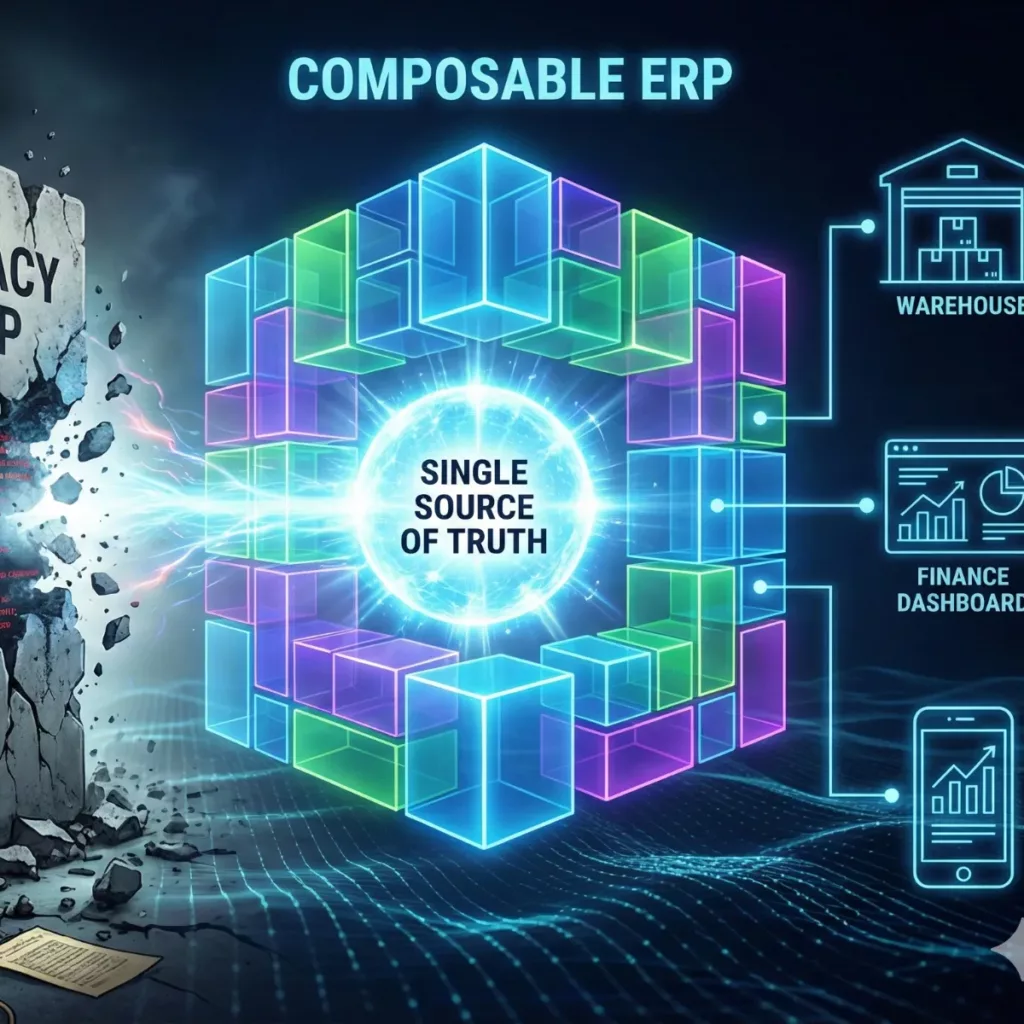
The market has decisively shifted to “Composable ERP.” This modular architecture prioritizes speed and seamless upgrades over massive, static suites. Custom Odoo development aligns with this shift, turning your back office from a heavy cost center into a proprietary advantage. To execute this strategy effectively, many organizations choose odoo erp implementation services in the usa provided by vinova, enabling them to build tailored modules, accelerate deployment, and maintain long-term flexibility without accumulating technical debt.
Do you know the architecture required to make this pivot without breaking your budget? Keep reading to engineer your competitive edge.
Table of Contents
Key Takeaways:
- US businesses must pivot from rigid, monolithic ERPs to “Composable ERP” architecture for agility in the 2025/2026 economy, driven by AI and labor shortages.
- Odoo offers a foundation of 30+ core apps and 40,000+ community modules, which Vinova customizes using the 80/20 Rule for proprietary advantage.
- Advanced Warehouse Management (WMS) in Odoo can increase picking speed by 30-50%, helping logistics hubs maximize workforce against 2026 labor shortages.
- Vinova ensures industry-specific compliance (HIPAA, ASC 606) and security, operating with ISO 27001 certified centers to mitigate cybersecurity risks.
Personalized ERP Systems for Diverse Business Models
In the US landscape of 2026, the era of the rigid, monolithic ERP is over. Driven by labor shortages, reshoring, and AI integration, businesses now require “composable” digital ecosystems. Odoo serves as the strategic framework for this agility, and Vinova leverages its open-source architecture to build bespoke solutions for U.S. industries.
The Architectural Shift: From Monoliths to Composable ERP
The prevailing trend is “Composable ERP.” This prioritizes modularity, allowing you to swap or upgrade capabilities without disrupting the core.
- The Problem with Legacy: Legacy systems (like traditional SAP or Oracle) often impose rigid structures. This forces companies to alter efficient workflows to match the software, creating “vendor lock-in” and stifling innovation.
- The Vinova/Odoo Advantage: Vinova harnesses Odoo’s open-source nature to ensure Data Sovereignty. You retain full ownership of your data and source code.
- Foundation: Odoo offers 30+ core apps and 40,000+ community modules.
- Customization: Vinova architects this foundation, identifying the right mix of standard and custom modules to fit your business like a bespoke suit.
Tailoring Solutions for the U.S. Mid-Market
For SMEs, the barrier to entry has been cost and complexity. Vinova bridges this gap.
- Cost-Effective Agility: We leverage Odoo’s model to deliver enterprise capabilities at a fraction of the TCO of proprietary competitors.
- Industry-Specific Compliance: Generic software fails in regulated sectors.
- Healthcare: We build HIPAA-compliant data handling.
- Construction: We implement project-based accounting compatible with AICPA standards.
- “Vinova Ready”: Our pre-configured frameworks for fintech, marine logistics, and retail accelerate time-to-value, letting you bypass initial configuration hurdles.
The Strategic Implementation Methodology
A personalized system requires a rigorous process to avoid the common pitfalls of scope creep and poor adoption. Vinova employs a six-phase lifecycle.
| Phase | Strategic Focus | U.S. Market Relevance (2026) |
| 1. Discovery & Gap Analysis | Mapping “As-Is” vs. “To-Be” processes. Identifying automation opportunities. | Critical for firms facing labor shortages; identifies processes ripe for AI automation. |
| 2. Solution Architecture | Designing integrations for U.S. tools (TaxJar, ADP, FedEx). | Ensures compliance with U.S. tax laws and seamless connection to domestic logistics/HR platforms. |
| 3. Custom Development | Coding bespoke workflows while preserving upgradeability. | Allows proprietary advantages (e.g., unique pricing algorithms) to be codified into the system. |
| 4. Data Migration | Cleaning and mapping legacy data (e.g., from QuickBooks/NetSuite). | Essential for AI readiness; clean data is the prerequisite for predictive insights. |
| 5. Testing & QA | Rigorous UAT and security verification (ISO 27001). | Mitigates cybersecurity risks, a top priority for U.S. CIOs. |
| 6. Deployment & Support | Managed “Go-Live” and ongoing hyper-care. | Provides stability in a rapidly evolving software landscape. |
How Customization Enhances Efficiency and Decision-Making
In the fast-paced U.S. market of 2026, efficiency is defined by the velocity and accuracy of information flow. The primary inhibitor to growth is the “data silo”—disconnected systems that fail to communicate. Vinova’s custom Odoo development dismantles these silos to create a “Single Source of Truth.”
1. Dismantling “Excel Hell”
A significant portion of U.S. operations still relies on fragmented spreadsheets to bridge gaps between legacy software. This results in “Excel Hell”—redundant entry and human error.
- The Unified Flow: We facilitate a seamless, automated chain reaction. When a sales order is confirmed, inventory is reserved, manufacturing is scheduled, and accounting entries are generated—instantly.
- The Impact: The shop floor, warehouse, and finance department operate on the exact same live dataset. If a raw material is consumed, the accounting ledger updates immediately. CFOs track cash flow and profitability in real-time, rather than waiting for retrospective month-end reports.
2. Automation as a Survival Mechanism
With acute labor shortages characterizing the 2026 market, automation is a survival mechanism. We embed intelligent automation directly into your business logic.
- Intelligent Procurement: Automated reordering rules trigger RFQs to suppliers when stock dips. AI-driven forecasting accounts for lead times and seasonal spikes, ensuring optimal stock without manual monitoring.
- Zero-Touch Finance: AI automatically matches bank statement lines with invoices. This automates reconciliation, allowing finance teams to focus on strategy rather than data entry.
- Process Compliance: In regulated industries (e.g., medical devices), we enforce mandatory quality checks. The system prevents a product from moving to shipping until all compliance data (batch numbers, expiration dates) is logged, mitigating recall risks.
3. Real-Time Analytics and Predictive Intelligence
We enable a shift from reactive to proactive management. Standard systems report what happened; Vinova’s solutions show what will happen.
- Predictive Dashboards: Role-specific dashboards visualize KPIs in real-time. A logistics manager views a heat map of warehouse congestion; a sales director sees predictive lead scoring models.
- Demand Forecasting: Using historical sales data and seasonal trends, the system forecasts future demand. This optimizes purchasing to reduce carrying costs for slow movers and prevent stockouts for high-demand items.
- Granular Profitability: Custom analytic accounting tags every expense to specific projects or product lines. You see the true net profitability of different segments, guiding clear decisions on what to expand and what to discontinue.
Vinova’s Expertise in Module Development and API Integration
In the crowded ERP market, Vinova stands out through profound technical mastery. We do not just configure Odoo; we engineer it. As an official Odoo Partner with ISO 9001 and ISO 27001 certified centers, we combine the cost advantages of our offshore hubs (Singapore, Vietnam) with the rigorous security protocols required by Western enterprises.
Custom Module Architecture: The “80/20” Rule
Odoo’s standard suite covers about 80% of business processes. The remaining 20% constitutes your unique competitive advantage—your proprietary workflows and pricing models. Vinova’s team of 50+ in-house experts builds these bespoke capabilities without breaking your system.
- Upgrade Safety: We adhere strictly to Odoo’s coding standards. Our custom modules are built as distinct “apps” that layer on top of the core system. This allows the core platform to receive security patches and feature updates without breaking your custom functionality.
Real-World Customization Examples:
- Complex Industry Logic: For a furniture manufacturer, we built a “Product Configurator.” Sales reps select attributes (fabric, dimensions), and the module automatically generates a unique Bill of Materials (BOM) and precise price, eliminating manual estimation errors.
- Advanced Billing Engines: For subscription services, we handle complex pro-ration and revenue recognition rules compliant with ASC 606 standards, automating logic too complex for standard tools.
- Mobile Functionality: We extend Odoo to the “deskless” workforce. Using frameworks like Flutter or React Native, we build native apps for field technicians to log parts usage offline or warehouse staff to scan barcodes, syncing seamlessly with the Odoo backend.
A Seamless API Integration Ecosystem
In 2026, no ERP operates in a vacuum. A typical U.S. business relies on a “best-of-breed” constellation of SaaS tools. Vinova knits these into a cohesive whole.
| Integration Domain | Specific Platforms | Strategic Benefit for U.S. Businesses |
| E-commerce | Shopify,Magento, Amazon | True Omnichannel: Enables strategies like “Buy Online, Pick Up In-Store” (BOPIS) and prevents overselling by keeping inventory live across all channels. |
| Logistics | FedEx, UPS, USPS, DHL | Speed: Real-time rate calculation and label printing directly within Odoo. Crucial for meeting 2-day delivery expectations. |
| Finance | Stripe, PayPal, QuickBooks | Accuracy: Secure tokenization and automatic journal entry synchronization accelerate Order-to-Cash cycles and ensure PCI compliance. |
| Tax Compliance | TaxJar, Avalara | Risk Mitigation: Automated sales tax calculation based on ship-to addresses is essential for navigating complex U.S. nexus laws. |
Technical Proficiency and Deployment
We optimize our stack to leverage the full power of Odoo.
- Core Stack: We use Python for backend logic to implement complex algorithms and PostgreSQL for transactional integrity and scalability.
- Flexible Deployment:
- Odoo.sh: For clients wanting built-in CI/CD tools to test customizations thoroughly before go-live.
- Private Cloud (AWS/Azure): For clients with strict data sovereignty needs (e.g., defense, healthcare), we deploy on hardened private infrastructure to ensure full control over data location.
From Retail to Logistics: Adapting Odoo to Any Environment
As 2026 approaches, Vinova’s expert customization of Odoo unlocks its versatility for the U.S. market. Three sectors—Retail, Logistics, and Manufacturing—stand to benefit most from these tailored solutions, addressing challenges from omnichannel complexity to labor shortages.
Retail: The Omnichannel Imperative
The line between “online” and “offline” retail has vanished. Retailers must deliver a unified experience where customers can buy on social media, return in-store, and earn loyalty points across both.
- The Challenge: Legacy POS systems often fail to communicate with e-commerce warehouses in real-time. This causes “ghost inventory”—items appear in stock online but are unavailable physically—leading to cancelled orders.
- Vinova’s Solution: A unified Odoo Retail solution where POS and E-commerce share a single real-time database. We integrate hardware like scanners and IoT devices for total stock visibility.
- 2026 Trend: To combat labor shortages, we implement self-checkout kiosks and mobile POS solutions. Floor staff can service customers anywhere in the store, maximizing revenue per employee.
Logistics: Resilience in the Face of Disruption
The 2026 logistics landscape is defined by trade compliance, labor pressures, and the need for speed. Warehouses must process higher volumes with fewer people.
- The Challenge: Managing multi-warehouse networks and complex routing (cross-docking, drop-shipping) requires logic that basic software lacks.
- Vinova’s Solution: We implement advanced Wave and Batch Picking to optimize worker movement. Custom routing rules automatically select the optimal warehouse based on destination, minimizing shipping costs.
- Compliance: To meet regulations like the Uyghur Forced Labor Prevention Act (UFLPA), we configure deep traceability using serial numbers. You can trace the complete journey and origin of every item—a non-negotiable requirement in 2026.
Manufacturing: The Smart Factory (Industry 4.0)
U.S. manufacturing is “reshoring,” but high domestic labor costs demand extreme efficiency.
- The Challenge: Factories suffer from disconnected machines. Planners rely on whiteboards while critical data remains trapped in local machine controllers.
- Vinova’s Solution: We integrate Odoo with the Internet of Things (IoT). IoT Boxes connect to digital scales, cameras, and foot pedals. Machine cycles and quality control images are automatically attached to Work Orders, eliminating manual data entry.
- Predictive Maintenance: Using IoT sensor data (vibration, temperature), Odoo triggers maintenance requests before a machine fails. This reduces unplanned downtime and protects expensive equipment.
Real Results: Smarter Operations, Faster Growth
In the landscape of 2026, the value of an ERP is not measured by software features, but by its ability to act as a force multiplier. When Vinova deploys Odoo, the goal is to create a digital infrastructure that allows you to outpace competitors through sheer operational agility.
Consider the transformative potential for these three specific U.S. business archetypes.
1. For the “Stagnant Manufacturer”: Breaking Bottlenecks
The Pain: A mid-sized firm hits a growth ceiling. The production line is competent, but the back office is drowning in “Excel Hell.” The shop floor is a “black box” to finance, leading to missed orders and guesswork in scheduling.
The Vinova Transformation: We transition you from reactive to predictive using Custom IoT Integration.
- The Mechanism: Shop floor machines connect directly to Odoo via IoT boxes. They automatically log cycles and material consumption, creating a live “digital twin” of the factory.
The Result: The “black box” opens.
- Real-Time Costing: Finance sees manufacturing costs down to the penny.
- Confidence: Planners accept rush orders knowing exact capacity.
- Scale: Production scales without hiring a single additional data entry clerk.
2. For the “Fragmented Retailer”: Unifying the Brand
The Pain: A rapidly expanding brand struggles with the chaos of success. Managing Shopify, Amazon, and brick-and-mortar stores on three different systems leads to the “Ghost Inventory” crisis—selling products online that were just bought in-store.
The Vinova Transformation: We implement a Unified Odoo Ecosystem.
- The Mechanism: POS and E-commerce feed into a single master inventory database. Custom connectors sync Amazon and Shopify in real-time, while automated rules balance stock between warehouses.
The Result: True omnichannel fluidity.
- BOPIS: Customers can Buy Online, Pick Up In-Store without friction.
- Zero Overselling: You recover lost revenue and protect your reputation.
- Unified Loyalty: Marketing treats the customer as one entity across digital and physical realms.
3. For the “Labor-Constrained Logistics Hub”: Doing More with Less
The Pain: Facing the severe labor shortages of 2026, a distribution center cannot hire enough staff to meet 2-day delivery demands. Pickers walk miles daily due to inefficient routing, and shipping errors are climbing.
The Vinova Transformation: We configure Odoo’s Advanced WMS to act as a “Digital Supervisor.”
- The Mechanism: We implement “Wave Picking” and “Batch Picking” strategies to optimize walking paths. Mobile barcode scanners validate every item instantly against the digital order.
The Result: Maximizing the existing workforce.
- Efficiency: Picking speed increases by 30-50% as software guides the most efficient routes.
- Accuracy: Shipping errors drop to near zero, slashing return costs.
- Growth: The business scales volume without being held back by recruitment struggles.
Vinova’s Portfolio: “LiveIn” and “MoveAide”
Vinova’s specific project portfolio further demonstrates their capability to deliver high-stakes, consumer-facing technology solutions integrated with complex back-end logic.
- LiveIn: Vinova developed the mobile application and backend for this long-stay rental platform. The solution required complex booking logic, payment integration, and inventory management for property listings. Functioning as a “house-renting assistant” for the Southeast Asian market, this project demonstrates Vinova’s ability to build intuitive, consumer-facing interfaces that interact seamlessly with complex backend database logic.
- MoveAide: For this review aggregator in the moving industry, Vinova built a system to automate the collection of customer reviews and publish them to enhance Search Engine Optimization (SEO). This project highlights their expertise in digital marketing integration and automated workflow design, helping a service-based business leverage data to drive growth.
Future-Ready Businesses Start with Vinova’s Odoo ERP
As the business world looks toward 2026, market volatility and technological change will only accelerate. Survival depends on systems that are adaptable, intelligent, and scalable. Vinova’s Odoo ERP development services provide that robust foundation.
Embracing AI and Automation Trends
The Odoo roadmap (versions 18, 19, and beyond) focuses heavily on Artificial Intelligence. Features like predictive lead scoring and automated bank reconciliation are becoming standard requirements, not novelties.
- From Recording to Deciding: Vinova helps you move from simple data recording to intelligent decision support.
- Proactive Suggestions: By 2026, your ERP will not just list transactions. It will suggest actions—recommending which supplier to use based on risk profiles or identifying which products to discount based on aging stock analysis.
Long-Term Partnership and Lifecycle Support
ERP implementation is a continuous lifecycle, not a one-time event. Vinova provides long-term “Hypercare” to ensure your system evolves with your business.
- Regular Upgrades: We manage upgrades to access the latest security patches and features.
- Performance Tuning: We perform continuous tuning to ensure the system remains fast and responsive as your data volumes grow.
The Cost-Benefit of Open Source in 2026
In an inflationary economy, the Total Cost of Ownership (TCO) of Odoo presents a compelling case against proprietary giants.
- Invest in Innovation: With no licensing fees for the Community edition and transparent pricing for Enterprise, you invest budget in custom features that drive revenue rather than operational overhead.
- The Hybrid Advantage: Vinova’s model combines Singaporean project management with Vietnamese development resources. This amplifies the cost advantage, making enterprise-grade ERP accessible to the U.S. mid-market.
Conclusion
The modern business environment demands total flexibility. Rigid, old software slows down your growth. Custom Odoo ERP provides the foundation for true business agility. It breaks down data silos to give your team one single source of truth. Automation handles all routine tasks. Real-time data drives smarter, faster management decisions. Your system becomes a competitive tool, not a limit. Build the tailored digital ecosystem you need to stay ahead.
Schedule your discovery call to start building a custom Odoo architecture for your business.
FAQs:
What is “Composable ERP” and why is it essential for U.S. businesses in the 2026 economy?
Composable ERP is a modular architecture that prioritizes speed, agility, and seamless upgrades over rigid, monolithic systems. The document states it is essential because U.S. businesses, driven by acute labor shortages and rapid AI integration, can no longer afford inflexible software and must pivot to a system that can evolve quickly.
How does Vinova approach Odoo customization, and what is the “80/20 Rule”?
Vinova uses the “80/20 Rule” to customize Odoo. Odoo’s standard suite covers about 80% of business processes, while the remaining 20% constitutes a business’s unique competitive advantage (proprietary workflows, pricing models). Vinova builds these bespoke capabilities as distinct “apps” that layer on top of the core system, which preserves upgradeability while coding the client’s unique logic.
What are the key benefits of Vinova’s custom Odoo solution for operational efficiency?
The primary benefit is creating a “Single Source of Truth” by dismantling “data silos” and eliminating “Excel Hell.” This enables a seamless, automated chain reaction where, for example, a confirmed sales order instantly reserves inventory, schedules manufacturing, and generates accounting entries. This allows the shop floor, warehouse, and finance department to operate on the exact same live dataset.
What is Vinova’s strategic implementation process for a new custom Odoo ERP?
Vinova employs a rigorous six-phase lifecycle to avoid scope creep and poor adoption:
- Discovery & Gap Analysis: Mapping current vs. desired processes.
- Solution Architecture: Designing integrations for U.S. tools (e.g., TaxJar, ADP, FedEx).
- Custom Development: Coding bespoke workflows.
- Data Migration: Cleaning and mapping legacy data (e.g., from QuickBooks/NetSuite).
- Testing & QA: Rigorous User Acceptance Testing (UAT) and security verification (ISO 27001).
- Deployment & Support: Managed “Go-Live” and ongoing “Hypercare.”
How does Vinova ensure compliance and security for its U.S. clients?Vinova ensures industry-specific compliance, such as building HIPAA-compliant data handling for healthcare and implementing revenue recognition rules compliant with ASC 606 standards. For security, they operate with ISO 27001 certified centers and offer deployment on hardened Private Cloud (AWS/Azure) for clients with strict data sovereignty needs (e.g., defense, healthcare).