Can your AI strategy survive a world where a single model is no longer legal in every country?
In 2026, the “global model” is dead, replaced by Sovereign AI architecture. While the US led with $109 billion in AI funding through 2025, new EU mandates and China’s strict licensing have created a massive “compliance chasm.” Multinational firms now face “double jeopardy”—simultaneous fines from different governments for the same algorithm.
If you operate globally, your technical stack must be bifurcated to stay legal. Is your infrastructure ready for this regulatory fragmentation?
Table of Contents
Key Takeaways:
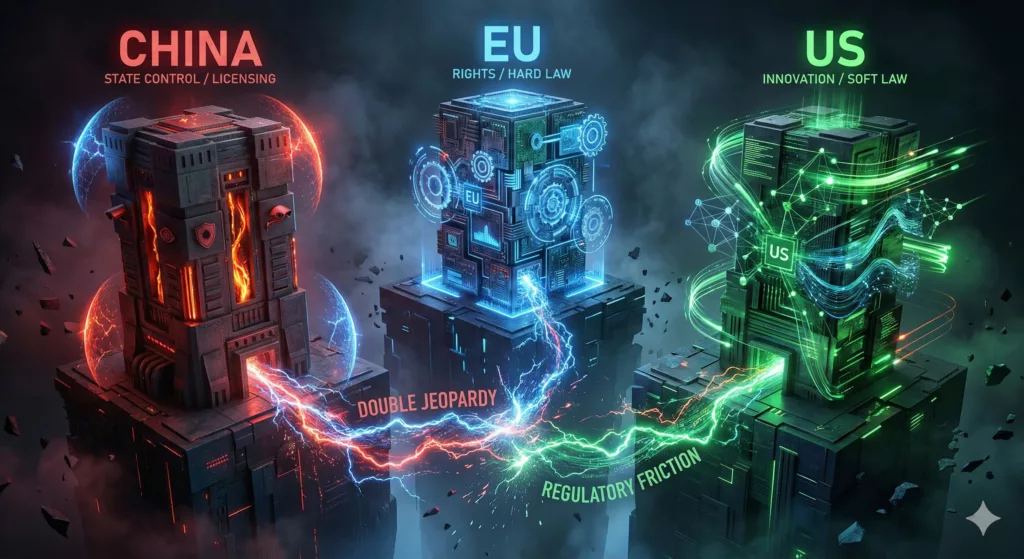
- The global AI landscape is split into a “Tri-Polar Order”: the EU (Rights/Hard Law), China (State Control/Licensing), and the US (Innovation/Soft Law).
- The US soft compliance model attracted $109 billion in 2025 private AI investment, nearly 13 times the $8 billion raised in the European Union.
- Multinational firms face a “double jeopardy” risk from cumulative fines and must build “Sovereign Cloud” architecture with separate regional technology stacks.
- The EU AI Act requires mandatory red teaming and transparency for systemic risk models over $10^{25}$ FLOPS, with fines potentially reaching 7% of global turnover.
How Did AI Regulation Evolve into a Geopolitical Split by 2026?
By 2026, the global AI landscape has shifted from voluntary ethics to hard enforcement. AI is no longer just a commercial tool. It is now a core part of national security and industrial strategy. This change happened as governments realized AI could influence public opinion, automate hacking, and disrupt jobs.
From Ethics to Enforcement
In the early 2020s, AI was governed by “soft law.” Companies followed voluntary guidelines. This changed in 2024 when Generative AI showed it could hallucinate, manipulate, and disrupt at scale. Today, we see a “Tri-Polar Order” of AI regulation:
- The Brussels Model (The Regulator): Europe focuses on preventing harm before it happens. They use strict risk levels and rights assessments. They view AI as a potential danger to citizens.
- The Beijing Model (The Controller): China focuses on “Sovereign Security.” AI is used for growth but must follow strict political rules. They view AI as a tool of state power.
- The Washington Model (The Innovator): The U.S. focuses on market dynamics and technological dominance. This model views early regulation as a threat to innovation. It prefers to handle problems after they happen through the courts.
The Death of the Universal Model
In 2026, there is no longer one “global” AI model. A single AI cannot satisfy China’s socialist values, Europe’s strict privacy laws, and the U.S. demand for unfiltered creativity all at once.
Companies are now “balkanizing” their technology. They build separate “stacks” for different regions:
- China-stacks: Built for local political alignment.
- EU-stacks: Built for compliance with the EU AI Act.
- US-stacks: Built for speed and innovation.
The U.S. Landscape in 2026: The New Federal Push
The U.S. has moved to stop a “patchwork” of different state laws. In late 2025, a new Executive Order (EO 14365) was signed to centralize AI policy.
Key U.S. Developments:
- The AI Litigation Task Force: Started in January 2026, this DOJ group challenges state laws that are deemed “onerous” or harmful to innovation.
- CAISI (Center for AI Standards and Innovation): Formerly the AI Safety Institute, this group now leads the push for “voluntary standards” that ensure U.S. dominance in the global market.
- The Funding Lever: The federal government is now withholding broadband funding (BEAD funds) from states that pass AI laws that conflict with national policy.
[Table: Regional AI Regulatory Comparison]
| Feature | European Union (AI Act) | United States (Innovator) | China (Sovereign) |
| Primary Goal | Protect fundamental rights | Maintain tech lead | Ensure state control |
| Philosophy | Precautionary (Ex-ante) | Market-driven (Ex-post) | State-aligned (Control) |
| Stance on Bias | Audits for high-risk tools | Prevents “woke” constraints | Must reflect core values |
| Compliance | Mandatory audits & labels | Voluntary NIST standards | Mandatory state filing |
How is the EU Actively Enforcing its “Compliance Superpower” Status in 2026?
As of January 2026, the European Union has transitioned from writing laws to active enforcement. The “Brussels Effect” is in full force. Global tech providers are currently re-architecting their systems to keep access to the European Single Market. However, the specific rules for AI have made global alignment difficult. Many firms are now building separate “EU-specific” versions of their models.
Enforcement Timeline: The Three Waves
The EU AI Act applies in stages. We are currently in the middle of the most critical implementation window.
- February 2025 (The Bans): The EU banned “unacceptable risk” systems. This stopped the use of social scoring, biometric categorization based on protected traits (like race or political views), and untargeted facial scraping. Many US security firms had to disable these features for EU clients.
- August 2025 (The GPAI Shift): Obligations for General Purpose AI (GPAI) became legally binding. Providers of models like GPT-4 and Claude must now publish summaries of their training data and follow strict copyright policies.
- August 2026 (The High-Risk Deadline): The industry is in a “compliance sprint” for this date. This covers “High-Risk” systems in areas like employment, education, and law enforcement. Organizations are racing to finish their quality management systems (QMS) before the cutoff.
Systemic Risk and Red Teaming (Article 55)
A major part of the 2026 landscape is the “Systemic Risk” classification. Any model using more than $10^{25}$ FLOPS is considered a systemic risk. This captures all major frontier models.
Under Article 55, these providers must perform “adversarial testing” (red teaming). In the EU, red teaming is a legal requirement, not just a suggestion.
- Goal: Use human experts and automated agents to force the AI to hallucinate or break safety rules.
- Outcome: Providers must document these “failure boundaries” and show the specific “model adaptations” (like fine-tuning) they used to fix them.
- Documentation: Technical dossiers must be submitted to the EU AI Office. This makes red teaming a continuous part of the software lifecycle.
The Transparency Trap (Article 53)
Article 53 has become a primary battlefield for copyright lawsuits. It mandates that all GPAI providers publish a “sufficiently detailed summary” of their training data.
Rightsholders are using these mandatory disclosures to sue AI labs. US labs used to treat their datasets as trade secrets. Now, they must disclose data provenance (where the data came from). To avoid legal risk, some providers are training “EU-stacks” on smaller, licensed datasets rather than the “scrape-all” models used in other regions.
Bias and Fairness Laws in 2026
The EU AI Act explicitly codifies protections against algorithmic bias for high-risk systems.
- Data Governance: Article 10 requires that training data be checked for biases.
- Biometric Bans: Using AI to deduce sensitive traits like ethnicity or sexual orientation is prohibited.
- The Bias Monitoring Exception: In a rare move, the EU allows providers to process sensitive personal data—a special exception to GDPR—if the only purpose is to detect and correct bias in the model. This shows how serious the EU is about fairness.
The Brussels Effect and Geo-fencing
The EU AI Act has “extraterritorial reach.” It applies to any company in the world if its AI’s output is used within the Union. For example, a bank in New York using an AI to screen loan applications for EU citizens must comply with the Act.
This has created a “compliance dragnet.” Multinational firms now face a choice: adopt the strict EU standards globally or use “geo-fencing” to block EU users from their most advanced, unaligned models. In 2026, geo-fencing is becoming a standard business strategy for US-based startups that cannot yet afford the high cost of EU compliance.
What Does China’s “Permission-Based” Sovereign Control Model Mean for Global AI?
While the US focuses on innovation and the EU focuses on rights, China’s 2026 AI framework is built on sovereignty and state control. China uses a “permission-based” model. You cannot launch a model without a government license. Every AI output must align with “Socialist Core Values.”
The Socialist Core Values Constraint
The most distinct part of China’s law is the requirement for ideological alignment. This is a legal hard constraint. It is not just a suggestion for safety.
The 2026 Enforcement Reality:
- Explicit Bans: AI cannot generate content that questions the state, harms the national image, or disrupts social stability.
- Historical Nihilism: Filters must block any content that challenges the official history of the Communist Party.
- Security Assessments: To get a license, a provider must pass a “Security Assessment.” Regulators test the AI with thousands of sensitive political prompts. If the AI gives a “wrong” answer on topics like Taiwan or national history, it fails.
- Strict Liability: Companies are legally responsible for what their AI says. A political hallucination can lead to a lost license or criminal charges.
The Algorithm Registration System
China uses a unique “Algorithm Registry” run by the Cyberspace Administration of China (CAC). Any AI with “public opinion properties” must register.
This is a state-facing tool for control. Companies must disclose how their algorithms work and what data they use. The government uses this registry to see exactly how information flows across platforms. In 2026, the CAC also uses this to fight “algorithm addiction” and price discrimination.
Foreign Investment and the “Negative List”
Investing in Chinese AI is difficult for Western firms. The “Negative List for Market Access” keeps key sectors restricted.
- Ownership Caps: Foreign ownership in “Value-Added Telecommunications Services” is usually capped at 50%.
- Licensing Barriers: A GenAI model that influences public opinion needs a specific license. These are almost never granted to companies owned by foreigners.
The 2026 “Hard Ban”
In 2026, a “Hard Ban” exists on both sides of the Pacific.
- In China: Western models like GPT-4 or Claude are blocked. They cannot pass the “Socialist Core Values” test without changing their core code. This creates a de facto ban on frontier US models.
- In the US: The 2026 National Defense Authorization Act (NDAA) bans “Covered AI” from government networks. This specifically targets Chinese models like DeepSeek and High Flyer, viewing them as tools for espionage.
Case Study: Proxy Partnerships (Apple Intelligence)
It is illegal to deploy a standard Western AI directly to Chinese consumers. To solve this, companies use “Proxy Partnerships.”
When Apple launched Apple Intelligence in China, it partnered with local firms like Alibaba and Baidu.
- The Process: When a user in China asks a question, the request stays in China. It is processed by a local model, such as Alibaba’s Qwen.
- The Result: The user sees an Apple-branded experience, but the “brain” of the AI is a government-approved Chinese engine. This ensures the AI follows all local censorship laws while keeping the data inside the country.
What Standards is the US Focusing on to Secure AI Agent Systems?
In 2026, the United States remains committed to a “Soft Compliance” model. This strategy prioritizes speed, market leadership, and national security. Unlike the EU’s strict laws or China’s total state control, the U.S. relies on voluntary frameworks and industry-led standards.
The NIST AI Risk Management Framework (AI RMF)
The NIST AI RMF is the foundation of U.S. policy. It is a voluntary guide that helps companies identify and manage AI risks. It uses a four-step process: Govern, Map, Measure, and Manage.
Adoption Trends:
- Major Tech and Contractors: Adoption is high among large firms like Microsoft and AWS. These companies use the NIST framework to show they are responsible. This helps them win government contracts and provides a legal shield in case of lawsuits.
- The “Long Tail” Problem: Small startups often ignore the framework. Without the threat of government fines, many young companies view compliance as an unnecessary cost.
- The State Patchwork: Because there is no binding federal law, individual states have stepped in. California and Colorado have passed their own safety and transparency laws. This has created a complex “patchwork” of rules that companies must follow to do business across state lines.
The Center for AI Standards and Innovation (CAISI)
The Center for AI Standards and Innovation (CAISI) is the U.S. version of the EU AI Office. However, it does not have the power to fine anyone. Instead, it focuses on research and voluntary agreements.
In early 2026, CAISI is focused on AI Agent Systems. Since agents can take autonomous actions in the real world, CAISI is setting the standards for how to secure them. While these standards are voluntary, they are becoming the “standard of care” in U.S. courts. If a company ignores CAISI guidelines and their AI causes harm, a judge is more likely to find them negligent.
The Innovation Gap: U.S. vs. Europe
The difference in regulation has led to a massive gap in investment and growth.
- The U.S. Advantage: The “Soft Compliance” model has attracted the most capital. In 2025, U.S. private AI investment reached $109 billion. This is nearly 13 times the amount invested in the EU ($8 billion). Investors prefer the U.S. because it allows for rapid experimentation.
- The EU Struggle: In Europe, the cost of following the AI Act is high. European VCs report that startups are spending their early funding on legal fees instead of hiring talent or buying compute power.
- The “Right to Fail”: A 2025 MIT study found that 95% of AI projects fail to deliver a return. The U.S. model accepts this high failure rate as a natural part of innovation. Critics of the EU model argue that strict pre-market rules make it too expensive for companies to try new things and fail, which slows down the next big breakthrough.
[Table: U.S. vs. EU Economic Impact (2025/2026)]
| Metric | United States | European Union |
| Private AI Investment | $109 Billion | $8 Billion |
| Model Development | Leads in “Frontier” models | Leads in “Aligned” models |
| Regulatory Cost | Low (Internal governance) | High (Mandatory audits) |
| Market Ethos | Move Fast and Break Things | Precautionary Principle |
What is the “Double Jeopardy” Risk and Can You Be Fined By Both the EU and China?
Multinational AI firms face a unique threat in 2026. This is the risk of “Double Jeopardy.” It means you can be investigated and fined by both Europe and China for the same single incident.
The Limit of Legal Protection
There is a legal rule called ne bis in idem. It means “not twice for the same thing.” It usually protects people from being tried twice for one crime. However, this only works within one country or region. No international treaty stops the EU and China from both punishing your company for the same data breach or AI failure.
Scenario: A Medical AI Failure Imagine a medical AI hallucinates and gives harmful advice to patients in both Germany and China.
- EU Action: Regulators investigate under the AI Act and GDPR. Fines can reach 7% of your global turnover.
- China Action: The government investigates for “social stability” threats. This can lead to license suspension and criminal charges for your local managers.
- The Result: You face “stacked liability.” These fines are cumulative. One does not offset the other.
Data Sovereignty: The Great Divide
Data sovereignty is the foundation of the 2026 AI split. Governments are now “ring-fencing” their data to keep it within their borders.
China’s Data Lockdown China’s PIPL and Data Security laws force companies to store data locally.
- Localization: If your AI handles “Important Data,” it must stay on Chinese servers.
- Export Restrictions: The government almost never allows sensitive AI data to leave the country. This forces companies to build “China-only” data lakes. If a self-driving car learns from Chinese road data, those updates cannot easily be sent back to the U.S. to improve your global model.
The EU Compliance Hook The EU allows data to flow to “adequate” countries. However, the AI Act adds a new complication. If you use a European dataset to train a model in the U.S., you must still follow EU copyright and transparency rules when you deploy that model back in Europe. You cannot escape EU law by moving your training servers to a different country.
What is the Core Difference Between the EU’s and China’s Object of Protection?
In 2026, the world is split into three different AI zones. Each zone has a different goal and a different set of rules. For a global company, this means you cannot use a single AI strategy. You must adapt to each region.
Comparison of AI Regimes (2026)
| Feature | European Union | China | United States |
| Main Goal | Rights and Safety | State Security | Innovation |
| Model | Hard Law (Risk-based) | Hard Law (Licensing) | Soft Law (Voluntary) |
| Control | Mandatory Audits | Algorithm Filing | NIST Framework |
| Reach | High (Market access) | High (Data laws) | Low (Export focus) |
| Content | Transparency | Socialist Values | Free Speech |
| Fines (Max) | 7% Global Turnover | License Revocation | Civil Liability |
Key Differences: EU vs. China
The biggest difference between Europe and China is what they protect.
The Object of Protection
- The EU: Protects the individual. The laws focus on privacy and fairness. If an AI scans resumes, the EU calls it “High Risk” because it might discriminate against a person.
- The China: Protects the state. The laws focus on social stability. If an AI recommends news, China calls it “High Risk” because it might influence public opinion against the government.
Registration vs. Transparency
- In Europe: Transparency is for the people. AI systems must use watermarks or public labels so citizens know they are talking to a machine.
- In China: Transparency is for the state. Companies must put their code and data into a government “Algorithm Registry.” This allows the state to see how the AI moves information.
The Future: The “Sovereign Cloud”
By late 2026, the only way to run a global AI business is to use “Sovereign Cloud” architecture. You must build three separate “stacks” of technology that do not touch each other.
- The EU Cloud: This stack is hosted in cities like Frankfurt or Paris. it follows all GDPR and AI Act rules. It uses models trained on European values and filtered for copyright.
- The China Cloud: This stack is hosted in Shanghai or Guizhou. It follows Chinese censorship laws. It uses local models like Alibaba or Baidu. It is completely “air-gapped” from your global network so no data can leak out.
- The Global/US Cloud: This stack is hosted in the U.S. or the Asia-Pacific region. It runs the most powerful “frontier” models. It uses soft safety rules and focuses on maximum performance and creativity.
Conclusion:
In 2026, navigating international regulations is a core business challenge. The “Great Divergence” means your software must adapt to different legal standards across the globe. You must satisfy EU AI Act conformity assessments while avoiding restricted sectors on China’s Negative List. Compliance is no longer a back-office task; it is the foundation of your product roadmap. A successful MVP must be built with these global rules in mind from the very first day.
Vinova develops MVPs for tech-driven businesses. We help you build products that meet strict international standards, including ISO 9001 quality management. Our team handles the technical complexity of cross-border data rules and security audits. We help you launch a compliant product so you can focus on global growth.
Contact Vinova today to start your MVP development. Let us help you build a product that succeeds across every market.
Frequently Asked Questions (FAQs)
1. What are the main differences between China’s AI laws and the EU AI Act?
The core difference lies in the object of protection:
- The European Union (EU AI Act): Protects the individual. Laws focus on privacy, fairness, and fundamental rights (e.g., calling AI for resume screening “High Risk” due to potential discrimination).
- China (Sovereign Control Model): Protects the state. Laws focus on national security and social stability. AI content must align with “Socialist Core Values,” and systems are considered “High Risk” if they could influence public opinion against the government.
Additionally, the EU uses Transparency for citizens (e.g., watermarks) while China uses the Algorithm Registry for state control over how information flows.
2. Is it legal to deploy Western AI models in China in 2026?
It is generally illegal to deploy a standard Western AI directly to Chinese consumers in 2026. Models like GPT-4 or Claude are “blocked” because they cannot pass the required “Security Assessment” that verifies alignment with “Socialist Core Values.”
To operate, companies use Proxy Partnerships (e.g., Apple partnering with Alibaba or Baidu) where the user’s request is processed by a local, government-approved Chinese AI engine to ensure compliance and data localization.
3. What is the “Hard Ban” in China’s 2026 AI governance?
The “Hard Ban” refers to the de facto block on Western models in China. These models are restricted because their core code and training cannot satisfy the legal hard constraint of aligning with “Socialist Core Values.”
The term also refers to the reciprocal restriction in the US, where the 2026 National Defense Authorization Act (NDAA) bans “Covered AI” (specifically Chinese models) from government networks.
4. How does “Soft Compliance” affect AI innovation in the US?
The US “Soft Compliance” model—which relies on voluntary frameworks like the NIST AI Risk Management Framework—prioritizes speed and market dominance over pre-market regulation.
This approach has led to an “Innovation Gap” by:
- Attracting Capital: Drawing significantly more investment, with $109 billion in private AI investment in 2025, nearly 13 times the amount raised in the EU.
- Encouraging Risk: Creating a culture of “Move Fast and Break Things” and accepting the “Right to Fail,” which allows for rapid experimentation and faster development of “Frontier” models.
5. Can a company be fined in both the EU and China for the same AI model?
Yes, this is known as the “Double Jeopardy” risk. Since there is no international treaty to prevent it (ne bis in idem does not apply globally), a company can face simultaneous investigations and fines from both the EU (under the AI Act/GDPR) and China (for “social stability” threats) for the same incident. These fines are cumulative and do not offset each other, resulting in “stacked liability.”