CRM implementation in 2026 is no longer a software deployment exercise. Modern platforms embed autonomous AI agents that monitor customer interactions, execute multi-step sales workflows, and update records in real time without human input. When CRM software implementation is done correctly, the result is a unified customer intelligence hub that aligns sales, marketing, customer success, and finance into a single source of truth. When it’s done incorrectly (dirty legacy data, brittle point-to-point integrations, no adoption plan), the same AI agents generate process anomalies, send incorrect communications, and compound bad data at scale.
This guide covers the full CRM implementation services lifecycle: what to prepare before you start, how to select the right platform, how to execute CRM integration services that actually hold up, and what Vinova delivers across every phase.
Table of Contents
Key takeaways
- Modern CRM implementation requires agentic architectures and clean data loops to prevent AI hallucinations, ensuring platforms act as unified intelligence hubs rather than reactive, traditional systems.
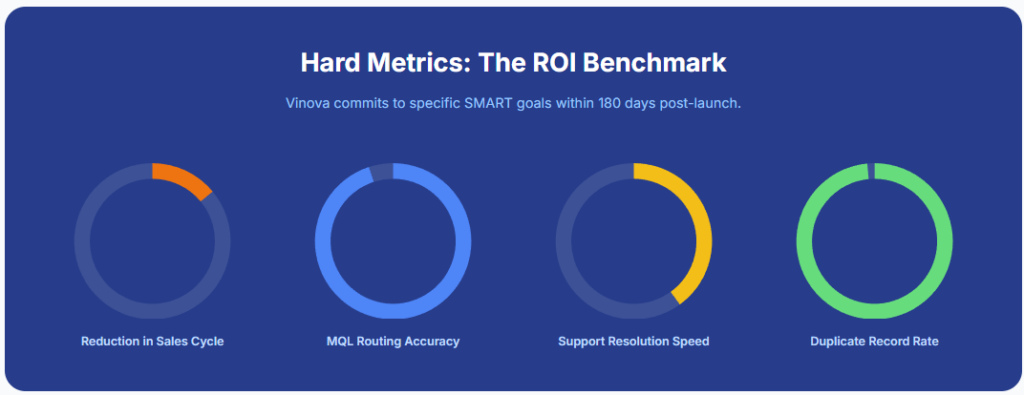
- Success mandates four organisational pillars to achieve key ROI benchmarks, including a 14% reduction in sales cycle duration and a 40% reduction in Tier-1 support resolution time.
- Implement decoupled middleware to eliminate brittle point-to-point connections while enforcing strict PDPA and MAS TRM compliance through field-level sensitivity tiering and robust zero-trust access controls.
- Enterprise implementations cost between 50,000 and 200,000+ SGD, requiring a dedicated 15% post-launch budget for hypercare support and continuous optimisation to ensure long-term organisational adoption.
What CRM Implementation Actually Entails in 2026
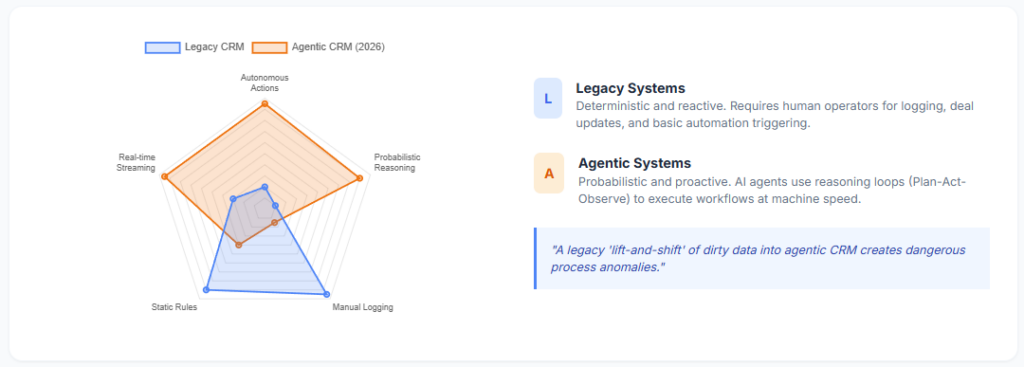
A CRM platform today is the central engine of go-to-market execution, responsible for aligning sales, marketing, customer success, and finance into a single, real-time view of every customer relationship. The shift from traditional rule-based systems to agentic architectures has fundamentally changed what CRM implementation requires.
Traditional CRM systems were reactive and deterministic: human operators manually logged calls, updated deal stages, and triggered static automation rules (send an email when a lead status changes to qualified). The system waited for human input before doing anything.
An agentic CRM operates probabilistically and proactively. Autonomous AI agents embedded in the data layer monitor multi-channel interactions, reason through complex customer journeys, determine the next logical action, and execute it without waiting for a rep to update a record. This fundamentally changes what CRM software implementation requires: clean data loops, robust API orchestrations, and carefully designed human-AI collaboration workflows. A legacy lift-and-shift data migration into an agentic CRM doesn’t just produce a poor outcome. It produces a dangerous one, because AI agents consuming dirty data will hallucinate, send incorrect communications, and execute flawed workflows at machine speed.
Before CRM Implementation Begins: Four Organisational Prerequisites
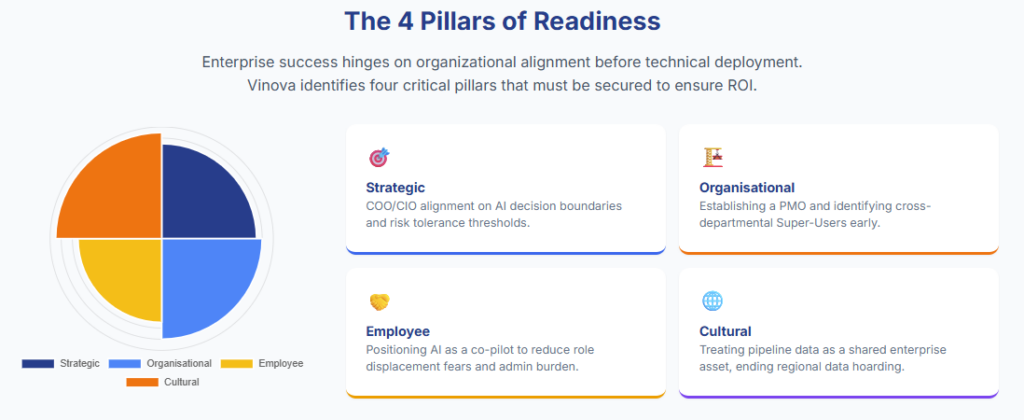
Enterprise CRM implementation projects succeed or fail based on organisational readiness, not technical capability. Vinova mandates alignment across four pillars before a single configuration is touched.
| Pillar | What Must Be Done Before Go-Live | What Fails Without It |
| Strategic | COO, CIO, and VP of Sales communicate a unified CRM vision; define boundaries for autonomous AI decision-making; set risk tolerance thresholds for agent-driven actions | Implementation drifts without clear scope; AI agents execute outside intended parameters; ROI benchmarks are never set |
| Organisational | Dedicated Project Management Office (PMO) established; Super-Users identified from every affected department (sales, marketing, CS, RevOps) | No single accountability owner for delivery; configuration decisions made by IT without business input; adoption gaps emerge at launch |
| Employee | Training positions the CRM as a co-pilot that automates admin tasks; addresses user fears around surveillance and role displacement | Users bypass the platform and manage deals in spreadsheets; adoption data is corrupted from day one |
| Cultural | Data-sharing policies established; pipeline data and account histories treated as shared enterprise assets, not team-level property | Regional data hoarding persists; CRM contact records become fragmented and inconsistent; AI agents work from incomplete data |
The cultural pillar is the most frequently underestimated. Legacy corporate structures foster data hoarding, where individual regional sales teams treat customer relationships as proprietary property. A modern crm setup demands that pipeline data, account histories, and customer interactions are treated as shared enterprise assets governed by explicit data-entry accountability policies. Without this shift, the CRM becomes a compliance checkbox while actual deal management happens in local Excel files.
CRM Platform Selection: What Vinova Recommends in 2026
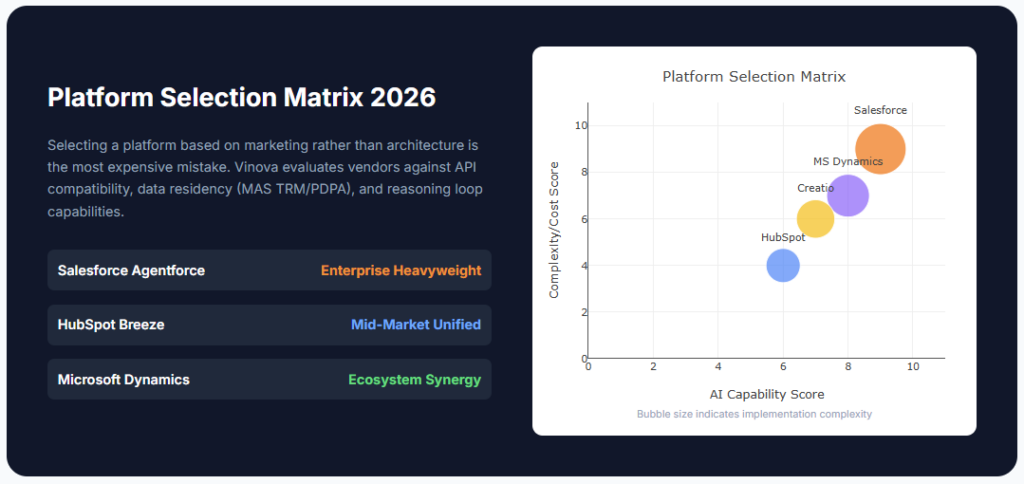
Choosing the wrong CRM platform is the most expensive crm implementation mistake because it’s the hardest to reverse. Platform selection must match business requirements against technical capabilities, existing integration infrastructure, and total cost of ownership, not vendor marketing.
| Platform | Best For | AI and Agent Capability | Complexity and Cost |
| Salesforce Agentforce | Large enterprises with complex, multi-cloud operations and high customisation requirements | Atlas Reasoning Engine (Plan-Act-Observe-Decide loops); native Salesforce Data Cloud for real-time streaming | High. Typically 6 to 12 months to implement; consumption-based per-conversation or per-action licensing |
| HubSpot Breeze | SMEs and mid-market organisations needing rapid deployment and unified marketing-sales-service alignment | Out-of-box agents (Customer, Prospecting, Data, Company Research); Agentic Engagement Object for real-time sales actions | Medium. User-friendly; faster deployment; outcome-based pricing; less customisable than Salesforce at enterprise scale |
| Creatio | Organisations needing custom industry-specific workflows without heavy developer dependency | No-code multi-agent workflow builder; drag-and-drop visual designer for autonomous process automation | Medium. Flexible; lower dev overhead; strong for custom schema design without engineering teams |
| Microsoft Dynamics 365 | Enterprises already on Microsoft ecosystem (Azure, Teams, SharePoint, Power BI) | Copilot embedded across sales, service, and finance modules; deep Power Automate integration | Medium-High. Licensing scales with modules; strong for existing Microsoft infrastructure; complex permissions model |
Vinova’s platform recommendation process begins with a formal system selection matrix produced during Phase 2 of the CRM implementation services lifecycle. We require shortlisted vendors to demonstrate API compatibility with your existing ERP, billing, and identity management systems before any licensing decision is made. For Singapore-based clients in financial services, we additionally verify platform alignment with MAS TRM guidelines and PDPA data residency requirements.
The 9-Phase CRM Implementation Lifecycle: How Vinova Delivers
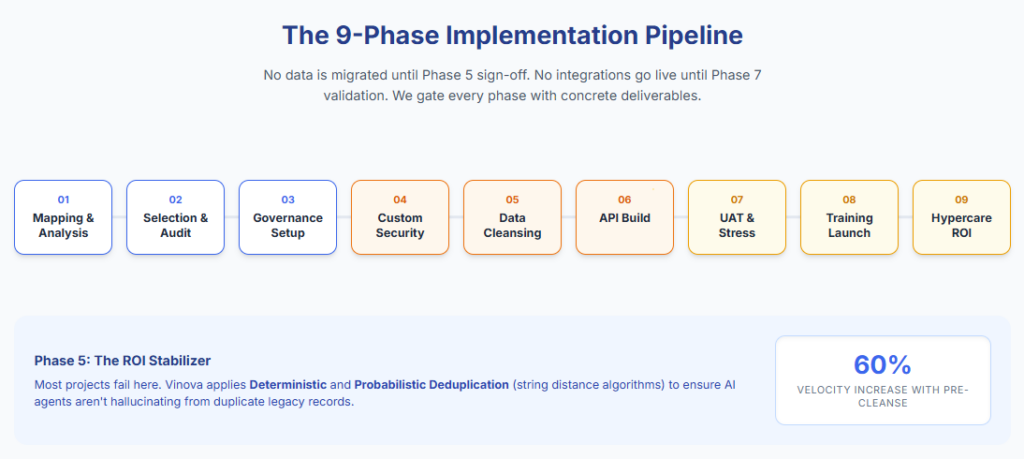
Vinova structures every CRM implementation engagement across nine sequential phases, each gated by a concrete deliverable before the next begins. No data is migrated until Phase 5 is signed off. No integrations go live until Phase 7 UAT is complete.
| # | Phase | What Happens | Vinova Deliverable |
| 1 | Requirements mapping and process analysis | Analysts map every customer-facing process using event-storming; trace data lineages to identify manual entry points, system mismatches, and integration dependencies | Functional Requirements Document (FRD); unified data lineage registry; documented process maps |
| 2 | Platform selection and vendor architecture audit | Technical review of shortlisted vendors: API structures, sandbox capabilities, data residency configurations, and agentic execution model compatibility | System selection matrix; security architecture report; completed software licence contracts |
| 3 | Project planning and governance | PMO established; RACI matrix defined; project schedule built with 25% minimum buffer on baseline estimates; risk escalation matrix activated | Gantt chart; project charter; RACI matrix; risk register with scored escalation tiers |
| 4 | System customisation and security layering | Custom objects, relationship fields, page layouts, and validation rules configured; RBAC access controls restrict sensitive records by job function; MFA and PII masking applied | Sandbox configuration; customised data schemas; documented RBAC permission sets |
| 5 | Pre-migration data audit and cleansing | Legacy records profiled; duplicates identified via deterministic (exact email/tax ID match) and probabilistic (string distance) deduplication; phone numbers normalised to E.164; data classified into sensitivity tiers | Approved data mapping dictionary; pre-migration cleansing script; data sensitivity classification manifest |
| 6 | CRM integration services and API pipeline build | Decoupled iPaaS or ESB middleware deployed; thin API wrappers built around legacy ERP systems; asynchronous queuing and circuit-breakers configured; error logging dashboards activated | Active API endpoints; data synchronisation pipelines; system integration test logs |
| 7 | UAT and cross-department validation | Super-Users execute core operational processes in sandbox environments; automated workflow and AI agent testing; stress scenarios run including corrupt API payloads and frustrated user state simulations | UAT logs; system bug tracking register; verified test pass reports; departmental sign-offs |
| 8 | Training, documentation, and launch | Role-specific training delivered to sales, marketing, CS, and RevOps; legacy system write permissions decommissioned; production data integrity verified; go-live sign-off executed | System documentation repository; trained user base; cutover validation checklist; go-live sign-off |
| 9 | Post-launch hypercare and continuous optimisation | Dedicated hypercare desk activated; weekly database audits for duplicates and data exceptions; AI prompt structures refined based on real-world usage; 90-day ROI evaluation completed | Hypercare ticketing logs; monthly optimisation backlog; 90-day post-launch ROI report |
Phase 5 pre-migration data cleansing deserves specific attention for COOs and Sales Directors. Most crm implementation projects underestimate the state of their legacy data. Vinova audits legacy databases using profiling scripts to identify duplicate records, missing fields, and formatting inconsistencies. We apply deterministic deduplication (exact email, tax ID, or composite key matches) and probabilistic deduplication (string distance algorithms that catch variations like “Acme Corp” vs “Acme Corporation”) before any record enters the new system. In our modernisation project for the Singapore Safety Driving Centre (SSDC), Vinova migrated highly sensitive customer counter systems and legacy Windows Server infrastructure to a modern unified web platform with zero-downtime cutover, achieved by completing a full data normalisation cycle before the migration pipeline was executed.
CRM Integration Services: Connecting Your CRM to the Enterprise Stack
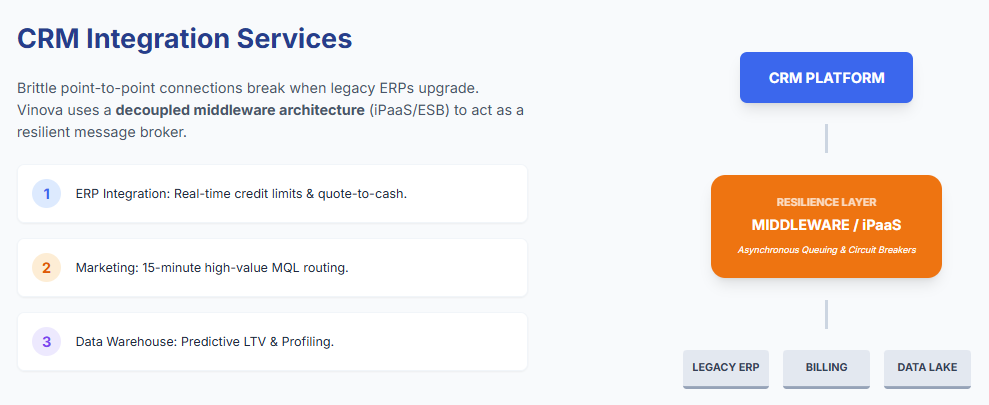
The most technically demanding phase of any CRM implementation is building the integration layer. Point-to-point connections, where the CRM queries other systems’ databases directly, are brittle: when a legacy ERP upgrades its schema, every direct connection breaks simultaneously. Vinova’s CRM integration services use a decoupled middleware architecture: an iPaaS or enterprise service bus (ESB) acts as a centralised message broker between the CRM and all connected enterprise systems, handling data transformation, schema mapping, and message queuing independently of either system.
| Integration Type | What It Connects | Why It Matters for CRM |
| ERP integration | Synchronises accounts, customer codes, payment terms, and quote-to-cash pipeline between CRM and ERP (SAP, Oracle, NetSuite) | Sales reps see real-time account credit limits and invoice status without switching systems; closed-won opportunities trigger automatic ERP order creation |
| Billing and finance systems | Pulls real-time invoice records, outstanding balances, credit limits, and active subscriptions | Customer service agents can resolve billing disputes without escalating to finance; revenue leakage from unapplied credits is caught automatically |
| Marketing automation | Passes behavioural intent scores, web activity logs, event participation data, and campaign interaction histories from platforms like Marketo, HubSpot, or Pardot | Sales reps contact leads at peak intent moments; AI prospecting agents route high-value MQLs to the correct account executive within 15 minutes of form submission |
| Enterprise data warehouse | Supplies consolidated historical transactional data, powering predictive lifetime value (LTV) calculations and deep customer profiling | AI agents make probabilistic deal progression decisions based on full customer history, not just current pipeline stage |
| Legacy ERP wrapping | Thin REST API wrapper built around legacy databases that lack native API capability, packaging ERP schemas into standard JSON payloads | Prevents brittle point-to-point connections; when the legacy ERP upgrades its schema, the wrapper absorbs the change without breaking the CRM integration |
Vinova CRM Integration Case Study: Navig8 Connect
When Navig8 Asia needed a custom Marine Shipping ERP that integrated vessel tracking, billing pipelines, real-time voyage monitoring, and 20+ separate operational modules, point-to-point hardcoding was never an option. Vinova architected Navig8 Connect using a scalable API-first decoupled middleware layer, integrating all modules into a unified data pipeline with no direct inter-system database connections. The result: 60% increase in system development velocity, zero integration failures during subsequent ERP upgrade cycles, and a fully maintained platform that continues to serve Navig8’s global shipping operations.
Vinova’s CRM integration build standard includes asynchronous queuing and circuit-breaker logic. When a downstream system goes offline during a scheduled maintenance window, the middleware holds transactions in queue and automatically retransmits them when the target system recovers, preserving data consistency without manual intervention.
PDPA and MAS TRM Compliance in CRM Implementation
For Singapore-based businesses, CRM software implementation that handles personal data triggers PDPA obligations from the moment data extraction begins. The Transfer Limitation Obligation (Section 26) governs any personal data accessed by offshore development teams. MAS TRM guidelines govern vendor risk management for financial sector clients.
Vinova’s standard compliance framework across all CRM implementation engagements:
- Data Protection Impact Assessment (DPIA) completed before any personal data is moved; formal data flow mapping across all source and target systems
- Data classified into sensitivity tiers at field level: Tier-1 PII (NRIC, passport, credit card) receives AES-256 encryption at rest and strict row-level RBAC; Tier-4 public company profiles receive standard access controls
- NRIC numbers replaced with secure tokenised system identifiers at the point of data ingestion, consistent with PDPC’s tightened NRIC Advisory Guidelines; physical NRIC numbers never stored in unencrypted CRM free-text fields
- Zero-Trust RBAC enforced throughout the migration window; engineers access only the data required for their specific role in the pipeline
- AES-256 encryption at rest and TLS 1.3 encryption in transit across all integration and staging layers; legacy API keys audited and decommissioned before go-live
- Storage limitation policies configured directly in the CRM: inactive records automatically purged after defined retention periods; verified deletion workflows handle PDPA Right of Erasure requests
- For MAS-regulated clients: SOC 2 Type II documentation provided; vendor risk grading documented; audit rights contractually preserved
Vinova’s compliance-native approach to CRM implementation services was validated through our multi-year Whole-of-Government (WOG) GRC platform development for GovTech Singapore, where we designed automated control check pipelines that shift compliance verification left into the build process rather than treating it as a post-launch audit.
Driving CRM Adoption: From Launch to Long-Term Use
The measure of a successful CRM implementation is not technical completion. It is organisational adoption. If end-users bypass the platform and manage opportunities in spreadsheets, the investment is lost regardless of how well the system was configured.
System standardisation before training
Embed mandatory validation rules that prevent incomplete records from advancing in the pipeline (a deal cannot progress to proposal without a linked contact, confirmed budget, and defined decision-making team). Restrict layouts to role-relevant fields only, removing configuration complexity that has nothing to do with a rep’s daily workflow. Establish explicit policies prohibiting sensitive identifiers in free-text comment fields.
Role-based training, not platform-wide orientation
Sales Representative track: pipeline management, calendar integrations, and sales cadence automations. Show reps how autonomous prospecting agents handle initial account research and email logging. Sales Management and RevOps track: forecasting dashboards, pipeline velocity, and deal progression metrics. Customer Support track: case management, escalation queues, and real-time support histories. Data Steward track: audit logs, deduplication dashboards, and consent tracking. Vinova draws on user-centric design experience from mobile deployments for Abbott Labs and gamification systems for Singapore Institute of Technology (SIT) to deliver training that compresses onboarding cycles and eliminates the post-launch friction that causes CRM abandonment.
Hypercare and decommissioning legacy systems
The first 30 days post-launch are the most critical. Vinova deploys a dedicated hypercare support desk with committed technical leads and Business Analysts resolving system issues in real time. Daily standups with department heads and Super-Users address operational bottlenecks before they become adoption blockers. Legacy system write permissions are decommissioned at go-live, preventing users from reverting to old habits. A 90-day CRM implementation ROI evaluation report benchmarks actual performance against the SMART goals defined in Phase 1.
| Ready to Start Your CRM Implementation? Book a complimentary 2-hour consultation with Vinova’s CRM implementation team. We’ll assess your current systems, define your integration requirements, and map a delivery plan to your timeline and budget. No commitment required. Schedule Your Free 2-Hour CRM Implementation Consultation with Vinova |
Five CRM Implementation Mistakes That Kill ROI
| Mistake | How It Plays Out | The Fix |
| No SMART goals defined before go-live | Scope creeps; timelines drift; ROI can’t be calculated because no baseline was set | Lock 5 to 7 KPIs in current-state before selecting a platform. Baseline metrics approved by Finance, Operations, and Sales before any schema design begins |
| Platform selected on marketing, not architecture | Integration complexity only discovered post-contract; licensing costs escalate; implementation takes twice as long as projected | Run a formal system selection matrix. Require vendors to prove API compatibility with your existing ERP, billing, and identity management systems |
| Skipping pre-migration data cleansing | Duplicate, incomplete, and inconsistent legacy records loaded into the new system; AI agents send incorrect communications and execute flawed automated workflows | Mandatory data profiling and normalisation phase before any extraction begins. Deterministic and probabilistic deduplication; E.164 phone normalisation; sensitivity tiering |
| End-user friction ignored | Users bypass the CRM and manage deals in spreadsheets; adoption data is corrupted from launch day | Embed Super-Users in UAT from Phase 1. Role-based training positioned around AI co-pilot benefits. Decommission legacy system write permissions at go-live |
| No post-launch budget allocated | Platform becomes rigid; evolving business needs aren’t addressed; adoption declines 6 months post-launch | Allocate minimum 15% of total implementation budget for post-launch optimisation, hypercare, and continuous development |
In-House vs. Partner: Which CRM Implementation Model Fits?
The delivery model decision determines whether your CRM implementation runs on time, within budget, and actually gets used. Internal IT teams have deep institutional knowledge but typically lack specialist experience in advanced CRM integration services, multi-jurisdictional compliance, and agentic AI orchestration. This skills gap is the primary driver of timeline slippage and post-launch fragility in self-delivered implementations.
| Parameter | In-House IT Delivery | Vinova Hybrid Delivery Model |
| Technical depth | Strong on internal business context; typically limited in advanced API frameworks, agentic reasoning engine configuration, and multi-jurisdictional compliance | Multi-platform expertise across Salesforce, HubSpot, Microsoft Dynamics; custom Java, Python, .NET, and Ruby backends; ISO 27001 and MAS TRM certified delivery |
| Timeline | Slower; implementation team members balance project delivery with day-to-day IT support and operational maintenance | Dedicated development squads deploy proven crm implementation frameworks; up to 60% acceleration in delivery velocity |
| Security and compliance | Moderate-to-high risk; internal teams often lack specialist experience with PDPA, MAS TRM, GDPR, and multi-jurisdictional compliance audits | Strictly minimised; Vinova operates as a sovereign-grade partner under ISO 27001:2022, ISO 9001:2015, MAS TRM, and PDPA compliance protocols |
| Internal opportunity cost | High; core developers redirected from business-critical product work and operational support to implementation delivery | Negligible; internal IT remains focused on core operations while Vinova manages design through delivery |
| Post-launch support | Limited; internal resources are quickly pulled back to IT support queues as post-launch energy dissipates | Structured hypercare desk; customised SLAs; dedicated long-term development retainer available for continuous optimisation |
| Cost structure | High fixed cost: full-time salaries, benefits, CPF (Singapore), and opportunity cost of redeployment | 40 to 60% below equivalent Singapore-only agency rates; fixed-price discovery phase with dedicated team sprints for execution |
Vinova’s hybrid delivery model pairs local Singapore-based strategic management (requirements gathering, stakeholder alignment, compliance governance) with scaled engineering execution across Hanoi, Da Nang, and Ho Chi Minh City. Clients get local accountability under Singapore’s regulatory framework and offshore engineering economics. For crm setup projects, this structure delivers a fixed-price scoping phase before any execution budget is committed, dedicated sprint teams for integration and migration execution, and post-launch hypercare with structured SLAs.
FAQ: CRM Implementation for Singapore Businesses
How long does a CRM implementation take?
Timeline depends primarily on data complexity, number of integrations, and customisation requirements. As a baseline: a focused crm setup for a mid-market SME (single platform, standard integrations, clean data) runs 3 to 5 months. A full enterprise CRM implementation with custom objects, ERP integration, AI agent configuration, and compliance requirements runs 6 to 12 months. Vinova builds 25% minimum buffers into all baseline estimates and structures payments around working deliverables, not calendar milestones.
What does CRM implementation cost in Singapore?
Vinova structures CRM implementation services in two phases. A fixed-price scoping and discovery phase (requirements mapping, platform selection, compliance scoping, data audit) typically runs SGD 15,000 to SGD 40,000. Full implementation execution (customisation, CRM integration services, data migration, UAT, training, launch, and hypercare) ranges from SGD 50,000 for simpler SME deployments to SGD 200,000+ for enterprise-scale implementations with complex ERP integrations and compliance requirements. As a Singapore-headquartered company with Vietnam delivery, Vinova operates at 40 to 60% below equivalent Singapore-only agency rates.
How does CRM integration work with a legacy ERP?
Vinova’s CRM integration services for legacy ERP connectivity use a three-layer decoupled architecture: a thin REST API wrapper built around the legacy system’s database (packaging ERP schemas into standard JSON without modifying the source system), a middleware iPaaS or ESB layer handling data transformation and message queuing between CRM and ERP, and asynchronous queuing logic that holds transactions during ERP maintenance windows and retransmits them automatically on recovery. This eliminates brittle point-to-point connections that break every time the ERP upgrades its schema.
How do we stay PDPA-compliant during CRM software implementation?
Before any personal data moves, Vinova completes a DPIA and formal data flow map. All customer fields are classified into sensitivity tiers. NRIC numbers are replaced with tokenised identifiers at ingestion. Zero-Trust RBAC restricts data access to authorised engineers only. AES-256 encryption and TLS 1.3 are enforced across all layers. Storage limitation policies are configured into the CRM itself, automating record purging and erasure requests. For MAS-regulated clients, Vinova additionally provides SOC 2 Type II documentation and contractually preserves audit rights.
What is the difference between CRM implementation services and CRM integration services?
CRM implementation services cover the full deployment lifecycle: platform selection, configuration, customisation, data migration, user training, and go-live. CRM integration services cover the specific technical work of connecting the CRM to other enterprise systems: ERP, billing platforms, marketing automation stacks, and data warehouses. Integration is a phase within the broader implementation lifecycle (Phase 6 in Vinova’s 9-phase model) but is often engaged separately when an organisation already has a deployed CRM and needs to connect it to a new or upgraded enterprise system.
What ROI can we expect from a CRM implementation?
Vinova measures CRM implementation ROI across four specific metrics agreed at the start of every engagement: sales pipeline efficiency (target: 14% reduction in average sales cycle duration within 180 days), lead velocity (target: 95% of high-value MQLs routed to the correct account executive within 15 minutes of form submission), service resolution (target: 40% reduction in Tier-1 support case resolution time within 90 days), and data integrity (target: duplicate contact record rate below 1.5% sustained by real-time validation APIs). These are baselines. Actual outcomes vary by organisation, but SMART goal definition before go-live is the mechanism that makes ROI trackable.
| Vinova: Singapore-headquartered CRM implementation services. ISO 27001:2022 and ISO 9001:2015 certified. MAS TRM and PDPA-aligned delivery.300+ engineers across Singapore, Hanoi, Da Nang, and Ho Chi Minh City. Trusted by Samsung, OCBC Bank, AIA, SP Group, GovTech, Abbott Labs, and PwC.Recognised by The Straits Times as one of Singapore’s Fastest-Growing Companies 2024, 2025, and 2026. Schedule a 2-hour consultation: |