Choosing among Singapore’s edutech companies in 2026 requires more than comparing content libraries and pricing tiers. Enterprise procurement in Singapore’s learning technology market is shaped by government subsidy architecture, strict PDPA compliance obligations, and technical integration requirements that most global platforms don’t satisfy out of the box. The SWDA merger on July 1, 2026, the SFEC expiry on November 30, and the launch of the Enterprise Workforce Transformation Package on December 1 are all creating urgent decision windows for School Boards, University CIOs, and Enterprise Training Directors.
This guide covers the Singapore market structure, how to evaluate best edutech partners against local compliance and integration benchmarks, how to maximise government grant funding, and what Vinova delivers as Singapore’s leading expert edutech implementation partner.
Table of Contents
Key takeaways
- Singapore’s EdTech market reaches a projected US$2.2 billion by 2027, driven by over SGD 2 billion in annual public funding and the new Skills and Workforce Development Agency.
- EdTech companies must navigate strict regulatory requirements, including PDPA data residency, LTI v1.3 interoperability, and IMDA’s January 2026 AI governance framework, to secure public sector procurement.
- Enterprises can reduce training costs significantly by stacking subsidies like PSG and SFEC, with some scenarios creating a net surplus position through absentee payroll recovery.
- All remaining SkillsFuture Enterprise Credit balances will be forfeited on November 30, 2026, before the redesigned Enterprise Workforce Transformation Package launches on December 1, 2026.
Singapore’s EduTech Market in 2026: The SWDA Restructuring
On July 1, 2026, the Singapore government merged SkillsFuture Singapore (SSG) and Workforce Singapore (WSG) into a single statutory board: the Skills and Workforce Development Agency (SWDA). Co-overseen by the Ministry of Manpower (MOM) and Ministry of Education (MOE), the SWDA acts as a unified coordinator integrating career guidance, skills training, job matching, and enterprise-level job redesign under a single digital framework.
This structural change has direct implications for how edutech companies position and sell into Singapore. B2B corporate learning platforms in Singapore already demonstrate conversion rates up to three times faster than B2C alternatives, driven by the state’s corporate subsidy architecture which shifts the financial burden away from corporate buyers. The SWDA merger accelerates this dynamic by unifying the funding pipeline and digital skills intelligence under one agency, making corporate training procurement faster and more integrated.
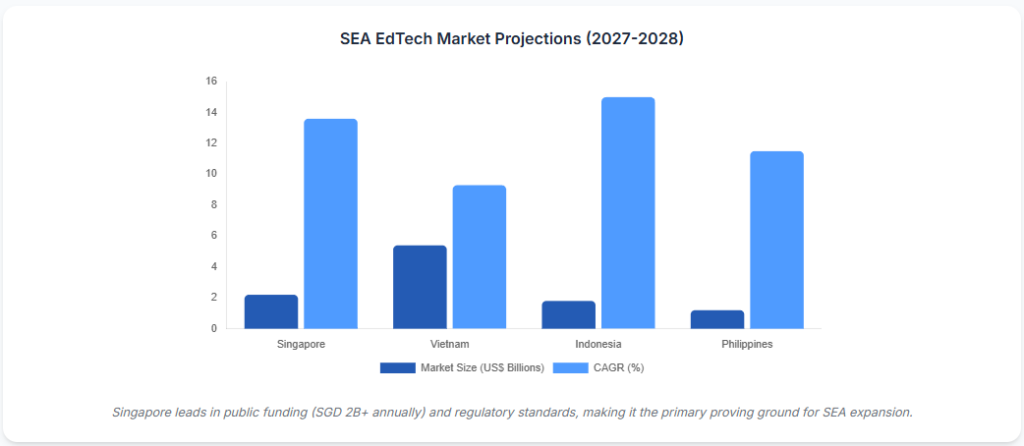
For edutech companies and their technology partners, the Singapore domestic market (US$2.2 billion by 2027, growing at 13.6% CAGR) is the compliance-first proving ground for Southeast Asian expansion. Annual public funding exceeds SGD 2 billion. Early-stage VC funds including Fresco Capital, Owl Ventures, Wavemaker Partners, and EDBI use regional expansion capability as a primary filter during Series A rounds.
| Country | EdTech Market Size | CAGR | Key Characteristics |
| Singapore | US$2.2 Billion by 2027 | 13.6% | High public funding (SGD 2B+ annually); strict PDPA and IMDA compliance; Vinova serves as an approved technology delivery partner |
| Vietnam | US$5.4 Billion by 2028 | 9.3% | 16M K-12 students; 1.7M higher education enrolment; strong demand for English and STEAM. Primary hub for Vinova’s offshore delivery operations |
| Indonesia | US$1.8 Billion by 2027 | 15.0% | Largest SEA population; mobile-first upskilling demand; decentralised geography driving regional LMS deployments |
| Philippines | Emerging growth sector | Double-digit | Fast-growing digital adoption; Standard Contractual Clauses used for cross-border data protection frameworks |
For technology delivery partners, the Singapore-Vietnam corridor is the optimal operating model for this market. Vinova maintains its governance and solution architecture headquarters in Singapore (serving as the compliance and client accountability hub), with ISO 9001 and ISO/IEC 27001:2022 certified Offshore Development Centres in Hanoi, Da Nang, and Ho Chi Minh City (the engineering delivery engine). This structure allows edutech companies to scale dynamically while maintaining Singapore-grade engineering and regulatory standards.
How to Get Your EdTech Platform Approved by Singapore MOE
Navigating entry into Singapore’s public K-12 and tertiary education infrastructure requires formal procurement pathways. Rather than running school-by-school sales cycles across 350+ individual institutions, edutech companies must secure placement within Ministry of Education bulk tenders and approved supplier panels. Under the National Digital Literacy Programme (NDLP), schools select pre-approved personal learning devices and software suites directly from the MOE bulk tender panel.
Integration with the Singapore Student Learning Space (SLS) is governed by the Application Development Framework (ADF), requiring compliance with the 1EdTech Consortium’s global standards. Specifically: LTI v1.3 Core Specifications built on OpenID Connect (OIDC) security profiles and JSON Web Tokens (JWT) for secure session authentication, and LTI Deep Linking 2.0 for embedding learning resources directly into SLS lessons with real-time analytics flowing back to institutional databases.
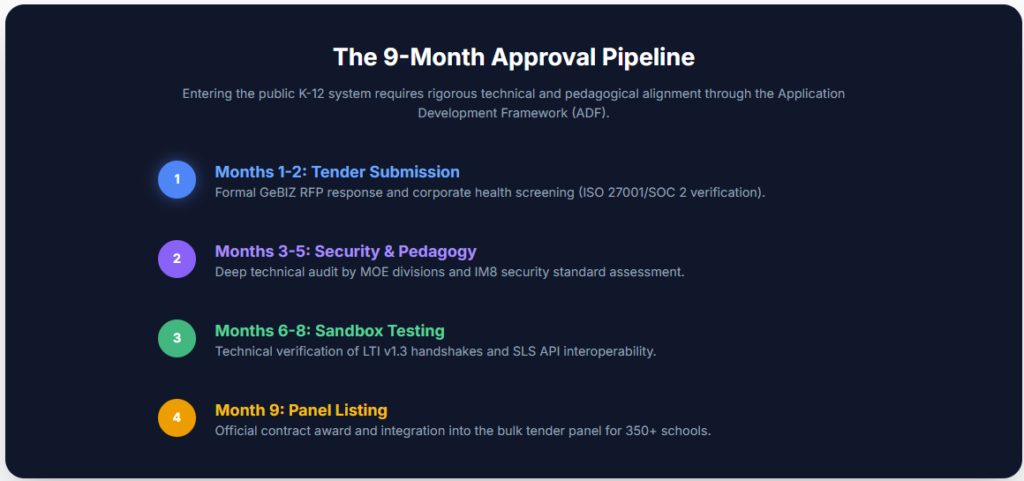
The approval cycle for best edutech platforms seeking SLS ADF onboarding spans six to nine months:
| Timeline | Stage | What Happens |
| Months 1 to 2 | Tender submission and initial evaluation | Formal RFP response via GeBIZ; initial screening of corporate health, technical viability, and relevant certifications (ISO 27001, SOC 2) |
| Months 3 to 5 | Pedagogical and cybersecurity alignment | Deep technical and pedagogical audit by MOE educational technology divisions; IM8 security standard assessment; verification of Singapore Student Learning Space (SLS) API compatibility |
| Months 6 to 8 | Interoperability and ADF sandbox testing | Technical sandbox testing to verify LTI v1.3 secure handshake and LTI Deep Linking 2.0 capabilities with SLS dummy accounts; OIDC and JWT session authentication confirmed |
| Month 9 | Final authorisation and panel listing | Official contract award and addition to MOE bulk tender panel; direct procurement by all 350+ state schools enabled without individual school-level sales cycles |
Navigating these regulatory gates is significantly easier with a technology partner that has an established public sector track record. Vinova’s delivery of the whole-of-government GRC platform for GovTech Singapore and the Next-Gen Digital Workbench for IPOS International demonstrates the IM8 compliance, GeBIZ procurement familiarity, and government API integration depth that MOE evaluations look for. For tertiary institutions, Vinova partnered with the Singapore Institute of Technology (SIT) to deliver the AdventureLEARN platform, combining Design Thinking workshops with two-week Agile sprint cycles, ensuring the technology remained aligned with student behaviours and SIT’s secure campus infrastructure.
The SkillsFuture Ecosystem: How Enterprise Demand Is Generated

State funding flows directly create enterprise demand for edutech companies. Under the SkillsFuture Level-Up Programme, the government provides a SGD 4,000 credit top-up to every working Singaporean citizen aged 40 and above, earmarked for courses with documented employability outcomes in data analytics, AI, and sustainability.
The SkillsFuture Queen Bee Network amplifies this at the enterprise level. Industry leaders act as anchor institutions driving digital transformation across their broader ecosystems and SME supplier networks:
- United Overseas Bank (UOB): Operating through UOB FinLab, guides SMEs through digital, sustainability, and AI readiness programs linked to proof-of-concept sprints and financial advisory
- ST Logistics: Partners with CET centres to deliver curricula in workplace data analytics, Power BI modelling, and sustainable supply chain operations
- YCH Group: Drives Industry 4.0 adoption, collaborating with tertiary institutions on SME skills advisory and digital logistics frameworks
- FairPrice Group: Guides its SME supplier network through omnichannel retail automation, service design, and sustainable sourcing
To serve these enterprise ecosystems, edutech companies must integrate seamlessly with local business processes. Vinova’s custom software deployments, leveraging Odoo backends and Salesforce connections, enable enterprises to map user upskilling directly to performance metrics, transforming training data into actionable corporate intelligence.
Maximising Singapore Government Grants for EdTech Deployment
Critical 2026 funding transition: SFEC to EWTP
The existing SkillsFuture Enterprise Credit (SFEC) framework expires permanently on November 30, 2026. Any remaining credit balances after this date are forfeited. On December 1, 2026, the redesigned SFEC launches under the Enterprise Workforce Transformation Package (EWTP), replacing the retrospective pay-first-claim-later model with a real-time digital wallet. Eligible enterprises receive a fresh SGD 10,000 credit deposited directly into their portal for upfront offset at the point of course enrolment.
To qualify for SFEC and EWTP, businesses must meet three criteria simultaneously during the qualifying period:
- Maintain at least 3 local FTEs (Singapore Citizens or PRs) with active CPF contributions
- Contribute a minimum of SGD 750 in Skills Development Levy (SDL) dues without payment defaults
- Maintain an active ACRA corporate registry status in Singapore
WDG(JR+): The high-cap grant for enterprise training technology
The Workforce Development Grant (Job Redesign+), abbreviated WDG(JR+), replaces the previous PSG-JR framework and is administered by the Singapore Business Federation (SBF) and Singapore National Employers Federation (SNEF). It provides up to 70% funding support for SMEs (50% for non-SMEs) for workforce consultancy, capability building, and training technology solutions, capped at SGD 150,000 per enterprise. This is the primary grant for large-scale edutech companies integration projects that exceed the SFEC credit limit.
Multi-grant stacking: the real cost of enterprise training
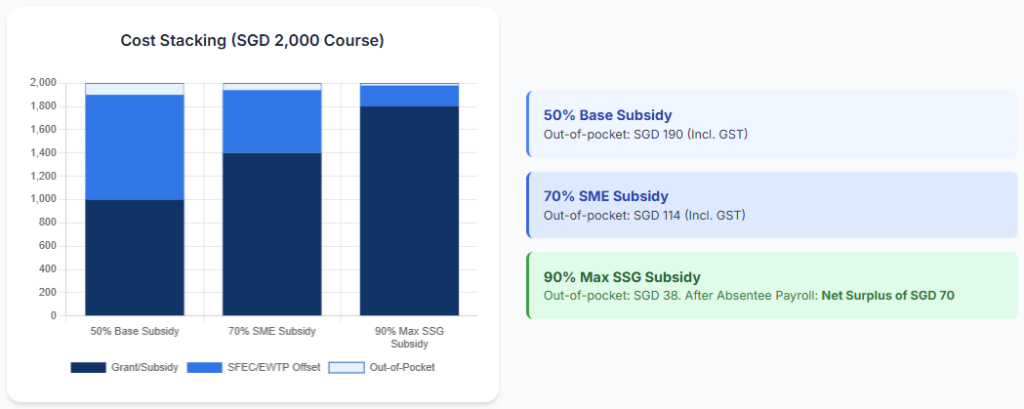
Corporate finance officers combine baseline SSG course fee subsidies, PSG software funding, SFEC offset, and the Absentee Payroll (AP) scheme (capped at SGD 100,000 per enterprise annually) to recover employee payroll costs during training. The table below simulates the stacking sequence for a SGD 2,000 training deployment across subsidy tiers, assuming a 24-hour course:
| Stacking Step | 50% Base Subsidy | 70% SME/MCES Subsidy | 90% Max SSG Subsidy |
| Gross course fee | SGD 2,000 | SGD 2,000 | SGD 2,000 |
| Course fee grant | -SGD 1,000 | -SGD 1,400 | -SGD 1,800 |
| Nett course fee | SGD 1,000 | SGD 600 | SGD 200 |
| GST (9%) | SGD 90 | SGD 54 | SGD 18 |
| Upfront payable | SGD 1,090 | SGD 654 | SGD 218 |
| SFEC offset (90% of nett fee) | -SGD 900 | -SGD 540 | -SGD 180 |
| Final out-of-pocket (excl. GST) | SGD 100 | SGD 60 | SGD 20 |
| Final out-of-pocket (incl. GST) | SGD 190 | SGD 114 | SGD 38 |
| Absentee Payroll (SGD 4.50/hr x 24hrs) | SGD 108 | SGD 108 | SGD 108 |
| Net corporate position | SGD 82 (4.1% of gross) | SGD 6 (0.3% of gross) | -SGD 70 (Net credit, -3.5%) |
At the 70% SME/MCES subsidy tier, a SGD 2,000 training course costs the enterprise SGD 6 net after all stacking. At the 90% maximum SSG subsidy tier, the absentee payroll recovery creates a net surplus position of SGD 70, effectively making the training free and generating a positive cash return. Corporate training directors who have not yet activated SFEC before November 30, 2026 are leaving material funding on the table.
Singapore EdTech Compliance: PDPA, LTI v1.3, and IMDA AI Governance

Securing enterprise and public sector contracts among Singapore’s best edutech providers requires strict compliance across three regulatory pillars. The platform’s technical partner must satisfy all three before any procurement conversation with a government body or public institution can advance.
| Compliance Pillar | Requirement | Vinova Implementation |
| PDPA data residency | All employee and student PII must be stored within Singapore; no unauthorised cross-border transfer under Section 26 Transfer Limitation Obligation | All production databases hosted exclusively in AWS ap-southeast-1 (Singapore); offshore development teams access environments through VDI hosted in Singapore cloud zones; no PII ever downloaded to offshore devices |
| LTI v1.3 interoperability | Mandatory compliance with 1EdTech Consortium standards for SLS integration; OpenID Connect security profiles and JSON Web Tokens for authenticated sessions; LTI Deep Linking 2.0 for direct resource embedding | Vinova engineers custom REST and GraphQL API handshakes to sync training platforms with HRIS databases, GoBusiness portal, and national TPGateway pipelines; LTI v1.3 sandbox-tested before SLS panel submission |
| IMDA Agentic AI Governance (January 22, 2026) | World’s first framework for autonomous AI systems in education and enterprise; requires bounded AI autonomy, human oversight checkpoints, comprehensive audit trails, and protection against prompt injection | Vinova’s AI deployments (including SIT AdventureLEARN AI simulations) enforce strict identity access management, threat modeling, and human-in-the-loop approval checkpoints; ISO 27001 audit trails maintained across all AI tool calls |
| IM8 security for public sector | GovTech Instruction Manual 8 governs security architecture, access controls, and data handling for all government and public sector digital systems | Validated through Vinova’s GovTech whole-of-government GRC platform and IPOS Digital Workbench engagements; security architecture scoped to IM8 from Phase 1 |
| AES-256 encryption and access controls | Role-based access controls, JWT authentication, AES-256 at rest, TLS 1.2 or higher in transit | Standard across all Vinova EdTech deployments under ISO/IEC 27001:2022 certified delivery processes |
The VDI architecture for PDPA-compliant offshore development
For edutech companies using offshore engineering resources, PDPA Section 26 (Transfer Limitation Obligation) applies the moment Singapore personal data is accessed by offshore teams. Vinova’s structural solution:
- All production databases, student learning analytics, and employee credentials hosted exclusively in AWS ap-southeast-1 (Singapore)
- Vietnam-based development squads never pull local PII to local hardware; all access is through Virtual Desktop Infrastructure (VDI) hosted within Singapore cloud zones
- This completely satisfies PDPA Section 26: zero unauthorised cross-border export of Singaporean personal data during build, migration, or maintenance cycles
- ASEAN Model Contractual Clauses signed before any data enters development pipelines
Expert EdTech Partner Evaluation: The 2026 Procurement Scorecard
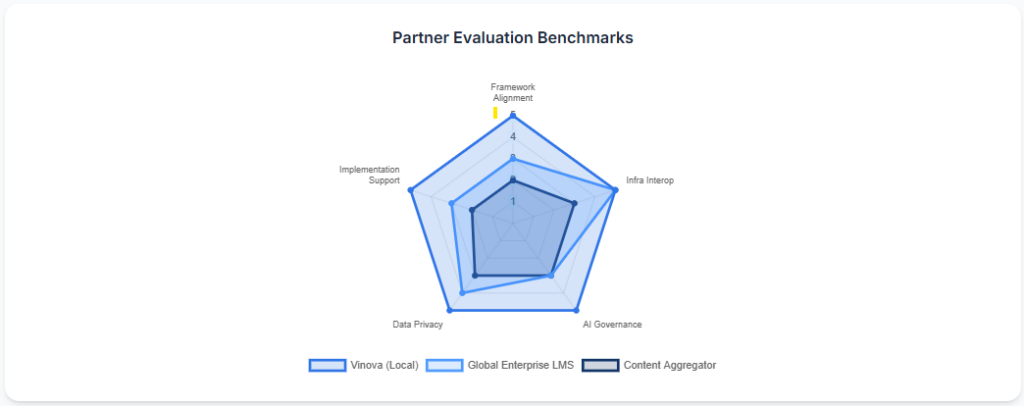
This scorecard assists School Boards, University CIOs, and Enterprise Training Directors in evaluating expert edutech implementation partners against Singapore’s specific regulatory and operational benchmarks. The four pillars and their weightings reflect the actual procurement criteria used by Singapore public institutions:
| Evaluation Pillar | Weight | Vinova (Local Tech Partner) | International Enterprise LMS (iSpring, Anthology) | Global B2B Content Aggregator (Udemy Business) |
| Framework alignment: content mapped to WSQ taxonomy and Skills Framework 2.0 | 35% | 5/5: Custom LMS architectures mapped natively to TPGateway; dynamic course-to-skills tagging | 3/5: Requires manual mapping to localised skills dataset | 2/5: Global catalog lacks alignment with Singapore national skills pathways |
| Infrastructure interoperability: HRIS sync, GoBusiness portal, SIS integration | 30% | 5/5: Custom high-touch integration with government APIs, TPGateway, and Singpass attendance; validated through SP Group and GovTech track record | 5/5: Robust native LTI v1.3 and Deep Linking 2.0 | 3/5: Standard enterprise SSO; limited custom local API integration |
| Human-centred AI governance: IMDA Model AI Framework alignment | 25% | 5/5: Custom AI models with human-in-the-loop controls, risk boundaries, and threat modeling; IM8 compliant | 3/5: Globally standardised AI features; requires custom setup for Singapore compliance | 3/5: Automated AI recommendations; limited localised oversight controls |
| Data privacy and residency: PDPA compliance; no unauthorised cross-border export | 10% | 5/5: AWS ap-southeast-1 hosting; VDI pipeline for offshore access; PDPA Section 26 fully satisfied | 4/5: Dedicated local cloud hosting on enterprise tiers | 3/5: Multi-tenant global hosting; potential cross-border flow risks |
| Weighted score | 100% | 5.00 / 5.00 | 3.90 / 5.00 | 2.65 / 5.00 |
Local technology partners with Singapore public sector delivery experience score significantly higher on Framework Alignment and Infrastructure Interoperability because they can build custom TPGateway integrations, Singpass attendance verification, and GoBusiness portal connections that international platforms offer only as manual workarounds. The 5/5 score on Data Privacy and Residency reflects Vinova’s VDI pipeline, which is the only architecture that satisfies PDPA Section 26 for offshore development while maintaining full engineering capability.
| Build Your EdTech Platform with Vinova Book a complimentary 2-hour consultation with Vinova’s EdTech engineering team. We’ll assess your LMS architecture, map your Singapore compliance requirements (PDPA, LTI v1.3, IMDA AI Governance), and design a scalable delivery plan for your institution or enterprise. No commitment required. Schedule Your Free 2-Hour EdTech Consultation with Vinova |
FAQ: Choosing EdTech Companies in Singapore
How do I stack SFEC and PSG to fund corporate training in Singapore?
To combine PSG and SFEC for maximum funding offset, follow this sequence. First, identify a training course or software suite pre-approved under the PSG framework. Second, confirm the provider is registered on the SkillsFuture for Business portal with courses mapped to a recognised Skills Framework. Third, submit a PSG application through the Business Grants Portal (BGP) before the project starts; approval covers up to 50% of qualifying costs. Fourth, complete the training ensuring minimum attendance and assessment thresholds are met. Fifth, submit final documentation to Enterprise Singapore via BGP. Sixth, apply the SFEC offset to cover up to 90% of the remaining out-of-pocket balance, reducing your final cash outlay to approximately 5% of the original gross cost. Add Absentee Payroll claims to reduce this further. Act before November 30, 2026: all SFEC balances are forfeited at the cutoff date.
What PDPA requirements apply to LMS platforms processing Singapore student or employee data?
Learning Management Systems processing Singapore personal data must satisfy four requirements. Consent and purpose limitation: granular consent interfaces must detail how personal and performance data is collected and used. Mandatory local data residency: employee training metrics, evaluation results, and PII must be stored in Singapore (typically AWS ap-southeast-1 dedicated private instances). Secure offshore development access: if development or maintenance involves offshore resources, all access must be through Singapore-hosted VDI; no physical data may be downloaded to offshore devices. Access control and encryption: RBAC, JWT authentication, AES-256 at rest, and TLS 1.2 or higher in transit. Non-compliance with the Transfer Limitation Obligation carries fines up to SGD 1,000,000 or 10% of annual Singapore turnover.
How long does it take for an EdTech platform to get MOE approval in Singapore?
The formal evaluation and approval process for edutech companies seeking deployment within Singapore’s public school infrastructure takes six to nine months. Month 1 to 2: GeBIZ tender submission and corporate health screening. Months 3 to 5: pedagogical audit and IM8 cybersecurity review. Months 6 to 8: LTI v1.3 and SLS ADF sandbox interoperability testing. Month 9: final authorisation and MOE bulk tender panel listing. Working with a technology partner that already holds IM8-compliant delivery credentials (such as Vinova’s GovTech track record) compresses the cybersecurity review phase and reduces the risk of rejection at the Months 3 to 5 gate.
What is the IMDA Agentic AI Governance Framework and how does it affect EdTech AI tools?
On January 22, 2026, IMDA released the Model AI Governance Framework for Agentic AI, the world’s first framework governing autonomous AI systems. For edutech companies deploying AI-driven personalisation engines, automated grading tools, or intelligent tutoring agents, the framework requires four practices. Bounded autonomy: strict design boundaries on the AI agent’s access to sensitive student databases and administrative systems. Human oversight checkpoints: explicit approval workflows before automated systems generate official academic scores or deploy content at scale. Audit trails: comprehensive logging of all AI tool calls and prompt executions, reviewable under ISO 27001 parameters. API security: protection against adversarial prompt injection across all integration vectors. EdTech platforms that cannot demonstrate IMDA Framework alignment will face increasing friction in Singapore public sector procurement from 2026 onwards.
| Vinova: Singapore’s expert EdTech implementation and engineering partner. ISO 27001:2022 and ISO 9001:2015 certified. PDPA, IM8, and IMDA AI Governance compliant. 300+ engineers across Singapore, Hanoi, Da Nang, and Ho Chi Minh City. EdTech clients include Singapore Institute of Technology (SIT), GovTech Singapore, and IPOS International. Recognised by The Straits Times and Statista as one of Singapore’s Fastest-Growing Companies for three consecutive years: 2024, 2025, and 2026. Schedule a 2-hour consultation right here. |