Singapore represents one of the most advanced ecosystems for programmable finance in Southeast Asia. Rather than a top-down legislative mandate, open banking solutions Singapore enterprises rely on emerged from a collaborative, market-led framework orchestrated by MAS and the Association of Banks in Singapore. This guide covers how that ecosystem actually works, from the APIs underneath it to the shift toward embedded finance now reshaping corporate banking.
Table of Contents
Key Takeaways:
- Market-Led, Not Mandated: Singapore powers open finance through shared public infrastructure (SGFinDex, Singpass) and collaborative frameworks rather than rigid, top-down legislative decrees.
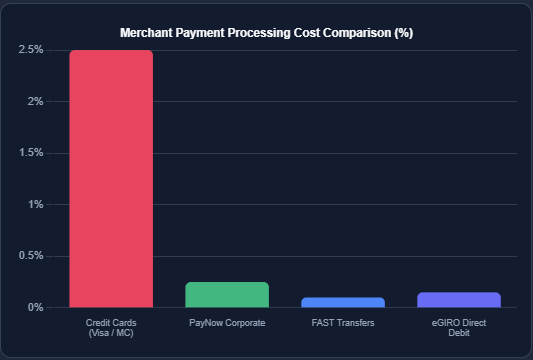
- Direct A2A & Embedded Workflows: Enterprises are replacing card networks with direct account-to-account rails (PayNow Corporate, FAST, eGIRO), slashing payment processing fees by up to 85% and automating straight-through ERP reconciliation.
- High Security & Regional Interoperability: Stricter technical governance (mandatory Singpass FAPI 2.0 compliance by December 31, 2026, MAS TRM resilience) paired with multilateral linkages like Project Nexus positions Singapore as ASEAN’s central cross-border clearing hub.
What Is Open Banking and How Does It Work?
What is open banking: a technical and regulatory framework letting third-party financial providers, enterprise platforms, and FinTech applications access financial account data and initiate payments programmatically via secure APIs, subject to explicit user consent.
Singapore diverged from prescriptive regimes like the UK’s CMA Open Banking Order and the EU’s PSD2/PSD3, where regulators legally mandated standardised interfaces. MAS instead bet that long-term adoption requires banks to see open APIs as strategic revenue engines, not compliance overhead. In November 2016, MAS and ABS jointly published the Finance-as-a-Service API Playbook, standardising technical specifications and security governance across hundreds of API endpoints, supported by the MAS Financial Industry API Register, the API Exchange (APIX) sandbox, and the FinTech Regulatory Sandbox.
| Dimension | Singapore Collaborative Model | UK CMA / EU PSD2 Model |
| Regulatory instrument | MAS Financial Services ITM, ABS-MAS API Playbook, TRM Guidelines | CMA Open Banking Order, EU PSD2 (Directive 2015/2366) |
| Infrastructure architecture | Public-private data switch (SGFinDex) underpinned by Singpass | Dedicated private standard bodies (Open Banking Limited) |
| Data scope | Comprehensive Open Finance: banking, tax (IRAS), CPF, CDP, life insurance | Primarily payment accounts and basic transaction history |
| Commercialisation model | Commercial monetisation permitted for enterprise APIs | Mandatory, unmonetised baseline access |
| Identity and authentication | Singpass National Digital Identity with PKI, FAPI 2.0, OIDC | Bank-specific Strong Customer Authentication (SCA) |
At the centre of this sits the Singapore Financial Data Exchange (SGFinDex), the world’s first public digital infrastructure built on a national digital identity system (Singpass) and centrally managed consent. SGFinDex is a stateless, zero-knowledge routing switch, it doesn’t read, aggregate, or store financial data itself, bridging public datasets (CPF, IRAS, HDB) and private institutions (banks, CDP, life insurers). Security runs on mutual TLS, Demonstrating Proof-of-Possession (DPoP, RFC 9449), and consent valid for a maximum of 365 days, revocable instantly through a centralised Singpass dashboard. All Singpass-integrated APIs must complete migration to full FAPI 2.0 compliance by December 31, 2026.
The Technical Core: Open Banking API Architecture and Platforms
Data Retrieval vs. Payment Initiation: Two Different API Modalities
An open banking API operates across two primary modalities. Data Retrieval APIs extract structured account information (balances, historical transactions, verification proofs) without transactional clearing risk. Payment Initiation APIs are active execution engines, connecting directly to FAST, generating dynamic PayNow QR payloads with invoice metadata, configuring eGIRO mandates, and automating FX bookings.
| Parameter | Data Retrieval APIs (Read-Only) | Payment Initiation APIs (Read-Write) |
| HTTP methods | Idempotent GET / query-based POST | State-altering POST, PUT, PATCH |
| Operational latency | P99 under 500ms; cached balance reads | P99 under 1,500ms (including interbank clearing handshakes) |
| Security and scopes | Standard OAuth 2.0 (read:balances, read:transactions) | FAPI 2.0, DPoP (RFC 9449), Pushed Authorization Requests |
| Payload formats | Structured JSON objects, bank statement schemas | ISO 20022 message formats (pain.001, pacs.008), JSON tokens |
| Typical endpoints | /accounts/{id}/balance, /transactions/history | /transfers/fast, /payments/paynow/dynamic-qr, /egiro/mandates |
Proprietary Bank APIs vs. Unified Aggregation Platforms
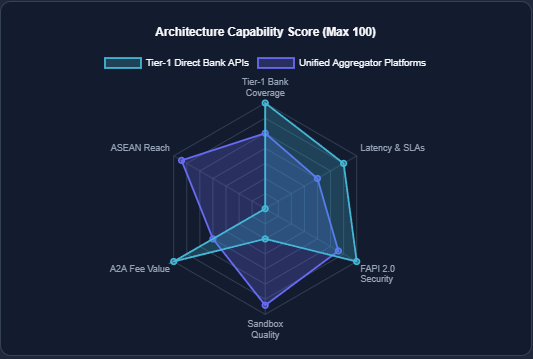
Enterprises choosing an open banking platform face an architectural decision. Singapore’s Tier-1 banks provide advanced, highly customisable corporate API suites: DBS RAPID offers nearly 200 modular APIs covering cash management, virtual account creation, and trade finance digitisation, while OCBC Velocity and UOB Infinity provide similarly robust corporate interfaces. Direct integration delivers functional depth and the lowest per-transaction fees, but requires substantial engineering resources to accommodate idiosyncratic data models and bilateral commercial contracts per bank.
Unified middleware platforms like Finverse and Brankas abstract this complexity, providing a normalised REST/JSON layer across multiple banks in a single SDK. The trade-off: a fractional per-call fee markup, an added network hop, and functional scope limited to the aggregator’s common feature set.
Proprietary vs. Open-Source API Frameworks
Engineering teams occasionally consider an open source banking api framework to eliminate subscription fees and retain control over the codebase. In a MAS-regulated market, that carries real operational risk:
- Security and patching liability: MAS Cyber Hygiene Notices mandate critical vulnerabilities patched within 30 days; unmanaged open-source repositories have no commercial SLA for zero-day fixes, placing the entire burden on internal teams
- Connector maintenance and schema drift: banks frequently modify API schemas and authentication flows without notice; any upstream change can break a self-maintained pipeline, requiring emergency internal development
- Regulatory audit readiness: MAS TRM inspections require documented cryptographic key management, HSM integration, and immutable audit trails, exactly the SOC 2 Type II and ISO 27001 compliance packages managed platforms already provide
High-Value Use Cases: Open Banking for Business Accounts
This is where most open banking solutions Singapore enterprises actually deploy first, since it maps directly to a line item CFOs already track.
Open banking for business accounts solves the operational problem of fragmented liquidity, replacing manual portal logins and batch SWIFT MT940 messaging with automated, intraday treasury operations.
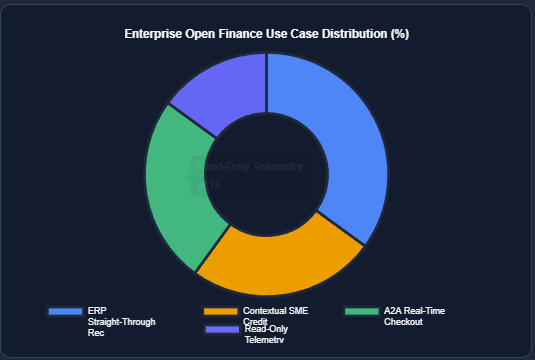
- Automated treasury and multi-bank reconciliation: integrating data pipelines directly into ERP platforms (SAP, NetSuite, Microsoft Dynamics, Xero, QuickBooks) gives treasurers unified intraday cash visibility and lets dynamic Virtual Account numbers auto-match incoming PayNow or FAST payments against open receivables in real time, cutting Days Sales Outstanding without manual reconciliation
- Direct B2B payment initiation: replacing card-based checkout with PayNow Corporate dynamic QR codes or eGIRO direct debit reduces payment processing costs by up to 85% while eliminating settlement float and chargeback exposure
- Contextual SME financing: MAS-licensed Digital Wholesale Banks like ANEXT Bank and Green Link Digital Bank ingest live cash-flow telemetry, daily revenue inflows, supplier payment regularity, operating margins, to approve unsecured working capital lines and invoice factoring in minutes rather than weeks, based on real operational capacity instead of 18-month-lagging financial statements
| Parameter | PayNow Corporate | FAST | eGIRO | Credit Cards |
| Settlement velocity | Instantaneous (<3 sec) | Instantaneous (<3 sec) | Intraday to T+1 | T+2 to T+7 business days |
| Merchant fee | 0-0.5% (or flat ~S$0.20-0.50) | Flat ~S$0.00-0.50 per transfer | Flat ~S$0.20-0.50 per pull | 1.5-3.5% + S$0.50 |
| Chargeback risk | Zero (irrevocable) | Zero (irrevocable) | Minimal | High |
How to Choose the Best Open Banking Platforms in Singapore
Choosing well among open banking solutions Singapore offers means assessing best open banking platforms for enterprise integration across governance, connector reach, resilience, and commercial economics, not just feature checklists:
| Category | Criteria | Benchmark |
| Governance | MAS TRM alignment | Full mapping against MAS TRM Guidelines and Cyber Hygiene Notices |
| Governance | Security certifications | Active SOC 2 Type II, ISO/IEC 27001:2022, PCI-DSS Level 1 |
| Governance | FAPI 2.0 roadmap | Documented migration pathway ahead of the December 2026 deadline |
| Connector coverage | Tier-1 bank integration | Direct API connectivity to DBS, OCBC, UOB, Standard Chartered, HSBC, Citibank |
| Connector coverage | Digital Wholesale Banks | Native API support for licensed DWBs (ANEXT Bank, Green Link Digital Bank) |
| Connector coverage | Government infrastructure | Integration capability with SGFinDex, Myinfo Business, IRAS, CPF, CDP |
| API and SLAs | Availability | 99.9%+ monthly uptime; critical downtime capped at 4 hours per 12 months |
| API and SLAs | Latency | P99 under 500ms for data APIs; P99 under 1,500ms for payment initiation |
| Developer ergonomics | Sandbox and SDKs | Dynamic test profiles, production SDKs for Node.js, Python, Go, Java |
| Commercial economics | Clearing cost | Fixed per-transaction A2A fee under S$0.50, no hidden markups |
Leading providers active in the region include Finverse (over 40 financial institutions across Singapore, Malaysia, the Philippines, Vietnam, and Indonesia), Brankas (an Open Finance Suite spanning compliance and embedded finance, ISO 27001 and PCI-DSS certified), Salt Edge (global compliance gateways), and Aspire (a Singapore-based B2B financial operating system natively integrating PayNow and eGIRO rails).
The 2026 Shift: Moving from Standalone APIs to Embedded Finance
The fundamental difference: open banking connects data, embedded finance embeds action directly into non-banking interfaces. Open Banking 1.0 focused on read-only visibility, pulling records into dashboards and manual credit portals. Embedded Finance integrates transactions, credit origination, and liquidity management directly into native enterprise SaaS and B2B marketplaces, operating invisibly inside existing workflows:
- Contextual B2B working capital: an inventory management platform continuously analyses turnover and automatically provisions an embedded working capital loan from a digital bank the moment purchase orders are generated, no branch visit or application required
- In-workflow automated payroll: an HRMS calls Payment Initiation APIs to disburse salaries instantly via FAST across thousands of employee accounts, simultaneously posting reconciling journal entries to the general ledger
- Programmatic marketplace escrows: B2B e-commerce platforms use BaaS APIs to generate segregated virtual accounts for buyer deposits, releasing supplier payouts via real-time A2A rails once delivery milestones are digitally verified
Regionally, Singapore functions as ASEAN’s cross-border clearing node: bilateral corridors already link PayNow to Thailand’s PromptPay, Malaysia’s DuitNow, and India’s UPI, settling in seconds at transparent rates. Project Nexus, led by the BIS Innovation Hub with the central banks of Singapore, Malaysia, Thailand, Indonesia, and the Philippines, extends this into a multilateral gateway: standardised ISO 20022 message translation, real-time FX discovery, and continuous settlement across every connected national Instant Payment System at once, rather than a separate bilateral link for every country pair.
How Vinova Approaches Open Banking and Payment Infrastructure
Vinova doesn’t have a named, public open banking platform to point to, and it’s more useful to be direct about that than to imply otherwise. What Vinova does have is the specific combination of capability this ecosystem actually requires.
- MAS-regulated fintech delivery, proven: Vinova built a highly compliant digital asset hub for a MAS-regulated digital asset trading platform’s Asia Pacific operations, including end-to-end system development, AWS cloud deployment, and strict adherence to financial security standards under an ongoing multi-year contract exceeding S$1,000,000 annually
- Direct PayNow and FAST integration experience: Vinova’s engineering practice has built production payment architecture around Singapore’s real-time rails specifically, the same PayNow Corporate, FAST, and eGIRO integration patterns this guide’s business-account use cases depend on
- ISO-certified, MAS TRM-aware delivery: ISO 27001 and ISO 9001 certification apply the same audit-ready governance discipline (encrypted key management, immutable logging, incident response) that MAS TRM inspections and SOC 2 Type II certification demand
- Hybrid Delivery Model: Singapore-based governance paired with a scalable Vietnam engineering base reduces development cost by 30% to 50% versus a fully onshore build, without trading away security or compliance depth
| Evaluating Open Banking Solutions in Singapore? Vinova is a Singapore-headquartered FinTech engineering partner building MAS TRM-aligned, PayNow and FAST-integrated payment infrastructure for enterprises across Singapore and the wider APAC region. Book a free architecture review with our local engineering team, real Singapore accountability, not a generic offshore integration shop. Book Your Free Fintech Solutions Singapore Consultation with Vinova |
Frequently Asked Questions
Is open banking mandatory for banks in Singapore?
No, and that’s the defining feature of Singapore’s model versus the UK or EU. MAS took a market-led approach rather than a legislative mandate, incentivising banks through the ABS-MAS API Playbook and supporting infrastructure (SGFinDex, APIX, the FinTech Regulatory Sandbox) rather than compelling participation by law. In practice, Singapore’s Tier-1 banks have built API suites (DBS RAPID, OCBC Velocity, UOB Infinity) that go well beyond the regulatory baseline mandated in prescriptive regimes, because MAS positioned open APIs as a revenue opportunity, not a compliance cost.
How do open banking APIs maintain data security and PDPA compliance?
Through layered technical and regulatory controls: mutual TLS and FAPI 2.0 authorisation with DPoP token binding at the protocol level, MAS TRM Guidelines and Cyber Hygiene Notices at the institutional level (mandatory MFA, 30-day critical patch SLAs, 1-hour incident notification to MAS), and PDPA’s Purpose Limitation and Notification obligations at the data-governance level, requiring data collected for one disclosed purpose to never be silently repurposed, and automatically purged or anonymised once consent expires.
What is the difference between open banking and embedded finance?
Open banking connects data, typically through a user-initiated action like clicking “link account,” and the interaction happens on the bank’s own interface. Embedded finance embeds the financial action itself directly inside a non-banking product: a working capital loan triggered automatically by inventory data inside an ERP, or instant payroll disbursement triggered by an HR platform, with no redirect to a bank login page at all. Open banking is Open Banking 1.0’s foundation; embedded finance is where the commercial value actually gets captured on top of it.
| Vinova: Singapore’s FinTech and payments engineering partner since 2010. ISO 27001:2022 and ISO 9001:2015 certified, MAS TRM aware. 300+ projects delivered. Payment rail integration (PayNow, FAST, eGIRO), MAS-regulated digital asset platform delivery, and Hybrid Delivery Model engineering for Singapore and APAC enterprises. Financial Times Top 500 High-Growth Companies Asia-Pacific 2026. The Straits Times Singapore’s Fastest-Growing Companies 2024, 2025, and 2026. Contact Vinova to Scope Your Open Banking Integration |