By the Vinova Engineering Team. Reviewed under ISO 27001:2022 and ISO 9001:2015 delivery standards.
Agile software development with Scrum is too often reduced to sprint metrics and burn-down charts that look busy but do not guarantee compliant, production-ready software. This guide shows how Singapore enterprises use Scrum to carry Personal Data Protection Act (PDPA) and Monetary Authority of Singapore (MAS) Technology Risk Management (TRM) obligations into every sprint, avoid the five most common delivery failures, and structure a Singapore-Vietnam hybrid team that stays accountable under Singapore law.
The question for a Chief Technology Officer (CTO) or Chief Risk Officer (CRO) is not how many story points the team burned. It is whether every increment is something you could defend to a regulator on the day it ships.
Key Takeaways
- Breach notification runs on a short clock. Once an organization assesses that a data breach is notifiable, it must notify the Personal Data Protection Commission (PDPC) as soon as practicable and no later than 3 calendar days after that assessment. Sprint-level logging and incident runbooks make that assessment fast.
- The NRIC deadline is fixed. Private organizations must stop using full or partial National Registration Identity Card (NRIC) numbers for authentication by 31 December 2026, and the PDPC has said it will step up enforcement from 1 January 2027.
- Compliance belongs in the Definition of Done. An increment that has not passed security scanning, test coverage, review, and PDPA checks is not delivered, whatever the sprint board shows.
- Hybrid delivery needs hard governance. Singapore-based Product Ownership with dedicated Vietnam squads lowers cost while keeping accountability, IP ownership, and data controls under Singapore law.
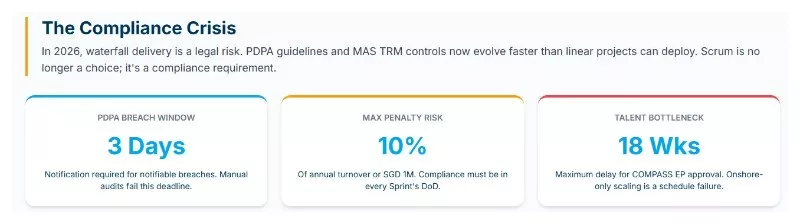
Table of Contents
Why Singapore Enterprises Are Adopting Agile Software Development with Scrum in 2026
Traditional waterfall development struggles in Singapore’s environment for a structural reason: the regulatory and integration landscape changes faster than a linear project can adapt. Freezing specifications months before launch invites technical and compliance drift. By the time a waterfall project deploys, PDPA guidance, MAS TRM expectations, and GovTech Instruction Manual 8 (IM8) controls may have moved, and the rework lands after the budget has been spent.
Iterative agile software development with Scrum addresses this by treating compliance requirements as Product Backlog items rather than post-development audit activities. Each sprint, typically two weeks, delivers a working, integrated, tested increment. The Sprint Review creates a mandatory inspection point where stakeholders verify both features and regulatory alignment against the team’s Definition of Done.
Public sector buying is moving the same way. Under GovTech’s Outcome-Based Procurement guideline, agencies describe the problem and the performance indicators they expect rather than a fixed solution, then refine requirements through pilot stages. That favors teams that can adapt scope without breaking a contract.
Regulatory obligations that Scrum teams carry into every sprint
Three obligations shape how a Singapore-facing platform should be planned. Each one belongs on the Product Backlog with an owner and acceptance criteria. If the NRIC migration has no owner, it turns into a scramble against a fixed deadline of 31 December 2026.
PDPA and NRIC Obligations and Their Sprint-Level Implications
| Obligation | What applies | What it means for the backlog |
|---|---|---|
| PDPA breach notification | Notify the PDPC of a breach that is likely to cause significant harm, or that involves the personal data of 500 or more individuals, as soon as practicable and no later than 3 calendar days after assessing that it is notifiable. | Add data-flow maps, audit logging, and an incident runbook to the Definition of Done, so the assessment can start the moment a breach is suspected. |
| NRIC authentication | Private organizations must stop using full or partial NRIC numbers, and NRIC-based default passwords, for authentication by 31 December 2026. Enforcement increases from 1 January 2027. | Manage the migration as a prioritized Product Backlog epic with user stories, acceptance criteria, and a release date ahead of the deadline, not as a one-time project. |
| PDPA financial penalties | Up to 10% of annual Singapore turnover for organizations with turnover above SGD 10 million, and up to SGD 1 million otherwise. | Treat compliance stories as sprint-level work reviewed every sprint, not as a legal review at the end. |
The Three Roles of a Cross-Functional Scrum Team
Understanding how to use Scrum in software projects starts with team structure. Effective Scrum delivery relies on a self-contained, cross-functional team that removes inter-departmental handoffs by placing every skill needed to design, build, validate, and deploy an increment inside one squad. Three accountabilities structure that team.
The Product Owner
The Product Owner is solely accountable for maximizing the value of the product and for managing the Product Backlog. In Singapore’s enterprise context, that means translating corporate strategy, user data, and regulatory demands into clear, actionable user stories.
The Product Owner prioritizes compliance backlog items: scheduling Data Protection Impact Assessments (DPIAs), planning NRIC decoupling work, and coordinating with the designated Data Protection Officer (DPO). Changes to requirements are routed through the Product Owner, which protects the team from conflicting stakeholder demands that destroy sprint focus.
The Scrum Master
The Scrum Master is a process coach and delivery facilitator, not a meeting scheduler. At Vinova, the role carries technical literacy: our Scrum Masters read the pipeline, the branching model, and the board, so they can resolve blockers rather than only log them.
A Scrum Master’s performance is measured by improvement in the team’s operating data over time: velocity consistency, sprint goal success rate, and shorter cycle-time bottlenecks, not by meeting attendance.
The Cross-Functional Developers
The Developers design, build, and test a working increment in every sprint, as part of a team-based agile methodology. Rather than working in functional silos, a Scrum team combines frontend, backend, QA, and DevOps capability in one squad. Work can then move from the Product Backlog to a potentially shippable state within one sprint, with fewer dependencies on outside teams.
Building a complete, fully local cross-functional team in Singapore runs into two constraints: the domestic market cannot fill every role quickly, and foreign hires need an Employment Pass, which requires meeting the qualifying salary and scoring 40 points under the Complementarity Assessment Framework (COMPASS). Vinova, one of the technology companies in Singapore with 16 years of delivery behind it, addresses these constraints through its Singapore-Vietnam hybrid model.
Product Owners, Business Analysts, and governance leads stay onshore in Singapore to hold stakeholder alignment. High-velocity development, automated QA, and DevOps execution scale through Vinova’s delivery centers in Hanoi, Da Nang, and Ho Chi Minh City. Vietnam runs on UTC+7, one hour behind Singapore, so daily Scrums and planning sessions fit inside the Singapore business day.
Scrum Events: How Vinova Runs a Sprint
Vinova has run agile software development with Scrum delivery cycles for 16 years across 300+ companies and government agencies. The Scrum Guide defines five events: the Sprint itself, Sprint Planning, the Daily Scrum, the Sprint Review, and the Sprint Retrospective. Backlog refinement is an ongoing activity rather than a formal event, but we treat it as part of the rhythm because the quality of every sprint depends on it.
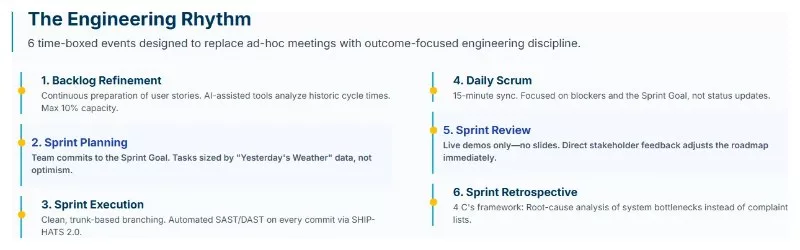
Scrum Time-Boxes: Scrum Guide Maximums and a Two-Week Sprint
1. Backlog Refinement
An ongoing activity, not a single event. The Product Owner, Developers, and Scrum Master continuously prepare user stories for the next two to three sprints. Acceptance criteria follow the Card-Conversation-Confirmation pattern. Vinova’s squads use AI-assisted tools to analyze historic cycle times, flag estimation risks, and pre-draft API definitions. Output: a prioritized Product Backlog in which upcoming items carry clear acceptance criteria and mapped dependencies.
2. Sprint Planning
A collaborative session where the team agrees what will be built and how. The Product Owner presents priorities, the team proposes a Sprint Goal, and Developers select backlog items they can complete, sized against real capacity and informed by recent velocity rather than optimistic estimates. Output: a Sprint Backlog with committed items, engineering tasks, and an agreed Sprint Goal.
3. Sprint Execution
Developers pull work from the sprint board using trunk-based or short-lived branching, which keeps code stable and prevents long-lived branch drift. For Singapore public sector and GovTech-adjacent environments, execution workflows can run on GovTech’s SHIP-HATS DevSecOps platform and deploy to Government on Commercial Cloud (GCC).
Every commit triggers an automated build loop: static application security testing (SAST) via Semgrep, dependency scanning via Nexus IQ, code quality analysis via SonarQube, and dynamic application security testing (DAST). Output: verified, compliant code merged into the main branch in a stable, integrated environment.
4. Daily Scrum
A 15-minute, Developer-led sync at the same time every working day. It exists to synchronize the team around the Sprint Goal, not to report status to management. Developers cover what moved the Sprint Goal forward, what they will address next, and what blocks them. The Scrum Master takes blockers offline and resolves them outside the sync. Output: an updated sprint board and an adjusted plan for the next 24 hours.
5. Sprint Review
A working session at the end of the sprint where the team demonstrates the increment live in a staging environment. No slides. No status reports. Stakeholders use the application and give feedback, and the Product Owner discusses market changes, progress against the Product Goal, and the likely next priorities. Output: a prioritized feedback list added to the Product Backlog and an updated release outlook.
6. Sprint Retrospective
The last event of each sprint, focused on how the team works. Vinova’s squads use the 4 C’s retrospective format rather than an unstructured list of likes and dislikes:
- Connections: the team reviews the outcomes of improvements committed in the previous retrospective and links them to current sprint data.
- Concepts: the squad inspects systemic bottlenecks, technical debt, and team dynamics to find root causes, such as pull request rework rates, unassigned tickets, and version control conflict patterns.
- Concrete Practice: Developers propose specific, actionable adjustments to engineering workflow, code review, or communication.
- Conclusions: the team commits to a small number of high-priority Specific, Measurable, Achievable, Relevant, and Time-bound (SMART) improvements, each with a named owner, and places them in the next Sprint Backlog.
The format earns its place because it pushes the team toward system-level root causes instead of subjective complaints.
The Rule: A retrospective that ends in opinions instead of owned changes has not happened. system level, not subjective lists of complaints. Time-boxed to 90 minutes for a two-week sprint.
Scrum Artifacts: Transparency, Commitment, and the Definition of Done
Three artifacts create transparency across every Scrum delivery cycle. Each carries a commitment that removes ambiguity about what is being built, why, and to what standard.
Product Backlog: Commitment to the Product Goal
The single source of truth for all requirements: future user stories, technical refactoring, platform upgrades, and compliance tickets. Higher-priority items are refined and defined in greater detail. The Product Goal describes a target future state of the product: completing an enterprise system integration, scaling a platform to higher concurrent user volumes, or achieving full compliance with updated regulatory guidelines. Every backlog item must trace directly to the Product Goal. Items that don’t belong in the backlog.
Sprint Backlog: Commitment to the Sprint Goal
The single, ordered source of work for the product: user stories, technical refactoring, platform upgrades, and compliance tickets. Higher-ranked items are refined in greater detail. The Product Goal describes a target future state, such as completing an enterprise system integration, scaling to higher concurrent user volumes, or achieving compliance with updated regulatory guidance. Every backlog item should trace to the Product Goal. Items that cannot be traced to it do not belong in the backlog.
Sprint Backlog: Commitment to the Sprint Goal
The Product Backlog items selected for the sprint, plus the Developers’ plan for delivering them, owned entirely by the Developers. It is a visible, real-time board showing each item’s status through development, testing, and deployment. The Sprint Goal states the value the team commits to delivering. It unifies focus and gives the Scrum Master a basis for resolving scope conflicts when stakeholders ask for mid-sprint additions.
Increment: Commitment to the Definition of Done
The working, integrated software at the end of each sprint. To count as complete, every piece of work must meet Vinova’s enterprise Definition of Done:
Vinova Enterprise Definition of Done
| DoD requirement | Standard |
|---|---|
| Security scanning | Zero critical or high vulnerabilities flagged by SAST, DAST, or Software Composition Analysis (SCA) scanners |
| Test coverage | Over 80% automated unit and integration test coverage across all modified services |
| Code review | Peer review completed, approved, and merged into the main development branch |
| PDPA compliance | Personal data masked or tokenized in logs, and data retention rules validated for all modified data flows |
| Deployment validation | Clean deployment to staging that passes automated UI and API smoke tests |
The Definition of Done is non-negotiable. An increment that does not meet it is not delivered, whatever the sprint board shows. That is the structural answer to velocity theater: it converts story-point counting into production-grade verification.
Five Agile Software Development with Scrum Failure Vectors
Sixteen years of Scrum delivery have shown Vinova five recurring failure patterns across Singapore’s enterprise and public sector markets. Drawing on corporate software development and managed IT services Singapore engagements, we have seen the cost of each firsthand. Each is preventable, and each is expensive when it is not.
1. Scrumfall
The failure: Organizations write bloated upfront requirements documents, then run consecutive sprints as sequential single-discipline phases: Sprint 1 for requirements, Sprints 2 and 3 for development, Sprint 4 for manual testing. Testing and feedback arrive late, reproducing the defects of waterfall with the ceremony overhead of Scrum.
Vinova’s mitigation: A Definition of Done that requires developers, automated QA specialists, and DevOps engineers to work concurrently inside every sprint, so each sprint delivers a working, integrated increment. For legacy integration, the Strangler Fig pattern lets Vinova build cloud-native services around an existing monolith and shift traffic incrementally, so end users see no disruption. On two such programs, for a Singapore utility group’s digital arm and a global maritime shipping group, Vinova recorded a 60% gain in development velocity without halting live operations.
2. Ceremony Fatigue
The failure: Meetings overrun their time-boxes, turn into micromanagement status reports, and squeeze out engineering time. Context-switching accumulates and sprint commitments are missed.
Vinova’s mitigation: The Scrum Master enforces every time-box: Daily Scrum at 15 minutes, Retrospective at 90 minutes for a two-week sprint. Asynchronous channels carry routine status updates, and live sessions focus on unblocking engineering work and refining complex requirements. Anything that can be resolved asynchronously is.
3. Distributed Team Disconnect
The failure: When distributed teams span large time-zone gaps, six hours or more, collaboration defaults to email chains and delayed messages. Blockers linger, daily syncs fragment, and integration errors accumulate during handoffs.
Vinova’s mitigation: Squads are structured to maximize overlapping working hours. Strategic Product Ownership stays onshore in Singapore, and development runs from Vietnam, one hour behind. Daily Scrums, refinement, and sprint planning all happen during standard Singapore business hours. A flight from Changi to Ho Chi Minh City takes about two hours, which makes in-person quarterly retrospectives practical.
4. The Tooling Trap
The failure: Jira or Git repositories configured as administrative logs instead of collaborative boards. Developers log hours and ticket updates by hand, velocity and burn-down data become unreliable, and engineering decisions get made on bad metrics.
Vinova’s mitigation: Integrate the toolchain directly with Git and DevSecOps pipelines. Jira or GitLab boards update ticket status automatically from commit and pull request activity, so reporting shifts from manual inputs to objective DevOps Research and Assessment (DORA) metrics aggregated by the platform.
5. Rigid Contractual Conflict
The failure: Fixed-price contracts with frozen specifications are applied to agile delivery. Teams are penalized for adapting to user feedback, and reprioritizing the backlog becomes a contract violation.
Vinova’s mitigation: Structure agreements around dedicated sprint capacity and clear outcomes rather than static feature milestones. The client buys a high-performing squad’s capacity and keeps the flexibility to adapt the backlog as business and regulatory needs change. Outcome-focused buying of this kind is consistent with the direction of GovTech’s Outcome-Based Procurement guideline.
Agile Software Development with Scrum vs. Kanban vs. Scrumban
Not every engineering initiative suits agile software development with Scrum. Technology leaders should select the workflow system by project lifecycle stage, operational risk, and team composition.
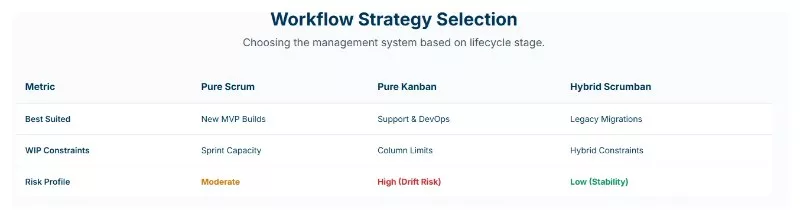
Scrum, Kanban, and Scrumban Compared
| Operational metric | Pure Scrum | Pure Kanban | Hybrid Scrumban |
|---|---|---|---|
| Core metric tracked | Sprint velocity: story points completed per sprint | Lead time (backlog to deploy) and cycle time (in progress to done) | Cumulative flow, cycle time stability, and Sprint Goal completion rate |
| WIP constraints | Set by the Sprint Backlog commitment and capacity per sprint | Enforced on board columns (for example, a maximum of 3 active items in Dev) | Time-boxed sprint commitments paired with column-level WIP limits |
| Team structure | Three accountabilities: Product Owner, Scrum Master, Developers | No mandated roles; adapts to the existing team structure | Keeps core roles (Product Owner, Scrum Master) but lets Developers pull work as capacity frees up |
| Best-suited scenario | New product builds, Minimum Viable Product (MVP) development, and strategic feature releases | Site Reliability Engineering (SRE), DevOps, and maintenance: support desks, bug-fixing, infrastructure stability | Legacy migrations and microservice refactoring with evolving requirements |
| Risk profile | Moderate: mitigated by time-boxed iterations, stakeholder reviews, and continuous testing | Higher: without time-boxed milestones, work can drift without structured release goals | Lower: combines sprint focus with the flexibility of continuous pull workflows |
The decision is not ideological. Vinova applies Scrum to greenfield product builds and major feature releases, Kanban to DevOps and infrastructure stability, and Scrumban to legacy migration programs where requirements evolve mid-execution. The right answer depends on what you are building, not on which framework sounds more agile.
The Vinova Seamless Hybrid Delivery Model: Scrum at Singapore Standards
The enterprises that move fastest in Singapore do not close the talent gap simply by paying more for local engineers. They structure the delivery hierarchy correctly: governance and compliance stay onshore, and execution scales offshore. Vinova has operated this model for 16 years, and it serves organizations looking for custom software development in Singapore as well as one of the app development companies in Singapore as a scalable delivery arm.
The cost logic is straightforward. The table below compares one senior engineer on statutory components only: base salary, employer CPF, and the Skills Development Levy (SDL). Employer Central Provident Fund (CPF) is 17% of ordinary wages up to the SGD 8,000 monthly ceiling, so it is capped at SGD 1,360 a month, and SDL is at most SGD 11.25.
Monthly Cost of One Senior Engineer: Singapore Hire vs. Vinova Dedicated Engineer
| Cost component | Singapore senior engineer | Vinova dedicated senior engineer |
|---|---|---|
| Base salary or delivery rate | SGD 13,000 (illustrative base within the SGD 10,000 to 15,000 senior band) | USD 26 to 37 per hour, 160 hours: SGD 5,574 to 7,933 |
| Employer CPF | SGD 1,360 (17%, capped at the SGD 8,000 ordinary wage ceiling) | Included in the rate |
| Skills Development Levy | SGD 11.25 (maximum) | Included in the rate |
| Monthly cost (statutory components only) | SGD 14,371 | SGD 5,574 to 7,933 |
| Monthly saving | Not applicable | SGD 6,438 to 8,797, or 45% to 61% |
Illustrative exchange rate of SGD 1.34 per USD. Excludes recruitment fees, bonuses, benefits, and onboarding cost for the Singapore hire. The Vinova rate is fully loaded and carries no work-pass wait.
The Takeaway: The saving of SGD 6,438 to 8,797 per senior engineer each month is what lets governance stay onshore while execution scales offshore.
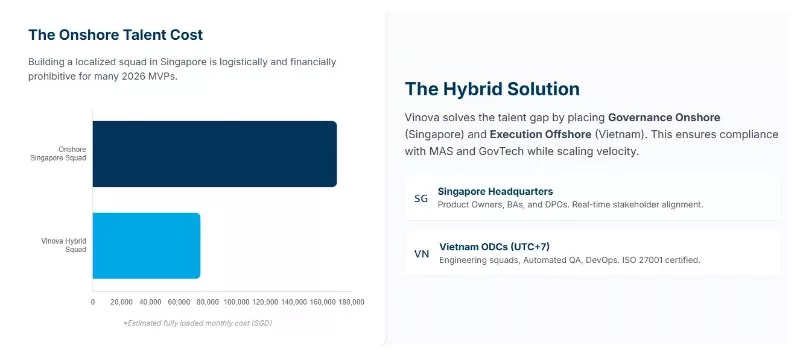
Vinova’s Seamless Hybrid Delivery Model keeps Scrum discipline intact. Product Owners, Business Analysts, and core governance leads sit in Singapore, close to local stakeholders and to MAS and GovTech compliance requirements. Engineering squads execute from Vinova’s ISO 9001:2015 and ISO/IEC 27001:2022 certified delivery centers in Ho Chi Minh City, Hanoi, and Da Nang. The same engagement model supports mobile programs, and Vinova also operates as an iPhone app development company for Singapore enterprises.
Squads also use AI coding assistants inside the sprint workflow, held to the same code review and Definition of Done gates as any other code, as part of Vinova’s work among the AI companies in Singapore.
Delivery quality is tracked against the four DORA software delivery metrics. The table below sets Vinova’s delivery standard beside the 2024 DORA report’s elite performance cluster.
Delivery Standard vs. DORA 2024 Elite Cluster
| DORA metric | Vinova delivery standard | DORA 2024 elite cluster |
|---|---|---|
| Deployment frequency | On demand, via Jenkins, GitHub Actions, and Bitbucket Pipelines | On demand |
| Failed deployment recovery time | Under 1 hour, via blue-green deployment and automated rollback | Under 1 hour |
| Change failure rate | Under 4%, enforced by SonarQube quality gates and automated regression tests on every commit | About 5% |
| Lead time for changes | Tracked on every sprint dashboard | Under 1 day |
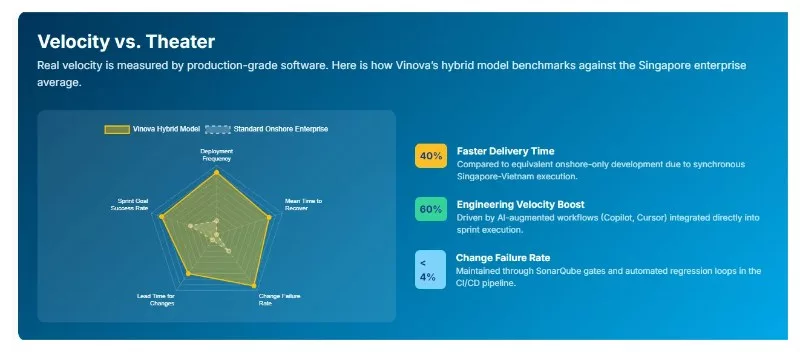
These are the delivery standards Vinova applies across engagements with government agencies, financial institutions, and enterprise operators, and they are reviewed against production data every sprint.
All IP created during Vinova engagements is legally owned by the client, transferred on creation. Engineers commit directly to client-owned repositories (GitHub, GitLab, Bitbucket) with single sign-on (SSO) and multi-factor authentication (MFA) enforced, and source code is not held on Vinova-controlled infrastructure. Offshore engineers reach client systems through virtual desktops hosted in Singapore cloud zones, with local download disabled. Where personal data does cross a border, PDPA Section 26 requires comparable protection under a legally enforceable arrangement, such as one built on the ASEAN Model Contractual Clauses.
|
Build Real Engineering Velocity with Vinova Book a complimentary 2-hour consultation with Vinova’s Singapore-based engineering team. We will review your current delivery process, identify where velocity theater is costing you sprint capacity, and outline a compliant agile delivery model for your enterprise. No commitment required. Schedule Your Free 2-Hour Agile Delivery Consultation with Vinova |
Agile Software Development with Scrum: Frequently Asked Questions
What is the difference between Agile and Scrum, and why does it matter for Singapore enterprises?
Agile is a philosophy: a set of values and principles from the Agile Manifesto that prioritize customer collaboration, continuous feedback, and working software. It does not mandate roles, events, or schedules. Scrum is a framework that puts those principles into practice. It defines three accountabilities (Product Owner, Scrum Master, Developers), five events (the Sprint, Sprint Planning, Daily Scrum, Sprint Review, Sprint Retrospective), and three artifacts (Product Backlog, Sprint Backlog, Increment).
The distinction matters because many failures in Scrum adoption trace back to conflating the two. Organizations adopt the values (adapt, collaborate, iterate) without Scrum’s structural accountability: time-boxed sprints, a non-negotiable Definition of Done, and a Product Owner who owns the backlog. The result feels agile but produces the same rework patterns as waterfall.
How do modern Scrum teams avoid Scrumfall when integrating with legacy enterprise architectures?
Four strategies, applied across Singapore enterprise legacy integration programs:
- Product inception and low-fidelity prototyping: a structured conceptualization phase that validates risk assumptions before the team commits to full delivery. This is how Vinova’s 8 to 12 week MVP validation cycle works in practice.
- API virtualization and mocking: Developers define API schemas for integration boundaries during refinement. Frontend and backend teams mock those endpoints and build concurrently, without waiting for the legacy system to expose a live endpoint.
- Strangler Fig pattern: cloud-native services are built around the edges of the monolith, replacing components incrementally while traffic routing shifts, so end users see no disruption.
- Continuous regulatory integration: PDPA and IM8 requirements are split into modular user stories and prioritized in sprint backlogs, rather than deferred to a final manual audit.
What is the 3-5-3 structure in Scrum, and how does Vinova run the 4 C’s retrospective?
As a quick Scrum framework overview, the 3-5-3 shorthand counts three accountabilities (Product Owner, Scrum Master, Developers), five events (the Sprint, Sprint Planning, Daily Scrum, Sprint Review, Sprint Retrospective), and three artifacts (Product Backlog, Sprint Backlog, Increment). Dropping any element weakens the framework’s ability to produce inspectable, empirical delivery cycles.
Vinova’s Sprint Retrospective uses the 4 C’s format: Connections (previous commitments against current data), Concepts (build and delivery data analyzed for systemic bottlenecks), Concrete Practice (specific, testable workflow changes), and Conclusions (one or two SMART improvements with named owners for the next sprint). The output is a change to the system, not a list of opinions.
How does Vinova keep Scrum metrics accurate across a distributed Singapore-Vietnam team?
- Synchronous cadences: Vietnam’s UTC+7 time zone is one hour behind Singapore, so daily Scrums, refinement, and planning happen during standard Singapore business hours.
- Evidence-based estimation: Developers size items in relative story points against historic velocity, not optimistic hour estimates, so commitments reflect what the team has actually delivered.
- Automated telemetry: Jira and GitLab boards update from Git events such as branch creation, pull request approval, and merge, so burn-down charts reflect the real state of the code.
- DORA dashboards: deployment frequency, lead time for changes, failed deployment recovery time, and change failure rate are reviewed at every Sprint Retrospective as objective benchmarks.
What toolchain does high-scale Scrum delivery need in Singapore?
Observability: application performance monitoring tied to build and deployment logs, so a failed release can be traced to the commit that caused it.eans building compliance into the Definition of Done from day one, not treating it as a final audit step.
Planning and boards: Jira or GitLab boards configured with epics, user stories, and automated workflow triggers.
Version control and branching: GitLab or GitHub Enterprise with trunk-based development or short-lived feature branches, to minimize merge conflicts and support continuous integration.
Public sector pipelines: GovTech’s SHIP-HATS DevSecOps platform and Container Stack (CStack) on Government on Commercial Cloud, with infrastructure-as-code and policy-as-code checks supporting IM8 alignment.
DevSecOps scanning: SonarQube for code quality, Semgrep for SAST on developer commits, Nexus IQ for software composition analysis, and Fortify on Demand for deeper SAST and DAST before deployment.
Agile Software Development with Scrum, Resolved: Compliance, Velocity, and Cost Engineered Together
Agile software development with Scrum works when compliance, velocity, and cost are engineered together, not managed as separate workstreams. For Singapore enterprises facing the NRIC deadline and PDPA penalties, that means building compliance into the Definition of Done from the first sprint, not treating it as a final audit. Vinova’s approach is built around accountability:
- Fiduciary Governance & Regulatory Alignment: Delivery operations certified under ISO/IEC 27001:2022 (Information Security) and ISO 9001:2015 (Quality Management) and GovTech Category 1B approved, with delivery designed to align with PDPA, IM8, and MAS TRM requirements.
- Singapore Corporate Governance: Master Services Agreements governed under Singapore law with Singapore International Arbitration Centre (SIAC) arbitration, so IP ownership and accountability are defined before the first sprint.
- Agile Delivery Practice: Scrum Masters with technical depth, a Definition of Done that carries security and PDPA gates, and DORA metrics reviewed every sprint, across custom software development engagements.
- Engineering Depth: 300+ in-house engineers across Singapore and Vietnam delivery hubs in Ho Chi Minh City, Da Nang, and Hanoi, with 8% to 12% annual voluntary attrition, so the people who build your system are still there to run it.
Ready to start? Schedule a consultation with our technical directors.
Vinova: a Singaporean Government-Grade Digital Transformation Partner, Made Accessible. For 16 years, we have designed digital systems for 300+ companies and government agencies worldwide, backed by ISO 27001:2022 and ISO 9001:2015 certification and Singapore GovTech Category 1B approval. |