Is your critical AI system a liability or an asset? Global AI spending has surged past $300 billion in 2026, and Singapore’s National AI Strategy 2.0 has pushed regional adoption well ahead of most comparable markets. Capital doesn’t guarantee quality, and by 2028, autonomous agents are projected to drive the majority of B2B buying decisions. In that environment, your tolerance for error disappears. Reliability is now the metric business survival gets measured against.
Do you have the engineering strategy to guarantee that certainty? AI for enterprise Singapore that survives contact with production traffic takes a fundamentally different discipline than building a proof-of-concept, and an enterprise AI strategy without that discipline is how pilots stall out before they ever reach production. This guide covers the three pillars of AI reliability, where most Singapore enterprise AI initiatives actually break, and Vinova’s governance-first delivery model, backed by a real client outcome in a regulated industry.
Table of Contents
Why Reliability Defines AI Success in Singapore
In 2026, AI in Singapore has shifted from experimental exploration into critical infrastructure. That shift brings a sobering reality with it: reliability isn’t just an engineering goal anymore. It’s the primary determinant of whether a business survives its own AI rollout.
The end of “move fast and break things”
That era is over for anything touching production revenue. Organisations without sufficient guardrails face what amounts to a “death by AI” risk: catastrophic failures, legal liability, and reputational damage that compounds fast once autonomous agents are making decisions nobody is directly reviewing. Legal and regulatory claims tied to inadequate AI governance are climbing sharply this year, and Agentic AI, systems that execute tasks autonomously, is quickly becoming the default rather than the exception. The tolerance for error has evaporated along with it.
The three pillars of reliability
For Singapore enterprises, reliability comes down to three non-negotiable pillars:
| Operational Uptime | Model Integrity | Governance |
| Microservices isolation and circuit breakers absorb traffic spikes without cascading failures | Automated drift detection prevents hallucination and silent accuracy decay from corrupting decisions | Compliance is mandatory, not aspirational, with real financial consequence for getting it wrong |
- Operational uptime: systems must withstand traffic spikes and third-party API outages without cascading into a full platform failure
- Model integrity: automated safeguards must catch hallucination, bias, and silent performance decay before they corrupt a real decision
- Governance: compliance is mandatory. The average cost of a data breach has reached $10.22 million, which makes governance a line item CFOs actually track, not a checkbox
Reliability engineering as a service
Vinova addresses this directly. We move beyond standard software development into Reliability Engineering as a Service: combining Singapore’s rigorous Smart Nation governance standards with a cost-efficient hybrid delivery model, giving Singapore enterprises the operational certainty they need to run AI at scale, not just demo it.
Where Singapore Enterprise AI Initiatives Actually Break
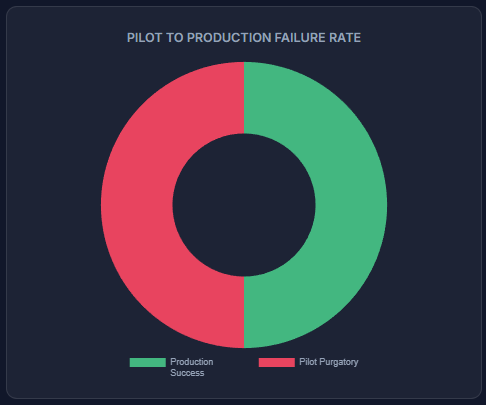
AI technology itself is mature. Keeping it stable in production is where most teams struggle. In 2026, roughly half of AI projects never make it from pilot to production, and the cause is almost always a reliability gap, not a capability gap.
The data quality and drift crisis
- Silent failure: as a model interacts with real-world data that drifts from its training distribution, accuracy erodes quietly. Without automated detection, AI recommendations can lose 20% to 50% of their reliability before anyone notices
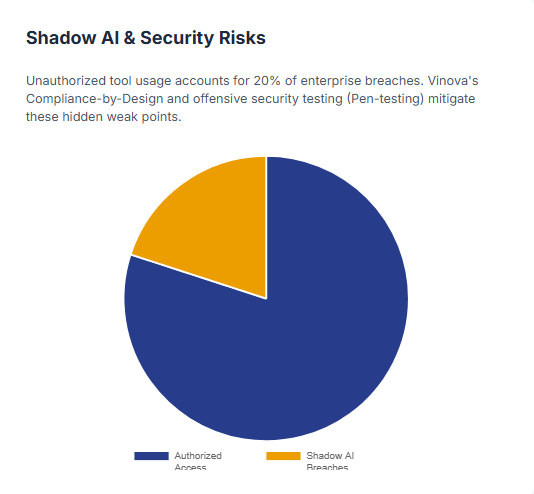
- Shadow AI: employees using unauthorised AI tools now account for roughly 20% of enterprise data breaches, creating hidden weak points that never show up on an approved-vendor list
The fragmentation trap
- Brittle systems: mid-sized organisations routinely juggle 100 to 300 disconnected tools. If one API fails, an LLM provider timing out, for instance, the whole application can crash rather than degrade gracefully
- Compliance friction: connecting these systems while maintaining PDPA and MAS TRM or GovTech IM8 standards is one of the most common friction points Singapore CTOs report, and it’s rarely solved by adding another point solution
The ROI gap
- Pilot purgatory: pilot projects frequently fail to show a clear path to profit, and CFOs are delaying a meaningful share of planned 2027 AI spending as a direct result
- Trust issues: a system that isn’t fault-tolerant doesn’t get trusted with revenue-generating tasks, which traps genuinely useful AI initiatives in permanent testing mode instead of production
Vinova’s Framework: What AI for Enterprise Singapore Actually Needs to Hold Up
Vinova solves stability problems with engineering discipline, not just better model training. Enterprise AI that recovers automatically from failure takes deliberate architecture, not a system that simply avoids failure until it doesn’t.
Strategic architecture: microservices and circuit breakers
Monolithic applications are fragile by design: one error can take down the entire system. Vinova mandates a Microservices Architecture that separates the AI engine from core business logic, so a model failure doesn’t crash the platform around it.
The Circuit Breaker Pattern: production apps in 2026 depend on third-party APIs like OpenAI or Anthropic, and those services do stall. Using resilience frameworks like Resilience4j, if an external AI service slows or fails, the breaker trips and immediately stops routing requests to it. Rather than crashing, the system falls back to a pre-set alternative, a cached response or a rule-based answer, so users keep getting a functional response while the primary service recovers.
Governance-first delivery model
Security can’t be an afterthought bolted on before an audit. Vinova runs a Compliance-by-Design framework specifically to close the gaps Shadow AI and unmonitored data flows create.
- ISO certified: Vinova operates under ISO 9001 (Quality Management) and ISO 27001 (Information Security), giving clients a verified layer of protection rather than a self-reported one
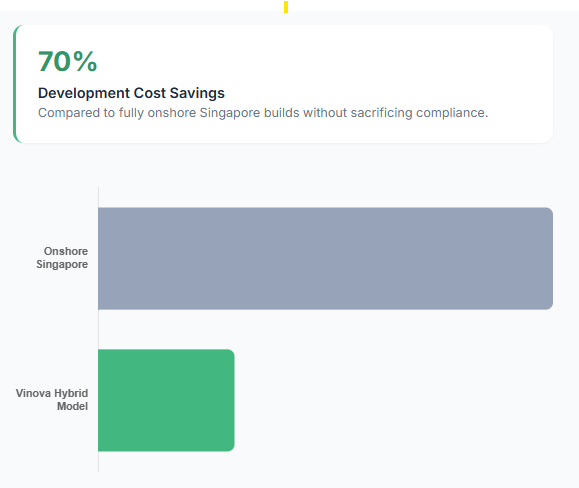
- Hybrid delivery: Singapore-based strategic oversight from Vinova’s Toa Payoh HQ, paired with scalable engineering delivery through Vietnam ODCs in Hanoi, Da Nang, and Ho Chi Minh City. This structure lowers development cost by up to 70% while maintaining strict adherence to Singapore regulatory standards including PDPA, MAS TRM, and GovTech IM8
Testing, Validation, and Continuous Learning Pipelines
A static AI model is already obsolete the day real-world conditions shift. Vinova runs Continuous Training pipelines, treating model validation as an ongoing operational discipline rather than a one-time pre-launch gate.
Automated drift detection
To catch silent failure before it compounds, Vinova deploys automated telemetry tracking data properties in real time, using statistical measures like Kullback-Leibler Divergence and the Population Stability Index to quantify how far live data has drifted from the original training distribution. We don’t guess when to alert on this: dynamic thresholds are calculated automatically rather than hardcoded, so when PSI crosses a critical limit, the system triggers an alert and can kick off a retraining pipeline on its own, closing the loop before accuracy visibly degrades for users.
Lossless data cleansing
Reliability starts with data integrity. Traditional data cleansing deletes an entire row the moment it finds one error, which wastes usable information at scale. Using frameworks like Apache Spark and Cleanframes, Vinova takes a lossless approach instead: missing values get corrected through statistical inference rather than discarding the row outright, reducing bias and keeping training datasets more representative of reality.
Offensive security: AI penetration testing
A significant share of unauthorised AI activity inside an enterprise traces back to internal misuse rather than external attack, which is why Vinova runs rigorous AI penetration testing as standard, not an optional add-on. We test specifically for prompt injection (tricking the model into ignoring its own guardrails) and model inversion (forcing a model to reveal private training data it was never supposed to expose), so a determined internal or external actor can’t quietly turn your own AI system against you.
Case Study: Building a Fault-Tolerant AI Platform for a Central Banking Client
Client: Monetary Authority of Singapore (MAS), for the SAMSv2 platform.
The challenge: a central banking environment demanding the highest levels of security, operational resilience, and regulatory compliance. In financial infrastructure, downtime or a compliance gap isn’t just an inconvenience, it’s a direct regulatory event with real consequences.
Vinova’s solution: we implemented IM8-compliant enterprise architecture, establishing DevSecOps pipelines and secure system integration from the ground up. Compliance was built into the architecture from day one, with secure data handling protocols derived directly from Vinova’s ISO 27001 certified processes, not retrofitted after an audit flagged a gap.
The results: zero high-severity security vulnerabilities identified in review, full regulatory approval, and reliable long-term service operation. Vinova’s hybrid team resolved integration challenges quickly enough to maintain a continuous operational tempo throughout delivery.
On how to build an AI enterprise app, read our guide right here.
| Ready to Build AI You Can Actually Rely On? Book a complimentary 2-hour AI Infrastructure Readiness Assessment with Vinova’s engineering team. We’ll audit your current architecture for single points of failure, review your drift monitoring gaps, and scope a governance-first delivery plan for US regulatory requirements. No commitment required. Schedule Your Free AI Reliability Assessment with Vinova |
AI for Enterprise Singapore FAQ
What does “AI for enterprise Singapore” actually mean beyond the buzzword?
In practice, it means AI systems built to Singapore’s specific operating conditions from day one: PDPA-compliant data handling, MAS TRM or GovTech IM8 alignment where relevant, and infrastructure that assumes it will be audited, not just demoed. A generic AI proof-of-concept built for a global market and a system genuinely built for AI for enterprise Singapore look similar on a slide deck and behave very differently the first time a regulator asks for an audit trail or a compliance officer asks how a decision was made.
What is the primary determinant of business survival in the Singapore AI market in 2026?
Reliability. Global AI spending has doubled to over $300 billion, and Singapore’s National AI Strategy 2.0 has pushed regional investment and adoption ahead of most comparable markets, but capital deployed doesn’t equal a system that actually holds up in production. As autonomous agents take on more of the decision-making, the gap between enterprise AI at the proof-of-concept stage and enterprise AI that runs reliably in production is where most initiatives actually fail.
What are Vinova’s three non-negotiable pillars of AI reliability?
Operational uptime (systems withstand traffic spikes and API failures without cascading), model integrity (automated detection catches hallucination and drift before they corrupt a decision), and governance (compliance is mandatory and enforced structurally, not audited in after the fact).
How does Vinova’s architecture keep a system available even when an external AI API fails?
Two mechanisms working together. A Microservices Architecture separates the AI engine from core business logic, so a model failure doesn’t take down the whole platform. On top of that, the Circuit Breaker Pattern monitors external AI service calls (OpenAI, Anthropic, etc.); if one stalls or fails, the breaker trips and routes traffic to a pre-set fallback, a cached response or a rule-based answer, so the system keeps serving functional responses while the primary service recovers rather than failing outright.
What is “Shadow AI” and why does it matter for enterprise security?
Shadow AI is employees using unauthorised AI tools outside of IT-approved channels. It’s a genuine security blind spot precisely because it doesn’t show up on a sanctioned-vendor list, and unauthorised or ungoverned AI usage more broadly is a recurring root cause behind enterprise AI security incidents, underscoring why governance needs to be architectural, not policy-only.
What does Vinova’s hybrid delivery model actually offer a Singapore enterprise?
Singapore-based strategic oversight and client governance from Vinova’s Toa Payoh HQ, paired with scalable engineering execution out of Vietnam ODCs in Hanoi, Da Nang, and Ho Chi Minh City. That structure reduces development cost by up to 70% compared to an equivalent fully onshore Singapore build, while maintaining strict adherence to PDPA, MAS TRM, and GovTech IM8 throughout delivery, not just at handoff.
| Vinova: Singapore’s AI reliability engineering partner since 2010. ISO 27001:2022 and ISO 9001:2015 certified. PDPA, MAS TRM, and GovTech IM8 aligned. 300+ in-house engineers across Singapore, Hanoi, Da Nang, and Ho Chi Minh City. 300+ successfully delivered projects across regulated industries including financial services. Financial Times Top 500 High-Growth Companies Asia-Pacific 2026. The Straits Times Singapore’s Fastest-Growing Companies 2024, 2025, and 2026. Explore Vinova’s AI engineering services. |