Navigating the decentralised technology landscape in 2026 requires more than standard software engineering talent. As enterprises migrate critical financial operations, supply chain logistics, and digital asset platforms to distributed ledgers, demand for specialised Web3 and enterprise engineers has reached an all-time high. Finding, vetting, and retaining top-tier talent remains one of the largest hurdles for growing companies and enterprise leaders alike.
Whether you need secure smart contracts, a decentralised application (dApp), zero-knowledge privacy solutions, or permissioned ledgers integrated into legacy systems, this guide covers everything you need to know about how to hire blockchain developers who deliver measurable business value.
Already comfortable with the fundamentals and want the Singapore-specific regulatory side instead — MAS licensing myths, IP ownership defaults, GST treatment, SIAC arbitration? See our guide to the traps specific to hiring in Singapore.
Table of Contents
Key Takeaways:
- Define your needs: Clearly categorize your project (public dApp vs. enterprise permissioned ledger) to determine whether you need a dedicated blockchain app developer or a hybrid engineer capable of bridging both systems.
- Prioritize security certifications: Always verify potential partners for ISO 27001 (Information Security Management) and ISO 9001 (Quality Management) to ensure institutional-grade handling of private keys and digital assets.
- Consider the hybrid model: Offshore hybrid teams often provide the best ROI by combining cost-efficient rates ($35–$80/hr) with built-in access to full-stack expertise, QA, and security auditing, outperforming individual freelancers.
- Account for full-cycle costs: A basic smart contract build typically ranges from $25,000 to $50,000, while larger enterprise projects can reach $350,000+, making it essential to budget for integration, testing, and compliance alongside pure development.
Understanding the Role: What Does a Blockchain Developer Do?
A blockchain developer designs, implements, and maintains decentralised software architectures. Unlike traditional web or backend engineers working with centralised databases, blockchain engineers specialise in cryptographically secured, immutable, distributed networks. Roles generally fall into three specialisations:
- Core protocol developers: architect the underlying blockchain networks, consensus algorithms (Proof-of-Stake, BFT), cryptographic frameworks, and base-layer security parameters
- Application (dApp) developers, the blockchain app developer role most companies actually need: build smart contracts and front-end/back-end integrations for decentralised applications, DeFi protocols, digital asset platforms, and Web3 interfaces
- Hybrid and enterprise blockchain engineers: bridge permissioned enterprise networks (Hyperledger Fabric, R3 Corda, Enterprise Ethereum) with public blockchain ecosystems (Ethereum, Solana, Arbitrum, Base) to balance data privacy with public verification
Core Responsibilities of a Dedicated Blockchain Engineer
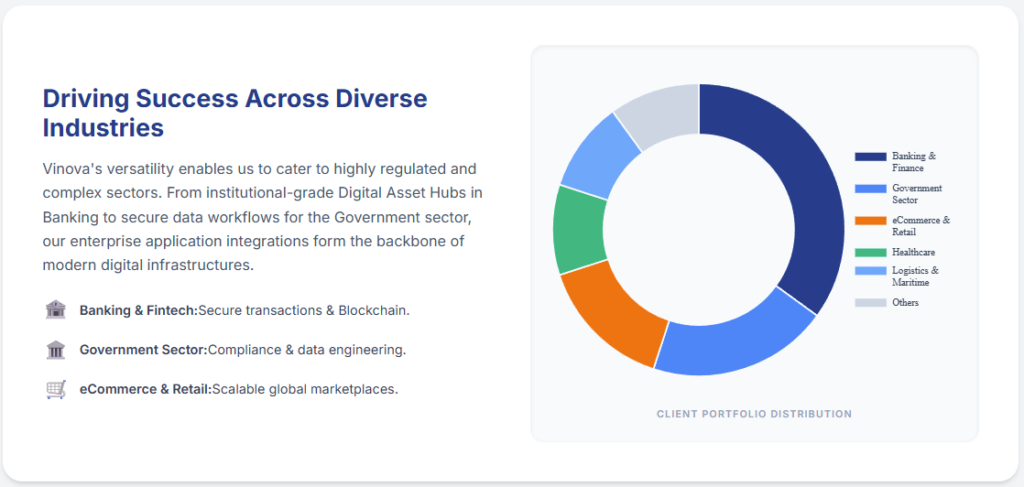
When you hire blockchain developers, their day-to-day work extends well beyond standard coding. A qualified engineer takes ownership of:
- Smart contract engineering and architecture: designing self-executing agreements using Solidity, Rust, Vyper, or Move, with heavy emphasis on gas optimisation and vulnerability prevention
- Decentralised application (dApp) development: building web-based interfaces and connecting them to distributed ledger networks using Web3 client libraries (Web3.js, Ethers.js, Viem, Wagmi)
- Cross-chain and hybrid system integration: connecting private corporate databases and legacy ERPs with public or private blockchain networks through secure APIs, middleware, account abstraction (ERC-4337), and cross-chain messaging protocols
- Cryptographic security and auditing: implementing public-key infrastructure, digital signatures, zero-knowledge proofs (zk-SNARKs/zk-STARKs), and rigorous unit/fuzz testing to prevent costly exploits
- Tokenomics and digital asset standards: minting, managing, and standardising fungible (ERC-20), non-fungible (ERC-721/1155), and real-world asset (RWA) tokenisation standards aligned with compliance and project economics
- Consensus and node operations: configuring, deploying, and maintaining node infrastructure for high availability, data synchronisation, and transaction finality
Key Strategic Benefits of Hiring Professional Blockchain Talent
Investing in specialised engineering capability yields distinct advantages over retraining generalist web developers on the fly.
1. Bulletproof system security and compliance
On an immutable ledger, code deployment is permanent. A single flaw in a smart contract can mean irreversible financial loss. Experienced blockchain developers bring an adversarial mindset, running formal verification and edge-case testing to safeguard digital assets before deployment, not after an exploit.
2. Faster time-to-market with AI-augmented engineering
Navigating Web3 SDKs, devnets, testnets, and gas estimation requires deep domain experience. Leading teams now integrate AI-augmented workflows (Cursor, GitHub Copilot, Claude Code) into secure SDLC pipelines to accelerate development lifecycles by up to 40% without compromising code quality.
3. Scalable, future-proof architecture
As transaction volumes grow, choosing the wrong chain, Layer-2/Layer-3 rollup, or state management strategy leads directly to network congestion and exorbitant fees. Expert developers design scalable architectures capable of handling genuine enterprise throughput from day one.
4. Enterprise validation: case study proof
Enterprise Digital Asset Hub: end-to-end development, AWS cloud deployment, security compliance, and ongoing engineering for an institutional-grade Digital Asset Hub, an annual contract exceeding SGD 1,000,000. Tier-1 financial institutions and regulatory-compliant digital asset platforms need partners with institutional-grade delivery standards and proven cloud infrastructure experience, not a team learning enterprise compliance on the project.
Essential Skill Set to Look For in Candidates (2026 Benchmark)
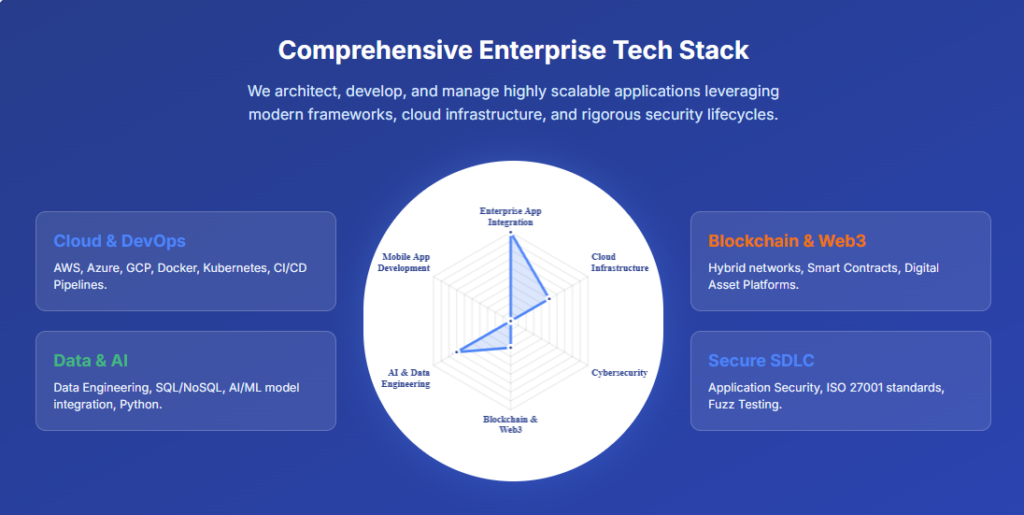
When evaluating candidates or development partners, verify proficiency across these domains:
| Category | Must-Have Competencies and Technologies |
| Smart contract languages | Solidity, Rust, Vyper, Move |
| Blockchain platforms | Ethereum (EVM), Solana, Hyperledger Fabric, Polygon, Arbitrum, Base, Avalanche |
| Cryptographic standards | Elliptic Curve Cryptography (ECC), SHA-256, Zero-Knowledge Proofs (zk-SNARKs/zk-STARKs), Account Abstraction (ERC-4337) |
| Web3 tooling and frameworks | Foundry, Hardhat, Anchor, Viem, Ethers.js, Wagmi |
| General programming | C++, Go, Python, TypeScript / JavaScript, Node.js |
| DevOps and security | Docker, Kubernetes, Infura, Alchemy, AWS KMS, Hardware Security Modules (HSMs), Chainlink, ISO 27001 SDLC |
Comparing Hiring Models: In-House vs. Freelance vs. Offshore Hybrid
Choosing the right engagement model depends directly on your budget, technical leadership, and project scale:
| Dimension | In-House | Freelance | Offshore Hybrid |
| Cost efficiency | Low ($150k-$250k+ salary, benefits, overhead) | High ($65-$150/hr, variable reliability) | Very high ($35-$80/hr, enterprise-grade) |
| Scalability | Slow (months to source and onboard) | Medium (dependent on contractor availability) | Fast (pre-vetted teams ready in days) |
| Technical depth | Variable (limited to single hire scope) | Unverified (requires deep internal testing) | Comprehensive (full-stack Web3 teams) |
| Hybrid expertise | Rare (hard to find public + enterprise mix) | Unlikely | Built-in (specialised in bridging enterprise and public chains) |
| Code quality and governance | High (direct internal oversight) | Low to moderate | High (ISO certified quality, SLAs, tech leads) |
Why the offshore hybrid blockchain developer model dominates in 2026
For companies seeking maximum return on investment, sourcing an offshore hybrid blockchain developer or managed hybrid dev team offers the best balance:
- Dual architecture capabilities: engineers fluent in enterprise privacy (Hyperledger, R3 Corda) and public scale (Ethereum EVM, Layer 2s, Rust/Solana)
- Cost optimisation: access to top-tier global engineering talent at $35 to $80/hr, versus domestic US/EU rates exceeding $150 to $250/hr
- Overlapping work hours and agile alignment: structured agile workflows with real-time sync windows for product managers and technical leads
Step-by-Step Hiring and Security Vetting Playbook
Follow this structured playbook to screen, evaluate, and hire top blockchain talent safely:
- Define your technical architecture: determine whether your project needs a public blockchain, a private enterprise ledger, or a hybrid blockchain development strategy combining both
- Choose the right delivery model: decide between full-time core staff or a managed dedicated team of offshore hybrid blockchain developers
- Verify partner security and certifications: ISO 27001 (Information Security Management, critical for private key and digital asset handling), ISO 9001 (Quality Management), and ISTQB-certified QA engineers running standardised testing and security auditing protocols
- Conduct practical code audits: ask candidates to analyse an intentionally flawed smart contract and identify reentrancy bugs, access control flaws, or unhandled exceptions
- Formalise IP and governance protections: strict NDAs, complete intellectual property transfer terms, and secured physical/cloud development environments
The Vinova Technical Interview Playbook
Evaluating top-tier blockchain engineers requires probing beyond theoretical surface knowledge to test structural architecture design, gas efficiency, and defensive coding mindset. Rooted in Vinova’s 16+ years of software engineering excellence and ISO 9001-certified delivery standards across our Singapore HQ and Vietnam offshore tech centres, this is the same interview playbook our technical leaders use to separate general full-stack developers from genuine Web3 architects.
Technical and architectural evaluation
Smart contract error handling and EVM control flow. Question: how do require, assert, and custom errors using revert CustomError() differ in Solidity, and what are their respective gas implications in modern EVM executions?
What to look for: candidates should highlight that while require historically checked conditions and assert tested internal invariants, custom errors using revert CustomError(arg1, arg2) are the 2026 industry standard for gas optimisation. They avoid storing expensive error string literals in contract bytecode, meaningfully reducing deployment and execution costs.
Data storage and state write optimisation. Question: explain the architectural difference between storage, memory, and calldata in EVM execution. How do you structure contract storage variables to optimise gas costs?
What to look for: candidates must explain that storage writes directly to the immutable state tree (the most expensive operation), memory provides temporary execution space for internal calls, and calldata is non-modifiable, temporary space for external function parameters (cheapest for reading inputs). Advanced engineers will discuss variable packing under 32-byte slots, immutable and constant keywords, and minimising state mutations during loop executions.
Cryptographic verification and zero-knowledge trees. Question: how do Merkle trees enable light clients and zero-knowledge rollup systems (zk-SNARKs/zk-STARKs) to verify data integrity efficiently?
What to look for: a clear explanation of cryptographic hash pairing producing a single Merkle Root, and how Merkle proofs allow verification of transaction membership in logarithmic time, O(log N), without downloading full block datasets. This is a critical capability when integrating public chains with private enterprise databases.
Consensus invariants and double-spending prevention. Question: how do distributed ledgers structurally prevent double-spending without relying on a central clearinghouse or single point of failure?
What to look for: detailed discussion around deterministic state transition functions, block finality windows, cryptographic signatures (ECDSA/BLS), and consensus mechanics such as Proof-of-Stake validator attestations, slashing penalties, or Byzantine Fault Tolerant threshold cryptography in enterprise permissioned networks like Hyperledger Fabric or R3 Corda.
Modern account abstraction and Web3 UX architecture. Question: how does ERC-4337 (Account Abstraction) change key management, paymasters, and user onboarding in consumer-facing Web3 applications?
What to look for: the candidate should articulate how ERC-4337 decouples account ownership from private keys by converting user accounts into smart contract wallets, and explain the roles of Bundlers (packaging user operations) and Paymasters (sponsoring gas fees or accepting fiat/ERC-20 tokens for gas), enabling seedless social recovery and Web2-smooth onboarding.
Behavioural and cultural fit evaluation
Exploit remediation and crisis response. Question: describe a critical vulnerability, reentrancy risk, or unhandled exception you uncovered during unit testing, fuzzing, or a formal security audit. How did you remediate it?
What to look for: systematic DevSecOps practices. Candidates should reference hands-on experience with modern testing toolstacks (Foundry, Hardhat, Slither, Mythril, or Playwright for automated E2E tests) and strict adherence to defensive design principles like the Checks-Effects-Interactions pattern or reentrancy guards.
Tracking rapid Web3 stack evolution. Question: how do you stay updated on rapid EVM/EIP changes, emerging smart contract languages (Rust, Move, Vyper), and zero-knowledge developments?
What to look for: active participation in audit competitions (Code4rena, Sherlock), tracking Ethereum Improvement Proposals, participating in open-source GitHub repositories, and testing experimental frameworks on testnets.
Cross-functional enterprise communication. Question: how do you explain complex technical trade-offs, such as choosing between Layer-1 security finality and Layer-2 transaction latency and gas costs, to non-technical product managers or enterprise C-suite executives?
What to look for: the ability to translate low-level cryptographic mechanisms into business ROI, financial risk mitigation, compliance impacts, and end-user performance metrics.
Onboarding and Retaining High-Performing Blockchain Developers: The Vinova Operating Model
Hiring top-tier blockchain talent is only the initial milestone. In high-demand Web3 engineering, maintaining code momentum and safeguarding intellectual property require an enterprise-grade onboarding process and a retention strategy backed by institutional standards.
At Vinova, our ISO 27001:2022 and ISO 9001:2015 certified hybrid delivery model bridges Singapore management oversight with high-velocity offshore engineering in Vietnam. We apply this exact operational framework to onboard and retain elite blockchain talent.
Vinova’s 90-day onboarding playbook
Security, key management, and DevSecOps provisioning (Days 1-15): hardware key authentication (YubiKey/FIDO2) and role-based repository access under Vinova’s ISO 27001 security guidelines, plus pre-configured, dockerized development environments equipped with standard frameworks (Foundry, Hardhat, AWS KMS keys for staging, isolated local devnets), so developers can write code on Day 1 without environment friction.
Architecture integration and knowledge bridging (Days 16-45): structured Confluence architecture repositories, past smart contract audit reports, threat models, and API specifications, paired with dedicated mentorship from a Vinova Senior Tech Lead or Solutions Architect to guide peer code reviews, clarify domain-specific smart contract logic, and align on team coding standards.
Agile sprint delivery and milestone mapping (Days 46-90): 30-60-90 day KPIs managed through Jira and Smartsheet, with initial deliverables focused on high-impact, bounded tasks, refactoring gas-intensive contract functions, building automated fuzzing suites, or executing cross-chain bridge API integrations.
Long-term retention strategies
- Value-aligned compensation packages: competitive base salaries combined with long-term retention triggers, performance bonuses, equity options, or multi-year vested token allocations with structured cliff periods, to align engineer success directly with project longevity
- Sponsored continuous upskilling: funding advanced security auditing courses, Web3 certifications (Certified Blockchain Developer), and attendance at global tech summits or hackathons
- Autonomous, high-trust work culture: flexible, remote-first workflows backed by modern async tools (Slack, Jira, GitHub Enterprise, and AI-augmented coding assistants like Cursor and GitHub Copilot). High-performing Web3 developers excel when evaluated on outcome, code quality, and security rather than micromanaged hours
Vinova onboarding and retention action plan
| Pillar | Strategic Focus | Vinova Operational Action | Enterprise Impact |
| Onboarding | ISO-compliant security setup | Provision YubiKey hardware tokens, AWS KMS staging keys, and zero-trust repository permissions | Prevents key leaks and reduces environment configuration time from weeks to hours |
| Onboarding | Architectural mentorship | Pair new hires with a Vinova Tech Lead for structured PR reviews and Confluence walkthroughs | Cuts developer ramp-up time by up to 50% while preserving code style consistency |
| Onboarding | Agile delivery alignment | Map 30-60-90 day performance milestones using Jira and Smartsheet sprint boards | Establishes early delivery velocity and measurable engineering output |
| Retention | Incentive alignment | Benchmark compensation against market rates; structure multi-year equity or token vesting | Minimises turnover in high-demand roles and protects institutional project memory |
| Retention | Continuous upskilling | Sponsor ISO 27001 DevSecOps training, security audit workshops, and Web3 certifications | Keeps full-stack and smart contract engineering skills current as the stack evolves |
| Retention | Async developer autonomy | Deploy asynchronous workflows supported by AI tooling (Cursor, Copilot, Claude Code) | Boosts engineering throughput, reduces burnout, and improves job satisfaction |
How Much Does It Cost to Hire Blockchain Developers in 2026?
Cost varies by geographic region, engagement model, and candidate seniority:
- In-house US/EU senior engineer: $150,000 to $250,000+/year, plus token or equity incentives
- Freelance Web3 developer: $65 to $150+/hour
- Offshore hybrid blockchain developer or team: $35 to $80/hour, delivering enterprise-grade architecture at significantly lower overhead
2026 project-based budget benchmarks
- Basic smart contract or dApp audit/build: SGD $25,000 to $50,000 (1 to 2 months)
- Mid-sized enterprise blockchain development project: SGD $60,000 to $150,000 (3 to 5 months)
- Full-scale hybrid multi-chain ecosystem: SGD $150,000 to $350,000+ (6 to 12+ months)
| Ready to Hire Blockchain Developers Who Deliver? Book a free 2-hour consultation with Vinova’s senior Web3 architects. We’ll assess your chain and architecture requirements, and scope a delivery team that fits your budget and timeline. No commitment required. Book Your Free Blockchain Architecture Consultation with Vinova |
Hire Blockchain Developers FAQ
What’s the difference between a blockchain development company and hiring individual freelance developers?
A blockchain development company provides a full team with built-in project management, QA, and security auditing under a single accountable contract, versus assembling and managing individual freelancers yourself. For a genuinely practical blockchain development project, most companies underestimate how much of the total effort is integration, testing, and security review, not just writing smart contracts, which is exactly where a solo freelancer’s coverage gets thin. Blockchain development companies with ISO-certified processes solve that gap structurally, not by hoping the freelancer happens to be thorough. If you’d rather compare vetted companies directly than manage the hiring process yourself, see our ranking of blockchain development companies in Singapore.
How long does it take to hire a blockchain developer and start a project?
In-house hiring for a senior blockchain engineer typically runs 2 to 4 months once you account for sourcing, technical interviews, and negotiation, longer if you need someone with genuine dual public/enterprise chain experience, since that combination is rare. An offshore hybrid team can typically start within days to a couple of weeks, since the vetting has already happened before the engagement, not during it.
Do I need a blockchain app developer or an enterprise blockchain development specialist?
It depends on who’s using the system. A consumer-facing DeFi app, NFT marketplace, or public Web3 product needs a blockchain app developer focused on smart contracts, gas optimisation, and public-chain UX. A supply chain platform, institutional settlement system, or internal enterprise tool handling private data usually needs enterprise blockchain development expertise instead, permissioned ledgers like Hyperledger Fabric or R3 Corda, paired with legacy system integration. Many real projects need both, which is exactly the dual-architecture case for a hybrid team over a single specialist.
What security certifications should a blockchain development partner actually have?
ISO 27001 (Information Security Management) is the non-negotiable one, since it directly governs how a partner handles private keys and digital asset custody, not just general data security. ISO 9001 covers consistent quality management, and ISTQB-certified QA engineers indicate the team runs standardised testing and security auditing protocols rather than ad-hoc review. A partner missing all three is asking you to trust their process on faith alone.
Can a small team afford enterprise-grade blockchain development?
More often than the sticker price suggests. An offshore hybrid team delivering enterprise-grade architecture at $35 to $80/hour is frequently cheaper than a single in-house senior hire at $150,000 to $250,000 a year, and comes with a full team’s coverage (security auditing, QA, project management) instead of one person’s bandwidth. A basic smart contract or dApp build starting around $25,000 to $50,000 is genuinely within reach for many small teams that assume blockchain development is enterprise-only spend.
| Vinova: Singapore’s blockchain development and enterprise engineering partner since 2010. ISO 27001:2022 and ISO 9001:2015 certified. 300+ successful digital projects delivered for 250+ global clients across Singapore, Southeast Asia, Europe, and North America. Senior offshore hybrid blockchain developers specialising in public chains (Ethereum, Solana, Polygon) and enterprise systems (Hyperledger, AWS Cloud). Financial Times Top 500 High-Growth Companies Asia-Pacific 2026. The Straits Times Singapore’s Fastest-Growing Companies 2024, 2025, and 2026. Explore Vinova’s blockchain development services. |