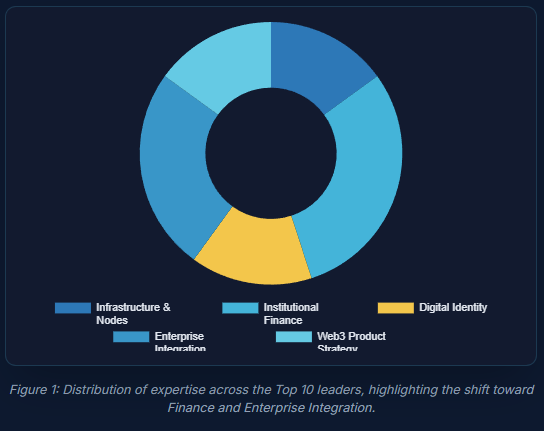
Singapore hosts one of the densest concentrations of blockchain talent in Asia, spanning infrastructure providers, institutional finance platforms, DeFi specialists, and enterprise integrators. There is no single “best” blockchain development company here; the right choice depends entirely on what you’re building, your regulatory exposure, and whether blockchain is the whole product or one piece of a larger system.
This guide profiles the top blockchain development companies actively building in Singapore’s sector in 2026, whether you’re searching for a blockchain development company businesses can trust with a full build, or a blockchain software development company to integrate into an existing product, what each one actually does, who they’ve worked with, and who they’re genuinely the right fit for. It closes with a quick-reference table and a short checklist for evaluating any vendor, whichever of the ten you’re considering.
Table of Contents
Our Evaluation Methodology
To compile this shortlist, we assessed active Singapore blockchain vendors against five benchmarks:
- Production track record: verified live deployments, not just prototypes or unlaunched demos
- Regulatory and compliance alignment: experience navigating MAS frameworks, ISO 27001, and institutional risk requirements
- Infrastructure and security rigour: documented smart-contract auditing, ZKPs, MPC, and penetration testing practices
- Integration versatility: ability to connect decentralised protocols with legacy enterprise systems (ERP, core banking, cloud APIs)
- Technical specialisation: proven depth in a specific domain, whether that’s node infrastructure, asset tokenisation, trade finance, or verifiable credentials
1. Vinova: Best for Blockchain Woven Into an Existing Enterprise System
Connects decentralised protocols with core enterprise ERPs without disrupting existing operational workflows.
Vinova is a Singapore-headquartered software engineering firm founded in 2010, with 16+ years of delivery and 300+ projects across banking, maritime logistics, and digital asset infrastructure. Blockchain is one part of a broader enterprise software practice, not the entire business. One independent industry guide described it as “a reliable, long-standing development company in Singapore… focused on building custom dApps and maintaining long-term technical partnerships with SMEs and startups.”
Its blockchain case studies include a multi-year partnership with digital asset exchange XBourse Global (backend trading infrastructure, wallet integrations), a verifiable-credentials platform (CredShare), and Navig8 Connect, a maritime data platform echoing the trade-document provenance work also seen in XinFin’s niche. Beyond blockchain specifically, Vinova counts enterprise names like Samsung and OCBC among its broader client base. Its real differentiator against the more blockchain-exclusive names above is enterprise integration, connecting blockchain into legacy ERP or core banking rather than shipping it in isolation. Best if you already have a working business and need blockchain added without disrupting it; a more specialised name below may fit better for a pure-play token launch or Cardano-native build.
- Good fit for projects requiring integration with legacy systems and existing enterprise workflows, not a standalone blockchain product
The Trade-Off
Vinova functions as a long-term enterprise integration partner, not a token-launch marketing agency, if that’s specifically what you need, a name later on this list fits better.
The Key Takeaway
Choose Vinova if you need to integrate custom dApps or tokenisation modules into legacy ERPs (SAP, Oracle, Odoo) and enterprise cloud infrastructure without disrupting what’s already running.
Key Features
- Enterprise integration as the core discipline: connecting blockchain to legacy ERP, core banking, and existing operational systems
- 16+ years and 300+ delivered projects of broader software engineering underneath the blockchain-specific work
- Combined capability across blockchain, AI, and IoT, so a project can draw on more than one discipline from the same team
Benefits
- Blockchain gets added into what you already run, without a rebuild or a second vendor relationship to manage
- One long-term technical partner rather than juggling a blockchain specialist alongside your regular software vendor
- Lower integration risk, since the same team that understands your legacy systems is the one building the blockchain layer
2. Chainstack: Best for Managed Web3 Infrastructure
Removes the operational overhead of running nodes, letting engineering teams focus entirely on application logic.
Among the options for a blockchain development company Singapore teams researching infrastructure providers will run into, Chainstack stands out early. Founded in 2018 by Laurent Dedenis and Eugene Aseev, Chainstack is headquartered in Singapore and has raised roughly $6M across investors including SBI Ven Capital, Sygnum, and Azimut Group. Rather than building applications, Chainstack builds the plumbing underneath them: managed blockchain nodes and RPC APIs across 70+ protocols, deployable in minutes.
The company reports handling over 100 billion requests a month with 99.99%+ uptime, and counts Web3 platforms like Ronin and the Robinhood-linked Robinhood Chain among its node customers. If your team is building a dApp and needs reliable, low-latency chain access without running your own node infrastructure, Chainstack is the specialist to talk to, though it won’t help with the application layer itself, that’s not what it sells.
- Worth prioritising where reliability and compliance genuinely matter, e.g. fintech, gaming, supply chain
The Trade-Off
Chainstack focuses exclusively on node and RPC infrastructure. It doesn’t offer application-layer design or smart contract development, so you’ll still need a separate team for the product itself.
The Key Takeaway
Choose Chainstack if you need enterprise-grade, multi-chain RPC infrastructure without managing physical node clusters in-house.
Key Features
- Unified access to 70+ blockchain protocols through a single API, no separate integration per chain
- Latency-aware routing that steers requests to the nearest healthy node, delivering sub-100ms responses globally
- Both managed and self-hosted deployment options, so infrastructure control isn’t an all-or-nothing choice
Benefits
- You stop babysitting node uptime, patching, and failover, and put that engineering time into your actual product
- Predictable performance at scale means fewer surprises when usage spikes, without over-provisioning in advance
- Multi-chain support from day one, so a future chain migration doesn’t mean rebuilding your infrastructure layer
3. STACS (Hashstacs): Best for Institutional Finance and Tokenisation
Bridges legacy financial workflows with blockchain settlement through regulatory-compliant infrastructure.
For a blockchain development company Singapore banks specifically trust, STACS, legally Hashstacs Pte Ltd, is a Singapore fintech firm built specifically for capital markets and asset tokenisation, running on its own blockchain platform, Vetta. Its track record is unusually deep on the regulated-finance side: “Project Nathan” with Swiss private bank EFG (structured products, MAS FSTI grant-funded), a proof-of-concept with Deutsche Bank Securities Services, OTC derivatives processing with CSOP Asset Management, and an ESG data registry built under MAS’s Project Greenprint. STACS was also selected for Mastercard’s Start Path programme in its inaugural batch.
This is the company to shortlist if you’re a bank, asset manager, or exchange working on digital securities, structured products, or ESG data infrastructure specifically, domains where STACS has already shipped production platforms with named financial institutions, not just pilots.
- Strong fit for projects involving digital securities, real-world asset (RWA) tokenisation, or institutional DeFi
The Trade-Off
STACS is highly specialised for capital markets and institutional finance. It’s not the right fit for generic consumer dApps or gaming projects.
The Key Takeaway
Choose STACS if you’re a bank, asset manager, or exchange launching regulated digital securities, RWAs, or ESG registries.
Key Features
- Vetta, a purpose-built platform for digital securities and structured products, not a generic smart-contract toolkit adapted for finance
- Direct MAS regulatory pedigree: FSTI grant-funded pilots and Project Greenprint involvement, not just self-reported compliance claims
- Live production integrations with named institutions (EFG Bank, Deutsche Bank, CSOP Asset Management), not only proof-of-concepts
Benefits
- A faster, lower-risk path to launching a regulated tokenised product, since the platform has already cleared MAS-adjacent scrutiny elsewhere
- Settlement and asset-management workflows that plug into how banks already operate, rather than forcing a parallel process
- Credibility with institutional counterparties who recognise STACS’s track record with peer financial institutions
4. Accredify: Best for Verifiable Credentials and Digital Identity
Turns paper documents into instantly verifiable digital credentials at national scale.
Not every blockchain development company Singapore businesses shortlist builds consumer products; Accredify, founded in December 2019 and headquartered in Singapore, builds blockchain-based verifiable credentials, tamper-proof digital certificates that can be instantly verified. It’s raised a $7M Series A (iGlobe Partners, SIG Venture Capital) and reports having issued over 10 million credentials with more than 12 million verifications processed.
Its client list leans heavily government and institutional: Singapore’s ACRA, the National University of Singapore, CAAS, SCDF, and the Ministry of Health, for whom it co-developed Singapore’s HealthCerts digital COVID-status standard during the pandemic. It’s deployed on Singapore’s Government Commercial Cloud and Healthcare Cloud, and won AWS Local Software Partner of the Year in 2024. If your use case is credentials, certificates, or any document that needs to be tamper-proof and instantly verifiable at scale, this is the most specialised option on this list.
- Strong fit where trust, authenticity, and anti-fraud protection are the core requirement, not a nice-to-have
The Trade-Off
Accredify is focused strictly on document verification and credentials. It won’t build DeFi protocols or custom tokenomics.
The Key Takeaway
Choose Accredify if your organisation needs tamper-proof, instantly verifiable certificates or identity credentials backed by government-grade security.
Key Features
- W3C and OpenBadges standards compliance, so credentials are globally interoperable rather than locked to one platform
- Backend-as-a-service architecture, meaning it can power an existing front-end rather than forcing a full platform swap
- Proven deployment on government-grade cloud environments, including Singapore’s Healthcare Cloud and MINDEF Commercial Cloud
Benefits
- Documents become instantly, independently verifiable, removing the manual back-and-forth of checking authenticity with the issuer
- Meaningfully reduces fraud risk on credentials, certificates, and licences at a scale most in-house teams can’t build for
- A track record already proven at national scale (10M+ credentials issued) de-risks adopting it for a smaller institution
5. TokenMinds: Best for Web3 Product Launches with Marketing Built In
Aligns technical smart contract architecture with go-to-market tokenomics under one roof.
As a blockchain development company Singapore founders raising a token round often encounter, TokenMinds is a Singapore-based Web3 and AI agency founded around 2016 by Rob Eijgenraam, reporting over 200 global clients across blockchain, tokenisation, gaming, and iGaming. Its differentiator is that it doesn’t stop at development: it pairs smart contract engineering (Ethereum, Polygon, BNB Chain, Solana) with token launch strategy, marketing, and community growth under one roof, and has more recently added an AI-native product layer (agentic treasury management, automated KYC checks) on top of its Web3 work.
If you’re launching a token, DeFi product, or gaming platform and need go-to-market support alongside the build, not just code, TokenMinds is built for exactly that combination. If you already have marketing in-house and just need engineering, that bundled model may be more than you need.
- Good fit where you need both technical depth and regulatory awareness for Singapore and APAC markets
The Trade-Off
The bundled development-and-marketing model may offer more service scope than you need if you’re only after standalone code development.
The Key Takeaway
Choose TokenMinds if you need one partner to handle both technical smart contract execution and token launch marketing.
Key Features
- Smart contract engineering across Ethereum, Polygon, BNB Chain, and Solana under one team, not a single-chain specialist
- Development and go-to-market (marketing, community, token strategy) run as one integrated engagement, not separate contracts
- A newer AI-native layer (agentic treasury tools, automated KYC checks) layered on top of the core Web3 build capability
Benefits
- One vendor relationship instead of coordinating a dev shop and a marketing agency separately, with less risk of the two being misaligned
- Faster path from build to launch, since go-to-market planning happens in parallel with development, not after
- Regulatory and compliance awareness baked into the token design itself, reducing the odds of a costly redesign later
6. AuroBlocks: Best for Focused, Boutique DeFi and NFT Builds
Delivers senior-level engineering focus for fast-moving Web3 MVPs.
A smaller blockchain development company Singapore founders sometimes overlook, AuroBlocks is a smaller, bootstrapped Singapore studio co-founded by Tejas Chitnis and Ashwin Yardi, founded around 2018. It’s a genuinely boutique operation, publicly listed team sizes run under 50, working across NFT platforms, DeFi protocols, staking systems, and token creation, with sector work spanning banking, logistics, gaming, retail, and healthcare.
Its size cuts both ways: a small, focused Web3 studio can move fast and give a project direct access to senior people, but it also means less redundancy and bench depth than a larger firm if a project scales quickly or needs broad non-blockchain engineering alongside the Web3 work. Best suited to a well-scoped DeFi, NFT, or asset-tokenisation build rather than a sprawling enterprise integration.
- Good fit for startups needing a full-stack Web3 product team that can move from concept to MVP quickly
The Trade-Off
Smaller engineering capacity means less bench depth for a massive enterprise legacy transformation compared to larger systems integrators.
The Key Takeaway
Choose AuroBlocks if you want a dedicated boutique Web3 studio to take a DeFi or NFT concept to MVP quickly.
Key Features
- Broad tooling across NFT platforms, staking protocols, decentralised exchanges, and token creation under a single small team
- Direct founder involvement (Tejas Chitnis, Ashwin Yardi) on client work, rather than layers of account management
- Sector experience spanning gaming, retail, logistics, and healthcare, not narrowly confined to one vertical
Benefits
- Faster turnaround on a well-scoped build, since decisions don’t need to move through a large organisational structure
- Direct access to senior technical people throughout the project, not just at the pitch stage
- Lower overhead cost typical of a boutique studio, useful when budget matters as much as capability
7. ROCKETECH: Best for Design-Led Consumer dApps
Bridges complex Web3 backend protocols with intuitive, consumer-ready mobile design.
Unlike most entries here, this blockchain development company Singapore clients hire isn’t blockchain-only. ROCKETECH is a different kind of entry on this list: founded in 2015 with offices spanning Kyiv, Singapore, London, and San Francisco, it’s a broader custom software and mobile app development company where blockchain is one service line among several (alongside UX/UI design and IT staff augmentation), not its sole focus.
That shows in its blockchain work, crypto wallets and NFT platforms built with a stronger emphasis on interface design and usability than some of the more engineering-first names on this list. If your blockchain product’s success depends heavily on consumer-facing UX, not just backend correctness, ROCKETECH’s broader software and design background is a genuine advantage. If you need deep, specialised protocol-level expertise, a blockchain-only shop may serve you better.
- Good fit where UX, design, and mobile experience are as critical as the underlying chain logic
The Trade-Off
As a broader software and design firm, ROCKETECH may lack the deep protocol-level research capability of a crypto-only studio.
The Key Takeaway
Choose ROCKETECH if consumer adoption and seamless mobile UX matter as much to your dApp as the underlying smart contract.
Key Features
- A broader software and UX/UI design discipline that blockchain work sits inside, not a blockchain-only shop
- International team footprint (Kyiv, Singapore, London, San Francisco) built for round-the-clock delivery
- Design-led product process applied to crypto wallets and NFT platforms specifically, not generic app templates
Benefits
- Better real-world adoption, since the product is built to be genuinely usable, not just technically correct
- One team can handle both the blockchain layer and everything else the product needs, cutting vendor coordination
- A larger engineering bench to draw on if the project’s scope grows beyond the original blockchain feature
8. Saola Labs: Best for Complex Backend and Real-Time Transaction Systems
Excels at complex backend integrations bridging traditional systems with decentralised finance.
A blockchain development company Singapore and Vietnam both claim, Saola Labs operates across Singapore and Vietnam, with a technical focus on DeFi, tokenisation, and Web3 payments, AMM DEXs, lending protocols, non-custodial wallets, and crypto trading, staking, and custody infrastructure. Independent client reviews on Clutch consistently highlight its handling of complex backend integrations, including web-based eSIM management tooling for a telecom client, a use case well outside typical crypto-native work.
That range, from DeFi protocols to telecom backend systems, suggests real strength in general systems engineering with blockchain layered in, not just template smart contracts. Worth shortlisting for projects with real-time transaction complexity or unusual backend integration requirements, less of a fit if you want a pure-play crypto specialist.
- Good fit where the project has genuine backend complexity, not just a standard token contract
The Trade-Off
The cross-border delivery model needs structured project governance to keep the Singapore and Vietnam teams fully aligned.
The Key Takeaway
Choose Saola Labs if your project involves complex backend logic or high-frequency transaction processing alongside blockchain code.
Key Features
- Dual Singapore and Vietnam engineering base, combining regional presence with cost-efficient delivery capacity
- Demonstrated range outside pure crypto work, including telecom eSIM management backend systems
- Both DeFi (AMM DEXs, lending protocols, non-custodial wallets) and CeFi (custody, staking, on/off-ramp) capability in-house
Benefits
- Genuine engineering depth for complex, real-time transaction systems, not just template smart-contract deployment
- Flexibility to build either a fully decentralised product or a centralised-finance-style platform without switching vendors
- Cost efficiency from the Vietnam-based engineering capacity without losing Singapore-based project oversight
9. EMURGO: Best for Cardano-Specific Development
Offers unmatched, protocol-level expertise for projects building natively on Cardano.
Not your typical blockchain development company Singapore style entry, EMURGO occupies a unique position: founded in Japan in June 2017 by Ken Kodama, it’s one of three founding pillars of the Cardano blockchain itself (alongside Input Output Global and the Cardano Foundation), now headquartered in Singapore with offices across Indonesia, India, the US, and Africa. It built Yoroi, Cardano’s first light wallet, and runs EMURGO Ventures, a roughly $100M investment vehicle backing Cardano-ecosystem startups, plus EMURGO Academy for developer education.
If your project is built specifically on Cardano, or you’re evaluating Cardano as a chain, EMURGO’s institutional position inside that ecosystem is unmatched on this list. Outside the Cardano ecosystem specifically, its relevance narrows considerably, this is a chain-specific specialist, not a multi-chain generalist.
- Good fit where you need Cardano-specific smart-contract and tooling expertise, not general multi-chain support
The Trade-Off
EMURGO is strictly focused on the Cardano ecosystem. It doesn’t offer development on Ethereum, EVM L2s, or Solana.
The Key Takeaway
Choose EMURGO if your project is committed to building natively within the Cardano ecosystem.
Key Features
- Founding-pillar status in the Cardano protocol itself, alongside Input Output Global and the Cardano Foundation
- Built and operates Yoroi, Cardano’s first light wallet, giving it direct product experience in the ecosystem it advises on
- Runs its own roughly $100M investment vehicle (EMURGO Ventures) and a developer education arm (EMURGO Academy)
Benefits
- Insider-level access to Cardano’s roadmap and tooling that a general multi-chain shop genuinely can’t match
- Potential access to EMURGO’s investment and accelerator network if the project is Cardano-aligned
- Lower technical risk building on Cardano specifically, since the team helped build the chain itself
10. XinFin / XDC Network: Best for Trade Finance and Tokenised Real-World Assets
Connects trade finance assets to digital liquidity via native ISO 20022 banking standards.
Among banks searching for a blockchain development company Singapore regulators recognise, XinFin, founded in 2017 by Ritesh Kakkad and Atul Khekade, built the XDC Network, a Singapore-headquartered enterprise blockchain purpose-built for trade finance, with native interoperability with ISO 20022 banking messaging standards. The network’s XDC 2.0 upgrade (Q4 2024) was developed with Princeton professor Pramod Viswanath’s protocol team. XDC was the first blockchain admitted to the global Trade Finance Distribution Initiative and partnered with Tradeteq to issue the first regulated, trade-finance-backed security tokens. It’s also connected to Contour Network, a bank-led trade document digitisation platform involving MUFG, ICBC, Bank of China, and DBS.
This is the specialist for tokenising real-world trade assets, invoices, letters of credit, warehouse receipts, at institutional scale, an unusually narrow and well-proven niche. If your project isn’t trade finance or ISO 20022-adjacent, this specialisation won’t be directly relevant.
- Good fit for institutions needing a regulated, scalable blockchain built for financial operations specifically
The Trade-Off
XinFin/XDC is highly specialised for trade finance, supply chain assets, and letters of credit. It’s less relevant for consumer Web3 apps.
The Key Takeaway
Choose XinFin/XDC Network if you need an enterprise DLT platform that integrates with institutional trade finance workflows.
Key Features
- Native interoperability with ISO 20022, the messaging standard banks already run on, rather than requiring a bespoke bridge
- XDC 2.0 consensus upgrade developed with academic input from a Princeton-led protocol team, not built in isolation
- Direct ties into bank-led trade infrastructure through the Contour Network (MUFG, ICBC, Bank of China, DBS)
Benefits
- Tokenised trade assets that can actually talk to existing bank messaging systems, not sit in a separate blockchain silo
- Credibility and potential distribution access through its established bank consortium relationships
- Proven infrastructure for a genuinely hard problem, digitising a $19 trillion, historically paper-based asset class
Comparison Matrix: Top Blockchain Developers in Singapore
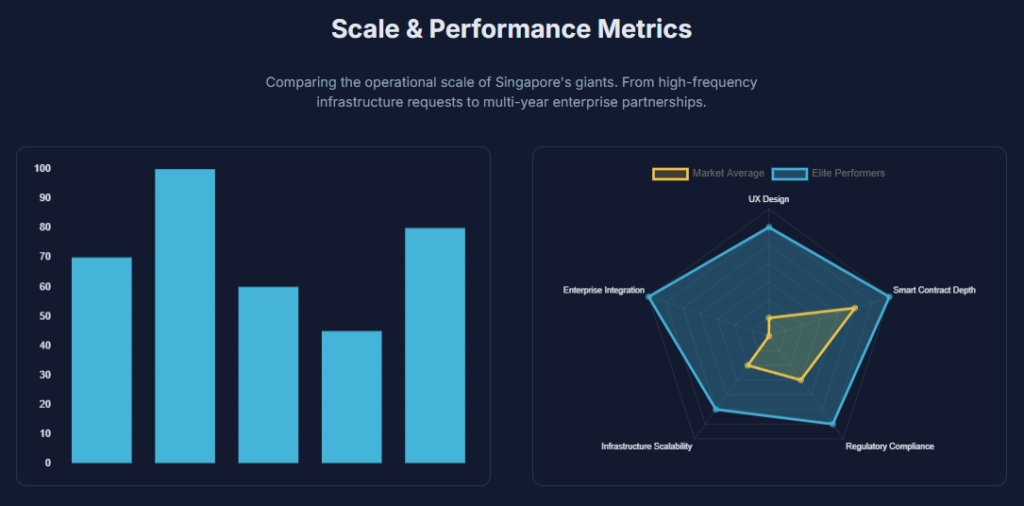
A side-by-side snapshot of every blockchain development company Singapore on this list:
| Company | Core Specialty | Target Client / Best Fit | Key Advantage |
| Vinova | Enterprise blockchain integration | Enterprises, banks, maritime | 16+ years integrating blockchain with ERPs |
| Chainstack | Managed RPC and node infrastructure | dApp developers and Web3 platforms | 70+ protocols with sub-100ms RPC latency |
| STACS | Institutional capital markets DLT | Banks, asset managers, ESG | Production-proven with MAS and major banks |
| Accredify | Verifiable credentials and digital identity | Governments and universities | 10M+ credentials issued on government cloud |
| TokenMinds | Web3 product development and launch | Token founders and DeFi projects | Bundled development and token launch marketing |
| AuroBlocks | Boutique DeFi and NFT development | Startups and Web3 founders | Agile boutique team with direct founder access |
| ROCKETECH | Custom app and UX/UI development | Retail dApps and crypto wallets | Design-led mobile development and strong UX |
| Saola Labs | High-throughput Web3 backends | DeFi protocols and CeFi platforms | Dual Singapore/Vietnam cost-efficient depth |
| EMURGO | Cardano ecosystem development | Cardano-native projects | Founding entity of Cardano and a $100M fund |
| XinFin / XDC | Trade finance and asset tokenisation | Trade banks and supply chain | Native ISO 20022 financial messaging |
There’s no single “best” company on this list. Your actual top choice depends on your chain, use case, regulatory exposure, and whether you’re building infrastructure, a product, or an enterprise solution woven into something that already exists.
How to Evaluate Any of These Vendors
Whichever blockchain development company Singapore you’re leaning toward, ask for the same things before signing:
- Relevant production deployments, not only prototypes, demos, or token launches
- Smart-contract audit arrangements and a documented testing process
- Security controls for wallets, private keys, bridges, APIs, and admin permissions
- Regulatory experience relevant to your use case, particularly around MAS requirements if Singapore users, payments, custody, or securities are involved
- Post-launch support: monitoring, incident response, upgrades, and whether that capacity survives past the individual who built it
- Clear ownership terms for source code, smart contracts, documentation, and intellectual property
For the fuller evaluation framework — agency-vs-freelancer trade-offs, staffing models, and a complete due-diligence checklist — see our complete guide to hiring blockchain developers.
A useful procurement approach is to get proposals from at least two categories on this list, an infrastructure or chain specialist and a broader enterprise integrator, since they’ll frame the same problem differently. This list is a starting point for that shortlist, not a substitute for reference checks and a technical review of each vendor’s actual Singapore-based team.
| Considering Vinova for Your Blockchain Project? Book a free 2-hour blockchain architecture consultation with Vinova’s Singapore-based team. We’ll assess your use case against MAS regulatory requirements and scope a security-first delivery plan. No commitment required. Schedule Your Free Blockchain Strategy Consultation with Vinova |
Frequently Asked Questions
A few questions that come up often when comparing a blockchain development company Singapore shortlist against real project requirements:
Which blockchain development company in Singapore is best for banks and financial institutions?
STACS (Hashstacs), XinFin (XDC Network), and Vinova are the top choices for financial institutions. STACS specialises in capital markets tokenisation and ESG registries under MAS frameworks. XinFin offers native ISO 20022 compatibility for trade finance. Vinova provides ISO 27001-compliant integration with core enterprise banking systems for institutions that need blockchain woven into existing infrastructure rather than a standalone platform.
What’s the difference between a Web3 infrastructure provider and a blockchain software development company?
A Web3 infrastructure provider like Chainstack supplies node access, RPC APIs, and network connectivity so developers don’t have to manage servers themselves. A blockchain software development company (such as Vinova, Saola Labs, or AuroBlocks) builds the actual smart contracts, dApp front-ends, tokenomics, and backend systems that run on top of that infrastructure.
If you’re specifically comparing vendors for smart contract work rather than broader blockchain infrastructure, see our dedicated comparison of smart contract development companies in Singapore.
How do I choose between a boutique Web3 studio and an enterprise integrator?
Choose a boutique Web3 studio (AuroBlocks, TokenMinds) if you’re launching a startup MVP, token round, or standalone DeFi/NFT protocol and need fast execution. Choose an enterprise integrator (Vinova) if you need to connect smart contracts into existing enterprise software (SAP, Oracle, Odoo), maintain legacy data pipelines, or enforce ISO 27001 cybersecurity controls across a broader system.
What compliance standards matter when hiring a blockchain software company in Singapore?
Key regulatory and security benchmarks include Monetary Authority of Singapore (MAS) licensing requirements (the Payment Services Act, if custody or digital payment tokens are involved), ISO 27001 certification for data security, and compliance with relevant domain standards, W3C/OpenBadges for identity credentials, or ISO 20022 for financial messaging where trade finance is involved.
For the specific procurement traps that catch enterprises out on this front — MAS licensing myths chief among them — see our breakdown of these procurement traps.
A Closer Look: Vinova’s Blockchain Track Record
Since Vinova is one of the ten companies on this list, and one of the few positioned as a broader enterprise blockchain development company rather than a blockchain-only specialist, here’s the deeper evidence behind its entry: the kind of documented capability, delivery process, and named client outcomes worth checking for any vendor you’re evaluating seriously, not just the one below.
Core blockchain capabilities
- Smart contract development, formal verification, and auditing across Ethereum, Polygon, Hyperledger, BNB Chain, Solana, Arbitrum, and custom L2/L3 rollups, with multi-tiered static analysis and internal penetration testing before mainnet
- Next-generation DApp engineering with Account Abstraction (ERC-4337) and passkey authentication, removing wallet-setup and seed-phrase friction for non-technical users
- Institutional asset tokenisation (RWA) and wallet infrastructure, including Multi-Party Computation, multi-signature governance, and fiat/stablecoin gateway integrations
- Zero-Knowledge Proofs and permissioned DLT networks (Hyperledger Fabric, Enterprise Ethereum, Corda) for confidential transaction validation without exposing enterprise data on-chain
- Web3, AI, and enterprise middleware integration bridging decentralised protocols with ERPs (Odoo, SAP, Oracle) and cloud infrastructure (AWS, Azure, GCP)
Case studies
XBourse Global, digital asset exchange infrastructure: a highly secure, high-throughput technical engine for digital asset trading and account management. Serving as XBourse’s core engineering partner for over three years, Vinova architected scalable backend trading modules, secure wallet integrations, and high-performance API connectors.
CredShare, verifiable digital credentials and identity: a secure credential platform leveraging cryptographic verification, letting institutions issue, manage, and verify tamper-proof digital certificates instantaneously.
Navig8 Connect, maritime supply chain data integration: a unified platform connecting disparate vessel management databases and external reporting systems across 20+ operational modules, serving as a model for blockchain-enabled trade finance and electronic bill of lading (eBL) provenance.
Banking and financial services: enterprise banking clients, including institutions like OCBC Bank, require bank-grade cybersecurity, ISO 27001 compliance, and zero downtime. Vinova deploys dedicated hybrid onshore/offshore development centres under a Multi-Layered ODC Security Framework for core integrations, cloud infrastructure, and cybersecurity operations.
Check out Vinova’s guide on the key innovations shaping blockchain development.
Delivery methodology
- Design Thinking and use case discovery: mapping user journeys and tokenomic viability before any code is written
- Technical architecture and smart contract design: defining on-chain versus off-chain data boundaries and state machines
- Agile development and Shift-Left QA: automated testing authored alongside code in 2-week sprints, not bolted on before launch
- ISO 27001 governed security and smart contract audits: vulnerability scans and dynamic stress testing before mainnet deployment
- CI/CD deployment and managed operations: 24/7 monitoring and SLA-backed support after launch, when many vendors have already moved to the next contract
| Vinova: Singapore’s blockchain development and enterprise engineering partner since 2010. ISO 27001:2022 and ISO 9001:2015 certified. PDPA and MAS-aligned. 16+ years of delivery, 300+ projects shipped, 250+ global clients. Blockchain and Web3 clients include XBourse Global, CredShare, Navig8 Group, and OCBC Bank. Financial Times Top 500 High-Growth Companies Asia-Pacific 2026. The Straits Times Singapore’s Fastest-Growing Companies 2024, 2025, and 2026. Explore Vinova’s blockchain services. |