Did you know that nearly 88% of consumer mobile apps are uninstalled within 30 days of download?
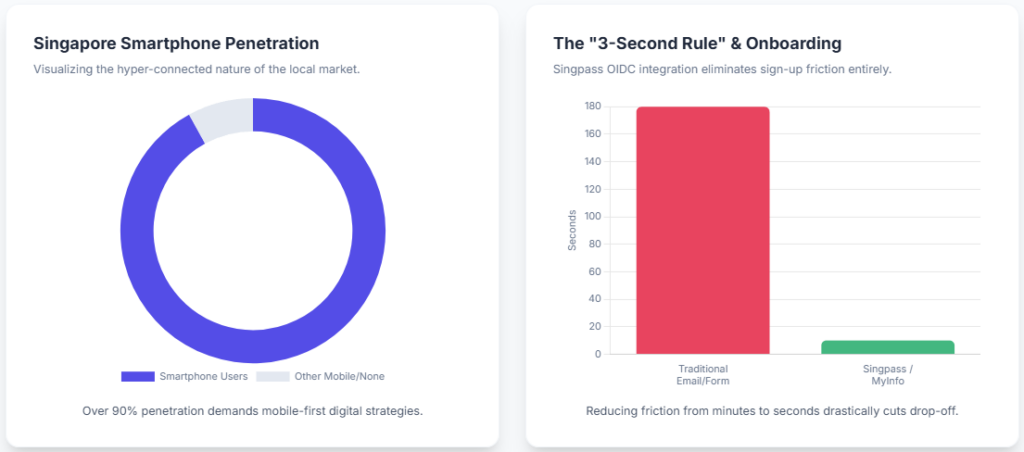
In Southeast Asia’s hyper-competitive digital economy—where Singapore boasts over 92% smartphone penetration—users don’t give second chances. If your application takes more than three seconds to load, demands a tedious 5-field signup form, or stumbles during payment checkout, your potential customer has already moved on to a competitor.
Building a successful consumer mobile app in 2026 isn’t just about sleek UI or flashy features; it’s about engineering habit-forming digital experiences that eliminate friction at every touchpoint. From sub-10-second Singpass onboarding to localized payment rails like PayNow and AI-driven personalization, the playbook for winning B2C users in Singapore has fundamentally evolved.
Whether you are a startup founder planning your first MVP or an enterprise leader modernizing a digital flagship, this comprehensive guide breaks down the strategy, architecture, tech stack, and monetization models required to launch a high-retention consumer mobile app.
Table of Contents
Key takeaways:
- Eliminate Onboarding Friction: With 88% of B2C apps uninstalled within 30 days, using Singpass/MyInfo OIDC cuts signup times from minutes to under 10 seconds, drastically boosting user retention.
- Integrate Local Payment Rails: Direct integration with regional financial infrastructure (PayNow, SGQR, GrabPay, DBS PayLah!) is essential to prevent checkout cart abandonment.
- Cross-Platform is the Sweet Spot: Building with Flutter or React Native delivers near-native performance while saving up to 40% in costs across iOS and Android, fitting 80% of SEA consumer app needs.
- Custom Architecture Outperforms Low-Code: Scalable microservices combined with strict regulatory compliance (PDPA & ISO 27001) provide the performance, security, and enterprise ROI low-code platforms cannot sustain.
What Is a Consumer Mobile App?
A consumer mobile app (also known as a B2C application) is a mobile software program built for individual end-users to perform personal tasks, shopping, banking, ride hailing, streaming, or fitness tracking. Unlike enterprise mobile apps designed for workplace operations, this type of app prioritises friction-free UI/UX, fast onboarding, high emotional engagement, and mass-market scalability across iOS and Android.
Mobile software has fundamentally transformed how individuals shop, manage finances, access healthcare, and travel across Southeast Asia. For Singapore enterprises, tech startups, and regional brand leaders, successful development in this space requires balancing seamless local digital infrastructure (Singpass, PayNow) with the scalable, secure architecture needed to expand across diverse Southeast Asian markets.
Executive Summary and Regional Market Dynamics
In Singapore’s hyper-connected, high-density digital ecosystem, where smartphone penetration exceeds 90%, winning with this kind of app requires far more than clean visual design. Based on Vinova’s 16+ years of mobile engineering experience across 250+ digital platforms, building a market-leading consumer app in Southeast Asia, whether it’s an e-commerce storefront, a fintech wallet, or apps on demand for logistics and services, demands:
- Frictionless onboarding: sub-10-second signup flows powered by national digital identity infrastructure (Singpass/MyInfo)
- Localised financial pathways: direct integration with regional settlement networks (PayNow, SGQR, GrabPay, DBS PayLah!, e-wallets)
- Strict security and compliance: adherence to PDPA, Cyber Security Agency (CSA) guidelines, and ISO 27001 standards
- Habit-forming UX and AI personalisation: data-driven UI/UX and 24/7 conversational AI engines optimised for retention in a competitive attention economy
Strategic takeaways for building a consumer mobile app
The 3-second rule for user retention: every app in this category wins or loses on speed and ease of use. At Vinova, our telemetry data shows that if onboarding or a core transaction flow takes more than a few seconds, user drop-off increases exponentially.
National infrastructure integration is essential: incorporating national digital rails (Singpass/MyInfo, PayNow Corporate, SGQR) eliminates sign-up friction. In Vinova’s client implementations, Singpass OIDC integration reduced sign-up time from minutes to under 10 seconds.
Custom architecture beats low-code for scalability: while low-code tools work for internal utility prototypes, a high-yield app requires scalable custom architecture. When Vinova transitioned life insurance platform FWD Tapp from a low-code environment to custom mobile architecture, the client recouped their entire capital investment within 24 months and won the Digital Insurance Initiative of the Year.
Singapore as a launchpad for regional apps: architectures built in Singapore must account for rapid scaling into SEA markets (Indonesia, Vietnam, Philippines), adapting to variable device hardware, fluctuating network latencies, and diverse local payment gateways.
Consumer Mobile Apps vs. Enterprise Mobile Apps
Understanding the fundamental operational and strategic differences between a B2C consumer app and B2B enterprise software is critical for digital product strategy, tech stack selection, and go-to-market planning:
| Dimension | Consumer Mobile Apps (B2C) | Enterprise Mobile Apps (B2B) |
| Target audience | General public, individual end-consumers | Internal employees, corporate managers, B2B partners |
| Acquisition channel | App Store/Play Store organic search, ASO, social performance marketing | Corporate IT provisioning, enterprise sales contracts, MDM |
| Design philosophy | Hyper-intuitive, zero-learning-curve, emotionally engaging, visual-first | Process-oriented, functional, feature-dense, workflow-driven |
| Monetisation | Freemium, in-app purchases, microtransactions, in-app advertising | SaaS recurring licences, per-seat pricing, multi-year contracts |
| Retention drivers | Habit formation, instant gratification, personalisation, gamified rewards | Workplace mandates, daily operational necessity |
| Tolerance for friction | Extremely low, high risk of immediate uninstall on failure | Moderate to high, users are paid to navigate complex workflows |
| Security and compliance | PDPA, GDPR, OAuth 2.0, Singpass verification | Enterprise SSO, RBAC, SOC2, strict audit logs |
5 Major Categories of Consumer Mobile Apps in Singapore (With Vinova Case Studies)
The Southeast Asian market for this category of app spans five primary verticals, illustrated by real-world digital transformations Vinova has engineered:
1. Fintech and insurance consumer mobile apps
Featured case study, FWD Tapp: Vinova engineered a custom life insurance app for FWD Insurance. By building a secure, high-performance app with streamlined eKYC and policy management, the client recovered their entire capital investment within 24 months and was awarded Digital Insurance Initiative of the Year.
Core technical priorities: eKYC identity verification, policy management backends, secure multi-factor authentication, high-throughput transaction processing, and MAS compliance.
2. On-demand and facility management consumer apps
Featured case study, Gofix FM on-demand platform: Vinova engineered a multi-platform ecosystem for Gofix FM, simultaneously deploying a native iOS app, native Android app, and web portal. The solution simplified service booking, real-time technician tracking, and automated task dispatch, successfully scaling to over 30,000 active users.
Core technical priorities: geospatial tracking, dynamic dispatch algorithms, real-time push updates, localised mobile payment rails, and dual-ended user/provider workflows.
3. Automotive, AI, and experience platforms
Featured case study, Porsche Experience Centre (PEC+) and SSDC: Vinova partnered with Porsche Asia Pacific to build the PEC+ platform, integrating an AI strategy alongside an Odoo ERP backend. For both PEC+ and the Singapore Safety Driving Centre, Vinova deployed 24/7 AI-powered conversational NLP engines within the app to drive personalised customer engagement and automated booking support.
Core technical priorities: AI/LLM chatbot integration, real-time booking engines, Odoo ERP synchronisation, interactive facility tours, and high-end brand UI/UX design.
4. E-commerce and retail consumer mobile apps
Regional market context: Shopee, Lazada, FairPrice Group, TikTok Shop. Vinova’s engineering focus for this category: high-speed catalogue indexing, PayNow/SGQR payment gateway integrations, automated cart recovery, and responsive cross-platform architecture (Flutter/React Native).
5. Digital health, fitness, and lifestyle apps
Regional market context: HealthHub, Healthy 365, Doctor Anywhere. Vinova’s engineering focus: syncing with Apple HealthKit/Google Fit, Singpass MyInfo verification, gamified health challenges, and strict PDPA medical data encryption.
5 Essential Features of a High-Retention Consumer Mobile App
To minimise churn and convert app downloads into active daily users, Vinova incorporates five core architectural pillars into every build:
- Frictionless onboarding with Singpass/MyInfo: integrating via OpenID Connect (OIDC) lets users consent to auto-filling verified personal data, replacing lengthy multi-step forms with 10-second biometric authorisation (Face ID/Touch ID)
- AI-driven personalisation and engagement: capturing real-time telemetry (clicks, view duration, purchase history) to dynamically customise feeds and layouts, plus conversational AI chatbots (as built for SSDC and PEC+) providing 24/7 instant support
- Context-aware, event-driven push notifications: triggered by real-time location, time of day, or user actions, rather than unfocused broadcasts that cause users to mute permissions or uninstall
- Multi-rail localised payment architecture: PayNow/SGQR account-to-account transfers, local e-wallets (GrabPay, DBS PayLah!, ShopeePay), cards and digital wallets, and Buy-Now-Pay-Later (Atome, Grab PayLater)
- Microservices and cloud-native backend architecture: containerised microservices (Docker, Kubernetes) hosted on AWS or Google Cloud, ensuring seamless auto-scaling when a marketing spike would otherwise crash a monolithic server
Tech Stack Selection for Your App
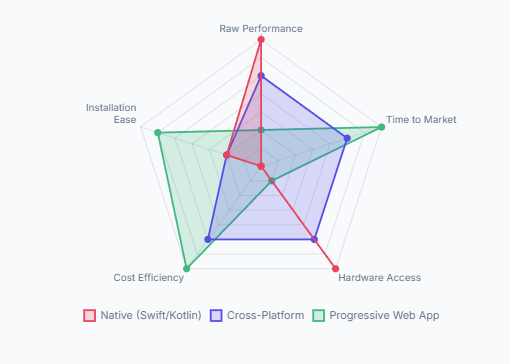
Choosing the right development stack directly impacts time-to-market, performance, development cost, and long-term maintenance:
| Criteria | Native (Swift/Kotlin) | Cross-Platform (Flutter/RN) | Progressive Web Apps |
| Performance | Maximum (60-120 FPS guaranteed) | Near-native, high performance | Moderate, browser-dependent |
| Codebase | Separate iOS and Android | Single unified codebase | Single unified web codebase |
| Hardware access | 100% immediate native API access | High, via plugins | Restricted (limited Bluetooth, background GPS, AR) |
| Time-to-market | Longer, needs specialised native teams | Faster, cost-effective | Fastest, standard web stack |
| Install friction | App Store/Play Store required | App Store/Play Store required | Instant via link, QR, or Add to Home Screen |
| Store fees | Subject to 15-30% store fees | Subject to 15-30% store fees | Zero store fees or review delays |
Vinova’s stack selection framework
- Choose Native (Swift/Kotlin) if: your consumer mobile app requires deep OS integration, uncompromised frame rates, 3D graphics, or complex background hardware sensors
- Choose Cross-Platform (Flutter/React Native) if: you need a polished, high-performance product deployed simultaneously to iOS and Android with a single codebase. This is the recommended stack for 80% of consumer apps in Singapore
- Choose Progressive Web Apps if: your distribution strategy relies on web SEO, QR code scanning (dining orders), or instant access without store downloads
Data Privacy, Security, and PDPA Standards in Singapore
Every app operating in Singapore in this category must adhere to strict regulatory guidelines to safeguard user data and maintain brand trust.
- PDPA: Vinova embeds privacy-by-design into every build, enforcing explicit consent banners, purpose-limited data collection, and automated user data deletion settings
- ISO 27001 certified security: apps are built within a certified ISO 27001 framework, with automated vulnerability scans, biometric authentication, and AES-256 encryption at rest and TLS 1.3 in transit
- Automated fleet QA testing: to prevent device-specific crashes across diverse smartphone models, Vinova uses automated cloud device labs (Appium/Detox) to test every release across hundreds of real iOS and Android devices
How to Monetise a Consumer Mobile App in Southeast Asia
Monetisation strategy must align with consumer spending habits across Singapore and broader SEA markets:
- Freemium subscriptions: core app utilities free, premium features behind monthly/annual tiers, highly effective in Singapore’s high-ARPU market
- In-app purchases and microtransactions: sell virtual goods, extra features, or digital content unlocks directly within the app
- In-app advertising: monetise a large, free user base through native banners, interstitial video, or rewarded ads
- Transaction and commission fees: charge a percentage or flat booking fee on real-world services or e-commerce purchases, as Grab, Shopee, and Gofix all do
Vinova’s 5-Stage Consumer Mobile App Development Lifecycle
Building a successful product in this category requires an agile, risk-mitigated engineering process:
- 1. Product discovery and strategy: defining target user profiles, business monetisation models, and technical requirements
- 2. Design Thinking and UX prototyping: mapping user journeys and interactive wireframes to optimise conversion loops
- 3. Cloud-native app development: writing clean, modular frontend code and microservice backends
- 4. Automated QA and security VAPT: testing across real mobile hardware and conducting penetration testing
- 5. Launch, analytics, and scaling: monitoring performance telemetry, gathering app store reviews, and delivering continuous updates
| Ready to Build a High-Retention Consumer App? Book a free product strategy consultation with Vinova’s engineering team. We’ll assess your target market, recommend the right tech stack, and scope a build that scales across Southeast Asia. No commitment required. Schedule Your Free Product Strategy Consultation with Vinova |
Consumer Mobile App FAQ
What’s the main difference between a consumer mobile app and an enterprise mobile app?
This category of app is built for individual end-users for personal tasks (shopping, entertainment, finance), focusing heavily on seamless UX, speed, and voluntary usage. An enterprise app is built for business employees to run operational workflows, prioritising process management, internal administrative controls, and system access over visual appeal.
How much does it cost to build a consumer mobile app in Singapore?
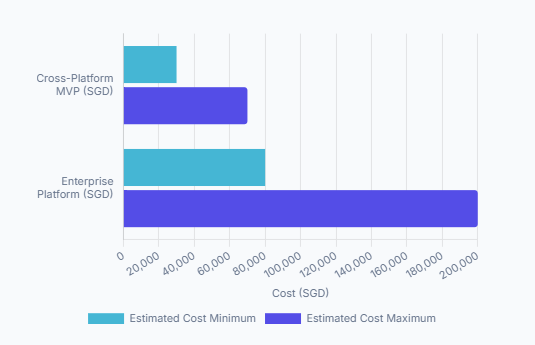
An MVP built with cross-platform frameworks (Flutter/React Native) typically ranges between SGD $30,000 and $70,000. Full-scale enterprise consumer platforms with custom AI engines, Singpass OIDC integration, and ERP backends generally range from SGD $80,000 to over $200,000.
How long does consumer mobile app development take with Vinova?
Building and launching a core consumer mobile app MVP takes approximately 3 to 5 months. Larger enterprise consumer platforms involving custom AI models, complex payment gateways, and multi-system integrations require 6 to 9 months.
Why should a business integrate Singpass/MyInfo into its app?
Integrating Singpass/MyInfo enables 1-click identity verification via Face ID/Touch ID. It eliminates tedious manual registration forms, reduces onboarding user drop-off by up to 70%, and protects your application against fake account creation.
Is cross-platform development recommended for a consumer mobile app?
Yes. Modern cross-platform frameworks like Flutter and React Native let you build a high-performance consumer mobile app for both iOS and Android simultaneously using a single codebase. This reduces development costs by up to 40% and speeds up time-to-market without compromising visual quality.
What separates the top consumer apps in Southeast Asia from the rest?
Speed and trust, more than feature count. The best consumer apps in the region, the Grabs and Shopees of the market, all share the same underlying discipline: sub-10-second onboarding, localised payment rails that don’t force a user to a foreign gateway, and a backend that doesn’t buckle the first time a marketing campaign actually works. Most apps that fail to break out technically function fine; they just never got these fundamentals right before scaling.
| Vinova: Singapore’s consumer and enterprise mobile app development partner since 2010. ISO 27001:2022 and ISO 9001:2015 certified. 300+ applications delivered for 250+ clients globally, including FWD, Gofix FM, Porsche Experience Centre Singapore, and the Singapore Safety Driving Centre. Financial Times Top 500 High-Growth Companies Asia-Pacific 2026. The Straits Times Singapore’s Fastest-Growing Companies 2024, 2025, and 2026. Explore Vinova’s mobile app development services. |