As enterprise AI in Singapore and the broader APAC region matures from speculative pilots under National AI Strategy 2.0 to mission-critical operational infrastructure, decision-makers face a genuinely complex set of choices. With the Singapore Government committing over S$1 billion toward AI talent, compute infrastructure, and enterprise adoption, 68% of Singapore-headquartered enterprises have prioritised Custom AI Model Development in 2026, up from 44% in 2024.
Generic, off-the-shelf public LLMs frequently fall short in domain-specific tasks, strict PDPA data sovereignty environments, and workflows requiring IMDA AI Verify or MAS FEAT compliance. What actually works for making AI that survives contact with a real regulated enterprise is rarely the biggest model, it’s the right architecture for the specific problem. This report gives enterprise technical leaders and procurement teams hard market data, localised SGD/USD pricing benchmarks, and procurement criteria to commission and scale production-grade AI engineering initiatives.
Table of Contents
Singapore and APAC Enterprise AI Market Metrics
The numbers behind why Custom AI Model Development specifically, not off-the-shelf API wrappers, has become the default enterprise posture in Singapore this year:
| Metric | 2026 Figure |
| Government capital injection | S$1.0B+ allocated under NAIS 2.0 |
| Enterprise AI adoption rate | 68% of SG enterprises in active deployment |
| Market CAGR (SE Asia AI dev) | 38.4% (2024-2028 projected) |
| Target AI talent pool (SG) | 15,000+ AI practitioners targeted by EDB/IMDA |
| Top regulatory focus | PDPA, IMDA AI Verify, MAS FEAT, GovTech GCC 2.0 |
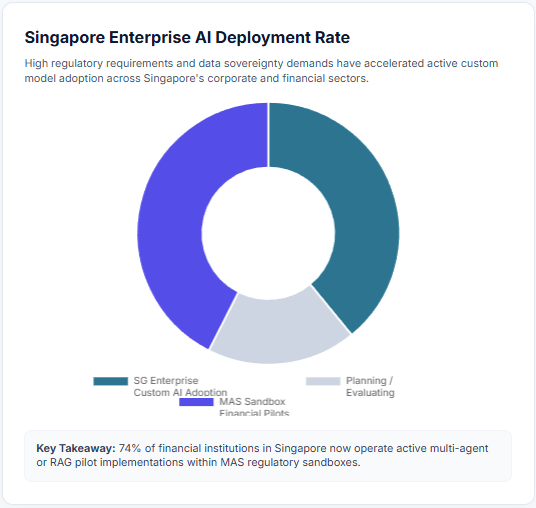
- 74% of financial institutions in Singapore report active multi-agent or RAG pilot implementations under MAS regulatory sandboxes
- Average time-to-production friction: in-house DIY projects face an average 9.2-month delay from AI talent scarcity, where senior ML engineers command S$280,000/year
- Outsourcing ROI: partnering with a Singapore-headquartered firm with regional hybrid engineering pods reduces total cost of ownership by 42% while cutting delivery timelines to 6-12 weeks
Core Service Architecture and Enterprise Use Cases
Production-grade Custom AI Model Development deployed within Singapore’s enterprise and public sector ecosystems demands strict architectural decoupling across five layers:
| Layer | Components |
| Application | Cross-platform mobile (iOS/Android), enterprise web portals, POS/Odoo UI |
| Orchestration and agentic | LangGraph, CrewAI, Model Context Protocol (MCP), custom tool routing |
| Service and inference | vLLM, TensorRT-LLM, semantic prompt caching, AI Verify guardrail engine |
| Model | Fine-tuned SLMs (Llama 3.3, DeepSeek), GraphRAG, sovereign models (SEA-LION v2) |
| Data | PDPA-masked pipelines, vector indexing (Qdrant), AWS ap-southeast-1 storage |
Data engineering and sovereign data pipelines
Data preparation accounts for 35% to 45% of overall engineering effort, and in Singapore it has to explicitly follow the PDPC Guidelines on Selected Topics in Data Protection. For finance and healthcare clients unable to expose PII/PHI to cloud services, that means constructing synthetic datasets using local differential privacy and rejection sampling before training. Pipelines also need to handle Singapore’s multilingual corporate landscape (English, Bahasa Melayu, Mandarin, Tamil) alongside localised domain terms, Singpass integration codes, MAS regulatory filings, HDB/SFA jargon, while coupling dense embeddings with sparse retrieval algorithms hosted entirely in local data centres (AWS ap-southeast-1 or Azure Southeast Asia) to keep zero cross-border data leakage.
Fine-tuning vs. RAG vs. pre-training: the decision that actually matters
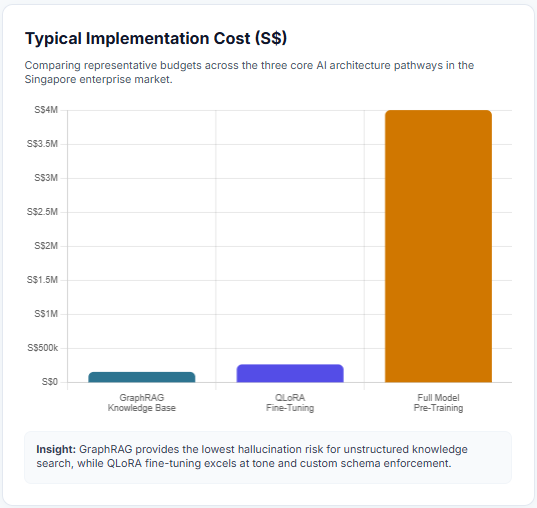
Choosing the right strategy balances cost, domain specificity, latency, and compliance:
| Metric | GraphRAG | PEFT / QLoRA Fine-Tuning | Full Pre-Training |
| Primary objective | Dynamic knowledge retrieval, source attribution | Corporate tone, schema enforcement, task specialisation | Foundational dialect/vocabulary (regional SEA base models) |
| Data requirements | Unstructured docs (SOPs, contracts, patents) | 1,000-50,000 curated instruction-response pairs | 10B+ tokens of raw domain/regional text |
| Compute overhead | Low; vector store hosting | Moderate (1-8x H100 GPUs, 6-48 hrs) | Ultra-high (100s of GPUs for months) |
| Time to deploy | 3-6 weeks | 4-10 weeks | 6-12+ months |
| Hallucination risk | Very low (cites exact sources) | Medium (needs RAG fallback) | High (needs external validation) |
| Typical cost range (SGD) | S$160,000 | S$270,000 | S$4,000,000+ |
Agentic AI and Model Context Protocol architecture
Singapore enterprise buyers are moving beyond simple Q&A chatbots toward autonomous multi-agent orchestration, agents executing multi-step workflows by connecting directly to backends like SAP SuccessFactors and Odoo ERP via the Model Context Protocol. MCP’s standardised JSON-RPC 2.0 interface lets firms swap underlying LLMs, moving from GPT-4o to an on-premise open-weight model like Llama 3.3 or DeepSeek-R1, without rewriting the system connectors or API hooks underneath.
High-ROI Regional Enterprise Case Studies
These aren’t hypothetical scenarios. Each of the four below reflects delivered AI model development work for a named Singapore client:
| Client / Sector | Challenge | Architecture | Outcome |
| IPOS International (GovTech/LegalTech) | Manual patent application review, prior art search, report creation | Custom AI Digital Workbench: text extraction, case management, multi-document RAG synthesis | 70% reduction in manual document review time; faster regional patent examination |
| Porsche Asia Pacific (PEC+ Singapore) | 24/7 personalised engagement for international visitors | NLP conversational AI connected to Odoo POS/Inventory and event booking backends | 24/7 multilingual engagement; 35% increase in automated booking conversions |
| Singapore Institute of Technology (SIT) | Early identification of at-risk students | Predictive ML models, AWS Glue pipelines, AWS Comprehend NLP for student analytics | Over 85% predictive accuracy in early intervention; automated course recommendations |
| SP Group / SP Digital (Energy & Infrastructure) | Talent acquisition, SAP SuccessFactors integration, workflow automation | AI-driven offshore squads (Python AI engine, React frontends) integrated with SAP | Accelerated development lifecycle using AI-assisted SDLC, while meeting CII security standards |
Pricing Models, Cost Drivers, and Time-to-Value
What Custom AI Model Development actually costs in Singapore depends heavily on which of three commercial tiers a project falls into:
Tier 1: Feasibility PoC / MVP
Budget: S$35,000 to S$100,000 (US$25k-US$75k). Duration: 4 to 8 weeks. Deliverables: single use-case validation, PDPA-masked dataset audit, basic RAG architecture, and a functional React or Flutter prototype for executive demonstration. Best for mid-market Singapore firms or innovation labs validating feasibility before board-level capital allocation.
Tier 2: Production workflow automation and agentic systems
Budget: S$100,000 to S$350,000 (US$75k-US$250k). Duration: 8 to 16 weeks. Deliverables: a fine-tuned domain model (QLoRA on Llama 3.3 70B, for example), MCP tool servers, vector database clustering, a native iOS/Android or web application, and continuous MLOps monitoring. Best for business units automating high-cost operational processes under strict accuracy and security requirements.
Tier 3: Enterprise platform and sovereign infrastructure
Budget: S$350,000 to S$1,600,000+ (US$250k-US$1.2M+). Duration: 16 to 36 weeks. Deliverables: a multi-agent autonomous mesh, fine-tuned proprietary model weights, private cloud deployment, and complete SOC 2 Type II, ISO 27001, and GovTech GCC 2.0 compliance. Best for multinationals, financial institutions, and government agencies scaling AI across regional subsidiaries.
The Singapore hybrid delivery cost advantage
Pure onshore Singapore agencies command high billable rates, roughly S$2,800 per man-day for senior AI engineers. Vinova’s Singapore-headquartered hybrid model pairs local solution architects, project managers, and security auditors handling client communications and compliance with offshore AI engineering pods executing development at optimised rates, delivering a 40% to 50% reduction in overall project cost. Because delivery runs in the same timezone (SGT/UTC+8), collaboration stays real-time rather than handed off across a multi-hour gap the way a Western or distant offshore vendor typically operates.
Inference vs. training economics on local cloud
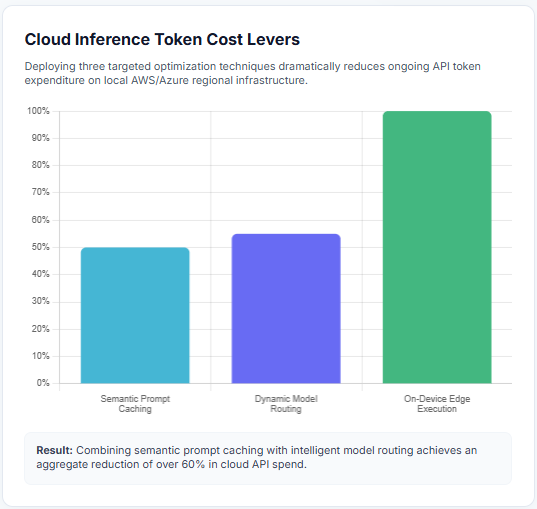
Operational inference cost scales directly with monthly query volume on AWS Singapore (ap-southeast-1). Three levers bring that cost down in practice: semantic prompt caching, storing embedding cache hits for repetitive queries, cuts third-party LLM API spend by 40% to 60%; model routing sends routine tasks (parsing, classification) to lightweight 3B-8B SLMs and reserves frontier models for genuinely complex queries, reducing token bills by over 50%; and on-device quantised execution (4-bit AWQ/GGUF via ExecuTorch or Apple MLX) eliminates recurring cloud inference costs entirely for mobile field teams.
Technology Stack and Sovereign Cloud Matrix
Production custom AI engineering spans foundational models, orchestration layers, vector storage, and continuous MLOps evaluation:
| Category | Tool | Best Use Case | Sovereign Cloud Readiness |
| Foundation models | GPT-4o / o3 | High-complexity reasoning, code generation | Azure OpenAI Singapore Region |
| Foundation models | Claude 3.5 Sonnet | Advanced agentic tool use, document analysis | AWS Bedrock (ap-southeast-1) |
| Foundation models | Llama 3.3 70B | Private VPC fine-tuning, domain execution | Fully self-hosted (AWS/Azure SG) |
| Foundation models | DeepSeek-V3 / R1 | High-efficiency math and code synthesis | Fully self-hosted / on-premise |
| Agent frameworks | LangGraph | Cyclic, stateful multi-agent workflows | Open source (Python/TS) |
| Agent frameworks | CrewAI | Role-based multi-agent task execution | Open source (Python) |
| Vector databases | Qdrant | High-throughput hybrid search | Self-hosted / cloud SG node |
| Vector databases | Pgvector | Augmenting existing Postgres databases | Native AWS Aurora / Azure Postgres |
| MLOps and evals | Arize Phoenix | Tracing, hallucination detection | Fully self-hosted |
| MLOps and evals | LangSmith | End-to-end tracing, regression tests | Cloud managed / dedicated VPC |
Vendor Landscape and Competitive Benchmarking
Enterprise buyers in APAC need to distinguish between large-scale system integrators, specialised regional Custom AI Model Development shops, and global generalists, since project size and specialisation vary enormously across this list:
| Agency | Specialisation | Key Strengths | Typical Project Size | HQ / Delivery Model |
| Vinova | Custom enterprise AI, agentic workflows, mobile and edge AI | Native MCP implementation, fine-tuned SLM deployments, rapid 6-week PoC model | S$350,000+ | Singapore HQ (hybrid SG + SEA delivery) |
| NCS Group | Large-scale public sector and enterprise system integration | Deep GovTech ecosystem integration, massive public infrastructure | S$3,000,000+ | Singapore |
| ScienceSoft | Healthcare and financial legacy IT modernisation | Deep healthcare compliance (HIPAA, HL7, FHIR), ERP integrations | S$800,000+ | USA (offshore EU delivery) |
| LeewayHertz | Generative AI platforms and Web3 custom models | Blockchain integrations, custom GenAI application building | S$500,000 | USA / India |
| Addepto | Big data engineering and predictive analytics | Large-scale data pipelines, computer vision and ML models | S$400,000 | Europe |
The honest read on Vinova’s position here: it’s the smallest minimum project size on this list, not the largest. NCS operates at a fundamentally different scale (large public-sector system integration), ScienceSoft and Addepto specialise in domains Vinova doesn’t lead in (legacy healthcare IT, big data engineering), and LeewayHertz leans heavily into Web3. Vinova’s niche is specifically rapid, mobile-and-edge-capable Custom AI Model Development delivered by AI model developers working inside Singapore’s regulatory stack from day one, not a claim to out-scale every name on this table.
Singapore Enterprise Regulatory and Procurement Checklist
Before executing a Statement of Work for any Custom AI Model Development engagement, verify five compliance pillars:
- Full IP transfer and governing law: contracts must explicitly grant 100% ownership of fine-tuned model weights, synthetic datasets, custom LoRA adapters, and orchestration code under Singapore law, and vendors should be contractually barred from using client data to train models shared with other clients
- PDPA and cross-border data transfer compliance: vendor pipelines shouldn’t transmit raw PII across borders without approved safeguards, and zero-data-retention agreements should be required for any commercial LLM API calls
- IMDA AI Verify and MAS FEAT alignment: for financial services and regulated sectors, models need evaluation against the AI Verify framework for explainability, robustness, technical safety, and non-bias
- GovTech GCC 2.0 and ISO security standards: public sector or government-linked engagements require Government Commercial Cloud compliance alongside ISO 27001 and ISO 9001 certification
- Clear model drift and retraining warranties: since AI models drift as operational data evolves, contracts should include 6 to 12 months of MLOps monitoring, automated re-evaluation, and scheduled retraining cycles
| Ready to Build Custom AI for Your Organisation? Book a free Enterprise AI Strategy Call with Vinova’s engineering team. We’ll scope a rapid PoC, validate feasibility, and map a path to production. No commitment required. Book Your Free Enterprise AI Strategy Call with Vinova |
Custom AI Model Development FAQ
What does the ai model development process actually look like end to end?
Five stages in practice, and this is the actual Custom AI Model Development process, not a marketing simplification of it: discovery and use-case validation (which architecture, RAG, fine-tuning, or pre-training, actually fits), data engineering and PDPA-compliant pipeline construction, model development itself, MCP-based agentic integration into existing backends, and ongoing MLOps monitoring for drift. Most projects that stall do so at the data engineering stage, not the model stage, since that’s routinely 35% to 45% of total effort.
How do generative AI solutions for mobile app development differ from a standard chatbot integration?
A standard integration calls a cloud API and displays the response. Genuine generative AI solutions for mobile app development go further: on-device quantised models (4-bit AWQ/GGUF via ExecuTorch or Apple MLX) handle routine inference locally with zero recurring cloud cost, while a native iOS/Android app connects to backend agentic workflows via MCP for anything requiring heavier reasoning or enterprise data access. That split matters commercially, not just technically, since it’s what keeps inference cost predictable at scale.
Why does data engineering cost more than most enterprises expect?
Because it’s genuinely 35% to 45% of total project effort, not a preliminary step before the real work starts. PDPA-compliant synthetic data generation, multilingual pipeline handling, and hybrid vector retrieval all have to be built correctly before a single fine-tuning run happens, and rework at this stage is far more expensive than getting it right the first time.
How should a CTO choose between the ai model developers on the vendor benchmarking table above?
Match specialisation to the actual problem, not brand recognition. A large-scale government system integration project fits NCS’s scale better than a boutique AI shop. A healthcare legacy modernisation project benefits from ScienceSoft’s HIPAA/HL7/FHIR depth. A mobile-first, rapid-PoC, MCP-native agentic build, the profile most mid-market Singapore enterprises actually have, is exactly where a specialised regional partner with a fast feasibility cycle fits best.
| Vinova: Singapore-headquartered AI development and cybersecurity engineering partner since 2010, 16+ years of experience. 300+ projects delivered for 250+ enterprise clients worldwide. Rapid 6-week feasibility PoCs, 100% data sovereignty and IP ownership, native MCP and GraphRAG implementations. Clients include IPOS International, Porsche PEC+ Singapore, SIT, and SP Group/SP Digital. Financial Times Top 500 High-Growth Companies Asia-Pacific 2026. The Straits Times Singapore’s Fastest-Growing Companies 2024, 2025, and 2026. Book an Enterprise AI Strategy Call with Vinova’s engineering team. |