Static, monolithic learning platforms are no longer a viable foundation for Singapore institutions. Under the Smart Nation 2.0 framework and the MOE EdTech Masterplan 2030, continuous edutech innovation is a regulatory and operational mandate. Institutions that treat software as a one-time deployment rather than an evolving product lifecycle fall behind on compliance, lose students to more agile competitors, and produce graduates whose skills don’t align with the SkillsFuture frameworks that Singapore’s industry depends on.
This guide covers the five strategic edutech innovation areas reshaping Singapore’s learning infrastructure in 2026, the three critical implementation failure vectors to engineer around, how Singapore’s cross-border data transfer rules actually work, and how to evaluate whether to build, buy, or partner when designing your institution’s technology roadmap.
Table of Contents
Key Takeaways:
- Continuous edutech innovation is now a mandate for Singaporean institutions to align with Smart Nation 2.0 and the MOE EdTech Masterplan 2030, preventing student attrition and compliance failure.
- Implementing composable architectures and microservices, such as the Strangler Fig pattern, allows institutions to modernize legacy systems incrementally, avoiding the downtime risks associated with risky, all-at-once migrations.
- Effective AI deployment requires strict governance, including zero-data retention policies and GovTech-compliant guardrails, ensuring AI assistants act as Socratic guides rather than tools for student cognitive offloading.
- Hybrid delivery models, combining local governance with external engineering experts, offer higher velocity and lower costs—40% to 60% savings—compared to traditional in-house IT development teams.
Why Continuous EduTech Innovation Has Become Non-Negotiable

Legacy student information systems and monolithic LMS platforms carry structural liabilities that compound over time. Rigid database schemas, tightly coupled integration dependencies, and brittle code architectures create technical debt that makes it impossible to deploy micro-features or integrate real-time data pipelines without risking system downtime. The cost of inaction is not theoretical.
Tech-native students in 2026 benchmark their institutional digital experience against consumer applications. Rigid platforms that don’t deliver real-time feedback, intuitive mobile interfaces, or personalised learning paths lose students to agile competitors. This is not a positioning threat. It is an enrolment problem. Meanwhile, Singapore’s industry demand for AI, machine learning, and data engineering capabilities is outpacing what institutions relying on outdated digital curricula can produce. Manual administrative processes consume the time that qualified academic staff should spend on mentorship and research.
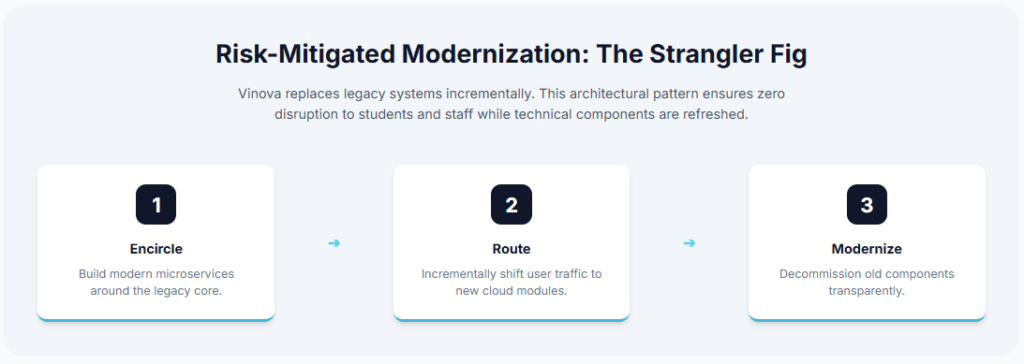
Vinova resolves structural stagnation using the Strangler Fig pattern for risk-mitigated legacy modernisation. Rather than risky all-at-once migrations, Vinova engineers build modern, cloud-native microservices around the edges of the existing monolith, incrementally replacing components and transparently shifting traffic routing so that end users experience zero disruption. This is the architecture Vinova applied for Navig8 Group and SP Digital, and it is the standard approach for any Singapore institution where system downtime carries operational or reputational cost.
Five Strategic EduTech Innovation Areas for Singapore Institutions
1. Human-Centred AI Assistants: Socratic Guides, Not Answer Engines
The primary risk of deploying consumer-grade generative AI in classrooms is cognitive offloading: students bypass critical thinking by using model outputs as shortcuts. Under the MOE AI-in-Education (AIEd) Framework, engineered AI assistants must function as Socratic guides, not answer engines. Singapore’s Learning Assistant (LEA) is configured to ask targeted, scaffolded questions that prompt students to formulate their own hypotheses and articulate their working logic.
The architecture that enforces this is a state-machine with defined pedagogical boundaries: concept elicitation, misconception probing, guided resolution through conceptual analogy, and synthesis verification through real-world scenario prompting. Maximum interaction turns are capped. When a student signals cognitive frustration above a defined threshold, the system escalates to educator notification and pauses the session. The AI cannot hand over the answer because the architecture physically prevents it.
2. Automated Grading and Feedback Loops: SAFA and FA-Math
Evaluating student performance at scale requires content-specific grading assistants operating within structured parameters. General-purpose LLMs lack the deterministic accuracy academic assessment demands. Singapore’s solution is two specialised pipelines:
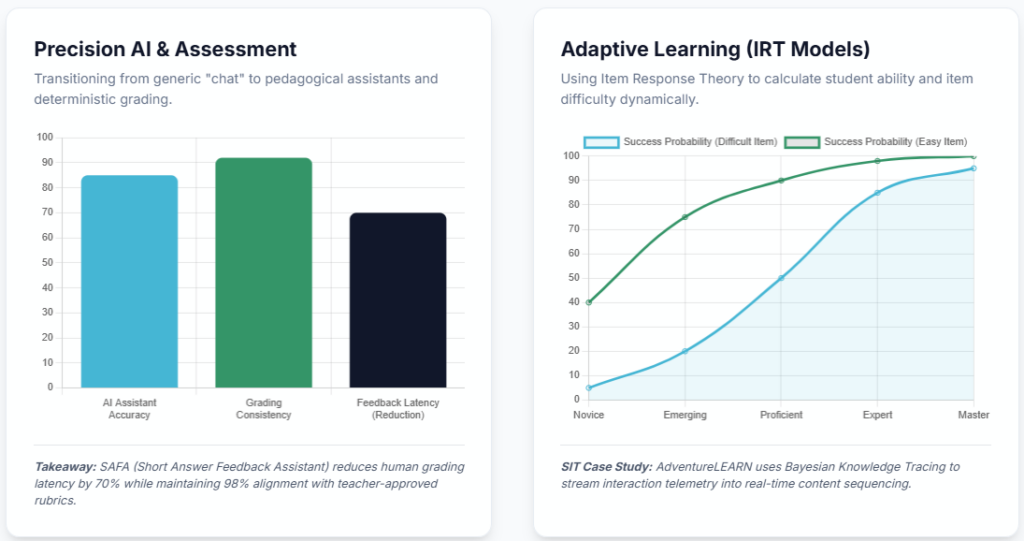
- Short Answer Feedback Assistant (SAFA): integrates generative AI models with teacher-uploaded rubrics and knowledge bases to analyse open-ended conceptual responses, outputting suggested marks and draft annotation cards. All outputs remain in draft state until the educator reviews and approves.
- Feedback Assistant Mathematics (FA-Math): a deterministic, rules-based engine using computer algebra systems and symbolic engines rather than LLM inference. FA-Math analyses handwritten workings, identifies procedural errors, applies Bar Model methodologies, and awards partial marks to the nearest 0.5 increments. Vinova implements both pipelines as standard components of any institution-facing AI deployment.
3. Adaptive Learning Engines: Real-Time Personalisation at Scale
Singapore’s MOE Adaptive Learning System (ALS) uses non-generative, data-driven machine learning to customise learning paths based on student readiness in real time. The ALS models student proficiency using Item Response Theory (IRT), calculating the probability of a correct response as a function of student ability and item difficulty and discrimination parameters. Student interaction telemetry (time-to-first-click, action sequences, response patterns) streams into Apache Kafka and Apache Flink pipelines, with latent student ability continuously updated via online Bayesian estimation.
Vinova’s production implementation of this architecture is the SIT AdventureLEARN platform for the Singapore Institute of Technology. AdventureLEARN runs Dynamic Bayesian Knowledge Tracing (BKT) over student ALSI diagnostic data, personalising content sequencing in real time. Gamification mechanics (virtual currency redeemable for real-world rewards, progress visualised as a virtual campus topology) drive sustained engagement without cognitive offloading. Built through Design Thinking workshops and 2-week Agile sprint cycles, AdventureLEARN was presented at EDUtech Asia as a Global Inspiration Case.
4. Composable Campus and API-First Interoperability
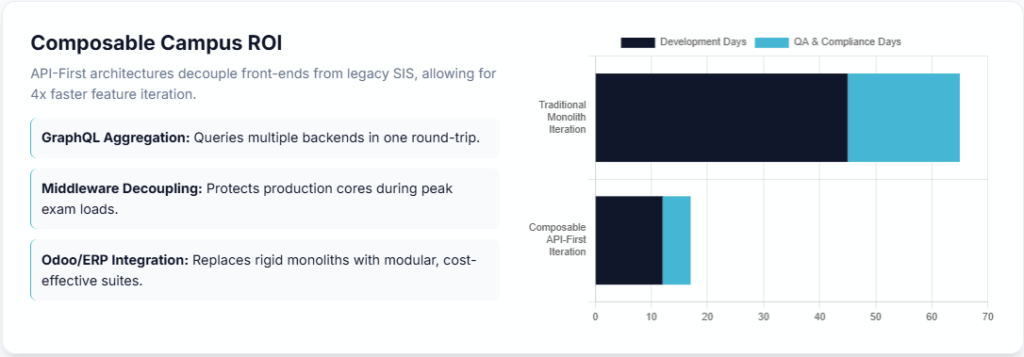
Moving past monolithic SIS limitations requires a composable architecture: API gateways (Kong or Envoy) decoupling core operational systems from student and staff portals. GraphQL microservices allow front-end developers to query multiple backend systems (enrolment records, financial ledger, timetabling) in a single network round-trip, eliminating the waterfall query chains that degrade performance under peak concurrent loads.
Vinova’s campus middleware deployments additionally integrate with Odoo open-source modules (for institutions needing modular ERP without per-seat SaaS licensing) and with enterprise systems like Salesforce (for mapping workforce upskilling directly to performance metrics). For the Porsche Experience Centre Singapore, Vinova deployed Odoo Enterprise for back-office workflow management when custom build was not the right call: a genuine architecture-first recommendation, not a preference for unnecessary code.
5. Immersive Classrooms and Spatial Computing
Medical, engineering, and maritime training programmes require risk-free high-fidelity simulation that physical environments cannot provide affordably. Spatial computing platforms use hybrid WebGL/WebXR architectures running real-time physics and multi-user state on edge servers, with WebRTC data channels providing low-latency state synchronisation. Streaming optimised, low-polygon 3D environments to browser-based VR headsets (Apple Vision Pro, Meta Quest 3) eliminates native app installation friction while maintaining complete access control through SSO. SkillsFuture ETSS provides up to 90% co-funding for certifiable spatial computing programmes.
Building a Culture Where EduTech Innovation Actually Lands
Technology investments fail when forced upon an underprepared workforce. The three professional development pathways that determine whether edutech innovation takes hold:
- Smart Nation Educator Fellowship: six-month immersive programmes that move teacher leaders from passive technology users to active curriculum designers. Each cohort leaves with a concrete digital integration plan for their subject area, not just a credential
- e-Pedagogy integration: building the habit of using SLS analytics dashboards as diagnostic instruments, not reporting tools. When a teacher can identify a specific comprehension gap from xAPI telemetry and adjust their next lesson plan accordingly, the technology is working. Vinova designs platforms around this workflow
- SkillsFuture for Digital Workplace 2.0: aligning institutional upskilling to national frameworks so that generative AI literacy is a measurable competency, not a one-day workshop outcome
A specific operational risk that is frequently underestimated: when deploying custom generative AI tools for academic staff, IT departments must enforce zero-data retention policies with upstream model providers. If student essays, proprietary research datasets, or internal policy documents are ingested by model providers without this contractual control, they risk exposure via public model prompts. Vinova structures Data Processing Agreements (DPAs) with zero-retention clauses as standard before any generative AI tool enters a production educational environment.
Three EduTech Innovation Failure Vectors and How Vinova Mitigates Them
1. Fragmented data silos blocking personalised learning
Institutions carry disconnected databases: student records in MS SQL Server, assessment scores in Oracle, SLS telemetry in JSON files. Building a coherent personalised learning system requires unifying these. Vinova designs event-driven, hybrid-cloud data pipelines using Debezium for Change Data Capture (CDC) streaming from legacy databases into Apache Kafka, Apache Airflow for ETL orchestration, dbt for transformation and schema unification, and pgvector-enabled PostgreSQL as the clean vector store for downstream AI recommendations. This is the same pipeline architecture Vinova applies across enterprise clients including Navig8 Group, SP Group (SP Digital), and SBI Digital Markets.
2. PDPA and cross-border data transfer: what the law actually requires
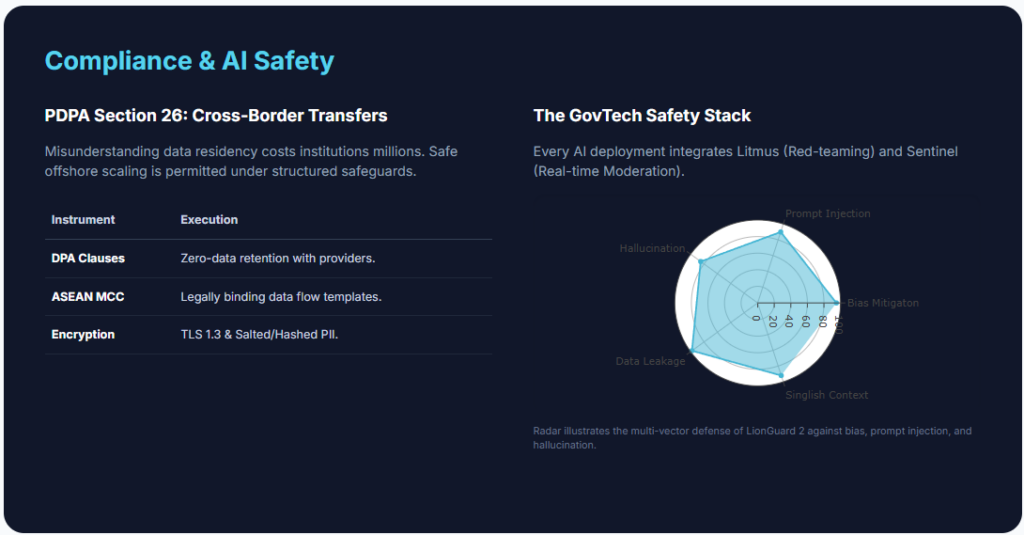
PDPA Section 26 is frequently misread as a data residency mandate. It is not. The Transfer Limitation Obligation permits cross-border data transfer to international cloud servers provided the recipient is bound by legally enforceable obligations delivering protection comparable to the PDPA. Vinova has structured cross-border compliant architectures for MAS, GovTech, IPOS, OCBC Bank, and Prudential under this framework. The compliance instruments that make it work:
| Compliance Instrument | Technical Operationalisation | Reference Standard |
| Data Processing Agreement (DPA) | Contractual clauses binding the recipient cloud provider to data protection standards comparable to PDPA | PDPC Standard Contractual Clauses |
| ASEAN Model Contractual Clauses | Recognised cross-border transfer mechanisms and model contract templates for ASEAN data flows | ASEAN Model Contractual Clauses (MCCs) |
| Data Transfer Impact Assessment (DTIA) | Formal risk analysis verifying that the destination country offers comparable data protection safeguards | PDPA Section 26 Framework |
| Pseudonymisation and encryption | TLS 1.3 in transit and AES-256 at rest; NRIC and student IDs salted and hashed prior to outbound transmission | ISO/IEC 27001 Security Controls |
Vinova additionally integrates Secure Virtual Desktop Infrastructure (VDI) for any engagement involving offshore engineering squads, ensuring that personal data remains inaccessible outside approved secure endpoints hosted in Singapore cloud zones. This architecture satisfies Section 26 fully. For edutech expert partners working across MAS, GovTech, IPOS, OCBC Bank, and Prudential, this is the compliance baseline Vinova has validated in production.
3. Algorithmic bias and AI safety in high-stakes educational contexts
Generative AI models are probabilistic, susceptible to prompt injection, toxicity, and hallucinations. In an educational context, unsafe or biased outputs degrade student wellbeing and violate national safety guidelines. Vinova deploys GovTech’s dual AI testing and guardrail stack on every edutech innovation engagement involving AI:
- Litmus: integrates directly into CI/CD pipelines, running automated red-teaming scenarios evaluating models against five core risk vectors (hallucination, bias, undesirable content, data leakage, adversarial prompt vulnerability) before any deployment reaches production
- Sentinel with LionGuard 2: a real-time inline proxy routing all user inputs and LLM outputs through context-aware moderation trained on Singapore’s linguistic environment, processing code-mixed English, Singlish, Chinese, Malay, and Tamil. Off-topic detection and system prompt leakage filtering run on every interaction
- Human-in-the-loop review: for high-stakes assessments, AI-generated feedback is staged for educator approval before release. The educator’s judgment is never removed from the chain
Two Next-Gen EduTech Innovation Trends to Build for Now

Autonomous AI agents for enrolment and administration
The transition from generative chatbots to agentic AI marks a significant shift in edutech edtech infrastructure. AI agents operate autonomously to complete complex administrative workflows: an automated enrolment advisor can verify transcript authenticity, cross-check prerequisite requirements, update the SIS via API, and generate a customised study path, with minimal human intervention in the execution layer.
To manage the risks of autonomous execution, institutions must operationalise GovTech’s Agentic Risk and Capability (ARC) Framework alongside IMDA’s Model AI Governance Framework for Agentic AI (published January 2026). The specific technical controls: sandboxed code execution inside isolated containers (gVisor runtimes) to prevent unauthorised server commands, and deterministic finite-state machine controls preventing agents from mutating database records without explicit cryptographic human authorisation for high-risk operations.
Blockchain-verified digital micro-credentials
Static paper diplomas are a liability in a labour market that moves at software speed. Blockchain-based verifiable credentials using W3C Verifiable Credentials and decentralised identifiers (DIDs) give institutions the infrastructure to issue cryptographically verifiable competency records that students manage via secure digital wallets. Employers across ASEAN labour markets verify credential authenticity instantly, without manual registry lookups. IMDA’s Blockchain Challenge directly supports this infrastructure for Singapore institutions. Institutions that build this now own the credential layer their graduates carry into every job market in the region.
Evaluating EduTech Innovation Delivery: In-House IT vs. Edtech Expert Partner
.
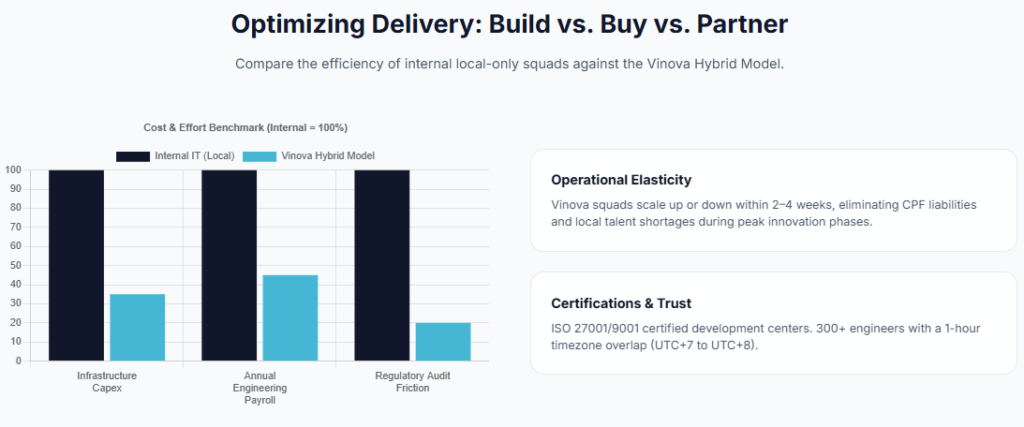
Developing custom, compliant educational platforms entirely in-house leads to project stagnation: local talent shortages, COMPASS EP processing delays, and high fixed overhead regardless of project phase. Off-the-shelf software fails Singapore’s compliance mandates and complex integration requirements. Neither path delivers government-grade edutech innovation at the speed Singapore’s institutions need. The optimal model is hybrid: engage an edutech expert partner to retain local governance, product vision, and compliance oversight in Singapore while scaling intensive engineering execution through cross-border delivery teams.
| Parameter | Internal IT Departments | Vinova Hybrid Delivery Model |
| Technical stack depth | Typically restricted to legacy enterprise suites with limited local expertise in modern edutech innovation stacks | High proficiency across Next.js, React, Node.js, Go, Python, pgvector, LTI 1.3, and event-driven microservices architectures |
| Delivery velocity | Slow: 3 to 6 months to onboard local engineering talent under COMPASS EP processing | Accelerated: cross-functional squads operational within 2 to 4 weeks; 1-hour timezone overlap (UTC+7 to UTC+8) |
| Regulatory compliance | High internal friction; teams frequently lack specialist knowledge of PDPA, IMDA AI Verify, IM8, and SLS integration standards | ISO/IEC 27001:2022 and ISO 9001:2015 certified; ISTQB Partner since 2023; GovTech GRC delivery experience across MAS, GovTech, IPOS, OCBC Bank, and Prudential |
| Capital expenditure | Extremely high: competitive local salaries, CPF (17%), SDL, benefits, and office overhead regardless of project phase | 40% to 60% below Singapore-only engineering costs; senior engineer rates from USD 2,800 to 4,500 per month all-inclusive |
| Operational elasticity | Low: significant financial and organisational friction when adjusting headcount around academic cycles | High: scales up or down to align with active development phases without CPF liabilities or EP cancellation complexity |
Vinova combines Singapore-based senior solution architects and client engagement leads with 300+ engineers across ISO 9001 and ISO/IEC 27001:2022 certified development centres in Hanoi, Da Nang, and Ho Chi Minh City. The 1-hour timezone differential (UTC+7 to UTC+8) supports real-time daily collaboration throughout the full Singapore business day. Code reaches staging only after clearing automated quality and security gates, underpinned by Vinova’s ISTQB Partnership (since 2023) and DORA metric benchmarking across all squads.
Two grant schemes reduce the capital investment required for any edutech innovation engagement. IMDA’s Advanced Digital Solutions (ADS) scheme offsets up to 70% of custom integration and software development costs. Enterprise Singapore’s Enterprise Development Grant (EDG) provides 50% to 70% co-funding for capacity upgrading and proprietary engineering. Structured stacking of both schemes materially reduces net project cost.
| Request a Custom Tech-Audit with Vinova Book a complimentary 2-hour technical audit with Vinova’s edtech expert engineering team. We’ll assess your current learning infrastructure, identify your highest-ROI innovation priorities, and map a delivery plan to Singapore’s EdTech Masterplan 2030 and your compliance requirements. No commitment required. Schedule Your Free EdTech Innovation Audit with Vinova |
EduTech Innovation FAQs
What is the difference between standard digitalisation and continuous edutech innovation?
Standard digitalisation is a phase-based process replacing manual tasks with digital equivalents: converting paper worksheets to PDFs, moving in-person lectures to pre-recorded video. This typically produces static, monolithic platforms that cannot adapt as institutional needs change. Continuous edutech innovation treats software as an evolving product lifecycle. It relies on decoupled microservices, modern API gateways, and automated CI/CD pipelines that allow engineering teams to deploy micro-updates, integrate new machine learning models, and refresh compliance protocols without disrupting operational uptime. The institutional difference is not a feature comparison. It is a structural architectural commitment.
How do Singapore universities ensure PDPA and IMDA AI Verify compliance when deploying generative AI tools?
Compliance requires controls at three layers:
- Data protection core: AES-256 at rest and TLS 1.3 in transit; sensitive identifiers salted and hashed before model processing; DPAs with cloud providers enforcing zero-data retention policies preventing internal data from being used for generic model training
- Safety interceptor: all classroom AI prompts routed through GovTech’s Sentinel proxy; LionGuard 2 evaluates prompts and outputs in real time for injections, toxicity, and unauthorised PII leakage
- Compliance audit: formal evaluations against all 11 domains of IMDA’s AIVerify framework; process evidence reports verifying model transparency, explainability, safety, data governance, and human accountability across the full system lifecycle
Why do large-scale edutech innovation projects fail, and how do you measure ROI in the first academic year?
Three failure modes are structurally consistent. First, the monolithic integration trap: forcing new features into legacy core databases causes performance degradation and system downtime. Second, change management neglect: deploying complex systems without aligning them to actual e-Pedagogy workflows guarantees teacher resistance and low adoption. Third, poor data alignment: fragmented legacy databases produce data quality so low that AI recommendations become unreliable, eroding institutional trust in the platform.
Three measurable ROI metrics validate first-year performance:
- Administrative resource recovery: measure the reduction in staff hours spent on manual grading and system administration after deploying SAFA and FA-Math
- Student cohort retention: track reduction in at-risk student drop-outs from adaptive platforms that flag students for early intervention (as demonstrated in SIT AdventureLEARN)
- System integration cost savings: measure the reduction in maintenance costs from replacing brittle legacy integrations with clean API-first middleware
What technical standards are required to connect a custom application to Singapore’s Student Learning Space (SLS)?
SLS integration under the MOE Application Development Framework (ADF) requires LTI v1.3 and Deep Linking 2.0 for secure SSO and launch validation, with incoming JSON Web Tokens signed using RS256 algorithms. Systems must expose OIDC authorisation endpoints and a JWKS public keyset endpoint for cryptographic token verification. For custom HTML5 interactives, xAPI (Experience API) integration is required to stream student performance markers, time-spent telemetry, and response evaluations to the platform’s central Learning Record Store (LRS). Vendors without LTI 1.3 certification cannot enter the SLS panel. There is no workaround.
What database architectures and frontend frameworks are recommended for high-concurrency multi-tenant learning platforms?
PostgreSQL with Row-Level Security (RLS) is the standard database architecture for multi-tenant edutech edtech platforms requiring strict tenant data isolation at the database level (not application level), ensuring data separation even if an application-level exploit occurs. Pair with PgBouncer or Supavisor for connection pool management under high-concurrency spikes. Use Redis for caching and session state. For the frontend: React or Next.js with server-side rendering (SSR) for fast page loads on low-powered personal student learning devices. Deploy an API gateway (Kong) with Redis caching to handle concurrent loads during exam release periods without backend database strain. Vinova applies this stack across every institutional multi-tenant engagement.
| Vinova: Singapore’s edtech expert engineering and edutech innovation partner. ISO 27001:2022 and ISO 9001:2015 certified. GovTech IM8 validated. PDPA and IMDA AI Verify compliant. 300+ engineers across Singapore, Hanoi, Da Nang, and Ho Chi Minh City. EdTech clients include SIT AdventureLEARN, GovTech Singapore, IPOS, MAS, OCBC Bank, and Abbott Labs. Financial Times Top 500 High-Growth Companies Asia-Pacific 2026. The Straits Times Singapore’s Fastest-Growing Companies 2024, 2025, and 2026. Request your tech audit. |