Choosing and implementing an enterprise CMS in 2026 is no longer a straightforward platform procurement decision. Marketing teams need content velocity, multisite control, and personalisation at scale. IT teams need security, compliance, and predictable infrastructure costs. Most enterprise CMS platforms claim to deliver both. Very few actually do without a specialist web development agency that understands how to configure, integrate, and govern them correctly.
This guide covers the enterprise CMS landscape in 2026, how to select the right architecture for your organisation, what PDPA and GDPR compliance requires from your CMS infrastructure, and how Vinova delivers enterprise CMS development services for Singapore businesses.
Table of Contents
Key Takeaways:
- Modern enterprise CMS must balance marketing velocity with IT governance, transitioning from simple publishing tools to structured hubs that feed machine-readable data to external systems.
- Organizations choose between three architectures, with most mid-to-large enterprises adopting Hybrid Headless models to effectively combine developer flexibility with visual authoring tools for marketing teams.
- Security and compliance like PDPA must be architected from the start, requiring a 2-4 week discovery phase to map workflows, integration needs, and data residency obligations.
- Implementations range from SGD 80,000 to 500,000+, with hybrid delivery models offering 40-60% lower costs while supporting complex requirements like the 99.99% uptime achieved by Kubota Tractor.
The Core Tension in Enterprise CMS: Marketing Velocity vs. IT Governance

Most enterprise CMS projects stall because they’re scoped as a technology decision rather than an organisational one. Marketing Directors need to publish content across multiple brands, regions, and channels without raising a developer ticket for every layout change. IT and security teams need to enforce data residency, access controls, and audit trails without becoming a publishing bottleneck. These two requirements are genuinely in conflict on most legacy platforms.
The 2026 market has a name for this pressure: The Crunch. It’s intensified by a structural shift in how content reaches audiences. AI-generated search summaries, social video platforms, and algorithm-mediated feeds are consuming direct website traffic, forcing enterprises to treat their enterprise CMS not just as a publishing tool but as a structured content hub that feeds machine-readable data to external systems. The CMS that can’t output clean, schema-first content to third-party channels is already behind.
Resolving this tension is the first thing Vinova’s enterprise CMS development engagements tackle. Before selecting a platform, Vinova’s Business Analysts run a 2 to 4 week discovery workstream that maps the client’s content workflows, integration requirements, and compliance obligations. Platform selection follows the requirements. Not the other way around.
Enterprise CMS Architecture: Three Models and When to Use Each
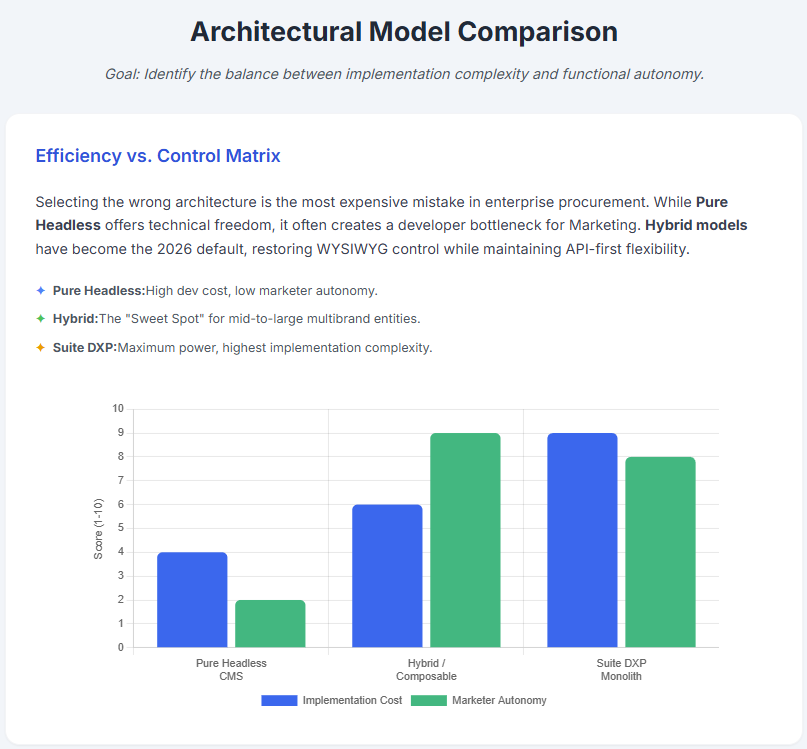
The 2026 enterprise CMS market splits into three distinct architectural categories. Choosing the wrong one is the most expensive mistake an organisation can make, because re-platforming mid-programme typically costs more than the original implementation. As a website development company that has delivered across all three models, Vinova’s recommendation depends entirely on the client’s content team structure, integration complexity, and compliance requirements.
Pure Headless CMS
Decouples the content repository entirely from presentation. Content is stored as structured data and delivered via API to any frontend or channel. Excellent for developer-led teams building multi-platform applications. The trade-off: marketing teams lose visual editing controls, making every layout change a developer dependency.
Hybrid / Composable Headless CMS
Maintains a fully decoupled, API-first delivery layer while restoring visual authoring tools for marketing teams. Through inline editors and drag-and-drop page builders, marketers retain layout control without touching code. Content is still delivered via REST or GraphQL APIs to decoupled frontends. This is the model Vinova recommends for most mid-to-large enterprise organisations in Singapore, particularly those managing multiple brands or regional sites. Platforms like Progress Sitefinity and dotCMS operate in this category.
Suite DXP (Monolithic)
Full-stack digital experience platforms like Adobe Experience Manager (AEM) and Sitecore XM Cloud offer the deepest personalisation, journey orchestration, and AI capabilities, but come with the highest implementation complexity and longest deployment runways. Both platforms have transitioned toward cloud-native SaaS delivery (AEM’s Edge Delivery Services; Sitecore’s Azure-native XM Cloud), but migrating existing monolithic deployments remains a multi-quarter engagement requiring specialist architects.
Here’s how the three categories compare across the criteria that matter most for enterprise decision-makers:
| Criteria | Pure Headless | Hybrid / Composable Headless | Suite DXP (Monolithic) |
| Target audience | Developer-led product teams; multi-platform apps | Mid-to-large multibrand enterprises needing marketer autonomy | Global conglomerates on centralised legacy stacks |
| Marketer experience | Steep learning curve; form-field editors only | WYSIWYG visual editors alongside API-first pipelines | High marketer capability; steep developer learning curve |
| AI readiness | High via API endpoints and custom LLM prompts | Native embedded AI assistants, semantic search, and RAG-driven answers | Custom agent builders, predictive modelling, automated journey agents |
| Security and compliance | Decoupled; relies on SaaS SOC 2 Type II controls | Multi-tenant database isolation, visual RBAC, HIPAA hosting options | Centralised compliance engines; air-gapped on-premise options |
| Multisite and localisation | Developer assembly required per endpoint | High; multilingual layouts, translations, and multisite tools built-in | Unified localisation matrices with deep translation workflows |
| Total cost of ownership | Low licensing; high developer cost | Mid-range; faster marketer self-service reduces ongoing dev spend | High; multi-quarter deployment; dependent on specialist integrators |
| Implementation complexity | Medium; requires custom frontend build | Medium; low-code tooling reduces integration overhead | High; complex legacy migrations; long deployment runways |
Enterprise CMS Platform Comparison: What Vinova Recommends and Why
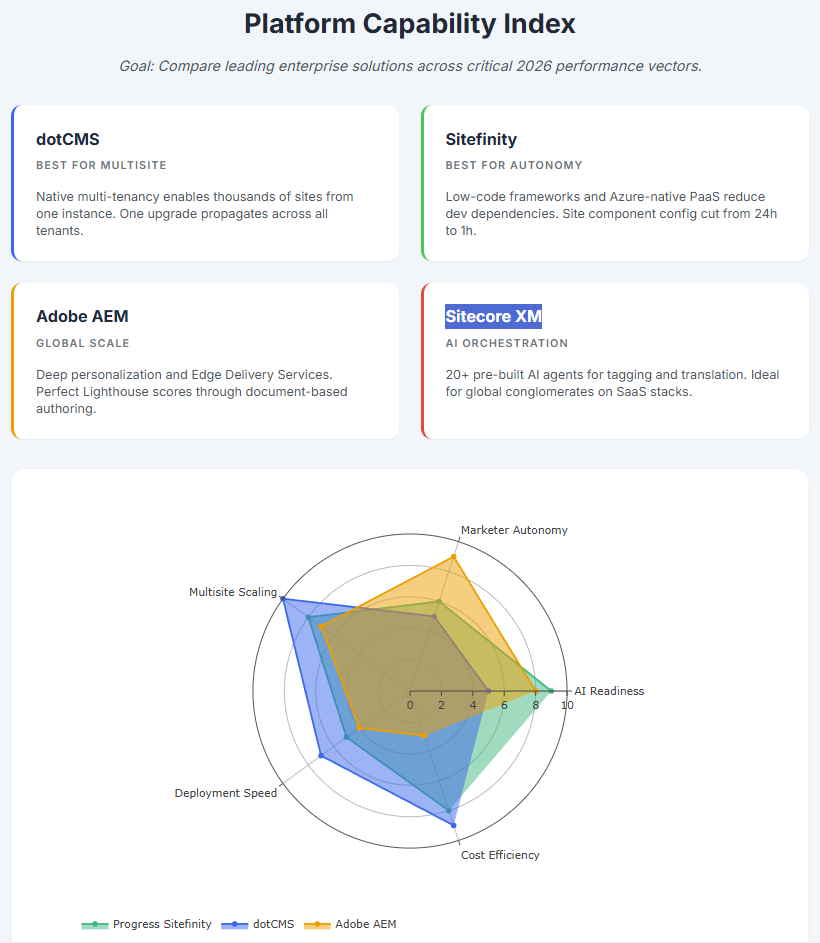
As a Singapore-based web development agency with 300+ enterprise projects delivered, Vinova works across all major enterprise CMS platforms. The right platform depends on your content team’s technical maturity, your multisite and localisation requirements, and your compliance environment.
| Platform | Architecture | Best For | AI Capability | Vinova Delivery Fit |
| dotCMS | Java-based; native multi-tenancy; hybrid headless | Multibrand enterprises managing many sites from one instance | API-extensible; integrates with external LLMs | Strong; multisite architecture aligns with Vinova’s enterprise delivery model |
| Progress Sitefinity | ASP.NET Core + Next.js; low-code integration framework | Mid-to-large multibrand enterprises; dealer and franchise networks | Native AI assistants; RAG via Nuclia integration (5.0 Forrester score) | Strong; Azure-native PaaS reduces infrastructure overhead in Vinova ODC model |
| Adobe AEM + EDS | Suite DXP; serverless Edge Delivery alongside full AEM stack | Global enterprises with existing Adobe stack and large content teams | GenStudio for asset generation; automated creative variations | Viable; requires specialist AEM certified engineers; long delivery runway |
| Sitecore XM Cloud | Azure-native SaaS; Next.js and framework-agnostic frontend | Global conglomerates needing personalisation and agentic orchestration | SitecoreAI: 20+ pre-built agents for tagging and translation | Viable; complex legacy migrations require senior architects; Vinova partner network required |
dotCMS: Best for High-Volume Multisite Operations
dotCMS’s native multi-tenancy model is its defining differentiator. Instead of provisioning a separate infrastructure stack per brand or micro-site, dotCMS runs thousands of independent sites from a single application instance with logical data isolation between tenants. For enterprise organisations managing large dealer networks, regional brand sites, or franchise portals, this yields a substantial TCO advantage: one platform upgrade propagates across all tenants simultaneously, eliminating the maintenance overhead of managing parallel upgrade cycles. The Universal Visual Editor (UVE) preserves drag-and-drop page editing for marketing teams on fully headless frontends.
Progress Sitefinity: Best for Marketer Autonomy at Enterprise Scale
Sitefinity’s combination of low-code integration frameworks and Azure-native PaaS delivery addresses the two most common enterprise CMS bottlenecks: developer dependency and infrastructure maintenance. The Food and Agriculture Organisation (FAO) used Sitefinity to cut website component configuration time from 24 hours to 1 hour across 700 multilingual sites managed by a team of 10. Kubota Tractor Corporation reduced new dealer site deployment to under two weeks and achieved 99.99% uptime across 354 dealer sites after migrating to Sitefinity Cloud. Sitefinity also scored the highest possible 5.0 in the Search criterion of the Forrester Wave: Digital Experience Platforms, Q4 2025, driven by its RAG integration for multilingual answer engines.
Adobe AEM and Sitecore: When You Need the Full Suite
AEM’s Edge Delivery Services now enables document-based authoring (from Word, SharePoint, or Google Docs) with edge-rendered performance, targeting perfect Lighthouse scores without CMS compilation overhead. Sitecore XM Cloud adds 20+ pre-built AI agents for automated content tagging and translation. Both platforms are the right call for global conglomerates that need enterprise-scale personalisation and are willing to invest in the specialist implementation resources required. For Singapore-based enterprises, Vinova’s hybrid delivery model (Singapore-based architects, Vietnam-based engineering squads) makes these platforms financially viable at a cost 40 to 60% below equivalent Singapore-only agency rates.
PDPA and GDPR Compliance in Enterprise CMS Development
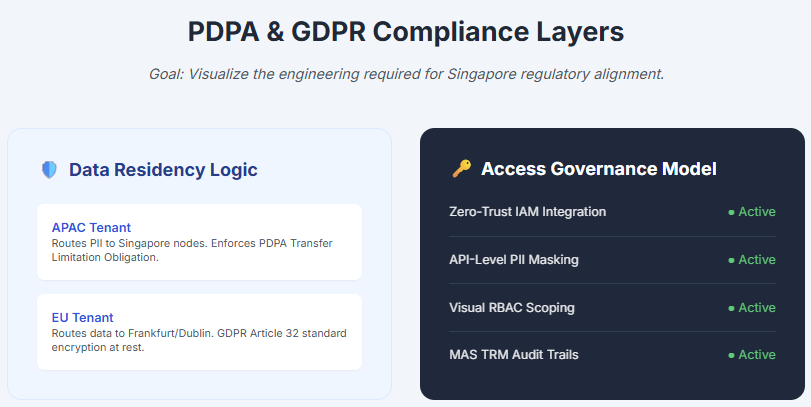
For Singapore-based enterprises, enterprise CMS development that touches personal data must comply with the PDPA’s Transfer Limitation Obligation and, for global operations, GDPR Article 32. This isn’t a configuration step at the end of an implementation. It has to be designed into the CMS architecture from the start. Getting it wrong after go-live means re-engineering database schemas, access controls, and API outputs under production pressure.
Here’s how Vinova engineers compliance into every enterprise CMS deployment:
| Compliance Layer | Requirement | Enterprise CMS Implementation |
| Database isolation | Prevent cross-tenant data contamination (GDPR Article 32; PDPA TLO) | Separate database schema per tenant for regulated sectors; shared schema with enforced tenant_id validation for lower-risk deployments |
| Regional data hosting | Store personal data within jurisdictional borders | APAC customer data routed to Singapore or regional cloud nodes; EU data to Frankfurt or Dublin; enforced at infrastructure level |
| API-level PII masking | Prevent PII leakage through public content APIs | Field-level encryption and tokenisation at rest and in transit; anonymised behavioural profiles routed to global reporting tenants |
| Access governance | Restrict content publishing and data access to authorised personnel | Visual RBAC with role-scoped publishing permissions; Zero-Trust IAM enforced across all staging and production CMS environments |
| Vendor certification | Independently verified security controls | Vinova holds active ISO/IEC 27001:2022 and ISO 9001:2015 certifications across all delivery locations |
For clients in financial services, Vinova’s CMS development services are additionally scoped to align with MAS Technology Risk Management (TRM) guidelines. This includes vendor risk grading, documented incident response SLAs, and audit rights preserved in all CMS vendor contracts. Clients including OCBC Bank and Prudential require this level of documentation before any enterprise platform is provisioned.
Why Hybrid Headless Is Now the Default for Enterprise CMS Projects
The industry went through a pendulum swing. Monolithic CMS platforms gave marketing teams visual control but buried IT in code bloat and complex upgrade cycles. Pure headless architecture fixed the IT problem and created a new one: marketing teams lost all visual editing capability and became dependent on developer pipelines for basic layout changes.
Hybrid headless architecture resolves both sides. The content layer is fully decoupled and API-first, satisfying developer performance goals and enabling structured content delivery to any channel. The authoring layer restores visual, inline editing for marketing teams without touching the delivery infrastructure. For enterprise organisations managing multiple brands, regional sites, or franchise networks, this is now the baseline expectation from any serious web development agency pitching enterprise CMS work.
The specific benefits for enterprise Marketing Directors:
- Content editors publish without raising developer tickets for layout changes
- New micro-sites and regional properties can be onboarded without provisioning new infrastructure stacks
- Content is structured and machine-readable, enabling delivery to AI summaries, voice interfaces, and partner platforms via API
- IT teams enforce governance, access controls, and compliance at the infrastructure layer without touching editorial workflows
- Deployment pipelines run continuously with automated quality gates, eliminating release-cycle downtime windows
Vinova’s Enterprise CMS Development Services: How We Deliver
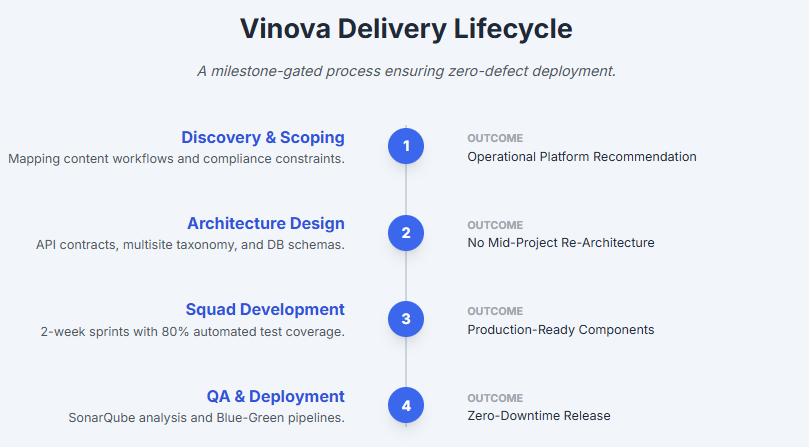
Vinova is a Singapore-headquartered website development company and IT consulting firm with 300+ enterprise projects delivered since 2010. Recognised by The Straits Times as one of Singapore’s Fastest-Growing Companies for three consecutive years (2024, 2025, and 2026), Vinova delivers enterprise CMS development services under ISO/IEC 27001:2022 and ISO 9001:2015 certified processes, with engineering squads across Singapore, Hanoi, Da Nang, and Ho Chi Minh City.
| Delivery Phase | What Vinova Does | Outcome |
| Discovery and scoping | Business Analysts map content workflows, integration requirements, and compliance constraints before any platform is selected | Platform recommendation grounded in your actual operations, not vendor preference |
| Architecture design | Senior architects design API contracts, database schemas, multisite taxonomy, and content governance models before a line of code is written | No mid-project re-architecture; clean interfaces between CMS, frontend, and third-party martech |
| CMS development services | Dedicated squads build custom components, integration layers, editorial workflows, and automated deployment pipelines | Production-ready CMS delivered on a two-week sprint cadence with 80% automated test coverage on critical paths |
| QA and deployment | Every release passes SonarQube static analysis, automated regression testing, and a 48-hour peer code review SLA before reaching production | Zero-defect deployment path; Blue-Green pipeline for zero-downtime releases |
| Post-launch evolution | Long-term dedicated squads maintain and extend the platform as content operations scale | Platform evolves with your roadmap; same team retains architectural context across years |
Vinova’s enterprise CMS clients span some of Singapore’s most demanding sectors. For GovTech Singapore, Vinova delivered a multi-million dollar whole-of-government GRC platform requiring the highest data sovereignty and uptime standards. For IPOS International, Vinova built the Digital Workbench, a secure enterprise content and workflow platform with deep Office 365 integration and custom patent examination workflows. For the Singapore Institute of Technology (SIT), Vinova deployed a campus integration platform using a proprietary AI Agentic Framework to automate scheduling and resource optimisation, producing measurable reductions in annual operational costs.
| Ready to Implement Your Enterprise CMS? Book a complimentary 2-hour consultation with Vinova’s enterprise CMS development team. We’ll review your current web architecture, recommend the right platform for your content operations, and map a delivery plan to your timeline and budget. No commitment required. Schedule Your Free 2-Hour Enterprise CMS Consultation with Vinova |
FAQ: Enterprise CMS Development for Singapore Businesses
What is enterprise CMS development and how is it different from standard web development?
Enterprise CMS development covers the full lifecycle of selecting, configuring, integrating, and maintaining a content management system for large organisations managing multiple brands, regions, or channels. Unlike standard web development, enterprise CMS development services involve multisite architecture, content governance frameworks, compliance engineering (PDPA, GDPR, MAS TRM), integration with martech stacks, and long-term editorial workflow design. The implementation complexity is significantly higher, and the choice of web development agency determines whether the platform actually gets used as intended or becomes shelfware.
Which enterprise CMS platform is best for Singapore businesses in 2026?
It depends on your content team structure, compliance requirements, and multisite scale. For mid-to-large multibrand enterprises prioritising marketer autonomy, Progress Sitefinity and dotCMS are Vinova’s first recommendations. For global conglomerates needing the deepest personalisation and AI orchestration capabilities, Adobe AEM or Sitecore XM Cloud are the right choice at a higher implementation cost and longer delivery runway. Vinova runs a structured discovery workstream before making any platform recommendation.
How much do enterprise CMS development services cost in Singapore?
Enterprise CMS implementation costs in Singapore typically range from SGD 80,000 to SGD 500,000+ depending on platform complexity, number of sites, integration depth, and compliance requirements. As a Singapore-headquartered website development company with Vietnam delivery, Vinova operates at 40 to 60% below equivalent Singapore-only agency rates without compromising on ISO-certified quality standards. Annual maintenance and evolution retainers typically run 15 to 20% of the initial build cost.
How do enterprise CMS platforms handle PDPA compliance for Singapore organisations?
PDPA compliance in an enterprise CMS context requires database isolation at the tenant level, regional data hosting (Singapore or APAC nodes for local data), API-level PII masking before content is exposed to external channels, and Zero-Trust access governance for publishing workflows. Vinova engineers these controls into the architecture before any content goes live, not as a retrofit after launch.
What is the difference between a headless CMS and an enterprise CMS?
A headless CMS is an architectural pattern: content is stored as structured data and delivered via API, decoupled from any specific frontend. An enterprise CMS is a platform category defined by scale, governance, multisite capability, compliance controls, and integration depth. Most modern enterprise CMS platforms are either pure headless or hybrid headless. The distinction that matters for enterprise organisations is whether the platform supports marketer-led publishing at scale without developer dependency, which is what hybrid headless enterprise CMS development specifically addresses.
How long does an enterprise CMS implementation take?
A focused enterprise CMS implementation (single brand, clear integration requirements) typically takes 3 to 5 months to go live. A full multisite, multilingual deployment with martech integration and compliance engineering runs 6 to 10 months. Large-scale re-platforming from a legacy monolithic CMS to a composable headless architecture requires 10 to 18 months depending on content volume and integration complexity. Vinova’s milestone-gated delivery model ties each payment phase to a working deliverable, not a calendar date.
| Vinova: Singapore’s enterprise CMS development and web development agency. ISO 27001:2022 and ISO 9001:2015 certified.300+ engineers across Singapore, Hanoi, Da Nang, and Ho Chi Minh City. 300+ projects delivered. Trusted by GovTech, IPOS, SP Group, OCBC Bank, Prudential, and Samsung. Schedule a 2-hour consultation |