Are you prepared to lose 30% of your customers to silent churn? In the 2026 AI landscape, trust is not a bonus; it is your primary retention strategy. While 96% of leaders believe GenAI increases breach risks, only 24% of projects are actually secured.
This gap is a massive liability. With regulatory fines now hitting €35 million, governance has become critical infrastructure. You cannot afford to treat ethical frameworks as optional. AI development in the USA by Vinova embeds security-by-design, compliance automation, and responsible AI governance into every stage of deployment—transforming regulatory pressure into long-term customer trust.
Do you know the three pillars required to close this compliance gap today? Keep reading to future-proof your AI operations.
Table of Contents
Key Takeaways:
- Non-compliance with the EU AI Act can result in fines up to €35 million or 7% of annual turnover, making robust ethical governance a critical business liability.
- The “Trust Deficit” causes “silent churn,” with approximately 30% of consumers abandoning a brand after a poor, biased, or opaque AI interaction.
- A major security gap exists as 96% of leaders see breach risks from Generative AI, but only 24% of AI projects are secured adequately.
- Vinova’s framework includes ISO-certified governance, custom models to limit inherited bias, and a “Sanitization Layer” to defend against next-gen prompt injection attacks.
Introduction – Why Ethical AI Is Crucial for Modern Businesses
The era of “move fast and break things” is over. In 2026, the artificial intelligence landscape focuses on trust and compliance. Governance is no longer optional; it is a primary market driver.
The Financial Stakes
Ethical frameworks are now critical infrastructure. The global AI Governance Market will reach approximately $419 million in 2026. It is expanding at a Compound Annual Growth Rate (CAGR) of 35.74%.
Companies that neglect responsible AI face a quantifiable “Trust Deficit.” This directly impacts the bottom line.
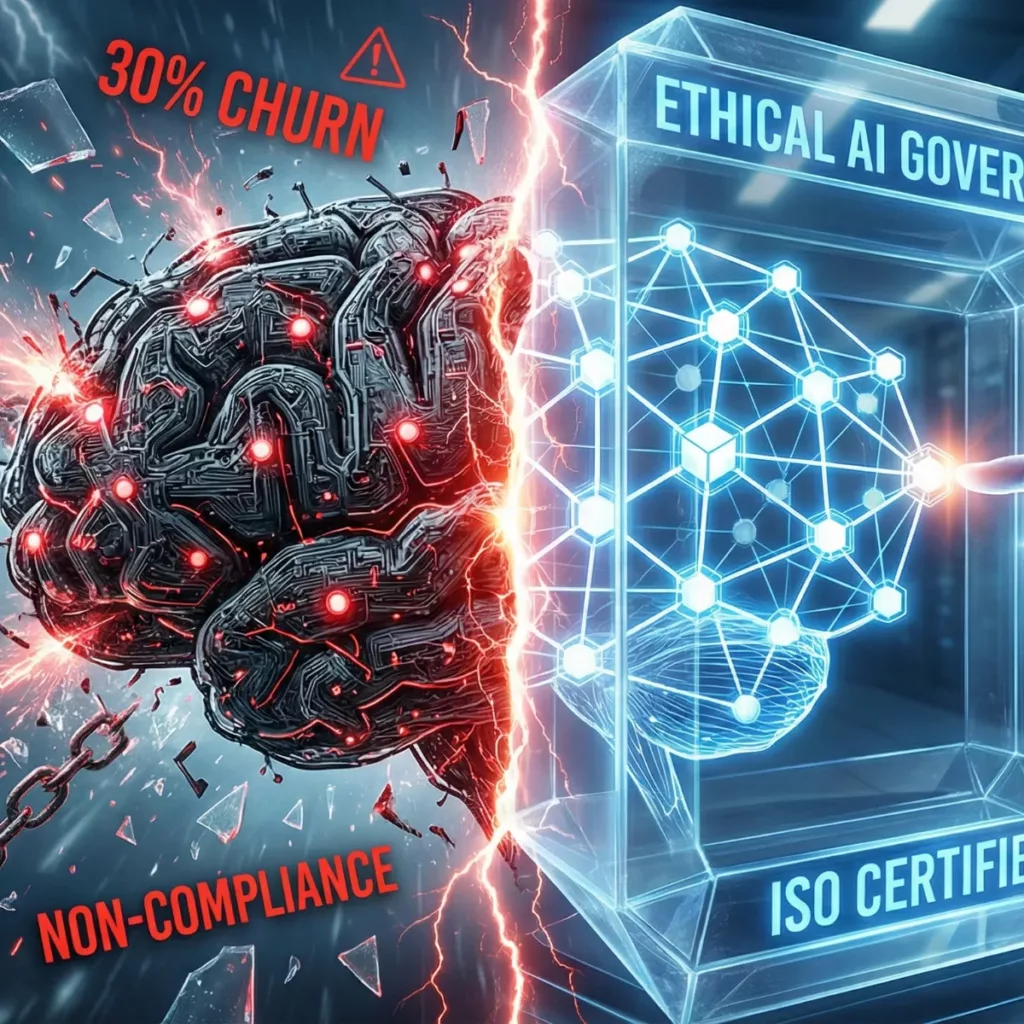
The Cost of Bias: Silent Churn
Poor AI interactions have immediate consequences. Customers do not always complain; they simply leave.
- Silent Churn: Approximately 30% of consumers abandon a brand after a poor, biased, or opaque AI interaction.
- No Warning: These users leave without lodging a formal complaint, making the loss difficult to track without advanced metrics.
Compliance is not just about avoiding fines. It is about retaining revenue.
The Challenges of Data Bias and Transparency
As organizations scale from pilots to full deployment, they face two massive hurdles: Algorithmic Bias and the legal demand for Explainability.
The High Cost of Bias
Bias is not just a PR problem; it is a legal liability. In 2026, sophisticated algorithms often identify “proxy” variables. A model might ignore race but discriminate based on zip codes or vocabulary patterns. This inadvertently recreates prohibited outcomes in hiring, lending, or healthcare.
The financial repercussions are severe. Under the fully enforceable EU AI Act, violations regarding prohibited practices lead to fines of up to €35 million or 7% of total worldwide annual turnover, whichever is higher.
The “Black Box” and Consumer Anxiety
The “Black Box” problem—where AI decisions are opaque—drives customer fear. Users engage with AI, but they do not trust it.
A 2026 consumer sentiment survey reveals the depth of this anxiety:
- 53% of customers cite data misuse and lack of clarity as their top concerns.
- 73% of consumers use AI for daily tasks, yet only 39% believe organizations use their data responsibly.
This gap between high usage and low trust represents a significant vulnerability. Companies that fail to provide transparent, explainable solutions risk losing their user base to competitors who do.
How Vinova Ensures Fairness and Accountability in AI Models
Vinova shifts the focus from buying a product to building a service. Ethical governance is not an add-on; it is a core part of the architecture. This approach allows clients to utilize the hybrid delivery model—saving roughly 70% on costs—without compromising compliance or security.
ISO-Certified Governance and Consultation
Trust requires verification. Vinova holds ISO 27001 (Information Security) and ISO 9001 (Quality Management) certifications.
Ethical Consultation Development does not start immediately. Vinova offers a specialized consultation first. They map your specific use cases against strict regulations like the EU AI Act and Singapore’s Model AI Governance Framework. You know the legal risks before you write a single line of code.
Custom Model Development Generic public APIs often contain unchecked biases from the open internet. Vinova builds custom models instead. They curate “clean” training datasets specific to your industry. This limits the risk of inherited bias and ensures the AI speaks your business language.
Human-in-the-Loop (HITL) Architecture
Accountability demands human oversight. For high-stakes decisions, Vinova implements Human-in-the-Loop (HITL) architectures.
The AI acts as a tool, not the boss. For critical actions—like approving a large financial transfer or performing medical triage—the system pauses. It requires explicit human verification. This “break glass” protocol prevents automation bias. Human judgment remains the final word.
Data Protection Standards for US Companies
US compliance in 2026 is a fragmented patchwork. State and federal obligations often conflict. You cannot navigate this environment with a generic policy. You need a “Compliance-by-Design” engineering approach.
Navigating the Regulatory Matrix
California (CPRA), Colorado, and Virginia now enforce strict privacy laws. Compliance requires rigorous Data Minimization protocols. Collect only what is strictly necessary. If you do not store it, it cannot be stolen.
Healthcare & Finance For regulated sectors, compliance is non-negotiable. Solutions must be HIPAA-compliant and SOC 2 ready.
The gap in security is alarming. 96% of leaders believe Generative AI increases the likelihood of a security breach. Yet, only 24% of projects are secured accordingly. You must close this gap immediately.
Encryption Standards Mandate defense-grade encryption standards.
- Data at Rest: Use AES-256.
- Data in Transit: Enforce TLS 1.3.
This ensures that sensitive Patient Health Information (PHI) or financial records remain cryptographically secure, even if a physical device is compromised.
The Security Lifecycle: SAST and DAST
Secure applications before deployment. Employ a rigorous dual-testing regime.
SAST (Static Application Security Testing) Scan source code repositories automatically. Identify vulnerabilities like SQL injection flaws or hardcoded keys early in the development cycle. Fix the code before it compiles.
DAST (Dynamic Application Security Testing) Launch simulated attacks against the running application. This identifies runtime vulnerabilities that static analysis misses. You must test the lock by trying to pick it.
Building Trust Through Responsible AI Practices
In 2026, the primary security threat has evolved from simple data theft to Agentic Manipulation. As businesses deploy “AI Agents” that execute tasks autonomously—negotiating contracts, moving funds, or managing supply chains—they face new attack vectors like Indirect Prompt Injection.
This occurs when attackers hide malicious commands inside standard web content (e.g., invisible text on a resume or a hidden command in a vendor email) to trick your AI agent into exfiltrating data or executing unauthorized transactions.
Vinova’s “Sanitization Layer” Defense
To secure these autonomous systems, Vinova implements a Content Sanitization Layer. Think of this as a digital airlock for your data.
Instead of feeding raw internet data directly to your executive AI, we deploy a lightweight, secondary AI model that acts as a “bouncer.” This smaller model scans all incoming streams—emails, scraped websites, and documents—specifically looking for adversarial patterns and hidden prompt injections.
Only after the data is scrubbed and verified does the “bouncer” pass it to the main agent for processing. This segregation of duties ensures that even if malicious content enters the pipeline, it is neutralized before it can influence decision-making logic.
Radical Transparency and ROI
Trust is a financial asset. Vinova advises clients to practice Radical Transparency.
- Explicit Labeling: If a user is chatting with a bot, the interface must explicitly state it. Ambiguity breeds suspicion.
- The Trust Dividend: Organizations that prioritize responsible AI see significant returns. While 95% of AI pilots fail to scale due to user resistance, “AI High Performers”—those who master governance and trust—are capturing 5%+ of their enterprise-wide EBIT directly from AI adoption.
Users who trust the system share more data, follow recommendations, and remain loyal. Those who don’t engage in “silent churn”—abandoning your platform without a word.
Conclusion – Innovate Responsibly with Vinova’s Ethical AI Framework
The “wild west” era of artificial intelligence has ended. Today, sustainable innovation requires a foundation of rigorous ethics and ironclad security. The risks of ignoring this shift are now existential: from the €35 million fines of the EU AI Act to the 30% silent churn of dissatisfied customers.
Vinova stands as your strategic partner in this new landscape. We combine ISO 27001-certified security, HIPAA-compliant architectures, and a proactive Ethical Consultation methodology to help you harness the power of AI without compromising your values or legal standing.
Whether tackling the “Black Box” problem through explainable custom models or defending against next-generation prompt injection attacks, our framework ensures that your business doesn’t just innovate—it innovates responsibly.
Ready to secure your AI future? Schedule an Ethical AI Assessment with our experts to benchmark your models against the latest safety standards.
Frequently Asked Questions (FAQ)
1. What are the biggest financial risks of neglecting Ethical AI and compliance?
The financial risks are significant and two-fold:
- Regulatory Fines: Non-compliance with the fully enforceable EU AI Act can result in fines up to €35 million or 7% of total worldwide annual turnover, whichever is higher.
- Customer Churn: The “Trust Deficit” leads to “silent churn,” where approximately 30% of consumers abandon a brand after a poor, biased, or opaque AI interaction, directly impacting revenue retention.
2. What is “Silent Churn” and how does it relate to AI ethics?
“Silent Churn” refers to the approximately 30% of consumers who leave a brand without lodging a formal complaint after a negative experience with a biased, opaque, or poorly governed AI system. Since these users leave without warning, the loss is difficult to track, making robust ethical governance a primary retention strategy.
3. What is the major security gap mentioned regarding Generative AI projects?
While 96% of business leaders believe Generative AI increases the likelihood of a security breach, only 24% of AI projects are adequately secured. This gap creates a massive liability and necessitates immediate closure with rigorous security protocols.
4. How does Vinova’s framework ensure compliance and fairness in AI models?
Vinova’s framework focuses on a “Compliance-by-Design” approach through:
- ISO-Certified Governance: Holding ISO 27001 (Information Security) and ISO 9001 (Quality Management) certifications.
- Custom Models: Building curated models to limit inherited bias from generic public APIs, ensuring the AI is trained on clean, industry-specific datasets.
- Human-in-the-Loop (HITL): Implementing human oversight for high-stakes decisions, preventing “automation bias” and ensuring human judgment remains the final word.
5. What is “Agentic Manipulation” and how does Vinova defend against it?
Agentic Manipulation is the evolution of the security threat, where attackers target autonomous “AI Agents” through new vectors like Indirect Prompt Injection. This involves hiding malicious commands in standard content (like invisible text on a resume) to trick the AI agent into exfiltrating data or executing unauthorized transactions.
Vinova counters this with a Content Sanitization Layer, which acts as a lightweight, secondary AI model (a “bouncer”) to scan and neutralize adversarial patterns in all incoming data streams before they reach the main executive AI.
6. What data protection standards are mandated for US companies, particularly in regulated sectors?
Compliance requires a “Compliance-by-Design” approach, including:
- Data Minimization: Collecting only what is strictly necessary.
- Sector-Specific Compliance: Solutions for healthcare and finance must be HIPAA-compliant and SOC 2 ready.
Encryption Standards: Mandating defense-grade encryption: AES-256 for Data at Rest and TLS 1.3 for Data in Transit.