The experimental phase of Generative AI ended in 2025. Now, the market has split: is your business an “Achiever” or a “Spectator”?
Nearly one-third of US enterprises—the Achievers—integrate AI deep into core systems like ERP and CRM. These firms report a Return on Investment two to three times higher than their rivals. The value is no longer in the model itself. It is about deep, operational integration.
Can your current architecture handle the real-time data flow that modern Agentic AI requires? The strategic imperative for 2026 is operational—and this is where Vinova’s AI development in USA delivers real value. Vinova provides end-to-end AI development solutions for US enterprises, focusing on scalable architectures, real-time data integration, and production-ready AI systems embedded directly into ERP, CRM, and core business platforms.
Table of Contents
Key Takeaways:
- “Achievers,” about one-third of the market, integrate AI deep into core systems (ERP, CRM) and see a 2x-3x higher Return on Investment than competitors.
- Connecting modern Agentic AI to legacy systems faces architectural conflicts, like needing real-time data versus old batch processing, and a severe data quality crisis.
- Vinova’s Hybrid Integration Framework uses the “Strangler Fig Pattern” and an Anti-Corruption Layer (ACL) to safely modernize legacy systems and clean messy data.
- Integrated AI drastically boosts efficiency, reducing unplanned maintenance downtime by up to 50% and cutting logistics costs by 15-30% via Agentic Logistics.
Introduction – Why AI Integration Matters for U.S. Businesses
By fiscal year 2026, the landscape for US enterprises has shifted. The experimental phase of Generative AI is over. We have moved from isolated pilot programs to systemic integration.
The difference between market leaders and laggards is no longer about who has the best model. It is about who integrates that model deepest into their business.
The ROI Gap: Achievers vs. Spectators
The “Intelligence Divide” in the US market is widening.
- Achievers: This group makes up one-third of the market. They have woven AI into their core systems (ERP, CRM, and mainframes). They treat AI as a layer that activates their data, not just a standalone app. Consequently, their ROI is two to three times higher than their competitors.
- Spectators: These organizations remain stuck. Their legacy systems are too rigid to connect with modern, cloud-native AI agents.
The Economic Reality
For US businesses, integration is a survival tool. The economy faces labor shortages and high operational costs. Competitors in Asia are moving fast.
Integration drives efficiency. The global AI market is now valued at over $539 billion. This value comes from enterprise-grade services that demand security and reliability, not consumer chatbots.
The Rise of Agentic Systems
The technology itself has changed. The dominant tool of 2026 is “Agentic AI.” These are autonomous systems that reason, plan, and execute tasks across different platforms.
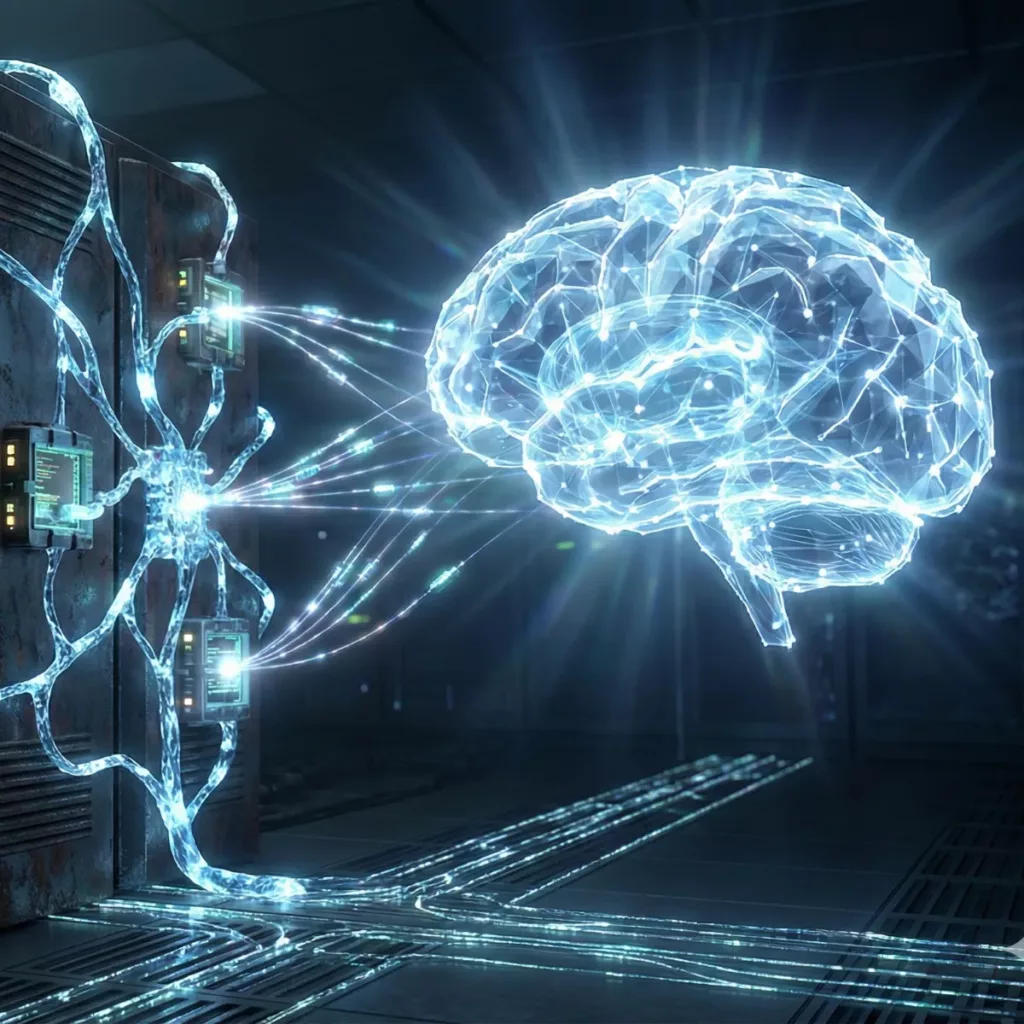
These agents need access. An AI supply chain agent is useless if it cannot read real-time inventory levels from SAP or write a purchase order to an Oracle database. Connecting the “brain” (AI) to the “body” (enterprise systems) is the critical engineering challenge of the decade.
Compliance is Mandatory
New regulations like the EU AI Act and US federal standards impose strict constraints. You can no longer rely on “black box” external models. Data must be governed and traced.
Integration allows you to keep sensitive data within your controlled environment while still using modern models. This “sovereign AI” approach makes integration a compliance requirement, not just a technical task.
Common Challenges When Connecting AI to Legacy Systems
Connecting modern AI to existing US enterprise infrastructure is difficult. Most established businesses operate in a “brownfield” environment. They have layers of technology accumulated over thirty or forty years. Connecting new AI agents to these old stacks creates conflict.
Architectural Conflict: Old vs. New
The biggest barrier is the design difference between legacy systems and modern AI.
- Batch vs. Real-Time: Legacy systems often process data in nightly batches. An AI agent needs data in milliseconds. If the AI asks for customer history, it might get data that is 24 hours old. This makes real-time decisions impossible.
- Language Barrier: Old systems use outdated protocols like SOAP. Modern AI uses REST and JSON. They do not speak the same language.
- Structure: Legacy apps are often “monoliths.” The interface, logic, and data are stuck together. You cannot change one part without risking the whole system.
The Data Quality Crisis
Data is the fuel for AI, but in many companies, it is trapped or dirty.
- Silos: A customer’s billing data sits in a mainframe. Their support history is in the cloud. These systems often lack a common ID to link them. The AI cannot see the full picture.
- Garbage In, Garbage Out: Old systems were built for humans who could interpret vague notes. An AI sees a blank field or a cryptic abbreviation as an error. This causes “hallucinations” or bad decisions.
- Unstructured Data: Much of the knowledge needed to train a model is locked in PDF contracts or scanned invoices. Legacy databases cannot read these files.
The Burden of Technical Debt
“Technical debt” is the cost of choosing quick fixes over long-term solutions. By 2026, this debt is high.
- The Black Box: Many mission-critical apps run on code written by developers who retired years ago. Documentation is missing.
- Fear of Failure: IT teams spend up to 70% of their budget just keeping the lights on. They fear that adding an AI hook will break the core business engine. This leads to “bolt-on” AI solutions that do not truly integrate.
The Security Perimeter Paradox
Legacy systems use a “castle-and-moat” security model. Once you are inside the network, the system trusts you. AI requires a “Zero Trust” approach.
- Data Leakage: There is a risk that sensitive personal data (PII) could be sent to an external AI model.
- Access Control: Old systems often lack granular controls. You cannot easily tell the system to let the AI see some data but not all of it.
- Audit Trails: If an AI denies a loan, you need to know why. Legacy logs often cannot trace the specific data point that led to the decision.
Cultural Friction
The workforce managing legacy systems is different from the workforce building AI.
- Legacy Teams: Fluent in COBOL and DB2. They prioritize stability and uptime.
- AI Teams: Fluent in Python and PyTorch. They prioritize speed and experiments.
These two groups often struggle to collaborate. Legacy teams may block AI deployments due to perceived risks.
The Integration Friction Matrix
| Challenge Domain | Legacy Characteristic | AI Requirement | Consequence |
| Architecture | Monolithic (All-in-one) | Microservices (Modular) | High risk of system breakage during updates. |
| Data Protocol | SOAP, XML | REST, JSON | Complex translation layers add delay. |
| Processing | Nightly Batches | Real-time | AI acts on outdated data. |
| Security | Castle-and-Moat | Zero Trust | Hard to manage agent permissions. |
| Talent | Mainframe Specialists | Data Scientists | Communication gaps between teams. |
Vinova’s Hybrid Integration Framework for Seamless AI Adoption
To navigate the treacherous landscape of legacy modernization, Vinova has codified a Hybrid Integration Framework that serves as a bridge between the deterministic past and the probabilistic future. This framework is not merely a set of tools but a strategic architectural methodology designed to enable the “Strangler Fig Pattern” of modernization—gradually replacing or augmenting legacy functionality without the risk of a catastrophic “big bang” rewrite.21
The Core Philosophy: The Strangler Fig Pattern
Vinova’s approach aligns with the dominant 2026 modernization strategy known as the Strangler Fig Pattern. Just as a strangler fig tree grows around a host tree, eventually replacing it, Vinova’s framework allows organizations to build new AI-driven microservices around the edges of their monolithic legacy systems. The legacy system remains operational, ensuring business continuity, while specific functions are peeled off one by one and rebuilt as modern, AI-enabled services. This allows for incremental value delivery and risk mitigation.21
Key Components of the Hybrid Integration Platform (HIP)
Modernizing legacy systems is risky. A “big bang” rewrite can crash critical operations. Vinova uses the “Strangler Fig Pattern” to mitigate this. We build new AI-driven microservices around the edges of your monolithic system. We peel off functions one by one, rebuilding them as modern services while the legacy core keeps the business running.
The Hybrid Integration Platform (HIP)
Our platform acts as a translation layer. It ensures cloud-native AI agents can communicate fluently with on-premise mainframes.
1. The API Facade and Gateway
We wrap your rigid legacy logic in a robust API Facade.
- Modern Interface: To an AI developer, your mainframe looks modern. They call a clean endpoint like GET /customer/history. The facade handles the complex translation into COBOL copybooks or SQL queries.
- Defense: AI agents can generate thousands of queries per second. Our gateway enforces rate limiting and caching. This protects your fragile backend from a “Denial of Service by AI.”
2. The Anti-Corruption Layer (ACL)
Old systems have messy data. We use an ACL to prevent that mess from infecting your new AI.
- Translation: If your legacy system uses code “99” for “returned,” the ACL translates it to “Status: Returned” before the AI sees it.
- Isolation: If the legacy logic changes, the AI does not break. We only update the ACL. This decoupling keeps your AI development agile.
3. Intelligent Data Fabric
Moving petabytes of data to a central lake takes too long. We use Data Virtualization.
- Virtual Layer: We connect to SQL, NoSQL, and mainframes to present a single, unified view to the AI. The data stays in the source systems until requested.
- Vectorization: For Generative AI, we automatically ingest and sanitize unstructured documents. We convert them into vector embeddings, enabling RAG (Retrieval-Augmented Generation). This allows agents to query your knowledge base accurately without hallucinations.
4. Event-Driven Architecture (EDA)
We solve the “batch processing” problem with tools like Apache Kafka.
- Change Data Capture (CDC): We monitor legacy logs. When a new record is written (e.g., an order is placed), we publish an event immediately.
- Real-Time Reaction: AI agents subscribe to these events. They can trigger a workflow instantly—like running a fraud check—effectively turning a batch system into a real-time system without touching the legacy code.
Vinova’s 4-Stage AI Development Lifecycle
We follow a disciplined process to ensure quality and reliability.
Stage 1: Define and Collect We start with strategy, not code. We define SMART objectives and KPIs. We implement the Data Fabric to ensure “Decision-Grade” quality, cleaning missing values so the AI is not trained on garbage.
Stage 2: Build Models We train Domain-Specific Language Models (DSLMs). These are smaller, faster, and more secure than generic models. We focus on feature engineering to extract predictive signals from your specific legacy data.
Stage 3: Deploy We use MLOps for safe deployment. We run “Canary Deployments” in “shadow mode.” The AI makes predictions, but we do not act on them until we verify they match or exceed the accuracy of your current system. This builds trust.
Stage 4: Optimize and Scale We monitor for Model Drift. If live data diverges from training data, we automate retraining cycles. We also focus on FinOps to optimize GPU usage, ensuring the cost of running the AI never exceeds the value it generates.
Use Case – AI Integration in Supply Chain Optimization
In 2026, the supply chain sector is the primary driver for hybrid AI integration. Resilience is a boardroom priority. US enterprises now leverage “Agentic Logistics.” These systems do not just provide visibility; they predict disruptions and execute remedies in real-time.
The Challenge: A Fragmented Stack
Modern supply chains rely on a patchwork of technologies. You have an on-premise ERP for financials, a Warehouse Management System (WMS) for inventory, and a Transportation Management System (TMS) for freight.
These systems operate in silos. A delay recorded in a carrier’s API might not update your ERP for days. This leads to inaccurate promises to customers.
The Solution: The AI Control Tower
Vinova’s Hybrid Integration Framework builds a Unified Control Tower. This intelligence layer ingests data from all disparate systems via an API facade. It creates a “digital twin” of your entire supply chain.
1. Predictive Demand and Inventory
- Mechanism: The AI model combines historical sales data from the legacy ERP with real-time external signals like weather patterns and social media trends. Deep learning models detect non-linear demand patterns that standard tools miss.
- Operational Shift: We move from static safety stock to “Dynamic Inventory Buffering.” If the AI predicts a hurricane near a major port, it automatically orders a stock transfer to a safe regional hub before the storm hits.
- Impact: Companies using this approach report a 30% reduction in forecast errors and a 25% decrease in inventory holding costs.
2. Visual Inspection and Quality Control
- Mechanism: We retrofit legacy conveyor belts with Edge AI cameras. These use computer vision to inspect packages at high speed.
- Integration: When the camera detects a defect, it signals the legacy Programmable Logic Controller (PLC) to divert the package. It simultaneously logs the defect in the cloud and updates the vendor quality score in your ERP.
- Impact: This ensures near-perfect accuracy without slowing down the line. Return rates drop significantly.
3. Agentic Route Optimization
- Mechanism: This is “Agentic AI” in action. The system fixes problems rather than just flagging them.
- Autonomous Action: If port congestion occurs, the agent analyzes alternatives. It calculates the cost of air freight versus sea freight. It then rebooks the shipment via the TMS API and updates the customer’s ETA in the CRM automatically.
- Impact: Delivery reliability improves by up to 20%. Logistics costs fall by 15% because the system avoids expedited shipping fees through early intervention.
4. The Last Mile
- Mechanism: AI orchestrates drivers, autonomous vehicles, and drones. It integrates with mobile apps and GPS telematics.
- Optimization: The system re-optimizes routes based on real-time traffic. It can even predict if a customer will not be home based on historical data and reschedule the delivery preemptively.
- Impact: Delivery becomes a strategic advantage. You get tighter delivery windows and higher customer satisfaction scores.
Benefits: Efficiency, Automation, and Data Cohesion
Integrating AI with existing systems multiplies business value. By 2026, organizations bridging the “intelligence divide” see compounding benefits across three specific pillars.
Operational Efficiency: The Productivity Engine
Labor is scarce. Efficiency drives profit. Integrated AI acts as a scalable workforce that augments human capability.
- Resource Optimization: AI connects to Enterprise Asset Management (EAM) systems. It analyzes IoT sensors to predict equipment failure before it happens. This “Predictive Maintenance” schedules repairs during off-hours. Unplanned downtime drops by up to 50%, and maintenance costs fall by 15-30%.
- Augmented Workforce: In customer service and HR, AI “Co-pilots” handle information retrieval. When an employee asks a question, the AI searches all legacy repositories instantly. This cuts search time by 40%. Staff can focus on high-value tasks.
- Speed to Market: Integrated code generation tools accelerate development. They help developers refactor legacy code and launch new features in days rather than months.
Intelligent Automation: Beyond RPA
Robotic Process Automation (RPA) handles repetitive tasks. Agentic AI handles complex decisions.
- Autonomous Procurement: AI agents integrated with your ERP manage “tail spend.” They identify needs, solicit bids, and negotiate pricing based on history. They issue purchase orders autonomously. This cuts the procure-to-pay cycle by weeks.
- Self-Healing IT: Integrated AI monitors your IT stack 24/7. If a legacy server shows signs of memory leakage, the AI automatically spins up a containerized instance to offload traffic. This prevents crashes and ensures continuous operations.
Data Cohesion: The Single Source of Truth
The most profound benefit is resolving data fragmentation.
- The Golden Record: The integration process forces you to map and clean data. This results in a “Golden Record”—a consistent view of customers and products across the entire enterprise.
- Democratized Intelligence: Non-technical staff can now access deep insights using Natural Language Querying (NLQ). A sales manager can ask, “Show me the impact of the port strike on Q3 revenue.” The AI queries the ERP, TMS, and CRM simultaneously to generate the answer.
- Regulatory Compliance: Data cohesion simplifies the law. When data flows are mapped, responding to “Right to be Forgotten” mandates (GDPR/CCPA) becomes automated. This significantly reduces legal risk.
Table 2: Quantitative Impact of AI Integration (2026 Benchmarks)
| Metric | Improvement Range | Driver | Source |
| ROI Multiplier | 2x – 3x | Integrated data vs. disconnected pilots | 5 |
| Logistics Costs | -15% to -30% | Predictive routing & carrier selection | 5 |
| Inventory Costs | -20% to -25% | Dynamic safety stock & demand forecasting | 6 |
| Delivery Reliability | +20% | Agentic exception prevention | 5 |
| Maintenance Downtime | -50% | IoT-integrated predictive maintenance | 31 |
| Process Efficiency | +40% | Automation of routine information retrieval | 31 |
Conclusion – Future-Proof Your Enterprise with AI Development
n the mature AI landscape of 2026, integration is destiny. The divergence between “Achievers”—who have married legacy stability with AI intelligence—and “Spectators” is now visible in market share and stock performance.
To join the Achievers, you must stop viewing AI as a project and start viewing it as the new operating system of the enterprise.
The Strategic Roadmap for Integration
- Adopt the Strangler Fig Pattern: Don’t attempt a risky overnight replacement. Systematically hollow out legacy systems by building new, AI-enabled microservices around the edges.
- Invest in the “Middle”: The war is won in the unglamorous middleware—API Gateways and Data Fabrics. These layers provide higher long-term ROI than spending on the largest models.
- Prepare for the Agentic Future: We are entering the era of B2B Agentic Commerce, where your internal systems must be API-accessible to negotiate directly with suppliers’ AI agents.
- Embrace Sovereign AI: As models become specialized (DSLMs), the ability to host private models within your infrastructure will be your key competitive advantage for data privacy.
The Final Shift
Integrating AI is the digital equivalent of electrification. Just as 20th-century factories had to be re-architected to replace steam engines with electric motors, the enterprise of 2026 must be re-wired to replace static logic with fluid intelligence.
By partnering with experts in hybrid integration frameworks like Vinova, you can turn the weight of your legacy past into the foundation of your intelligent future.
Ready to start the rewiring process? Contact Vinova to assess your legacy architecture for AI integration readiness today.
FAQs:
- What is the core difference between “Achievers” and “Spectators” in AI integration?
- Achievers (about one-third of the market) have woven AI deep into their core enterprise systems (ERP, CRM, mainframes), treating it as a layer that activates their data, resulting in two to three times higher ROI. Spectators remain stuck, as their rigid legacy systems are unable to connect with modern, cloud-native AI agents.
- What is the “Strangler Fig Pattern” and why is it Vinova’s preferred modernization strategy?
- The Strangler Fig Pattern is a strategic architectural methodology where new, AI-driven microservices are built around the edges of a monolithic legacy system, gradually replacing or augmenting its functionality. Vinova uses this pattern because it mitigates the risk of a catastrophic “big bang” rewrite, ensuring business continuity while allowing for incremental value delivery and modernization.
- What are the biggest technical challenges when connecting modern AI to legacy systems?
- The primary challenges include: Architectural Conflict (legacy systems use nightly batch processing and old protocols like SOAP, while AI requires real-time data and modern REST/JSON), a Data Quality Crisis (data trapped in silos, or “dirty” data causing AI hallucinations), and Technical Debt (outdated, undocumented code, leading to fear of failure when integrating new components).
- How does Vinova’s Hybrid Integration Platform (HIP) solve the problem of “dirty data” from legacy systems?
- The HIP utilizes an Anti-Corruption Layer (ACL) to prevent messy data from infecting new AI systems. It acts as a translation layer, cleaning and standardizing data (e.g., translating a legacy code “99” to “Status: Returned”) before the AI sees it. It also uses an Intelligent Data Fabric with Data Virtualization to provide a unified view of data without moving petabytes of information.
- What is an example of “Agentic AI” in action within the supply chain use case?
In supply chain optimization, Agentic Route Optimization is Agentic AI in action. If a disruption like port congestion occurs, the autonomous agent will analyze alternatives, calculate costs (air vs. sea freight), automatically rebook the shipment via the Transportation Management System (TMS) API, and update the customer’s Estimated Time of Arrival (ETA) in the CRM—fixing the problem without human intervention.