In 2026, Singapore remains the premier digital and financial epicentre of Southeast Asia. But driving digital transformation here comes with distinct operational hurdles: rapid tech inflation, steep local hiring overheads, tight talent availability for specialised engineering roles, and stringent regulatory standards.
To stay agile and cost-effective, forward-thinking organisations are shifting away from traditional full-time hiring toward strategic IT outsourcing. This shift is no longer just about cutting costs. It is about securing specialised capabilities, expanding delivery bandwidth, and building resilient technical infrastructure backed by government-grade governance.
This guide covers the complete spectrum of options in Singapore (often searched as IT outsourcing SG or IT outsource Singapore): Partial IT (Staff Augmentation), Offshore Development Centres (ODC), and full Managed Services, alongside real-world cost benchmarks, regulatory compliance standards, and decision frameworks for 2026.
Table of Contents
Key Takeaways:
- Strategic Shift: IT outsourcing in Singapore is no longer just about cutting costs—it is a strategic necessity to overcome local hiring delays, COMPASS/EP hurdles, and niche tech talent shortages.
- Three Core Engagement Models: Organizations can choose based on control needs: Staff Augmentation (direct daily management), Offshore Development Centers / ODC (long-term dedicated teams), or Managed Services (turnkey SLA delivery).
- 55%–65% Savings with Hub-and-Spoke: Pairing Singapore-based strategic leadership and IP governance with nearshore regional execution (e.g., Vietnam) slashes engineering costs while maintaining same-timezone agility.
- Government-Grade Security is Mandatory: Successful outsourcing in Singapore requires strict regulatory alignment with PDPA, MAS TRM guidelines, and ISO 27001 security standards.
1. Why Singapore Companies Are Rethinking Their IT Resourcing Strategy
Building and retaining an in-house engineering team solely in Singapore has become increasingly complex under modern market conditions.
Common failure signs of in-house tech operations
- Extended hiring lags: under COMPASS and updated Employment Pass salary thresholds (SGD $6,400+ minimum for financial services in 2026), recruiting senior developers or cloud architects locally can take 10 to 18 weeks
- Prohibitive overhead costs: CPF contributions, Skills Development Levy, healthcare benefits, and recruitment fees elevate fixed operational expenditure
- Skill bottlenecks in emerging tech: rapid advancements in Generative AI, cloud-native DevSecOps, and automated threat defence require niche talent scarce in the local pool
- Internal team burnout: operational routine, daily helpdesk tickets, system patching, legacy maintenance, diverts core engineers away from revenue-driving innovation
The 2026 solution: strategic resourcing
By partnering with an established IT outsource provider, companies bridge immediate talent gaps while maintaining competitive ROI. Modern resourcing models let leadership pair Singapore-based strategic direction with regional execution capacity.
2. The Spectrum of Outsourcing Models in Singapore
How internal IT and outsourcing capacity divide responsibility varies along a spectrum, from full client control at one end to full vendor management at the other: Partial IT/Staff Augmentation (individual skill gap filling), ODC (a dedicated regional engineering hub), and Complete IT/Managed Services (turnkey operational delivery).
A. Partial IT and Staff Augmentation (direct control)
This model supplements your existing in-house team with external engineers under your direct management.
- How it works: pre-vetted specialists integrate directly into your sprint teams, repositories (GitHub/GitLab), and communication channels (Jira/Slack)
- Management structure: client-led. Your internal CTO, Engineering Lead, or Product Manager directs daily standups and sprint velocity
- Best for: rapidly filling immediate skill gaps (GenAI integration, cloud migration, mobile app engineering) without long-term headcount liabilities
B. Offshore Development Centres / ODC (dedicated hybrid engine)
An ODC acts as a long-term, dedicated regional extension of your core tech organisation.
- How it works: a trusted provider establishes a dedicated engineering facility in a regional hub (such as Ho Chi Minh City, Vietnam) anchored by strategic leadership and account oversight in Singapore. The vendor handles facility security, local HR, and payroll, while you retain absolute control over product roadmaps and source code IP
- Management structure: joint leadership. The vendor manages operational administration while you direct product strategy and technical standards
- Best for: scaling multi-year product development, preserving domain knowledge, and achieving long-term capital efficiency
C. Complete IT Outsourcing and Managed Services (turnkey / vendor managed)
This model transfers full operational responsibility for specific IT functions or standalone software builds to a specialised vendor.
- How it works: the client defines business requirements, milestone deliverables, and SLAs. The vendor manages staffing, technical architecture, and quality assurance
- Management structure: vendor-managed. The provider assumes full delivery accountability
- Best for: non-core operational support (24/7 helpdesk, cloud infrastructure management) or fixed-scope enterprise applications
3. Core IT Outsourcing Services in Singapore
When evaluating partners for IT outsourcing services in Singapore, enterprise requirements generally fall into four pillars: infrastructure and cloud, software and application development, IT helpdesk and onsite support, and cybersecurity and compliance.
Managed IT infrastructure and cloud services
- AWS, Azure, and Google Cloud infrastructure management
- CI/CD pipeline automation, containerisation (Docker/Kubernetes), microservices architecture
- Database optimisation, automated backups, and 99.99% uptime monitoring
Software development and dedicated engineering teams
This is where a vendor delivers the most direct product velocity:
- Native mobile (iOS/Android) and web application development
- Enterprise system integration (SAP, ERP, CRM, custom middleware)
- AI/ML solution engineering, Retrieval-Augmented Generation architectures, LLM integrations
IT helpdesk and onsite technical support
Localised support across Singapore’s key commercial hubs (CBD, Marina Bay, Jurong Innovation District, Changi Business Park):
- Tier 1 to Tier 3 user helpdesk support
- Onsite engineer dispatch for network maintenance, workstation setups, hardware troubleshooting
- SLA-backed response times for high-priority office outages
Government-grade cybersecurity and regulatory compliance
- PDPA-compliant data handling via Virtual Desktop Infrastructure (VDI)
- Vulnerability Assessment and Penetration Testing (VAPT) and Secure SDLC practices
- Architectural alignment with MAS TRM guidelines and government-grade IM8 security principles
4. Cost Comparison and Pricing Models in Singapore
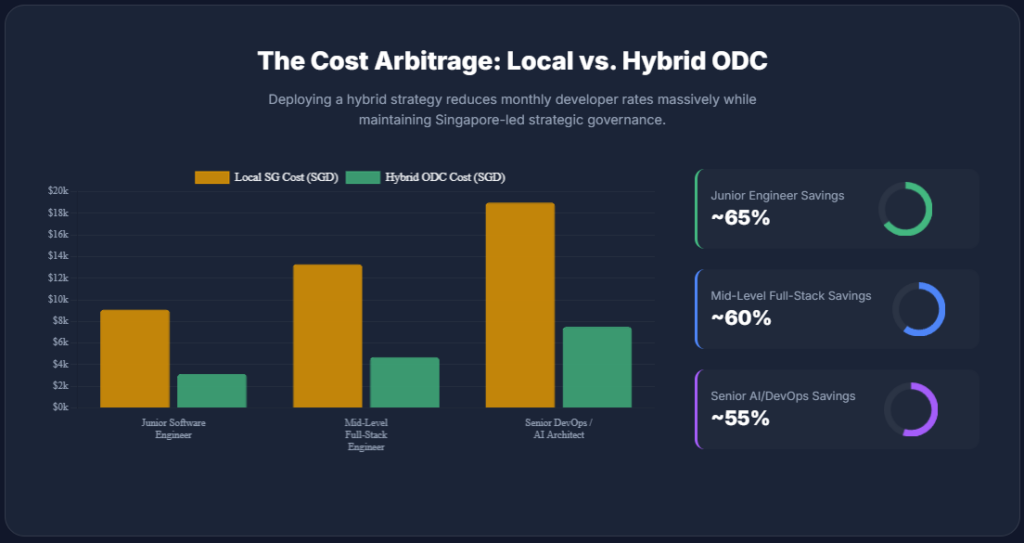
Deploying a hybrid resourcing strategy (Singapore strategic anchor plus a regional engineering hub) yields 55% to 65% cost reduction compared to direct local hiring:
| Role | Singapore Fully Loaded (Monthly) | Hybrid Model (Monthly) | Avg. Savings |
| Junior Software Engineer | SGD $7,800 – $10,400 | SGD $2,700 – $3,600 | ~65% |
| Mid-Level Full-Stack Engineer | SGD $11,000 – $15,600 | SGD $4,000 – $5,400 | ~60% |
| Senior DevOps / AI Architect | SGD $16,000 – $22,000 | SGD $6,500 – $8,500 | ~55% |
Common pricing and engagement models
| Model | Description | Primary Use Case | Key Advantage |
| Time and Materials | Billed hourly or daily per specialist | Short-term staff augmentation, agile sprints | High flexibility, scope shifts easily |
| Monthly Dedicated Rate | Flat monthly fee per dedicated engineer/squad member | ODCs, long-term staff augmentation | Predictable burn rate, maximum savings |
| Fixed-Price Contract | Milestone-linked fee against a defined scope of work | Standalone software builds, MVP development | Budget certainty, risk transferred to vendor |
| Managed SLA Retainer | Monthly subscription against guaranteed service levels | 24/7 helpdesk, cloud maintenance, SOC monitoring | Clear uptime guarantees |
5. Strategic Focus: The Singapore “Hub-and-Spoke” ODC Strategy
A proven framework used across Singapore is the Hub-and-Spoke ODC Model, pioneered by enterprise tech leaders like Vinova:
| Location | Role in the Model |
| Singapore (Hub) | Strategic direction, IP ownership, government-grade security governance, and client-facing account leadership |
| Vietnam (Spoke), Ho Chi Minh City | High-volume development, AI and data systems engineering |
| Indonesia (Spoke) | Mobile and web application development |
| Philippines (Spoke) | 24/7 helpdesk support and quality assurance |
Why Singapore serves as the hub: Singapore’s legal system provides a well-established environment for holding intellectual property, contractual agreements, and governance, and Senior Solution Architects, Product Owners, and Account Directors based here maintain direct client alignment and project oversight under strict security protocols.
Why regional tech hubs serve as the spokes: neighbouring hubs like Ho Chi Minh City offer large pools of university-trained software engineers, AI specialists, and QA automation experts, operating within the same time zone band (UTC+7/UTC+8) for real-time collaboration without delay.
6. Real-World Track Record: Commercial Enterprise Case Studies
When selecting among outsourced IT companies in Singapore, proven execution across high-security corporate environments and commercial market leaders is a crucial differentiator.
- SP Group (SP Digital): contract panel services providing AI-assisted QA engineering, automated testing pipelines (Playwright/Cursor/Copilot), and enterprise software development supporting smart energy platforms
- Porsche Experience Centre / Porsche Asia Pacific: end-to-end design, development, and maintenance of custom booking platforms, web systems, and high-volume event registration engines with international payment integrations
- Abbott Laboratories: custom enterprise mobile and cloud application development supporting healthcare technology deployment with strict data privacy compliance
- Navig8 Group and EM Services: complex enterprise platform development and SAP integration, powering high-availability logistics, maritime, and facility management platforms
- Regional financial and enterprise leaders (OCBC, FWD, Samsung, PwC, SPH, Razer): scaling engineering velocity across FinTech, InsurTech, e-commerce, and high-growth enterprise digital ecosystems
7. Vendor Evaluation Checklist for Singapore Buyers
Not every one of the IT outsourcing companies Singapore businesses find online meets the same bar. Genuine operational discipline, not just marketing copy, is what separates a real partner from a reseller of contractor hours. Before signing, verify these five standards:
- Government-grade security standards: does the vendor operate under ISO/IEC 27001:2022 certification with physical, network, and system security controls matching statutory requirements?
- Regulatory alignment: are they fully compliant with PDPA (including secure VDI offshore setups) and MAS TRM guidelines?
- Local account accountability: does the vendor provide on-the-ground project directors or architects in Singapore for face-to-face governance?
- Transparent billing, no hidden fees: are overheads (equipment, software licensing, recruitment, CPF liabilities) fully absorbed by the vendor?
- Deployment velocity: can the vendor onboard pre-vetted, production-ready engineers within 2 to 4 weeks?
8. Decision Framework: Choosing the Right Outsourcing Model
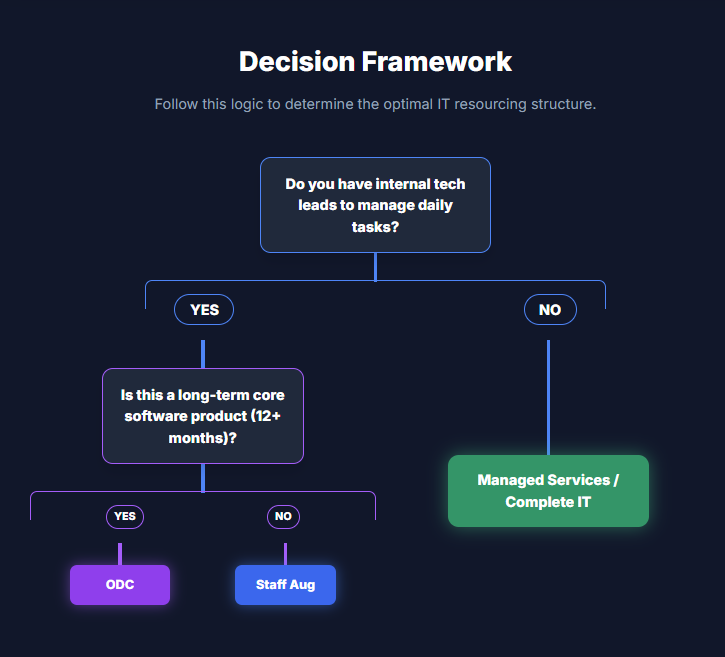
Three questions, in sequence, narrow this down quickly:
- Do you have internal technical leads to manage daily engineering tasks? If no, you’re looking at Complete IT / Managed Services (turnkey delivery), since there’s no internal capacity to direct day-to-day work
- If yes: is this a long-term core software product, 12 or more months? If yes, an Offshore Development Centre (Singapore-anchored, Southeast Asia-delivered) is usually the better structural fit for preserving domain knowledge over that timeline
- If no (shorter-term or a specific skill gap): Partial IT / Staff Augmentation gets you the right specialist fastest, without the overhead of standing up a dedicated centre for a shorter engagement
| Design the Right Resourcing Model with Vinova Book a complimentary strategic consultation with Vinova’s Singapore technical advisory team. We’ll assess your talent gaps, compliance requirements, and budget to design the right resourcing model. No commitment required. Schedule Your Free Strategic Consultation with Vinova |
IT Outsourcing Singapore FAQ
What is the average cost of IT outsourcing in Singapore?
Onsite Singapore staff augmentation for senior roles runs SGD $65 to $150+ per hour. A hybrid regional ODC model reduces monthly developer rates by 55% to 65%, for example, SGD $4,000 to $5,400 a month for a mid-level full-stack engineer, versus SGD $11,000 to $15,600 fully loaded locally.
How do IT outsourcing companies in Singapore ensure data protection and PDPA compliance?
Reputable providers enforce Virtual Desktop Infrastructure (VDI), encrypted data transmission, role-based access controls, Non-Disclosure Agreements, and ISO 27001 certification as standard, not as add-ons negotiated after the contract is signed.
What’s the real difference between staff augmentation and full IT outsource service?
Control, and how much of it your business keeps versus hands to the vendor. This is the same question as evaluating outsourcing in IT companies broadly: staff augmentation keeps daily management, sprint direction, and technical decisions with your internal team, the vendor just supplies the people. A full IT outsource service (Managed Services) transfers operational accountability to the vendor entirely, you define requirements and SLAs, they own delivery. Neither is universally better; it depends on whether you have the internal leadership bandwidth to direct the work day to day.
Should a growing SME outsource IT in Singapore or hire locally first?
For most growing SMEs, software IT outsourcing wins on speed and cost before local hiring even becomes realistic, COMPASS EP processing alone can add 10 to 18 weeks to a local senior hire, time most SMEs don’t have. Staff augmentation or a small ODC engagement gets specialised capability in place in 2 to 4 weeks, at 55% to 65% lower monthly cost than an equivalent local hire, while you validate whether the role justifies a permanent local team down the line.
What sets Vinova apart as an IT outsourcing partner in Singapore?
Headquartered in Singapore with 16+ years of enterprise experience, Vinova has been recognised by The Straits Times as one of Singapore’s Fastest-Growing Companies for three consecutive years (2024-2026). Vinova delivers government-grade IT outsourcing that combines Singapore strategic leadership with high-velocity engineering centres in Vietnam, adhering to ISO 27001, PDPA, and MAS TRM compliance standards throughout, not applied as a final review step before delivery.
| Vinova: Singapore’s IT outsourcing and enterprise engineering partner since 2010. ISO 27001:2022 and ISO 9001:2015 certified. 300+ global projects delivered. Clients include SP Group, Porsche Experience Centre, Abbott Laboratories, Navig8 Group, EM Services, OCBC, FWD, Samsung, PwC, SPH, and Razer. Financial Times Top 500 High-Growth Companies Asia-Pacific 2026. The Straits Times Singapore’s Fastest-Growing Companies 2024, 2025, and 2026. Explore Vinova’s IT Staff Augmentation and IT Outsourcing services. |