By the Vinova ODC Practice. Reviewed under ISO 27001:2022 and ISO 9001:2015 delivery standards.
The Short Answer
Offshore development data security requires a tri-fold operational framework: legal title perfection under common law, logical Zero-Trust Network Access (ZTNA), and physical facility isolation. For Singapore enterprises scaling engineering pods into Vietnam, regulatory compliance (MAS TRM and PDPA) is preserved by enforcing a strict Zero-PII Development Boundary (using synthetic data in offshore staging), anchoring contracts to Singapore legal jurisdiction with SIAC arbitration, and securing endpoints through centrally managed MDM hardware with kernel-level USB blocking.
Hiring senior software engineers in Singapore in 2026 is a capital-exhaustion bottleneck.
With domestic senior developer base compensation commanding S$12,000 to S$16,000+ per month, before accounting for the S$8,000 monthly CPF wage ceiling, recruiter fees, and Grade-A CBD office footprints, expanding engineering capacity locally drains corporate runway. Scaling technical squads into Vietnam (Ho Chi Minh City, Da Nang, Hanoi) provides 55% to 65% in structural cost reductions while preserving a negligible 1-hour time zone delta with Singapore.
Yet, enterprise offshore expansions almost never stall over developer syntax or technical capability.
Deals stall exclusively in Enterprise Risk, Legal, and Compliance reviews.
When a Singapore bank CISO, FinTech VP of Engineering, or General Counsel evaluates setting up 30 to 50 engineers in an emerging market, their primary concerns center on fiduciary liability:
- *Will our proprietary source code leak into competitor repositories or public LLMs?*
- *How do we satisfy the Monetary Authority of Singapore (MAS) and the Personal Data Protection Act (PDPA) when code is compiled abroad?*
- *If an offshore engineer breaches an NDA or asserts moral rights over an algorithm, can our legal team actually enforce our IP in a Singapore court?*
A superficial agency blog full of marketing platitudes like “we take security seriously” will be rejected by an enterprise audit committee. Winning enterprise procurement sign-off demands an unassailable, fiduciary-grade defense.
Key Takeaways:
1. The Singapore Legal Shield: Executing Master Services Agreements directly with Vinova’s Singapore entity under Singapore Common Law, backed by present-tense future copyright assignment and SIAC arbitration, eliminates foreign municipal court risk.
2. The Zero-PII Development Boundary: Compliance with the Singapore PDPA Transfer Limitation Obligation (Sec 26) is preserved by strictly decoupling code compilation from customer data; production PII never leaves Singapore domestic cloud VPCs.
3. The Moral Rights Defense: Vietnam IP Law (Art 19.4) renders developer moral rights strictly inalienable; enforcing advance written consent under Article 20, Clause 3 alongside negative covenants preserves refactoring rights.
4. Endpoint DLP Beyond Encryption: Full-disk encryption protects data at rest, not in use; stopping insider exfiltration requires kernel-level hardware USB mass-storage blocking, clipboard isolation, and automated 15-minute programmatic offboarding.
Here is the unvarnished statutory, architectural, and operational blueprint for securing offshore development data security in a high-velocity Vietnam Offshore Development Center (ODC) under Singapore governance.
Table of Contents
1. Offshore Development Data Security: The Singapore Enterprise Dilemma
Strategic Rule of Thumb: Never treat offshore development data security as a collection of ad-hoc policies. To pass enterprise risk review, deploy “Security-as-a-Platform”: pre-audited ISO 27001 facilities, hardware-enforced endpoint controls, and Singapore-governed contracts ready on Day 1.
Managing domestic sprint cadences, shipping product features, and presenting to board committees leaves technical leadership zero bandwidth to fly to Ho Chi Minh City or Da Nang to inspect physical door locks, configure network subnets, and audit individual developer workstations.
When companies attempt to handle offshore compliance piecemeal without a structured 10-point vendor vetting checklist to audit developer IAM, host-country labor covenants, and repository access, procurement reviews collapse:
| Control Vector | Traditional Agency Outsourcing | The Dedicated Vinova ODC Model |
|---|---|---|
| Developer seating | Open floors | Biometric-isolated private labs |
| Endpoint policy | Unmanaged personal laptops (BYOD) | Enrolled enterprise MDM (Jamf/Intune) |
| Repository access | Monolithic repository access | Microservice least-privilege scoping |
| Legal counterparty | Direct foreign entity contracting | Singapore Dual-Entity Shield (SIAC) |
| Test data | Customer PII copied to staging | Zero-PII synthetic testbed pipelines |
| Outcome | Rejected by audit committee | Procurement and CISO sign-off |
Confronting the “Code Is Our Lifeblood” Objection
In technology scale-ups and institutional financial firms, software source code is not a generic business asset; it is the core valuation driver of the enterprise.
When engineering leaders reject offshore software expansion, they are rarely rejecting the economic arbitrage. They are rejecting the loss of custodial control. In commodity outsourcing arrangements, third-party agencies treat developers as interchangeable resources, rotating coders across multiple client accounts and encouraging bad hygiene: shared credentials, hardcoded keys, and open USB interfaces.
The dedicated Vinova ODC framework directly counters this risk. The offshore pod operates as an organic, dedicated extension of your internal engineering department:
- Developers review pull requests inside your private, client-owned GitHub Enterprise or GitLab accounts.
- Your onshore Singapore leads retain 100% architectural governance, PR approval mandates, and code veto power.
- Daily communication runs directly through your internal Slack or Microsoft Teams instances, adhering to the same agile sprint rituals as your domestic engineers.
The 4 Existential Questions Facing Singapore Procurement Committees
Before your General Counsel, Chief Information Security Officer (CISO), and Board Audit Committee sign off on a Vietnam delivery center, they require precise, defensible answers to four structural questions:
- Jurisdiction & Title: Under whose legal jurisdiction does our code live, and can our corporate entity enforce intellectual property ownership in a Singapore court without litigating in an emerging market?
- Moral Rights Friction: How do we reconcile Vietnam’s civil-law statutory moral rights with common-law commercial copyright assignment to ensure developers cannot block future code refactoring?
- Regulatory Governance: Does the offshore technical architecture comply with the Monetary Authority of Singapore (MAS) Technology Risk Management (TRM) Guidelines and the Singapore Personal Data Protection Act (PDPA)?
- Endpoint & AI Exfiltration: What technical controls prevent an offshore developer from leaking proprietary algorithms to public generative AI tools or local storage devices?
Vinova Field Insight: Overcoming a Singapore FinTech CISO Veto for a 20-Engineer ODC Deployment
A Singapore-headquartered institutional digital wealth and B2B payment platform licensed under the Payment Services Act (PSA) 2019 needed to expand engineering capacity by 20 senior software engineers. Local senior base salaries of S$14,000 to S$16,000/month were draining corporate runway.
The Procurement Veto: Engineering leadership proposed expanding into Vietnam, but the Chief Information Security Officer (CISO) and General Counsel issued an immediate veto citing source code custodial risk, Vietnamese moral rights refactoring ambiguity (Article 19.4), and MAS TRM Section 5 third-party risk liability.
The Vinova Governance Architecture: (1) Contractual Shield: executed a Master Services Agreement directly with Vinova’s Singapore entity under Singapore Common Law, incorporating present-tense future copyright assignment under Section 140 of the Copyright Act 2021, Article 20.3 moral rights safe harbor consents, and SIAC arbitration at Maxwell Chambers. (2) Zero-PII Boundary: enforced synthetic data testbeds (Tonic.ai) in offshore staging, with production databases and encryption keys remaining strictly inside client-controlled AWS Singapore (ap-southeast-1) VPCs. (3) Tier-2 Biometric Isolation: commissioned a private 20-seat biometric enclave in Ho Chi Minh City with mantrap access, 90-day encrypted CCTV retention, Jamf-enforced kernel-level USB driver blocking, and restricted Docker container networking.
The Result: The client’s CISO and External Audit Committee conducted an on-site physical and logical inspection of the HCMC facility, issuing full security sign-off in 14 business days. The 20-person pod was fully seated within 6 weeks, cutting annualized engineering spend by 62% (saving over S$1.8M annually) with 0% voluntary turnover, enabling the client to satisfy external audit committees and regulatory third-party risk assessments with zero control deficiencies.
2. Building a PDPA Compliant Offshore Development Center: The Data Residency Myth
Data Privacy Rule of Thumb: Software development is logic creation and code compilation, not customer data storage. You do not need to export Singapore customer records to build software; isolate offshore developers within a Zero-PII staging environment using synthetic datasets.
Software compilation is logic creation, not customer data storage.
The “Data Residency Myth” costs Singapore firms millions in unneeded domestic payroll: the mistaken belief that Singapore law prohibits software from being engineered abroad, or mandates that source code, staging servers, and developers remain physically inside Singapore borders.
The Singapore Personal Data Protection Act 2012 (PDPA) contains zero statutory localization mandates requiring software development, algorithmic design, or application testing to take place domestically.
The primary statutory boundary governing cross-border operations is the Transfer Limitation Obligation (Section 26 of the PDPA):
PDPA Section 26: Org transfers personal data → Foreign Country, only if Protection Standard ≥ Singapore PDPA
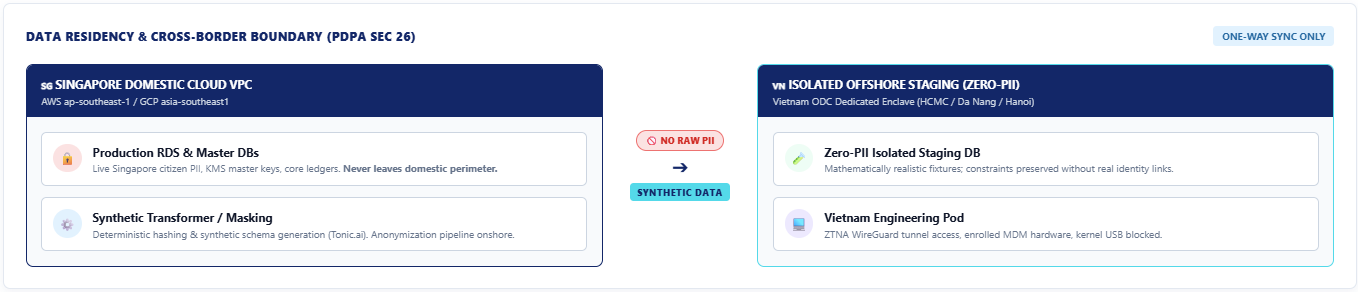
Section 26 dictates that an organization must not transfer personal data outside Singapore unless the recipient is bound by legally enforceable obligations providing a standard of protection comparable to the PDPA.
Enterprise technology organizations comply with Section 26 not by drafting complex cross-border customer transfer consent waivers, but by decoupling software compilation from customer production data entirely, the core discipline behind singapore vietnam odc data protection.
The Zero-PII Development Boundary in Practice: Singapore Vietnam ODC Data Protection
| Layer | What Lives There |
|---|---|
| Singapore Domestic Cloud Perimeter (AWS ap-southeast-1 / GCP) | Production databases and real customer PII; KMS encryption keys and financial transaction ledgers; live core banking, ERP, and transaction systems. |
| Isolated Offshore Staging Environment (Zero Customer PII) | Mathematically realistic mock data and synthetic schemas; salted string hashes and anonymized customer records; accessible by Vietnam ODC developers only via a ZTNA WireGuard tunnel. |
Data flows one way: automated synthetic transformation (Tonic.ai or deterministic masking) moves from the Singapore perimeter into the offshore staging environment. Raw production data never travels the reverse path. This one-way boundary is the operational core of singapore vietnam odc data protection.
- Production Data Sovereignty: Production databases containing live Singapore citizen Personally Identifiable Information (PII) remain permanently hosted inside client-controlled domestic cloud regions (e.g., AWS Singapore ap-southeast-1, Google Cloud Singapore asia-southeast1, or Microsoft Azure Singapore Central). Production credentials and KMS decryption keys are never provisioned to offshore staff.
- Synthetic Data Generation Pipelines: Development and testing environments in the Vietnam ODC operate strictly on synthetic or deterministically masked datasets. Automated data pipelines strip out real names, NRIC/FIN numbers, phone numbers, and bank account coordinates, replacing them with synthetically generated fixtures that preserve database constraints, relational foreign keys, and payload distributions.
- Cryptographic Pseudonymization: Where real-world data patterns are required for complex integration testing or load profiling, data masking engines apply irreversible one-way hashing (HMAC-SHA256 with pepper keys held strictly onshore in Singapore). Because the resulting records cannot be re-identified by the offshore developer, the assets cease to constitute “personal data” under Section 2(1) of the PDPA, completely neutralizing cross-border regulatory exposure.
- Technical Replication Ban: An explicit technical and contractual ban prohibits replicating, restoring, or downloading raw production database snapshots to offshore developer laptops.
3. IP Protection Outsourcing Vietnam: The “Singapore Governance Shield”
Fiduciary Rule of Thumb: Never contract directly with a domestic foreign entity in an emerging market under local civil law. Execute all MSAs, NDAs, and IP assignments directly with a Singapore holding entity under Singapore Common Law, backed by present assignment of future copyright and binding SIAC arbitration.
Direct contracting under foreign civil law is a corporate governance trap.
If a contract dispute arises over proprietary source code or an IP breach, a direct domestic contract forces the Singapore enterprise to litigate inside Vietnamese provincial civil courts. Your legal counsel will face unfamiliar civil codes, formal state-language translation mandates, evidentiary backlogs, and prolonged judicial procedures.
Furthermore, while Vietnam is a signatory to the 1958 New York Convention, enforcing a foreign court judgment through local civil courts requires navigating Part Seven of the Vietnam Civil Procedure Code 2015 (Articles 451 to 462). Local courts can refuse enforcement if they deem an award contrary to domestic “public policy,” a loophole that introduces substantial execution risk.
To solve this, Vinova deploys the Singapore Dual-Entity Governance Shield:
Client Parent Entity (Singapore Enterprise / FinTech / Bank) → Master Services Agreement (Singapore Common Law, SIAC arbitration, Section 140 present assignment of future copyright) → Vinova’s Singapore Holding Entity (HQ, Est. 2010; direct legal counterparty; treasury reserves in Tier-1 Singapore banks) → Intercompany IP Assignment and back-to-back operational delivery agreement → Vinova Vietnam Wholly Owned Operating Hubs (HCMC, Da Nang, Hanoi; wholly owned Foreign-Invested Enterprise; 300+ in-house engineers on Article 21 labor contracts; irrevocable Art 20(3) moral rights consents and powers of attorney).
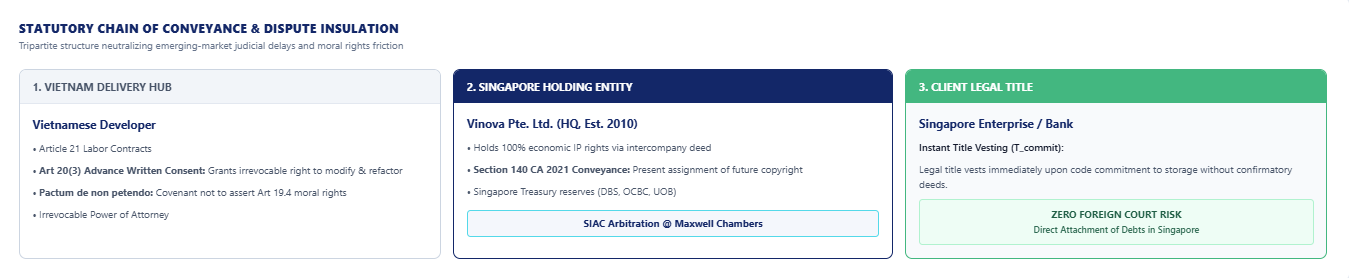
Statutory Mechanics: Singapore Copyright Act 2021 (Section 133 vs. Section 140)
To ensure unclouded legal ownership of software codebases, technology agreements must navigate the codified Singapore Copyright Act 2021:
- The Authorship Default (Section 133): Under Section 133(1)(a) of the Copyright Act 2021, the default legal rule is that the human author is the first owner of copyright. While Section 134 provides an employment exception, this presumption does not automatically transfer legal title across international borders between separate corporate entities.
- The Present Assignment of Future Copyright (Section 140): Under the codified Copyright Act 2021, the operative legal mechanism governing prospective software assignment is Section 140 (“Assignment: assignment of future copyright”). This mechanism was historically located under Section 133 of the repealed 1987 Act, which is the source of a common (but outdated) citation in older contract templates and other agencies’ content.
Section 140(1) statutorily dictates that where an agreement made in relation to future copyright is signed by or on behalf of the prospective owner, the copyright vests in the assignee immediately upon coming into existence, without requiring any secondary confirmatory deeds:
Contract Execution (T₀): “hereby assigns future copyright” under Sec. 140 CA 2021 → Code Fixation (T_commit) ⇒ Legal Title Vests Instantly in Client
Agreements that merely state “the developer agrees to assign” create only an executory contract. Under common law, this transfers only equitable title upon code creation, leaving legal title unperfected until formal confirmatory deeds are signed post-delivery.
By incorporating present-tense assignment language (“hereby irrevocably assigns, transfers, and conveys all existing and future rights, title, and interest”) under Section 140, legal title to every line of code, database schema, and architectural document vests in the Singapore client the millisecond it is committed to storage. This is the statutory backbone of ip protection outsourcing vietnam engagements structured under Singapore law.
The Vietnamese Moral Rights Conflict: Article 19.4 vs. Article 20.3
When software is authored in Vietnam, cross-border assignment must account for the Vietnamese Law on Intellectual Property (Law No. 50/2005/QH11, amended by Law No. 07/2022/QH15).
Vietnamese law establishes a strict division between Economic Rights and Moral Rights:
- Economic Rights (Article 20): Reproduction, derivative adaptation, distribution, licensing, and commercialization. These rights are 100% assignable and transferable under Articles 38 to 40.
- Moral Rights (Article 19): Inherent to the human developer. Under Article 19.4, an author holds the perpetual right to protect the integrity of the work from distortion, modification, or mutilation. Crucially, under Article 45, Clause 2, moral rights protected under Article 19.4 cannot be transferred or sold. Any contract clause stating “developer waives all moral rights” is legally void ab initio under Vietnamese public policy.
In software engineering, code must be continuously refactored, updated, and modified. If an offshore developer leaves an engagement and claims that downstream refactoring “distorts” their original code, they could attempt to seek injunctive relief.
Vinova neutralizes this exposure through an Enforceable Tripartite Chain of Conveyance:
- Advance Statutory Written Consent (Article 20, Clause 3): Under Law No. 07/2022/QH15, Article 20, Clause 3 explicitly provides that derivative adaptations affecting moral rights are permitted if the author grants written consent. Every Vinova developer executes an agreement granting explicit, irrevocable written consent authorizing the client and its successors to refactor, modify, decompile, adapt, or delete code without limitation.
- Negative Covenant Not to Assert (pactum de non petendo): The developer executes an irrevocable covenant promising never to assert moral rights claims or seek injunctive relief under Article 19.4 against the client or its commercial affiliates, supported by valid financial consideration built into their base compensation.
- Universal Power of Attorney (Civil Code 2015, Articles 562 to 569): The developer grants an irrevocable Power of Attorney authorizing the corporate entity to manage public attributions and formalize all derivative consents on their behalf.
- Intercompany Assignment to Singapore: Vinova Vietnam assigns 100% of economic rights and the full benefit of employee covenants to Vinova’s Singapore entity under Articles 38 to 40.
- Final Common-Law Vesting: Vinova’s Singapore entity vests unencumbered legal title in the Singapore client under Section 140 of the Singapore Copyright Act 2021.
SIAC Institutional Arbitration & Immediate Singapore Asset Execution
All Master Services Agreements are governed under Singapore substantive law with dispute resolution seated at the Singapore International Arbitration Centre (SIAC) under SIAC Rules at Maxwell Chambers.
This delivers a decisive fiduciary advantage: direct asset attachment in Singapore.
Because your contracting counterparty is a Singapore entity with local corporate bank accounts (DBS, OCBC, UOB), share capital, and treasury assets, an arbitral award can be converted into a court judgment under the Singapore International Arbitration Act 1994. In the event of an IP breach, an enterprise client can enforce an Attachment of Debts (garnishee order) against Singapore commercial bank accounts within weeks, completely bypassing emerging-market judicial delays.
4. MAS TRM Compliance Offshore Software: Enterprise Regulatory Compliance Mapping
Regulatory Rule of Thumb: Under MAS TRM Section 5, financial institutions cannot outsource risk responsibility. Require your ODC partner to provide pre-audit inspection rights, independent SOC 2 Type II reports, automated SAST/DAST gating, and mandatory MFA across all administrative endpoints.
Under MAS TRM, risk accountability cannot be outsourced. Achieving MAS TRM compliance offshore software delivery requires the offshore partner to operate as an audited extension of your own control environment, not a black box.
For Singapore financial institutions, including digital banks, major payment institutions (MPIs) licensed under the Payment Services Act 2019, capital market intermediaries, and enterprise FinTech scale-ups, contracting an offshore development center is classified as a Material Technology Third-Party Arrangement.
| Regulatory Baseline | Statutory / Guideline Mandate | Vinova ODC Operational Control |
|---|---|---|
| MAS TRM 2021, Section 5 | Third-Party Risk Oversight & Audit Inspection Rights | Unrestricted audit access for internal auditors and MAS teams; annual SOC 2 Type II reports. |
| MAS TRM 2021, Section 10 | Secure Software Development & Testing Segregation | Automated SAST/DAST in CI/CD; strict Dev/Stage/Prod split; 4-eyes dual-peer code review. |
| MAS Notice FSM-N06 (Cyber Hygiene, banks) | Non-Negotiable Endpoint & Perimeter Baselines | Vaulted administrative PAM; CIS Level-2 OS hardening; critical patch SLA under 14 days. |
| Singapore PDPA, Section 26 | Transfer Limitation Obligation | Zero-PII Development Boundary; anonymized and synthetic data; domestic cloud hosting only. |
| Singapore IM8 Standards | Government ICT Security & Management Principles | Aligned with public sector IM8 baselines; biometric badge-access and NVR; clean-desk / zero-BYOD policy. |
| Vietnam PDPD, Decree 13/2023 | Cross-Border Data Transfer Impact Assessment (A05) | Article 25 TIA dossier filed with A05 for HR/payroll data; dual-jurisdiction DPA terms. |
MAS Technology Risk Management (TRM) Guidelines 2021 & Government IM8 Alignment
The MAS TRM Guidelines mandate that a financial institution retains ultimate governance over all technology risks, explicitly prohibiting the outsourcing of risk management responsibilities:
- Section 5 (Third-Party Risk Management): FIs must conduct rigorous initial due diligence and continuous oversight. Vinova contractually guarantees unrestricted physical and logical audit rights for the client’s internal auditors, external audit partners, and MAS supervisory inspectors. Facilities provide annual independent SOC 2 Type II and ISO/IEC 27001:2022 audit attestations.
- Public Sector & IM8 Security Alignment: This rigorous physical and logical isolation framework is structured to support enterprise and public sector compliance. As an empanelled vendor on Singapore Government bulk ICT frameworks (including GVT(T)24014 for Application Development & Support), Vinova’s delivery architecture is designed to align with Singapore Government Instruction Manual 8 (IM8) baselines—enforcing biometric badge-access doors, dedicated CCTV coverage with 90-day retention, isolated client VLANs, and enterprise MDM controls.
- Section 10 (Software Application Development and Management): The software delivery lifecycle must enforce absolute environment segregation. Development, User Acceptance Testing (UAT), Staging, and Production environments must be logically and physically separated. Offshore engineers in Vietnam are strictly prohibited from holding credentials to production environments or live databases.
- Automated CI/CD Gating: Shift-left DevSecOps automation enforces Static Application Security Testing (SAST) and Software Composition Analysis (SCA) inside continuous integration pipelines. Build pipelines block code promotion automatically if critical vulnerabilities remain unaddressed.
MAS Cyber Hygiene Notices: From the Legacy Numbered Notices to the FSM-N Series
MAS’s Cyber Hygiene regime establishes mandatory, legally binding baseline security requirements that Vinova enforces across all delivery center workstations. Readers researching older material will find these requirements referenced under legacy notice numbers (including Notice 655 for banks); MAS cancelled that generation of numbered notices on 10 May 2024 and replaced them with the current FSM-N series issued under the Financial Services and Markets Act 2022, including Notice FSM-N06 for banks. The underlying requirements Vinova enforces are unchanged across that transition:
- Requirement 4.1 (Administrative Account Control): Developers operate under standard, non-privileged operating system profiles. Administrative credentials must be vaulted, randomly generated, and managed through Privileged Access Management (PAM) with hardware-backed Multi-Factor Authentication (MFA).
- Requirement 4.2 (Automated Patch Management): Critical security vulnerabilities must be patched within 14 calendar days; high-severity vulnerabilities must be remediated within 30 days.
- Requirement 4.3 (Security Hardening): Workstations strictly adhere to Center for Internet Security (CIS) Level-2 benchmarks, disabling unused system services, enforcing local host firewalls, and enabling full-disk encryption.
- Requirement 4.4 (Network Perimeter Defense): Next-Generation Firewalls (NGFW) enforce default-deny egress policies, deep packet inspection, and intrusion prevention.
For dual-headquartered institutions operating across Singapore and Australia, our infrastructure aligns with APRA Prudential Standard CPS 234 (Information Security), incorporating mandatory 72-hour incident notification SLAs and independent annual penetration testing, as detailed in our complete Australian IT outsourcing guide.
Friction Point We Hit: Vietnam Decree 13 Article 25 A05 TIA Dossier Submission Realities
Under Vietnam’s Personal Data Protection Decree (Decree 13/2023/ND-CP), an enterprise transferring personal data of Vietnamese citizens abroad must formulate and submit a Transfer Impact Assessment (TIA) dossier to the Ministry of Public Security (Department of Cybersecurity and High-Tech Crime Prevention, A05) within 60 working days of the transfer.
While client production code contains zero customer PII, transferring local Vietnamese developer HR records, biometric access logs, and payroll data to our Singapore corporate headquarters technically triggers this requirement. Commercial agencies frequently ignore this filing, exposing their local entities to administrative sanctions.
Vinova’s in-house legal and compliance practice maintains fully audited Article 25 TIA dossiers registered directly with A05, accompanied by bilateral intercompany Data Processing Agreements (DPAs) that harmonize the Singapore PDPA with Vietnam Decree 13, eliminating regulatory non-compliance risks for client audit committees.
5. Offshore Development Data Security in Practice: Zero-Trust Engineering Topology & Shift-Left SSDLC
Architectural Rule of Thumb: Zero-trust means never trusting an endpoint simply because it sits inside an office. Require posture-checked WireGuard tunnels, hardware YubiKeys, microservice repo segmentation, and pre-commit secrets blocking before a developer can touch code.
Perimeter VPNs are dead. Code security demands continuous endpoint verification.
Securing source code from exfiltration demands a modern Zero-Trust Network Access (ZTNA) architecture that continuously validates identity, device health, and context:
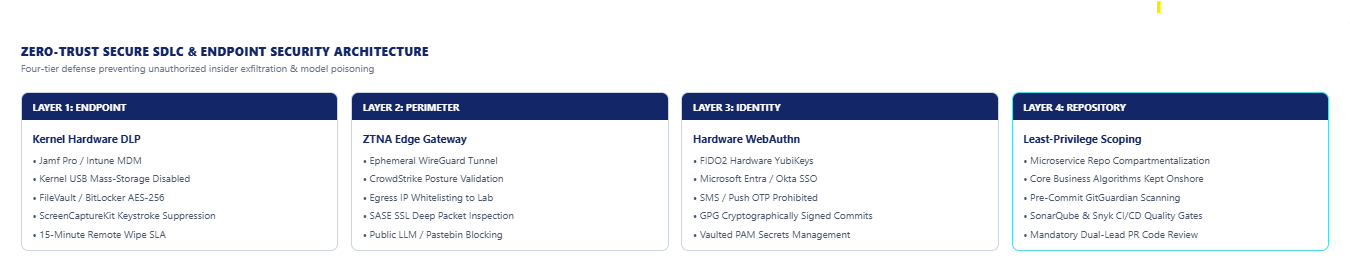
| Layer | Technical Controls |
|---|---|
| 1. Managed Hardware Pod (HCMC / Da Nang / Hanoi) | Enrolled Jamf Pro / Intune endpoint; CIS Level-2 hardened OS (macOS / Win 11); FileVault / BitLocker 256-bit AES; kernel USB mass-storage drivers disabled. |
| 2. Posture-Checked Tunnel (ZTNA Edge Gateway) | Ephemeral mutual TLS 1.3 WireGuard / IPSec; CrowdStrike Falcon EDR active and verified; egress IP whitelisted to the physical lab. |
| 3. Hardware Identity Gate (Central SSO Gateway) | FIDO2 WebAuthn (YubiKey 5 Series); Okta / Microsoft Entra ID authentication; SMS and mobile push OTP explicitly prohibited. |
| 4. Repository Boundary (Least-Privilege Scoping) | Client-owned GitHub Enterprise / GitLab; microservice repo compartmentalization; signed GPG commits and mandatory dual-lead review. |
1. Codebase Compartmentalization & “Least-Knowledge” Architecture
To mitigate insider risk, enterprise platforms must eliminate monolithic repositories, decoupling complex workflows, such as core banking ledgers, risk scoring engines, and ERP pipelines outlined in our enterprise application architecture guide, into discrete, peripheral microservices:
- Offshore developers are provisioned with access restricted exclusively to assigned peripheral microservices (e.g., API gateway connectors, UI components, reporting pipelines).
- Core proprietary algorithms, such as quantitative pricing engines, proprietary risk models, or anti-fraud scoring algorithms, remain restricted to onshore Singapore architects.
- Core libraries required by offshore services are compiled through internal CI/CD pipelines into obfuscated, private binary packages (hosted on private registries like GitHub Packages or Artifactory) and consumed by offshore teams as pre-compiled, opaque dependencies.
2. Shift-Left DevSecOps & Secure SDLC (SSDLC)
Security controls are embedded directly into the developer workflow and CI/CD pipelines:
- Pre-Commit Secrets Blocking: Developer workstations enforce local git hooks (via Husky and lint-staged) running TruffleHog and GitGuardian to scan staged diffs. Any commit containing API keys, private certificates, or high-entropy tokens is rejected locally before reaching the repository.
- Automated SAST & SCA Scanning: Pull requests automatically trigger SonarQube Enterprise static analysis and Snyk Software Composition Analysis. Merges are blocked if the Quality Gate detects unresolved High/Critical vulnerabilities (CVSS ≥ 7.0) or GPL-3.0 licensing conflicts.
- Cryptographically Signed Commits: Developers sign git commits using individual GPG keys tied to verified enterprise email identities. Direct pushes to main or release branches are programmatically blocked; pull requests require mandatory dual-peer review with final approval from a Singapore technical lead.
3. Enterprise Generative AI Governance & Zero Data Retention (ZDR)
Uncontrolled use of consumer generative AI tools creates severe intellectual property leaks:
| Implementation Tier | Technical Control | Risk Mitigation |
|---|---|---|
| 1. Network Boundary Filtering | SSL/TLS deep packet inspection at Secure Web Gateway (SASE) | Blocks consumer web and API endpoints: api.openai.com, chatgpt.com, claude.ai. |
| 2. Endpoint Profile Enforcement | MDM application whitelisting via Jamf Pro / Microsoft Intune | Programmatically blocks unvetted IDE plugins and browser autocomplete extensions. |
| 3. Enterprise AI Licensing (ZDR) | GitHub Copilot Enterprise / Azure OpenAI Service | Enforces Zero Data Retention (ZDR); code is never cached or used to train external models. |
| 4. Labor Contract Prohibitions | Registered internal labor regulations (Labor Code Art 21) | Unauthorized code input to external LLMs is defined as gross misconduct for dismissal. |
Friction Point We Hit: Docker Devcontainer Endpoint Port Exfiltration & Clipboard Sandboxing
In high-security engineering environments, developers often work inside Docker devcontainers to standardize tooling. However, default Docker desktop configurations on macOS and Windows allow local port binding and bridge-networking to unmanaged local loopback interfaces.
During an internal red-team audit, our security architects discovered that an engineer could run a local Python script to bind an internal container port to an unmanaged local port, bypassing certain browser-based DLP controls.
Vinova deployed custom MDM application sandboxing via Microsoft Intune and Jamf App Sandboxing. We restricted local container networking to isolated internal bridge networks, locked out unapproved virtualization runtimes, and enforced OS-level clipboard isolation that prevents copying code from corporate IDEs into personal communication tools or unmanaged text files.
6. Physical Facility & Endpoint Security in Vinova’s Delivery Hubs (HCMC, Da Nang, Hanoi)
Facility Security Rule of Thumb: Disk encryption protects data at rest; it does nothing to stop an authorized insider who is already logged in. Defend data in use through dedicated biometric cleanrooms, disabled USB drivers, and automated screen-recording suppression.
Full-disk encryption protects data at rest; it does nothing to stop an insider already logged in.
Physical and endpoint security represents the final line of defense against data exfiltration.
| Facility Security Vector | Tier-1 Managed Enclave | Tier-2 Private Biometric Lab |
|---|---|---|
| Physical Access Control | Perimeter turnstiles, RFID access badges, visitor logs | Dual-biometric ingress (facial geometry + fingerprint) with anti-tailgating mantrap |
| Mobile Device Governance | Personal phones allowed in office desk areas | Strict zero-phone policy: all personal devices locked in outer biometric lockers |
| Environmental Controls | Shared printing facilities, standard office whiteboards | Clean-desk, clean-screen; physical paper and printers strictly prohibited |
| CCTV Video Surveillance | Common area coverage, 30-day recording retention | 360-degree HD CCTV, zero blind spots, 90-day encrypted local NVR retention |
| Network Isolation | Corporate shared VLAN, standard enterprise Wi-Fi | Dedicated client VLAN, 802.1X port security, isolated fiber line in locked server rack |
The “Authorized Insider” Threat Model: Limitations of Full-Disk Encryption
Enterprise CISOs recognize that Full-Disk Encryption (FDE), such as Apple FileVault 2 or Microsoft BitLocker, protects data only at rest. It ensures that if a powered-down laptop is physically stolen from a taxi, the data on the SSD cannot be read.
However, once an authorized developer logs into their active user session, the storage volumes are fully decrypted by the OS kernel. FDE provides zero defense against an authorized insider copying code to an external flash drive or uploading files to an external web service.
To stop insider exfiltration, Vinova enforces Operating System Kernel-Level Endpoint DLP:
- Hardware Port Blocking: Jamf Pro (macOS) and Microsoft Intune (Windows 11 Enterprise) configuration profiles disable external storage drivers at the kernel level. USB mass-storage interfaces are completely disabled. Keyboards, mice, and YubiKeys operate normally, while external flash drives and portable SSDs are denied driver execution.
- Screen-Capture & Clipboard Governance: macOS ScreenCaptureKit and Windows Display Session Manager profiles block third-party screen-recording utilities. Display subsystems suppress optical recording and screenshot keystrokes, and secure web gateways with SSL inspection actively block unauthorized file uploads to public cloud storage (Google Drive, Dropbox, Mega) and public pastebins.
- Instant Remote Cryptographic Wipe: If an endpoint is reported missing, or if an employment contract is terminated, administrators dispatch an instant remote wipe command via MDM, permanently destroying encryption keys and zeroing local storage.
7. Human Risk Governance: Vetting, NDAs, and the 15-Minute Rapid Offboarding SLA
Human Governance Rule of Thumb: Never rely on standard police checks that omit spent convictions. Procure Judicial Record Certificate No. 2, back NDAs with registered internal labor regulations, and enforce programmatic offboarding within 15 minutes.
Background screening that omits spent convictions is an enterprise blind spot.
Technical architecture is only as secure as the human operators managing it.
Pre-Employment Vetting: Judicial Record Certificate No. 2 & University Partnerships
In Vietnam, criminal background screening is governed by the Law on Judicial Records (Law No. 28/2009/QH12).
Many commercial staffing agencies procure Judicial Record Certificate No. 1 (Phiếu lý lịch tư pháp số 1). Certificate No. 1 is insufficient for enterprise banking and security environments because it omits spent convictions, criminal records that have been legally expunged over time.
Vinova mandates Judicial Record Certificate No. 2 (Phiếu lý lịch tư pháp số 2), issued directly by the Department of Justice (Sở Tư pháp) or the National Centre for Judicial Records:
- Scope: Provides an unredacted record of all past convictions (spent and unspent), as well as official bans from holding corporate, managerial, or financial positions.
- Compliance with Directive 23/CT-TTg: Prime Minister Directive No. 23/CT-TTg (dated July 9, 2023) prohibits employers from indiscriminately demanding Certificate No. 2 where not strictly mandated by statutory labor categories. Vinova ensures compliance by making background verification a voluntary, consented pre-employment condition tied to specialized financial software access, preserving data protection rights under Decree 13.
Academic Talent Pipelines: Recognized as an ITviec “Vietnam Best IT Companies Winner,” Vinova maintains direct institutional partnerships with Vietnam’s premier technical universities, including Vietnam National University (VNU) in Ho Chi Minh City and Hanoi, Hanoi University of Science and Technology (HUST), and Danang University of Technology (DUT). Every candidate undergoes rigorous academic and managerial reference vetting, auditing both technical capability and past confidentiality compliance.
This rigorous pre-employment vetting underpins Vietnam’s sub-12% voluntary tech attrition, as detailed in our comparative analysis of Vietnam vs. India vs. Philippines Software Outsourcing, preserving codebase continuity and eliminating the institutional knowledge drain that plagues high-churn offshore hubs.
The 15-Minute Rapid Offboarding SLA & Runbook
Mitigating the risk of IP theft during employee departure requires an automated, time-bound offboarding process:
| Timeline | Action |
|---|---|
| Minute 00 | HR triggers departure workflow in Enterprise HRIS. |
| Minutes 01–03 | Automated SCIM webhook terminates central IdP session; invalidates all active OIDC/SAML refresh tokens. |
| Minutes 03–05 | Automated GitHub/GitLab API call revokes personal access tokens (PATs), deletes SSH keys, purges access. |
| Minutes 05–08 | MDM agent (Jamf/Intune) issues remote device lock and container wipe; kills active IDE and terminal sessions. |
| Minutes 08–12 | Biometric lab profiles and RFID credentials revoked; hardware placed in anti-static secure evidence locker. |
| Minutes 12–15 | Employee signs Property Handover Protocol and reaffirms trade secret non-disclosure covenants (Labor Code). |
Navigating Vietnamese Labor Law on Immediate Access Revocation
Under the Vietnamese Labor Code 2019 (Articles 45 to 48), employees on indefinite contracts must provide 45 days’ notice, while those on 12- to 36-month contracts must provide 30 days’ notice.
Executing an immediate 15-minute logical access termination is legally compliant when structured as Paid Gardening Leave: the employee is placed on immediate leave with full base salary and statutory social/health insurance paid through the statutory notice period, while all physical and logical access to intellectual property is revoked instantly.
| Evaluation Vector | Commodity Offshore Agency / Broker | Vinova Singapore Enterprise ODC | Enterprise Risk Impact |
|---|---|---|---|
| 1. Legal Jurisdiction | Contracts with domestic foreign entity under local civil law. | Master Agreement with Vinova’s Singapore entity (Singapore Common Law). | Direct recourse in Singapore courts; zero emerging-market court exposure. |
| 2. Dispute Forum | Local municipal civil courts or foreign arbitration centers. | SIAC institutional arbitration seated at Maxwell Chambers. | Arbitral awards directly satisfiable against Singapore bank accounts. |
| 3. IP Conveyance | Standard “agreement to assign” language; equitable title only. | Present assignment of future copyright (Section 140, Copyright Act 2021). | Legal title vests instantly upon commit; no post-project conveyance deeds. |
| 4. Moral Rights Defense | Unaddressed, or relies on unenforceable blanket waivers. | Advance written consent under Art 20(3) plus negative covenant. | Eliminates developer legal challenges over downstream code refactoring. |
| 5. MAS TRM & IM8 Compliance | Vendor refuses pre-audit inspection; no SOC 2 Type II reports. | Contractual pre-audit inspection rights; SOC 2 Type II; IM8 aligned. | Enables enterprise and financial institutions to pass rigorous third-party audits. |
| 6. Data Sovereignty | Live customer records copied to offshore staging servers. | Zero-PII Development Boundary; synthetic data testbeds. | Complete compliance with Singapore PDPA Transfer Limitation rules. |
| 7. Logical Access | Shared passwords, basic consumer VPNs, open network routing. | ZTNA WireGuard tunnels, hardware FIDO2 YubiKeys, Entra ID SSO. | Eliminates credential theft and lateral network traversal. |
| 8. Code Isolation | Developers clone entire monolithic codebases locally. | Microservice compartmentalization; core algorithms held onshore. | Prevents insider exfiltration of proprietary business algorithms. |
| 9. Endpoint Hardware | Unmanaged BYOD personal laptops with active USB ports. | Centrally enrolled Jamf/Intune MDM with disabled USB mass storage. | Blocks physical exfiltration to flash drives or external storage. |
| 10. Offboarding SLA | Ad-hoc manual account revocation taking 24 to 72 hours. | Contractually binding under-15-minute programmatic offboarding. | Prevents departing developers from exporting code during notice periods. |
(To structure binding performance benchmarks and access guarantees into your master contracts, review our companion guide to SLA in Outsourcing: What It Means and Why It Protects You.)
Explore Vinova’s Comprehensive ODC Services and Security Architecture
See the Singapore Governance Shield, the Zero-PII Development Boundary, and the physical lab security model in this guide, applied to your own engineering roadmap. Confidential facility tours available on request.
9. Legal & Compliance FAQ (For Singapore Legal & InfoSec Teams)
Under Singapore law, how does Section 140 of the Copyright Act 2021 protect our software IP in Vietnam?
Under Section 140 of the Singapore Copyright Act 2021 (“Assignment: assignment of future copyright”), executing an agreement containing present-tense assignment language (“hereby assigns future copyright”) ensures that legal title to all prospective authorial works (source code, schemas, documentation) vests in the client automatically upon creation. Because the Master Services Agreement is executed directly with Vinova’s Singapore entity, the transfer operates under Singapore common law, bypassing foreign conveyancing procedures and establishing an unbroken chain of legal title from Day 1.
Is software IP assignment governed by Section 133 of the Singapore Copyright Act?
Not under the current Act, though this is a common and understandable mix-up, and a search for singapore copyright act section 133 software ip usually reflects exactly this confusion. Section 133 of the Copyright Act 2021 governs the default first-ownership rule (the human author owns copyright unless an exception applies), not assignment. The operative provision for assigning future copyright is Section 140. The confusion exists because this same mechanism sat at Section 133 under the repealed 1987 Act; when the 2021 Act renumbered the statute, the assignment provision moved to Section 140. Any MSA or IP deed that still cites “Section 133” for assignment is referencing the old numbering and should be corrected.
How does Vinova ensure our offshore development center adheres to MAS TRM Section 5 and Section 10?
Under MAS TRM Section 5, Vinova contractually guarantees unrestricted pre-audit and inspection rights for your internal audit teams and MAS inspectors, supported by annual independent SOC 2 Type II attestation reports. Under Section 10, we enforce strict environment segregation (Development, UAT, Staging, Production). Offshore developers operate under least-privilege access, automated SAST/DAST testing runs inside the CI/CD pipeline, and all code promotion into staging requires dual-peer code review and approval from an onshore Singapore technical lead.
Can we legally comply with the Singapore PDPA if software development is performed in Vietnam?
Yes. Compliance with the PDPA Transfer Limitation Obligation (Section 26) is achieved through technical decoupling: offshore development pods operate under a Zero-PII Development Boundary. Production databases remain permanently hosted inside client-controlled Singapore cloud perimeters (AWS ap-southeast-1 / GCP Singapore). Offshore staging environments are populated exclusively with synthetically generated data or deterministically masked fixtures that contain zero real customer PII, ensuring that regulated personal data never crosses international borders. This is the core of pdpa compliant offshore development center design.
How do we prevent offshore developers from feeding our proprietary codebase into public AI models?
We enforce multi-tiered technical and contractual controls. Network layer: Secure Web Gateways perform deep SSL packet inspection, blocking traffic to public consumer AI endpoints. Endpoint layer: MDM profiles restrict unapproved IDE plugins and browser extensions. Enterprise AI licensing: where AI assistance is approved, we provision GitHub Copilot Enterprise under commercial agreements that guarantee Zero Data Retention (ZDR). Labor contracts: unauthorized code transmission to external AI tools is contractually defined as gross misconduct under Article 21 of the Vietnamese Labor Code.
What happens if a developer breaches confidentiality or leaks code: what legal recourse do we have in Singapore?
Your Master Services Agreement is executed directly with Vinova’s Singapore entity under Singapore law, with dispute resolution administered by the Singapore International Arbitration Centre (SIAC). Any arbitral award can be converted into a Singapore court judgment under the International Arbitration Act 1994, allowing direct enforcement and attachment against Vinova’s bank accounts, corporate assets, and treasury holdings in Singapore (DBS, OCBC, UOB). This structure provides immediate financial recourse without requiring litigation in foreign municipal courts.
Can our internal security team conduct an on-site physical and logical audit of the Vietnam delivery lab?
Yes. Enterprise client security teams and external auditors maintain contractual rights to conduct scheduled on-site audits of our Tier-2 biometric delivery labs in Ho Chi Minh City, Da Nang, and Hanoi. Audits include reviewing physical mantrap access logs, inspecting CCTV forensic archives (90-day retention), auditing switch VLAN configurations, and verifying MDM endpoint profiles.
10. Scale with Enterprise Governance: Vinova Singapore Delivery
Evaluating offshore engineering capacity should never require choosing between cost efficiency and enterprise risk governance. Offshore development data security is not a trade-off against velocity; done right, it is what makes the velocity defensible.
By bridging Singapore corporate governance, common-law legal protections, and SIAC arbitration with Vietnam’s high-velocity engineering talent, Vinova provides the institutional infrastructure required to pass board-level procurement and CISO audits:
- 16+ Years of Systems Leadership: Over 300 enterprise platforms delivered across Singapore, Australia, and the United States, backed by our Singapore headquarters.
- Public Sector & Enterprise Panel Experience: Empanelled supplier under Singapore Government bulk ICT tenders (including GVT(T)24014 for Application Development & Support), with delivery models designed to align with strict IM8 and ISO 27001 security controls.
- Dual ISO Certifications & Industry Recognition: Delivery hubs certified under ISO/IEC 27001:2022 (Information Security) and ISO 9001:2015 (Quality Management), and recognized as an ITviec Vietnam Best IT Companies Winner.
- Turnkey Private Biometric Labs: Physically isolated enclaves with mantrap ingress, 90-day CCTV retention, and kernel-level USB blocking across Ho Chi Minh City, Da Nang, and Hanoi, with infrastructure scaling to 500+ ODC personnel by 2028.
- Singapore-Governed Contracts: Master agreements, NDAs, and SLAs held directly by Vinova’s Singapore entity under Singapore jurisdiction.
Explore our companion guides on SLA in Outsourcing: What It Means and Why It Protects You and our evaluation of ODC vs Build-Operate-Transfer (BOT) models for more information.
Ready to audit our delivery facilities? Schedule a confidential security consultation and Vietnam lab inspection briefing with our Singapore Solutions Directors today.
Vinova: Singapore’s mobile and web application development partner since 2010. ISO 27001:2022 and ISO 9001:2015 certified.
300+ in-house engineers across Singapore, Hanoi, Da Nang, and Ho Chi Minh City, building mission-critical mobile and web applications for enterprise and institutional clients.
Financial Times Top 500 High-Growth Companies Asia-Pacific 2026. The Straits Times Singapore’s Fastest-Growing Companies 2024, 2025, and 2026.