A plain-language guide to telling these two apart — before either one eats your budget.
If you’re planning a new product, you’ve probably heard both terms thrown around in the same meeting: “let’s build an MVP” and “we should POC this first.” They get used almost interchangeably, which is a problem, because building the wrong one first is one of the more common ways early-stage budgets get wasted.
Here’s the plain-language difference, a quick way to tell which one you actually need, and what each one should realistically cost you.
Table of Contents
Key Takeaways:
- Treat POC code as disposable research: A Proof of Concept tests whether an unproven technology or complex integration works; build it fast in an isolated sandbox, but never try to patch it into production software.
- Skip to an MVP when tech risk is low: If your system uses standard web or mobile patterns, technical feasibility is rarely the issue—launch a scoped MVP to test user demand, pricing, and retention instead.
- Use clickable prototypes to bridge the gap: If stakeholders or designers just need to visualize workflows and user interfaces, build a prototype first rather than paying developers to write code for unvalidated ideas.
- Sequence your budget to survive: Invest $5,000 to $20,000 on a 2- to 4-week POC spike to de-risk unknown blockers before committing $30,000 to $60,000+ toward an 8- to 12-week MVP build.
The Core Difference, in One Line
A Proof of Concept (POC) answers a question for your engineers: can this actually be built? A Minimum Viable Product (MVP) answers a question for your market: will people actually use or pay for this?
Those are two completely different risks, and they call for two completely different builds. Spend your budget on a polished MVP before you’ve proven the underlying tech works, and you risk building a beautiful interface on top of an engine that can’t run. Spend months on a POC for something that’s already been solved a hundred times — a standard login flow, a Stripe checkout — and you’ve just delayed the only feedback that actually matters: what real users think.
POC vs. MVP: A Direct Comparison
| Dimension | Proof of Concept (POC) | Minimum Viable Product (MVP) |
|---|---|---|
| Purpose | Prove it’s technically possible | Prove people will actually use or pay for it |
| Audience | Your own engineers and sponsors | Real end users and early customers |
| Timeframe | 1–3 weeks, strictly time-boxed | 8–12 weeks |
| Typical cost | Roughly $5,000–$20,000 | Roughly $35,000–$100,000+ |
| What happens to the code | Thrown away once the question is answered | Becomes the permanent foundation you build on |
The Missing Middle: What About a Prototype?
There’s a third option people often conflate with a POC: an interactive Prototype — a clickable mockup, usually built in a tool like Figma, with zero working code behind it.
A POC tests the engine. It’s often ugly and headless, and it exists purely to prove an algorithm works or that two systems can talk to each other. A prototype tests the interface — it lets you put a clickable design in front of real users and watch where they get confused, before a single line of backend code gets written.
Rule of thumb: if your uncertainty is technical, build a POC. If it’s about usability or workflow, build a prototype. If both are already settled and you need to test market demand, build the MVP.
When You Need a POC First
The most expensive mistake in product engineering is building a beautiful interface on top of an engine that doesn’t work yet. If your product depends on an unproven technical assumption, stop designing screens — spend two weeks proving the architecture first.
A POC makes sense when the honest answer to “can we build this?” is genuinely unclear. A few common examples:
- You’re using AI or an LLM for something accuracy-sensitive — extracting data from contracts, automating a decision — and you don’t yet know if it’ll be accurate enough to trust.
- You need to connect to an old, unfamiliar, or poorly documented system — a legacy ERP, a banking mainframe — and you’re not sure a clean integration is even possible.
- Your product depends on hitting a hard performance number — processing speed, transaction volume — that you haven’t tested under real load.
The one rule that matters most here: treat POC code as disposable. It’s built fast, with shortcuts, hardcoded values, and skipped validation — all reasonable, because its only job is to answer one question. Trying to evolve that code into your actual product is one of the fastest ways to bake in technical debt you’ll be paying down for years. Once the question is answered, keep what you learned and build the real thing on a clean foundation.
When You Can Skip Straight to an MVP
If you’re building a fairly standard web app with an established tech stack, you don’t need a POC. The technology isn’t your risk — whether anyone cares is. Skip the science project and build something real people can react to.
You can usually skip the POC stage when:
- Your product runs on well-understood, widely-used technology — standard databases, documented APIs from providers like Stripe or Twilio. Building a POC just to check whether Stripe can process a payment isn’t derisking anything.
- The real unknown is whether customers want this, not whether it can be built.
- You need something real users or investors can actually log into — most enterprise buyers and investors don’t sign off on a terminal-window demo.
Skipping the POC doesn’t mean skipping good engineering practice, though. A real MVP still needs production-grade security, clean, maintainable code, and basic automated testing from day one — “minimum” refers to scope, not to quality.
What Should You Build First? A Quick Decision Tree
If you’re still not sure which stage you’re at, work through these three questions in order:
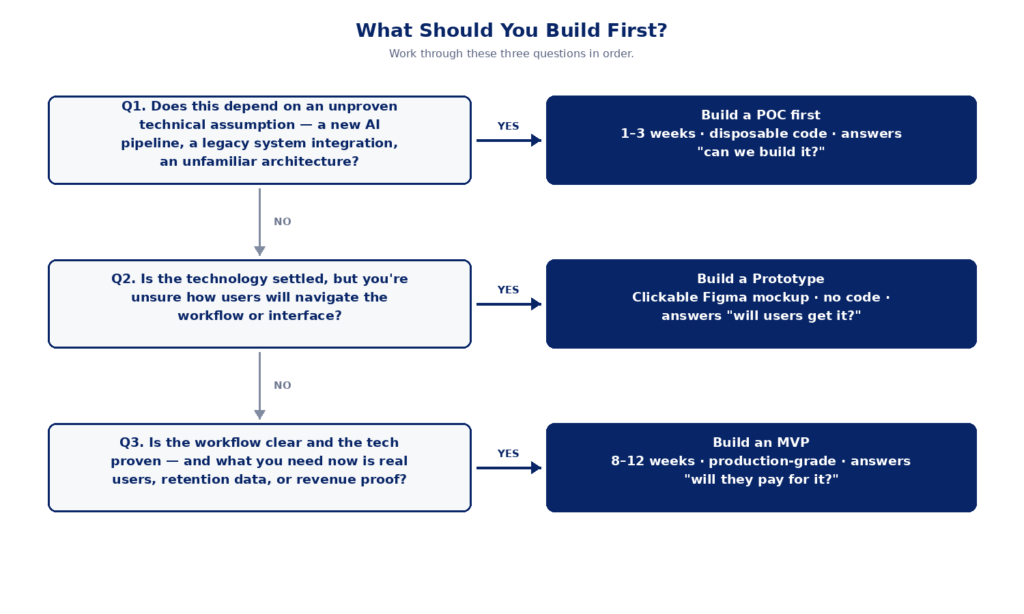
Quick self-assessment
| Your situation | Build this | Roughly |
|---|---|---|
| “We’re not sure our AI model is accurate enough for this use case.” | POC | 1–2 weeks |
| “We need to know if we can sync securely with an old ERP system.” | POC | 2–3 weeks |
| “We know the backend works, but we’re not sure how users want to navigate it.” | Prototype | 1–2 weeks |
| “We’re building on standard, well-understood tech and need customer feedback.” | MVP | 8–10 weeks |
| “We need real usage data and revenue signals to close a funding round.” | MVP | 10–12 weeks |
Not sure if you need a POC, a prototype, or an MVP?
Talk through your product stage with Vinova’s team — no commitment required.
Why the Order Matters
For anything with real technical or market uncertainty, the most capital-efficient path usually isn’t picking one or the other — it’s sequencing them. A short, disposable POC spike answers the scariest technical question first, for a fraction of what a full build would cost. If it fails, you’ve saved most of your budget and can pivot without much lost. If it succeeds, a lightweight prototype lets you pressure-test the user experience while changes still cost a design revision, not a rewritten codebase. Only then does the MVP get built — on a validated foundation, with a much better idea of what “minimum” should actually include.
This sequencing is also where a good engineering partner earns their fee: isolating the riskiest assumption first, keeping quality gates in place even at MVP speed, and not letting a two-week spike quietly turn into six months of unplanned work.
Frequently Asked Questions
Can we reuse our POC code to build the MVP?
Usually not. A POC is built for speed, not durability — hardcoded values, skipped validation, minimal testing. Reusing it as an MVP foundation tends to bake in fragility and technical debt that’s expensive to unwind later. Keep the learnings, rebuild the code cleanly.
What does each one actually cost?
As a rough guide, a POC typically runs $5,000–$20,000 over 1–3 weeks. A production-ready MVP typically runs $35,000–$100,000+ over 8–12 weeks, depending on complexity and compliance requirements.
What if the POC fails?
That’s a good outcome, not a bad one — it just saved you from spending far more building something that wouldn’t have worked. A failed POC usually means one of three things: pivot the technical approach, renegotiate the constraints, or shelve the idea before it costs you more.
Which one do investors want to see?
Outside of genuine deep-tech (novel algorithms, hard science), most investors want to see an MVP with real traction — active users, retention, early revenue — not a technical proof of concept.
Vinova: Singapore’s product engineering partner since 2010. ISO 27001:2022 and ISO 9001:2015 certified.
Part of a 300+ engineer bench delivering POC spikes, prototypes, and production-ready MVPs across Singapore, Australia, and the US.
Financial Times Top 500 High-Growth Companies Asia-Pacific 2026. The Straits Times Singapore’s Fastest-Growing Companies 2024, 2025, and 2026.