By the Vinova ODC Practice. Reviewed under ISO 27001:2022 and ISO 9001:2015 delivery standards.
The Short Answer: Offshore Development Center Cost in Vietnam
An Offshore Development Center (ODC) in Vietnam costs between $2,200 and $4,800 USD per developer per month on an all-inclusive dedicated retainer ($14 to $30 USD per hour). A fully assembled, cross-functional 5-person engineering pod averages $19,100 USD per month, delivering 61% to 65% total cost reduction compared to in-house hiring in Singapore or Australia.
For technology executives and product leaders in Singapore, Sydney, and Melbourne, scaling engineering capacity in 2026 is no longer just a recruitment challenge. It is an exercise in corporate capital efficiency, and offshore development center cost is the number that decides whether a hiring plan survives its first conversation with the CFO.
Domestic software engineer compensation has reached record highs, with base salaries upward of AUD $150,000 to $185,000 in Sydney and SGD $120,000 to $162,000 in Singapore. That is before statutory pension contributions, state payroll taxes, enterprise workstations, and amortized placement fees, and in-house engineering expansion rapidly depletes runway.
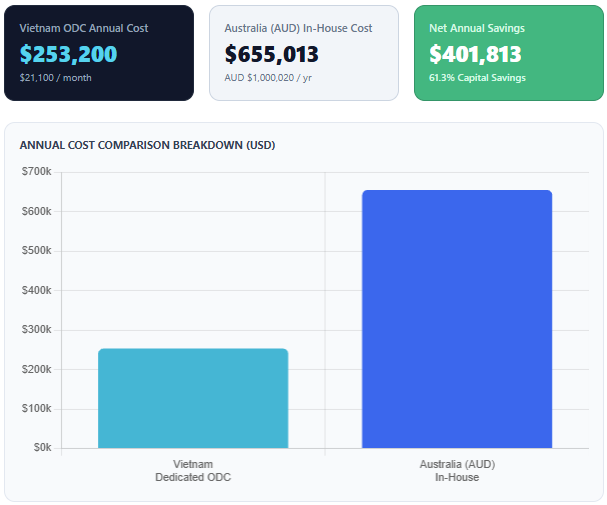
Consequently, forward-looking engineering leaders are moving away from unpredictable freelance billing and commodity outsourcing and establishing Offshore Development Centers (ODCs) in Vietnam. Structured under a modern governance framework, an ODC preserves full architectural and backlog control while unlocking a 55% to 65% reduction in Total Cost of Ownership (TCO).
Key Architectural & Financial Takeaways
1. The 65% Loaded Arbitrage: A dedicated 5-person Vietnam pod cuts annualized engineering spend by $365K to $427K USD versus Sydney or Singapore hiring. The same domestic budget would fund roughly 2.6x to 2.9x the engineering capacity.
2. The Statutory Ceiling Reality: Never budget offshore base pay in isolation. With the 13th-month bonus and the insurance caps under Decrees 73 and 161, effective employer overhead settles at 12% to 14%, with no statutory severance liability.
3. The Anti-Telephone Direct-Comm Rule: Direct developer-to-lead channels and Solutions Architect code reviews replace non-coding PM intermediaries and end the 24- to 48-hour communication drag.
4. The Singapore Bridge Fiduciary Shield: Singapore common law, present-tense IP conveyance, and binding SIAC arbitration make awards enforceable across 170+ New York Convention states.
This guide provides an empirical, data-backed breakdown of offshore development center cost, Vietnam software developer rates 2026, ODC pricing models, total cost modeling, and governance structures to help you build an accurate engineering budget.
Table of Contents
1. Offshore Development Center Cost in 2026: Executive Snapshot
Financial Rule of Thumb: Never budget an offshore expansion on developer base pay alone. The only metric that protects your balance sheet is the fully loaded dedicated retainer inclusive of statutory insurance, workstation security, line management, and recruitment amortization.
Headline developer rates are an illusion, and any offshore development center cost estimate built on them inherits the illusion.
To evaluate software engineering rates in Vietnam, financial models must distinguish between two numbers:
- Local Gross Base Salary: What the engineer takes home before personal income tax.
- All-Inclusive Dedicated Retainer: The enterprise billing rate charged by an established engineering partner.
The dedicated retainer represents your true operational cost. It wraps developer compensation, statutory benefits, hardware procurement, physical infrastructure, network security, continuous training, line management oversight, and corporate operating margin into a single predictable invoice.
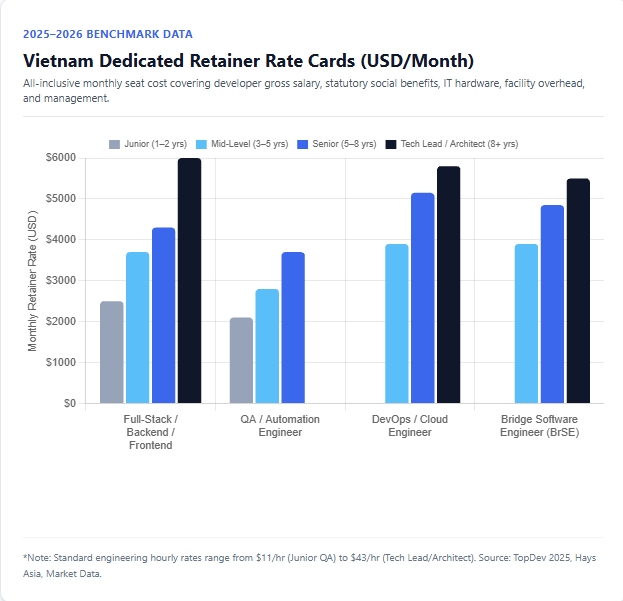
Offshore Development Center Cost by Role: The Vietnam Software Developer Rates 2026 Rate Card
The table below benchmarks local gross salary against the all-inclusive dedicated retainer for each role and seniority tier.
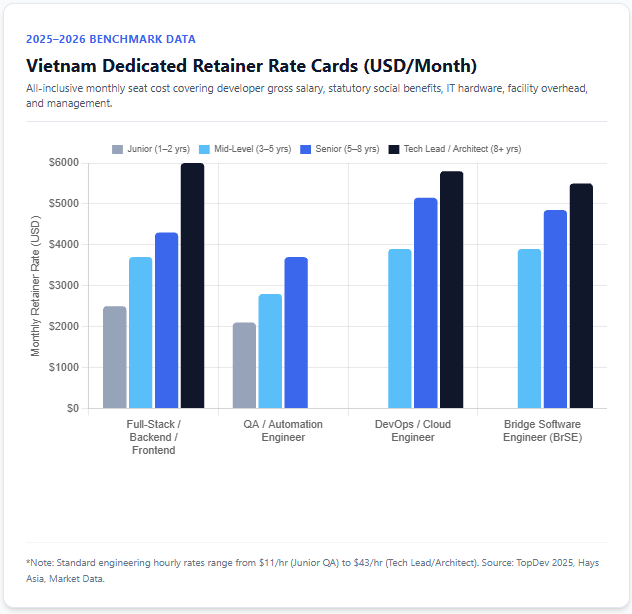
| Role Architecture | Seniority Tier | Local Gross Salary (USD/Month) | Dedicated Retainer (USD/Month) | Dedicated Hourly Equivalent (USD/Hour) | Market Baseline & Experience Signals |
|---|---|---|---|---|---|
| Full-Stack / Backend / Frontend Engineer | Junior (1 to 2 yrs) | $600 to $1,200 | $2,200 to $2,800 | $14 to $18 | Core syntax execution, supervised bug fixing, foundational component delivery. |
| Full-Stack / Backend / Frontend Engineer | Mid-Level (3 to 5 yrs) | $1,300 to $2,200 | $3,200 to $4,200 | $20 to $26 | Independent module ownership, complex API integration, relational database design. |
| Full-Stack / Backend / Frontend Engineer | Senior (5 to 8 yrs) | $2,200 to $3,800 | $3,800 to $4,800 | $24 to $30 | Distributed systems architecture, microservices, performance tuning, code review leadership. |
| Full-Stack / Backend / Frontend Engineer | Tech Lead / Architect (8+ yrs) | $3,500 to $5,500+ | $5,200 to $6,800 | $33 to $43 | High-concurrency design, domain-driven architecture, cross-team technical governance. |
| QA / Automation Engineer | Junior (1 to 2 yrs) | $500 to $950 | $1,800 to $2,400 | $11 to $15 | Manual test case execution, regression runs, issue documentation. |
| QA / Automation Engineer | Mid-Level (3 to 5 yrs) | $1,000 to $1,600 | $2,400 to $3,200 | $15 to $20 | Selenium, Cypress, Playwright automated scripting, API testing. |
| QA / Automation Engineer | Senior Automation (5+ yrs) | $1,700 to $2,600 | $3,200 to $4,200 | $20 to $26 | End-to-end test framework design, load and stress profiling, CI/CD pipeline integration gates. |
| DevOps / Cloud Platform Engineer | Mid-Level (3 to 5 yrs) | $1,500 to $2,400 | $3,400 to $4,400 | $21 to $28 | Terraform, Docker, Kubernetes container orchestration, AWS and GCP pipeline automation. |
| DevOps / Cloud Platform Engineer | Senior / Platform (5+ yrs) | $2,500 to $4,200 | $4,500 to $5,800 | $28 to $36 | Multi-region cloud design, FinOps, zero-trust network topology, disaster recovery orchestration. |
| Bridge Software Engineer (BrSE) / PM | Mid-Level (3 to 5 yrs) | $1,600 to $2,500 | $3,400 to $4,400 | $21 to $28 | Technical requirements translation, client backlog grooming, sprint velocity tracking. |
| Bridge Software Engineer (BrSE) / PM | Senior BrSE / PM (5 to 8+ yrs) | $2,500 to $4,000 | $4,200 to $5,500 | $26 to $34 | Architectural translation, executive stakeholder alignment, risk escalation management. |
Tech Stack Cost Deltas: What Drives Rate Variations?
Standardized web stacks have deep liquidity in Vietnam. Specialized cloud infrastructure and machine learning command steep premiums.
| Tech Stack | Premium Over Core Web | What Drives It |
|---|---|---|
| Core Web / Full-Stack (React, Vue.js, Node.js, .NET Core, Java Spring Boot) | +0% (baseline) | The deepest labor liquidity in Vietnam, which means rapid candidate replacement and predictable rate cards. |
| Mobile Native / Hybrid (Flutter, React Native, Swift, Kotlin) | +12% (range +10% to +15%) | Southeast Asia’s mobile-first consumer economy and regional fintech super-apps. |
| DevOps & Cloud Platform (Kubernetes, Terraform, AWS) | +20% (range +15% to +25%) | An acute shortage of senior engineers proficient in production Kubernetes orchestration, infrastructure-as-code, and cloud security posture management. |
| Data Lakehouse (Databricks, Snowflake, Kafka) | +25% | Specialist platform skills with a thinner talent pool than core web. |
| Applied AI / LLM Engineering (PyTorch, RAG) | +35% (range +25% to +40%) | Rapid enterprise adoption of custom retrieval-augmented generation (RAG) pipelines, model fine-tuning, and agent frameworks has created an aggressive talent war for Python, PyTorch, and vector database specialists. |
The Cost of a Dedicated Software Team in Vietnam: A 5-Person Offshore Development Center Cost Model
To see how rate cards translate into balance-sheet impact, consider an enterprise software pod configured to scale a modern cloud application, spanning the core capabilities outlined in our types of enterprise applications architecture guide:
- 1x Technical Lead / Solutions Architect (8+ years experience)
- 2x Senior Full-Stack Engineers (5 to 8 years experience)
- 1x Mid-Level Mobile Engineer (3 to 5 years experience)
- 1x QA Automation Engineer (3 to 5 years experience)
Financial and statutory assumptions (2026): Exchange rates are benchmarked at 1 AUD = 0.655 USD and 1 SGD = 0.765 USD. In-house domestic models factor in the statutory Superannuation Guarantee of 12.0% for Australia, Singapore CPF capped at the S$8,000/month Ordinary Wage ceiling, state payroll taxes, workers’ compensation, amortized recruitment placement fees (an 18% fee amortized over 24 months), and commercial real estate and workstation overhead.
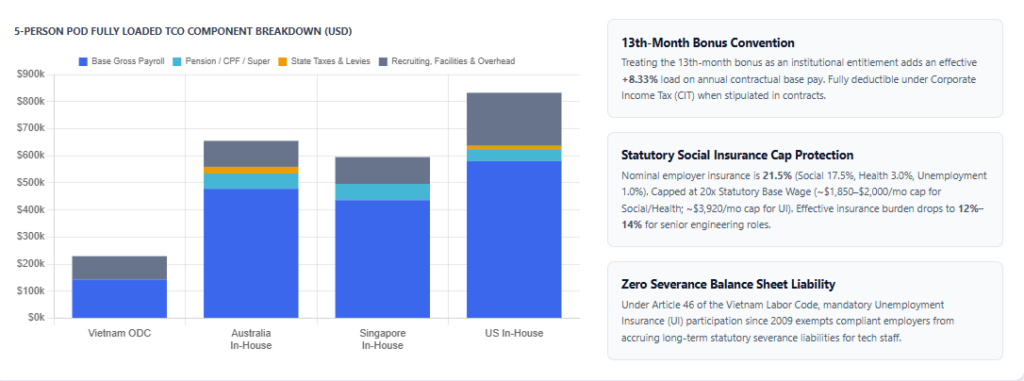
| Financial Comparison Metric | Vietnam Dedicated ODC (USD) | Australia In-House (AUD) | Australia In-House (USD Eq.) | Singapore In-House (SGD) | Singapore In-House (USD Eq.) |
|---|---|---|---|---|---|
| Tech Lead / Architect Base | In retainer | AUD $185,000 | USD $121,175 | SGD $162,000 | USD $123,930 |
| 2x Senior Full-Stack Base | In retainer | AUD $310,000 | USD $203,050 | SGD $240,000 | USD $183,600 |
| 1x Mid Mobile Base | In retainer | AUD $115,000 | USD $75,325 | SGD $84,000 | USD $64,260 |
| 1x QA Automation Base | In retainer | AUD $120,000 | USD $78,600 | SGD $84,000 | USD $64,260 |
| Total Annual Gross Base Pay | In retainer | AUD $730,000 | USD $478,150 | SGD $570,000 | USD $436,050 |
| Mandatory Pension / CPF | Included | AUD $87,600 (12.0%) | USD $57,378 | SGD $77,520 (capped) | USD $59,303 |
| State Payroll Taxes / Surcharges | Included | AUD $37,595 (5.15%) | USD $24,625 | n/a | n/a |
| Workers’ Comp / Health Insurance | Included | AUD $10,950 (1.50%) | USD $7,172 | SGD $18,000 | USD $13,770 |
| Amortized Tech Recruiter Fees | Included | AUD $65,700 (9.00%) | USD $43,034 | SGD $51,300 (9.00%) | USD $39,245 |
| Office Space, Hardware & SaaS | Included | AUD $70,000 | USD $45,850 | SGD $60,000 | USD $45,900 |
| Total Fully Loaded Annual Cost | USD $229,200 | AUD $1,001,845 | USD $656,208 | SGD $776,820 | USD $594,267 |
| Total Fully Loaded Monthly Cost | USD $19,100 | AUD $83,487 | USD $54,684 | SGD $64,735 | USD $49,522 |
| Net Capital Savings vs. ODC (USD) | Baseline | n/a | USD $427,008 | n/a | USD $365,067 |
| Net Savings Percentage | Baseline | n/a | 65.1% | n/a | 61.4% |
The Strategic Bottom Line
Operating this five-person engineering pod through a dedicated Vietnam ODC yields over $427,000 USD in annual net savings compared to Sydney or Melbourne, and over $365,000 USD compared to Singapore.
For less than the fully loaded cost of two senior developers in-house domestically, an enterprise can deploy a complete, five-person cross-functional engineering unit in Vietnam. That is two and a half times the headcount, and it extends financial runway at the same time.
Vinova Field Insight: Scaling a Regulated FinTech Pod under MAS TRM Guidelines
In an enterprise engagement for a Singapore-headquartered digital asset and institutional financial platform, domestic talent competition had pushed senior developer salaries past S$14,000/month, threatening runway and stalling multi-currency clearing features.
The Deployment: Vinova deployed a dedicated 6-person engineering pod in Ho Chi Minh City (1 Solution Architect, 3 Senior Full-Stack Engineers, 1 DevOps Engineer, and 1 QA Automation Lead) paired with a Singapore-based Enterprise Engagement Director.
The Result: Annualized engineering overhead fell by $385,000 USD compared to local Singapore hiring. The platform passed strict Monetary Authority of Singapore (MAS) Technology Risk Management audits and third-party SOC 2 Type II compliance reviews with zero data-sovereignty non-conformities. Two-week sprint release velocity improved by 45%, moving the platform from manual bi-monthly builds to automated daily CI/CD deployments.
2. What Is an Offshore Development Center (ODC) and How Does It Operate?
Architectural Rule of Thumb: An ODC is an organic engineering squad, not an outsourcing queue. Embed offshore developers directly into your GitHub repos, CI/CD pipelines, and daily Slack standups with zero non-technical gatekeepers.
Stop treating offshore engineering as a transactional ticket-taking queue.
If you isolate developers behind non-coding intermediaries and throw Jira tickets over an organizational wall, pull request velocity stalls, architectural alignment disintegrates, and codebases rot.
A modern Offshore Development Center (ODC) operates as an organic, fully integrated engineering squad inside your organization. The engineers work exclusively for your company, adopt your continuous integration and deployment (CI/CD) pipelines, participate in your daily standups, and report directly to your technical leadership. When evaluating whether to build internal IP or buy off-the-shelf software, understanding custom software development concepts and classifications helps engineering directors determine why proprietary team ownership provides a durable competitive moat.
| Client Retains (Product Core) | ODC Partner Provides (Scale) |
|---|---|
| Product strategy and backlog | Class-A physical facility and labs |
| Architectural governance and PRs | Hardware and endpoint security |
| Daily standups and sprint rituals | Local payroll, tax, and compliance |
| 100% repository IP ownership | Continuous technical upskilling |
| Direct engineering management | Recruitment and bench backfill |
Friction Point We Hit: The “Game of Telephone” BrSE Communication Bottleneck
In legacy offshore models, enterprises are told that all communications must flow through a dedicated Bridge Software Engineer (BrSE) or non-technical Project Manager.
The Root Cause: When an Australian or Singapore product manager needs an urgent bug triage or architectural clarification, routing tickets through a non-coding intermediary turns daily standups into a game of “telephone.” Requirements get mistranslated, edge cases get dropped, and pull request turnaround stretches from hours into days.
The Solution: In Vinova’s ODC architecture, we enforce Direct-Comm Governance. English-fluent developers participate directly in client Slack or Teams channels and review code directly in GitHub or GitLab. The BrSE role becomes a Hands-On Technical Solutions Architect who focuses on API interface definitions, automated testing gates, and architectural risk mitigation, not manual message forwarding.
The Two Primary ODC Engagement Models
When evaluating how an ODC physically and legally operates, providers typically offer two deployment architectures:
1. The Contractor / Managed Pod Model (Fastest Time-to-Market)
In this model, the ODC partner provides the physical office infrastructure, enterprise workstations, developer benefits, HR operations, and legal employment of record (EOR) under local labor statutes. The client retains total daily control over task assignment, sprint backlogs, and code review.
- Who it is for: High-growth scale-ups and mid-market product companies seeking to spin up 5 to 25 engineers within 30 to 45 days without incorporating a foreign subsidiary.
2. The Customer Model / Dedicated Private Lab (BOT-Ready)
Here, the partner constructs a physically partitioned, custom-branded engineering enclave within their delivery hub. This private lab features dedicated biometric access gates, air-gapped corporate networks, isolated server hardware, and strict compliance with the client’s internal security audits.
- Who it is for: Financial institutions, digital health platforms, and mature enterprises running 20 to 100+ seats that require MAS or ISO-grade security isolation, or that intend to execute a Build-Operate-Transfer (BOT) acquisition within 24 to 36 months.
3. ODC vs. Staff Augmentation vs. Project Outsourcing: Model Selection Matrix
Choosing the right engineering engagement model requires evaluating three dimensions: cost predictability, architectural control, and institutional knowledge retention. The model you pick changes your offshore development center cost curve as much as the rate card does.
- Project-Based Outsourcing: Best for bounded, non-core initiatives with defined functional specifications. The vendor manages the timeline and assumes delivery risk, charging a premium margin for change requests. Once the software is released, the engineering team is disbanded, meaning institutional knowledge is lost.
- IT Staff Augmentation: Best for plugging immediate, short-term skill deficits (for example, adding a single specialized cloud security engineer for a three-month audit). The developer plugs directly into your team, but you manage all administrative and onboarding burdens, and the developer may depart when the contract concludes.
- Dedicated ODC: Best for core, multi-year product development. A dedicated squad scales with your roadmap, retains architectural context across sprints, and operates under shared governance metrics.
Model Comparison Matrix
| Evaluation Dimension | Fixed-Scope Project Outsourcing | IT Staff Augmentation | Dedicated Offshore Development Center (ODC) |
|---|---|---|---|
| Cost Predictability | High initial certainty, but expensive change-request fees. | Moderate; billed per hour or per day logged. | Highest; fixed, all-inclusive monthly retainer per seat. |
| Hourly Rate Efficiency | Lowest; contains high vendor management and buffer margins. | Moderate; standard contractor market rates. | Highest; wholesale seat rates deliver 55% to 65% structural savings. |
| Architectural Control | Low; vendor dictates technical architecture. | High; developer works within your internal repository. | Complete; client owns technical roadmap, PR approvals, and architecture. |
| Domain Knowledge Retention | Zero; team disperses immediately post-delivery. | Low to moderate; individual contractor departs after task completion. | High; permanent team builds cumulative institutional knowledge. |
| Management Overhead | Low; vendor manages day-to-day work. | High; internal leads manage individual tasks. | Balanced; vendor handles operations and HR, client leads technical direction. |
| Intellectual Property Risk | Moderate; depends on contract clarity post-launch. | Low; covered under standard consulting IP terms. | Lowest; present-tense assignment under Singapore common law. |
Need to evaluate whether individual contractors or a full squad fits your current stage? Read our comprehensive comparison on IT Staff Augmentation vs. IT Outsourcing to benchmark team control, onboarding velocity, and project governance.
4. ODC Pricing Models: Which Structure Protects Your Margin and Your Offshore Development Center Cost?
Engaging an ODC typically involves one of four commercial pricing models. Selecting the appropriate model determines how financial and operational risks are shared between you and your partner, and which of these ODC pricing models fits depends on roadmap length and team size.
| ODC Pricing Model | Who Carries the Risk | Fee Structure | Optimal Use Case |
|---|---|---|---|
| 1. Fixed Monthly Dedicated Retainer | The vendor: wage inflation, leave, and labor compliance | Flat per-seat fee, all-inclusive | Multi-quarter and multi-year roadmaps scaling from 5 to 50+ developers |
| 2. Cost-Plus (Open-Book) | The client: local salary inflation | Payroll at cost plus a 15% to 25% management fee per seat | Pods of 15+ engineers heading for an in-house transition |
| 3. Build-Operate-Transfer (BOT) | The vendor during incubation; the client at handover | Standard dedicated rates, then a transfer fee of 15% to 25% of total contract value | Large enterprises building an independent Global Capability Center in Vietnam |
| 4. Time & Materials (T&M) | The vendor: bench time, pauses, offboarding | A 15% to 25% hourly premium over retainer equivalents | Discovery, refactoring spikes, and proof-of-concepts under 90 days |
1. Fixed Monthly Dedicated Retainer (Vinova’s Core Framework)
Under the dedicated monthly retainer, the enterprise pays a flat, negotiated monthly fee per developer seat based on seniority and technology stack.
- What is covered: Base compensation, statutory social insurances, 13th-month bonus accruals, enterprise hardware, office facilities, recruitment overhead, line management, and corporate operating margin.
- Why it works: It offers total budget predictability. If a developer falls ill or takes statutory annual leave, your monthly billing does not fluctuate. The vendor assumes all domestic wage inflation and labor compliance risks throughout the contract term.
2. The Cost-Plus Model (Open-Book Commercials)
In a cost-plus arrangement, the vendor exposes the exact gross payroll paid to each engineer. The client reimburses this gross salary alongside statutory employment taxes at cost, then pays a separate, fixed monthly management fee (typically 15% to 25%) per seat to cover operational infrastructure and vendor margin.
- Strategic trade-off: While it offers line-item transparency into payroll, the client directly absorbs local salary inflation risks and must actively participate in individual compensation reviews.
3. Build-Operate-Transfer (BOT) Financing
Under the BOT model, the partner establishes the development center, hires the engineering team, implements operational processes, and manages delivery for an agreed incubation period (typically 24 to 36 months). At the end of the term, the client exercises a contractual option to legally transfer the entire operation, including employment contracts, facility leases, workstation assets, and intellectual property, into a wholly owned captive subsidiary.
- Commercial mechanics: Operating retainers during the “Operate” phase mirror standard dedicated rates, but the final handover involves a transfer fee (standardly 15% to 25% of the total contract value over the operational term).
4. Time & Materials (T&M): The 15% to 25% Flexibility Premium
Under a T&M model, developers bill strictly for verified hours logged against tickets in Jira or Linear.
- The commercial reality: T&M carries an hourly rate premium of 15% to 25% over dedicated retainer equivalents. Because the enterprise guarantees no forward resource utilization, the vendor absorbs the financial risk of sudden project pauses, bench time, and offboarding. The higher rate serves as a cash reserve to cover unbilled capacity.
Explore Vinova’s Offshore Development Center (ODC) Services
See how the all-inclusive retainer, Direct-Comm Governance, and Singapore-law IP structure in this guide translate into a dedicated Vietnam pod and an offshore development center cost you can forecast.
5. Offshore Software Development Total Cost of Ownership (TCO): What’s Not on the Contractor Invoice
Fiduciary Rule of Thumb: Ignore headline hourly rates. Hidden statutory taxes, timezone clarification drag, and unhedged developer turnover will erode a naive DIY offshore build within 6 months. Model total cost of ownership at the balance-sheet level.
Evaluating an offshore engagement purely on developer hourly rates is an unforced balance-sheet error. Offshore software development total cost of ownership is the metric that survives a CFO review, and it is where most offshore development center cost estimates quietly go wrong.
Attempting to run a “do-it-yourself” offshore operation by hiring remote freelancers or incorporating a shell company abroad exposes your balance sheet to hidden operational taxes that quickly erode initial savings.
1. The “DIY Offshore” Hiring Fallacy: Statutory Overheads in Vietnam
Under the Vietnam Labor Code (Law No. 45/2019/QH14), maintaining direct employees introduces statutory liabilities that must be funded:
- The mandatory 13th-month salary: Although technically an incentive under Article 104 of the Labor Code, market convention treats the 13th-month bonus as an implied contractual obligation. Companies must budget an additional 8.33% of gross annual base payroll to cover this year-end payment.
- Compulsory statutory insurance: Vietnamese law mandates employer contributions totaling 21.5% of gross salary (17.5% Social Insurance, 3.0% Health Insurance, and 1.0% Unemployment Insurance).
The Statutory Insurance Capping Mechanism
Under Decree No. 73/2024/ND-CP and Decree No. 161/2026/ND-CP, the calculation ceiling for Social and Health Insurance is capped at 20 times the general statutory base wage (roughly $1,850 to $2,000 USD per month). Decree 161 raised that base wage from VND 2.34 million to VND 2.53 million effective 1 July 2026, lifting the cap from VND 46.8 million to VND 50.6 million. Unemployment Insurance is capped separately at 20 times the regional minimum wage (roughly $4,200 USD per month) and was unaffected.
Because mid-level, senior, and lead developers earn above these salary caps, the effective employer insurance burden drops from the nominal 21.5% down to 12% to 14% of gross salary.
- Severance pay liabilities: Article 46 of the Labor Code mandates that employees with at least 12 months of service receive severance pay of half a month’s salary per year of work. However, Article 46, Clause 2 explicitly excludes any period during which the employee participated in compulsory state Unemployment Insurance. Because state UI has been mandatory for tech workers since 2009, compliant employers carry zero statutory severance liability on their balance sheets.
When you engage through an established ODC, all statutory bonuses, insurance caps, and local labor liabilities are consolidated into your fixed monthly retainer.
2. The Timezone and Coordination Tax
Offshoring to opposing timezones (such as North American EST or Western Europe) introduces communication drag.
Under an asynchronous model with a 10- to 12-hour time difference, an engineer blocked by an ambiguous user story at 10:00 AM local time submits a question that the onshore product manager only sees 12 hours later. The developer reviews the response the following morning. A single clarification loop stretches into a 24- to 48-hour delay, degrading sprint delivery velocity by an estimated 15% to 25%.
| Timezone Pair | Synchronous Overlap | Effect on Delivery |
|---|---|---|
| Singapore (UTC+8) vs. Vietnam (UTC+7) | 7 synchronous working hours daily | Zero friction |
| Australia AEST (UTC+10) vs. Vietnam (UTC+7) | 5 to 6 synchronous working hours daily | Live sprints |
| US Eastern EST (UTC-5) vs. Vietnam (UTC+7) | No standing overlap | Overnight lag: 24- to 48-hour clarification cycles |
The Nearshore APAC Advantage: Vietnam (UTC+7) operates just one hour behind Singapore (UTC+8) and three hours behind the Australian Eastern seaboard (UTC+10 AEST, four hours during daylight saving). Engineering teams in Vietnam share seven overlapping hours daily with Singapore and five to six overlapping hours with Sydney and Melbourne, slightly fewer during daylight saving. As analyzed in our complete IT outsourcing guide for Australian businesses, nearshoring to Southeast Asia provides synchronous live standups, real-time code reviews, and instant incident response during standard business hours while eliminating the 70- to 90-day hiring lag typical of domestic Australian recruitment.
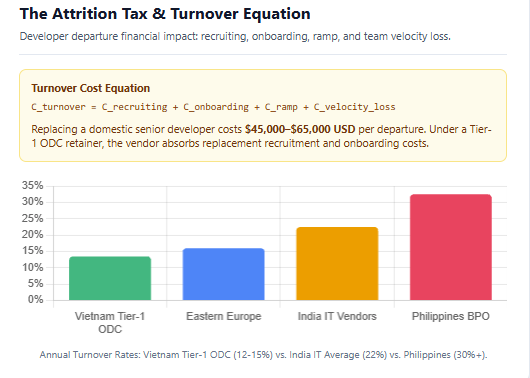
3. The Attrition Tax: How Turnover Inflates Offshore Development Center Cost
Unplanned developer departures represent an unrecoverable operational expense. The full cost of a departure is the sum of three components:
Turnover cost = Recruitment cost + Ramp-up cost + Velocity loss
- Recruitment cost: Agency search fees, technical screening hours, and management interviews, totaling 1.5 to 2.0 months of gross salary.
- Ramp-up cost: Direct payroll paid while a new developer ramps up to speed over three to four months, at 25% productivity in Month 1, 50% in Month 2, and 75% in Month 3 (breakdown below).
- Velocity loss: The broader team throughput lost while senior developers step away from the core roadmap to mentor new hires, reducing pod output by 10% to 15% over a 60-day onboarding window.
| Ramp-Up Month | New Hire Productivity | Unproductive Payroll |
|---|---|---|
| Month 1 | 25% | 75% of one month’s salary |
| Month 2 | 50% | 50% of one month’s salary |
| Month 3 | 75% | 25% of one month’s salary |
| Total ramp-up cost | 1.5 months of salary per replacement |
In major tech hubs like Sydney or Singapore, replacing a senior software developer costs between $45,000 and $65,000 USD in direct and indirect expenses.
While legacy offshore destinations in South Asia face developer attrition rates between 20% and 25%+, Tier-1 engineering firms in Vietnam maintain annual attrition rates below 12% to 15%. Under an ODC agreement, your partner absorbs all recruitment costs and provides pre-vetted replacement engineers to safeguard your delivery timelines.
6. Offshore Development Center Cost by Country: Why Vietnam Leads the ODC Landscape in 2026
Enterprise engineering teams evaluating offshore expansion compare Southeast Asia against traditional outsourcing destinations in South Asia and nearshore Europe:
| Comparative Dimension | Vietnam | India | Philippines | Eastern Europe (Poland / Romania) |
|---|---|---|---|---|
| Senior Developer Retainer (USD/Mo) | $3,800 to $4,800 ($24 to $30/hr) | $3,800 to $5,500 ($24 to $35/hr) | $3,200 to $4,500 ($20 to $28/hr) | $5,500 to $7,500 ($35 to $47/hr) |
| EF English Proficiency Index (2025) | #64 | Score: 500 (Moderate) | Score: 484 (Low) | #28 | Score: 569 (High) | #15 | Score: 600 (Very High, Poland) |
| Active Software Talent Pool | ~530,000 to 560,000 devs | 5,400,000+ IT workforce | ~400,000 tech/BPO talent | ~600,000 devs combined |
| Annual Tech/STEM Graduates | ~57,000 tech grads | 1,500,000+ tech grads | ~40,000 tech grads | ~45,000 CS grads |
| Annualized Developer Attrition | 12% to 15% (Tier-1 firms) | 20% to 25%+ across hubs | 25% to 40% (heavily BPO) | 14% to 18% across hubs |
| Geopolitical & Macro Stability | High: single-party stability, neutral foreign policy, active FDI incentives. | Moderate: stable institutions, regional regulatory complexities. | Moderate: institutional stability, seasonal storm disruptions. | Moderate to Volatile: NATO border proximity; direct exposure to regional conflicts. |
English proficiency figures: EF English Proficiency Index 2025 (Vietnam ranked 64th of 123 countries and regions; the Eastern Europe column shows Poland).
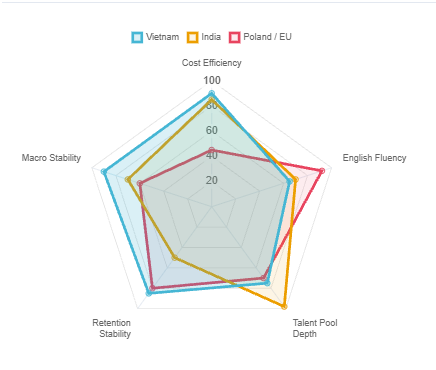
- India: Unmatched scale and resource depth, but rapid salary inflation in Tier-1 cities (Bangalore and Hyderabad) and high developer churn (20% to 25%+) introduce project continuity risks.
- The Philippines: Exceptional English proficiency, but the talent market remains focused on customer experience, IT support, and business process outsourcing, with a smaller pool of native distributed systems architects.
- Eastern Europe: Strong algorithmic capabilities, but rising operational rates ($35 to $47+ per hour) have narrowed the cost arbitrage, paired with regional geopolitical risks.
- Vietnam: Strikes the ideal balance for 2026, combining technical rigor, low attrition, APAC timezone alignment, and sustainable cost savings.
For an in-depth breakdown of regional collaboration advantages, explore our guide on Why Vietnam Is Australia’s Go-To Offshore Tech Hub.
The Singapore Bridge: Why a Singapore-Vietnam ODC Model Protects Your IP
The main hesitation for international enterprises when establishing an offshore engineering center is legal and regulatory exposure: How do you safeguard proprietary IP, enforce non-disclosure agreements, and maintain regulatory compliance within an emerging market?
The “Singapore Bridge” resolves this problem by decoupling corporate legal governance from engineering execution. In a Singapore Vietnam ODC structure, three layers each do one job:
| Layer | Role and Controls |
|---|---|
| Enterprise client (Australia / Singapore / US) | Signs the Master Services Agreement (MSA): Singapore legal jurisdiction, SIAC binding arbitration, present-tense IP assignment. |
| Vinova’s Singapore contracting entity (fiduciary and legal counterparty) | Operational governance and execution: ISO/IEC 27001 ISMS controls, MAS TRM regulatory alignment, centralized endpoint security and MDM. |
| Vietnam delivery enclaves (Ho Chi Minh City / Hanoi / Da Nang) | 300+ in-house engineers, dedicated private pods, biometric access and clean-desk facilities. |
Under this model, your commercial contract is executed directly with Vinova’s Singapore-incorporated contracting entity, operating under Singapore commercial law. Software development is then carried out through Vinova’s engineering facilities in Ho Chi Minh City, Da Nang, and Hanoi.
Three Core Risk Mitigations
- Common Law Legal Framework: Singapore commercial law is grounded in English Common Law, providing well-established legal precedents for contract interpretation, liability limitations, and IP assignments.
- Enforceable Dispute Resolution via SIAC: Contracts mandate that any commercial disputes be resolved through binding arbitration at the Singapore International Arbitration Centre (SIAC). Under the 1958 New York Convention, SIAC arbitral awards are enforceable across more than 170 signatory nations.
- Banking Infrastructure and Currency Governance: Billing and settlements are conducted in SGD or USD through Singapore’s financial system, insulating your business from local currency swings and complex cross-border currency remittance rules.
7. How Long Does It Take to Set Up an ODC? (The 90-Day Implementation Roadmap)
Spinning up a high-performing ODC pod requires a structured, phased rollout. At Vinova, our teams follow a proven 90-Day Implementation Framework to move from initial planning to full sprint velocity in three 30-day phases: discovery, vetting and provisioning, and Sprint 0.
Days 1 to 30: Discovery, Architecture Alignment & Pod Design
- Technical discovery: Define your target tech stack, branching strategy, testing coverage expectations, and continuous integration rules.
- Pod architecture: Define the team structure (for example, 1 Lead Architect, 2 Full-Stack Engineers, 1 QA Automation) and establish candidate screening criteria.
- Bridge Software Engineer (BrSE) selection: Assign an experienced, hands-on bilingual technical lead to serve as the daily communication and architectural bridge between your onshore product leads and the offshore pod.
Days 31 to 60: Talent Vetting, Infrastructure & Secure Workstations
- Candidate screening and client sign-off: Vinova filters candidates through algorithmic tests, system design interviews, and English communication screens. Your internal engineering leads retain 100% veto authority via final technical interviews.
- Hardware and workplace provisioning: Secure, developer-grade workstations (for example, Apple Silicon M-series hardware) are configured through centralized Mobile Device Management (MDM) platforms.
- Network and security setup: Dedicated virtual private networks (VPNs), role-based repository access, and secure staging environments are isolated and verified.
Days 61 to 90: Sprint 0, Tooling Integration & Initial Ramp-Up
- Ceremony and tooling alignment: Offshore developers join your Slack or Microsoft Teams channels, configure sprint boards in Jira or Linear, and review product backlogs.
- Sprint 0 execution: The team addresses technical debt, configures automated testing environments, and submits initial pull requests to validate CI/CD pipelines.
- Full velocity delivery: By Day 90, the ODC pod operates as an organic extension of your engineering organization, participating in standard two-week sprint releases at full velocity.
8. Protecting Offshore Development Center Cost: Financial Risk Mitigation, Governance, IP & SLAs
Legal Rule of Thumb: If your offshore engagement relies on future-tense IP covenants or unverified overseas courts, your code ownership is an illusion. Require present-tense IP conveyance deeds executed under Singapore common law backed by binding SIAC arbitration.
To keep your offshore development center cost predictable over time, enterprise contracts must protect intellectual property, enforce strict cybersecurity standards, and hold the team to measurable engineering performance benchmarks.
100% Intellectual Property Assignment under Singapore Law
Standard contract language promising to assign rights “in the future” introduces legal risk during venture funding rounds, secondary offerings, or M&A audits.
Under Vinova’s Singapore-governed Master Services Agreement (MSA), our contracts incorporate present-tense intellectual property assignment provisions:
- The service provider and all individual engineers hereby irrevocably assign, transfer, and convey all rights, titles, and interests in all code, documentation, and architecture directly to the client immediately upon creation.
- Tripartite intellectual property deeds and non-disclosure agreements (NDAs) are executed with every assigned engineer before repository access is granted.
- Development work is conducted directly within client-owned GitHub Enterprise or GitLab accounts, governed by role-based Identity and Access Management (IAM). Local code storage is strictly prohibited on non-managed devices.
MAS TRM & ISO 27001 Security Safeguards
For fintechs, neobanks, and enterprises handling sensitive consumer data, our Vietnam delivery hubs operate under verified ISO/IEC 27001:2022 Information Security Management System (ISMS) standards and align with the Monetary Authority of Singapore (MAS) Technology Risk Management (TRM) guidelines:
| Safeguard Area | Control |
|---|---|
| Physical access | Biometric access and CCTV with 90-day forensic logs |
| Test data | Air-gapped testing with synthetic or masked datasets |
| Secure SDLC | Pre-commit SAST scanning and SCA dependency checks |
| Endpoints | MDM-managed endpoints with full-disk encryption |
| Data egress | Disabled USB mass storage and split-tunneling blocks |
| Access control | Multi-factor authentication and session auditing aligned to the MAS Notice on Cyber Hygiene |
Government-Grade Security Precedent: Our security architecture has been proven under the most rigorous scrutiny. As demonstrated in our multi-million dollar public sector ODC implementation, Vinova operates air-gapped cleanrooms and dedicated delivery pipelines that align with Singapore Instruction Manual 8 (IM8) and personal data protection mandates.
Friction Point We Hit: MAS Non-Production Data Masking & Staging Desync
During the offshore staging ramp-up for a regulated financial application, a client product team attempted to replicate an obscure production edge-case bug by importing a raw, unsanitized production database dump into the offshore staging cluster.
The Root Cause: While the offshore pod worked inside an ISO 27001-certified clean enclave, importing unmasked production records breached the client’s MAS TRM-aligned data-handling controls and cross-border data protection mandates. Furthermore, because production records contained encrypted customer identifiers, local service mocks failed, stalling test runs.
The Solution: In Vinova’s enterprise delivery pods, we strictly mandate Automated Deterministic Data Masking Pipelines. Before any database snapshot touches an offshore staging pod, our DevOps engineers run an automated data-scrubbing script that replaces customer PII with deterministically salted, synthetic test data. The pod retains authentic relational integrity across foreign keys without exposing real customer records to offshore nodes.
Enforcing Performance SLAs and Delivery Metrics
A well-structured ODC contract should not bill merely for developer presence; it must track concrete engineering throughput. To maintain delivery velocity, your agreement should define measurable Service Level Agreements (SLAs) and Key Performance Indicators (KPIs):
| KPI | Benchmark |
|---|---|
| Pull Request (PR) Turnaround Time | Senior leads review and triage merge requests within 24 business hours to avoid sprint bottlenecks. |
| Sprint Burndown Predictability | The pod reliably achieves at least 85% of planned story points across consecutive two-week sprints. |
| Defect Escape Rate | Critical production defects attributable to offshore pod deliverables stay below 2% of total shipped user stories. |
| Mean Time to Resolution (MTTR) | High-priority hotfixes are scoped, remediated, and pushed to staging within agreed support-tier windows, standardly 4 to 12 hours. |
For a detailed framework on how to incorporate delivery guarantees, liquidated damages, and response tiers into your contracts, read our guide on SLA in Outsourcing: What It Means and Why It Protects You.
9. 5 Questions to Ask an ODC Partner Before Signing
Before committing to an ODC engagement, ask prospective partners these five vetting questions to separate marketing promises from genuine engineering capability, and to test how honestly they build their offshore development center cost quotes. You can also cross-reference vendor onboarding and IP standards against our 10-point IT team augmentation service checklist.
- “Do you operate your own dedicated delivery centers in Vietnam, or are you an offshore broker?”
Why it matters: Many regional agencies are simply sales brokers who subcontract delivery to unvetted third parties. Ensure your partner directly owns and operates physical delivery facilities in hubs like Ho Chi Minh City, Da Nang, and Hanoi. - “Under which legal jurisdiction is the Master Services Agreement governed?”
Why it matters: Resolving contractual disagreements or enforcing IP terms in foreign civil courts can be costly and difficult. Ensure your contract is held by a Singapore or domestic entity backed by binding SIAC arbitration. - “Does our internal engineering team retain 100% interview and veto authority over every hire?”
Why it matters: In commodity outsourcing, providers assign whoever is available on their internal bench. An enterprise-grade ODC partner sources tailored candidate shortlists for your tech stack, giving your team final sign-off authority on every engineer. - “What is your annual developer turnover rate, and who covers the cost of onboarding a replacement?”
Why it matters: If an engineer departs, the vendor should guarantee a minimum 30-day notice period, provide pre-screened replacements, and fund a mandatory two-week knowledge transfer period at zero additional cost. - “Are monthly rate cards fully loaded and all-inclusive, or are hardware, software tooling, and 13th-month bonuses invoiced separately?”
Why it matters: Protect your margins by insisting on a fixed monthly retainer model. The rate should explicitly incorporate statutory employer social insurance, 13th-month bonuses, physical facilities, workstation provisioning, and local compliance.
10. Frequently Asked Questions (FAQ)
What does ODC stand for in software development?
ODC stands for Offshore Development Center: a dedicated, long-term engineering facility in a foreign country that works as an integrated extension of your in-house team, sharing your roadmap, tools, and culture.
What is the average offshore development center cost per month in Vietnam?
$2,200 to $4,800 USD per developer on an all-inclusive dedicated retainer ($14 to $30 per hour), depending on role and seniority. Mid-level engineers average $3,200 to $4,200, and senior architects $5,200 to $6,800. A complete 5-person pod runs $19,000 to $22,000 per month.
What are typical Vietnam software developer rates in 2026?
On a dedicated retainer: $2,200 to $2,800 per month for junior engineers (1 to 2 years), $3,200 to $4,200 for mid-level, $3,800 to $4,800 for senior, and $5,200 to $6,800 for tech leads and architects. Mobile, DevOps, data, and AI specializations add roughly 12% to 35%.
How much does a dedicated software team in Vietnam cost?
A benchmark 5-person pod (1 tech lead, 2 senior full-stack engineers, 1 mid-level mobile engineer, 1 QA automation engineer) costs about $19,100 USD per month, or $229,200 per year, fully loaded. That is 61% to 65% below the equivalent in-house team in Singapore or Australia.
What are the main ODC pricing models?
Four: a fixed monthly retainer (flat per-seat fee, vendor carries wage inflation), cost-plus (payroll at cost plus a 15% to 25% management fee), build-operate-transfer (the partner incubates the center, then transfers it for 15% to 25% of contract value), and time and materials (a 15% to 25% premium). Multi-year roadmaps usually favor the retainer for its budget predictability.
What drives offshore development center cost the most?
Five levers: the seniority mix of the pod, the tech stack premium (from +0% for core web to about +35% for applied AI), the pricing model, the statutory overhead you carry or have folded into a retainer, and attrition, at roughly 1.5 to 2.0 months of salary in recruitment plus a 1.5-month ramp-up per departure. Seniority mix and pricing model usually matter more than the hourly rate.
Does offshore development center cost include hardware, insurance, and the 13th-month bonus?
On an all-inclusive dedicated retainer, yes. It wraps developer compensation, statutory social insurance, 13th-month accruals, workstations, office facilities, network security, line management, and the partner’s margin into one invoice. Ask any prospective partner to confirm this in writing, because add-ons are where a low headline rate becomes a high bill.
How should I budget offshore development center cost for the first year?
Take the fully loaded monthly retainer per seat, multiply by twelve, and add a ramp-up allowance: new-hire productivity runs at 25%, 50%, and 75% across the first three months, which is about 1.5 months of unproductive payroll per new engineer. Then apply your pricing model’s fee: none for a fixed retainer, 15% to 25% for cost-plus or time and materials.
What is a Singapore-Vietnam ODC model?
It separates legal governance from engineering execution. You contract with a Singapore-incorporated entity under Singapore common law, with SIAC arbitration and present-tense IP assignment, while dedicated pods deliver the engineering in Vietnam.
What is the minimum team size required to set up an ODC?
3 to 5 engineers (for example, 1 tech lead or Bridge Engineer, 2 full-stack developers, and 1 QA automation engineer). That is enough capacity to justify dedicated agile management, secure networking, and steady sprint velocity.
Who owns the intellectual property and source code built by an ODC?
The client owns 100% of all IP, source code, designs, and database schemas from day one. Present-tense assignment deeds under Vinova’s Singapore-governed contracts transfer all work product to your entity immediately upon creation.
The Strategic Next Step: Model Your Offshore Development Center Cost
Scaling software capacity in 2026 does not require overpaying for domestic talent or accepting the legal ambiguities of unvetted overseas contractors. It requires an honest offshore development center cost model, built on fully loaded retainers rather than headline rates.
By pairing Vietnam’s technical depth and cost arbitrage with Singapore’s legal protections, enterprise technology leaders can significantly lower engineering expenses while accelerating product delivery.
Vinova, a Singaporean Government-Grade Technology Partner, Made Accessible, brings 16+ years of engineering track record, 300+ in-house developers, and delivery hubs across Ho Chi Minh City, Da Nang, and Hanoi to every dedicated pod. Explore our comprehensive ODC services and team models to see how the pieces fit together:
- Predictable financial modeling: All-inclusive monthly seat pricing with zero hidden payroll, hardware, or statutory fees.
- Rigorous technical vetting: Pre-screened candidates evaluated for system design, algorithmic capability, and English fluency, with 100% client veto power.
- Enterprise risk governance: Contracts executed under Singapore jurisdiction, enforceable SIAC arbitration, and delivery hubs aligned with ISO 27001 and MAS TRM standards.
Vinova: Singapore’s mobile and web application development partner since 2010. ISO 27001:2022 and ISO 9001:2015 certified.
300+ in-house engineers across Singapore, Hanoi, Da Nang, and Ho Chi Minh City, including teams who build image-heavy mobile and web applications for enterprise and government clients. We put our hands on the best free photo viewers so you don’t have to guess.
Financial Times Top 500 High-Growth Companies Asia-Pacific 2026. The Straits Times Singapore’s Fastest-Growing Companies 2024, 2025, and 2026.