By the Vinova Engineering Team. Reviewed under ISO 27001:2022 and ISO 9001:2015 delivery standards.
The Short Answer
Onshore and offshore software development are not rivals. Onshore teams are the right place for architecture, regulatory governance, and fast-moving discovery. Offshore teams are the right place for scaled, well-specified delivery. The hybrid model pairs the two: Singapore-based leaders who stay accountable under Singapore law, and dedicated Vietnam-based squads who execute. On the figures in this guide, a dedicated senior developer from Vinova costs roughly 45% to 61% less per month than a median Singapore senior hire, before recruitment fees are counted.
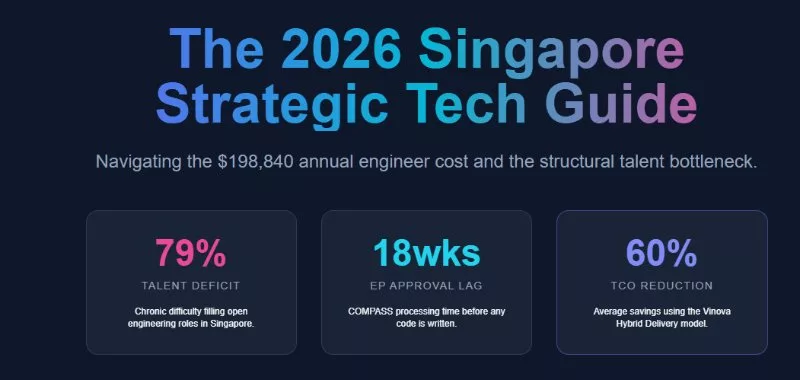
Offshore vendors love to quote the hourly rate. They rarely mention that a misaligned deliverable costs more to correct than the original development did. Onshore hiring has its own fiction: that the engineers are out there to be hired. In ManpowerGroup’s 2026 survey, 71% of Singapore employers reported difficulty filling roles.
Choosing between onshore and offshore software development is a strategic decision that affects compliance, delivery speed, and long-term cost. In Singapore’s tight talent market, rising engineering salaries and long hiring cycles have made a purely onshore plan hard to sustain. Since 2010, Vinova has delivered a hybrid model that combines Singapore-based leadership with scalable engineering teams across Hanoi, Da Nang, and Ho Chi Minh City.
The question for a Chief Technology Officer (CTO) is not onshore or offshore. It is which work belongs where, and who stays accountable for both.
Key Takeaways
- Cost: A dedicated Vinova senior developer runs SGD 5,574 to 7,933 a month, against SGD 14,371 in statutory cost for a Singapore senior engineer on a SGD 13,000 base. That is a saving of 45% to 61% a month, before recruitment fees.
- Talent: 71% of Singapore employers reported difficulty filling roles in ManpowerGroup’s 2026 survey, with engineering among the hardest skills to find. Onshore hiring alone cannot meet demand.
- Compliance: Sending personal data offshore is lawful under the Personal Data Protection Act (PDPA) when the recipient is bound by legally enforceable obligations to protect it to a comparable standard. A signed data processing agreement (DPA) is the foundation, not an afterthought.
- Governance: Offshore delivery fails without a governance layer. The hybrid model keeps architects, product owners, and compliance leads in Singapore, and puts scaled execution in dedicated Vietnam squads.
- Security: Vinova’s Vietnam delivery runs from isolated offshore development centers with Singapore-hosted virtual desktops, so no production code or customer personal data sits on local hardware.
Table of Contents
Onshore and Offshore Software Development: The Four Sourcing Models Defined
Before comparing cost and compliance, it helps to define the four models enterprises commonly use. Each offers a different balance of control, speed, and cost, which is why both belong in every sourcing strategy.
Onshore software development
Onshore means engineering talent based in Singapore, typically in the Downtown Core or the one-north innovation district. It offers synchronous, real-time collaboration and close corporate alignment. The constraint is supply: in ManpowerGroup’s 2026 survey, 71% of Singapore employers reported difficulty filling roles, and engineering ranked among the hardest skills to find. If the seat stays empty through months of recruitment, work-pass approval, and notice periods, the roadmap slips with it.
Hardest-to-Fill Skills in Singapore (ManpowerGroup 2026 Survey)
| Skill area | Share of Singapore employers reporting difficulty |
| AI model and application development | 26% |
| AI literacy | 25% |
| Engineering | 24% |
| IT and data | 17% |
For 2026, onshore capacity is essential for senior architectural leadership, regulatory governance, and stakeholder alignment. It is rarely viable as the only execution model for a large engineering program.
Offshore software development
Offshore means engineering delivery teams located across international borders in cost-efficient technology ecosystems. The historical model, in which a client hands over specifications and receives code, introduced quality risk and schedule slippage.
The 2026 offshore model has moved toward dedicated offshore development centers (ODCs) and integrated remote teams working inside shared continuous integration and continuous delivery (CI/CD) pipelines, standardized toolchains, and unified cloud environments. The risk is not the offshore model itself. The risk is offshore delivery without the governance layer that holds it to the same standard as onshore.
The Rule: offshore delivery gets the same governance as onshore, or it does not get the work.
Nearshore software development
For Singapore-based enterprises, nearshore usually means Vietnam or the Philippines. Vietnam offers three practical advantages. Its timezone (UTC+7) is one hour behind Singapore, compared with 2.5 hours for India and 5 to 7 hours for Eastern Europe. Direct flights take roughly 2 to 3.5 hours, and Singapore passport holders can enter without a visa for up to 30 days per entry. It also has a deep pool of engineering graduates and experienced developers. Together, these make real-time collaboration and on-site sprint reviews practical in a way that more distant hubs cannot match.
The hybrid model: Vinova’s onshore-offshore framework
The hybrid model resolves the trade-off by splitting the engineering hierarchy into two coordinated components.
Local governance: Project managers, solution architects, product owners, business analysts, and compliance leads are based at Vinova’s Singapore headquarters, providing direct stakeholder interface, regulatory alignment, and architectural oversight under Singapore law. They translate business mandates into written technical specifications, which is the document the offshore squad is held to.
Scaled delivery: High-volume software engineering, AI and machine learning (ML) development, test automation aligned to International Software Testing Qualifications Board (ISTQB) practice, and infrastructure operations run through Vinova’s ISO-certified delivery centers in Hanoi, Da Nang, and Ho Chi Minh City. The result is local accountability without local overhead.
Operational alignment: a one-hour timezone gap means the squad and the Singapore leads share the working day. Daily standups, live pair programming, and sprint ceremonies all run synchronously inside normal Singapore business hours, and quarterly on-site sprint reviews are a short flight away, not an expedition.
Shadow Bench Protection: every primary developer is paired with a shadow engineer who knows the same codebase and can step in mid-sprint. If the one engineer who understands the billing service resigns on a Tuesday, the sprint does not wait for a replacement to read a repository for the first time.
The Real Financials: Onshore vs. Offshore Software Development Costs in Singapore
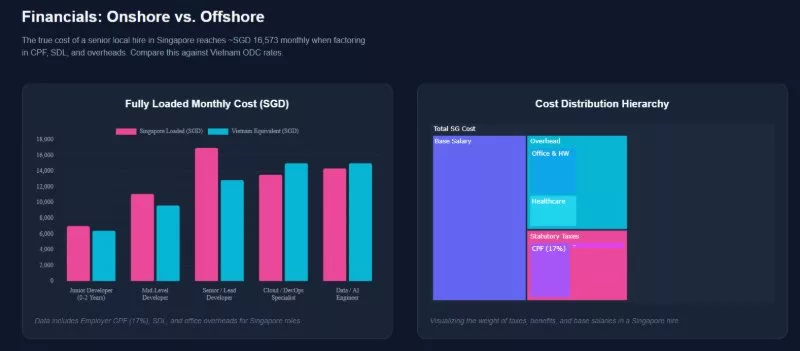
An accurate cost model looks past headline rates to the full cost of each model. The figures below use one set of stated assumptions, so every number can be traced.
The onshore cost reality
The onshore software development cost of a hire starts with base salary and adds statutory contributions. For Singapore Citizens and Permanent Residents, employers contribute 17% of ordinary wages to the Central Provident Fund (CPF), capped by the SGD 8,000 monthly ordinary wage ceiling, so employer CPF never exceeds SGD 1,360 a month. The Skills Development Levy (SDL) adds at most SGD 11.25. Benefits, hardware, office space, and recruitment fees (typically 15% to 20% of first-year base salary) come on top, and the table leaves them out, so it understates the true cost.
Onshore Monthly Cost by Role: Base Salary Plus Statutory Employer CPF (SGD)
| Role | Monthly base salary | Employer CPF | Base plus employer CPF |
| Junior developer (0 to 2 years) | 4,000 to 6,000 | 680 to 1,020 | 4,680 to 7,020 |
| Mid-level developer (2 to 5 years) | 6,500 to 9,500 | 1,105 to 1,360 | 7,605 to 10,860 |
| Senior developer / lead (5+ years) | 10,000 to 15,000 | 1,360 | 11,360 to 16,360 |
| Cloud / DevOps specialist | 8,000 to 12,000 | 1,360 | 9,360 to 13,360 |
| Data / AI systems engineer | 8,500 to 13,000 | 1,360 | 9,860 to 14,360 |
A senior cloud-native engineer on the 2026 median base of SGD 13,000 a month therefore costs SGD 14,371 a month on statutory components alone: SGD 13,000 in base salary, SGD 1,360 in employer CPF, and SGD 11.25 in SDL.
Hiring a foreign engineer adds work-pass requirements. Under the Complementarity Assessment Framework (COMPASS), an Employment Pass applicant must meet a qualifying salary of SGD 5,600 (SGD 6,200 in financial services), scaling to SGD 10,700 and SGD 11,800 for applicants aged 45 and above. These minimums rise from 1 January 2027 to SGD 6,000 and SGD 6,600, scaling to SGD 11,500 and SGD 12,700. The application must also earn 40 COMPASS points. The four foundational criteria are C1 (salary against local Professionals, Managers, Executives and Technicians (PMET) benchmarks), C2 (qualifications), C3 (company diversity), and C4 (support for local PMET employment), and two bonus criteria, C5 and C6, can add points. Plan for approval lead time before the engineer can start.
The offshore cost reality
A dedicated senior developer from Vinova’s Vietnam delivery team is priced at USD 26 to 37 per hour. At 160 productive hours a month, that is USD 4,160 to 5,920 a month, or roughly SGD 5,574 to 7,933 at an illustrative SGD 1.34 per USD. The rate is fully loaded: it covers base compensation, agency management, office infrastructure, workstation hardware, and local statutory taxes. There is no CPF, no SDL, no recruitment commission, and no work-pass wait.
Senior Developer Monthly Cost: Singapore Hire vs Vinova Dedicated Developer
| Cost line | Singapore senior hire | Vinova dedicated senior developer |
| Base salary or delivery rate | SGD 13,000 (median base) | USD 26 to 37 per hour, 160 hours: SGD 5,574 to 7,933 |
| Employer CPF | SGD 1,360 | None |
| Skills Development Levy | SGD 11.25 | None |
| Monthly cost (statutory components only) | SGD 14,371 | SGD 5,574 to 7,933 |
| Monthly saving | Not applicable | SGD 6,438 to 8,797, or 45% to 61% |
The Takeaway: The monthly saving of SGD 6,438 to 8,797 comfortably funds the Singapore-based governance layer.
A dedicated Vinova cross-functional squad of one senior developer, one mid-level developer, and a part-time QA specialist costs USD 6,500 to 9,500 a month, or roughly SGD 8,710 to 12,730. That is less than the statutory cost of one median Singapore senior hire. Across a typical corporate software development program, the saving comes from the difference in blended rates and from months of avoided vacancy.
Singapore salary benchmarks by tech stack
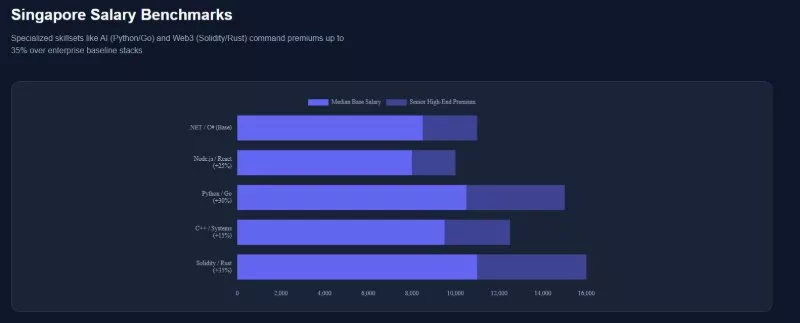
Stack choice shapes onshore cost. The table shows indicative median and senior-level monthly base salaries in Singapore for common enterprise stacks.
Indicative Monthly Base Salary by Tech Stack, Singapore 2026
| Stack | Key application domains | Median monthly base | Senior high end |
| C++ / C (systems and embedded) | Systems architecture, low-latency trading, IoT | SGD 9,500 | SGD 12,500+ |
| .NET Core / C# (enterprise) | Enterprise finance, secure transactional engines | SGD 8,500 | SGD 11,000+ |
| Node.js / React (full-stack) | Microservices, high-throughput web applications | SGD 8,000 | SGD 10,000+ |
| Python / Go (data and AI) | AI model inference, scalable event brokers | SGD 10,500 | SGD 15,000+ |
| Solidity / Rust (Web3) | Decentralized finance (DeFi), smart contracts | SGD 11,000 | SGD 16,000+ |
Three-way sourcing model comparison
The table below sets out a direct onshore offshore comparison across rate, onboarding speed, talent depth, and compliance exposure, so procurement and engineering leaders can weigh a development team location strategy against the hybrid model side by side.
Onshore vs Traditional Offshore vs the Vinova Hybrid Model
| Dimension | Onshore (Singapore) | Traditional offshore (vendor-led) | Hybrid (Vinova Singapore-Vietnam) |
| Average rate per hour | USD 51 to 85 / SGD 68 to 114 | USD 18 to 40 / SGD 24 to 54 | USD 26 to 37 / SGD 35 to 50 |
| Initial onboarding speed | Months: recruitment, work-pass approval, notice periods | 4 to 8 weeks: vendor onboarding and administrative pipeline | 2 to 4 weeks: pre-assembled cross-functional squads |
| Talent pool depth | Constrained: 71% of employers report difficulty filling roles | Broad, but quality and continuity vary by vendor | 300+ engineers across Singapore and Vietnam delivery hubs |
| Management overhead | Minimal: co-located, synchronous execution | High: requires dedicated asynchronous documentation and project management (PM) layers | Moderate to low: Singapore-based PM and architect layer |
| IP protection | Straightforward: governed entirely by Singapore law | Complex: cross-jurisdictional legal enforcement | Managed: Singapore contracting entity with local legal recourse |
| Long-term Total Cost of Ownership (TCO) risk | High: wage inflation, CPF adjustments, office footprint | High: rework costs, turnover, execution attrition | Low: scalable headcount and predictable operating rates |
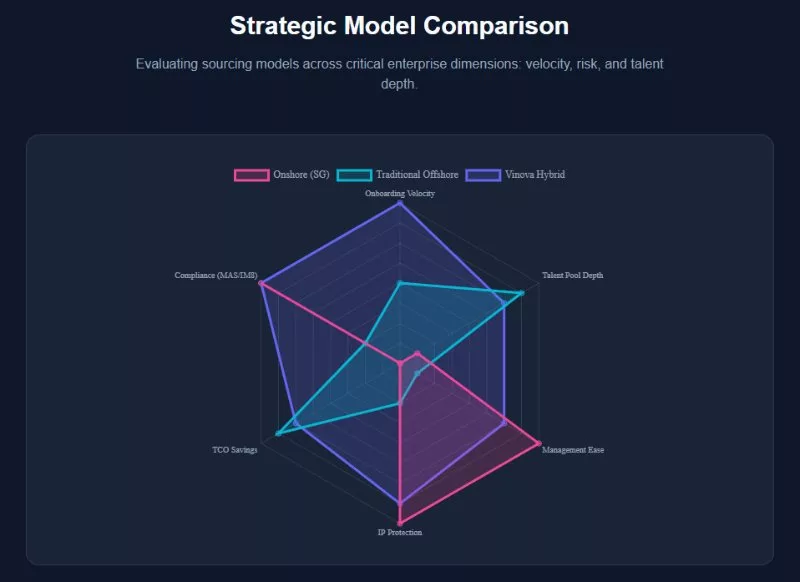
Practitioner Verdict: Onshore buys control. Traditional offshore buys rate. The hybrid model is the only column in this table built to buy both.
The Hidden Costs of Offshore Software Development: How Vinova Neutralises Them
Many financial models for offshore software development overlook the operational friction that balloons a budget. Vinova designs its delivery framework to find and contain these risks before they compound, drawing on dozens of onshore and offshore engagements.
1. Communication overhead
Offshore delivery needs more structured coordination than a co-located team. Without disciplined documentation, architectural intent is lost, and misaligned outputs cost more to correct than the original development.
Vinova’s mitigation: A mandatory 2 to 6 week Product Discovery workstream completes before any code is written. Business Analysts produce structured markdown documentation, user stories, database schema definitions, API contract specifications, and clearly defined acceptance criteria.
These deliverables are managed in tools such as Jira, Slack, and GitHub so that every stakeholder sees the same record. Offshore squads begin execution on day one with a clear architectural mandate and documented requirements, not verbal instructions.
2. Quality control and rework costs
When cross-border teams commit code without synchronized integration environments, semantic misalignments between services cause system failures. Resolving defects after commit consumes more engineering hours than the original build.
Vinova’s mitigation: Every code commit triggers an automated CI pipeline that runs unit tests, Static Application Security Testing (SAST) scans, and TypeScript schema verification in parallel. Vinova has been an ISTQB Partner since 2023.
Blue-green deployment pipelines are designed for zero-downtime production updates. Vinova’s proprietary Agentic AI Framework runs inside the CI/CD pipeline to analyze test failures and suggest code fixes, helping QA engineers triage faster.
3. The ticket-punching mindset
Traditional offshore models can produce developers who build exactly what a Jira ticket says, even when the logic contains an obvious inefficiency or architectural flaw. That transactional approach limits the proactive problem-solving that separates software as a living product from software as a deliverable.
Vinova’s mitigation: Vinova works under a “Software as an Evolving Asset” philosophy. Dedicated squads of 20 to 30+ engineers stay on a platform for two to three years or more across multi-year engagements. That continuity lets engineers build deep architectural knowledge, which supports proactive technical debt refactoring, API schema optimization, and platform-level improvement rather than ticket execution.
Inside an Isolated ODC: Four Security Layers Between Your Source Code and a Leak
Most providers of onshore and offshore software development describe their security as “ISO certified” and leave it there. A certificate says a process exists. It does not say whether a developer’s personal Gmail is reachable from the machine holding your source code.
Vinova’s Vietnam ODC facilities, audited and deployed for a Singapore utility group’s digital arm and operated under GovTech Category 1B contracts, are purpose-built, segregated environments, not shared co-working space. Each one stacks four layers of control.
The Four Security Layers of a Vinova Isolated ODC
| Layer | Controls | What It Stops |
| Layer 1: Governance and Vetting (The Foundation) | Independently audited ISO/IEC 27001:2022 Information Security Management System (ISMS) and ISO 9001:2015 quality certification. Mandatory background checks and security onboarding. Individual, legally binding NDAs signed directly between each dedicated offshore engineer and the customer. | Anonymous contributors, and confidentiality that exists only as a verbal assurance |
| Layer 2: Physical Security (The Fortress) | Dedicated, physically segregated project rooms: three dedicated ODC rooms in the Ho Chi Minh City office with capacity for 50+ workstations. Biometric fingerprint door readers, with access logs kept for 12 months. 24/7 CCTV with footage stored for at least 90 days and monthly video logs uploaded to customer cloud storage. | Tailgating, shared-room exposure, and incident claims nobody can verify |
| Layer 3: Network Security and Data Leak Prevention (The Moat) | A fully segregated network behind enterprise-grade firewalls, isolating client development traffic from Vinova’s general internal operations. Permanent network-level blocks on personal webmail (Gmail, Yahoo) and personal cloud storage (Google Drive, Dropbox) on every project machine. | Exfiltration by email attachment or file upload |
| Layer 4: Endpoint Security (The Guards) | Full-disk workstation encryption. USB ports, Bluetooth, and external storage peripherals permanently disabled through hardware and operating system policy. | A lost laptop or a thumb drive walking out of the room |
The layers are cumulative on purpose. If a project machine can reach personal webmail, the strongest firewall in the building is only as good as one developer’s Friday-afternoon shortcut. If USB ports stay enabled, full-disk encryption protects the laptop and nothing else.
Cross-Border Compliance: Where PDPA Section 26 Meets Singapore-Hosted Desktops
Cross-border data rules decide whether onshore and offshore software development can run as one program. Offshore engineers reach client source code and test environments exclusively through Virtual Desktop Infrastructure (VDI) hosted in Singapore cloud zones, such as Amazon Web Services (AWS) ap-southeast-1 or Google Cloud’s Singapore region. No production code or customer personally identifiable information (PII) resides on local Vietnam hardware. The data never crosses the border, because only the screen does.
Before project kickoff, Vinova also executes a formal DPA incorporating the ASEAN Model Contractual Clauses (MCCs). That gives the arrangement legally enforceable cross-border protection and supports the Transfer Limitation Obligation under Section 26 of the PDPA, as well as the third-party access expectations in the MAS TRM guidelines.
Practitioner Verdict: a certificate describes a process. A blocked webmail domain, a disabled USB port, and a 12-month door log describe a building you can audit.
The Honest Decision Matrix: When to Choose Onshore vs. Offshore Software Development
Choosing between onshore and offshore software development is rarely a binary call. It depends on how mature the requirements are, how sensitive the data is, and how fast the business strategy is still moving. The three scenarios below show when each software development location model, including the hybrid option, fits best.
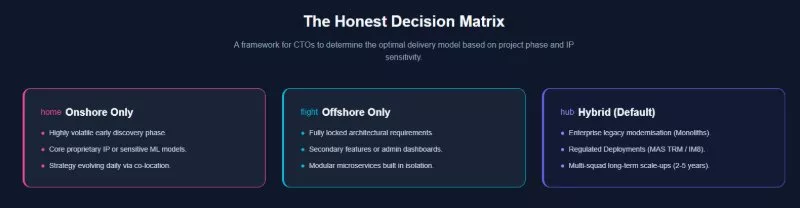
Choose onshore software development when
Onshore is not about proximity. It is about the phase of the work. These are the conditions where offshore adds more friction than it removes:
- The product concept is volatile and needs daily physical iteration: early-stage discovery, where requirements change faster than documentation can capture them.
- Core proprietary IP, sensitive ML models, or trade secrets are involved, and the data transfer risk outweighs the cost efficiency.
- Business strategy is evolving quickly enough that co-location is the only sufficient communication model.
Choose offshore software development when
Requirements are locked, architecture is defined, and the work is execution, not exploration. This is where offshore delivers without qualification:
- Requirements are fully documented: database schemas, API contracts, and acceptance criteria are signed off before development begins.
- The objective is scaling an established product stack: secondary features, integration middleware, or administrative dashboards where the architectural patterns are already set.
- Modular microservices or batch processing pipelines with clear interfaces can be built in isolation and integrated through automated pipelines.
Choose the hybrid model when
This is Vinova’s recommended model for enterprise programs because it combines governance with delivery speed. Neither pure onshore nor pure offshore delivers both, which is why an onshore and offshore software development model often outperforms either option alone.
- Enterprise legacy modernization: Monolithic systems being decomposed into cloud-native microservices need local architectural design paired with high-volume offshore execution squads.
- Monetary Authority of Singapore (MAS) Technology Risk Management (TRM) or IM8 regulated deployments: Fintech and public sector integrations need a Singapore-based compliance and architectural presence to carry governance obligations that cannot be delegated offshore.
- Multi-squad long-term scaling: An enterprise adding dozens of engineers needs architectural consistency and local account governance across a two to five year horizon.
Risk Mitigation: How to Vet an Offshore Software Development Partner
Before signing with any offshore software development provider, enterprise technology procurement leads should run multi-layered due diligence. Marketing materials and high-level case studies are not enough.
1. Verifiable client references
Ask for direct access to current and past enterprise clients in Singapore or APAC, and ask specific questions. Did the partner consistently meet sprint commitments? How was developer attrition handled mid-project? How did the team coordinate complex integration phases with internal technology leads? References who cannot answer these questions specifically have not run a real enterprise engagement.
2. Source code and codebase audit
Run independent static analysis on a representative codebase. Evaluate maintainability, technical debt ratios, and security vulnerability profiles. Review backend service structure, dependency injection patterns, and database migration schemas. Verify test suite coverage: a partner who cannot show comprehensive, maintainable test coverage has not operated at enterprise quality.
3. Asynchronous documentation review
Request a walkthrough of live Jira or Linear project boards. Verify that tasks are specified with dependencies mapped and blockers documented. Review past API documentation for endpoint clarity, payload schema definitions, and error code coverage. Assess the written English of technical leads and business analysts, because complex multi-phase integrations fail when architectural decisions cannot be communicated precisely in writing.
4. PDPA compliance and data security verification
Section 26 of Singapore’s PDPA (the Transfer Limitation Obligation) requires an organization that transfers personal data outside Singapore to ensure the recipient is bound by legally enforceable obligations to protect it to a standard comparable to the PDPA. A contract, binding corporate rules, or another binding instrument can provide that. A signed DPA is the usual mechanism, and it should cover purpose limitation, security controls, retention and deletion, sub-processor consent, and audit rights.
PDPA Financial Penalties for Intentional or Negligent Breaches
| Organization | Maximum financial penalty |
| Annual turnover in Singapore above SGD 10 million | Up to 10% of annual turnover in Singapore |
| All other organizations | Up to SGD 1 million per breach |
Vinova executes DPAs that incorporate the ASEAN MCCs and zero-retention clauses before any system enters a development environment.
Verify active, independently audited ISO 9001:2015 and ISO/IEC 27001:2022 certifications, not self-declared ones. For regulated financial institutions, MAS expects tight control of third-party access, including encryption, multi-factor authentication for privileged environments, and secure, isolated code repositories, in line with its Technology Risk Management Guidelines. For public sector work, GovTech’s IM8 framework sets the security and ICT management controls. Vinova’s controls are validated in production delivery for regulated financial institutions and public sector agencies, and Vinova is a GovTech Category 1B approved partner.
5. Milestone-gated trial project
No enterprise should commit to a long-term Master Services Agreement without testing delivery performance. Vinova’s Minimum Viable Product (MVP) Validation Framework deploys a fully functional proof of concept within 8 to 12 weeks, for SGD 40,000 to SGD 190,000. It validates architectural integrations and delivery velocity against your real systems before a full-program budget is committed.
Vinova’s Onshore and Offshore Software Development Track Record
Government agencies, regulated financial institutions, and global enterprises have relied on Vinova’s hybrid model for complex, compliance-sensitive projects across 16 years of onshore and offshore delivery. As one of the established technology companies in Singapore, Vinova delivers custom software development Singapore enterprises rely on for regulated, high-availability platforms, alongside managed IT services Singapore organizations use to run day-to-day operations. Its applied AI practice sits among the AI companies in Singapore, and its mobile teams build cross-platform products as a hybrid app development company, alongside work for enterprise clients as one of the app development companies in Singapore. Client names are withheld, and details are available under NDA.
Global maritime shipping group: legacy platform modernization
- Challenge: Modernize a fragmented custom Enterprise Resource Planning (ERP) platform for a global maritime shipping group, spanning 20+ operational modules integrated with live vessel tracking databases, without interrupting global shipping operations.
- Approach: The Strangler Fig pattern: cloud-native microservices built progressively around the legacy monolith, routing traffic transparently through event-driven Kafka pipelines while the legacy monolith was decomposed incrementally with no operational downtime. Real-time data stays synchronized through Apache Kafka, Debezium Change Data Capture (CDC), and dbt.
- Delivery structure: A dedicated offshore squad of 30+ engineers maintained the platform continuously for more than three years. A rigorous Product Discovery phase and functional scoping up front de-risked mid-project deviations, which is where long programs usually bleed budget.
- The Result: Development and system integration velocity rose by 60%. The less visible result was continuity: squad knowledge outlasted individual hires, so institutional knowledge became a risk-mitigation asset instead of a recurring onboarding cost. If a 20-module platform loses its experts every year, the ticket backlog quietly becomes the architecture.
Singapore financial markets operator: high-throughput data pipelines
- Challenge: Transaction immutability, sub-100ms processing consistency, and full adherence to MAS Technology Risk Management guidelines.
- Approach: Dedicated squads of 20 to 30+ engineers building high-throughput financial data pipelines, using Debezium CDC streaming into Apache Kafka and pgvector-enabled PostgreSQL.
Singapore public sector: multi-agency governance, risk, and compliance (GRC) platform
- Challenge: An automated risk assessment engine across multiple government agencies under IM8 security and GeBIZ procurement standards.
- Approach: Custom ServiceNow IRM integration with native business rules, workflow designers, and REST API connections, enabling agencies to shift compliance left into their development cycles.
National intellectual property office: digital workbench
- Challenge: Enable patent examiners to work with complex patent datasets through secure, custom data visualizations.
Luxury automotive experience center: back-office workflow management
- Challenge: Back-office workflow management for a new flagship experience center in Singapore.
- Architecture decision: After evaluating the requirements, Vinova recommended against custom development and implemented Odoo Enterprise instead: the right technology for the requirement, not the most expensive one.
Singapore utility group’s digital arm: zero-defect deployment path
- Challenge: A zero-defect deployment path for core utility-sector platforms under strict data sovereignty requirements.
- Approach: A shift-left quality philosophy and V-Model testing applied across all delivery phases.
Reported Outcomes by Engagement
| Engagement | Reported outcome |
| Global maritime shipping group | 60% increase in development and system integration velocity, zero operational downtime throughout the migration, and a 30+ engineer squad retained for over three years |
| Singapore financial markets operator | Platform built to MAS TRM guidelines, with squads maintained across a multi-year dedicated engagement |
| Singapore public sector GRC platform | Multiple agencies moved from reactive, audit-driven compliance to automated risk assessment built into engineering pipelines |
| National intellectual property office | Patent examination workflows digitized under national IP confidentiality standards, operating at scale across the examination division |
| Luxury automotive experience center | 100% workflow fit achieved, with the client’s budget preserved |
| Singapore utility group’s digital arm | Zero-defect deployment, a long-term dedicated squad retainer, and data sovereignty compliance maintained throughout |

Structure Your Engineering Delivery with Vinova
Book a complimentary 2-hour consultation with Vinova’s Singapore-based team. We will map your current onshore and offshore mix, identify your highest-cost friction points, and design a hybrid delivery model that satisfies Singapore’s compliance requirements. No commitment required.
Schedule Your Free 2-Hour Engineering Delivery Consultation with Vinova →
Onshore and Offshore Software Development FAQs
What is the true cost difference between onshore and offshore delivery when management overhead is included?
Overhead narrows the gap but does not close it. Offshore delivery needs more structured documentation and coordination than a co-located team, so budget for a discovery phase and a Singapore-based project manager explicitly.
On the figures in this guide, a median Singapore senior hire costs SGD 14,371 a month on statutory components alone, while a dedicated Vinova senior developer costs SGD 5,574 to 7,933. The monthly saving of SGD 6,438 to 8,797 comfortably funds the governance layer. A full cross-functional squad (one senior developer, one mid-level developer, and a part-time QA specialist) runs USD 6,500 to 9,500 a month, roughly SGD 8,710 to 12,730, which is less than one median senior hire in Singapore.
What are the primary PDPA and MAS TRM compliance risks when offshoring from Singapore?
The primary risk is breaching the Transfer Limitation Obligation in Section 26 of the PDPA. Personal data sent offshore without a legally enforceable arrangement that provides comparable protection exposes the organization to financial penalties of up to 10% of annual Singapore turnover (for organizations above SGD 10 million) or up to SGD 1 million per breach.
For MAS-regulated entities, the Technology Risk Management Guidelines add expectations on third-party oversight, incident response, and audit rights. Vinova mitigates these through three controls: a comprehensive DPA with zero-retention clauses executed before any system enters offshore environments; Singapore-hosted VDI that prevents local data storage on offshore endpoints; and active, independently audited ISO 9001:2015 and ISO/IEC 27001:2022 certifications.
When should a Singapore startup choose offshore software development over onshore?
Three conditions mark the right moment. The first is Series A or institutional funding, when the startup must scale its product roadmap without burning runway on Singapore-grade engineering salaries. The second is product-market fit validation: once the core concept is proven, continuous capacity is needed for secondary features, API integrations, and system optimization.
The third is specialized skills access, when roles such as React Native developers, cloud infrastructure architects, or AI engineers are unavailable locally or unaffordable at the quantity required. Until these conditions are met, and while requirements still change weekly, keep the core team onshore where communication bandwidth is highest. Once they are met, a dedicated offshore development center (ODC) model is the capital-efficient path to scale.
How does nearshore development in Vietnam compare to traditional offshore hubs?
Vietnam’s advantage for Singapore enterprises comes from three factors. Timezone: UTC+7 is one hour behind Singapore, which allows real-time daily standups across the Singapore business day. India is 2.5 hours behind, and Eastern Europe is 5 to 7 hours behind. Physical access: Ho Chi Minh City is roughly a 2-hour direct flight from Changi, Hanoi roughly 3.5 hours, and Singapore passport holders can enter visa-free for up to 30 days per entry, which makes quarterly on-site sprint integration practical.
Continuity: Vinova’s delivery teams run at 8% to 12% annual voluntary attrition, so architectural knowledge stays in the team across multi-year engagements.
What are the most common mistakes when structuring a hybrid onshore-offshore team model?
Unclear component boundaries: Placing onshore and offshore teams on highly interdependent tasks without explicit interface definitions creates integration bottlenecks and slows deployment pipelines.
Synchronous-first communication: Assuming the offshore team can work from verbal instructions and ad hoc meetings. Without structured asynchronous documentation, architectural intent is consistently lost.
No automated integration testing: Letting offshore developers commit to core repositories without automated testing pipelines creates regression cycles that cost more to fix than the original feature.
Treating the offshore team as a ticket executor: Managing the squad as isolated coders rather than collaborative product engineers limits proactive problem-solving and compounds technical debt over multi-year engagements.
Onshore and Offshore Software Development, Resolved: Governance Onshore, Scale Offshore
Onshore and offshore software development each solve a different problem. One prioritizes proximity and control, and the other provides scale and cost efficiency. For most Singapore enterprises, the hybrid model delivers the benefits of both, without the compliance risk of fully offshore delivery or the cost ceiling of a fully onshore team. Vinova’s version of it is built around accountability:
- Fiduciary Governance & Regulatory Alignment: Delivery operations certified under ISO/IEC 27001:2022 (Information Security) and ISO 9001:2015 (Quality Management) and GovTech Category 1B approved, with architectures designed to align with MAS TRM, IM8, and PDPA requirements.
- Singapore Corporate Governance: Master Services Agreements governed under Singapore law with Singapore International Arbitration Centre (SIAC) arbitration, so intellectual property ownership and accountability are defined before the first commit.
- Hybrid Delivery Practice: Singapore-based architects, product owners, and compliance leads paired with dedicated Vietnam delivery squads, so the people who design the system stay accountable for how it is built.
- Engineering Depth: 300+ in-house engineers across Singapore and Vietnam delivery hubs in Ho Chi Minh City, Da Nang, and Hanoi, with 8% to 12% annual voluntary attrition, so the people who build your platform are still there to run it.
Ready to structure your delivery model? Talk to a Vinova engineering lead, explore Vinova’s dedicated offshore development center service, or browse the full range of Vinova services.
Vinova: a Singaporean Government-Grade Digital Transformation Partner, Made Accessible. For 16 years, we have designed digital systems for 300+ companies and government agencies worldwide, backed by ISO 27001:2022 and ISO 9001:2015 certification and Singapore GovTech Category 1B approval.
300+ employees across offices in Singapore, Vietnam (Hanoi, Da Nang, Ho Chi Minh City), Norway (Oslo), and Thailand (Bangkok), scaling platforms and engineering capacity to serve clients across the globe. Financial Times Top 500 High-Growth Companies Asia-Pacific 2026. Recognized among Singapore’s Top 100 Fastest-Growing Companies in 2024, 2025, and 2026.