In 2026, Ruby is still a top-notch choice for web app development.
Your project’s Gemfile is its architectural blueprint. This ruby on rails gems list is Vinova’s opinionated, enterprise-tested reference for 2026: what still matters, what Rails 8 has replaced natively, and what to reach for when the native default isn’t enough. Drawn from 16+ years and 300+ delivered applications across regulated and high-scale enterprise environments.
Rails 8’s zero-dependency defaults (Solid Queue, Solid Cache, Solid Cable, Kamal, native auth) eliminate real infrastructure overhead for standard apps. Enterprise-scale requirements still demand a handful of battle-tested ruby on rails gems, the skill is knowing exactly which ones, and when the native default genuinely stops being enough.
Table of Contents
Key Takeaways:
- Default to Native First: Leverage Rails 8 native features—such as Solid Queue, Solid Cache, and native authentication—as your baseline; only introduce third-party dependencies like Sidekiq or Devise when performance metrics or specific complex requirements (e.g., OAuth2, SAML) confirm the native solution has hit its limit.
- Prioritize Hotwire: Standardize on the Hotwire stack (Turbo and Stimulus) for most enterprise CRUD and dashboard interfaces, as it delivers a responsive experience without the maintenance overhead of a separate frontend framework, unless the project has genuine needs for complex client-side state management.
- Non-Negotiable Security Baseline: Establish a firm quality foundation using tools like Brakeman, bundler-audit, and Rubocop; these are critical for ensuring team consistency and meeting enterprise-grade security and compliance (VAPT) standards before feature work begins.
- Justify Dependencies with Evidence: Avoid adding third-party gems based on “assumed future needs,” which often creates unnecessary technical debt; instead, wait until load testing or specific compliance constraints provide clear evidence that a specialized tool is necessary.
Rails 8 Native vs. Third-Party: What Changed
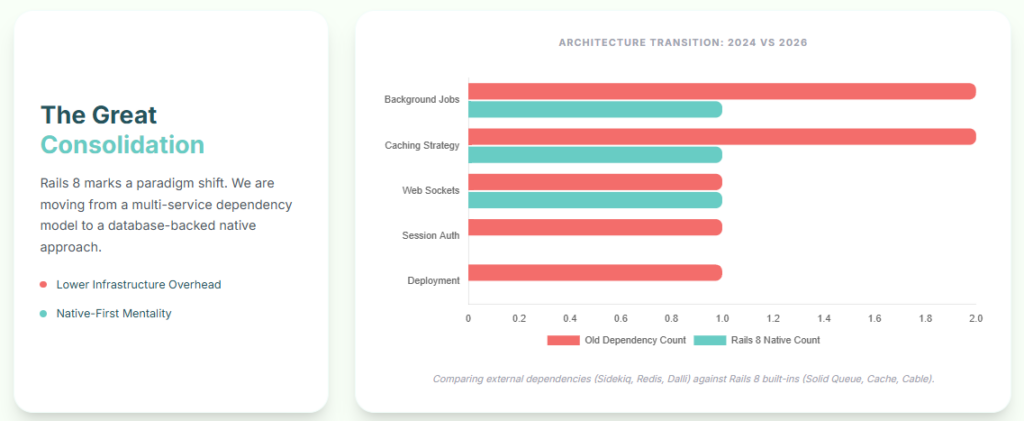
Rails 8 replaced several external dependencies with database-backed built-ins, and for most standard apps, that’s a genuine infrastructure win: one less service to provision, monitor, and secure. The third-party ruby on rails gems on this list still earn their place under specific load or compliance conditions, so the decision isn’t “native is always better,” it’s “native until you hit a measured limit it can’t clear”:
| Domain | Old Gem (2025 and earlier) | Rails 8 Native (2026) | When You Still Need the Gem |
| Background jobs | sidekiq + Redis | solid_queue | Sub-second latency, ultra-high throughput |
| Caching | Redis / dalli | solid_cache | Distributed low-latency caching at scale |
| WebSockets | Redis (Action Cable) | solid_cable | Massive concurrent real-time scaling |
| Authentication | devise or rodauth | rails generate authentication | OAuth2, SAML/SSO, WebAuthn, MFA |
| Deployment | capistrano | kamal | Legacy bare-metal, complex multi-server |
Solid Queue and Solid Cache work by leaning on modern NVMe-backed Postgres or MySQL, fast enough that Redis stops being a mandatory dependency for job queuing and caching at small-to-medium scale. That threshold is real, though: high-concurrency systems, live event booking, real-time transaction platforms, still hit Sidekiq/Redis’s ceiling before Solid Queue’s, because DB-backed queuing pays a write-contention cost under sustained parallel load that a dedicated in-memory queue doesn’t.
Authentication follows a sharper line, not a gradual one. Rails 8’s native generator produces clean, hashed-password session code, genuinely sufficient for a simple email/password app with zero extra dependencies. The moment OAuth2, SAML/SSO, WebAuthn, or MFA enters scope, which is most enterprise identity integration, the native generator simply doesn’t cover it; there’s no scaling up from it; you’re on Devise or Rodauth from day one.
Vinova’s rule of thumb: start native, measure, then justify the gem. A third-party dependency added because of an assumed future need is technical debt before it’s even written; one added because solid_queue’s write-contention showed up in load testing is an engineering decision with evidence behind it.
File Storage, Search, and Admin: Quick Picks
The remaining ruby on rails gems list entries most enterprise builds need, condensed to a straight recommendation:
| Feature | Active Storage | CarrierWave | Shrine |
| Flexibility | Moderate (opinionated) | High (traditional) | Highest (plugin-based) |
| Best for | Standard attachments | Legacy maintenance | Compliance-heavy workflows |
Pick Shrine over Active Storage the moment you need direct-to-S3 signed uploads, tokenised access, or multi-bucket isolation for compliance-sensitive data. Otherwise, Active Storage’s Rails-native defaults are enough.
Pair Ransack with pg_search for structured filters plus full-text search without standing up an external Elasticsearch cluster:
| @q = Course.ransack(params[:q]) # structured filters@courses = @q.result.merge(Course.fuzzy_search(params[:search_term])) # full-text |
Default to Administrate for admin dashboards: standard Rails views are easier to customise than Active Admin’s DSL once a dashboard needs to diverge from generated CRUD.
The Complete 2026 Ruby on Rails Gems Checklist
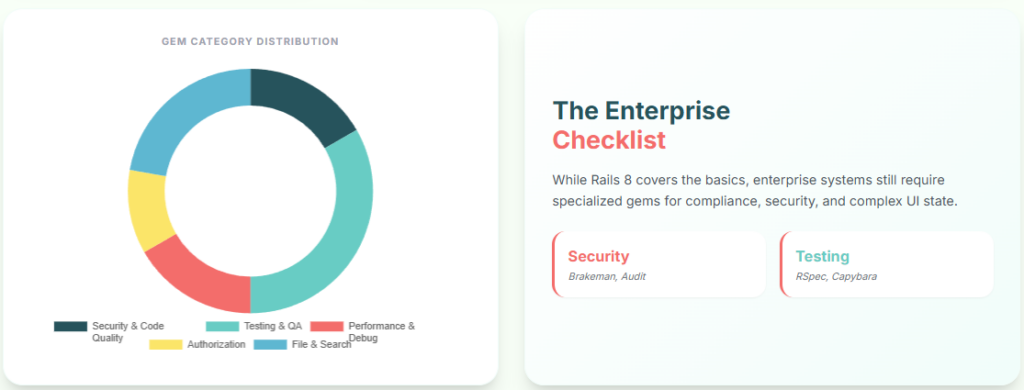
This is the reference. Every gem Vinova reaches for on an enterprise Rails build, organised by category, with what it does and when it earns its place in your Gemfile:
Code quality and security
| Gem | What It Does | Why / When |
| rubocop / rubocop-rails | Style and consistency enforcement | Every project, every commit, non-negotiable on distributed teams |
| brakeman | Static security analysis (SQLi, XSS, mass-assignment) | Required for VAPT sign-off on any regulated or public-facing build |
| bundler-audit | Scans Gemfile.lock against CVE databases | Every CI build, catches vulnerable dependencies before merge |
Testing and QA
| Gem | What It Does | Why / When |
| rspec-rails | BDD testing framework | Default test framework for enterprise Rails |
| factory_bot_rails + faker | Randomised, isolated test data generation | Avoids fixture bloat and brittle hardcoded test data |
| capybara | End-to-end browser interaction simulation | Critical user journeys: checkout, registration, multi-step forms |
| shoulda-matchers | One-liner validation and association assertions | Keeps Active Record spec files short and readable |
| timecop | Freezes or shifts time during tests | Time-sensitive logic: renewals, scheduled compliance windows |
| simplecov | Code coverage tracking | Vinova enforces an 80% minimum on every enterprise project |
Authorization
| Gem | What It Does | Why / When |
| pundit | Explicit, per-resource policy objects | Vinova’s standard for enterprise RBAC; scales cleanly with role complexity |
| cancancan | Single ability.rb permission file | Fine for small apps; becomes a liability at enterprise scale |
Performance and debugging
| Gem | What It Does | Why / When |
| bullet | Flags N+1 queries and unused eager loads | Dev and test environments, standard in every CI pipeline |
| pry-rails / debug | Interactive runtime debugging | Local development, inspecting state mid-execution |
| rack-mini-profiler | Per-page speed badge: SQL time, render time, memory | Diagnosing performance regressions before they hit production |
Utilities
| Gem | What It Does | Why / When |
| pagy | Ultra-fast, low-memory pagination | Default choice over kaminari or will_paginate |
| friendly_id | Human-readable, SEO-friendly URL slugs | Any public-facing or e-commerce route structure |
Background jobs, caching, and real-time
| Gem | What It Does | Why / When |
| solid_queue | DB-backed background jobs, Rails 8 default | Standard operational apps; removes Redis as a dependency |
| sidekiq + Redis | High-throughput background job processing | High-concurrency systems with sub-second latency requirements |
| solid_cache | DB-backed caching, Rails 8 default | Standard caching needs without a Redis cluster |
| solid_cable | DB-backed Action Cable, Rails 8 default | Standard WebSocket needs |
| Redis (Action Cable) | Distributed real-time pub/sub | Massive concurrent subscriber scaling: live feeds, chat |
Authentication and deployment
| Gem | What It Does | Why / When |
| rails generate authentication | Native password-hashed session auth, Rails 8 built-in | Simple email/password apps, zero extra dependencies |
| devise / rodauth | Full-featured authentication framework | OAuth2, SAML/SSO, WebAuthn, MFA, or enterprise SSO integration |
| kamal | Zero-downtime containerised deployment, Rails 8 built-in | Cloud-agnostic deployment across AWS, GCP, or bare metal |
File management, search, and admin
| Gem | What It Does | Why / When |
| shrine | Plugin-based file upload toolkit | Compliance-sensitive storage: signed URLs, multi-bucket isolation |
| ransack | Structured search form builder | Filtering by date range, status, category dropdowns |
| pg_search | PostgreSQL native full-text search | Free-text search without standing up Elasticsearch |
| administrate | Admin dashboard generator, standard Rails views | Vinova’s default; easier to customise than Active Admin’s DSL |
Frontend: Hotwire and reactive UI
Rails 8’s default frontend stance is Hotwire-first: server-rendered HTML with just enough JavaScript to feel like a SPA, without shipping a separate frontend build pipeline.
| Gem | What It Does | Why / When |
| turbo-rails | Page acceleration and partial-page updates without full reloads | Rails 8 default; covers most CRUD-heavy enterprise UIs out of the box |
| stimulus-rails | Lightweight JS controllers for sprinkling in interactivity | Pairs with Turbo for forms, modals, and dynamic UI without a full SPA framework |
| view_component | Encapsulated, testable server-rendered UI components | Design systems and reusable UI at enterprise scale, replaces partial sprawl |
| cssbundling-rails / tailwindcss-rails | Modern CSS build pipeline integration | Tailwind or utility-first CSS without leaving the Rails asset pipeline |
Reach past Hotwire into a full frontend framework (React, Vue) only when the UI genuinely needs client-side state management a page-acceleration model can’t give you, a real-time collaborative editor, for instance, not a dashboard with a few dynamic widgets. Most enterprise admin and operational UIs don’t need it, and the Hotwire stack is materially cheaper to build and maintain when they don’t.
API and serialization
Rails-as-API-backend is standard in 2026, whether serving a mobile app, a separate frontend, or third-party integrations. Raw as_json calls in the model layer don’t scale past a handful of endpoints.
| Gem | What It Does | Why / When |
| jsonapi-serializer | Fast, spec-compliant JSON:API serialization | Public or partner-facing APIs where a consistent, documented response shape matters |
| blueprinter | Explicit, view-like Ruby DSL for JSON serialization | Internal APIs where JSON:API’s spec overhead isn’t needed, faster to write and read |
| rswag / rspec-openapi | Generates OpenAPI/Swagger docs from request specs | Any API with external consumers who need current, trustworthy documentation |
| rack-cors | Cross-Origin Resource Sharing configuration | API consumed by a separate frontend domain or mobile app |
Image and file processing
| Gem | What It Does | Why / When |
| image_processing + ruby-vips | Fast image variant generation (resize, crop, format conversion) | Paired with Active Storage or Shrine for any user-uploaded imagery |
| image_optim | Lossless image compression pipeline | Reducing storage cost and page weight on media-heavy platforms |
| Build Your Rails App Right with Vinova Book a complimentary 2-hour architecture consultation with Vinova’s Singapore-based engineering team. We’ll review your Gemfile, flag security or performance gaps, and scope a delivery plan aligned to enterprise compliance requirements. No commitment required. Schedule Your Free 2-Hour Rails Architecture Consultation with Vinova |
Ruby on Rails Gems FAQ
Do I still need gems like Devise or Sidekiq now that Rails 8 has native equivalents?
Only once you hit the specific limit of the native option. Rails 8’s built-in auth is genuinely sufficient for simple email/password apps; it doesn’t cover OAuth2, SAML/SSO, WebAuthn, or MFA, which is most enterprise identity integration. Same logic for solid_queue versus Sidekiq: default to native, move to Sidekiq/Redis only once you have a measured throughput or latency problem it can’t solve. Both remain essential ruby on rails gems for the enterprises that genuinely need them, not defaults to reach for out of habit.
What’s the most important gem on this list for a security-sensitive enterprise project?
Brakeman. It’s the one gem that directly determines whether a Rails app passes VAPT review, a hard gate for public sector and financial services work, not a nice-to-have. Paired with bundler-audit for dependency CVE scanning and rubocop for team consistency, these three form the non-negotiable baseline before any feature work begins.
Pundit or CanCanCan for authorization?
Pundit for anything beyond a small app. CanCanCan’s single ability.rb file is convenient early, but becomes a monolithic liability once a platform has multiple stakeholder types and resource-specific permissions, which describes most enterprise multi-tenant portals. Pundit’s per-resource policy objects cost more setup time but stay maintainable as the permission model grows.
Shrine or Active Storage for file uploads?
Active Storage by default; it’s built into Rails and covers standard attachments. Move to Shrine once uploads need background processing, direct-to-S3 signed URLs, tokenised access, or multi-bucket isolation, typically compliance-sensitive document workflows. The decision is about workflow complexity, not gem popularity.
Ransack and pg_search, or an external search engine?
Ransack plus pg_search covers most enterprise Rails search needs without the operational overhead of running and securing an external cluster. An engine like Elasticsearch only earns its cost once search volume or complexity (typo tolerance at scale, faceted search across millions of records) genuinely exceeds what PostgreSQL’s native full-text search can handle efficiently.
Should a 2026 Rails app use Hotwire or a full frontend framework like React?
Hotwire (Turbo plus Stimulus) by default. It’s the Rails 8 native stance, and it covers the large majority of enterprise CRUD, dashboard, and form-heavy interfaces without the cost of maintaining a separate frontend build and API layer. Reach for React or Vue when the UI genuinely needs client-side state a page-acceleration model can’t provide, real-time collaborative editing, complex client-side data visualisation with heavy interaction, not because a dashboard has a few dynamic widgets. Most projects that reach for a full SPA framework by default are paying ongoing complexity cost for a requirement they don’t actually have.
| Vinova: Singapore’s Ruby on Rails and enterprise software engineering partner since 2010. ISO 27001:2022 and ISO 9001:2015 certified. PDPA and GovTech IM8 compliant. 300+ in-house engineers across Singapore, Hanoi, Da Nang, and Ho Chi Minh City. Rails platform clients include MAS, GovTech, SP Group, IPOS International, SILE, e2i, SIT, and Porsche/PEC+. Financial Times Top 500 High-Growth Companies Asia-Pacific 2026. The Straits Times Singapore’s Fastest-Growing Companies 2024, 2025, and 2026. Explore Vinova’s software engineering services. |