Table of Contents
The “Translation-First” Localization Myth
Most teams planning an international launch treat localization as a copy problem: translate the strings, swap the currency symbol, ship it. On paper this looks like a straightforward plug-and-play exercise. In practice, it’s where most teams discover that translating words accounts for less than 20% of what actually makes an app localized.
The remaining 80% is functional localization: local payment rails, national identity systems, address formats, data privacy law, regional UI conventions, and cultural expectations that have nothing to do with which language the buttons are in. An app that forces a local user through a foreign-shaped address form, or limits checkout to a payment method nobody in that market actually uses, will bleed conversion regardless of how fluent the copy is.
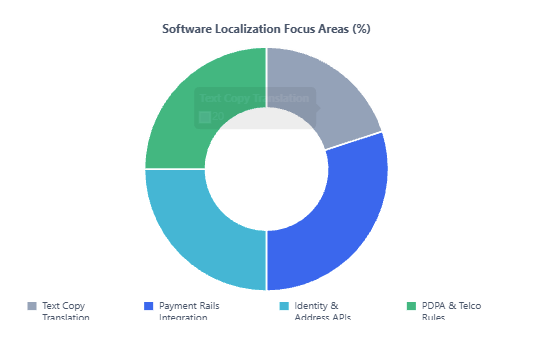
This is what genuinely comprehensive mobile application localization services need to cover — and what separates a translated app from a truly localized one.
What Mobile Application Localization Services Actually Include
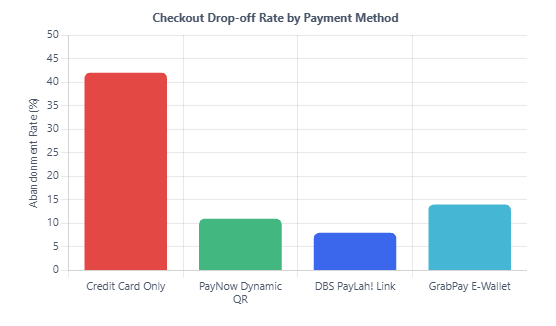
Every market has its own version of these categories. The categories themselves are universal:
- Local payment & financial rail integration. Credit card forms alone leave money on the table almost everywhere. Singapore has PayNow; India has UPI; Brazil has PIX; China has Alipay and WeChat Pay; the Netherlands has iDEAL. A localized app meets users on the rails they already use daily, not the ones that are easiest to integrate first.
- National identity & KYC systems. Many markets now have a sovereign digital identity layer — Singapore’s Singpass, India’s Aadhaar, the EU’s eIDAS — that lets users authenticate and pre-fill verified data in seconds instead of typing it manually. Ignoring it means building the slow way, on purpose.
- Address & geographic data formats. “Address Line 1, Address Line 2, City, State, ZIP” is a distinctly American shape. Singapore identifies a specific building with a 6-digit postal code and nothing else; Japan’s addressing logic runs block-first rather than street-first; plenty of markets have no formal postal code system at all. Forcing every market through one form schema guarantees friction somewhere.
- Data privacy & regulatory compliance. PDPA in Singapore, GDPR in the EU, CCPA in California, LGPD in Brazil — each imposes different rules on what personal data you can collect, how it must be masked or stored, and where it can legally live. This isn’t a UI decision; it’s an architecture decision made before the first screen is built.
- Typography & UI expansion. German and Finnish strings routinely run 30–40% longer than their English source. CJK languages need more vertical line-height per character. Arabic and Hebrew need full RTL layout support, not just longer buttons. A UI built to one language’s proportions breaks the moment a second language is added.
- Tone, multilingual strategy & cultural microcopy. Formality conventions differ by market — the German “Sie” versus “du,” Japanese keigo register — and forced colloquialism (slang dropped into a checkout flow to seem “local”) usually reads as inauthentic rather than charming, especially in transactional or financial contexts.
- Visual & cultural conventions. Color and iconography carry different meanings by region — red signals loss in Western financial UI and gain in Chinese financial UI, for instance — and a mailbox icon that reads instantly to an American user means nothing to someone who’s never seen a US-style mailbox.
- Engineering rigor & QA. Pseudo-localization testing, real-device QA across the actual hardware your market uses, and CI/CD gates that catch layout breaks before release are the same discipline everywhere, regardless of which market you’re localizing for.
To see what this looks like at full implementation depth rather than as a checklist, here’s a case study from a market we’ve spent over sixteen years localizing for: Singapore.
| Building Localized Apps for The Singapore Market? Vinova’s engineering teams have spent over sixteen years turning this exact framework into shipped, production-grade localized apps — payment rails, identity systems, compliance, and all. Whether you’re still evaluating markets or already committed to one, we can help you scope what genuine localization actually requires before you write a line of code. Talk to Vinova About Mobile Application Localization Services in Singapore |
Case Study: Localizing a Mobile App for Singapore
Singapore is a useful deep-dive precisely because it’s deceptive. It boasts a digital-first population, 95%+ smartphone penetration, and English as its primary administrative language — which makes it easy to assume a standard US or UK build will work with minimal changes. It won’t. Every category above has a specific, non-obvious answer in Singapore, and getting them wrong is exactly where global product teams see unforced drop-offs at onboarding and checkout.
Over sixteen-plus years delivering 300+ mobile and digital platforms across Singapore, collaborating with government agencies, regulated enterprises, and multinational corporations, Vinova’s engineering teams have built and audited enough of these apps to know exactly where they break. Here’s the detailed playbook: architectural internationalization (i18n), UI/UX best practices, API integrations, and regulatory compliance under the Personal Data Protection Act (PDPA).
Key Takeaways From the Singapore Case Study (TL;DR)
- Beyond English Copy: Singapore localization is defined by infrastructure integration: PayNow QR, Singpass/MyInfo identity verification, and 6-digit postal code auto-resolution.
- Locale Standards: Enforce the en_SG locale strictly (DD/MM/YYYY date format, metric measurements, and explicit SGD or S$ notations to eliminate currency ambiguity).
- Identity & Compliance: The Personal Data Protection Act (PDPA) strictly prohibits unmasked NRIC collection (SXXXX123A). Authentication should leverage MyInfo or SSIR-registered SMS/WhatsApp OTP rails.
- UI Flexibility: Design layouts with a +30% to +50% expansion buffer to comfortably accommodate Simplified Chinese (zh-SG), dynamic OS font scaling for an aging population, and CJK line-height requirements.
- Engineering Rigor: Embed pseudo-localization and locale regression testing early into CI/CD pipelines through “shift-left” automated testing to catch container clipping before production releases.
Foundational Concepts: Internationalization (i18n) vs. Localization (l10n)
Before touching UI components or third-party SDKs, engineering teams must separate architectural foundations from localized features.
Architectural internationalization (i18n) comes first: string externalization (.strings, strings.xml, .arb), UTF-8 encoding across DB/APIs/client runtimes, dynamic text layouts (Auto Layout / Flexbox), and dynamic locale formatters for dates, numbers, and currencies.
Functional localization (l10n) for Singapore builds on top of that foundation: Singpass/MyInfo authentication and KYC, PayNow dynamic QR and e-wallet checkout (PayLah!, GrabPay), SLA OneMap 6-digit postal code address resolution, and PDPA NRIC masking (SXXXX123A) with SSIR OTP compliance.
- Internationalization (i18n): The engineering process of designing your app’s codebase so it can adapt to different languages, regions, and technical standards without core structural refactoring. This includes decoupling hardcoded strings into resource bundles, enforcing UTF-8 character encoding, and building dynamic UI containers.
- Localization (l10n): The process of adapting that internationalized software for a specific locale—in this case, Singapore (en_SG / zh_SG). This encompasses integrating local identity providers, connecting sovereign payment gateways, tuning tone and microcopy, and adhering to statutory regulations set by the Monetary Authority of Singapore (MAS) and the Personal Data Protection Commission (PDPC).
9 Engineering & UI/UX Best Practices for Singapore Mobile Apps
1. Decouple Text from Code and Enforce the en_SG Locale
The Pitfall
Developers frequently hardcode English text directly into Swift, Kotlin, or Dart files under the assumption that “English is English.” At the same time, systems fall back to default US formats (en_US), causing dates to display as MM/DD/YYYY and single-character dollar signs ($) to leave users wondering whether prices are in US, Australian, or Singapore dollars.
The Implementation
1. Externalize All Copy: Separate strings into dedicated resource bundles:
- iOS: Localizable.xcstrings or Localizable.strings
- Android: res/values/strings.xml
- Flutter: Application Resource Bundle files (app_en.arb)
- React Native: react-i18next JSON dictionaries
2. Never Concatenate Dynamic Strings: Sentence syntax differs between languages. In English, you might assemble “You have ” + count + ” items”, but grammatical structures shift completely when an app later adds Chinese or Malay. Use keyed placeholders with tokenized parameters:
{ “cart_summary_items”: “You have {{count}} items in your cart.” }
3. Configure System Locale to en_SG:
- Dates: Enforce DD/MM/YYYY (e.g., 31/08/2026). Never expose an American 08/31/2026 format to Singaporean users.
- Currency Notation: Standardize on explicit prefixes—either SGD 24.50 or S$24.50. Never display a standalone $24.50 on transactional screens, especially for cross-border e-commerce or SaaS platforms where users frequently juggle multiple currencies.
Vinova Engineering Observation:
During code audits for overseas teams expanding into Singapore, our squads frequently find hardcoded string literals bypassing pull request reviews. To prevent this, we configure custom linter rules in our CI/CD pipelines (e.g., strict AST linting in ESLint or Android Lint) that break the build whenever unlocalized string literals are introduced directly into view components.
2. Accommodate Text Expansion and CJK Typography Constraints
The Pitfall
Fixed-width buttons, static container cards, and rigid navigation bars often look clean in Figma using English mockups. However, when text scales—or when secondary languages such as Simplified Chinese (zh-SG / zh-CN) are introduced—labels clip, ellipsis truncations hide critical CTAs, and descenders get cut off.
A fixed-width container clips at smaller screens or scaled fonts: a “Submit Application” button truncates to “Submit Applicat…” with no way for the user to read the full label. An adaptive container — Auto-Layout with wrap enabled — lets the same button grow vertically instead, wrapping to “Submit / Application” across two lines rather than cutting it off.
The Implementation
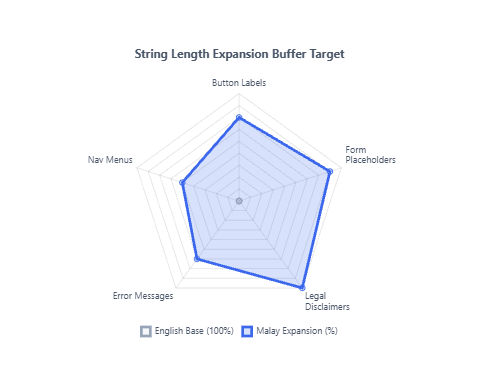
- Design for a +30% to +50% Expansion Buffer: While Chinese characters are dense and take up less horizontal space than English, languages like Malay or localized legal disclaimers can expand string length by up to 40%. Use Auto Layout (iOS) and Flexbox/ConstraintLayout (Android) with flexible constraints instead of hardcoded container dimensions.
- Handle CJK Vertical Line Heights: Simplified Chinese characters require greater vertical line-height (leading) than Latin typography. If your CSS or mobile theme sets tight line-heights (e.g., line-height: 1.0 to 1.2), Chinese diacritics and complex glyph radicals will be clipped at the top and bottom. Maintain a minimum line-height of 1.4 to 1.5 for non-Latin text rendering.
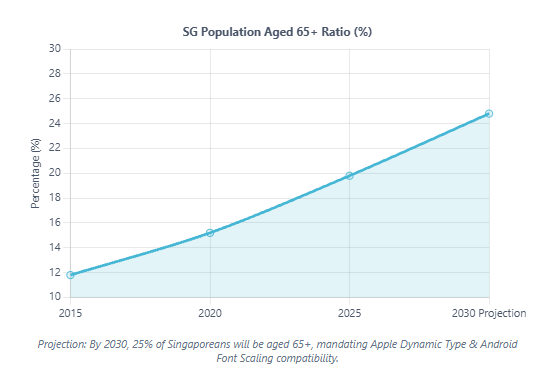
- Support Dynamic OS Type Scaling: Singapore has a rapidly aging population, with roughly a quarter of citizens projected to be 65 or older by 2030. Many users configure their smartphones to larger accessibility font sizes. Ensure your mobile views adhere to Apple’s Dynamic Type and Android’s Font Scaling APIs, allowing views to scroll vertically when fonts scale up.
Vinova Engineering Observation:
In our design-to-development handoffs, Vinova’s UI/UX engineers mandate that every button, card, and modal component be stress-tested at 135% font scale in Figma before a single line of frontend code is written. We back this up with automated visual regression tests in our CI pipeline, preventing UI clipping bugs from escaping into QA.
3. Integrate Local Payment Rails: PayNow QR, PayLah!, and E-Wallets
The Pitfall
Relying entirely on standard credit card input forms creates immediate checkout friction. In Singapore, credit cards remain popular, but account-to-account (A2A) transfers and digital wallets represent a massive share of everyday consumer transactions.
A well-built checkout screen offers two parallel paths: instant bank rails (PayNow Dynamic QR, DBS PayLah! deep link, OCBC/UOB app-to-app) and digital wallets (GrabPay, ShopeePay, Apple Pay/Google Pay).
The Implementation
- PayNow Dynamic QR Generation: PayNow allows real-time transfers directly from a user’s bank account via their NRIC, phone number, or Unique Entity Number (UEN). For mobile apps, generate dynamic PayNow QR codes embedded with the exact transaction amount and merchant reference number.
- Universal App-to-Bank Deep Linking: Improve the checkout flow by deep-linking directly into major mobile banking apps (DBS PayLah!, OCBC Digital, UOB TMRW). Instead of forcing the user to take a screenshot of a QR code, switch to their bank app, and upload the image from their photo gallery, use registered custom URL schemes or universal links to open the bank’s authorization drawer with a single tap.
- Native E-Wallet SDKs: Integrate GrabPay and ShopeePay alongside Apple Pay and Google Pay to accommodate local payment habits.
- Mandatory GST-Inclusive Pricing: Under Inland Revenue Authority of Singapore (IRAS) regulations, all quoted or displayed prices to end consumers must be inclusive of the prevailing Goods & Services Tax (GST). Displaying a net price on checkout items and tacking on GST only on the final payment confirmation screen creates user frustration and violates IRAS price display guidelines.
Vinova Engineering Observation:
When architecting PayNow deep links for our clients, the most common operational failure is handling the fallback state when a user does not have the target banking app installed. Vinova squads design a resilient fallback state machine: if the universal link fails to trigger the native banking app within a 1.5-second timeout, the app automatically transitions to displaying an EMVCo-compliant QR code with a one-tap “Save to Photos & Copy Amount” utility.
4. Replace Lengthy Forms with Singpass and MyInfo APIs
The Pitfall
Requiring users to manually fill out extensive profiles—full legal name, identity number, residential address, proof of income, and employer details—creates steep drop-off curves during user onboarding.
The Implementation
- Integrate Singpass / MyInfo: Run by the Government Technology Agency (GovTech), Singpass is Singapore’s sovereign digital identity ecosystem, used by virtually every resident citizen and employment pass holder.
- One-Tap Identity Verification: Integrating the MyInfo API enables users to authorize profile population via their Singpass app (using biometric Face ID or fingerprint scan). Within seconds, verified government data populates your onboarding fields—eliminating manual typing, transcription errors, and identity fraud.
- Essential Verticals: If your app operates in FinTech, PropTech, telecommunications, insurance, or healthcare, Singpass integration is the single most important trust and conversion driver you can build — see our breakdown of Singpass FAPI 2.0 readiness for financial apps for the compliance deadline and technical requirements.
- Singapore Phone Validation: For apps using SMS OTPs, validate local mobile numbers using strict regex: country code +65 followed by an 8-digit string starting strictly with 8 or 9: ^(\+65)?[89]\d{7}$
- SSIR Registry Compliance: The Infocomm Media Development Authority (IMDA) enforces the Singapore SMS Sender ID Registry (SSIR). If your backend sends transactional OTPs using an alphanumeric sender ID (e.g., VINOVA-AUTH) through providers like Twilio or MessageBird, that sender ID must be registered on the SSIR. Unregistered sender IDs are tagged as Likely-SCAM or blocked entirely by local telcos (Singtel, StarHub, M1).
Vinova Engineering Observation:
Having delivered enterprise integrations within Singapore’s government and private ecosystems, our engineers emphasize setting up proper server-to-server PKI encryption early. The MyInfo payload is encrypted using your app’s public key (JWE/JWS). Setting up automated key rotation scripts and staging sandbox environments against GovTech’s developer portal during Sprint 1 prevents weeks of blocked testing cycles later in the project.
5. Streamline Address Collection with 6-Digit Postal Code Auto-Fill
The Pitfall
Presenting Singapore users with a Western address format—Address Line 1, Address Line 2, City, State/Province, and Postal Code—is a glaring UX red flag. Singapore is a city-state without internal states, provinces, or counties.
The Western form asks for a street address line, a second address line, a city, a state or province, and a ZIP code — but Singapore has no states, provinces, or counties, so half those fields are redundant on arrival. The optimized Singapore flow asks for one thing: a 6-digit postal code (say, 138589). The system auto-fills the building name and road (“Sandcrawler, 1 Fusionopolis View”), and the user only ever has to type their own unit number.
The Implementation
- The Power of 6-Digit Postal Codes: Every building and landed estate in Singapore has a unique 6-digit postal code. The first two digits represent the postal sector; the remaining four identify the exact building or delivery point.
- Integrate Address APIs: Connect your client or backend to the Singapore Land Authority (SLA) OneMap API or the Google Places API.
- The 2-Step Address Flow:
1. User enters their 6-digit postal code (e.g., 138589). 2. The app queries the API and auto-fills the building name and road name (e.g., Sandcrawler, 1 Fusionopolis View). 3. The user only needs to enter their unit number: #XX-YY (Floor and Unit).
This reduces address entry time from two minutes to under ten seconds while eliminating shipping and delivery errors.
Vinova Engineering Observation:
To ensure flawless performance during flash sales or heavy transaction traffic, do not call third-party address APIs directly from the mobile client on every keystroke. At Vinova, we implement a lightweight Redis caching layer on the backend that stores resolved postal code mappings. This drops address lookup latencies from ~350ms to under 15ms while protecting clients against third-party API rate limits.
6. Master Tone and Multilingual Delivery: The English-First Reality
The Pitfall
Some international marketing teams assume that localizing for Singapore requires writing microcopy peppered with colloquial slang (“Singlish”—e.g., adding “lah”, “leh”, or “chope” to button labels). Unless your app is deliberately designed around a hyper-local satirical persona, forced Singlish sounds unnatural and erodes brand trust, particularly in transactional, enterprise, or financial contexts.
The Implementation
- The Professional Standard: Singapore digital users expect crisp, direct, highly functional business English. Microcopy should prioritize transactional clarity, system speed, and transparency:
- Weak (Verbose): “We’re super excited to process your order right now, please give us a moment!”
- Singapore-Optimized (Efficient): “Order received. Tracking details will update within 15 minutes.”
- Multilingual Readiness: While English is the default working language, Singapore officially recognizes four national languages: English, Malay, Mandarin Chinese, and Tamil.
- When to Implement Multilingual Support: While consumer B2B apps function well in English-only, consumer healthcare, government-adjacent services, transport, banking, and community/eldercare platforms should offer localization into Simplified Chinese (zh-SG), Malay (ms-SG), and Tamil (ta-SG).
Vinova Product Observation:
In our Design Thinking discovery workshops with Singapore clients, we test microcopy with actual end-user cohorts. The feedback is remarkably uniform: local users prefer apps that respect their cognitive load. Clear status chips, unambiguous confirmation sheets, and zero conversational fluff win user loyalty faster than manufactured personality.
7. Avoid Visual Pitfalls: Inverted Financial Colors and Icon Conventions
The Pitfall
Visual cues do not always translate universally across global borders. Cultural color associations and regional UI iconography can trigger incorrect user assumptions.
| Convention | Gain | Loss |
|---|---|---|
| Western financial UI | Green | Red |
| East Asian / Chinese financial paradigm | Red (prosperity) | Green (decline) |
The Implementation
- The Financial Color Inversion: In Western financial and trading applications, Green represents upward market momentum/gains, while Red represents downward drops/losses. In East Asian markets (and among many Chinese-speaking investors in Singapore), this convention is inverted: Red represents gains, luck, and prosperity, while Green represents market declines.
- Best Practice: If you are building a stock trading, crypto, or wealth management app, provide an explicit in-app toggle: “Color Palette: Western (Green Up / Red Down) vs. East Asian (Red Up / Green Down)”.
- Icon Metaphors: Avoid regionally obsolete metaphors. For instance, using an American-style roadside mailbox with a raised red flag to denote messages or notifications confuses users outside North America. Use universal, neutral iconography: bells for alerts, clean envelopes or speech bubbles for messaging, and standardized shopping bags/trolleys for e-commerce.
8. Enforce PDPA Compliance and Mask NRIC Data
The Pitfall
Indiscriminately collecting, storing, and displaying National Registration Identity Card (NRIC) or Foreign Identification Number (FIN) identifiers in app databases and user profiles.
The Implementation
Under Singapore’s Personal Data Protection Act (PDPA) guidelines enforced by the PDPC:
1. NRIC Collection Restrictions: Organizations are legally prohibited from collecting, using, or disclosing full NRIC numbers unless required by law (e.g., regulatory compliance under MAS for financial institutions, healthcare reporting, or mobile SIM registration). 2. Mandatory Field Masking: When NRIC/FIN numbers must be displayed on screen (such as account settings or verification screens), they must be masked, exposing only the last three digits and the trailing checksum letter: Full Identifier: S1234567A → Permitted Display: SXXXX567A 3. Data Residency: While PDPA allows cross-border data transfer provided standard data protection provisions are met, latency and enterprise compliance often favor hosting Singapore user data locally in sovereign cloud regions (e.g., AWS ap-southeast-1 or Google Cloud asia-southeast1 located in Singapore).
Vinova Security Observation:
In our Secure SDLC reviews, we enforce automated regex sanitizers at the API gateway layer. This prevents unmasked NRIC strings from inadvertently entering client-side analytic tracking events (like Firebase or Mixpanel) or unencrypted logging dumps—a vulnerability that can trigger severe PDPC financial penalties.
9. Implement Automated Pseudo-Localization and Real-Device QA
The Pitfall
Discovering text overflow, layout breaks, and font-rendering bugs only after your build is submitted to app review or deployed to production.
SOURCE STRING: “Account Settings” PSEUDO-LOCALIZED STRING (Expansion + Non-ASCII Glyphs): “[!!! Àccôûñt Šéttîñgš !!!]”
The Implementation
- Automate Pseudo-Localization: Integrate a pseudo-localization script into your CI/CD pipeline before real translations are completed. Pseudo-localization automatically pads strings with bracketed prefixes/suffixes and replaces standard Latin characters with accented equivalents:
- This exposes hardcoded strings instantly (any string that remains plain English was not externalized into your resource files).
- It tests for string expansion buffer capacity (+30%).
- It verifies that your mobile app fonts support non-ASCII characters without falling back to broken glyphs (tofu blocks: □).
- Real-Device Testing Across Local Fleets: While Singapore has high iOS penetration, the Android user base spans from flagship Galaxy devices to mid-range devices like the Samsung A-series and Xiaomi models. Never rely solely on desktop emulators; validate gesture navigation, payment deep-linking, and keyboard dismissal across physical hardware.
- Modern Customer Care Channels: When things go wrong, Singapore users rarely submit traditional, asynchronous email support tickets. Provide instant in-app support by deep-linking to WhatsApp Business or an integrated live chat module (Intercom, Zendesk Chat) within the app navigation bar.
Vinova QA Practice (Shift-Left Testing):
Vinova structures testing using the V-Model and Shift-Left methodology, embedding automated regression suites into every two-week sprint. By establishing dedicated user stories specifically for automated visual localization testing, our Software Quality Engineers catch text overflow and broken glyphs during the build stage—slashing post-release bug escapes by over 40%.
Architectural Comparison: Generic Western Mobile App vs. Singapore-Localized App
| Architectural Layer | Standard Western Mobile App | Singapore-Localized Mobile App |
|---|---|---|
| Authentication & KYC | Email + Password, Google / Apple SSO | Singpass / MyInfo one-tap autofill + SSIR-registered OTP |
| Payment Checkout | Manual 16-digit credit card fields, PayPal | Dynamic PayNow QR, DBS PayLah! deep link, GrabPay, Apple Pay |
| Address Input Flow | Line 1, Line 2, City, State, County, ZIP Code | 6-Digit Postal Code auto-fill (OneMap API) + Unit Number (#XX-YY) |
| Data Protection | Generic cookie banner / basic GDPR modal | Strict PDPA compliance: Masked NRIC display (SXXXX123A) |
| Pricing & Tax Display | Pre-tax pricing; tax calculated at checkout | Mandatory GST-inclusive price display (IRAS compliance) |
| Customer Support | Asynchronous email ticket queue | Instant WhatsApp Business deep-link / In-app real-time chat |
| Typography & Layout | Fixed-width containers, Latin-only line height | Auto Layout (+30-50% buffer), CJK line-height compensation |
Frequently Asked Questions (Singapore App Localization)
Why isn’t a standard US English mobile app sufficient for the Singapore market?
While Singapore is predominantly English-speaking, digital user expectations are shaped by local infrastructure. A standard US app lacks integration with Singapore’s payment rails (PayNow, PayLah!), sovereign digital identity (Singpass), and address architecture (6-digit postal code auto-resolution). These friction points lead to higher user drop-offs during onboarding and checkout.
How do you implement PayNow payments inside a mobile application?
PayNow can be implemented through participating acquisition banks (DBS, OCBC, UOB) or payment aggregators (Stripe, Adyen, HitPay). The app dynamically generates an EMVCo-compliant PayNow QR code containing the merchant UEN and exact transaction amount. On mobile devices, apps can use universal links to trigger an app-to-app switch directly into a banking app like DBS PayLah!. For a deeper breakdown of gateway options, fees, and PayNow QR mechanics, see our guide to payment gateways for Singapore businesses.
What are the legal PDPA rules for collecting NRIC numbers in mobile apps?
Under the Personal Data Protection Act (PDPA), collecting full NRIC numbers is illegal unless required by law (e.g., financial KYC or healthcare mandates) or necessary to verify identity to a high degree of fidelity. When NRIC data is captured or displayed in-app, it must be masked in the SXXXX123A format, exposing only the last 3 digits and checksum.
How does the Singapore 6-digit postal code system change checkout UX?
Unlike Western postal codes that cover broad geographic regions, every 6-digit postal code in Singapore identifies an individual building or landed house. By connecting your checkout flow to the Singapore Land Authority (SLA) OneMap API, users only need to type their 6-digit postal code to auto-populate the street and building name, leaving only the unit number (#XX-YY) to be manually entered.
Does an app targeting Singapore need to support Chinese, Malay, and Tamil?
For corporate B2B and SaaS tools, English is universally sufficient. However, for B2C mobile apps targeting a broad consumer demographic—specifically in healthcare, eldercare, public utilities, banking, and community services—providing multilingual support in Simplified Chinese, Malay, and Tamil is recommended to ensure accessibility across multi-generational households.
What do mobile application localization services actually include?
Beyond translation, proper mobile application localization services cover architectural internationalization (externalized strings, UTF-8 encoding, flexible layouts), local payment and identity rail integration, regional UI/UX conventions (date formats, color semantics, iconography), and compliance with local data protection law. For Singapore specifically, that means Singpass/MyInfo, PayNow, 6-digit postal code resolution, and PDPA-compliant NRIC handling — the same functional-localization layer that separates a genuinely localized app from a translated one.
Partner with Vinova for Your Singapore Mobile App Engineering
Building a successful mobile app for Singapore requires more than translating copy—it requires native engineering expertise that bridges international software architecture with local digital ecosystems.
Headquartered in Singapore, Vinova is an ISO 27001:2022 and ISO 9001:2015 certified IT consulting and mobile app development partner. With over sixteen years of experience and 300+ successful projects delivered for 300+ clients worldwide, including regulated government-linked and multinational enterprises, we engineer mission-critical mobile solutions built for high-performance execution:
- Native & Cross-Platform Development: Scalable mobile applications engineered in Flutter, React Native, iOS (Swift), and Android (Kotlin).
- Enterprise Local Integrations: Deep experience integrating Singpass / MyInfo v4 architectures, dynamic PayNow QR rails, and SLA OneMap geospatial services.
- Proven Agile & Quality Delivery: Disciplined two-week Scrum sprint cycles backed by the V-Model testing methodology, automated CI/CD pipelines, and “shift-left” quality control to minimize bug escapes.
- Security & PDPA Compliance by Design: Applications architected from the ground up to comply with PDPC personal data mandates and MAS technology risk management guidelines.
| Vinova: Singapore’s FinTech and payments engineering partner since 2010. ISO 27001:2022 and ISO 9001:2015 certified, MAS TRM aware. 300+ projects delivered. Payment rail integration (PayNow, FAST, eGIRO), MAS-regulated digital asset platform delivery, and Hybrid Delivery Model engineering for Singapore and APAC enterprises. Financial Times Top 500 High-Growth Companies Asia-Pacific 2026. The Straits Times Singapore’s Fastest-Growing Companies 2024, 2025, and 2026. Ready to Launch or Localize Your Mobile App for Singapore? Explore Mobile App Development Services at Vinova |