MarTech consulting has moved from a discretionary creative service to a data-engineering discipline. Browser privacy controls, ad blockers and consent choices mean client-side tags see only part of what customers do, and the gap varies by audience and browser mix. Marketing stacks also carry unused capacity: a Gartner survey found marketers use just 42% of their martech stack’s capabilities, and Zylo’s 2026 index puts unused SaaS licenses at 36%. Singapore’s PDPA, PDPC guidance and MAS TRM expectations add a third pressure: they shape how tracking and data pipelines can be built for any organization that handles personal data.
This guide covers what a marketing technology consultant actually solves in 2027, how Vinova’s martech services are structured, and what the right partner looks like for CMOs and Tech Leads making this investment.
MarTech consulting pays back when the data layer is engineered first: one customer view, consented first-party tracking, and compliance mapped before the first campaign goes live.
Key Takeaways
1. Measure data loss before you fix it. Safari, ad blockers and consent choices reduce what client-side tags capture. Chrome still offers users a third-party cookie choice, so the problem is not one browser’s policy. Server-side tracking can recover part of the signal, and Vinova measures the gap first.
2. Audit the stack before you buy more. Gartner found marketers use 42% of their martech stack’s capabilities. Overlapping and unused licenses are a data and governance problem as much as a budget problem.
3. Engineering beats creative support. Strategic martech consulting designs identity resolution, server-side pipelines and API integrations, then proves they work with data accuracy and integration stability.
4. Compliance is a Phase 1 deliverable. The PDPA, PDPC breach notification timing, the NRIC authentication phase-out, SS 714:2025 where a client pursues the Trustmark, and MAS TRM for financial services all shape the architecture from the start.
What Does MarTech Consulting Actually Solve?
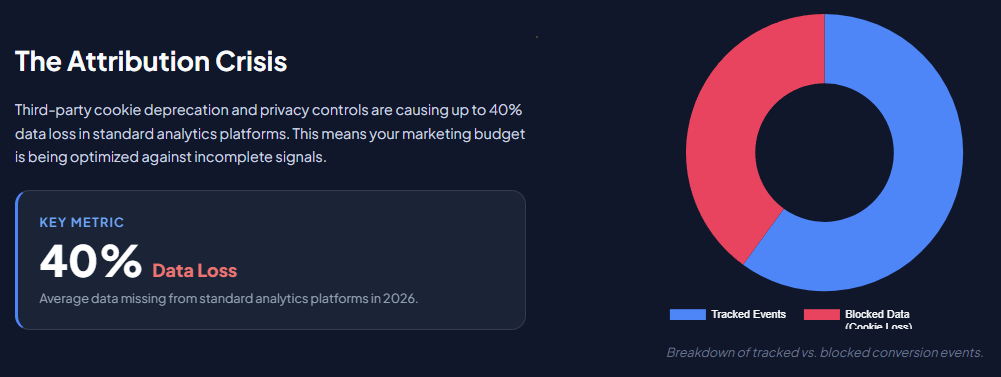
Most martech consulting engagements fail to distinguish between tactical fixes and strategic re-architecture. Tactical work resolves symptoms: a broken tag, a misconfigured webhook, a campaign that is not firing. Strategic martech consulting addresses root causes: why customer data is fragmented across six platforms, why attribution is unreliable, and why marketing spend is being optimized against inaccurate signals.
Vinova’s martech services are structured as engineering engagements, not campaign support. Senior architects based in Singapore lead the technical design and stakeholder alignment, and engineering squads in Hanoi, Da Nang, and Ho Chi Minh City execute the build. Vinova applies the same model to the digital platform of a Singapore statutory financial regulator, maintained under a continuous development contract.
The difference between a marketing technology consultant and a creative marketing agency is architectural accountability. A creative agency publishes campaigns. A martech consultant designs the database structures, configures identity resolution graphs, builds server-side tracking pipelines, and checks that the whole stack aligns with the PDPA. Performance is measured by data accuracy, system integration stability, and return on ad spend, not impressions.
What Are the Seven Core MarTech Consulting Capabilities?
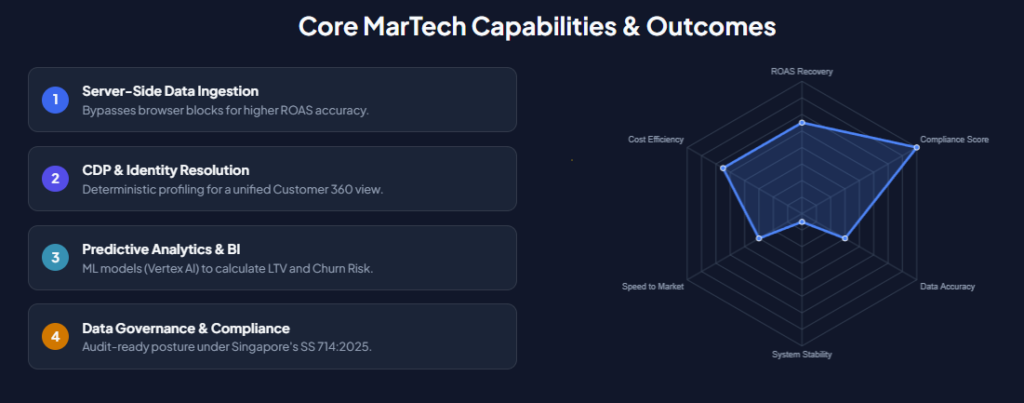
Vinova’s martech consulting practice covers seven capability areas, each addressing a specific failure mode in enterprise marketing stacks.
Core MarTech Consulting Capabilities and Outcomes
| Capability Area | What It Involves | Business Outcome |
|---|---|---|
| Stack audit and redundancy reduction | Full inventory of active software licenses; identification of overlapping platform capabilities and underutilized features across email, CRM, and analytics tools | Spend consolidated onto the tools that are actually used, with a prioritized remediation plan |
| Server-side data ingestion | Migration from client-side browser tags to first-party server-to-server data pipelines, with consent enforced at the server layer | Better conversion capture and ROAS measurement accuracy, reported against your own CRM and order data |
| CDP and identity resolution | Design of deterministic (exact identifier match) and probabilistic (ML-based behavioral signal) profile matching rules inside Customer Data Platforms | A single Customer 360 view across web, app, POS, and CRM touchpoints; personalization based on complete customer history |
| API integration and middleware | Custom REST, GraphQL, and webhook development; decoupled iPaaS middleware connecting legacy ERPs, SaaS platforms, and cloud data warehouses | Real-time data synchronization across the stack; elimination of manual batch exports and data rekeying errors |
| Predictive analytics and BI | ML models (Vertex AI, Snowflake Cortex) deployed over the data warehouse to calculate LTV, purchase propensity, and churn risk, then synced back to execution platforms | Marketing spend steered toward high-LTV segments; budgets reallocated based on propensity scores |
| Data hygiene and governance | Automated deduplication pipelines; E.164 phone normalization; email validation; compliance gap assessment against the PDPA, GDPR where it applies to your customers, and SS 714:2025 where pursued | A single source of truth across customer records; an audit-ready compliance posture; cleaner targeting data |
| Workflow automation | Trigger-based architectures firing on customer milestones (cart abandonment, tier upgrades, subscription renewals) across email, SMS, and paid channels | Campaigns that execute without manual intervention and shorter campaign cycles |
What Three Problems Does Every CMO Face in 2027?
1. Cookieless attribution: client-side tags miss conversions
Browser-level privacy controls, ad blockers and consent choices stop standard client-side scripts from seeing every conversion, so budget gets optimized against incomplete data. The picture is not a single cookie cliff. Google confirmed in October 2025 that Chrome keeps its approach of offering users a third-party cookie choice, while Safari’s Intelligent Tracking Prevention deletes script-set cookies after seven days of browser use without interaction, as Simo Ahava’s analysis of WebKit cookie rules explains.
A marketing technology consultant starts by measuring the gap: comparing tag-reported conversions with CRM and order records by browser and consent state. The fix is usually a server-side data ingestion model, where conversion events route through a first-party subdomain on dedicated cloud infrastructure. Cookie lifetime depends on the setup, because Safari can still cap server-set cookies at seven days when the response comes from a third-party CNAME or a different IP range. Vinova serves the tagging server from the client’s own domain and IP range and tests cookie lifetimes in Safari before sign-off.
2. Data silos: no single customer view across channels
When transactional records, digital behaviors, and CRM touchpoints sit in disconnected databases, accurate segmentation, attribution, and marketing automation pipeline engineering become nearly impossible. Vinova’s martech services resolve this through event-driven, hybrid-cloud data pipeline design: secure REST and GraphQL API gateways synchronize POS transactions, e-commerce behaviors, and CRM records into a unified Customer Data Platform (CDP), giving a real Customer 360 view. Where the connected platforms support event streaming, latency drops from batch intervals to seconds.
3. Shelfware: budget spent on platforms no one uses fully
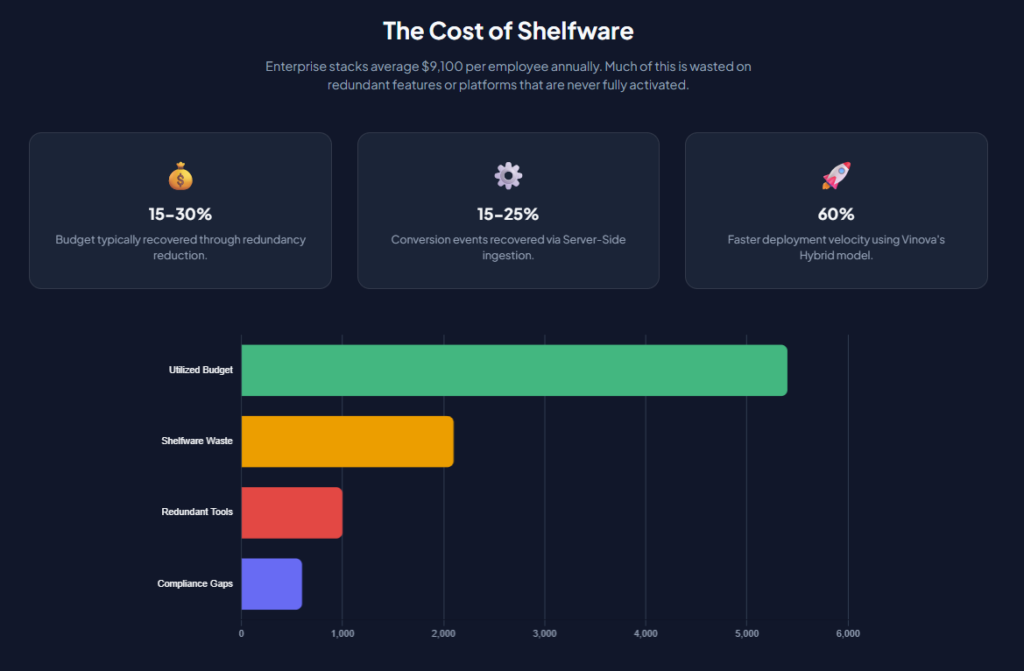
Most marketing stacks carry capabilities that are duplicated across tools or never activated. Two public benchmarks size the problem:
MarTech and SaaS Utilization Benchmarks
| Metric | Figure | Source and Note |
|---|---|---|
| Martech stack capabilities used by marketers | 42% | Gartner survey reported in October 2022, down from 58% in 2020 |
| Unused SaaS licenses, on average | 36% | Zylo 2026 SaaS Management Index, measured against industry-recommended utilization; covers SaaS broadly, not only martech |
| Median SaaS spend per employee | USD 9,455 | Zylo 2026 SaaS Management Index |
A structured martech consulting audit identifies redundant platform capabilities, unused features, and integration points that could be consolidated. Vinova’s MVP Validation Framework deploys a working proof-of-concept so enterprises can validate architectural integrations before committing budget to a full platform migration.
What Do SS 714:2025, PDPA and MAS TRM Mean for MarTech Consulting?
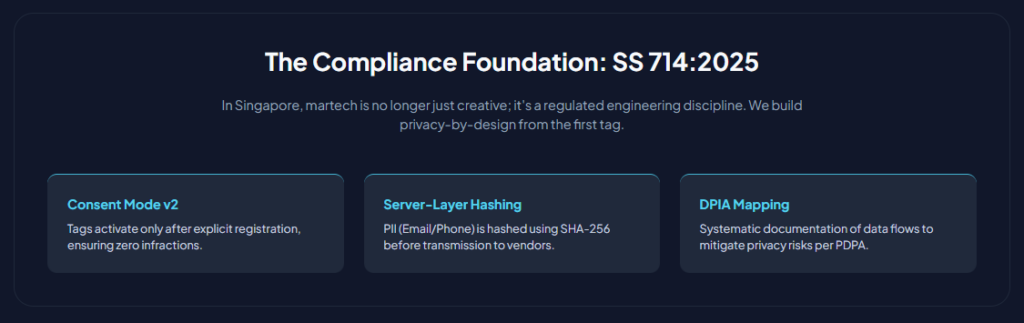
SS 714:2025 is the Singapore Standard that the Data Protection Trustmark (DPTM) certification became in July 2025. It is voluntary, grounded in PDPA obligations, and audited by accredited certification bodies. The PDPA itself applies to every organization handling personal data in Singapore, certified or not, and it has direct implications for how tracking architectures are designed, how consent is captured, and how data flows across integrated platforms.
Vinova’s martech services build compliance into the architecture from Phase 1, not as a post-launch audit, and map data flows to SS 714:2025 for clients pursuing the Trustmark. The obligations that most affect MarTech stack design:
- Data lifecycle documentation: the data lifecycle (collection, notification, consent) is documented and reviewed against the PDPA, and against SS 714:2025 where pursued, before any server-side pipeline goes live.
- Data Protection Impact Assessments (DPIAs): a systematic review of data flows to identify and mitigate privacy risks at each integration point.
- Consent Mode v2 integration: Consent Management Platforms (CMPs) are configured so the ad_storage, ad_user_data, ad_personalization and analytics_storage signals default to denied where opt-in is required, and tags activate only after consent is registered.
- Data minimization and hashing at the server layer: personal identifiers such as emails and phone numbers are hashed with SHA-256 before transmission to downstream platforms, and URL parameters that reveal sensitive personal information are stripped automatically.
- Encryption: TLS 1.3 in transit and AES-256 at rest are the design targets across pipeline layers, where the connected platforms support them.
- PDPC breach notification: the PDPC must be notified no later than three calendar days after an organization determines a breach is notifiable, as Baker McKenzie summarizes, so incident-response alerts are built into the pipeline.
- NRIC authentication phase-out: private organizations must stop using NRIC numbers for authentication by 31 December 2026, with the PDPC able to issue directions or penalties from 1 January 2027. Vinova audits CRM and marketing flows that depend on NRIC-based checks.
- Financial-sector vendor terms: for MAS-regulated clients, vendor arrangements are expected to cover audit access and incident notification terms, in line with MAS TRM expectations.
Vinova works in regulated environments such as government agencies, financial regulators, banks, insurers and healthcare providers. In each, privacy by design is a delivery requirement from the foundation, not something added afterward.
How Does Vinova’s Four-Phase MarTech Consulting Process Work?
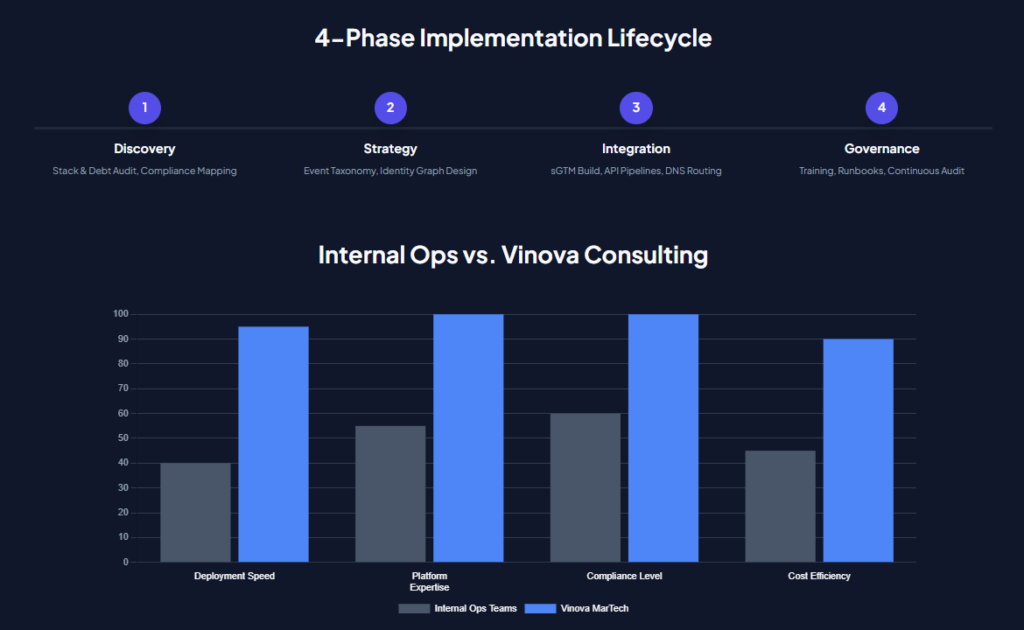
Vinova structures every martech consulting engagement across four sequential phases, each gated by a concrete deliverable before the next begins. No pipelines go live until Phase 3 data integrity testing is passed, and no client handover occurs until Phase 4 training and runbook documentation are complete.
Four-Phase MarTech Consulting Gates and Deliverables
| # | Phase | What Happens | Vinova Deliverable |
|---|---|---|---|
| 1 | Stack audit, discovery, and technical debt assessment | Full inventory of active software licenses; data flow and lineage mapping from ingestion to activation; privacy and compliance gap analysis under the PDPA and, where pursued, SS 714:2025; identification of shelfware and redundant platform capabilities | Software Licensing Inventory Matrix; End-to-End Data Flow Diagram; Compliance Gap Assessment Report |
| 2 | Unified data strategy and platform selection | Standardized event taxonomy designed (a consistent naming schema such as order_completed across all channels); unified identity resolution model specified; platform vetting across packaged and composable warehouse-native architectures; 3-year TCO model produced | Standardized Event Taxonomy Schema; Identity Graph Specifications; 3-Year Platform TCO Model |
| 3 | Integration, data pipeline build, and API development | Server-side Google Tag Manager (sGTM) containers deployed on secure cloud infrastructure; first-party DNS routing configured; custom ETL pipelines and middleware built to connect legacy databases with modern marketing platforms; all pipelines validated against data integrity and security standards | Configured sGTM Containers; Production-Ready API Gateways and Middleware; Verified Data Integrity Test Suite |
| 4 | Team onboarding, documentation, and governance | Role-based training workshops for marketing, operations, and IT teams; platform runbooks and standard operating procedures documented; recurring compliance audit schedule established; Vinova shifts to a governance and optimization retainer | Step-by-Step Platform Runbooks; Role-Based Training Completion; Ongoing Compliance Audit Schedule |
Which Enterprise Platforms Does Vinova Integrate?
Vinova’s martech services span the full enterprise MarTech stack, anchored to your core CRM implementation in Singapore. Platform selection is driven by architectural criteria: database performance, API throughput limits, query latency, and data compliance standards, not vendor marketing.
Enterprise MarTech Platforms and Vinova Integration Approach
| Layer | Platform | Technical Strength | Vinova Integration Approach |
|---|---|---|---|
| CRM and core engagement | Salesforce (Health Cloud, Financial Services Cloud) | Extensive relational schemas; vertical accelerators for regulated sectors | Connects to enterprise data repositories via ETL pipelines or custom middleware |
| CRM and core engagement | Microsoft Dynamics 365 | Native Azure integration; tight Microsoft ecosystem connectivity | Integrates via Azure-native API gateways and streaming data pipelines |
| CRM and core engagement | HubSpot Enterprise | Flexible custom object schemas; high API limits; fast deployment | Bidirectional sync via secure webhooks and custom REST API endpoints |
| Marketing automation | Adobe Marketo Engage | Lead-to-account matching; multi-tier scoring; customizable trigger logic | Integrates directly with CDPs to receive real-time audience segment updates |
| Experimentation and content | Optimizely | Composable design; low-latency testing; real-time content personalization | Edge-based content APIs and secure server-to-server tag managers |
| Data warehouse and BI | Snowflake Data Cloud | Zero-copy cloning; secure data clean rooms; warehouse-native CDP support | Direct warehouse-native data sharing with marketing activation platforms |
| Data warehouse and BI | Databricks Lakehouse | High-performance SQL; native ML libraries; Python pipelines | Reads and writes customer data from object storage without duplication |
| Analytics and data collection | Google Analytics 4 (GA4) | Predictive modeling; native BigQuery export; deep Google Ads integration | Tracking signals routed through a server-side Google Tag Manager environment |
Talk to Vinova’s MarTech Consulting Team
Schedule a complimentary two-hour architectural roadmap consultation with our Singapore solutions team. We audit your current stack, identify data loss and compliance gaps, and design a roadmap to a compliant MarTech architecture, with no commitment required.
What Does MarTech Consulting Look Like in Production?
Case Study 1: Retail and Maritime Logistics MarTech Transformation
Challenge: A retail and maritime logistics group operating across APAC could not connect in-store POS transactions with digital customer behavior across its e-commerce website and mobile app. Without unified data, cross-channel attribution was impossible, and marketing spend was being optimized against data loss of 35% or more.
Vinova’s approach: Vinova deployed a composable CDP with a custom enterprise middleware layer. POS transactions were matched to customer profiles using loyalty identifiers and phone numbers at checkout. E-commerce tracking migrated from client-side browser tags to sGTM containers hosted on secure cloud infrastructure, and a standardized event taxonomy (order_completed used consistently across POS and e-commerce) unified all channel data. The group’s maritime platform integrated 20+ operational modules, including vessel tracking and live cargo monitoring, connecting supply chain metrics directly to client CRM accounts. Unified CDP profiles fed downstream messaging platforms for automated post-purchase lifecycle campaigns.
Case Study 1 Outcomes
| Metric | Result |
|---|---|
| Recognized customer interactions | Increased by 45% |
| Omni-channel assisted conversion rate | Grew by 25% |
| Customer lifetime value | Rose by 32% within 9 months through targeted post-purchase automation |
| Operational development velocity | Increased by 60% through custom API orchestration |
Case Study 2: Healthcare MarTech With Privacy-First Tracking
Challenge: A regional medical technology provider needed to optimize patient intake, doctor directory search, and digital outreach campaigns while keeping patient-specific health data and diagnosis queries away from third-party advertising platforms.
Vinova’s approach: Vinova designed a privacy-first MarTech architecture. It deployed Salesforce Health Cloud with a secure patient portal and mobile application, and custom sGTM containers on secure cloud infrastructure with all tracking scripts routed through a first-party subdomain. Automated sGTM processing logic scrubbed personal health identifiers before conversion events were transmitted: emails and phone numbers hashed with SHA-256, URL parameters revealing clinical diagnoses stripped, and session IDs rotated every 7 days. A Consent Management Platform was integrated with Consent Mode v2.
Case Study 2 Outcomes
| Metric | Result |
|---|---|
| External compliance audits | Passed, with no data protection infractions recorded |
| Data loss in analytics and attribution | Dropped from 35% to under 5% |
| Average cost-per-acquisition on paid channels | Reduced by 22% |
Case Study 3: AI-Powered Platform at Scale
Challenge: Build an AI-powered legal document generation platform for a start-up, and scale it to global users rapidly from the MVP stage.
Vinova’s approach: Vinova applied MLOps and Continuous Training infrastructure to build automated pipelines that detect data drift and concept drift, so the AI models do not fail silently as user behavior evolves. Data lineage was documented from ingestion through to model activation.
Outcome: The platform scaled to users across 50+ countries within two months of launch.
How Do You Choose a MarTech Consulting Partner?

For CMOs and Tech Leads evaluating martech consulting partners, the capability gap between internal marketing operations teams and specialist consultancies is real. The table is Vinova’s qualitative comparison:
Internal Marketing Operations vs. Vinova MarTech Consulting
| Parameter | Internal Marketing Ops Teams | Vinova MarTech Consulting |
|---|---|---|
| Audit objectivity | Lower. Internal teams are often too close to their own workflows to identify structural inefficiencies or shelfware waste | Higher. An independent audit of system utility, data pipelines, and platform redundancies, without internal political pressure |
| Platform expertise | Variable. Keeping in-house teams skilled across several enterprise platforms (Salesforce, Adobe, Snowflake) is costly and needs continuous training investment | Engineering experience across the major enterprise ecosystems, delivered under ISO 27001:2022 and ISO 9001:2015 certified processes |
| Deployment speed | Slower. Internal IT and marketing resources are constrained by long roadmaps, operational tasks, and competing priorities | Dedicated squads and repeatable frameworks, with timelines scoped after the discovery phase |
| Overhead cost | Higher fixed cost. Full-time specialist engineers carry permanent salary, CPF, benefits, and recruitment overhead regardless of project volume | Engagement-based pricing gives access to specialist engineering only when needed, with Singapore management and Vietnam delivery |
| Compliance capability | Moderate. Internal teams may lack specialist knowledge of PDPA cross-border obligations, PDPC breach notification timing, and MAS TRM vendor requirements | Built into delivery from Phase 1, with experience in government, financial services, insurance and healthcare environments |
The technical credentials that separate a genuine marketing technology consultant from a general digital agency are relational data modeling, identity resolution graph design, first-party subdomain configuration and DNS routing, custom ETL middleware development, and demonstrable PDPA compliance delivery. Ask any prospective martech consulting partner to demonstrate these in existing client work before signing a contract.
What Should You Know Before Hiring a MarTech Consultant?
What does a MarTech consultant do versus a creative marketing agency?
A creative agency produces campaign content, manages paid media, and optimizes brand metrics such as reach, impressions, and CTR. A marketing technology consultant designs the underlying data infrastructure: identity resolution graphs, server-side tracking pipelines, CDP configurations, custom API integrations, and compliance architectures. Their performance is measured by data accuracy, system integration stability, and ROAS, not creative metrics. When a CMO’s attribution data is unreliable or the stack is leaking budget to shelfware, a creative agency cannot fix it. A martech consulting partner can.
How much do MarTech consulting services cost in Singapore?
Cost depends on engagement complexity: the number of connected systems, data quality, the depth of server-side tracking and CDP work, and compliance requirements. A stack audit and remediation project sits at one end. A full re-architecture that unifies POS, CDP, CRM, and a cloud data warehouse with compliance engineering sits at the other. Vinova scopes after the discovery phase so the budget follows evidence from your own stack. For funding, Enterprise Singapore has announced EDGE to combine the EDG, PSG, and MRA grants into one scheme, and says businesses can keep applying for the existing grants through the Business Grants Portal until then. Eligibility, qualifying costs, and funding rates vary by scheme, so check the current terms before you plan around a grant.
What is SS 714:2025 and why does it matter for MarTech?
SS 714:2025 is the Singapore Standard behind the Data Protection Trustmark, which became a national standard in July 2025. Certification is voluntary, is built on PDPA obligations, and is audited by accredited certification bodies. For martech consulting, it matters because it affects how consent is captured and stored, what data is passed to third-party advertising platforms, how identifiers are hashed or anonymized before transmission, and what documentation is kept for audits. Vinova maps data flows to the standard for clients pursuing certification.
How long does a MarTech stack audit and re-architecture take?
Duration depends on scope. A full engagement runs in four phases: discovery, system audits, compliance gap analysis and data mapping; architecture strategy, event taxonomy design and platform selection; custom API development, server-side tracking migration and sandboxed testing; and team onboarding, runbook production and transition to live production. Targeted engagements, such as a server-side tracking migration only or CDP identity resolution only, are shorter. Vinova gives a phase-by-phase plan with dates after discovery.
Can MarTech consulting recover attribution data lost to browser privacy controls?
Partly. Moving from client-side browser tags to a first-party, server-side data ingestion model improves resilience to ad blockers and cookie restrictions, but it does not override user consent, and results depend on setup. Vinova’s sGTM configurations route tracking signals through a first-party subdomain on dedicated cloud infrastructure, and cookie lifetimes are tested in Safari because third-party IP and CNAME setups can still be capped at seven days. Vinova compares tag-reported conversions with CRM records before and after the change, so recovery is reported from your own data.
What industries does Vinova’s MarTech consulting cover?
Vinova’s martech services span financial services and fintech, healthcare and medical technology, government and the public sector, retail and logistics, and enterprise technology and professional services. Across all sectors, martech consulting engagements are scoped to deliver compliant, production-ready data architectures, not advisory documents.
How Can Vinova Support Your MarTech Program?
Vinova, a Singaporean Government-Grade Technology Partner, Made Accessible, has delivered more than 300 projects across custom software, web, mobile, data, AI and cybersecurity over 16 years. Most MarTech programs fail at the data layer, not the campaign layer, and Vinova’s approach is built around accountability:
- Fiduciary Governance & Regulatory Alignment: Delivery operations certified under ISO 27001:2022 (Information Security) and ISO 9001:2015 (Quality Management) and GovTech Category 1B approved, with delivery designed to align with the PDPA, GovTech IM8 and MAS TRM expectations that apply to your sector.
- Singapore Corporate Governance: Master Services Agreements governed under Singapore law with SIAC arbitration, so IP ownership and accountability are defined before the first commit.
- MarTech Engineering Practice: Architects and engineers who build server-side tracking, CDP and identity resolution, enterprise system integration services, and compliance mapping across platforms including Salesforce, HubSpot, Marketo, Snowflake, and Google Analytics 4.
- Engineering Depth: 300+ in-house engineers across Singapore and Vietnam delivery hubs in Ho Chi Minh City, Da Nang, and Hanoi, with 8% to 12% annual voluntary attrition, so the people who build your MarTech stack are still there to run it.
Schedule a complimentary two-hour architectural roadmap consultation with our Singapore solutions team to audit your stack.
Vinova: a Singaporean Government-Grade Digital Transformation Partner, Made Accessible. For 16 years, we have designed digital systems for 300+ companies and government agencies worldwide, backed by ISO 27001:2022 and ISO 9001:2015 certification and Singapore GovTech Category 1B approval.
300+ employees across offices in Singapore, Vietnam (Hanoi, Da Nang, Ho Chi Minh City), Norway (Oslo), and Thailand (Bangkok), scaling platforms and engineering capacity to serve clients across the globe.
Financial Times Top 500 High-Growth Companies Asia-Pacific 2026. Recognized among Singapore’s Top 100 Fastest-Growing Companies in 2024, 2025, and 2026.