Disconnected marketing automation is a revenue risk. When customer data drifts between the marketing automation platform (MAP) and the CRM, sales teams chase disqualified prospects while high-intent leads sit in the marketing database. Browser privacy controls and ad blockers also reduce how many conversions client-side tags can see. The loss varies by audience, so measure it before you plan around it. Compliance adds pressure: under the PDPA, organizations must report a notifiable data breach to the PDPC no later than three calendar days after determining it is notifiable, and private organizations must stop using NRIC numbers for authentication by 31 December 2026, with the PDPC stepping up enforcement from 1 January 2027. A marketing automation consultant who works at the engineering level, not only the campaign level, is the difference between a revenue engine that compounds and one that leaks.
This guide explains what a marketing automation consultant at Vinova’s engineering level delivers, how marketing automation implementation is structured, and what Singapore CMOs and Growth Heads should check before they engage a partner.
Marketing automation pays back when the data layer is engineered first: clean sync between MAP and CRM, consented tracking, authenticated email, and compliance mapped before the first campaign goes live.
Key Takeaways
1. Sync failures cost pipeline. Batch sync between MAP and CRM leaves high-intent leads stranded in the marketing database while sales sees them as uncontacted.
2. Measure signal loss before you fix it. Safari, ad blockers, and consent choices reduce what client-side tags capture. Server-side tagging can recover part of that signal, but the recovery depends on setup and audience, so Vinova measures first.
3. Email authentication is a baseline requirement. Gmail and Yahoo require bulk senders to authenticate with SPF and DKIM, publish a DMARC record, offer one-click unsubscribe, and keep spam complaints low.
4. Compliance is a Phase 1 deliverable. The NRIC authentication phase-out, PDPC breach notification, and PDPA transfer rules shape the architecture from the start.
What Does a Marketing Automation Consultant Actually Do in 2027?
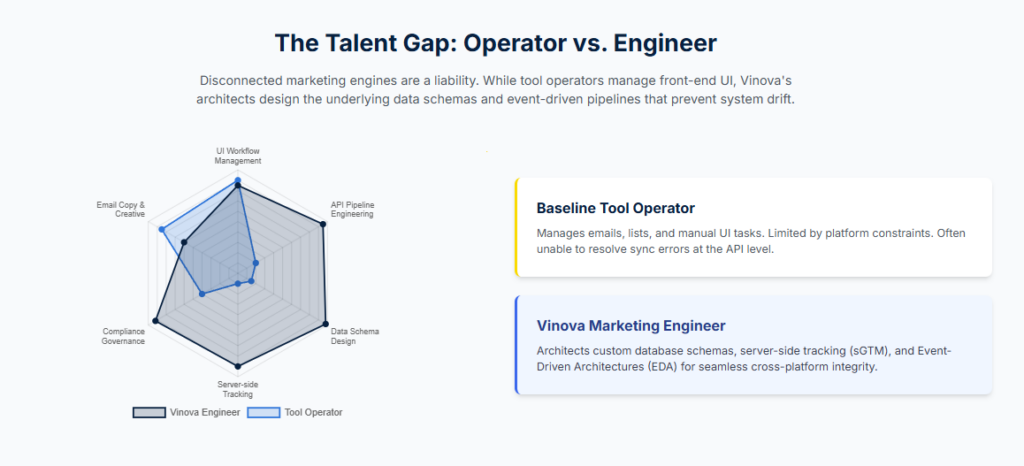
The role splits into two tiers. A baseline tool operator manages the front end of a single MAP (Marketo, HubSpot, Salesforce Marketing Cloud), builds single-branch email nurtures, manages static list segments, and resolves sync errors by hand. They work inside the platform. A marketing automation consultant at Vinova’s level works across the whole stack: designing data schemas, building event-driven pipelines, configuring server-side tracking infrastructure, and maintaining compliance across jurisdictions.
The distinction matters because many marketing automation implementation failures come from asking tool operators to solve systems engineering problems. When a MAP and CRM fall out of sync at scale, through API timeout chains, conflicting validation rules, or locked record conflicts, a tool operator cannot fix it. You need an architect.
Vinova’s marketing automation agency practice pairs Singapore-based senior architects (technical design, stakeholder alignment, compliance governance) with dedicated engineering squads in Hanoi, Da Nang, and Ho Chi Minh City (integration build, pipeline development, production deployment). Vinova applies the same model to a global maritime operator’s platform, where engineering 20+ integrated modules with real-time event-driven architecture increased development velocity by 60%.
When Should You Engage a Marketing Automation Consultant?
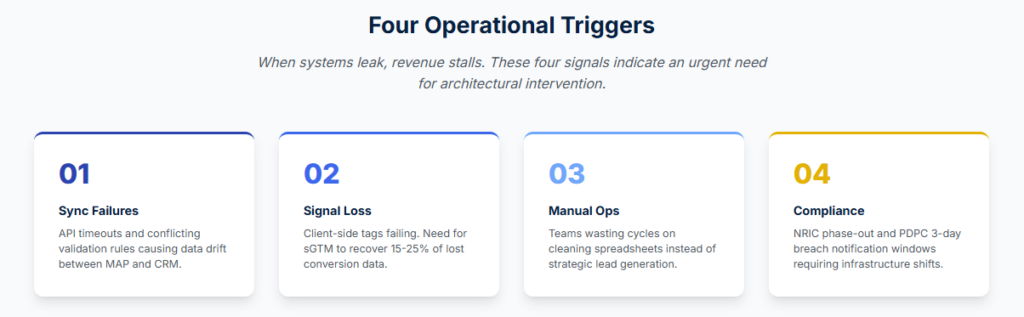
Four operational triggers usually signal that it is time.
1. Persistent MAP and CRM synchronization failures
When field-level mapping errors, API timeouts, conflicting validation rules, or locked record conflicts cause recurring data drift between your MAP and CRM, sales teams call disqualified prospects while qualified leads stall in the marketing database. Vinova’s marketing operations consultant practice begins every engagement with a full API audit and schema review before touching any campaign configuration.
2. Conversion signals dropping because of browser privacy controls
Client-side browser tags lose conversion events to Safari’s Intelligent Tracking Prevention (ITP), ad blockers, and consent choices. The loss varies by audience and browser mix, so Vinova measures it first by comparing tag-reported conversions with CRM and order records. Moving to server-side Google Tag Manager (sGTM) on dedicated cloud infrastructure (Google Cloud Run or AWS ECS/Fargate) can recover part of that signal.
Cookie lifetime depends on the setup. As Simo Ahava’s analysis of WebKit cookie rules explains, Safari deletes script-set cookies after seven days of browser use without user interaction, and it can cap server-set cookies at seven days when the response comes from a third-party CNAME or IP address. Serving the tagging server from your own domain and IP range is the safer design, and Vinova tests cookie lifetimes in Safari before sign-off.
3. Pipeline velocity stalled by manual operations
When internal teams spend cycles cleaning spreadsheets, resolving duplicate records, and fixing integration errors, strategic lead generation automation does not happen. Vinova’s One Team model deploys cross-functional squads that absorb the technical execution, freeing internal teams for growth work. Routing is configured so a qualified lead reaches the right rep inside a target window agreed with sales, such as 15 minutes, instead of the next business day.
4. Compliance obligations creating architectural pressure
Three Singapore obligations shape the architecture. Private organizations must phase out full and partial NRIC numbers as authentication by 31 December 2026, and from 1 January 2027 the PDPC may issue directions or financial penalties. Under the PDPA, organizations must notify the PDPC no later than three calendar days after determining a breach is notifiable, and notify affected individuals as soon as practicable, as Baker McKenzie summarizes. A data intermediary, such as a marketing automation partner, must tell the client without undue delay once it has credible grounds to believe a breach occurred.
A marketing automation consultant who does not build these constraints in from Phase 1 leaves the client exposed. Vinova’s marketing automation implementation process includes compliance mapping as a Phase 1 deliverable, not a post-launch audit.
What Marketing Automation Consulting Services Does Vinova Deliver?
Vinova’s marketing automation consulting practice covers seven service areas, each addressing a failure mode in enterprise automation stacks.
Enterprise Marketing Automation Capabilities and Outcomes
| Service Area | What Vinova Does | Business Outcome |
|---|---|---|
| Architecture audit and health assessment | Data-profiling scripts analyze schema consistency, API call distribution, system latency, and integration bottlenecks across the MAP and CRM stack | A clear picture of technical debt and a prioritized remediation plan before budget is committed to new tooling |
| Lead scoring and routing | Multi-dimensional scoring that combines firmographic fit (company revenue, industry, job title) with behavioral engagement (page visits, content downloads, demo requests); an A1 to C3 lead-grade matrix; automated routing to the right sales rep on threshold breach | Sales teams focus on higher-probability prospects, and lead handoff happens in minutes, not hours |
| Real-time trigger campaigns | Event-driven architecture (EDA) that fires workflows on real-time signals: high-intent page visits, webinar registrations, product usage API events, cart abandonment | Campaigns respond at the moment of intent, without manual scheduling |
| CRM and MAP sync engineering | Hybrid Integration Platform (HIP) using change data capture (CDC), anti-corruption layers, and the Strangler Fig pattern; bidirectional sync between MAP (HubSpot, Marketo, SFMC) and CRM (Salesforce, Microsoft Dynamics) | Less data drift between marketing and sales databases, with sync lag reduced from batch hours to seconds where the platform supports change events |
| Email deliverability infrastructure | SPF, DKIM, and DMARC configuration; SPF DNS lookup limit management to prevent PermError; VMC or CMC and BIMI setup for brand logo display | Sender reputation protected and inbox placement monitored, with brand logos displayed where mailbox providers support BIMI |
| Multi-touch attribution modeling | Markov chain and Shapley value models deployed in Snowflake or BigQuery; channel weight calculated from removal effect instead of arbitrary first-touch or last-touch rules | Budget reallocation guided by modeled channel contribution, with CPL and ROAS measurement improved |
| ABM infrastructure | Contact records linked to parent accounts; account-level engagement tracking across stakeholders; automated sales alerts when account activity rises above a threshold | Enterprise accounts managed as unified targets, with multi-stakeholder deal progression tracked automatically |
Why Does Email Deliverability Need Engineering?
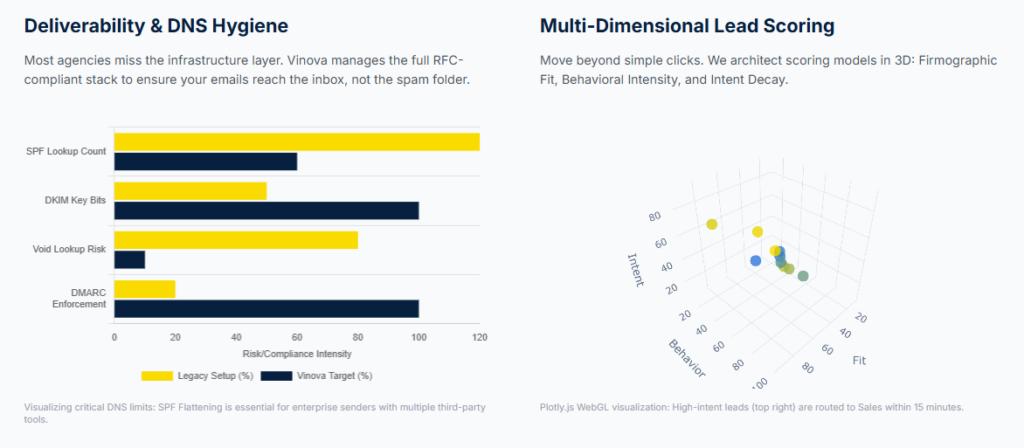
Email remains a core B2B lead generation automation channel, but deliverability degrades silently, and many marketing automation agency engagements never touch the DNS layer. Since 2024, Gmail and Yahoo also require senders of 5,000 or more messages a day to authenticate with SPF and DKIM, publish a DMARC record, offer one-click unsubscribe, and keep spam complaint rates below 0.10% and never at 0.30% or higher, per dmarcian’s summary. Vinova configures authentication to specification and fixes the specific failures that route legitimate mail to spam:
Core DNS Authentication Standards and Deliverability Remediations
| DNS Mechanism | Specification Limit or Requirement | Risk if Missed and Vinova Fix |
|---|---|---|
| SPF DNS Lookup Limit | Maximum 10 DNS-querying mechanisms per evaluation (RFC 7208) | Exceeding it triggers an SPF PermError, so SPF fails and mail can be routed to spam. Vinova consolidates or flattens include chains below the limit, and monitors them because provider IP ranges change |
| SPF Void Lookup Limit | Maximum 2 void (empty or failed) DNS lookups (RFC 7208) | Outdated or mistyped include references can cause an immediate SPF failure. Vinova audits and removes deprecated sending services during domain authentication setup |
| DKIM Signature Key Length | RFC 8301 requires signers to use RSA keys of at least 1024 bits, and 2048 bits is the common recommendation | Shorter keys are easier to attack and may be treated as weak by receivers. Vinova rotates DKIM keys to 2048 bits during deliverability engagements |
| DMARC Policy | A published record is required for Gmail and Yahoo bulk senders, and p=none is accepted. BIMI needs p=quarantine or p=reject | Without enforcement, domain spoofing can go unnoticed and BIMI cannot display. Vinova stages the rollout from p=none (monitoring) to p=quarantine to p=reject, with aggregate reporting throughout |
Beyond authentication, Vinova configures Brand Indicators for Message Identification (BIMI) so brand logos can appear in subscriber inboxes. BIMI needs DMARC at enforcement and either a Verified Mark Certificate (VMC, for registered trademarks) or a Common Mark Certificate (CMC, for logos displayed publicly for at least 12 months). Per Red Sift’s 2026 guide, Gmail accepts either certificate but shows the verified checkmark only for a VMC, Apple Mail requires a VMC, and Microsoft Outlook does not display BIMI logos. Vinova manages the full chain: SPF consolidation, DKIM key rotation, staged DMARC rollout, certificate issuance, and BIMI DNS record publication.
How Does CRM and MAP Sync Engineering Work?
The most technically demanding part of any marketing automation implementation is the integration layer between the MAP and CRM, building directly on your enterprise CRM implementation. Native connectors often run on scheduled batch updates, and the resulting sync lag can leave high-intent leads stranded in the marketing database while the CRM shows them as uncontacted.
Vinova’s Hybrid Integration Platform (HIP) framework replaces batch polling with change data capture (CDC) where the platform supports it. In Salesforce, a record change publishes a change event, and Vinova’s integration layer subscribes through the Pub/Sub API or CometD and streams the update to the MAP, so latency drops from batch intervals to seconds. Vinova also deploys an anti-corruption layer (ACL) that translates and normalizes schemas in both directions, so dirty or non-compliant legacy data cannot corrupt the target database.
The sync matrix defines the standard configuration Vinova applies across the four primary data objects in enterprise MAP to CRM integrations:
Enterprise MAP to CRM Data Object Synchronization Matrix
| Data Object | Sync Direction | Trigger Mechanism | Target Latency | Vinova Mitigation |
|---|---|---|---|---|
| Lead / Contact | Bidirectional | Change data capture (CDC) / event stream | Seconds | Message-queue buffering with three-tier exponential backoff retries to reduce UNABLE_TO_LOCK_ROW errors on concurrent updates |
| Account / Company | CRM to MAP (one-way) | SystemModstamp query | Minutes | Field mapping standards enforced and object relationships validated before sync activation |
| Opportunity | CRM to MAP (one-way) | Streaming / Pub/Sub API | Seconds | Dynamic schema discovery aligns mapped pipelines, and inactive opportunity stages are handled through conditional routing |
| Custom Objects | Bidirectional | Webhook / REST API | Minutes | Bulk API 2.0 batches high-volume payloads to reduce the risk of API limit exhaustion during campaign-triggered update waves |
What Do PDPA, PDPC, and NRIC Rules Mean for Marketing Automation in 2027?
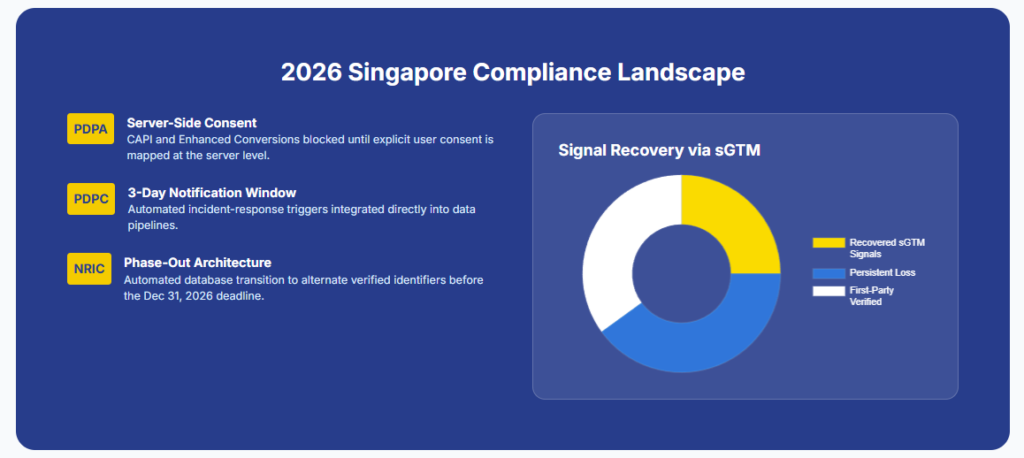
Marketing automation implementation that handles personal data carries specific PDPA obligations—and requires upstream MarTech stack compliance and data integrity—that most automation platforms do not address by default. Vinova builds these into every engagement from Phase 1:
- Server-side consent orchestration: Consent management platform (CMP) filters in the sGTM layer hold conversion APIs (Meta CAPI, Google Enhanced Conversions) until explicit consent is captured, and Google Consent Mode v2 signals (ad_storage, ad_user_data, ad_personalization, analytics_storage) are enforced at the server level.
- Consent logging for audit: Timestamped records of consent choices (IP address, selected preferences, banner version) are archived for regulatory review.
- PDPC breach notification: A breach is notifiable if it is likely to cause significant harm or is of significant scale. The PDPC must be notified no later than three calendar days after the organization determines this, and affected individuals as soon as practicable. Vinova integrates automated incident-response alert triggers into the pipeline.
- NRIC authentication phase-out: Private organizations must stop using full or partial NRIC numbers to authenticate individuals by 31 December 2026, for example as default passwords for digital documents or accounts. Vinova engineers migrate affected databases and flows to alternative verification, such as Singpass or one-time passwords, as part of compliance-scoped implementations.
- Cross-border data transfer: Data transfer agreements using ASEAN Model Contractual Clauses are signed before personal data enters offshore development pipelines, and staging environments are accessed through virtual desktop infrastructure hosted in Singapore cloud zones.
- Encryption: AES-256 at rest and TLS 1.3 in transit across MAP, CRM, and data warehouse integration layers, where the connected platform supports it.
Vinova works in regulated environments such as government agencies, financial regulators, banks, and insurers, where a post-launch compliance patch is not an option. For clients pursuing the Data Protection Trustmark, Vinova maps data flows to SS 714:2025, the Singapore Standard behind that certification since July 2025.
How Does the Five-Phase Implementation Lifecycle Work?
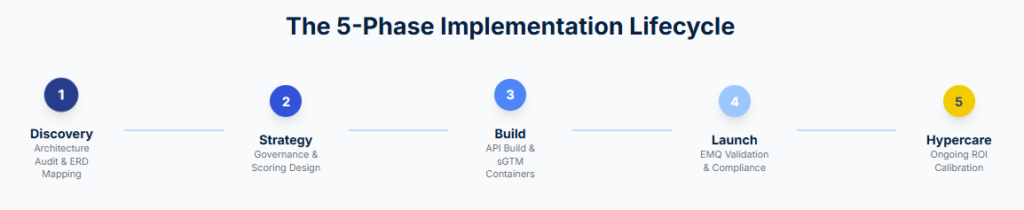
Vinova structures every marketing automation implementation across five sequential phases, each gated by a concrete deliverable before the next begins. No pipeline goes live until Phase 4 data validation is complete, and no handover occurs until Phase 5 hypercare is active.
Phased Implementation Gates and Deliverables
| # | Phase | What Happens | Vinova Deliverable |
|---|---|---|---|
| 1 | Discovery and architecture audit | Full inventory of active integrations, custom fields, and API endpoints; schema consistency profiled; API call distribution measured; data quality issues and integration bottlenecks documented | Entity-relationship diagram (ERD) across all connected systems; API limit assessment report; database cleanliness scorecard |
| 2 | Technical strategy and governance design | Standardized naming conventions, folder structures, and campaign taxonomies defined; lead lifecycle flowcharts and scoring thresholds designed; UTM parameter standards locked before any campaign assets are built | Technical governance playbook; lead lifecycle flowcharts; routing and assignment logic documentation |
| 3 | Integration build and API configuration | Bidirectional API pipelines established; webhooks configured; server-side GTM (sGTM) containers deployed on containerized cloud infrastructure (Google Cloud Run or AWS ECS/Fargate); custom domain mapping activated | Live integration layer connecting MAP and CRM; sGTM containers with first-party domain mapping; data flow validation report |
| 4 | Production launch and data validation | System goes live in production; API error logs monitored; field mapping accuracy verified; Event Match Quality (EMQ) scores validated; PDPA obligations confirmed across all data flows, with SS 714:2025 mapping where the client pursues the Trustmark | Live platform deployment; EMQ validation report; data sync health dashboard; compliance sign-off |
| 5 | Continuous optimization and hypercare | Campaign conversion rates analyzed; database hygiene scored monthly; API usage audited; scoring and attribution models adjusted from live data; Vinova hypercare desk available for real-time issue resolution | Monthly performance review; database hygiene scorecard; API usage audit; updated attribution model |
Case example: a Singapore university. The same phased pattern applies outside marketing. For a university’s central campus integration platform, Vinova developed a Python-native framework for rapid MVP development and data extraction, integrating with existing operational databases to automate scheduling and resource optimization. It began as a focused pilot and scaled into a full production platform under a long-term dedicated squad.
Talk to Vinova’s Marketing Automation Consulting Team
Schedule a complimentary two-hour architectural roadmap consultation with our Singapore solutions team. We audit your current MAP and CRM integration, identify pipeline velocity bottlenecks, and map a delivery plan to your growth targets and compliance requirements, with no commitment required.
Should You Build In-House or Hire an External Marketing Automation Consultant?

Revenue operations leaders weigh depth of specialist expertise against fixed overhead. The table is Vinova’s qualitative comparison:
In-House Operations vs. Vinova Hybrid Consulting Model
| Parameter | In-House Marketing Ops Teams | Vinova Marketing Automation Consulting |
|---|---|---|
| Platform expertise | Typically deep expertise on one or two active platforms | Engineering experience across Marketo, HubSpot, Salesforce, Google Cloud, and AWS |
| Integration depth | Often focused on native connectors, with limited custom API and CDC pipeline design experience | Custom API orchestration, webhook routing, middleware integration, and server-side tracking architecture |
| Time to market | Slowed by daily admin tasks, troubleshooting backlogs, and limited specialist capacity | Dedicated engineering squads and repeatable deployment frameworks, with timelines scoped after the discovery phase |
| Cost structure | Fixed costs: salaries, CPF, benefits, and training regardless of project volume | Engagement-based pricing with a fixed-price discovery phase and dedicated sprint teams for execution, using Singapore management and Vietnam delivery |
| Compliance capability | Moderate: internal teams may lack specialist knowledge of PDPA transfer obligations, PDPC breach notification timelines, and MAS TRM vendor requirements | Built into delivery under ISO 27001:2022 and ISO 9001:2015 certified processes, with compliance mapped in Phase 1 |
Vinova’s hybrid model pairs Singapore-based strategic management (requirements gathering, compliance governance, stakeholder alignment) with engineering execution across Vietnam. Vinova has been recognized in the Financial Times Top 500 High-Growth Companies Asia-Pacific 2026 and among Singapore’s Top 100 Fastest-Growing Companies in 2024, 2025, and 2026.
What Should You Know Before Hiring a Marketing Automation Consultant?
What is the difference between a marketing automation consultant and a digital marketing specialist?
A digital marketing specialist manages campaigns within existing platform interfaces: writing email copy, scheduling sends, managing ad channels, and reporting on creative metrics. A marketing automation consultant works at the systems level: designing database schemas, building bidirectional API pipelines, configuring server-side tracking infrastructure, and maintaining data integrity across integrated platforms. When attribution is broken, sync is failing, or lead routing is inconsistent, a campaign manager cannot fix it. A marketing automation agency with engineering depth can.
What does marketing automation implementation cost in Singapore?
Cost depends on integration scope, data quality, the number of connected systems, and compliance requirements. A simple setup with minor schema customization sits at one end. An enterprise architecture with server-side sGTM, real-time CDC sync, AI-assisted lead scoring, and full compliance engineering sits at the other. Vinova prices after a fixed-price discovery phase that audits the stack and scopes the work, so the budget follows evidence instead of a rule of thumb.
How does a marketing automation consultant handle deduplication across legacy CRM databases?
Vinova deploys structured deduplication pipelines using three matching approaches: deterministic matching (exact match on unique verified identifiers such as hashed email addresses or loyalty card numbers); probabilistic matching (string-distance algorithms that catch variations like ‘Acme Corp’ and ‘Acme Corporation’, or phonetic matching for name spelling variants like ‘Fischer’ and ‘Fisher’); and field normalization (E.164 phone formatting, company suffix standardization, email syntax validation). Records are merged using survivorship rules that preserve the most recent and authoritative source values without losing historical engagement data. As part of any marketing operations consultant engagement, Vinova produces a data quality scorecard before and after deduplication to confirm the reduction in duplicate rate.
How do I know if my MAP and CRM integration is failing silently?
Four warning signs: sales reps are calling leads that marketing considers unqualified (field mapping drift); high-intent leads are not appearing in the CRM for days after the qualification threshold is breached (sync lag from batch polling); duplicate contact records are accumulating in both systems (missing idempotency keys in API payloads); and attribution reports show more conversions in the MAP than the CRM records (conversion events lost in the integration layer). Vinova’s Phase 1 architecture audit produces an API limit assessment and an ERD schema map that identify where these failure points sit.
What is lead generation automation and how does Vinova implement it?
Lead generation automation refers to the event-driven systems that capture, score, route, and nurture leads without manual intervention. Vinova implements it through four layers: a server-side data ingestion layer that captures real-time behavioral signals from web, app, and offline channels; a multi-dimensional lead scoring model that combines firmographic fit and behavioral engagement with score decay logic; an automated routing engine that assigns qualified leads to the correct sales rep within a target window agreed with sales; and a trigger-based nurture architecture that fires personalized multi-channel communications based on observed intent signals. The result is a lead generation automation system that responds at the moment of intent and scales without adding headcount.
What marketing automation platforms does Vinova implement and consult on?
Vinova’s marketing automation consulting practice covers Marketo Engage, HubSpot Enterprise, Salesforce Marketing Cloud (SFMC), Adobe Campaign, and Microsoft Dynamics 365 Customer Insights Journeys (formerly Dynamics 365 Marketing) on the MAP side; Salesforce, Microsoft Dynamics 365, and HubSpot CRM on the CRM side; Snowflake, BigQuery, and Databricks for data warehouse attribution; and Google Analytics 4 with server-side GTM for measurement. As a marketing automation agency rather than a platform reseller, Vinova’s recommendation is architecture-first: which platform combination satisfies your data model, integration requirements, and compliance obligations, not which platform carries the highest commission.
Will server-side tracking recover the conversions my tags miss?
Part of them, not all. Server-side tagging improves cookie lifetime and resilience to ad blockers, but it does not override user consent, and results depend on setup. Safari, for example, can cap cookies from third-party IPs at seven days. Vinova compares tag-reported conversions with CRM records before and after the change, so recovery is reported from your own data instead of a benchmark.
What should we do about the NRIC authentication phase-out?
Audit every place where full or partial NRIC numbers verify identity: default passwords for digital documents, portal logins, and call center verification. Private organizations must stop this by 31 December 2026, and the PDPC may issue directions or financial penalties from 1 January 2027. Replace NRIC-based checks with alternative verification, such as Singpass or one-time passwords, and update the CRM and MAP flows that depend on them.
How Can Vinova Support Your Marketing Automation Program?
Vinova, a Singaporean Government-Grade Technology Partner, Made Accessible, has delivered more than 300 projects across custom software, web, mobile, data, AI and cybersecurity over 16 years. Most marketing automation programs fail at the data layer, not the campaign layer, and Vinova’s approach is built around accountability:
- Fiduciary Governance & Regulatory Alignment: Delivery operations certified under ISO 27001:2022 (Information Security) and ISO 9001:2015 (Quality Management) and GovTech Category 1B approved, with delivery designed to align with the PDPA, GovTech IM8 and MAS TRM expectations that apply to your sector.
- Singapore Corporate Governance: Master Services Agreements governed under Singapore law with SIAC arbitration, so IP ownership and accountability are defined before the first commit.
- Marketing Automation Engineering Practice: Architects and engineers who build MAP and CRM integrations, enterprise system integration services, server-side tracking, email authentication, and compliance mapping on platforms including Marketo, HubSpot, Salesforce Marketing Cloud, and Salesforce CRM.
- Engineering Depth: 300+ in-house engineers across Singapore and Vietnam delivery hubs in Ho Chi Minh City, Da Nang, and Hanoi, with 8% to 12% annual voluntary attrition, so the people who build your marketing automation stack are still there to run it.
Schedule a complimentary two-hour architectural roadmap consultation with our Singapore solutions team to audit your MAP and CRM integration.
Vinova: a Singaporean Government-Grade Digital Transformation Partner, Made Accessible. For 16 years, we have designed digital systems for 300+ companies and government agencies worldwide, backed by ISO 27001:2022 and ISO 9001:2015 certification and Singapore GovTech Category 1B approval.
300+ employees across offices in Singapore, Vietnam (Hanoi, Da Nang, Ho Chi Minh City), Norway (Oslo), and Thailand (Bangkok), scaling platforms and engineering capacity to serve clients across the globe.
Financial Times Top 500 High-Growth Companies Asia-Pacific 2026. Recognized among Singapore’s Top 100 Fastest-Growing Companies in 2024, 2025, and 2026.