Is your ERP system ready for the 2026 Industry 5.0 mandate? As US reshoring accelerates, rigid legacy software cannot support modular factory scaling.
Many firms now face an $11 million “lock-in penalty” due to closed ecosystems that block agile upgrades. CFOs are currently retiring traditional OEE metrics in favor of Capital and Carbon Efficiency (CCE) to track real-time sustainability. Odoo’s modular framework provides the unified data structure needed to connect shop-floor operations directly to your financial reporting. To unlock this level of transparency and flexibility, organizations turn to odoo erp implementation services in the usa provided by vinova, enabling them to break free from vendor lock-in, align operational data with financial KPIs, and support sustainability-driven decision-making at scale.
Do you know the three specific integrations required to transition from OEE to CCE? Keep reading to future-proof your manufacturing operations.
Table of Contents
Key Takeaways
- Legacy ERP systems pose an $11 million “lock-in penalty”; Odoo’s modular design is crucial for adopting the resilient 2026 Industry 5.0 standard.
- The new metric, Capital and Carbon Efficiency (CCE), supersedes OEE, utilizing Odoo’s IoT sensor integration to track the real-time “carbon cost” of production.
- Odoo 19 introduces Agentic AI for predictive maintenance and autonomous replenishment, alongside the Shop Floor App for digitizing expertise.
- Validated results show migrating to Odoo delivers a 35% increase in production efficiency and 18–20% savings in overall operational costs.
The Complexity of Modern Manufacturing Systems
By 2026, the United States manufacturing sector has transitioned into Industry 5.0. This era focuses on a synergy between high-speed automation and human ingenuity. The challenge for modern manufacturers is no longer just “output,” but building a resilient, sustainable operation that can weather labor shortages and supply chain shifts.
The operational environment is currently defined by three compounding complexities:
1. The Reshoring Reality: Modular Scaling
The “Midwest Renaissance” and broader domestic expansion have necessitated rapid facility scaling. To mitigate the risks of tariff volatility and long-lead supply chains, U.S. manufacturers are doubling down on domestic production.
- The Software Gap: Traditional ERPs struggle to handle “satellite factory” models.
- The Odoo Solution: Odoo’s cloud-native architecture allows for the rapid deployment of new warehouse and manufacturing nodes in days. Its multi-company and multi-warehouse capabilities ensure that as you scale physically, your digital infrastructure remains unified.
2. The “Silver Tsunami”: Tech-Enabled Craftsmanship
As the last of the Baby Boomer generation retires, the industry faces a massive loss of “tribal knowledge.” 2026 mandates a shift to Tech-Enabled Craftsmanship.
- Digitizing Expertise: Manufacturers are replacing traditional manuals with Odoo’s Shop Floor App.
- The Impact: Mobile-first, intuitive tablets guide less experienced workers through complex Bills of Materials (BoMs) and work orders. By embedding expert instructions and quality checks directly into the digital workflow, you effectively digitize the senior machinist’s expertise.
3. From OEE to Capital and Carbon Efficiency (CCE)
The traditional metric of Overall Equipment Effectiveness (OEE)—while still vital—is being superseded by CCE. Driven by regulatory mandates and Tier 1 buyer requirements, manufacturers must now track the “carbon cost” of every unit produced.
- Beyond Productivity: It isn’t just about how fast a machine runs (OEE), but how much energy and material it consumes to get there (CCE).
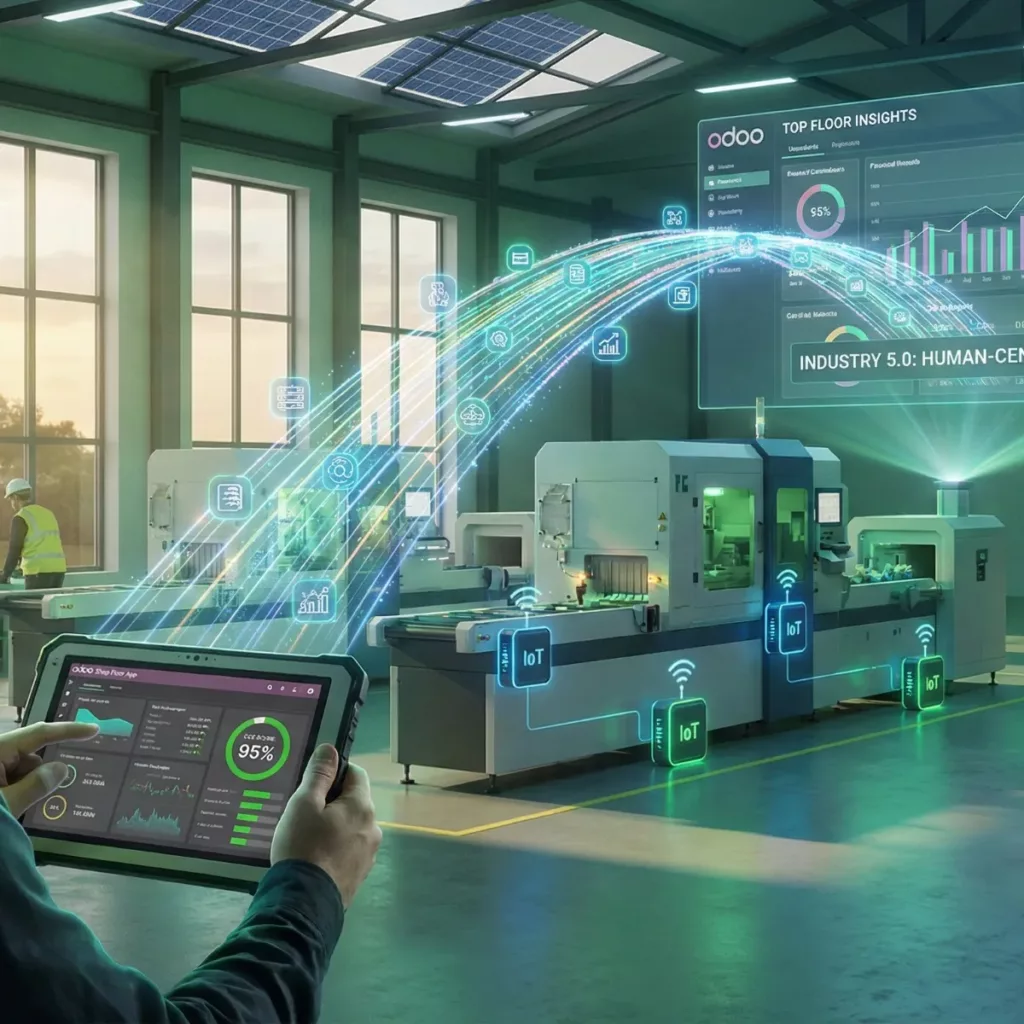
- Odoo Integration: By connecting IoT sensors to Odoo’s Manufacturing module, businesses can track real-time power consumption per work center. This data is no longer siloed; it flows directly into your sustainability reports, providing a transparent view of your facility’s environmental footprint.
Overcoming “Digital Concrete”
Legacy ERP systems often act as “digital concrete”—rigid structures that prevent agility. In 2026, Odoo serves as a fluid digital backbone.
- Modular MRP: Unlike monolithic systems, Odoo’s MRP module is “lean-first,” allowing you to pivot production lines or change routings in minutes.
- Real-time Costing: As raw material prices fluctuate due to trade policies, Odoo provides real-time costing updates, ensuring your margins remain protected during a pivot.
How Odoo ERP Bridges Gaps Between Production and Management
Odoo addresses the fragmentation of modern manufacturing by replacing “Patchwork Architecture”—separate software for accounting, MRP, PLM, and quality—with a Unified Data Model. This integration ensures that every stakeholder, from the CEO to the machine operator, works from the same real-time data set.
1. The “Single Source of Truth” Architecture
In Odoo, the traditional wall between the “Top Floor” (Management/Finance) and the “Shop Floor” (Production) dissolves through seamless data propagation.
- Real-Time Valuation: Odoo utilizes a perpetual inventory valuation system. Every barcode scan on the production line—from raw material consumption to finished goods storage—instantly updates Work-in-Progress (WIP) assets on the balance sheet. This removes the “reporting lag,” ensuring financial statements reflect physical reality in real time.
- Integrated PLM and Quality: Unlike competitors where Product Lifecycle Management (PLM) is a bolt-on, Odoo’s native PLM ensures Engineering Change Orders (ECOs) sync instantly. When an engineer approves a new Bill of Materials (BoM) version, the machine operator’s tablet updates immediately, preventing the production of obsolete or non-compliant revisions.
2. The Tablet-First Shop Floor
Odoo’s Manufacturing Execution System (MES) is designed for the modern mobile worker, typically deployed on low-cost consumer tablets. This Work Center Control Panel transforms the operator’s experience:
- Interactive Worksheets: Operators can view PDF drawings, instructional videos, or slides directly at their station.
- On-the-Fly Maintenance: If a machine malfunctions, workers can trigger a maintenance request directly from the line, which alerts the technical team and can automatically block the work center from further scheduling.
- Digital Thread Traceability: Recording serial numbers, lot numbers, and quality checks is done with a single tap. This creates an “unbreakable” digital thread, essential for industries with high compliance needs like aerospace or medical devices.
3. Smart Manufacturing (Odoo 18/19 Enhancements)
As we move into 2026, Odoo has further refined the connection between production and intelligence.
- AI-Powered Demand Prediction: Odoo 18/19 leverages AI to forecast component needs, reducing stockouts that typically halt production lines.
- Unified UoM and Packaging: The new versions use a simplified, unified model for units of measure and “pack-in-pack” tracking, eliminating the manual conversion errors that often lead to inventory discrepancies between production and accounting.
Vinova’s Custom Modules for Production Planning and Inventory Control
While Odoo provides a robust core, the high-stakes regulatory and operational demands of U.S. manufacturing in 2026 require specialized adaptation. Vinova, as a strategic Odoo partner, utilizes a “Modular Customization” strategy. We focus on extending Odoo’s functionality through encapsulated modules that preserve the integrity of the core system, ensuring seamless future upgrades to Odoo 19 and beyond.
1. Extending the Edge with Custom Mobile Apps
Vinova develops custom Android/iOS applications that interface directly with the Odoo backend via secure APIs. This extends your ERP’s intelligence to the very edge of your operations.
- Field Service & Logistics: For U.S. manufacturers with remote warehouse nodes or field technicians, our custom apps provide offline-first capabilities. Technicians can scan inventory, log material usage, and capture digital signatures even in dead zones. The system automatically syncs and triggers invoicing the moment connectivity is restored.
- Proprietary Planning Logic: We recognize that U.S. manufacturers face unique constraints, such as complex overtime rules or union-mandated break schedules. Vinova builds custom Production Planning modules that integrate these variables directly into the Master Production Schedule (MPS) logic, preventing scheduling conflicts before they occur.
2. Traceability and “Last Mile” Compliance
In 2026, traceability is not just about tracking—it is about survival. Vinova configures Odoo to meet the specific “Last Mile” requirements of highly regulated U.S. industries.
- FDA & MedTech Compliance: Drawing on Odoo 18’s enhanced traceability, we implement full lifecycle transparency. This includes linking serial numbers directly to supplier certifications and automated batch recall workflows, ensuring you are “audit-ready” at all times.
- Aerospace & Defense (CMMC): We harden Odoo environments to meet CMMC 2.0 standards. This involves implementing granular audit trails, encrypted data storage, and restricted access controls to protect sensitive technical data (CTI).
- Tax & Financial Localization: We integrate Odoo with Avalara to handle the thousands of U.S. tax jurisdictions automatically, ensuring your multi-state sales remain compliant with the latest nexus laws.
3. The “Adopt, Don’t Adapt” Philosophy
Our methodology emphasizes using Odoo’s standard features whenever possible—what we call “Adopt, Don’t Adapt.” * The Strategy: We push complex, proprietary business logic into independent, maintainable modules.
- The Benefit: This keeps your Odoo core “clean,” significantly reducing the cost and complexity of upgrading to new versions (like the upcoming Odoo 19), while still providing the tailored functionality your U.S. operations require.
Real Results: Lower Costs, Higher Throughput, Smarter Decisions
Based on validated implementation data from 2025–2026, the following scenarios illustrate how Vinova’s tailored Odoo solutions transform manufacturing operations. These models demonstrate the projected impact of migrating from fragmented systems to an intelligent ERP ecosystem.
Scenario A: Heavy Industry & Steel Fabrication
The Challenge: A structural steel producer struggles with quoting speed. Sales engineers use manual Excel sheets for 700+ parameters (grade, coating, dimensions), leading to 48-hour quote delays and frequent production rejections due to data entry errors.
The Vinova Solution: Vinova deploys Odoo Enterprise with a Custom Parametric Configurator. This logic-based module replaces spreadsheets, allowing sales teams to select parameters and automatically generate accurate Bills of Materials (BoMs) based on live commodity price feeds.
| Metric | Projected Impact | Business Outcome |
| Throughput Velocity | 30% Increase | Faster handoffs from Sales to Engineering. |
| Quoting Efficiency | 50% Reduction in Time | Engineers focus on acquisition, not data entry. |
| Revision Control | 100% Visibility | Zero risk of producing the wrong steel grade. |
Scenario B: Industrial Machinery & Assembly
The Challenge: A packaging machinery manufacturer operates in “firefighting mode.” Disconnected purchasing and production systems lead to critical stockouts, forcing expensive expedited shipping that erodes profit margins.
The Vinova Solution: Vinova implements Automated Replenishment & Dynamic Routing. By setting min/max rules and lead-time buffers, Odoo triggers automated RFQs the moment a manufacturing order is confirmed. Digital routings replace paper “travelers,” guiding workers through complex builds.
- Supply Chain Resilience: A 40% reduction in emergency raw material purchases, recovering lost margins from expedite fees.
- Production Speed: Lead times drop by 25% as workers no longer wait for missing parts or unclear assembly instructions.
Scenario C: Precision Manufacturing & Metal Assemblies
The Challenge: A contract manufacturer with 200+ SKUs faces a “financial black box.” Finance teams spend 15 hours a week manually reconciling shop floor costs in QuickBooks, leaving leadership with no real-time view of job profitability.
The Vinova Solution: Vinova unifies the architecture by integrating Manufacturing and Accounting via Analytic Accounting. Every labor hour and material cost is automatically tagged to specific projects. An Avalara integration handles multi-state tax complexities.
- Financial Efficiency: The team saves 15 hours per week, repurposing that time for strategic growth analysis.
- Data Integrity: Bank reconciliation errors drop by 90% through automated matching.
- Risk Mitigation: Automating sales tax calculations saves an estimated $10,000 annually in potential compliance penalties.
Integration with IoT and Data Analytics for Better Insights
In 2026, data is the raw material of decision-making. Odoo’s IoT and Analytics capabilities turn physical machine data into actionable business intelligence.
The Odoo IoT Box
The IoT Box serves as the bridge between “Operational Technology” (machines) and “Information Technology” (ERP).
- Direct Connectivity: It connects industrial devices—digital calipers, footswitches, scales, and cameras—directly to the Odoo database via WiFi, Bluetooth, or HDMI.
- Real-World Application: When a quality inspector measures a part with a connected Bluetooth caliper, the measurement is instantly recorded in the Quality Control module. If the value is out of tolerance, the system automatically blocks the manufacturing order and alerts a supervisor, removing human error and data falsification from the process.4
Agentic AI and Predictive Analytics (Odoo 19)
In 2026, data is the raw material of decision-making. The transition from Odoo 18 to Odoo 19 (released September 2025) marks a shift where your ERP no longer just records what happened, but actively suggests what should happen next through a combination of physical machine data and “Agentic AI.”
The Odoo IoT Box: Bridging OT and IT
The IoT Box serves as the vital bridge between “Operational Technology” (the hardware on your floor) and “Information Technology” (your Odoo database).
- Direct Connectivity: It connects industrial devices—digital calipers, footswitches, scales, and cameras—directly to Odoo via WiFi, Bluetooth, or HDMI.
- Eliminating Human Error: When a quality inspector measures a part with a connected Bluetooth caliper, the value is instantly recorded in the Quality Control module.
- Real-Time Guardrails: If a measurement falls out of tolerance, the system can automatically block the manufacturing order and trigger a “Quality Alert” to the supervisor’s dashboard, preventing non-compliant goods from ever leaving the station.
Agentic AI and Predictive Analytics (Odoo 19)
The Odoo 19 era introduces “Agentic AI”—autonomous assistants that can perform tasks, not just summarize text.
- Predictive Maintenance: By streaming vibration and temperature data from IoT-connected machines into Odoo, the system’s AI agents identify patterns that precede failure. It shifts your strategy from “Reactive Repair” to “Proactive Prevention,” automatically scheduling maintenance during non-production hours.
- Smarter Demand Forecasting: Odoo 19’s new AI app analyzes historical sales, seasonality, and external market variables to generate Demand Forecasts.
- Autonomous Replenishment: These forecasts feed directly into your Min/Max Reordering Rules. The AI can now draft Purchase Orders or Manufacturing Orders autonomously to ensure you never face a stockout on fast-moving items while minimizing the capital tied up in “dead stock.”
The “Ask AI” Advantage
Introduced as a core feature of the Odoo 19 ecosystem, “Ask AI” democratizes data access across your organization.
- Natural Language Queries: Instead of building complex SQL reports, a manager can simply type: “Show me which machines in the Houston plant had the most downtime last month” or “Predict my cash flow for Q1 based on current open invoices.”
- Visualized Insights: The system doesn’t just provide text; it renders instant, visualized graphs and tables, reducing the “Time-to-Insight” from hours to seconds.
Building a Connected Factory with Odoo ERP and Vinova
The “Connected Factory” of 2026 is no longer a futuristic concept; it is a live operational standard. Success is not defined by merely installing sensors, but by creating a unified ecosystem where data flows unimpeded from a shop floor vibration sensor to the CFO’s live cash-flow dashboard.
The Strategic Partnership: Beyond the Software
Achieving a true Industry 5.0 environment requires an implementation partner who understands both the nuance of Python code and the physical realities of the factory floor. Vinova serves as the bridge between high-level digital strategy and boots-on-the-ground execution.
1. System Design: Mirroring Physical Workflows
Vinova’s architects do not simply “install” Odoo; they perform a Business Process Analysis (BPA) to ensure the software architecture reflects your physical factory layout.
- Dynamic Routing: We configure Odoo to mirror your exact work centers and routings, ensuring that the digital “twin” of your production process provides accurate lead times and capacity planning.
- Master Data Hygiene: We execute a “Data Readiness Sprint” to normalize your master data (BoMs, SKUs, and Vendor records), ensuring your AI forecasting is built on a foundation of truth.
2. Hardware Integration: Ergonomics at the Edge
A connected factory is only as strong as its weakest link. Vinova specializes in the deployment of Odoo IoT Boxes and ruggedized hardware interfaces.
- Ergonomic Tablet Interfaces: We configure the Odoo Shop Floor app with task-first UX—using role-based menus and high-visibility cards—designed for workers wearing gloves or operating in high-glare environments.
- Direct Device Communication: By linking digital scales, footswitches, and cameras directly to Odoo, we remove the “manual data entry” bottleneck, allowing your operators to stay focused on craftsmanship rather than keyboards.
3. Change Management: Transitioning the Workforce
ERP failure is rarely a technical issue; it is a human one. Vinova’s 6-phase implementation methodology prioritizes user adoption.
- The Training Loop: We identify “Departmental Champions” early in the project and provide them with hands-on training and short-form video SOPs.
- Hypercare Support: During the critical post-launch period, our teams provide high-velocity support to address user friction points instantly, preventing the “reversion to old habits” that often plagues legacy migrations.
Building for the Next Decade
By combining Odoo’s modular, open-core technology with Vinova’s expertise in custom mobile extensions and U.S. regulatory compliance (CMMC/HIPAA), manufacturers can build a digital infrastructure that is resilient, scalable, and ready for the autonomous agents of tomorrow.
Conclusion
Legacy ERP systems are no longer just outdated; they are an $11 million penalty on your business. Rigid structures stifle growth, while the new Industry 5.0 standard demands a fluid digital backbone.
Odoo’s modular design provides the unified data model you need to survive.
Real results confirm the power of this shift. By moving to Odoo, you build a resilient, connected factory ready for Agentic AI, delivering:
- 35% increase in production efficiency.
- 18–20% savings in operational costs.
- Accelerated timelines (average reduction of two weeks).
- Compliance readiness for strict standards like CMMC and FDA.
Stop trying to adapt old software to a new world.
See exactly how Odoo handles your production floor. Schedule a 15-minute assessment of your current system now.
Frequently Asked Questions (FAQs)
What is the “Industry 5.0 mandate” and the associated “lock-in penalty”?
Industry 5.0, mandated by 2026, is an era in manufacturing focused on the synergy between high-speed automation and human ingenuity, emphasizing resilience and sustainability. The “$11 million ‘lock-in penalty'” refers to the estimated cost that firms face due to rigid, closed legacy ERP ecosystems that prevent agile upgrades and modular factory scaling, which is necessary for the current environment of US reshoring.
What is Capital and Carbon Efficiency (CCE), and why is it replacing Overall Equipment Effectiveness (OEE)?
CCE (Capital and Carbon Efficiency) is the new metric superseding the traditional OEE (Overall Equipment Effectiveness). While OEE tracks how fast a machine runs, CCE tracks the “carbon cost” and energy/material consumption of every unit produced. This shift is driven by Tier 1 buyer requirements and regulatory mandates that require manufacturers to track their real-time sustainability and environmental footprint.
How does Odoo ERP create a “Single Source of Truth” in a manufacturing environment?
Odoo replaces “Patchwork Architecture”—separate software for accounting, MRP, PLM, and quality—with a Unified Data Model. This integration dissolves the wall between Management and the Shop Floor. For example, every barcode scan on the production line instantly updates Work-in-Progress (WIP) assets on the balance sheet (real-time valuation), and Engineering Change Orders (ECOs) in PLM sync immediately to the machine operator’s tablet, ensuring all stakeholders are working from the same, real-time data set.
What is the role of the Odoo IoT Box in a Connected Factory?
The IoT Box acts as the bridge between “Operational Technology” (OT, the physical machines) and “Information Technology” (IT, the Odoo ERP database). It connects industrial devices like digital calipers, scales, and cameras directly to Odoo via WiFi or Bluetooth. This eliminates manual data entry, allows real-time data recording for quality control, and ensures that if a measurement is out of tolerance, the system can instantly block the manufacturing order and alert a supervisor.
What is Vinova’s “Adopt, Don’t Adapt” philosophy for Odoo implementation?
Vinova’s methodology prioritizes using Odoo’s standard, core features whenever possible to keep the system “clean.” Instead of heavily modifying the core Odoo code (which makes future upgrades difficult), they push complex, proprietary business logic for unique U.S. operational needs (like custom planning or complex tax/compliance) into independent, maintainable, encapsulated modules. This significantly reduces the cost and complexity of upgrading to new versions like Odoo 19.