Is your retail operation still waiting for human approval while your competitors automate their decisions?
In 2026, the industry has moved past simple predictions to Agentic AI that manages inventory and energy in real-time. Market leaders are now using autonomous agents to cut supply chain errors by 60% and reduce energy costs by up to 25%. These systems don’t just alert you to problems; they solve them instantly.
Read on to learn how to integrate these agentic workflows into your own stores and logistics to stay competitive.
Table of Contents
Key Takeaways:
- AI-driven energy optimization, using Decision-Focused Learning (DFL), can achieve an up to 40% reduction in retail HVAC costs and carbon emissions by strategically shifting usage.
- Agentic AI, operating on an OODA loop, creates a “self-healing” supply chain, with market leaders reducing supply chain errors by 60%.
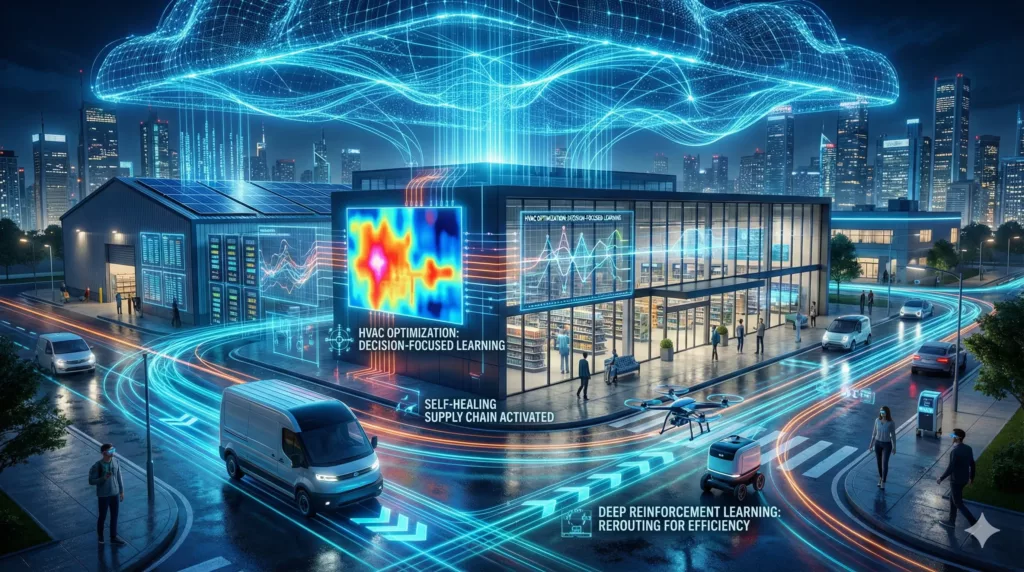
- Deep Reinforcement Learning in logistics agents cuts last-mile fuel costs by 18% and pushes on-time arrivals to 95% by dynamically rerouting in under 90 seconds.
- Predictive Maintenance, using prognostics with 99.6% accuracy, reduces maintenance costs by 25% and increases equipment uptime by 20%.
How Can AI-Driven Energy Optimization Harness the Thermodynamics of Profit?
In the United States, buildings generate roughly 31% of greenhouse gas emissions when accounting for electricity. For retail giants, HVAC systems are the largest expense, using 40% of a building’s total power. By 2026, many US retailers are hitting a 40% reduction in HVAC costs through AI, rather than expensive hardware upgrades.
The Rise of Decision-Focused Learning (DFL)
Traditional energy models (White-Box models) rely on physical math. To work, they need exact data on insulation, windows, and ductwork for every store. This is impossible to scale across 2,000 unique retail locations.
In 2026, the industry has shifted to Decision-Focused Learning (DFL). Developed by researchers at Johns Hopkins University, DFL ignores “perfect” temperature predictions. Instead, it focuses on the cost of the decision.
Standard AI minimizes prediction error. DFL minimizes the total bill. The model integrates the final goal—lowest cost and lowest emissions—directly into its training loop:
𝓛(θ) = ∑_{i=1}^{N} Cost(h(yᵢ, Optimize(ŷᵢ(θ))))
If overestimating a building’s heat retention leads to a smarter cooling decision at 4:00 AM, the AI chooses that “error” to save the user money.
Mechanisms of Savings: “Free Cooling”
AI achieves a 40% reduction by finding thermodynamic opportunities that standard thermostats miss.
- Outside Air Optimization (OAO): Standard systems only look at temperature. AI systems, like those from 75F, use cloud data to calculate “enthalpy” (humidity). This allows the system to identify “free cooling” from outside air that humans would ignore. OAO provides three times more free cooling hours per year than traditional controls.
- Thermal Banking: Platforms like BrainBox AI treat a store’s concrete and steel as a battery. The AI pre-cools the building when electricity is cheap (off-peak). It then allows the temperature to drift slightly during expensive peak hours, using the stored “coolness” to stay comfortable without running compressors.
Retail Success: 2026 Case Studies
The “40% savings” target is a reality for early adopters. While energy bills typically drop by 20–25%, carbon emissions reductions often hit the 40% mark because the AI shifts usage to cleaner grid times.
| Retailer / Project | Achievement | Primary Mechanism |
| Dollar Tree | 8,299 tCO2eq Reduction | BrainBox AI across 3,000 stores; optimized RTU runtimes. |
| HOM Furniture | 21.1% Cost Reduction | 75F OAO; replaced 10-year-old control logic with cloud AI. |
| Rockler Woodworking | 32% Energy Cost Savings | Standardized AI controls; ROI achieved in 12 months. |
| Bright Power HQ | 50% Heating Reduction | IoT sensors optimizing boiler and heat pump cycles. |
For many, these results come without replacing a single rooftop unit. In 2026, intelligence is the most cost-effective retrofit. By reducing machine runtime, AI also extends the life of existing equipment, deferring millions in capital costs.
How Do Grid-Interactive Efficient Buildings (GEBs) Turn the Retailer into a Virtual Power Plant?
By 2026, the definition of a “smart building” has changed. Efficiency is no longer enough. A building must now be Grid-Interactive. These Grid-Interactive Efficient Buildings (GEBs) talk to the power grid. They shift or shed their power load based on grid stress or price signals.
The US Department of Energy estimates that this flexibility could save the US power system up to $200 billion by 2030. It could also cut 80 million tons of CO2 emissions per year. Retailers are leading this trend. The global GEB market is expected to reach $18.57 billion in 2026.
Target: The Demand Response Leader
Target Corporation is a prime example of this model. By 2026, Target has enrolled nearly half of its 2,000 stores in demand response (DR) programs.
When the grid is stressed—usually on hot afternoons—the utility sends a signal to Target’s systems. The store automatically starts a “shed” protocol:
- HVAC: Systems are cycled off or temperatures are raised by 1–3 degrees.
- Lighting: Sales floor lights are dimmed to safe levels.
- Refrigeration: Non-essential heaters on glass doors are turned off.
This helps the utility avoid blackouts and keeps “dirty” backup power plants offline. In return, Target receives payments from the utility, turning energy management into a source of revenue.
Walmart: Ambient IoT and Virtual Power Plants
Walmart is moving even faster. By the end of 2026, Walmart will have installed battery-free “Ambient IoT” sensors across 4,600 U.S. stores and 40 distribution centers.
These sensors harvest energy from radio waves and light. They provide real-time data on the temperature of every freezer case and the foot traffic in every aisle. This data allows Walmart to build a Virtual Power Plant (VPP). Instead of shutting down a whole building, an AI can make thousands of tiny, “surgical” adjustments—like delaying a defrost cycle in one aisle—to save megawatts of power. Walmart can then sell this saved energy back to the grid.
The Role of Edge Computing
To manage these systems without lag or security risks, retailers use Edge Computing. This means processing data locally at the store rather than sending everything to a distant cloud.
- Speed: Frequency regulation for the grid requires a response in milliseconds. Only local “edge” servers can react this fast.
- Resiliency: If the internet goes down, the edge controller keeps the HVAC and food cooling running safely.
- Bandwidth: Sending terabytes of raw sensor data to the cloud is too expensive. Edge clusters filter the data and only send important alerts to the central office.
How is the Agentic Supply Chain Moving from Analysis to Autonomy?
The biggest shift in 2026 is the rise of Agentic AI. While standard AI creates content, Agentic AI executes tasks. These autonomous “agents” can reason, plan, and work with other systems to meet business goals without needing a human to click “approve” every time.
What is a Retail AI Agent?
In 2026, a logistics agent follows a loop called OODA:
- Observe: It reads real-time data from warehouses, weather reports, and social trends.
- Orient: It checks this data against goals, like “keep shipping costs low.”
- Decide: It runs simulations to find the best path forward.
- Act: It places orders or updates schedules directly in the database.
McKinsey research shows that 62% of companies are now moving from “AI assistants” to agents that act on their behalf.
Walmart’s “Self-Healing” Workflow
Walmart uses a Multi-Agent Architecture where specialized agents work together like a digital crew:
- Procurement Agents: They watch for demand spikes. If a storm is coming, they automatically order extra water and batteries for local stores.
- Logistics Agents: If a delivery truck is stuck in traffic, the agent recalculates the customer’s delivery window to the exact minute.
- Inventory Agents: These agents learn from every order. They move products to the best possible locations to make last-mile delivery faster and cheaper.
This system allows Walmart to react in minutes rather than days. It essentially “self-heals” the supply chain when things go wrong.
Autonomous Inventory Rebalancing
A major retail headache is having too many items in one store and not enough in another. In 2026, Rebalancing Agents solve this instantly.
Example:
- The Signal: An agent sees a social media trend for a specific jacket.
- The Search: It finds these jackets sitting in a store where the weather is warm.
- The Action: The agent automatically orders the stock to be moved to a cold-weather city where the trend is peaking. It also locks the price to prevent unnecessary discounts.
This is powered by Multi-Agent Reinforcement Learning (MARL). Different agents “negotiate” to find the best balance between high sales and low shipping costs.
Amazon’s Logic-Based Logistics
Amazon uses Logistics Agents built on its Bedrock platform. These agents use logic-based reasoning to handle complex scheduling problems. They don’t just follow a script; they mimic human logic to solve exceptions. This allows Amazon to manage its massive delivery network with very little human intervention, even when global shipping routes are disrupted.
How Do Algorithmic Logistics and Real-Time AI Optimize the Last Mile?
The “Last Mile” is the most expensive part of the supply chain. In 2026, it accounts for 53% of total shipping costs. To lower these costs, retail giants have moved beyond simple maps to dynamic, real-time AI and autonomous hardware.
Reinforcement Learning for Dynamic Rerouting
Traditional routing creates a static plan at the start of the day. In 2026, logistics agents use Deep Reinforcement Learning (DRL) to adapt as they move.
- Proximal Policy Optimization (PPO): This has become the industry standard for training delivery agents. PPO allows the AI to learn stable strategies in complex cities. For example, it can decide to move a package via a city bus for part of the trip to save fuel.
- Real-Time Adaptation: These algorithms can react to a traffic accident or a canceled order in under 90 seconds. By constantly recalculating the “reward function”—balancing fuel, time, and safety—the AI reroutes drivers mid-shift. This has cut fuel costs by 18% and pushed on-time arrivals to 95%.
Swarm Intelligence and Multi-Modal Logistics
The 2026 network uses a mix of vans, drones, and sidewalk robots. Coordinating these different machines requires Swarm Intelligence, which mimics biological systems like ant colonies.
- Information Sharing: If one sidewalk robot finds a blocked path, it instantly tells the “swarm memory.” Every other robot in the area then updates its route to avoid the same block.
- Self-Organization: If one sector is overwhelmed with orders, ground robots can autonomously move from a quiet area to help. The swarm focuses on “group efficiency” rather than individual speed.
The Hardware of Autonomy: 2026 Market Status
Autonomous delivery is no longer a test; it is now in full production.
- Drone Delivery: Walmart and Wing (owned by Alphabet) expanded to 150 new stores in early 2026. They now provide 30-minute delivery for millions of households. Houston was the first major metro to launch in this expansion.
- Sidewalk Robots: Companies like Serve Robotics and Starship have deployed over 1,000 robots each across major cities and campuses. These robots use “Physical AI” to navigate pedestrians and traffic signals safely.
- Market Growth: The US autonomous last-mile market is valued at approximately $24.5 million in 2026. While this sounds small, it represents the sale of the technology itself. The actual value of the goods moved by these machines is in the billions.
How Does Predictive Maintenance and Physical AI Ensure Asset Immortality?
In retail, equipment failure is a profit killer. A broken refrigeration compressor leads to thousands of dollars in spoiled food and emergency repair bills. By 2026, Predictive Maintenance (PdM) is the industry standard for protecting critical assets.
Axiom Cloud and the Cold Chain
Axiom Cloud provides a primary case study for 2026. A national grocery chain used their AI to monitor refrigeration across 115 stores.
- The Setup: The system required zero new hardware. It connected directly to existing controllers to harvest data.
- The Process: The AI analyzed pressure and temperature to find tiny leaks or valve failures that humans often miss.
- The Results: In one year, the system identified 238 anomalies. This saved the chain $1.4 million. Of that, $860,000 came from avoiding emergency repairs and energy waste. The rest came from preventing food spoilage.
Maintenance Technologies in 2026
Retailers are using three main technologies to achieve “asset immortality”:
- Vibration and Acoustic Analysis: Sensors “listen” to machines. Platforms like Carrier’s Abound detect a change in a motor’s hum weeks before it fails. This uses edge computing to process high-frequency sound data right at the machine.
- Digital Twins: Retailers build virtual replicas of their warehouses. AI runs thousands of “what-if” cycles on the twin to see when a belt or motor will wear out. This allows teams to fix parts during scheduled breaks rather than during a holiday rush.
- Prognostics: The field has moved from diagnostics (what is broken?) to prognostics (how much life is left?). New AI models can predict the Remaining Useful Life (RUL) of a component with up to 99.6% accuracy.
By shifting from “break-fix” to “predict-act,” retailers can reduce maintenance costs by 25% and increase equipment uptime by 20%. In 2026, staying competitive means ensuring your hardware never truly dies.
What Technological Substrate of Edge Computing, 5G, and Governance Supports Advanced AI?
Advanced AI capabilities like Agentic AI and Swarm Intelligence require a modern physical foundation. In 2026, the shift is moving away from the cloud and back to the store through Edge Computing and 5G.
Edge Computing: Processing at the Point of Sale
The strategic goal for 2026 is to process data as close to the action as possible. Sending every video feed and sensor signal to a central cloud is too slow and expensive.
- Speed: A sidewalk delivery robot or a checkout-lane AI cannot wait 100 milliseconds for a response from the cloud. It needs a response in under 10 milliseconds to avoid accidents or lag.
- Privacy: Retailers use “Vision AI” to track queue lengths and shopper habits. Processing this video at the edge means personal data never leaves the store, helping companies stay compliant with privacy laws like the CCPA.
- Next-Gen Hardware: At the NRF 2026 show, Intel launched its Core Ultra Series 3 “Panther Lake” processors, designed specifically for retail edge AI. Simultaneously, NVIDIA introduced the Rubin platform, which cuts the cost of running AI agents by 10x compared to older hardware.
Governance and “Human-in-the-Loop”
As AI agents gain the power to place orders and change prices, “trust” has replaced “technology” as the main barrier to adoption. CIOs are now using two methods to manage these agents:
- Policy-as-Code: This system uses machine-readable rules to set hard limits on what an AI can do. For example, a pricing agent might have the power to lower prices during a sale, but a “code-based policy” prevents it from ever dropping the margin below 10%.
- Explainable AI (XAI): Transparency is key for the “Human-in-the-Loop” model. If an AI agent reroutes a shipping truck, it must generate a log explaining its logic—such as “45-minute delay detected on I-95.”
These governance tools ensure that humans stay in control of the high-level strategy, while the AI handles the minute-by-minute tactical decisions.
Conclusion and Future Outlook
Artificial Intelligence is the bedrock of retail success in 2026. It is no longer a pilot project. Use Decision-Focused Learning to cut your energy costs by 25%. Deploy Agentic Workflows to reduce supply chain errors by 60%. These tools create a “Self-Correcting Enterprise” that reacts faster than the market changes.
Vinova develops MVPs for tech-driven businesses. We help you build autonomous systems that act on the future. Our team manages the technical complexity while you focus on your business goals. We turn your fragmented data into a resilient engine for growth.
Contact Vinova today to start your MVP development. Let us build the autonomous retail tools you need to lead in 2026.Artificial Intelligence is the bedrock of retail success in 2026. It is no longer a pilot project. Use Decision-Focused Learning to cut your energy costs by 25%. Deploy Agentic Workflows to reduce supply chain errors by 60%. These tools create a “Self-Correcting Enterprise” that reacts faster than the market changes.
Vinova develops MVPs for tech-driven businesses. We help you build autonomous systems that act on the future. Our team manages the technical complexity while you focus on your business goals. We turn your fragmented data into a resilient engine for growth.
Contact Vinova today to start your MVP development. Let us build the autonomous retail tools you need to lead in 2026.
FAQs:
How much can AI reduce retail HVAC energy costs?
AI-driven energy optimization can lead to a significant reduction in retail HVAC energy costs, with many U.S. retailers achieving an up to 40% reduction without expensive hardware upgrades.
While the financial energy bills typically decrease by 20–25%, the environmental impact is often higher, with carbon emissions reductions frequently hitting the 40% mark because the AI strategically shifts energy usage to cleaner grid times.
What is agentic AI in retail logistics?
Agentic AI represents a major shift from AI that creates content to AI that executes tasks autonomously. In retail logistics, Agentic AI refers to autonomous agents that can reason, plan, and work with other systems to meet business goals without requiring human approval for every decision.
A logistics agent operates using the OODA loop (Observe, Orient, Decide, Act). In practice, this takes the form of a Multi-Agent Architecture where specialized agents work together for a “self-healing” workflow, such as:
- Procurement Agents: Automatically ordering extra stock, like water and batteries, ahead of predicted demand spikes (e.g., before a storm).
- Logistics Agents: Instantly recalculating a customer’s delivery window if a truck is delayed by traffic.
- Inventory Agents: Rebalancing Agents that automatically move products between stores based on real-time signals, like a social media trend for a specific item.
How do algorithms optimize last-mile delivery in 2026?
Logistics agents in 2026 primarily use Deep Reinforcement Learning (DRL) algorithms for dynamic, real-time rerouting, moving past static, pre-planned routes.
- Deep Reinforcement Learning (DRL): Algorithms like Proximal Policy Optimization (PPO) enable the AI to adapt as vehicles move, constantly recalculating the “reward function”—balancing fuel, time, and safety. This allows the AI to react to a traffic accident or canceled order in under 90 seconds, rerouting drivers mid-shift. This has cut fuel costs by 18% and pushed on-time arrivals to 95%.
- Swarm Intelligence: This coordinates mixed fleets of vans, drones, and sidewalk robots. If one unit encounters an obstacle, it instantly shares that information with the “swarm memory,” allowing all other robots in the area to autonomously update their routes, focusing on overall “group efficiency.”
Can AI prevent retail equipment failure before it happens?
Yes, AI is the industry standard for preventing equipment failure through Predictive Maintenance (PdM). This approach moves the focus from diagnostics (what is broken?) to prognostics (how much life is left?).
Advanced AI models can predict the Remaining Useful Life (RUL) of a component with up to 99.6% accuracy. By shifting from a “break-fix” model to “predict-act,” retailers can:
- Reduce maintenance costs by 25%.
- Increase equipment uptime by 20%.
For example, a system like Axiom Cloud can analyze pressure and temperature in refrigeration units to find tiny leaks or valve failures that humans often miss, protecting against food spoilage and expensive emergency repairs.
What are the best energy-saving retail technologies for 2026?
The most effective energy-saving retail technologies focus on intelligence rather than expensive hardware replacement:
| Technology | What It Does | Key Mechanism |
| Decision-Focused Learning (DFL) | An AI model that minimizes the total bill (cost and emissions) directly, rather than just minimizing prediction errors for physical models. | It chooses the most cost-effective decision, even if it involves a “smarter error.” |
| Grid-Interactive Efficient Buildings (GEBs) | Buildings that “talk” to the power grid, shifting or shedding their power load based on utility price signals or grid stress. | Allows retailers (like Target) to enroll in Demand Response programs, generating revenue by temporarily dimming lights or cycling off HVAC during peak hours to prevent blackouts. |
| Outside Air Optimization (OAO) | Systems (like from 75F) that use cloud data to calculate “enthalpy” (humidity) to identify moments for “free cooling” from outside air. | Provides three times more free cooling hours per year than traditional thermostats. |
| Thermal Banking | Platforms (like BrainBox AI) that treat the store’s concrete and steel as a battery by pre-cooling the building when electricity is cheap. | The building uses its “stored coolness” to maintain comfort during expensive peak hours without running compressors. |
| Virtual Power Plants (VPPs) | A network of stores with Ambient IoT sensors that allows an AI to make thousands of tiny, “surgical” adjustments (e.g., delaying a defrost cycle in one freezer aisle) to save megawatts of power. | The retailer can then sell this saved energy back to the grid. |