The US workforce is changing fast. By August 2025, over 55% of employees used generative AI, sparking a 1.3% jump in total labor productivity. This new wave moves beyond simple chatbots to complex “Agentic AI” that acts autonomously across systems.
However, buying a model is easy, but integration is hard. Are you prepared to redesign your core workflows for this shift, or is legacy infrastructure still holding your business back from real efficiency gains?
To unlock the full value of agentic systems, organizations must partner with teams experienced in ai development in usa, ensuring AI solutions are securely integrated into existing workflows, compliant with enterprise standards, and scalable across departments.
Table of Contents
Key Takeaways:
- Generative AI adoption by over 55% of the US workforce by 2025 has driven a 1.3% increase in total labor productivity, proving significant economic impact.
- The next major shift is to Agentic AI, moving from passive chatbots to autonomous digital agents that perceive, plan, and execute complex actions across various systems.
- AI accelerates knowledge work, with US developers reporting up to 56% faster coding speed and one retailer seeing a 297% increase in conversion rates from personalization.
- Vinova addresses US enterprise hurdles by offering a hybrid model that cuts development costs by up to 70% while ensuring compliance with standards like ISO 27001 and HIPAA.
Introduction – Understanding the Evolution of AI in 2025 and Beyond
To understand where AI is going, you must understand where it failed. The history of AI is not a straight line of progress. It is a cycle of massive hype followed by crushing disappointment. For sixty years, the industry oscillated between “Symbolic AI” (teaching computers rules) and “Connectionism” (building artificial brains). This conflict defined the modern tools we use today.
The Era of Symbolic Logic (1950–1974)
In the beginning, scientists believed intelligence was just advanced logic. If you could describe the world in symbols and rules, a computer could “think.”
- The Turing Test (1950): Alan Turing defined the goal. He argued that if a machine could converse indistinguishably from a human, it was intelligent. This set a behavioral standard rather than a technical one.
- The Dartmouth Conference (1956): John McCarthy coined the term “Artificial Intelligence.” Researchers claimed that a machine as intelligent as a human would exist within a generation. They were wrong.
- ELIZA (1966): MIT created the first chatbot. It simulated a psychotherapist using simple pattern matching. Users formed emotional bonds with it, proving that humans are desperate to anthropomorphize machines.
These early systems were “Symbolic AI.” They were brilliant at logic puzzles but failed at messy, real-world tasks. They could prove a theorem, but they could not read handwriting or understand a spoken sentence.
The First AI Winter (1974–1980)
By the mid-1970s, the government stopped paying for promises. The US and British governments cut funding. The problem was “combinatorial explosion.” As problems got bigger, the number of rules required to solve them became unmanageable. Progress stalled. Research centers closed. This taught the industry a brutal lesson: capabilities must match the sales pitch.
The Expert Systems Boom (1980–1987)
AI returned to the boardroom in the 1980s. This time, the scope was narrower. Instead of trying to build a human brain, companies built “Expert Systems.”
These programs followed strict “If-Then” rules derived from human specialists.
- XCON (e.g., DEC): A system that configured computer orders. It saved the company $40 million annually by reducing errors.
- Adoption: By 1985, corporations spent over a billion dollars on these systems.
However, these systems were brittle. If a situation fell outside their pre-programmed rules, they crashed. They could not learn or adapt. When desktop PCs became cheaper and faster than the specialized hardware these systems required, the market collapsed again. This was the Second AI Winter.
The Quiet Revolution: Machine Learning (1990–2010)
While the public lost interest, researchers changed tactics. They stopped trying to program intelligence. They started using statistics to find it.
- Deep Blue (1997): IBM’s system defeated world chess champion Garry Kasparov. It did not think; it used brute force calculation to evaluate millions of moves per second.
- The Data Shift: The internet explosion in the late 90s provided the raw fuel for a new approach: Machine Learning. Instead of coding rules, engineers fed data into algorithms that generated their own rules.
- Neural Networks Return: In the 2000s, researchers like Geoffrey Hinton persisted with “neural networks”—layers of mathematical nodes mimicking the brain. With better hardware (GPUs) and more data, these networks began to recognize images and speech better than any human-written code.
By 2010, the theoretical war was over. Connectionism (learning from data) had won. This set the stage for the Deep Learning explosion that powers today’s generative models.
From Rule-Based Systems to Deep Learning
The history of AI in US business is a quest to separate intelligence from biology. It is a story of cycles: immense optimism followed by crushing disappointment. Understanding this history helps us understand the tools we use today.
The Era of Symbolic AI (1950s–1980s)
For decades, the dominant approach was “Symbolic AI,” also known as Good Old-Fashioned AI (GOFAI). Scientists believed they could replicate intelligence by teaching computers logic rules.
The Logic of “If-Then” Early business systems did not learn. Programmers manually coded them with “if-then” logic taken from human experts.
- The Concept: A medical system might have a rule like: IF patient has a fever AND a cough, THEN the probability of flu is 70%.
- The Success: The “Expert System” boom of the 1980s was the peak of this era. A famous success was XCON, used by Digital Equipment Corporation (DEC). It configured complex computer orders automatically. XCON saved DEC millions of dollars annually, proving that AI could deliver a real Return on Investment (ROI).
The Crash: The AI Winter These systems had a fatal flaw: they were “brittle.” They worked perfectly in small, controlled scenarios but failed in the messy real world.
If a situation occurred that wasn’t in the code, the system crashed. Maintaining them was a nightmare because humans had to constantly update thousands of rules. By the late 1980s, corporations stopped buying, funding dried up, and the “AI Winter” began.
The Statistical Turn: Machine Learning (1990s–2000s)
AI returned in the 1990s. This time, it didn’t use logic rules. It used statistics. This was the birth of Machine Learning (ML). Computers began to identify patterns in data to create their own rules.
The Internet as Fuel The rise of the internet provided the massive datasets these algorithms needed.
- Spam Filters: Engineers stopped writing rules like “block the word lottery.” Instead, they fed the system thousands of spam and non-spam emails. The algorithm learned the statistical probability that a message was junk.
- Recommendation Engines: Amazon pioneered “collaborative filtering.” The system analyzed millions of purchases to predict what you might buy next based on what similar users bought.
- Deep Blue: In 1997, IBM’s Deep Blue defeated chess champion Garry Kasparov. It wasn’t “thinking” like a human, but it proved computers could handle complex strategy.
The Deep Learning Revolution (2010–2020)
Around 2012, AI changed again. Three things converged to create the “Deep Learning” era: massive amounts of Big Data, powerful GPU chips, and better algorithms.
Neural Networks Deep Learning mimics the human brain using Artificial Neural Networks (ANNs).
- Self-Learning: In the past, engineers had to tell the computer what to look for (like “edges” or “corners” to find a shape). Deep Learning does this automatically. It processes data through layers of simulated neurons. The first layer sees edges, the next sees shapes, and the final layer recognizes a face or a car.
- The Turning Point: In 2012, a Google-linked team won the ImageNet competition. Their neural network identified images with shocking accuracy. This proved that AI could handle messy data like photos and voice.
The “Black Box” Problem This power came with a cost. Deep Learning models are complex. They make decisions based on billions of connections, making it hard to explain why they made a specific choice. This “Black Box” issue remains a challenge for regulated industries like healthcare and finance today.
| Era | Key Technology | Business Application | Limitation |
| 1950s-1980s | Rule-Based / Expert Systems | Logistics configuration (XCON), basic diagnostics | Brittleness: Failed when encountering rules outside its programming. |
| 1990s-2000s | Machine Learning (Statistical) | Spam filtering, credit scoring, recommendation engines | Feature Engineering: Humans had to tell the AI what to look for. |
| 2010s-2020 | Deep Learning (Neural Networks) | Image recognition, voice assistants, autonomous driving | Data Hunger: Required massive labeled datasets (Big Data). |
The Rise of Generative AI and Automation
By 2025, AI development in the US changed focus. It moved from classification (identifying data) to generation (creating new data). Large Language Models (LLMs) drive this shift. This creates a new era of automation for creative and strategic tasks.
The Generative Shift (2023–2025)
The release of models like ChatGPT made advanced AI available to everyone. Before 2023, only data scientists used these tools. Now, any employee with a browser can use them.
Generative AI is a core part of US business. Research shows that 88% of organizations use AI regularly in at least one department. This is a significant jump from 78% just a year ago.
From Passive Tools to Active Agents
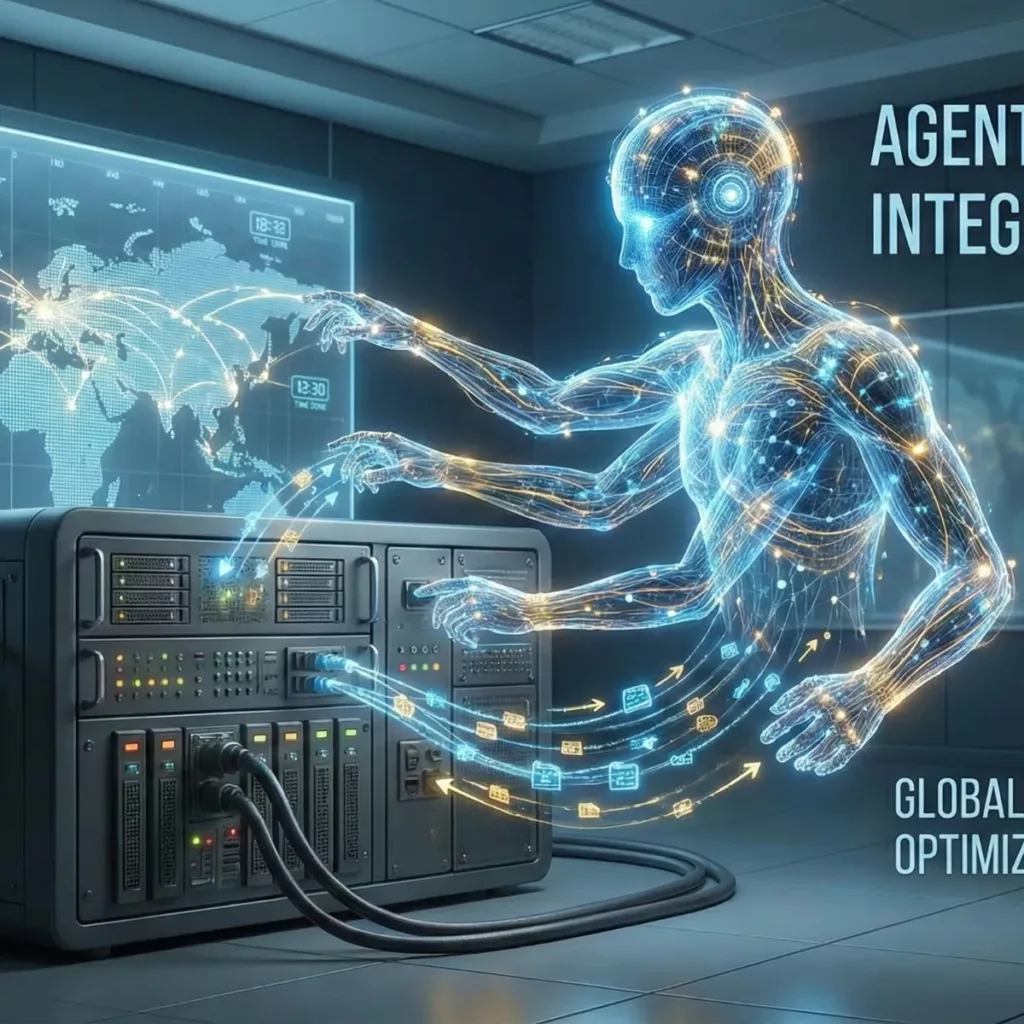
The most important update in 2025 is the move to Agentic AI.
- Passive AI (The Chatbot): You ask a question. The AI gives an answer. You must act on that information.
- Agentic AI (The Digital Employee): You give the AI a goal. It perceives the situation, plans steps, and executes actions across different software platforms.
Consider a logistics firm. An AI agent detects a weather delay in the Atlantic. It autonomously reroutes the supply chain to a southern port. It updates the inventory database. It drafts and sends emails to affected customers. It does all this without human help.
Surveys show 23% of enterprises are scaling these systems. Another 39% are currently experimenting with them. This forces companies to “rewire” their workflows.
The Productivity J-Curve
The economic impact is real. By August 2025, roughly 55% of the US workforce used generative AI.
Data suggests a “Productivity J-Curve.”
- The Dip: Initially, organizations face costs and friction as they redesign how they work.
- The Spike: Once systems are integrated, productivity accelerates rapidly.
Generative AI has increased total US labor productivity by 1.3%. This wave affects “knowledge work” like coding and writing, not just physical labor.
- Software Development: US developers using AI copilots report coding speed increases of up to 56%. This allows “citizen developers” to build apps easily.
- Customer Support: Generative agents handle complex questions. They increase task completion rates by 14% and reduce customer churn.
- Marketing and Design: 70.8% of businesses use generative design. They create multiple UI/UX variations instantly for rapid testing.
Challenges in the New Paradigm
Despite the benefits, US businesses face distinct hurdles in 2025.
Governance and Risk Autonomous agents create liability issues. If an AI agent negotiates a bad contract or makes an error in a trade, responsibility is unclear. There is a “governance gap” because regulations have not caught up with agentic decision-making.
Legacy Integration AI models are modern, but many US enterprises run on old infrastructure. Banking mainframes and decades-old ERPs are rigid. Connecting fluid AI agents to these static systems is a major technical bottleneck. It requires extensive API updates.
Data Sovereignty Companies worry about leaking Intellectual Property (IP) into public models. This drives the trend toward “Sovereign AI.” These are private, self-hosted models. They keep data, computing power, and model weights entirely within the company’s control. This isolates the business from external vendor risks.
How Vinova Adapts AI Frameworks for US Enterprises
US companies outside the “Big Tech” elite often lack the resources to build sophisticated AI infrastructure. The “War for Talent” drives salaries for AI engineers to unsustainable levels for mid-market firms. This gap elevates the role of specialized development partners like Vinova.
The Hybrid “Follow-the-Sun” Model
Vinova addresses the scarcity of domestic AI talent through a hybrid structure. They operate with headquarters in Singapore, development centers in Vietnam, and physical offices in California.
Operational Velocity This geographical distribution enables a continuous workflow. A US client in Seattle or San Jose defines requirements during their business day. As the US day ends, these requirements pass to the APAC teams. Development, testing, and QA occur while the US team sleeps. You receive results the next morning. This cycle accelerates time-to-market for MVPs and enterprise updates.
Cost Efficiency vs. Quality Assurance Pure outsourcing often causes communication breakdowns. Vinova mitigates this by keeping strategic management and client-facing roles in Singapore and the US. They leverage Vietnam’s engineering talent for execution. This structure reduces development costs by up to 70% compared to US-based teams, without the quality degradation found in typical low-cost outsourcing models.
Compliance as a Competitive Differentiator
For businesses in regulated sectors like healthcare and finance, security compliance is non-negotiable. Vinova acts as a risk partner by adhering to strict standards.
- ISO Certifications: Vinova holds ISO 9001 for Quality Management and ISO 27001 for Information Security Management. ISO 27001 mandates a systematic approach to managing sensitive data, providing assurance that IP remains secure.
- HIPAA Alignment: For healthcare clients, handling Protected Health Information (PHI) requires strict safeguards. Vinova builds apps with encryption, access controls, and audit trails embedded from the first line of code.
- SOC 2 Readiness: For SaaS companies, System and Organization Controls (SOC 2) are essential for enterprise sales. Vinova architects systems to meet these trust principles, which facilitates successful audits.
Strategic AI Development Services
The service portfolio targets the 2025 AI stack. It moves beyond simple web development to complex intelligent systems.
- AI & Machine Learning: They build custom AI models rather than just using off-the-shelf APIs. This includes bespoke predictive analytics engines and recommendation systems tailored to your specific data.
- Generative AI Integration: Vinova assists clients in integrating LLMs like GPT-4 into workflows. This involves prompt engineering and implementing ethical guardrails to prevent hallucinations or bias.
- Modernization of Legacy Systems: Many firms run on legacy PHP or .NET systems that cannot support modern agents. Vinova migrates these to AI-ready architectures like Node.js, React, and cloud-native environments. This creates the necessary API layers for AI integration.
Methodology: Agile and DevSecOps
AI projects require rapid iteration. Vinova employs Agile Scrum methodologies with short sprints of 1 to 4 weeks. This gives US clients visibility into progress and allows them to pivot based on real-time feedback.
They also integrate DevSecOps. Security checks sit directly in the CI/CD pipeline. As AI models are updated and retrained, the system detects vulnerabilities automatically. This prevents the introduction of risks during rapid deployment cycles.
Table: Vinova’s Strategic Alignment with US Enterprise Needs
| US Enterprise Pain Point | Vinova Solution | Evidence / Metric |
| High Cost of Domestic Talent | Hybrid Shore Model: Singapore Management + Vietnam Execution. | ~70% cost reduction compared to US onshore rates. |
| Talent Scarcity | Deep Talent Pool: Access to extensive engineering talent in SE Asia. | 500+ Team Size; 300+ projects delivered. |
| Regulatory Risk (HIPAA/SOC2) | Compliance-Ready Frameworks: Certified ISO 9001/27001 processes. | Work with Abbott (Healthcare) and OCBC (Banking). |
| Time-to-Market Pressure | Follow-the-Sun Workflow: 24-hour development cycle across time zones. | “Record time” delivery cited by Abbott Director. |
| Legacy Tech Debt | Modernization Services: Migrating legacy stacks to Cloud/AI-ready architectures. | Reviews citing successful system migrations. |
Case Study – AI-Driven Efficiency in US Retail
The US retail sector faces an “adapt or die” reality in 2025. The survivors of the last decade now fight an arms race of efficiency. Modern consumers expect a seamless experience everywhere. Vinova’s work illustrates the shift from reactive retail (responding to sales) to predictive retail (anticipating demand).
The Challenge: Data Fragmentation
US retailers operate across mobile apps, social media, and physical stores. The core problem is data fragmentation. Inventory data sits in one silo. Customer loyalty data sits in another. Online browsing history sits in a third.
This prevents a unified view of the customer. It leads to generic marketing, stockouts, and high churn. Studies show that 77% of retail companies struggle to extract useful insights from the data they already have.
The Solution: Unified Data and Predictive Intelligence
Vinova solves this by building a “Big Data” foundation. They unify disparate sources into a cohesive data lake before deploying AI.
Predictive Inventory Management Retailers analyze historical sales alongside external factors like weather and local events. This forecasts demand with 20% to 50% greater accuracy. It reduces the cost of overstocking (which kills margins) and understocking (which kills sales). In 2025, operational efficiency is the primary lever for profit.
Hyper-Personalization Engines Machine learning builds recommendation engines similar to Amazon or Netflix. These analyze past behavior to suggest products a user is statistically likely to buy.
This is the “N=1” Strategy. Treat every customer as a unique segment.
- Customer A: Buys running shorts and has a history of marathons. The AI suggests running shoes.
- Customer B: Buys the same shorts but purchases wellness products. The AI suggests a yoga mat.
The Impact One retailer utilizing these AI-driven personalization tools saw a 297% increase in conversion rates and a 27% rise in average order value (AOV).
Client Spotlight: Abbott and the “Internal Retail” Experience
Abbott, a global healthcare company, collaborated with Vinova on the “my benefit” HR mobile app. This project applied retail principles to internal enterprise services. Abbott needed to “sell” complex benefits packages to their own employees. This is a Business-to-Employee (B2E) retail experience.
The Execution Vinova developed a native iOS and Android application. It allowed employees to navigate benefits data intuitively. The team integrated Abbott’s legacy HR systems while providing a consumer-grade User Experience (UX) comparable to commercial apps like Spotify.
The Result The team delivered the app in record time. It streamlined the internal “transaction” of benefits management. This proved that retail principles—ease of use, speed, and personalization—apply equally to corporate tools.
Broader Impact: Logistics and Fintech
Vinova extends this expertise to adjacent sectors.
- Soulara: For this plant-based meal delivery service, the challenge was logistics. The team used data to predict churn and optimize delivery routes in a highly competitive market.
- Fintech: Vinova developed a personal finance app for a US startup. It achieved a 4.8-star rating from over 10,000 reviews. The app utilized AI for secure data encryption and personalized financial insights, demonstrating the capacity to build high-engagement consumer products.
Table 3: Economic Impact of AI Adoption in the US (2025 Snapshot)
| Metric | Value | Implication |
| Generative AI Adoption Rate | 54.6% (Workforce) | Faster diffusion than PC or Internet; rapid structural change. |
| Productivity Growth | +1.3% (Labor Productivity) | Significant reversal of recent productivity stagnation. |
| Software Dev Efficiency | +56% (Coding Speed) | Radical reduction in cost of software production. |
| Projected GDP Impact | +3.0% (by 2055) | Long-term wealth creation through automation. |
| Business Function Usage | 88% (Regular Use) | AI has moved from “Shadow IT” to core business strategy. |
Conclusion – Future-Ready AI Development with Vinova
The evolution of AI in US business represents the most significant accumulation of technological potential in history. We are moving from AI as a tool to AI as a colleague. In the coming era of “Agentic AI,” software will autonomously navigate complex economies, optimize supply chains, and personalize experiences at scale.
However, buying a model is easy; integration is hard. The primary failure mode in 2025 is the inability to rewire legacy organizations to support these advanced systems.
This is where Vinova becomes your strategic advantage.
We provide the scaffolding necessary to climb the AI maturity curve. By combining the cost structure of Southeast Asia with US regulatory rigor (HIPAA, SOC 2), we de-risk your transition. Whether you are a retailer, a healthcare giant like Abbott, or a fintech startup, we understand both the history of code and the future of intelligence.
Your imperative is no longer just to “adopt AI,” but to build the capacity for continuous evolution. Partnering with Vinova insulates you against future disruptions and positions you to thrive in the age of the autonomous enterprise.
Ready to build your future-ready AI strategy? Schedule a consultation with our experts to start your integration journey.
FAQs
- What is the next major evolution of AI for businesses beyond simple chatbots, and what is its significance?
The next major shift is to Agentic AI. This moves beyond passive chatbots to autonomous digital agents that can perceive, plan, and execute complex actions across different software platforms without human intervention. - What is the economic impact of Generative AI adoption on the US workforce and productivity?
Generative AI adoption by over 55% of the US workforce by August 2025 has driven a 1.3% increase in total labor productivity. Additionally, US developers using AI copilots report coding speed increases of up to 56%. - What are the primary challenges US businesses face when integrating advanced AI systems like Agentic AI?
The main hurdles are:- Governance and Risk: Autonomous agents create liability issues due to a “governance gap” where regulations have not caught up with agentic decision-making.
- Legacy Integration: Connecting modern, fluid AI agents to old, rigid infrastructure (like banking mainframes or decades-old ERPs) requires extensive technical updates.
- Data Sovereignty: Concerns over leaking Intellectual Property (IP) lead to the need for “Sovereign AI”—private, self-hosted models that keep data under the company’s control.
- How does Vinova’s service model help US enterprises with AI development costs and talent scarcity?
Vinova uses a Hybrid “Follow-the-Sun” Model with strategic management in the US/Singapore and development centers in Vietnam. This structure leverages global engineering talent to provide a continuous 24-hour workflow, which reduces development costs by up to 70% compared to US-based teams.
What specialized compliance and security standards does Vinova adhere to for regulated US industries?
Vinova is a risk partner that ensures compliance with strict standards, including holding ISO 9001 (Quality Management) and ISO 27001 (Information Security Management) certifications. For healthcare clients, they also align with HIPAA (Health Insurance Portability and Accountability Act) safeguards for handling Protected Health Information (PHI).