Global cybercrime costs are projected to exceed $12 trillion annually. As modern software architectures expand into multi-cloud environments, microservices, and AI integrations, traditional perimeter scanning is no longer sufficient. Enterprise organisations increasingly depend on white box penetration testing to uncover deeply hidden architectural and source-code vulnerabilities before malicious actors exploit them.
This guide breaks down core white box penetration testing concepts: structured methodology, code coverage metrics, enterprise DevSecOps integration, and how structural audits compare to black box and gray box approaches, grounded in the real-world security standards and compliance practices Vinova’s security team applies on client engagements.
Table of Contents
Key takeaways:
- Comprehensive Internal Visibility: White box testing, also known as clear-box or structural testing, provides security engineers with full access to source code, system architecture, and API documentation, allowing for an “inside-out” audit that identifies vulnerabilities missed by perimeter-focused scanning.
- Methodical, Hybrid Approach: The process combines automated tools (like SAST and SCA) with expert manual auditing of complex business logic, followed by dynamic Proof-of-Concept (PoC) exploitation to confirm real-world exploitability and eliminate false positives.
- Strategic Security and Compliance: Integrating white box assessments into the Secure Software Development Life Cycle (S-SDLC) supports compliance with strict standards such as ISO 27001, Singapore’s IM8 guidelines, and PDPA, while helping teams “shift left” to catch and remediate vulnerabilities early in development.
- Advanced Capabilities: Modern assessments now leverage AI for context-aware code auditing and evaluating LLM integration layers, while also providing pinpoint remediation guidance (exact file paths and line numbers) rather than just high-level severity labels.
What is White Box Testing?
White box security assessments, also known as clear-box, glass-box, or structural testing, are an exhaustive methodology where security engineers get full transparency into the target system’s internal structure. Testers are granted access to:
- Source code repositories: GitHub, GitLab, Bitbucket, and internal code repositories
- System architecture and data flow diagrams: microservice topologies, network trust boundaries, and data flow specifications
- Database and API documentation: OpenAPI/Swagger definitions, GraphQL schemas, and database ERDs
- Authentication and role configurations: system documentation, API keys, test accounts, and developer credentials
Unlike external attackers who probe perimeter defences without visibility, white box penetration testing lets security specialists work from the inside out: auditing underlying logic, execution paths, and secret handling to catch vulnerabilities that automated external scanners miss entirely.
White box auditing vs. static code analysis (SAST)
Both evaluate source code, but the distinction between automated scanning and actual penetration testing matters for security governance:
Static Application Security Testing (SAST): automated, rule-based scanners that analyse uncompiled code for known syntax patterns or CVE signatures. Fast, but SAST tools frequently generate false positives and cannot evaluate complex business logic.
Deep structural pen testing: a hybrid human-and-tool assessment where expert ethical hackers use SAST tools for initial scanning, then manually audit complex business logic and construct live dynamic Proof-of-Concept (PoC) exploits in a staging environment to confirm real-world exploitability, the step SAST alone can’t do.
The 5-Phase White Box Penetration Testing Methodology
To deliver actionable findings while meeting enterprise governance standards, Vinova’s security engineers follow this structured 5-phase methodology on every white box penetration testing engagement:
Phase 1: Scoping and threat modelling
The engagement begins by mapping trust boundaries, privilege models, and sensitive data handling. Security architects evaluate architecture diagrams, API specs, and data flows to identify high-risk components: payment processing, authentication workflows, administrative controls.
Phase 2: Automated static analysis (SAST) and dependency scanning
Testers deploy static code analysers and Software Composition Analysis (SCA) tools to rapidly identify baseline vulnerabilities, open-source CVE dependencies, outdated packages, and hardcoded secrets or API keys across the codebase.
Phase 3: Manual code review and business logic auditing
Automated tools can’t interpret human business context, so security specialists manually inspect critical code paths. This phase targets complex vulnerabilities that automation misses: Broken Object Level Authorisation (BOLA/IDOR), cryptographic flaws, race conditions, and privilege escalation vectors.
Phase 4: Dynamic Proof-of-Concept (PoC) exploitation
Once a potential vulnerability is flagged in code, testers execute the application in an isolated staging environment to construct a working exploit. Dynamic verification proves the real-world impact of the flaw and eliminates false positives, the difference between “this looks risky” and “this is exploitable.”
Phase 5: CVSS v4.0 risk scoring and remediation guidance
Findings are classified using the Common Vulnerability Scoring System (CVSS v4.0). Security consultants hand developers pinpoint remediation reports: exact file paths, line numbers, and secure coding recommendations, not a generic severity label with no path to fixing it.
Code Coverage Metrics in Structural Audits
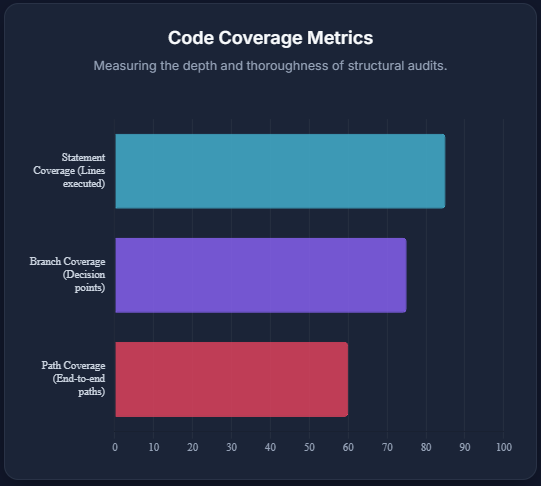
A properly executed white box penetration testing engagement lets security teams measure the depth and thoroughness of an audit using precise quantitative metrics:
- Statement coverage: the percentage of individual lines of code executed and analysed during testing
- Branch coverage: whether every decision point (if-else conditions, switch statements) has been tested for both TRUE and FALSE execution branches
- Path coverage: mapping and testing every potential end-to-end execution path through functions, loops, and microservice interactions, ensuring edge cases are fully vetted, not just the happy path
Enterprise DevSecOps and Regulatory Compliance Alignment
In modern software engineering, white box security audits aren’t a one-time event. They’re an integral part of the Secure Software Development Life Cycle (S-SDLC) and regulatory compliance frameworks.
Alignment with governance and compliance standards
Enterprise applications, especially those operating across Financial Services, Healthcare, and Government sectors in Singapore, must meet strict security baselines:
- ISO 27001 (Information Security Management): satisfies mandatory code review, vulnerability management, and technical compliance auditing controls under ISO 27001 Annex A
- Singapore Government IM8 (ICT Security and Management): aligns with government ICT standards requiring rigorous source code security audits, secure API design, and vulnerability disclosure for public sector applications. This is the same standard Vinova’s public sector engagements, including work for GovTech Singapore and IPOS International, are held to as part of GovTech panel vendor status, not a compliance layer added on top
- PDPA and GDPR: ensures sensitive Personal Identifiable Information (PII) is encrypted at rest and in transit, and verifies that data access controls can’t be bypassed at the source code level
- OWASP ASVS (Application Security Verification Standard): a structured framework for auditing authentication, access control, input validation, and data protection mechanisms
Shifting left with automated security pipelines
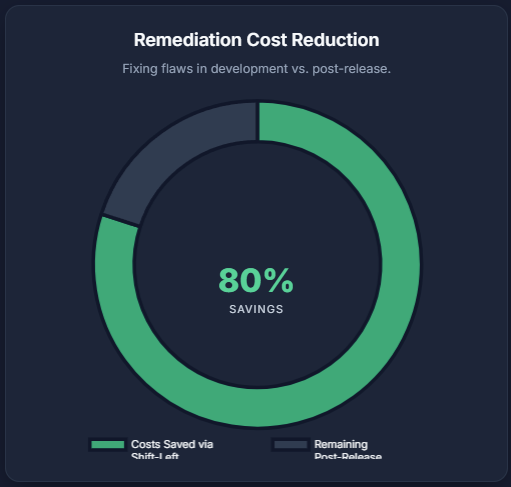
Embedding source code auditing directly into CI/CD pipelines (GitHub Actions, GitLab CI, Jenkins) catches and fixes vulnerabilities early in the development lifecycle, cutting remediation costs by up to 80% compared to post-release bug fixes. This is the same Shift-Left discipline Vinova applies across its software delivery practice generally, not something bolted on specifically for security-conscious clients.
AI and Automation in Modern Testing
Artificial intelligence has meaningfully changed white box security assessments:
- Context-aware AI auditing: machine learning tools help security engineers rapidly traverse multi-million-line codebases, flagging complex data flow anomalies, memory leaks, and injection risks a human reviewer would take far longer to find manually
- Auditing AI and LLM integration layers: modern white box penetration testing now includes evaluating custom LLM wrappers, prompt pipeline handlers, and vector databases for prompt injection flaws, insecure output handling, and training data exposure, a category of vulnerability that didn’t exist in most codebases five years ago
- Autonomous unit and stress test generation: AI-driven scripts generate edge-case inputs to test API boundaries and stress-test microservice communication paths
Essential Tools for White Box Penetration Testing
Security practitioners use a hybrid stack of static analysis engines, dynamic debuggers, secret scanners, and API interception tools:
| Category | Industry Standard Tools | Primary Purpose |
| SAST (Static Analysis) | Semgrep, SonarQube, Checkmarx, Veracode | Automated source code auditing for syntax vulnerabilities |
| SCA (Dependency Analysis) | Snyk, OWASP Dependency-Check | Identifying CVEs and license risks in open-source libraries |
| Secret Scanning | TruffleHog, GitGuardian | Detecting hardcoded credentials, API keys, and certificates |
| Dynamic Debuggers and Reverse Engineering | GDB, LLDB, Ghidra, IDA Pro | Runtime memory analysis, reverse engineering, and tracing |
| API and Web Testing | Burp Suite Professional, Postman | Intercepting, manipulating, and validating dynamic API calls |
Comparing White Box, Black Box, and Gray Box Testing
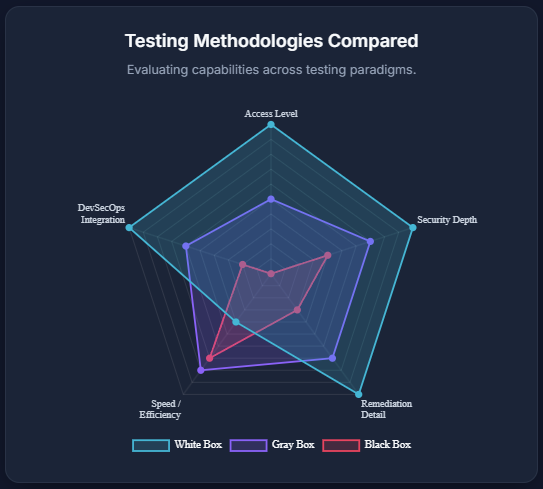
Choosing the right testing strategy depends on organisational goals, development maturity, and risk exposure:
| Feature | Black Box Testing | Gray Box Testing | White Box Testing |
| Access level | Zero knowledge (external attacker view) | Partial knowledge (API docs, user roles) | Full access (source code, schemas, docs) |
| Primary focus | External perimeter and WAF resilience | Authenticated application logic and APIs | Core source code, logic flaws, DevSecOps |
| Efficiency | Low (high time spent on recon) | High (focused on target workflows) | Maximum depth (line-by-line inspection) |
| Remediation detail | High-level (identifies vulnerable surface) | Actionable (identifies target endpoints) | Pinpoint (exact file, function, and line) |
| Best used for | Perimeter simulation, external compliance | Web applications, SaaS platforms, APIs | Critical code reviews, pre-release auditing |
Advantages and Limitations
Advantages
- Maximum security depth: identifies complex logical flaws, hardcoded secrets, and backdoor access points hidden deep within application source code
- Cost-effective remediation: supports Shift Left initiatives by catching defects during development, drastically lowering repair cost compared to a post-release fix
- Near-zero false positives: combining source code review with dynamic staging exploitation produces high-fidelity, verified findings rather than a long list of theoretical risks
Limitations
- Requires genuine engineering expertise: testers need expert software development skills and deep domain knowledge across multiple programming languages, not just security tooling familiarity
- Resource intensive: thoroughly reviewing complex enterprise architectures takes dedicated time and specialised tooling, which is why it’s typically reserved for critical, high-risk components rather than an entire codebase indiscriminately
| Ready for a White Box Penetration Test? Book a free 2-hour scoping consultation with Vinova’s Cybersecurity and DevSecOps Practice. We’ll map your trust boundaries, identify high-risk components, and outline a testing plan aligned to ISO 27001, IM8, or PDPA requirements. No commitment required. Book Your Free Security Scoping Consultation with Vinova |
White Box Penetration Testing FAQ
How is white box penetration testing different from a standard security audit?
A standard security audit often means a checklist review against a compliance framework, are the right policies documented, are the right controls named. White box penetration testing goes further: it means actually reading the source code, tracing execution paths, and constructing working exploits to prove a vulnerability is real, not just theoretically possible. The output is a pinpoint remediation report with exact file paths and line numbers, not a generic compliance checklist.
How long does a white box penetration test typically take?
It depends entirely on codebase size and the number of high-risk components in scope, but a focused engagement on critical components (authentication, payment processing, admin controls) typically runs 2 to 4 weeks. A full enterprise codebase across multiple services can run longer. Scoping and threat modelling in Phase 1 is what determines the realistic timeline, which is why it happens before any code review starts, not as an afterthought.
Do we need white box testing if we already run automated SAST scans?
SAST catches known syntax patterns and CVE signatures fast and cheaply, but it can’t evaluate business logic, and it generates enough false positives that teams often start ignoring its output. White box penetration testing uses SAST as a starting point, then adds manual review of business logic and dynamic proof-of-concept exploitation to confirm what’s actually exploitable. If your codebase handles payments, authentication, or regulated personal data, SAST alone leaves exactly the class of vulnerability, broken authorisation logic, privilege escalation, business logic flaws, that causes the most damaging real-world breaches.
Is white box penetration testing required for PDPA or IM8 compliance in Singapore?
Neither PDPA nor IM8 mandates the specific term “white box penetration testing” by name, but both require the kind of code-level assurance that only structural testing genuinely provides: PDPA requires proof that PII access controls can’t be bypassed, and IM8 requires rigorous source code security audits for public sector applications. In practice, organisations serious about meeting these obligations, rather than just documenting an intent to meet them, end up running white box assessments because black box testing alone can’t verify what’s actually happening inside the code.
What’s the difference between white box penetration testing and code review?
A standard code review focuses on code quality, readability, and adherence to team conventions, usually done by peers as part of the development process. White box penetration testing is adversarial: testers actively look for ways to break authentication, escalate privileges, or extract sensitive data, then build a working exploit to prove the flaw is real. The skillset overlaps, but the goal is fundamentally different: one improves code quality, the other proves security.
| About the Author: Vinova is a Singapore-headquartered IT consulting and software engineering partner with 16+ years of industry experience and 300+ successfully delivered digital projects worldwide. Certified: ISO 27001 (Information Security Management System) and ISO 9001 (Quality Management System) certified, with ISTQB-certified quality assurance and security engineering practices.Enterprise trust: a proven track record delivering secure, high-availability platforms for government agencies, public utilities (SP Group), financial institutions, and global enterprises. Compliance and governance: dedicated DevSecOps and security testing teams adhering strictly to Singapore Government IM8 guidelines, PDPA privacy frameworks, and international OWASP and NIST standards. Explore Vinova’s security consulting and auditing services. |